
 Software Development
 Security Services
 Cloud Services
 AI Services
 Other Services















 TechMagic Academy


Best SOC as a Service Providers in 2026: Top 10 Compared
Last updated:16 June 2026

A Security Operations Center (SOC) is the head and the base behind your company's cybersecurity efforts. It's where security experts monitor networks, identify vulnerabilities, and quickly respond to security incidents. A SOC is crucial for protecting critical data and staying ahead of risks.
But for many businesses, building and running an in-house SOC can be a tough challenge.
That’s where SOC as a service (SOCaaS) may be your saving grace. It gives you all the benefits of a full SOC, like 24/7 threat monitoring and quick incident response, without the overhead and overpayments. You get the human expertise you need to stay secure, without having to manage it yourself. But how to choose the right option for your business among other SOC as a service providers?
This best SOC as a service providers comparison covers ten leading providers in detail. For each, you'll find an honest look at their services, strengths, limitations, pricing, compliance coverage, industries served, and how they use AI.
This is our own comparison, and we recommend choosing a provider based on your needs rather than its position in the list. The order is there to make the providers easy to compare and is not a strict ranking.
Key takeaways
- A Security Operations Center (SOC) monitors your network 24/7, detects vulnerabilities, and responds to threats.
- Building an in-house SOC requires a heavy investment in staff, infrastructure, and tools. Top SOC requires even more.
- SOC as a service providers deliver these expert cybersecurity services remotely, without the cost and complexity of building an in-house SOC.
- SOCaaS scales with your business needs and cloud workloads.
- As your business grows, your application security needs change. Among service companies, choose managed SOC providers that can scale with you and your cloud workloads.
How We Selected the Best SOC as a Service Providers: Our Methodology
We have worked in application, cloud, and infrastructure security since 2014. Our team is CREST-accredited and runs penetration testing, managed security, vCISO, and SOC 2 and ISO 27001 compliance engagements, so we look at SOC providers from hands-on delivery experience rather than secondhand rankings.
That day-to-day exposure matters here. We regularly work alongside detection-and-response tooling in client environments, assess how providers handle the compliance frameworks our clients must meet, and see where managed security actually succeeds or stalls in production.
That is what lets us form our own view of where each provider fits, instead of aggregating other people's lists. We have kept this comparison neutral and applied the same structure and the same scrutiny to every provider below.
We have reviewed new research and listings of the best SOC vendors, including Gartner’s Managed Detection and Response Reviews and Ratings and PeerSpot’s Best SOC as a Service Solutions. However, the list below was not compiled according to the criteria of common knowledge.
When creating the list of top SOC as-a-service providers, we analyzed customer feedback on each company, the cybersecurity services they provide, their track record in this area, and their certifications. It was important to us that our list include those who have a solid cybersecurity philosophy, an understanding of the current threat landscape, and who adapt their approach to the needs of each client.
Based on all this, we have compiled a list of top SOC as a service providers businesses of different needs and sizes.
Top security operations center vendors
- Arctic Wolf
- EY Cybersecurity
- Abacode
- KPMG Cyber
- CrowdStrike Falcon Complete
- eSentire
- Rapid7 MDR
- OSIbeyond
- Optiv Security
- IBM Security
Top 10 SOC Service Providers
Now, we can talk about the top SOC as a service vendors in more detail.
1. Arctic Wolf
Arctic Wolf runs one of the largest commercial SOCs globally and is one of the best SOCs as a service providers. Its Aurora Platform ingests telemetry from endpoints, networks, cloud services, and identities, processing over 9 trillion events weekly across more than 10,000 customers. The defining feature is the Concierge Security Team: a dedicated security advisor assigned to each customer who learns the specifics of that environment over time.
Main services:
- Managed detection and response (MDR).
- 24/7 SOC monitoring and proactive threat hunting.
- Managed risk (vulnerability and exposure management).
- Managed security awareness (employee training, phishing simulations).
- Incident response.
Strengths:
- The Concierge Team model means you work with the same analysts consistently, not a rotating help desk.
- The Aurora Platform covers cloud, endpoint, network, and identity from a single architecture, delivering unified visibility with no data volume caps.
- Arctic Wolf offers a Security Operations Warranty of up to $3 million for qualifying incidents, which few providers include by default.
Limitations:
- Customers have limited direct access to raw SIEM data. If your team needs to run its own queries against collected logs, that is not currently supported.
- Full implementation can take several months in complex environments. The portal interface and ticketing system receive mixed feedback, particularly from new users.
Pricing model: Depends on the environment size and selected modules.
Compliance supported: SOC 2 Type II, ISO 27001, HIPAA, PCI DSS, GDPR, NIST CSF
Industries served: Healthcare, Financial Services, Manufacturing, Education, Legal, State and Local Government, Transportation
AI involvement: The Aurora platform uses agentic AI for alert triage, enrichment, and correlation. The design keeps human analysts in the decision loop: AI handles speed and volume; analysts handle investigation and judgment. Arctic Wolf explicitly avoids a fully autonomous response service.
Best suited for: Mid-sized to large organizations that want dedicated human analysts alongside broad, multi-signal security coverage.
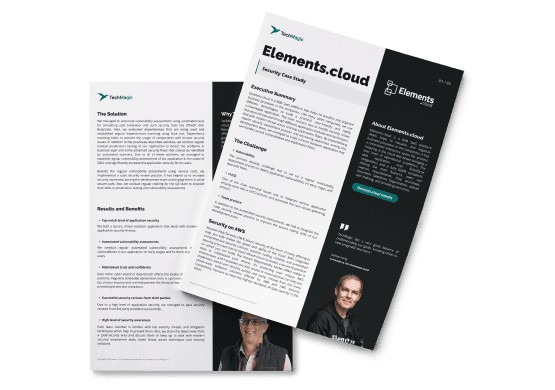
CyberSecurity services for Elements.Cloud
2. EY Cybersecurity
EY Cybersecurity is the security arm of Ernst & Young, a Big Four professional services firm. As one of the leading SOC as a service providers, it operates across 150+ countries, which matters for multinational organizations that need consistent coverage and local regulatory knowledge in the same engagement. The firm's security work connects naturally to its audit, legal, and tax practices.
Main services:
- Risk management and cybersecurity strategy.
- Threat detection and incident response.
- Continuous monitoring and SIEM.
- Compliance support.
- Managed Security Service Provider (MSSP) capabilities.
- Analytics and reporting.
Strengths:
- Few providers match EY's depth on regulatory and compliance topics. For organizations operating across multiple jurisdictions, EY can tie security programs to audit and legal workstreams that pure-play cybersecurity vendors cannot.
- EY runs substantial original research. Its 2026 Cybersecurity Roadmap Study surveyed 500 senior security leaders and gives clients access to useful peer benchmarks and threat data.
- The global footprint means a multinational client gets local expertise without managing multiple regional vendors.
Limitations:
- EY's model suits large enterprises. Small and mid-sized businesses are likely to find the cost and engagement structure mismatched to their needs.
- EY's security work skews toward strategy and consulting. If you need a fully managed, always-on SOC rather than advisory engagements, this is not the right fit.
- Delivery quality can vary by region and team, as it does with any large professional services firm.
Pricing model: Custom enterprise quote, project-based, or retainer structure depending on scope.
Compliance supported: SOC 2 Type II, ISO 27001, HIPAA, GDPR, PCI DSS, NIST CSF, SOX, EU AI Act governance
Industries served: Financial Services, Healthcare, Energy, Technology, Government, Manufacturing, Retail
AI involvement: EY has launched its EY.ai Agentic Platform, built with NVIDIA AI, and is integrating AI SOC platforms into SOC operations for threat detection and triage. EY's own research found that 75% of CISOs who invested in AI reported fewer cybersecurity incidents. Their approach to AI in security includes governance frameworks alongside technical deployment, consistent with the firm's broader compliance work.
Best suited for: Large enterprises and multinationals that need security consulting, compliance coverage, and managed capabilities in a single provider relationship.
3. Abacode by Thrive
Abacode targets small to mid-sized businesses with a combined managed security and compliance service. Its Cyber Lorica™ platform is a 24/7 SOC offering on a monthly subscription with no dependency on a specific vendor's technology stack.
Main services:
- Managed cybersecurity services.
- 24/7 SOC monitoring.
- Risk management and threat prevention.
- Compliance support (HIPAA, GDPR, PCI DSS, CMMC, and others).
- Incident response and remediation.
Strengths:
- Security operations and compliance advisory come bundled, which reduces the number of vendors an SMB needs to manage.
- Cyber Lorica™ works alongside the existing security stack rather than replacing it.
- Abacode has specific expertise in CMMC (Cybersecurity Maturity Model Certification), a meaningful credential for companies in the U.S. defense supply chain.
Limitations:
- As a smaller provider, Abacode has less analyst redundancy and geographic coverage than enterprise-scale SOCs. This may be a factor for organizations with distributed environments or high uptime requirements.
- Public peer review data on Abacode is thin compared to larger providers, making independent comparison harder.
- Organizations that grow beyond SMB scale may find platform and team capacity limiting.
Pricing model: Monthly subscription; costs vary based on your organization's size, environment, and specific security requirements.
Compliance supported: SOC 2 Type II, ISO 27001, HIPAA, PCI DSS, GDPR, CMMC, NIST 800-171
Industries served: Healthcare, Financial Services, Defense Contractors, Manufacturing, Legal, Non-profits
AI involvement: Cyber Lorica™ incorporates AI-driven threat detection alongside SIEM technology. AI surfaces anomalies; human analysts investigate flagged events. As one of the top AI-powered SOC as a service providers, Abacode has also published guidance on ISO 42001 (AI governance), indicating they apply the same compliance thinking to AI deployment that they apply to other regulatory areas.
Best suited for: Small to mid-sized businesses that want managed security and compliance support in one program, especially those in regulated sectors or the defense supply chain.
4. KPMG Cyber
KPMG Cyber is the cybersecurity practice of KPMG, another Big Four firm. It provides a wide range of cybersecurity services designed to help organizations manage and mitigate cyber risks. With a focus on both strategic and technical solutions, KPMG supports businesses in building robust security frameworks and ensuring compliance with relevant industry standards.
Main services:
- Risk assessments and security strategy.
- Threat detection and incident response.
- Vulnerability management.
- Cloud security.
- Compliance and regulatory support.
Strengths:
- KPMG's CrowdStrike partnership brings Falcon Next-Gen SIEM into client engagements, offering faster detections and more efficient investigations compared to legacy SIEM deployments.
- Coverage across 140+ countries gives KPMG practical reach for large global organizations, with local regulatory expertise included.
- Cross-functional capabilities in audit, tax, and legal mean security programs can be connected to compliance and governance work across the enterprise.
Limitations:
- KPMG's focus is on large enterprise clients. The engagement model and cost structure are not designed for mid-market organizations.
- As with other large consulting-led practices, service quality varies by region and the specific team assigned.
- Budgeting requires a full scoping engagement; there is no pricing transparency before you are well into the sales process.
Pricing model: Custom enterprise quote; advisory retainers or managed service agreements depending on scope.
Compliance supported: SOC 2 Type II, ISO 27001, HIPAA, PCI DSS, GDPR, NIST CSF, SOX, DORA
Industries served: Financial Services, Healthcare, Energy and Utilities, Government, Technology, Manufacturing
AI involvement: KPMG integrates CrowdStrike's Falcon Next-Gen SIEM, which uses real-time threat intelligence and AI-powered automation, into its managed service offerings. The partnership is specifically positioned around AI SOC platforms' capabilities for enterprise clients. KPMG's advisory practice also covers AI governance, relevant as clients deploy AI systems that introduce new attack surfaces.
Best suited for: Mid-sized and larger organizations seeking support across risk management, compliance, and security strategy from a single global provider.
5. CrowdStrike Falcon Complete
 CrowdStrike Falcon Complete is CrowdStrike's fully managed MDR service, built natively on the Falcon platform. CrowdStrike holds the #1 position in MDR market share per Gartner, with Leadership positions in major Gartner, Forrester, and IDC MDR reports. The key difference from most providers is that detection, investigation, and response all happen within the same environment rather than across separate tools.
Main services:
- 24/7 managed detection and response.
- Endpoint protection and EDR (Endpoint Detection and Response).
- Identity threat protection.
- Cloud workload security.
- Threat hunting.
Strengths:
- Gartner Peer Insights reviewers describe Falcon Complete as genuinely turnkey: detection, investigation, and containment without requiring internal teams to manage complex tooling. Coverage spans endpoint, identity, cloud, network, and SIEM in a single platform.
- The Falcon platform uses AI and behavioral analysis to identify threats quickly, with a low reported false-positive rate. Reviewers note that the system identifies attacks like fileless malware and lateral movement before they spread.
- CrowdStrike provides full remediation rather than containment guidance. The team resolves incidents rather than handing work back to the client.
Limitations:
- Falcon Complete works best if you are consolidating around CrowdStrike's platform. Organizations with significant investment in tools outside the CrowdStrike ecosystem may encounter coverage gaps.
- Pricing is among the highest in the category. Multi-year contracts with upfront payment requirements are common, which reduces flexibility.
- Report customization and API documentation have received criticism from technical teams wanting deeper integration options.
Pricing model: Approximately $12–20/endpoint/month for 100+ endpoints. Multi-module and enterprise deployments are custom-quoted. Multi-year contracts are frequently required.
Compliance supported: SOC 2 Type II, ISO 27001, HIPAA, PCI DSS, NIST CSF, FedRAMP, CMMC
Industries served: Financial Services, Healthcare, Government, Technology, Retail, Energy, Defense
AI involvement: AI is the core of the Falcon platform. The platform's models run on endpoint, identity, and cloud telemetry and can contain threats autonomously without waiting for human approval in many scenarios. CrowdStrike processes adversary intelligence in real time using machine learning to detect both known threats and novel behavioral patterns. This is the most AI-forward approach among the providers on this list.
Best suited for: Organizations that want a fully managed, AI-native service with broad attack surface coverage and are willing to consolidate their security stack to get consistent results.
6. eSentire

eSentire has focused on managed detection and response since 2001 and has been included in the Gartner Market Guide for MDR for five consecutive years. It serves over 2,000 organizations across 80 countries. Its Atlas MDR platform integrates with over 300 security tools, which means it works alongside existing security investments rather than replacing them.
Main services:
- 24/7 SOC monitoring.
- Threat intelligence and threat hunting.
- Incident management and response.
- Risk assessments and vulnerability management.
Strengths:
- Atlas MDR integrates with 300+ existing tools. Customers keep their current security stack; eSentire adds managed coverage on top.
- Gartner Peer Insights reviewers consistently highlight response speed and expert-level guidance. One customer noted consistent, actionable alerts over a six-year engagement.
- eSentire offers a 15-minute containment guarantee for eligible incidents, which is a concrete, measurable commitment.
Limitations:
- Pricing sits at the higher end for MDR services, estimated at $15–25 per endpoint per month for fully managed coverage. G2 reviewers generally find value at that price, but it is a notable investment.
- Some users report that customization options are limited and that the platform interface could be more intuitive.
- eSentire is a pure-play MDR provider. Security consulting, cloud architecture, and compliance advisory require separate vendors.
Pricing model: Three-tiered packages (foundational, comprehensive, advisory-level) with custom pricing. Estimated at $15–25/endpoint/month.
Compliance supported: SOC 2 Type II, ISO 27001, HIPAA, PCI DSS, GDPR, NIST CSF, CMMC
Industries served: Financial Services, Healthcare, Legal, Technology, Manufacturing, Retail, Education
AI involvement: Atlas MDR uses machine learning to reduce alert noise and surface high-confidence threats. Human analysts then investigate, contain, and remediate. eSentire positions this as AI-assisted rather than AI-autonomous; the SOC team handles final decisions on every confirmed incident.
Best suited for: Organizations that want reliable managed detection and response, have existing security tools they want to preserve, and prioritize fast, human-led incident containment.
7. Rapid7 MDR
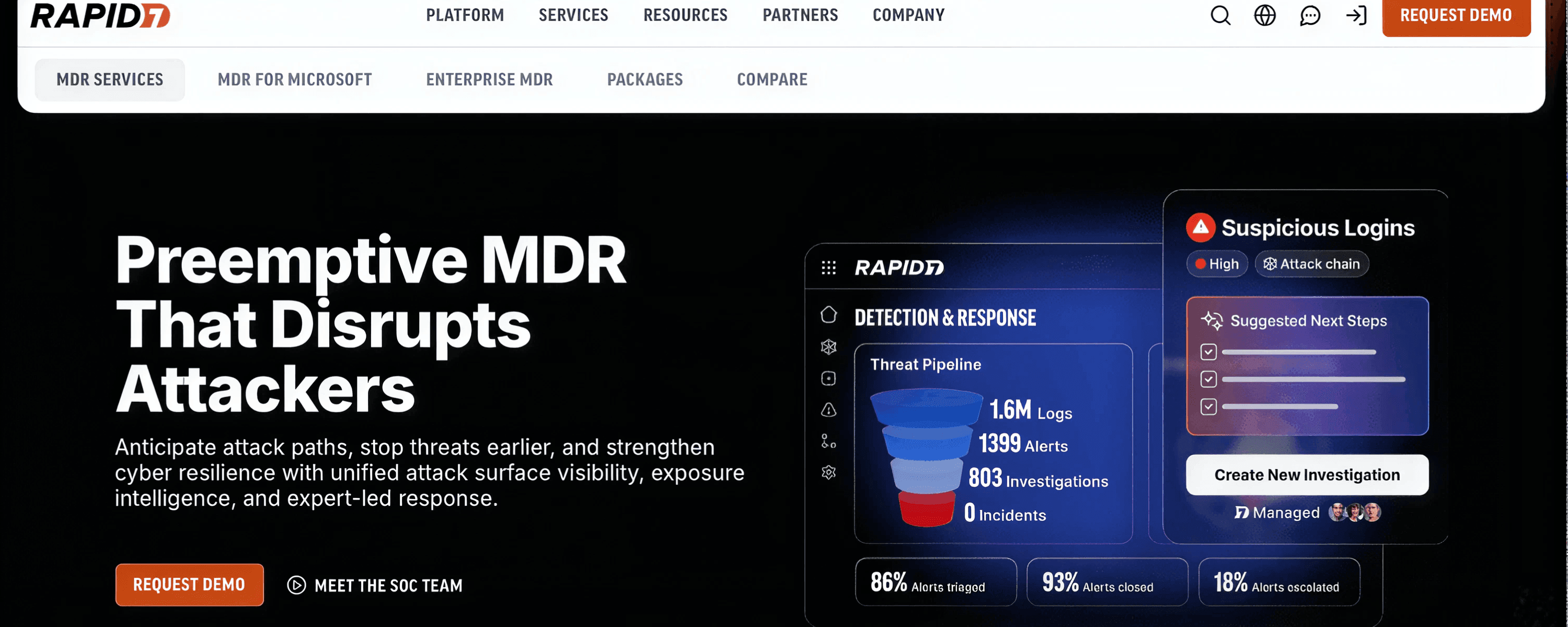 Rapid7 built its reputation in security research, including maintaining the Metasploit penetration testing framework. That background shows up in how its MDR service is built: the platform is unusually open, and vulnerability management is integrated directly into the detection workflow rather than sold separately. Rapid7 MDR was named a Leader in the 2025 Frost Radar for MDR and the 2025 Gartner Magic Quadrant for Exposure Assessment Platforms.
Main services:
- 24/7 managed detection and response.
- Threat hunting.
- Incident containment and remediation.
- Vulnerability and exposure management (integrated with MDR).
Strengths:
- Rapid7's AI Alert Triage closes 99.93% of benign alerts automatically across nearly five trillion weekly alerts, estimated to reclaim 200+ SOC hours per week for customers.
- Vulnerability and exposure data feeds directly into investigations. Analysts see not just what is happening, but what in the environment made it possible, which focuses response on the highest-risk issues.
- The platform gives customers visibility into the same console Rapid7's analysts use. For organizations that want to stay informed rather than hand over full control, this matters.
Limitations:
- Managed Threat Complete (the combined MDR and SIEM service) starts around $60,000–$80,000 per year. An IDC study found 422% three-year ROI, but the upfront cost is real.
- Rapid7 holds approximately 2.5% MDR market share, reflecting a smaller analyst and SOC footprint than CrowdStrike or eSentire.
- Some reviewers note that detection and visibility are strong, but response automation is less mature than competing platforms for certain use cases.
Pricing model: Quote-based. Managed Threat Complete starts around $60,000–$80,000/year for mid-market; enterprise pricing is custom. Unlimited data ingestion is included.
Compliance supported: SOC 2 Type II, ISO 27001, HIPAA, PCI DSS, GDPR, NIST CSF, FedRAMP
Industries served: Healthcare, Financial Services, Energy, Education, Technology, Manufacturing, Non-profits
AI involvement: Rapid7 uses agentic AI across its MDR service, most visibly in the AI Alert Triage system that closes benign alerts at scale. AI enriches alerts, drafts response paths, and filters noise. Human analysts validate and handle containment. Rapid7 holds 300+ patents in detection and response technology, with 25% focused on AI and machine learning.
Best suited for: Organizations that want managed detection combined with integrated exposure management and value transparency into how the service operates day to day.
8. OSI (OSIbeyond)
OSIbeyond is a Maryland-based managed IT and cybersecurity firm focused on government contractors, non-profits, and small businesses. It is a CMMC Registered Provider Organization, formally authorized to help companies working through Cybersecurity Maturity Model Certification, a requirement for organizations in the U.S. Department of Defense supply chain.
Main services:
- Managed security and IT services.
- Threat detection and incident response.
- Cloud security and infrastructure management.
- Compliance support (CMMC, NIST 800-171).
- Vulnerability assessments and risk management.
Strengths:
- OSIbeyond's CMMC specialization is a concrete differentiator for DoD contractors. Working with a Registered Provider Organization simplifies a compliance process that can otherwise be difficult to navigate independently.
- Clients consistently describe the team as reliable, proactive, and accessible. The service relationship tends to be more personal than at larger providers.
- The firm's focus on a specific client type means it understands the regulatory context that government contractors and non-profits operate in.
Limitations:
- OSIbeyond's analyst capacity and geographic redundancy are limited compared to enterprise-scale SOCs. Complex, distributed environments may outpace what the firm can comfortably support.
- The firm's strengths apply narrowly to its core client types. Organizations outside those use cases are not likely to be a good fit.
Pricing model: Project minimum of $10,000+; hourly rates approximately $100–$149/hour. Managed service packages are custom-quoted.
Compliance supported: SOC 2 Type II, ISO 27001, NIST 800-171, CMMC Level 2 and 3, HIPAA, GDPR
Industries served: Government Contractors (DoD), Non-profits, Small Businesses, Healthcare
AI involvement: OSIbeyond’s SOC operations rely on standard managed security platforms (SIEM, endpoint detection), and any AI capability comes from those underlying tools.
Best suited for: Small to mid-sized businesses, particularly government contractors and non-profits, that need managed security alongside practical compliance expertise.
9. Optiv Security
Optiv is one of the larger dedicated cybersecurity providers in North America, with partnerships across more than 450 security technology vendors. It works primarily as a security integrator and managed service provider rather than a platform company. Its vendor breadth defines how it operates: building and managing security programs from whatever combination of tools best fits the client environment.
Main services:
- Managed security services.
- Threat detection and incident response.
- Risk assessments and vulnerability management.
- Compliance support.
- Security strategy consulting.
Strengths:
- Working across 450+ vendor partners gives Optiv more tool flexibility than providers tied to their own platforms, which is useful for organizations with established multi-vendor environments.
- Gartner Peer Insights reviewers highlight the breadth of Optiv's service coverage and note that the firm moves faster on contracts and engagement scheduling than Big Four competitors.
- Optiv handles both implementation projects and ongoing managed services, covering different stages of security program maturity.
Limitations:
- Cost predictability is harder to establish with Optiv's model. Subscription pricing varies significantly based on service type, coverage level, and vendor choices, so meaningful estimates require detailed scoping upfront.
- Optiv's MDR service is newer than those of purpose-built MDR vendors and has a shorter track record in that specific capability.
- As an integrator rather than a platform vendor, outcomes depend heavily on the underlying tools chosen for each engagement, so quality can vary by stack.
Pricing model: Subscription-based; varies by service type, coverage scope, and environment size. Custom quotes required.
Compliance supported: SOC 2 Type II, ISO 27001, HIPAA, PCI DSS, GDPR, NIST CSF, CMMC
Industries served: Healthcare, Financial Services, Retail, Technology, Manufacturing, Government
AI involvement: Optiv's managed services incorporate AI-assisted detection workflows through the vendor platforms it deploys.
Best suited for: Organizations with multi-vendor environments that need a security integrator to build, manage, and optimize their security program across a range of technologies.
10. IBM Security (QRadar)
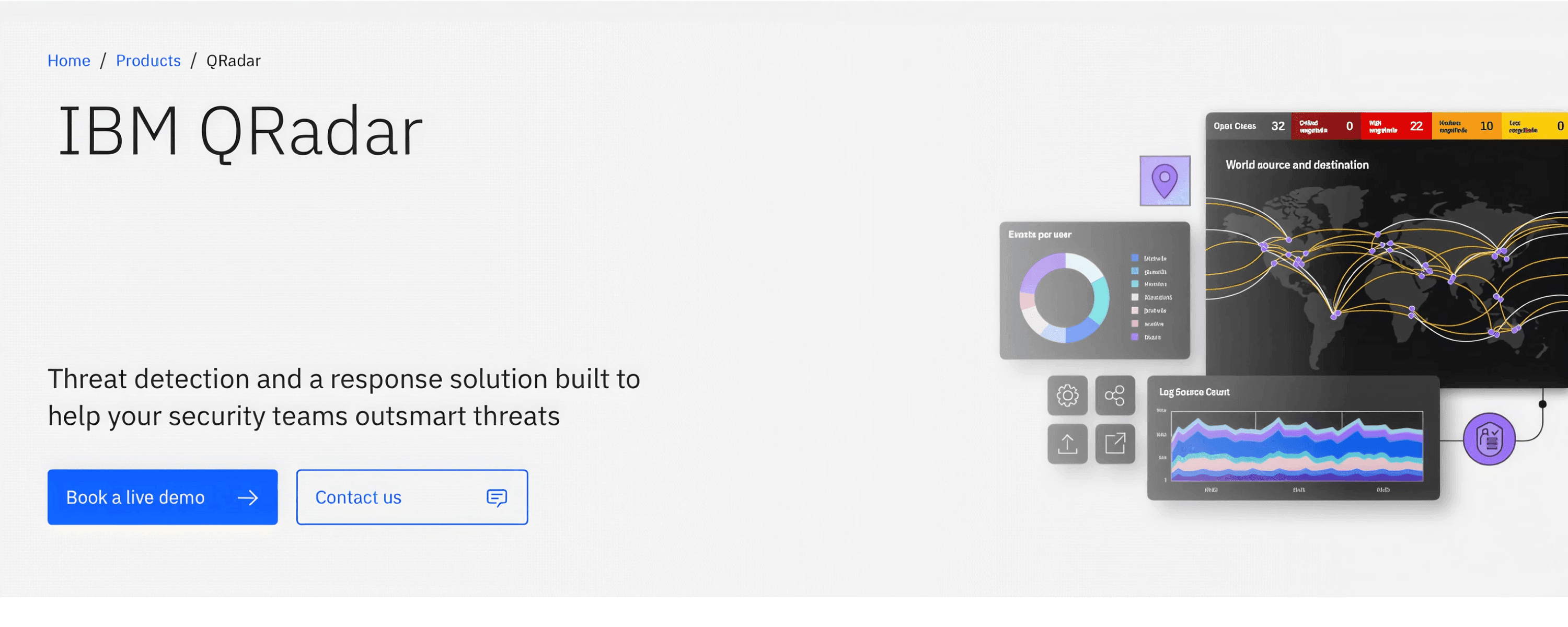 IBM Security is one of the longest-standing names in enterprise cybersecurity. Its managed SOC offering is built around QRadar, which is a SIEM platform with over two decades of deployment history in large, regulated environments. It is backed by X-Force, IBM's global threat intelligence and incident response division.
One significant development to flag: in 2024, IBM sold its QRadar SaaS assets to Palo Alto Networks. On-premises QRadar remains under IBM, and IBM Consulting has become a preferred MSSP for Palo Alto customers. If you evaluate IBM's managed SOC, you should factor this transition into your planning.
Main services:
- 24/7 managed detection and response (MDR).
- SIEM management and monitoring (QRadar).
- Threat intelligence via X-Force.
- Incident response and forensics.
- Compliance management.
- Cloud security monitoring (AWS, Azure, hybrid environments).
Strengths:
- QRadar has one of the broadest log source libraries in the industry, with support for 450+ integrations out of the box.
- X-Force threat intelligence, drawn from IBM's global research operations, feeds directly into managed SOC services, giving analysts current, context-rich data on adversary tactics and indicators of compromise.
- IBM's managed SOC has a documented track record in regulated industries. In one AWS deployment case, IBM reported a 92% reduction in false positives and 98 SOC analyst hours saved monthly through machine learning and SOAR automation.
Limitations:
- QRadar is resource-intensive. Tuning rules to reduce false positives requires significant time and expertise, and smaller SOC teams often find the overhead difficult to manage.
- IBM's managed security services are priced for enterprise scale. Mid-market organizations frequently find both the cost and the engagement model misaligned with their needs.
- Because the managed SOC is built around QRadar, the value is tightly coupled to that one platform, so teams standardizing on a different SIEM may see less benefit.
Pricing model: Custom enterprise quote. QRadar SIEM on-premises is licensed by events per second (EPS) and data volume; managed SOC services are priced separately based on scope and environment size.
Compliance supported: SOC 2 Type II, ISO 27001, HIPAA, PCI DSS, GDPR, NIST CSF, NIST 800-53, FedRAMP, SOX
Industries served: Financial Services, Healthcare, Government, Energy, Telecommunications, Retail, Defense
AI involvement: IBM applies Machine Learning and Artificial Intelligence across its managed SOC operations, including AI-powered alert triage, automated investigation workflows via QRadar SOAR, and X-Force threat intelligence enrichment. The SOAR platform automates playbook execution and incident coordination.
IBM has reported a 66% monthly workload reduction through SOAR orchestration in documented deployments. Broader AI investment is also reflected in IBM's Consulting division, which develops AI-driven security tooling for enterprise clients.
Best suited for: Large enterprises and regulated organizations that need a mature, deeply integrated SIEM-based SOC with strong compliance coverage and access to global threat intelligence.
How to Choose a SOC as a Service Provider
This SOC as a service providers comparison covers ten vendors, but the right choice depends on three practical factors: your internal capacity, your size and compliance needs, and your actual total cost.
Start with what your team can realistically manage
Be honest about how much ongoing involvement your team can sustain. CrowdStrike Falcon Complete and eSentire are built to run with minimal client-side effort. EY and KPMG expect active engagement on strategy.
If your internal security team is small, a low-overhead fully managed service is the safer starting point. If your analysts want direct access to investigation data, look for platforms with an open console, Rapid7 is the clearest example here.
Also map your threat surface before shortlisting. Organizations handling sensitive data across endpoints, cloud, and remote users need multi-signal coverage. If social engineering is a realistic risk in your sector (financial services, healthcare, legal), confirm that any provider you evaluate monitors identity and email, not just endpoints.
Match the provider to your size and stage
Small-sized companies, under 500 employees: Enterprise SOC contracts are usually too large and too complex for this segment. Abacode and OSIbeyond are built for it. They both bundle SOC monitoring with compliance support. OSIbeyond is the stronger option for DoD contractors needing CMMC coverage.
Mid-sized companies, 500-5000 employees: You likely have some internal security capacity but not enough for a 24/7 SOC. eSentire, Rapid7 MDR, and Arctic Wolf all perform well here. eSentire and Rapid7 work alongside existing tools; Arctic Wolf's Concierge model assigns dedicated analysts who learn your environment over time.
Enterprises, 5000+ employees and multinationals: EY and KPMG connect security to audit, legal, and regulatory work across jurisdictions. IBM Security suits enterprises with complex, SIEM-heavy on-premises environments. CrowdStrike Falcon Complete is the strongest option for AI-native, fully managed coverage at scale.
Factor in compliance and total cost before deciding
Compliance obligations often cut the shortlist faster than anything else. HIPAA for healthcare, PCI DSS for payment processing, CMMC for DoD contractors, FedRAMP for U.S. federal vendors – fewer providers on this list cover those frameworks, so check the compliance tables in each profile first. If you also need the provider to support audit workstreams, consulting-led firms like EY, KPMG, or IBM add value that pure-play MDR vendors don't.
On cost, the headline price is rarely the full picture. Arctic Wolf can take several months to reach full coverage in complex environments. IBM QRadar requires ongoing rule tuning that adds internal labor costs. CrowdStrike frequently requires multi-year upfront commitments.
And consulting engagements at EY or KPMG can expand in scope faster than fixed MDR packages. A provider at $15-25/endpoint/month for a fully managed service may cost less overall than a cheaper contract with significant internal overhead attached.
In this article, we reflect publicly available information as of June 2026. Pricing ranges are estimates based on third-party analysis and user reports; confirm figures directly with each provider. AI capabilities described are based on vendor communications and independent analyst coverage.
We're here to help

Final Thoughts
SOC as a Service (SOCaaS) is a cloud-based subscription model for managed detection of advanced persistent threats and response. It gives businesses the flexibility and cost-efficiency they need to secure their IT environment with cybersecurity professionals' expertise.
With dedicated SOC services, you get 24/7 monitoring, improved security posture, advanced threat and attacker tactics detection, and quick incident response, all without the internal strain. The right managed SOC provider lets you focus on growing your business and working on market demand while they take care of your cybersecurity and monitor potential attack surface.
Sharing critical data with a SOCaaS provider raises concerns about data privacy and control, especially in industries that handle sensitive customer data. So, selecting the most suitable one among security operations center companies is your main task. You need more than just technical expertise. You need a team that can help you stay ahead of new threats and offer a scalable and adaptable security strategy. Outsourcing your SOC means you get all these without the high cost of building an in-house team.
But the most important thing is to choose SOC solution providers who get your business, whether it’s understanding the specific risks you face, your current IT setup, identity protection, or how your needs will change as you grow. Your provider should be ready to adapt and evolve with you, ensuring that your security is always in line with new risks and regulations.
FAQ

SOC as a Service covers the full scope of outsourced security operations: monitoring, alerting, incident triage and response capabilities, SIEM management, compliance reporting, and sometimes vulnerability management and human-led threat hunting.
MDR (Managed Detection and Response) focuses specifically on detecting and responding to active threats, usually scoped to endpoints, identity, and network traffic. As for most cybersecurity services, SOC as a service providers offer both, bundled into different tiers.
At minimum: SOC 2 Type II and ISO 27001. SOC 2 Type II confirms security controls have been tested over time, not just documented. ISO 27001 is the international standard for information security management.
Beyond that, it depends on your sector. Healthcare requires HIPAA, payment processing requires PCI DSS, and U.S. federal vendors need FedRAMP. DoD contractors need CMMC. Most SOC as a service providers in United States carry the two baseline certifications; fewer hold FedRAMP or CMMC status, so if those apply to you, the shortlist narrows quickly.
Yes, but the better question is whether you can afford to build an equivalent internal SOC: hiring analysts, licensing a SIEM, and maintaining 24/7 coverage costs more than most managed contracts.
Any affordable SOC as a service providers comparison should weigh the contract price against the full cost of the internal alternative, including recruitment, tooling, and turnover. For most mid-sized businesses, the managed service wins on total cost.
SOC as a Service (SOCaaS) is an outsourced cybersecurity service where a third-party provider manages your organization's security operations. They monitor, detect, and respond to security threats, and also provide detailed reports on security events.
The main SOC functions are 24/7 monitoring of your networks, cloud services, applications, endpoints, and expert-led threat hunting. The SOC team also quickly identifies real risks, false positives, and filters out false alarms. As well as working with alert fatigue, they can take care of log management, endpoint protection, risk assessment, and even digital forensics.
When a breach happens, SOCaaS teams act quickly to contain the threat and isolate compromised systems, and guide your IT team through the necessary steps to fix the issue. Many SOCaaS providers also offer compliance reporting.
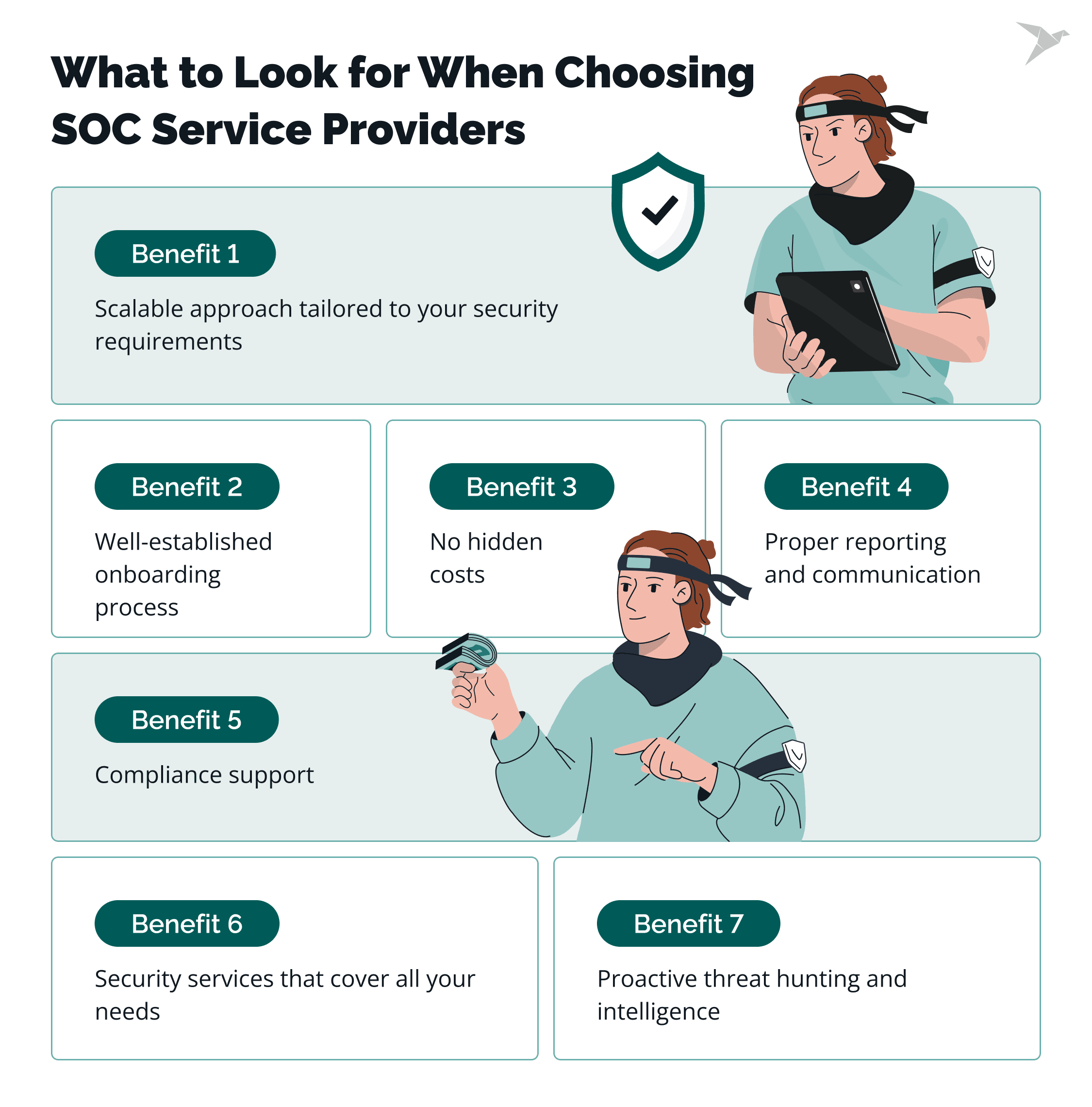
When selecting one of the top SOC service providers, make sure they can scale with your business and cover all your security needs, such as threat detection, security orchestration, endpoint detection, incident response, and vulnerability management. They should also use real-time intelligence to stay ahead of emerging risks and offer proactive support.
Look for transparency in communication and pricing, so you know exactly what you’re paying for. Ensure they integrate smoothly with your current systems and understand the regulatory compliance requirements you need to meet.
Managed services are more cost-efficient and effective in terms of expertise in the industries served. Outsourcing your SOC operations helps reduce the costs of maintaining your own SOC, existing security tools, and infrastructure.
With a top SOC service provider, their 24/7 monitoring, security analysts' services, fast incident response, and reporting capabilities, you ensure continuous protection without overburdening your internal resources. You also gain access to specialized expertise and the advanced tools to protect sensitive customer data and achieve complete visibility of the threat landscape.