
 Software Development
 Security Services
 Cloud Services
 AI Services
 Other Services















 TechMagic Academy


Key Components of EHR Integration Cost
Last updated:20 January 2025



The real cost of implementing EHRs isn't just about dollars... it's how you allocate them.
Healthcare is going through digital transformation, and electronic health records are a vital part of it. The benefits of EHRs are pretty obvious. Still, implementing one requires significant financial investment. That's why healthcare stakeholders must carefully consider the EHR implementation costs.
This article explains the topic in detail, including a clear cost breakdown, factors influencing expenses, and insights into making the best decisions.
Let's start!
Key Takeaways
- Electronic health records are a must-have for healthcare organizations today.
- Custom EHR solutions involve higher initial costs but offer full customization to meet an organization’s specific needs. They provide long-term scalability and better ROI. This makes them a suitable choice for larger healthcare facilities with specialized requirements.
- The total cost of EHR implementation depends on factors like the size of the organization, the complexity of workflows, and specific customization needs. Larger organizations will face higher costs for licensing, training, hardware, and integration.
- In addition to the initial implementation costs, training, and ongoing support play a crucial role in successful EHR adoption.
Let Us Clarify: What is EHR?
An electronic health record (EHR) is a digital system created to store and manage patient health information in a unified and accessible way.
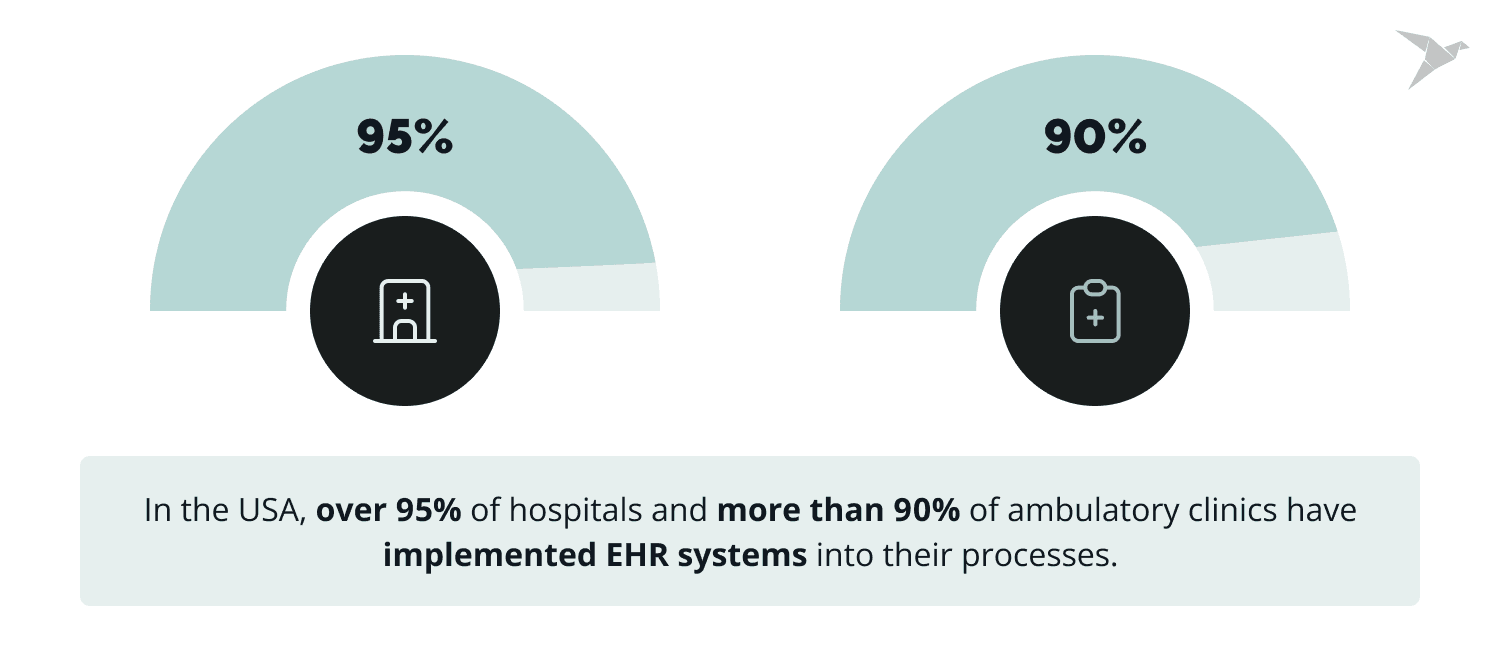
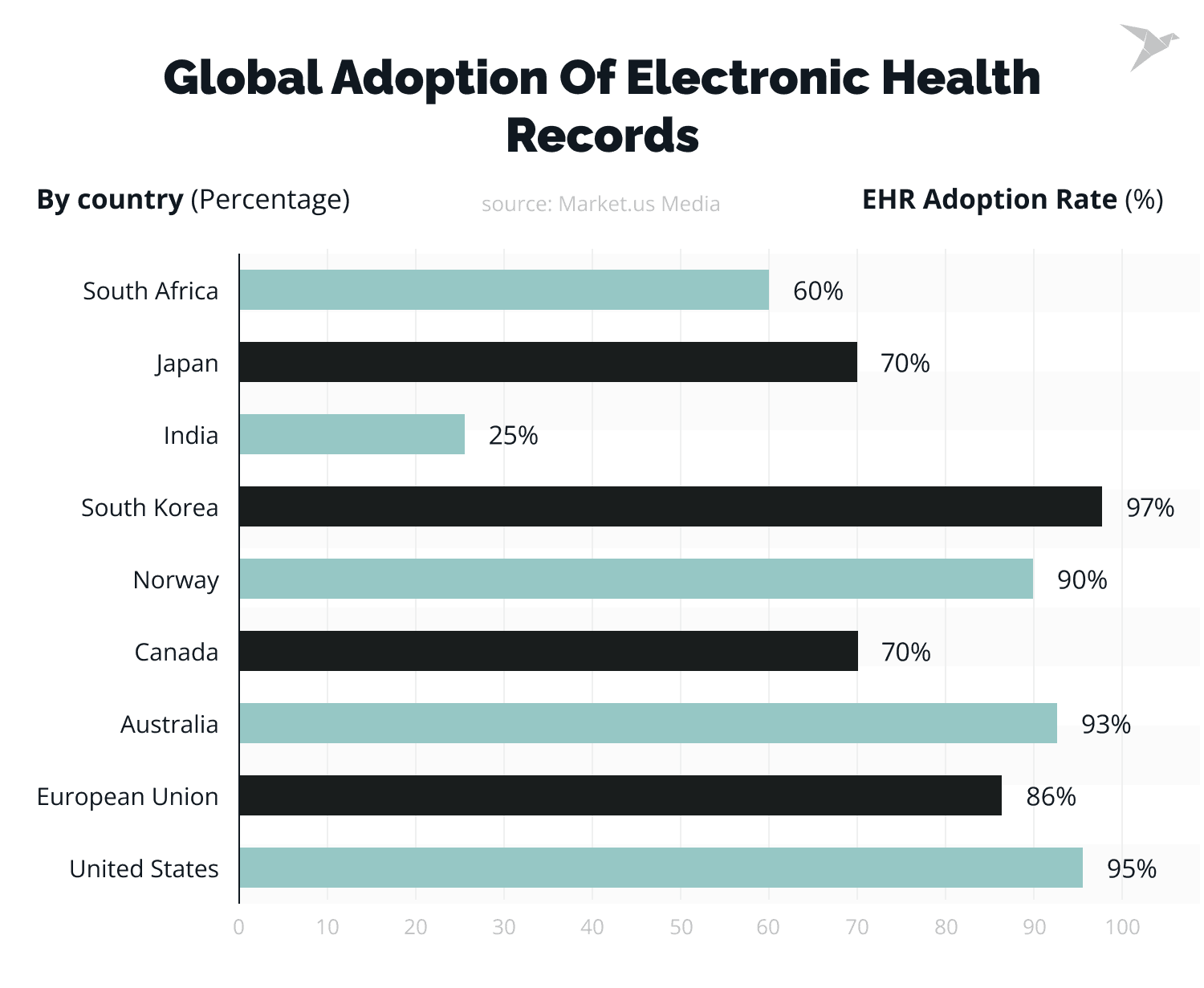
In the USA, the healthcare system has widely adopted EHRs. Namely, over 95% of hospitals and over 90% of ambulatory clinics have integrated these systems.
The following points differentiate an EHR from traditional paper records:
- Real-time access, as medical professionals can access patient data from anywhere
- Secure data sharing, as data is always relevant, safely stored and exchanged
- Advanced analytics for healthcare providers
- Improved accuracy and reduced human errors, as data is consistently updated
- Tools for compliance with regulations for data security and patient privacy
What is the purpose of EHR?
The primary goals of an EHR system are to centralize patient data and improve healthcare service delivery. It is a single source of truth for patient health information, which ensures precision and accessibility for medical professionals.
What are the core functions of an EHR?
Here are the key EHR functions:
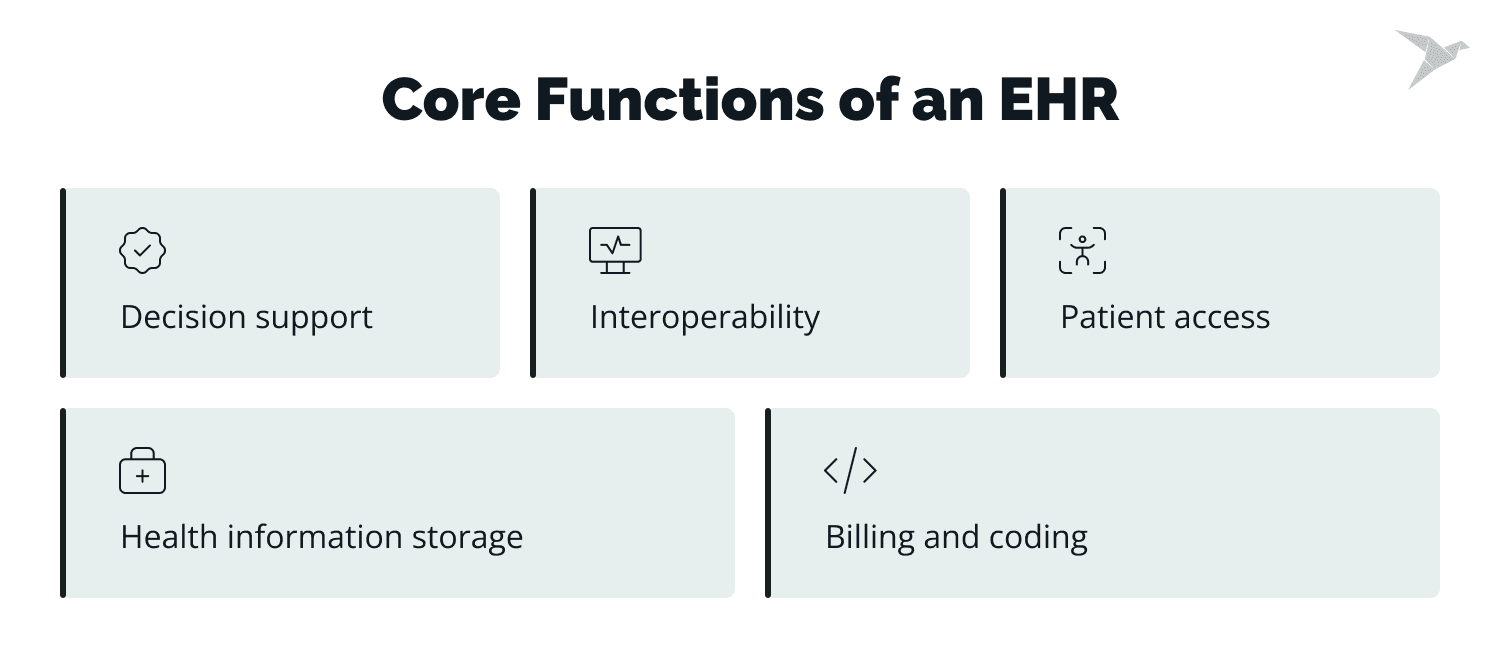
- Health information storage. Documents medical information, diagnoses, medications, vaccinations, allergies, and test results.
- Interoperability. Provides uninterrupted information exchange and communication between departments, facilities, and even external organizations.
- Decision support. Enables tools like alerts, reminders, and clinical guidelines to help in decision-making.
- Billing and coding. Optimizes insurance claims and billing processes.
- Patient access. Boosts patient engagement through portals where they can see and monitor their medical records and communicate with providers.
Learn about our expertise in the industry and what we have to offer
Importance and Necessity of EHR for a Medical Center
For healthcare providers, the EHR adoption is necessary for several reasons:
Better patient safety
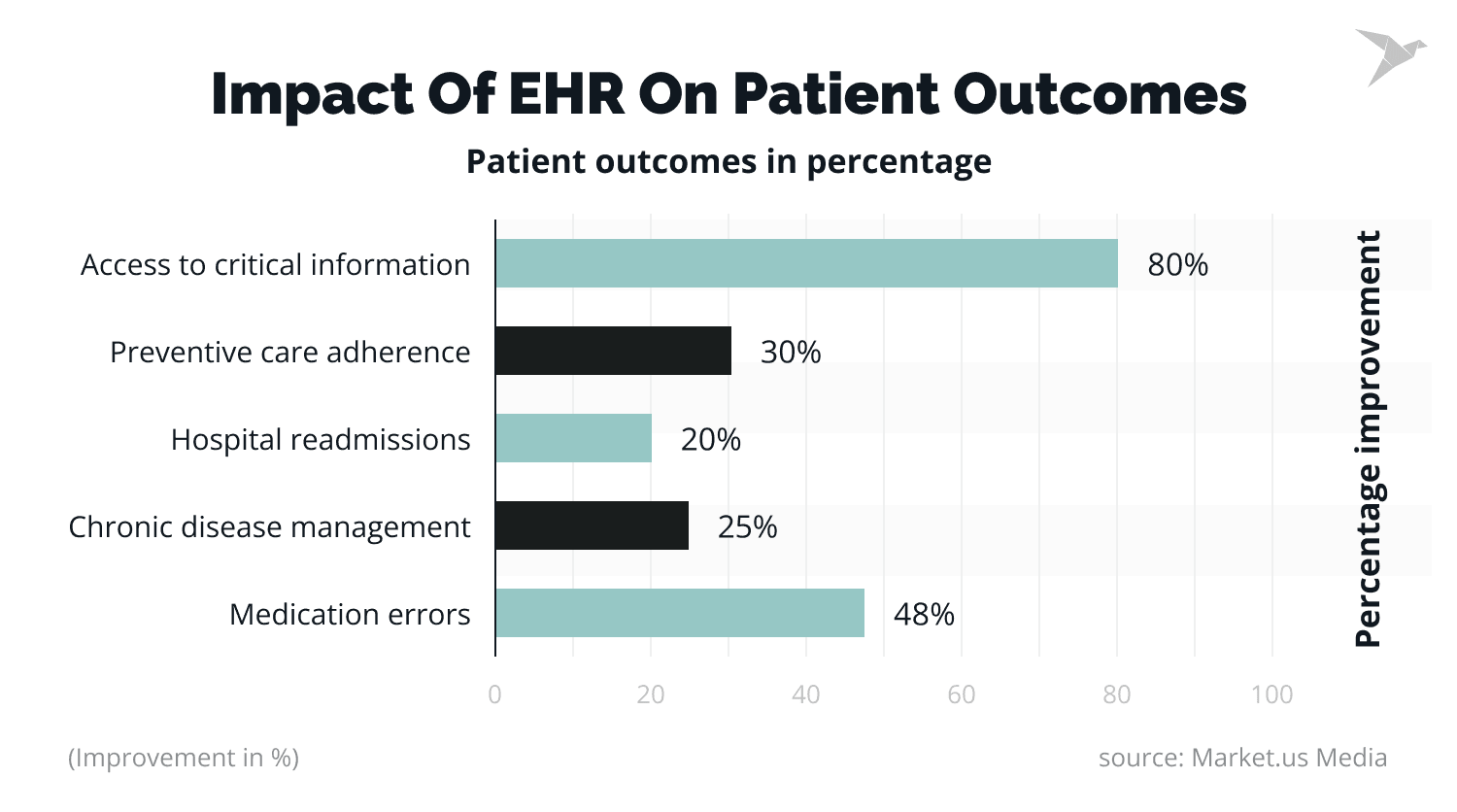
EHRs contribute to patient safety as they reduce medication errors. It has become possible due to many smart tools, such as alerts about potential drug interactions or allergies. Additionally, profound records enable precise diagnoses and prevent unnecessary or duplicate procedures.
Operational efficiency
The second benefit EHR implementation brings is much greater efficiency of operations. Efficiency rises as routine tasks such as appointment scheduling, prescription refills, and documentation are automated. Automation saves administrative staff hours of manual labor and allows them to pay attention to more important activities.
Better care coordination
A centralized way of data management is one more prominent advantage that EHRs provide. Such unified systems allow multiple medical workers to interact and collaborate seamlessly on a patient’s care. Constant updates ensure all team members have access to the relevant health information.
Financial benefits
EHRs bring financial advantages as they optimize billing accuracy, provide faster reimbursements, and minimize revenue loss. Electronic records also reduce overhead costs associated with maintaining paper records.
Regulatory compliance and risk management
Electronic health records help adhere to legal regulations by securely storing sensitive patient data. They reduce the risk of fines or penalties for data breaches or non-compliance.
Improved patient engagement
With EHR implementation, patients get access to their health data through user-friendly portals. This improves communication between patients and healthcare providers and fosters trust and satisfaction.
Secure and functional EHR solutions based on your unique needs

EHR Implementation Cost Breakdown
So, the most interesting part is here. Let’s consider the key components and required budget for implementing an EHR.
EHR implementation costs include various components that range based on the size of the organization, the complexity of the system, and certain customization needs. Implementation costs can be classified into direct and indirect costs. Direct costs relate to on-premises or cloud deployment, while indirect costs include training fees, personnel costs, and unexpected expenses such as security.
Here is a detailed breakdown:
System selection and licensing
The choice between a ready-made and custom EHR solution significantly affects costs:
Ready-made EHR solutions
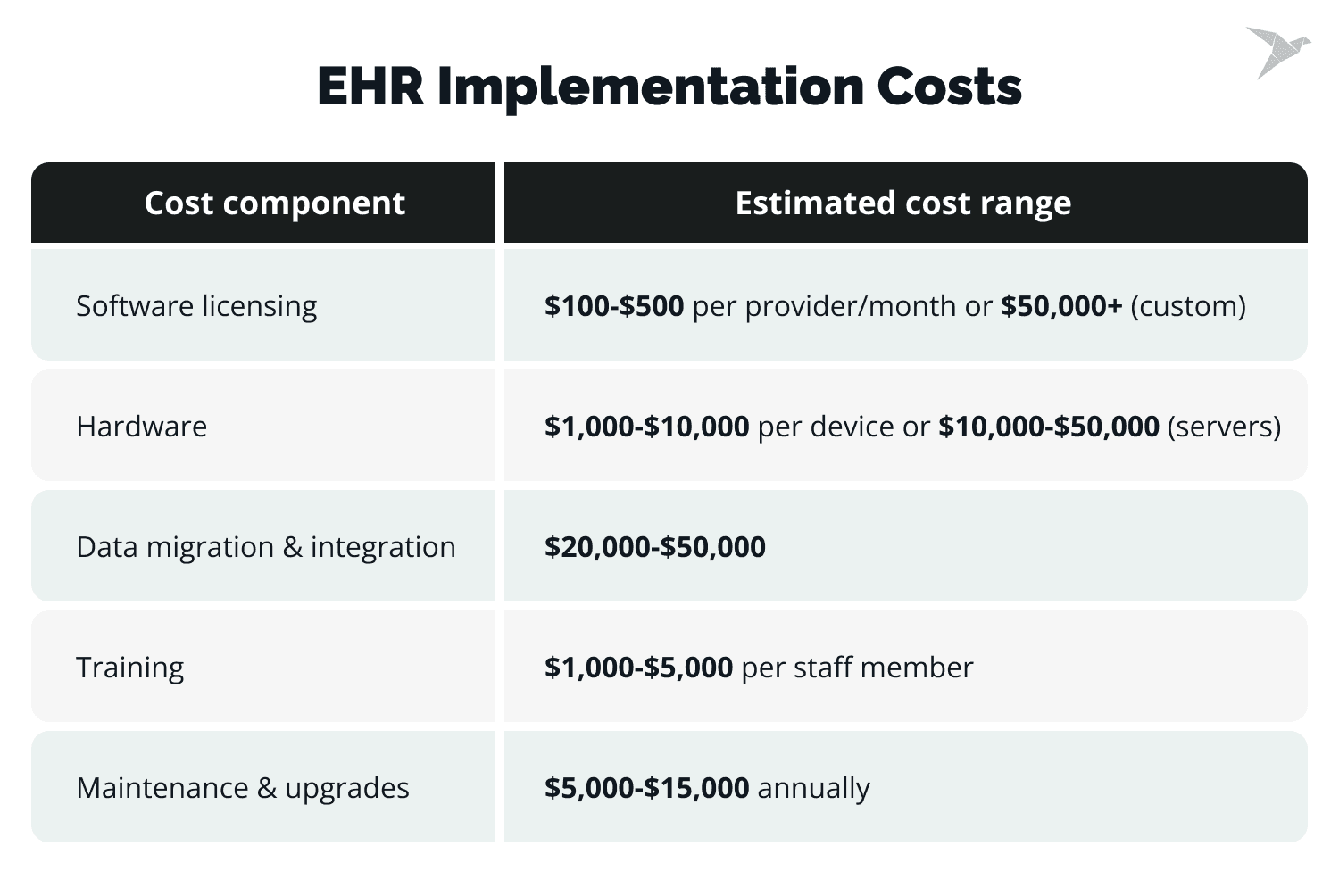
Ready-made EHR solutions are models that function on a per-provider subscription basis. Their prices range from $100 to $500 per provider per month.
Custom EHR solutions
The main peculiarity of customized EHR solutions is that the development team builds them from scratch. This fact allows the organization to meet its specific requirements, but logically, it adds to costs. Costs usually vary from $50,000 to $500,000 or more for large projects.
Keep reading to see the advantages and disadvantages of each solution in detail.
Hardware costs
The hardware needed for EHR implementation includes:
Workstations and tablets
Employees use workstations and tablets to access the system. The expenses can range from $1,000 to $10,000 each.
Servers
Organizations need servers for on-premises solutions. Pricing for them varies from $10,000 to $50,000.
Networking equipment
Organizations require the equipment, which includes routers, switches, and other IT infrastructure. The cost for these ranges from $5,000 to $15,000.
Integration and data migration
Transferring existing patient data to the new EHR system can be complicated and time-consuming. The cost of data integration and migration can range from $20,000 to $50,000. The final cost depends on the amount and format of the data. There may also be additional costs for integrating third-party applications, such as billing systems or laboratory information systems.
Training and support
Training staff to use the new EHR system is necessary for successful implementation. Training costs can vary from $1,000 to $5,000 per staff member. The exact sum depends on the system’s complexity. Post-implementation support can cost from $5,000 to $20,000 annually.
Ongoing maintenance and upgrades
EHR systems require ongoing costs for updates and maintenance. Annual EHR maintenance costs can reach from $5,000 to $15,000, including security updates and feature enhancements.
So, the cost breakdown is the following:
- Software licensing – $100-$500 per provider/month or $50,000+ (custom)
- Hardware – $1,000-$10,000 per device or $10,000-$50,000 (servers)
- Data migration & integration – $20,000-$50,000
- Training – $1,000-$5,000 per staff member
- Maintenance & upgrades – $1,000-$5,000 per staff member
What Key Components Influence the Cost of EHR Integration
The cost of EHR integration is mainly shaped by integration scope, data readiness, security requirements, vendor conditions, and the amount of organizational change involved. The more systems, workflows, and compliance demands you add, the more time goes into architecture, testing, and long-term support, which increases overall spend.
In practice, the total cost of EHR integration depends on both technical work and operational effort across teams. Now let’s explore the main cost drivers in detail.
Scope and complexity of the integration
Cost impact: High (often 20-35% of total integration budget)
This is the biggest pricing variable. A simple connection between an EHR and one external tool requires basic mapping and testing. Multi-system integration across facilities adds workflow logic, error handling, and performance planning.
Cost increases when the integration involves:
- Multiple departments (radiology, pharmacy, inpatient, outpatient)
- Different workflows for different locations
- Real-time exchange, not periodic sync
- Bi-directional updates (where both systems write and read data)
A wide integration scope also means more stakeholders and more rounds of review, which affects the timeline and effort.
Customization and configuration requirements
Cost impact: High (often 15-30% of total integration budget)
Most EHR platforms offer default modules, but many providers need changes to match their processes. That can include unique templates, custom clinical workflows, department-specific permissions, automation rules, or reporting logic.
Customization adds cost because it requires:
- Discovery workshops and workflow design
- Building and validating custom logic
- Longer QA cycles to prevent side effects
- Documentation for future updates
Custom work usually brings strong ROI when processes are specialized or the organization expects rapid growth.
Data migration and data cleanup
Cost impact: High (often 15-25% of total integration budget)
Migration rarely means “move everything as-is.” Legacy data tends to be inconsistent: missing identifiers, mismatched formats, duplicates, outdated codes, or partially digitized records. Cleaning it takes time and often involves manual review.
This part becomes expensive when:
- Records sit across multiple legacy systems
- Patient histories must be merged across facilities
- Data has to be normalized to a new schema
- You need mapping across ICD/CPT/SNOMED or internal coding systems
Data cleanup is one of the strongest predictors of integration delays, so it directly affects the budget.
Technical architecture and integration tools
Cost impact: Medium-High (often 10-20% of total integration budget)
The current IT environment can make integration smooth or slow. Modern, well-documented APIs reduce build time. Older systems may rely on rigid interfaces, outdated protocols, or limited interoperability support.
Costs are affected by:
- Whether you rely on FHIR APIs, HL7 v2, proprietary APIs, or a mix
- The need for middleware (interface engines, ETL, orchestration platforms)
- Availability of sandboxes and realistic test datasets
- Monitoring and observability tooling for integrations
The more tooling you need to introduce or maintain, the higher the long-term cost.
Security, compliance, and regulatory requirements
Cost impact: High (often 8-15% of total integration budget)
EHR integration expands the number of systems that access protected health data. That requires security design and ongoing controls.
This cost driver includes:
- Encryption at rest and in transit
- Access controls, role policies, identity management
- Audit logging, traceability, monitoring
- Compliance documentation, risk assessments, penetration testing
For regulated markets, security and compliance work often runs in parallel with engineering and adds meaningful hours to the project.
For a broad overview of the partners with the required expertise, browse the EHR development companies that specialize in compliant, scalable healthcare solutions.
Vendor fees and commercial terms
Cost impact: Medium (often 5-12% of total integration budget)
Even when engineering work is straightforward, vendor rules can add cost. Some EHR vendors charge for API access, interface setup, additional environments, or support. Others require certified partners for certain integration types.
Costs tend to rise when:
- API access is paid or restricted
- Documentation is incomplete
- Vendor reviews and approvals slow down delivery
- Interface licensing scales with usage or users
This factor often explains why two similar integration projects can have very different quotes.
Training and change management
Cost impact: Medium (often 5-10% of total integration budget)
Integration affects staff even when the UI stays the same. If data flows change, workflows change too, involving scheduling steps, documentation routines, handoffs, billing triggers, and reporting.
This part includes:
- Role-specific training for clinical and administrative teams
- Playbooks for updated workflows and edge cases
- Onboarding materials for new hires
- Communication and rollout planning across departments
Large rollouts across healthcare organizations typically require structured change management to prevent adoption issues and workflow disruption.
Testing, QA, and deployment readiness
Cost impact: High (often 10-20% of total integration budget)
This is where many budgets expand. Integration testing needs to confirm correctness under real conditions, not just “data moved.” That includes edge cases, high loads, failures, and recovery paths.
Testing effort grows with:
- End-to-end workflow testing (orders → results → documentation → billing)
- Regression testing against existing integrations
- Performance testing for peak hours
- Deployment planning, rollback paths, and post-go-live monitoring
Integration projects with weaker QA plans tend to face costly fixes after deployment.
Ongoing support, maintenance, and scalability
Cost impact: Medium-High (often 8-15% of total integration budget annually post-launch)
After launch, integrations need support. APIs change, vendors update modules, new clinics get added, and workflows evolve. Maintenance cost depends on how well the integration is built and monitored.
Budget typically covers:
- Monitoring and alerting (proactive issue detection)
- Incident response and debugging
- Periodic updates and compatibility fixes
- Scaling when volume or number of systems increases
This matters even more when integration is critical for billing, clinical continuity, and data exchange at scale.
Location and labor costs
Cost impact: Medium (often 10-25% variation in total budget depending on delivery model)
Costs vary based on who builds the integration and what expertise the project requires. Integration work often needs experienced engineers familiar with HL7/FHIR, healthcare security, and clinical workflows. And those skills affect pricing.
Key factors include:
- Engineering rates by region
- Seniority of the team (junior vs. senior HL7/FHIR specialists)
- Availability of dedicated QA and security reviewers
- Staffing model (in-house, outsourcing, mixed team)
This is one of the less visible cost drivers, but it influences the overall budget significantly.
Organizational size and internal capabilities
Cost impact: Medium-High (often 10-20% of total integration budget)
The level of internal readiness often determines how much external support is required. Strong internal teams can handle parts of discovery, testing coordination, documentation, and change management. Limited internal capacity increases dependence on vendors and consultants.
Cost rises when:
- Approvals require multiple leadership layers
- Stakeholders are spread across departments and facilities
- IT teams can’t allocate time for testing and rollout
- Post-launch ownership stays external
Integration scope also expands when the EHR must connect to billing, claims, and reporting workflows. That’s especially true when integration supports revenue cycle management and related financial operations.
All in all, integrating the EHR software costs more when the project includes a broad scope, custom workflows, complex data cleanup, strict compliance requirements, and extensive testing. Those same factors also tend to determine how stable and scalable the integration will be, which is why they drive EHR costs so strongly.
In addition to EHR cost, understanding the full scope of EMR system cost is essential for accurate budgeting, as expenses can include software, hardware, implementation services, training, and ongoing maintenance.
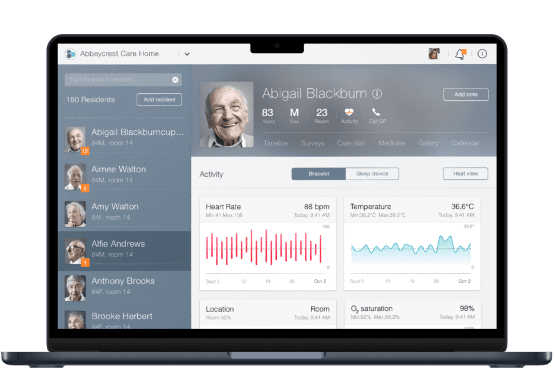
a Care home management app for E-type Care
What Budget You Need for EHR Implementation
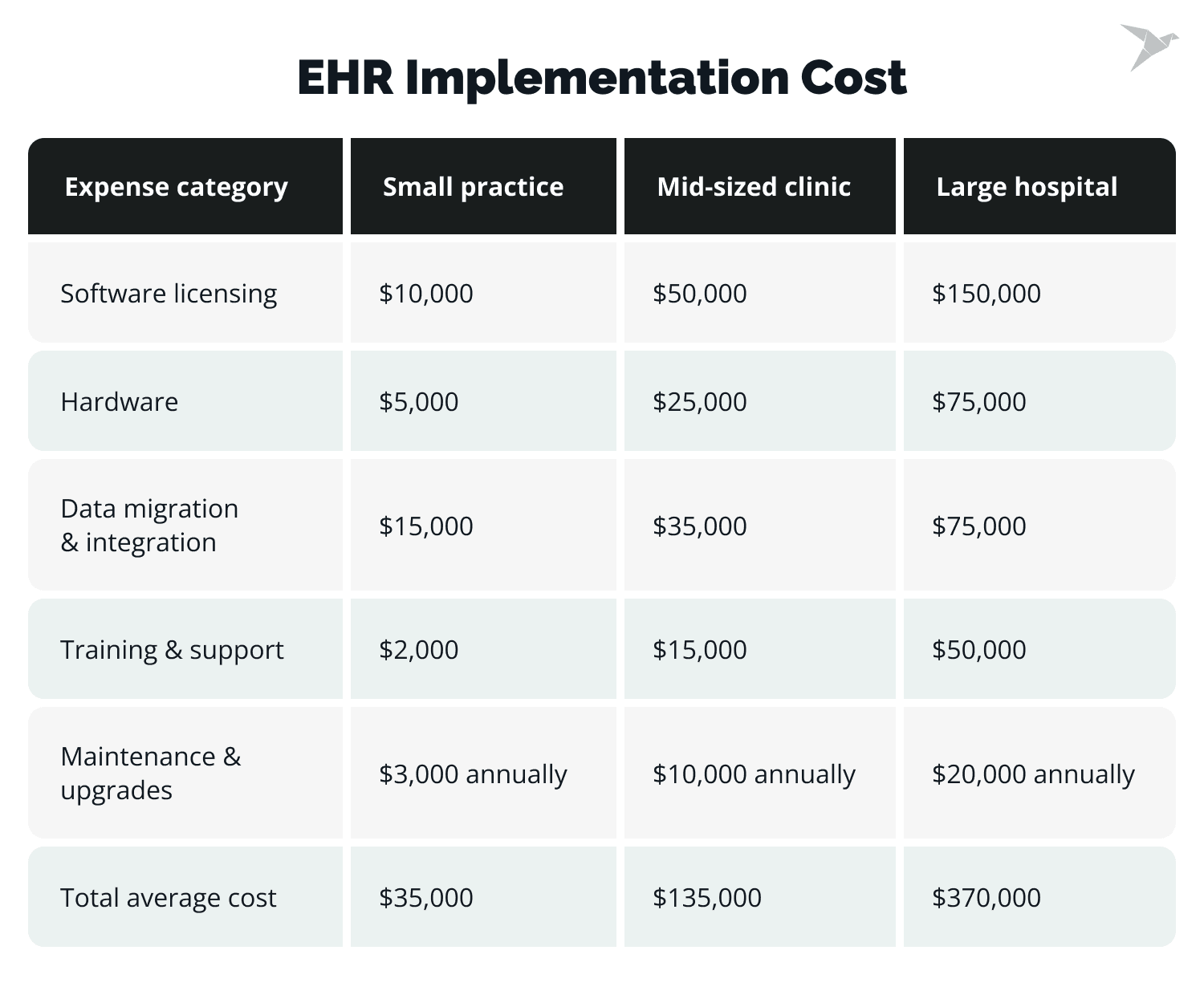
The total cost of electronic health records implementation depends on factors like organization size, system complexity, and specific customization needs. Below is a budget estimation for different types of healthcare organizations:
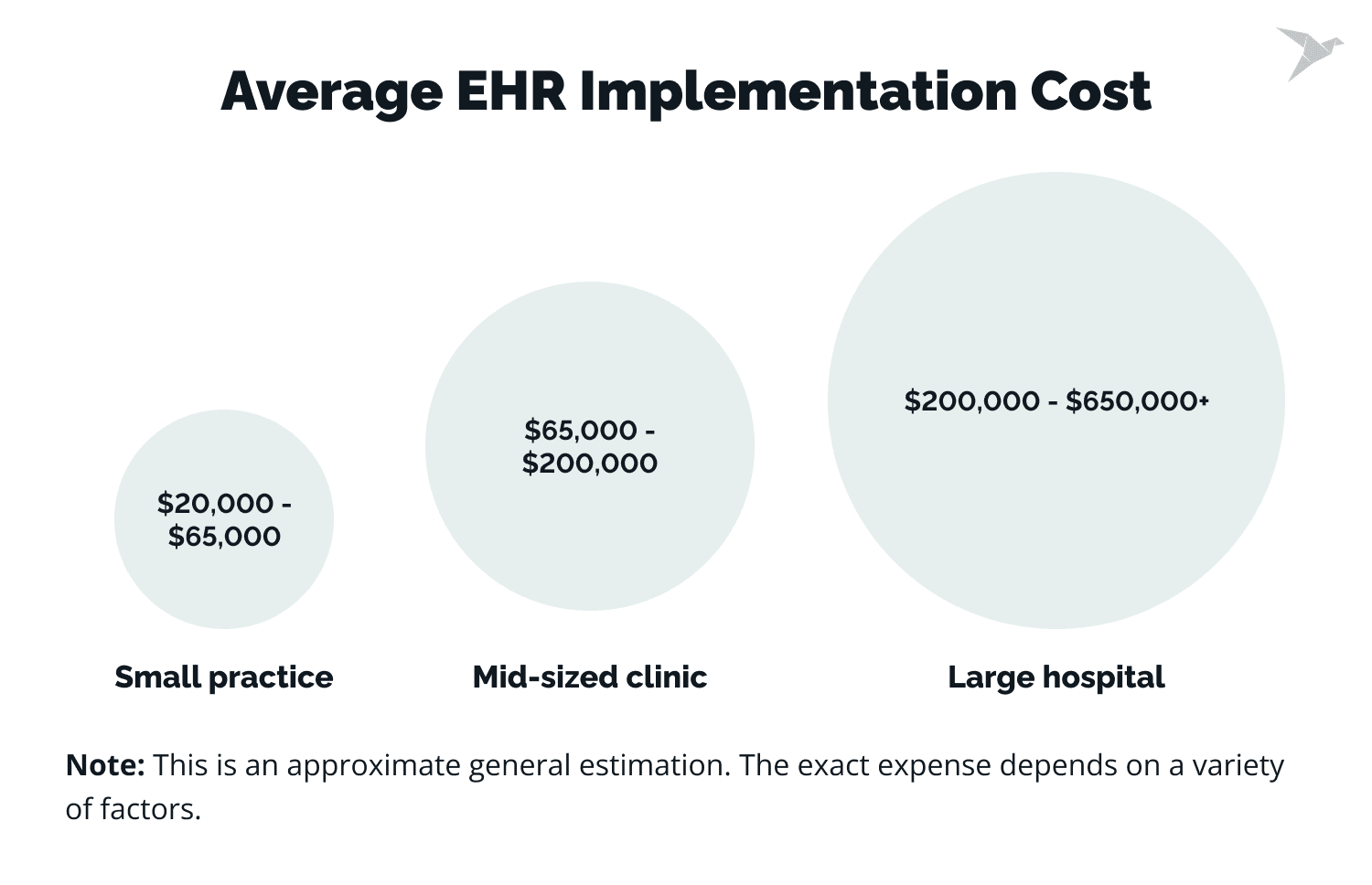
To sum up, the average EHR implementation cost is the following:
- $20,000-$65,000 for a small practice
- $65,000-$200,000 for a mid-sized clinic
- $200,000-$650,000+ for a large hospital
Ready-Made or Custom EHR Solution: Which Is Better?
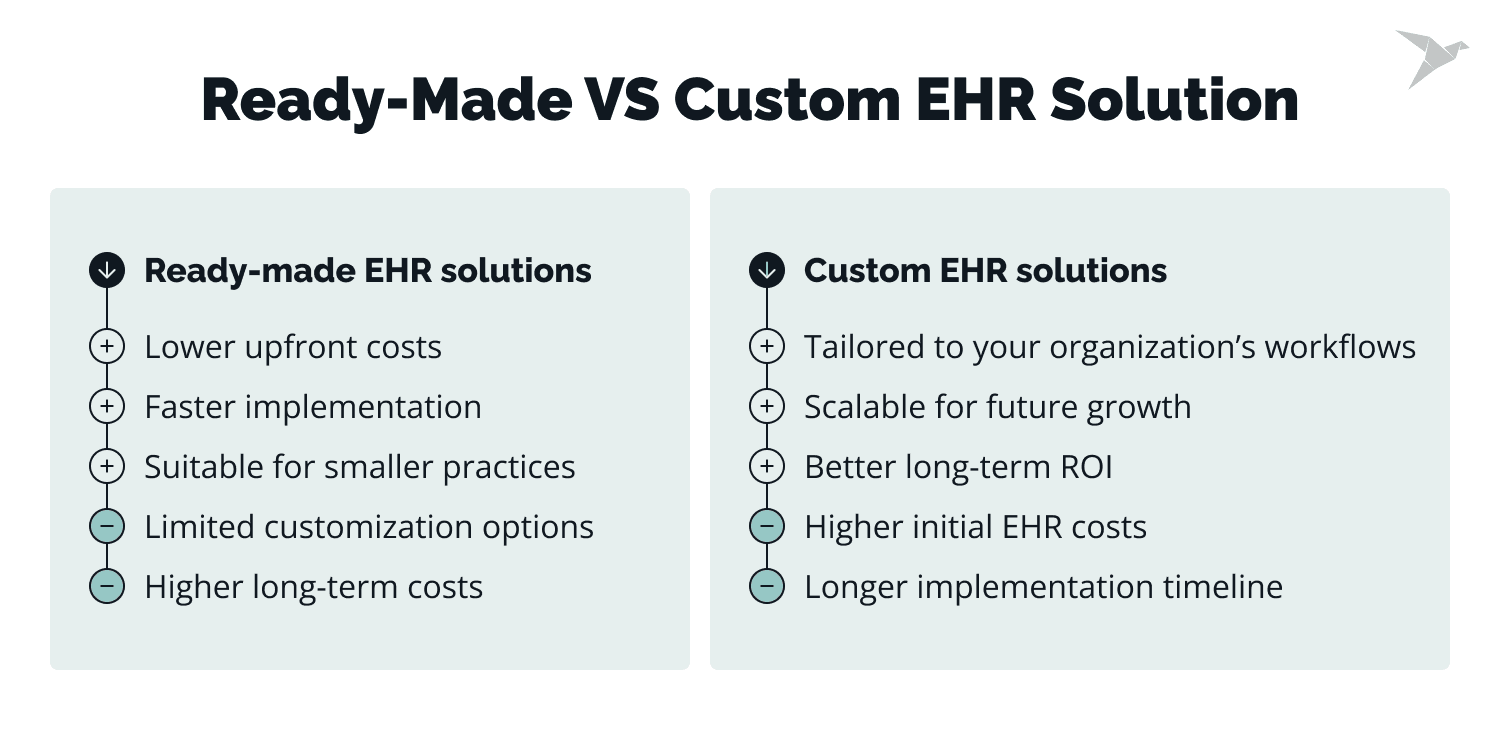
For organizations, the important question arises: Should I choose a ready-made or custom EHR solution? Let’s see the pros and cons of each decision!
Ready-made EHR solutions
So, the advantages of a ready-made EHR solution are the following:
Lower upfront costs
In the case of a ready-made EHR system, the estimated average upfront cost is lower for organizations. Ready-made solutions often function based on a subscription or licensing model, so there is no need for large initial expenses. For example, a small clinic using a ready-made EHR like Kareo or Athenahealth can start with a monthly subscription fee instead of spending thousands of dollars on development.
Faster implementation
These systems are pre-designed and ready to deploy, which lets healthcare providers start using them in a few weeks or even days. For instance, small practices adopting a system from an EHR vendor like Epic’s community model or Practice Fusion can be up and running quickly, which minimizes disruptions to patient care.
Suitable for smaller practices with standard requirements
Medical organizations with common needs (such as usual appointment scheduling, patient records, and billing) can benefit from ready-made solutions. For example, a solo practitioner or small dental office may find that a solution like SimplePractice meets all their requirements without overcomplicating processes.
As for the disadvantages, they are:
Limited customization options
Ready-made EHRs may not be suitable for custom business processes or specific needs, which makes it harder to optimize the work of specialized clinics. For example, it may be problematic for a mental health clinic to implement a personalized treatment plan into a general-purpose EHR.
Subscription-based pricing can result in higher long-term costs
While the initial cost of implementing EHR in hospitals is lower, monthly payments can increase drastically as time goes on. A clinic using a subscription-based service like AdvancedMD may end up paying more over five years than it would for a one-time custom solution.
Custom EHR solutions
The benefits of custom EHR solutions are:
Fully tailored to your organization’s workflows
Custom solutions allow providers to design every aspect of the system to fit their processes. For example, a multi-specialty hospital could create a bespoke EHR to streamline referrals, diagnostic workflows, and reporting, ensuring maximum efficiency.
Scalable for future growth
Custom EHR systems can adapt to the specific needs of an organization. These may be the incorporation of new departments or a grown patient base. For example, a healthcare system that is expanding can easily integrate additional modules, such as telemedicine or advanced analytics, into its custom platform. If your company needs professional telemedicine app development services, TechMagic can competently support you in this.
Better long-term ROI
Although costly initially, a custom EHR can reduce reliance on third-party services and eliminate ongoing subscription fees, which saves money in the long run. For example, a huge hospital system can recoup its expenses by cutting down on external licensing costs and boosting operational performance.
At the same time, the drawbacks are the following:
Higher initial EHR costs
Developing a custom EHR requires significant upfront investment in technology, skilled developers, and consultants. A midsize healthcare provider might spend hundreds of thousands of dollars to build a custom system from scratch.
Longer implementation timeline
Tailored EHRs require time to design, develop, test, and deploy. Often, it necessitates several months to a year or more. For example, a hospital that builds a custom system may experience delays in implementing the system due to complex workflows and significant staff training requirements.
How TechMagic Can Help
At TechMagic, our professionals provide custom healthcare software development. All our solutions aim to meet the unique needs of your organization. We offer:
- Comprehensive assessment. We analyze your workflows and requirements to design the optimal solution.
- Custom development. Our developers create scalable, secure, and compliant EHR systems.
- Seamless integration. We ensure smooth data migration and integration with third-party applications.
- Training and support. We assist in comprehensive training and ongoing support to ensure a seamless transition.
Wrapping Up
EHR implementation is a necessary investment for modern healthcare organizations. EHRs do offer many benefits. However, the associated budget for EHR implementation can range widely based on organizational size, customization needs, and other factors.
Understanding the software costs breakdown and key influencers is important for aligning budget and long-term goals. Partnering with a professional development team like TechMagic is essential for a successful implementation. Contact us to discuss the details or ask your questions.

FAQ

The cost of implementing EHR system varies depending on the organization's size and needs. It can range from $35,000 for small practices to $370,000 for large hospitals.
The EHR implementation costs depend on the amount of data, existing systems, and third-party application requirements. Additional expenses can be related to complex customizations and regulatory compliance.
The timeline for EHR implementation depends on the system's complexity. Ready-made EHR solutions can be implemented in a few weeks, while custom EHR systems may need several months to more than a year.