














vCISO Role in SOC 2 Compliance: Reducing Costs and Streamlining Certification for Startups
Last updated:19 January 2026


SOC 2 audits rarely fail due to weak technology. It fails because no one truly owns security. Startups feel this first: deals slow down, audits drag on, and teams argue over priorities. Hiring a full-time CISO often feels premature, yet moving forward without leadership is risky.
This is where SOC 2 and virtual CISO models start to make sense.
In this article, we explain how a vCISO helps startups meet compliance requirements without adding unnecessary cost or friction. We break down what a vCISO actually does, how this role differs from a full-time CISO, and why the lack of ownership is the main reason SOC 2 becomes expensive and slow. You’ll also see the practical role of vCISO in SOC 2, from setting strategic direction to guiding teams through audits without getting pulled into office politics.
Key takeaways
- A vCISO provides executive-level guidance and clear ownership without the cost of a full-time hire.
- SOC 2 becomes manageable when security decisions follow a defined strategic direction instead of reactive fixes. This is also essential to protect customer data, avoid data breaches, and show the organization's commitment to maintaining a strong security posture.
- Strong leadership reduces friction between teams and keeps security out of internal office politics.
- Clear ownership improves incident response readiness and long-term audit outcomes.
- Business leaders gain confidence that compliance requirements are met in a way that supports growth, not slows it down.
What is a vCISO, and How Does It Differ from a Full-Time CISO?
A vCISO (virtual CISO) is an external chief information security officer, a security leader who owns the security direction without joining as a full-time employee. Startups use this model when they need senior guidance but are not ready to hire a permanent executive.
Comparing CISO vs vCISO, vCISO sets priorities, builds and oversees security programs, and helps leadership identify and reduce security risks. They usually work part-time or on a retainer, with a scope defined in a contract.
A full-time CISO is a permanent executive and often runs internal teams and day-to-day security operations. A vCISO focuses more on strategy, decisions, and cross-team alignment than on operational management.
A vCISO is also different from a consultant. Consultants handle narrow, short-term tasks. A vCISO provides ongoing dedicated security leadership, shaping the company’s security posture and keeping risk management consistent over time.
Why Is SOC 2 Compliance So Expensive and Slow for Startups?
Service Organization Control 2 (SOC 2) is expensive and slow for startups, mainly because internal structures are not ready, not because the framework itself is overly complex. Most delays and budget overruns come from unclear ownership, immature processes, and early technical decisions that are hard to undo.
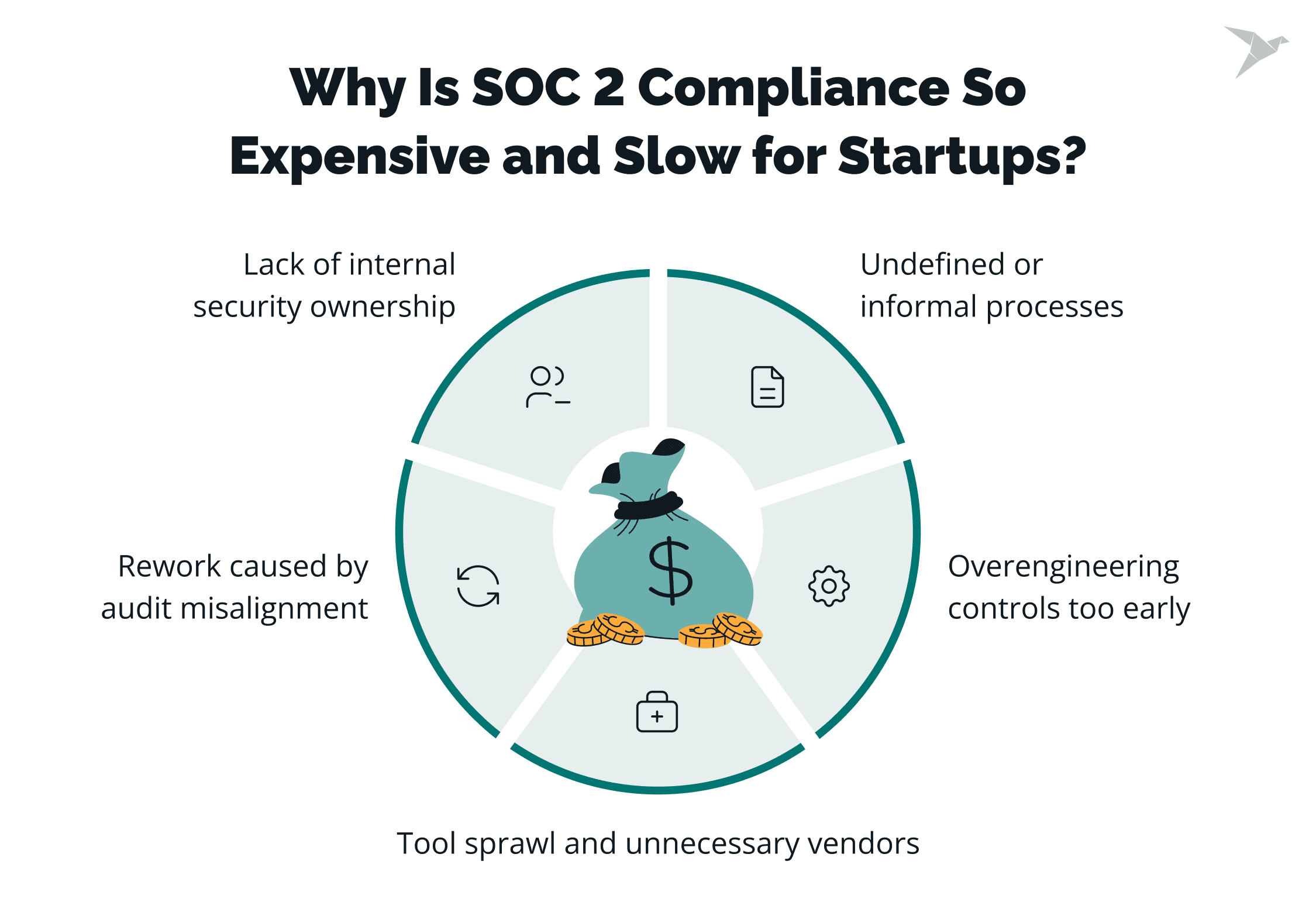
Lack of internal security ownership
When no one clearly owns security decisions, work stalls. Teams wait for approvals, make inconsistent choices, or duplicate effort. External auditors and advisors also lack a single point of contact, which increases review cycles and rework.
Undefined or informal processes
Many startups rely on tribal knowledge instead of documented processes. During SOC 2 preparation, these gaps surface all at once. Teams must stop delivery work to formalize workflows, assign responsibilities, and document controls under time pressure.
Overengineering controls too early
Startups often implement controls designed for larger organizations. These controls require more time, tools, and maintenance than are needed at the current stage. It all results in higher costs and slower progress without added audit value.
Tool sprawl and unnecessary vendors
When you buy multiple security tools before defining clear requirements, it creates overlap and integration issues. Teams spend time configuring, maintaining, and explaining tools that do not meaningfully support the audit scope.
Rework caused by audit misalignment
Misunderstanding audit expectations leads to redoing policies, evidence, and controls. This usually happens when teams design controls without early alignment with auditors, causing last-minute changes and extended timelines.
Let's discuss your security needs

Why Do Startups Struggle to Own SOC 2 Without Security Leadership?
From what we see in practice, startups struggle with SOC 2 ownership when security decisions are spread across roles that are not designed to lead them. Without clear security leadership, teams default to short-term fixes, inconsistent controls, and audit-driven work.
Engineering teams optimizing for delivery, not controls
Engineering teams are measured on shipping and system performance. When they own SOC 2, security controls are often delayed, simplified, or implemented only when they block releases. This leads to gaps and uneven coverage across systems.
Compliance tasks treated as side projects
SOC 2 work is often added on top of existing responsibilities. Without dedicated ownership, tasks move slowly, lose priority, or stop entirely during product or customer deadlines. Progress becomes irregular and hard to track.
Misinterpretation of SOC 2 requirements
Teams without security expertise may misread SOC 2 criteria or apply them too broadly. This results in controls that are either insufficient or overly complex, increasing both audit risk and implementation effort.
Reactive fixes driven by auditors instead of strategy
When there is no security owner, auditors effectively set the direction. Teams respond to findings late in the process, applying quick fixes that address symptoms rather than root causes. This creates churn, rework, and confusion close to audit deadlines.
How Does a vCISO Reduce SOC 2 Compliance Costs?
A vCISO reduces SOC 2 compliance costs by making deliberate scope and control decisions early, then keeping execution aligned with real risk and audit expectations. This approach avoids waste caused by overbuilding, tool sprawl, and late-stage corrections, even under tight budget constraints.
Scoping SOC 2 to actual business risk
A vCISO aligns the SOC 2 scope to how the business actually operates, not to a generic checklist. Through targeted risk analysis and existing security frameworks, they identify what truly matters for the product, customers, and data flows.
This prevents unnecessary work and focuses effort on closing real security gaps. This is a core part of the role of virtual CISO in SOC 2.
Eliminating redundant or low-value controls
Startups often implement overlapping or low-impact security controls because ownership is unclear. A vCISO reviews controls end-to-end, removes duplication, and right-sizes requirements such as access management to the company’s stage. Fewer controls mean less documentation, less maintenance, and lower audit effort.
Selecting tools that auditors can reasonably evaluate
Auditors do not require specific tools, but they do expect evidence that is consistent and reviewable. A vCISO helps teams choose tools and processes that produce clear audit evidence without overbuying.
This avoids spending on complex platforms that add cost without improving outcomes. These decisions are typically made as part of scoped virtual CISO services.
Preventing failed or repeated audits
Failed or extended audits are a major cost driver. A vCISO maintains audit readiness by aligning controls with audit criteria early and validating evidence before submission. Ongoing checks and limited continuous monitoring reduce surprises, lower the risk of repeat audits, and help prevent last-minute fixes after findings or security incidents.
Overall, we see that virtual CISO and SOC 2 work together when security ownership is clear. Consistent security leadership ensures decisions are intentional, evidence is reusable, and SOC 2 remains a controlled process rather than a costly scramble.
How Does a vCISO Streamline SOC 2 Readiness and Certification?
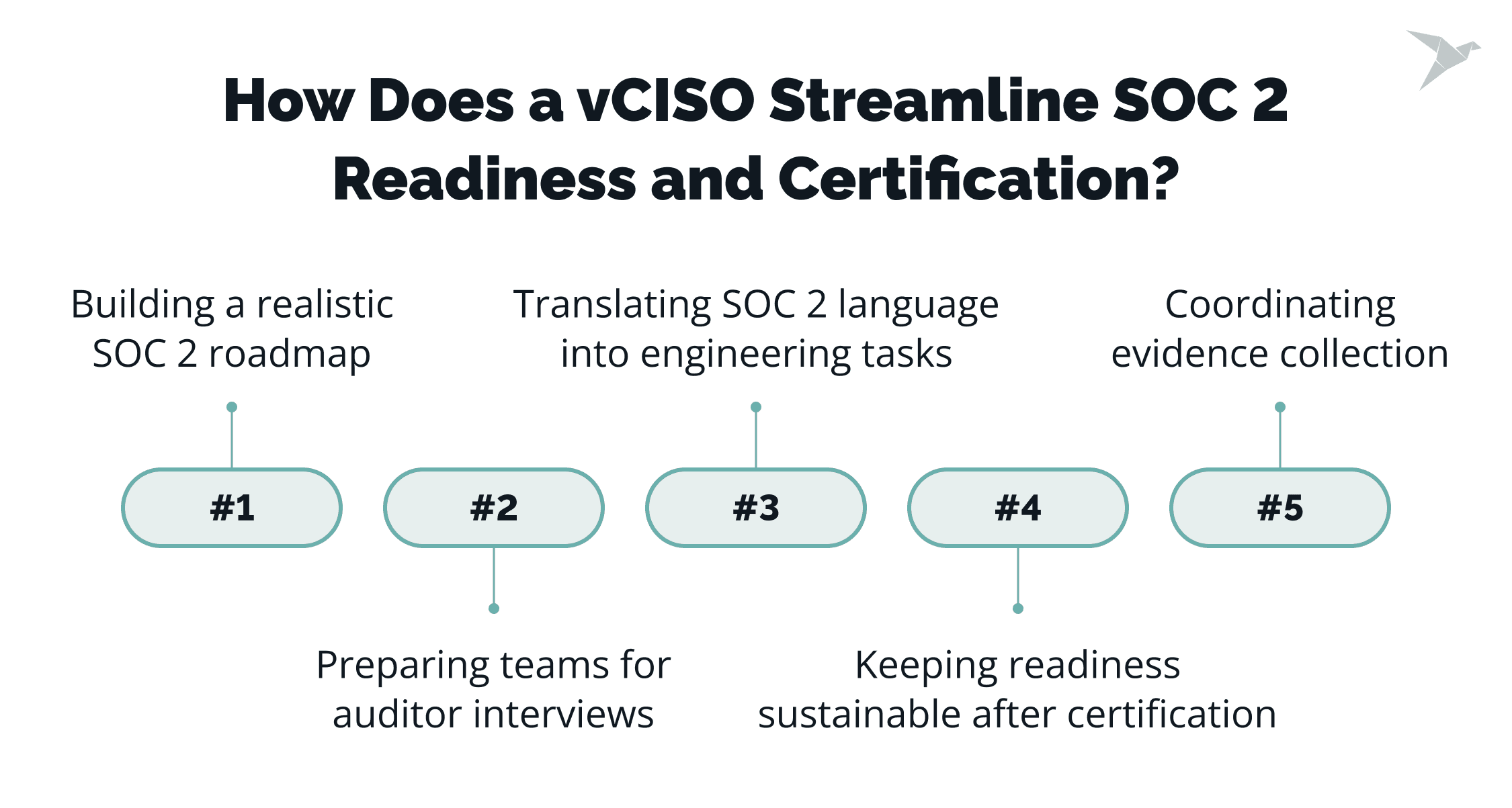
A SOC 2 consulting services help shorten SOC 2 timelines by turning compliance into a coordinated execution plan with clear owners, sequencing, and evidence flow. This is the practical vCISO role in SOC 2 compliance: reduce friction, avoid rework, and keep teams moving in the same direction.
Building a realistic SOC 2 roadmap
A vCISO builds a roadmap based on current maturity, team capacity, and business goals. Instead of aspirational timelines, the plan reflects real dependencies and the current threat landscape. This is where vCISO conducts targeted gap assessments to define what must be done now versus later.
Translating SOC 2 language into engineering tasks
The SOC 2 criteria are abstract. A vCISO converts them into concrete tickets and acceptance criteria engineers can act on. This includes practical tasks like tightening vulnerability scanning or updating incident response planning, aligned with regulatory demands and day-to-day workflows.
Coordinating evidence collection
Evidence gathering often causes delays. A vCISO defines what evidence is needed, who owns it, and when it is collected. This structure reduces back-and-forth and supports ongoing compliance instead of one-time document pushes.
Preparing teams for auditor interviews
Auditor interviews fail when teams are unprepared or inconsistent. A vCISO aligns talking points, clarifies ownership, and runs dry checks so teams can explain controls clearly and consistently. This helps mitigate risks of misinterpretation during review.
Keeping readiness sustainable after certification
SOC 2 does not end with certification. A vCISO designs processes that hold up for future audits, reducing repeat effort and last-minute fixes. This long-term view defines the virtual CISO role in SOC 2 compliance and how a virtual CISO helps teams stay audit-ready without slowing delivery.
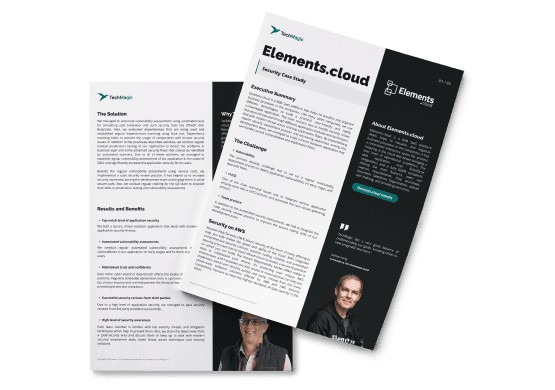
CyberSecurity services for Elements.Cloud
Which Parts of SOC 2 Can a vCISO Fully Own?
A vCISO can fully own the structure, direction, and coordination of SOC 2 work, while internal teams remain responsible for implementation and evidence.
Clear ownership boundaries reduce delays, confusion, and repeated work.
Control design and documentation
A vCISO designs SOC 2 controls and documents how they operate across systems and teams. This includes defining control intent, scope, and ownership. Internal teams are responsible for implementing the controls and following the documented processes.
Policy creation and maintenance
A vCISO creates and maintains required security and operational policies, ensuring they align with how the company actually works. Internal stakeholders review, approve, and follow these policies as part of normal operations. vCISO can also control implementation of the policy.
Risk assessments and gap analysis
A vCISO leads risk assessments and gap analysis to identify missing or weak controls. They prioritize remediation based on impact and effort. Internal teams provide system context and execute the required changes.
Audit preparation and remediation tracking
A vCISO prepares the company for audits by coordinating evidence, aligning teams, and tracking remediation tasks. They manage findings and follow-ups, while internal teams supply evidence and close technical gaps.
This split allows SOC 2 to move forward with clear leadership, without removing accountability from the teams that own the systems.
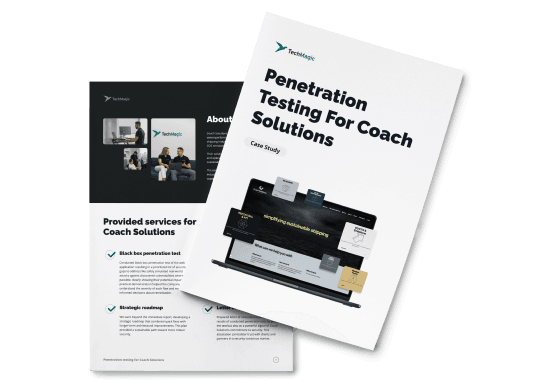
Penetration testing for Coach Solutions web application
When Should a Startup Bring in a vCISO for SOC 2?
A startup should bring in a vCISO when SOC 2 work starts to affect sales, delivery, or leadership focus. The right timing avoids both unnecessary early spend and rushed decisions later in the process.
Pre-sales SOC 2 preparation
When prospects begin asking about SOC 2, a vCISO can help assess readiness and define what is realistic to commit to. This prevents overpromising during sales and reduces the risk of setting timelines the team cannot meet.
Before selecting auditors or platforms
Early decisions about auditors, tooling, and scope have long-term cost and timing impact. A vCISO helps evaluate options based on company size and maturity, avoiding lock-in to approaches that require more effort than needed.
Transitioning from Type I to Type II
Type II introduces operational consistency over time. A vCISO helps structure controls and evidence so they hold up across the audit period, reducing stress and rework as expectations increase.
Scaling beyond founder-led security
When founders or early engineers can no longer manage security alongside core roles, ownership becomes fragmented. Bringing in a vCISO at this point creates clear leadership and keeps SOC 2 work moving without disrupting growth.
When internal execution starts to stall
If SOC 2 tasks exist but progress is slow, inconsistent, or repeatedly paused, that is a strong signal. This usually means ownership is unclear and decisions are being deferred. A vCISO helps restore momentum by setting priorities and resolving blockers.
After the first failed or extended audit attempt
Startups often try to self-manage the first audit and bring in help only after delays or unexpected findings. At that point, a vCISO can reset scope, fix structural issues, and prevent the same problems from repeating in the next cycle.
Final Thoughts
SOC 2 is not slow or expensive by default. It becomes that way when ownership is unclear, processes are immature, and decisions are delayed or misaligned. The goal is consistent execution against the trust services criteria, not last-minute document pushes.
The role of vCISO in SOC 2 compliance is to bring structure, prioritization, and clear accountability across teams. With the right vCISO services, startups reduce rework, avoid unnecessary spending, and keep compliance aligned with real operations.
As SOC 2 expectations continue to rise alongside other industry standards, startups need security leadership that scales without adding unnecessary overhead. Maintaining clear access controls and consistent execution becomes harder as teams grow, making early structure critical.
We are here to assist

FAQ

Yes, for many startups, a vCISO is enough to lead SOC 2 work. A vCISO owns scope, proactive strategies, priorities, and coordination while internal teams implement controls and provide evidence. This model supports vCISO and SOC 2 compliance without adding a permanent executive role.
Costs vary based on scope, timeline, company size, required key responsibilities, and so on. Most startups choose a vCISO model for cost efficiency, paying for senior expertise only when needed instead of a full-time salary.
A vCISO can replace a full-time in-house CISO for an extended period if security needs are stable and the team size is limited. You can hire this specialist for maintaining compliance with regulatory requirements, creating an effective cybersecurity program, security policy development, aligning security with business objectives, etc.
Many organizations also hire a virtual CISO (vCISO) to control the implementation of security policies or for audit readiness assessment. Over time, with rapid growth or as cybersecurity risks increase, some companies hire a full-time executive instead of vCISO engagement.
SOC 2 does not require a specific job title or virtual CISO services, but it does require clear ownership and ensuring security. A vCISO provides that ownership by setting proactive cybersecurity strategies, reducing the risk of reputational damage, and ensuring the company is prepared as the vCISO develops controls and processing integrity