 Software Development
 Security Services
 Cloud Services
 AI Services
 Other Services














 TechMagic Academy


Healthcare Penetration Testing: How to Protect Patient Data from Modern Cyber Threats
Last updated:26 December 2025



Healthcare systems are under constant pressure to stay available, connected, and secure. Yet attacks are becoming more frequent and harder to contain. Healthcare data breaches increased by about 20% in the first half of 2025 compared with the same period in 2024.
Many of the attack paths are not new or complex. They exist because systems evolve faster than security controls, and because hidden risks remain untested across environments that store sensitive information.
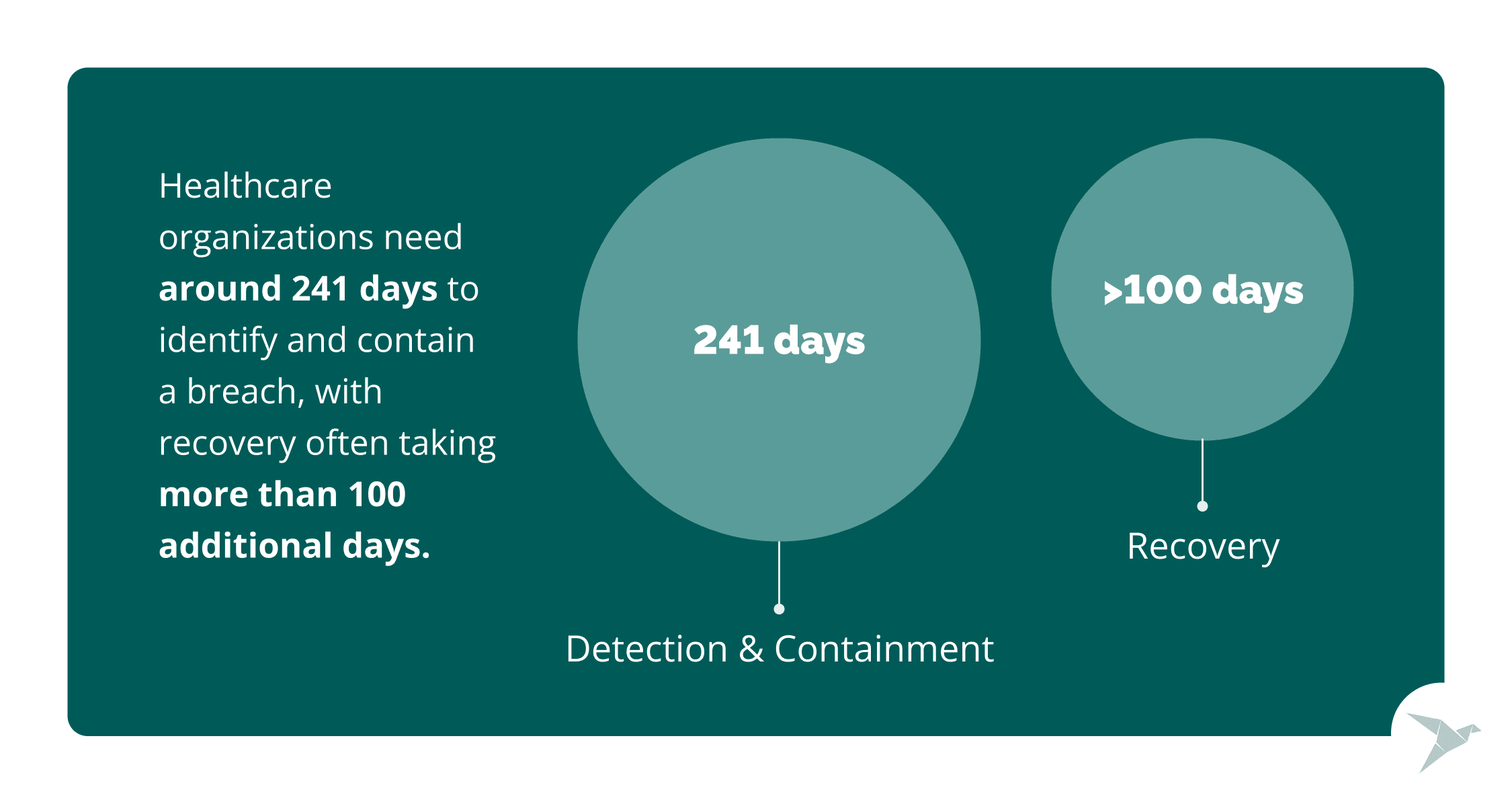
When something goes wrong, it rarely ends quickly. On average, healthcare organizations need around 241 days to identify and contain a breach, with recovery often taking more than 100 additional days. That gap between intrusion and detection creates real risk. During that time, attackers can move across systems, access patient information, including medical histories, and disrupt clinical operations.
In this article, we discuss how penetration testing services help healthcare organizations uncover those hidden security risks before attackers do. We explain how healthcare penetration testing differs from other industries, what systems and workflows are tested, how assessments are performed safely, and how testing supports compliance, risk management, and long-term security planning.
Key takeaways
- Healthcare organizations face growing cyber risk, with healthcare breach volumes rising and incident response often taking months. Long detection and recovery timelines increase exposure to sensitive patient data loss and operational disruption.
- Penetration testing is critical for revealing real attack paths by simulating how an adversary could gain access, move through systems, and reach protected health information.
- Healthcare penetration testing must account for patient safety, system availability, and regulatory compliance, which requires clear rules of engagement and careful coordination with clinical teams.
- Effective testing covers the full environment, including networks, EHRs, patient portals, mobile apps, APIs, cloud platforms, and connected medical devices.
- Regular penetration testing for healthcare cybersecurity strengthens risk management and comprehensive compliance efforts by providing objective evidence of security gaps and helping teams prioritize remediation.
- Independent penetration testing positively affects not only data security but also health insurance portability, maintaining HIPAA compliance, patient trust, and healthcare business outcomes.
How Does Penetration Testing for Healthcare Differ from Other Industries?
Security penetration testing for healthcare differs because systems handle protected health information (PHI), support clinical workflows, and often operate under strict availability and regulatory requirements.
In 2024, more than 275 million healthcare records were exposed or stolen in reported breaches, including some record-breaking incidents.
Regulatory and compliance constraints shape the scope
Healthcare environments are governed by the Health Insurance Portability and Accountability Act (HIPAA), Health Information Technology for Economic and Clinical Health Act (HITECH), and, in some cases, regional or international regulations.
These frameworks define regulatory compliance expectations and influence how testing is planned, executed, and documented. Penetration testers must prove that identified risks map to compliance obligations and not only technical weaknesses. Evidence collection, audit trails, and reporting formats matter as much as exploitability.
Tight testing windows
The healthcare industry cannot tolerate downtime or performance degradation. Clinical systems such as EHRs, PACS, and medication management platforms support real-time patient care. Pen testing process must avoid actions that could interrupt clinical workflows, corrupt medical data, or delay care.
This often leads to tighter testing windows, limited exploit depth, and strong coordination with IT and clinical teams.
Data sensitivity changes risk prioritization
Unauthorized access to PHI can lead to patient harm, regulatory penalties, and loss of trust. Pentesting, therefore, prioritizes data access paths that could exploit vulnerabilities, lead to privilege escalation, and lateral movement toward systems that store or process patient data, even if the initial vulnerability appears low risk in other industries.
Our expertise is at your disposal

What Exactly Is Tested for Penetration in Healthcare Organizations?
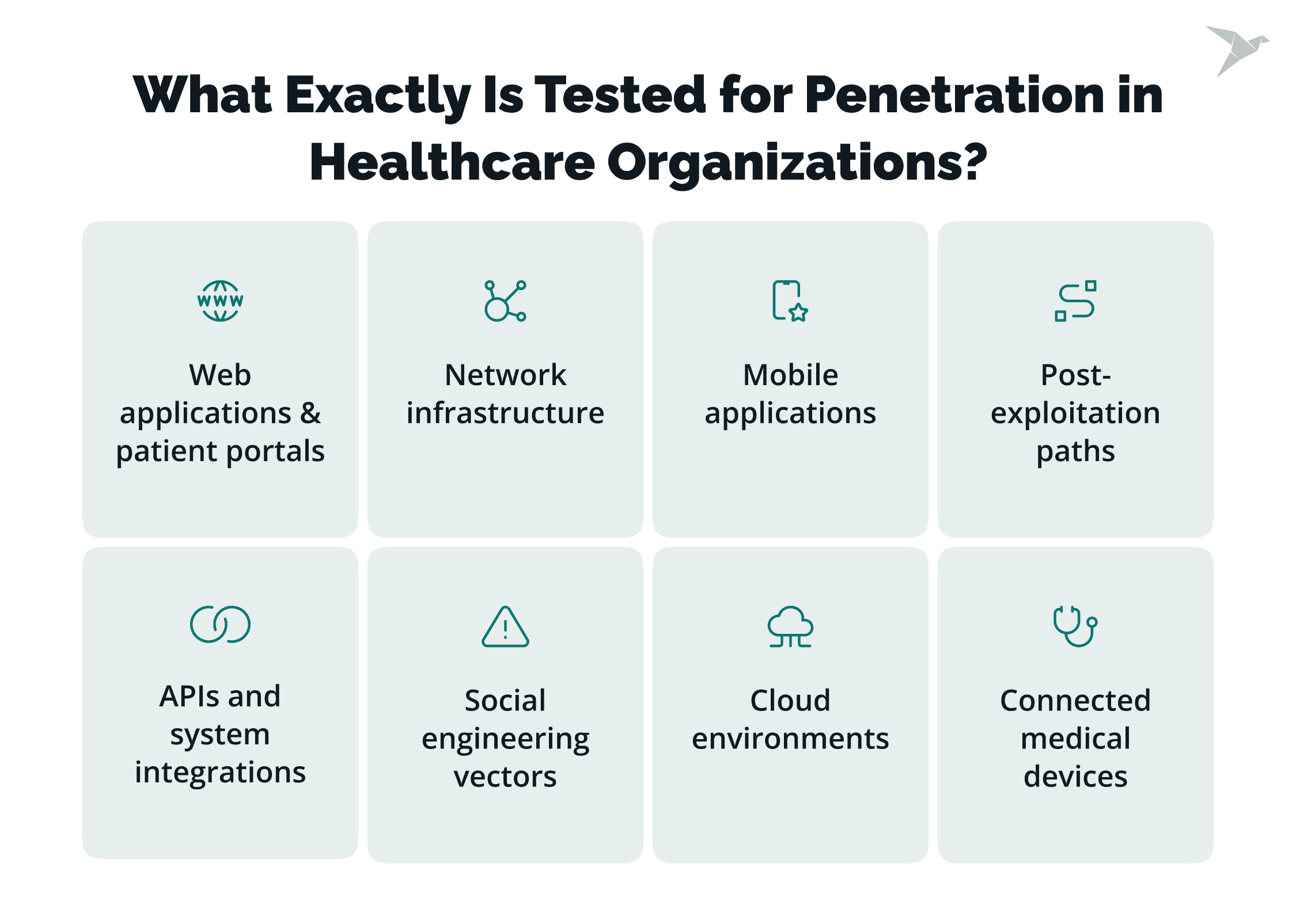
Pen testing focuses on the systems and workflows that keep care running and protect patient data. The primary goal here is to show where real-world attackers could get in, how they might move through the environment, and what information they could reach.
So, there are some common entry points we test in the first place.
Network infrastructure
Healthcare networks grow quickly and often include legacy systems, remote clinics, and temporary setups. We look at firewalls, switches, wireless networks, and VPN gateways to find weak configurations, exposed services, or outdated systems or protocols that could give attackers a foothold.
Web applications and patient portals
Patient portals, scheduling tools, clinician dashboards, and EHR web interfaces carry sensitive data and support daily operations. We test them for access control gaps, broken authentication, and insecure session handling. These are the issues that often appear when systems evolve faster than security teams can update them.
Mobile applications
Clinician and patient mobile apps often mix clinical workflows with convenience features. We check how these apps store data, authenticate users, and communicate with backend systems. This helps teams catch risks like insecure APIs or unintended exposure of protected health information.
Cloud environments
Cloud use is expanding across hospitals and HealthTech vendors. We assess identity policies, network configurations, service permissions, and integration points with on-premises systems. Misconfigurations remain one of the most common issues we uncover.
Connected medical devices
Penetration testing for healthcare often includes Internet of Medical Things (IoMT) devices such as infusion pumps, patient monitors, and imaging equipment. These devices have some specific regulatory limitations that restrict active exploitation.
Also, medical devices introduce unique risk because many run outdated software or rely on insecure communication channels. We test both the device and the surrounding infrastructure to see how an attacker could disrupt a clinical workflow or use the device as an entry point.
APIs and system integrations
Healthcare depends on integrations across EHRs, billing systems, labs, and third-party services. We test APIs for authentication issues, broken access controls, and insecure data flows—common risks in environments with many vendors and frequent updates.
Social engineering vectors
Human factors remain a primary attack path. As part of penetration testing for healthcare systems, we can conduct controlled phishing tests and other social engineering attacks to help teams understand where staff may need clearer guidance or training.
Post-exploitation paths
A single vulnerability rarely tells the full story. We examine how an attacker could move after gaining initial access, what privileges they could escalate, and which clinical or operational data they could reach. This helps teams see the real business and patient impact of each risk.
How Does Penetration Testing for Healthcare Facilities Work?
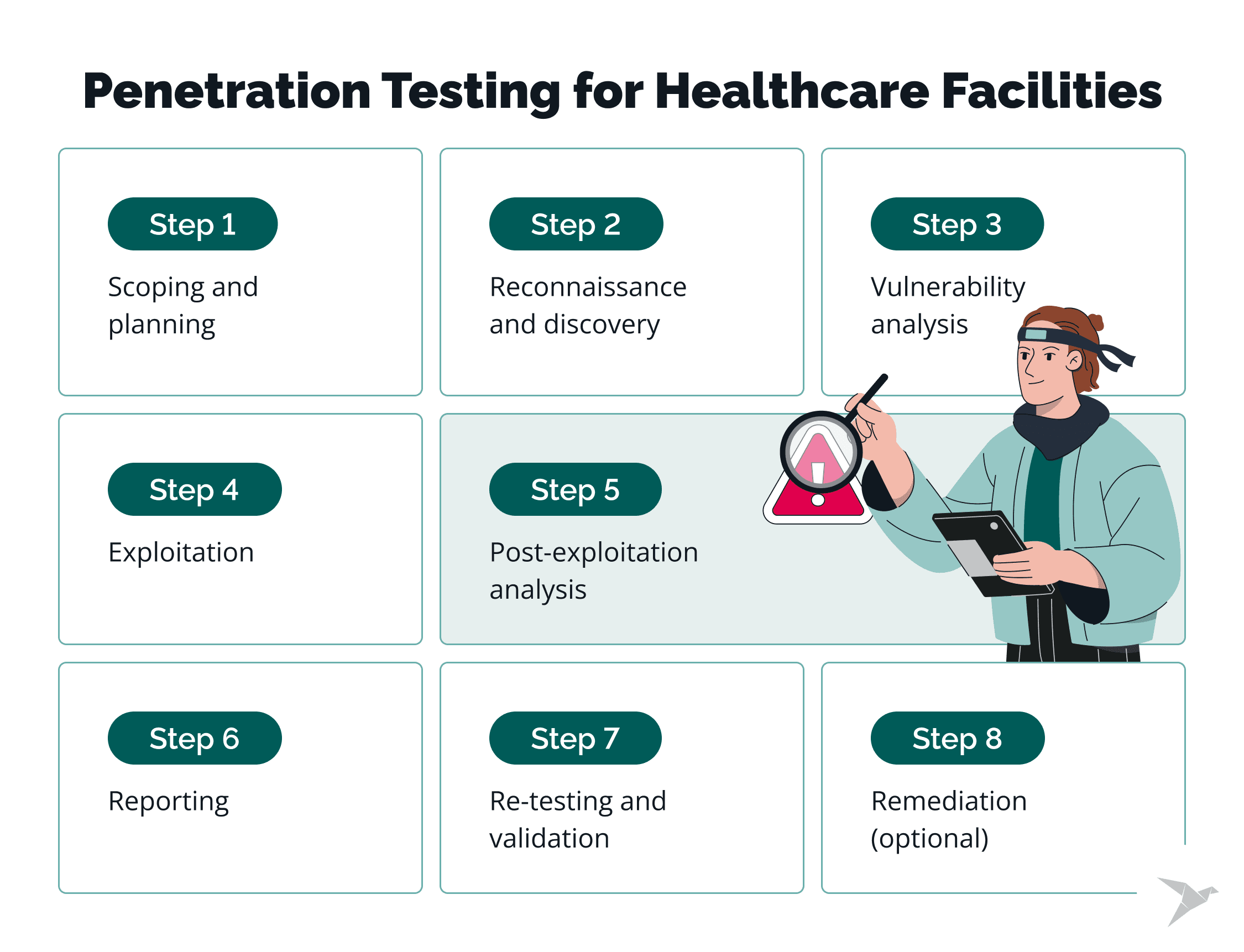
Cybersecurity penetration testing for healthcare follows a structured process that mirrors how real attackers operate, but in a controlled and safe way. Each step helps healthcare teams understand where risks exist and how to reduce them without disrupting clinical operations.
Scoping and planning
We work with your team to define the scope of the assessment. This includes selecting systems, applications, and networks to test, understanding clinical workflows, and agreeing on rules of engagement to avoid interruptions to patient care.
Reconnaissance and discovery
Our testers gather information about the environment to identify possible entry points. This can include mapping network assets, reviewing exposed services, analyzing public-facing applications, and identifying outdated or misconfigured systems.
Vulnerability analysis
We validate and prioritize the issues found during discovery. The focus is on understanding which weaknesses are realistic attack paths, how they could be chained together, and what impact they may have on patient data or critical operations.
Exploitation
Testers use controlled, real-world techniques to attempt to exploit identified vulnerabilities. The goal is to confirm how an attacker could gain access, move laterally, or escalate privileges—while ensuring all activity remains safe for production systems.
Post-exploitation analysis
After confirming an entry point, we assess how far an attacker could go. This includes reviewing access to sensitive data, mapping internal movement paths, and identifying potential disruptions to clinical or administrative workflows.
Reporting
We prepare a clear report that documents each finding, shows evidence of exploitation, and outlines practical steps for remediation. The goal is to give technical teams and leadership a shared view of risk and next steps.
Re-testing and validation
Once fixes are applied, we perform targeted re-testing to confirm that vulnerabilities are resolved. This helps security and compliance teams verify closure and maintain an accurate risk posture.
Remediation (optional)
Remediation support is available as an optional step after testing. If needed, we can help teams address the identified issues in a practical and prioritized way, focusing on changes that reduce risk without disrupting clinical workflows.
This may include guidance on configuration updates, patching, or access controls. Teams can also choose to handle remediation internally, using the findings as a clear roadmap for next steps.
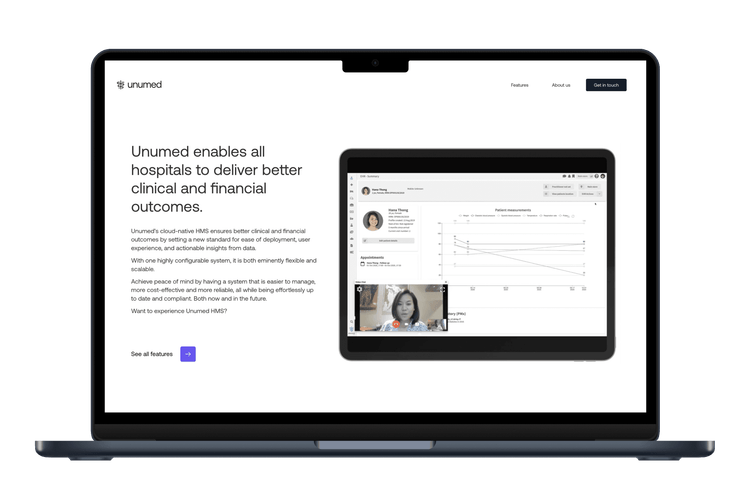
Penetration testing of a cloud-native hospital management system before the annual ISO 27001 audit
What Risks and Vulnerabilities Are Commonly Found in Healthcare Systems?
Our penetration testing service for healthcare often reveals patterns that stem from operational pressures, legacy systems, and the need to keep clinical services running without interruption. The findings below reflect issues we routinely uncover when working with hospitals, clinics, and HealthTech vendors.
Outdated legacy systems and unsupported devices
Many clinical and administrative systems run on outdated operating systems or embedded firmware that can’t be updated without disrupting care. We frequently see devices that are out of support, lack security patches, or rely on deprecated protocols, making them easy targets for attackers looking for a predictable entry point.
Weak access controls and inadequate user management
Healthcare environments balance fast access with high security, but this often leads to gaps. We commonly find shared accounts in clinical settings, missing MFA on critical systems, weak password rotations, and user roles that accumulate permissions over time. These issues allow attackers to escalate privileges with minimal effort.
Insecure APIs and third-party integrations
Modern healthcare relies on integrations to move data between EHRs, labs, imaging systems, billing platforms, and external partners. In our tests, insecure authentication tokens, insufficient rate limiting, and over-permissive API endpoints are frequent findings. These weaknesses give attackers multiple paths to sensitive patient and billing data.
Misconfigured cloud environments
Cloud adoption continues to grow, but rushed migrations often leave gaps. We regularly identify overly broad IAM roles, publicly accessible storage, exposed management ports, and inconsistent network segmentation between cloud and on-premises systems. These issues can expose PHI or allow lateral movement across hybrid environments.
Unpatched software and vulnerable services
Systems that require continuous uptime, such as imaging servers or medication dispensing systems, are often excluded from regular patch cycles. As a result, known vulnerabilities remain open for months or years. We see the same pattern across connected devices, middleware servers, and administrative workstations.
Ransomware entry points
The largest U.S. healthcare breach ever, impacting about 192.7 million people, stemmed from a ransomware attack on a major healthcare tech unit.
Email remains the most common delivery method, but our assessments often uncover additional weak spots: externally exposed RDP instances, outdated endpoint protection, permissive SMB shares, and insufficient network isolation. These vulnerabilities create a direct path for ransomware to spread quickly across clinical systems.

Unencrypted PHI transmission
In environments with mixed modern and legacy systems, we often find data moving between internal services without encryption. Older HL7 interfaces, outdated TLS versions, and unencrypted file transfers expose PHI to interception during routine operations.
Social engineering risks
Phishing remains one of the most successful attack vectors. Controlled simulations consistently show that staff are targeted through impersonation of internal IT teams or clinical leadership. These tests highlight gaps in training, escalation procedures, and verification workflows.
Poor network segmentation
Flat or loosely segmented networks allow attackers to move from low-risk systems to high-value targets such as EHR databases or imaging servers. We often find that segmentation plans exist on paper but are not enforced consistently across switches, VLANs, and clinical device networks.
Insufficient monitoring and logging
Gaps in logging, unmonitored systems, and fragmented SIEM coverage make it difficult for teams to detect or trace suspicious activity. During automated testing, it’s common for critical events like authentication failures or unusual data access to go unnoticed.
What Compliance Standards Influence Healthcare Penetration Testing?
As we mentioned before, pentesting in healthcare has unique requirements as it is shaped by several regulatory and industry frameworks. These standards help healthcare organizations understand what must be protected, how risks should be managed, and where security testing fits into ongoing compliance efforts.
HIPAA Security Rule
The HIPAA Security Rule requires healthcare organizations to safeguard electronic protected health information. While HIPAA compliance checklist does not explicitly mandate penetration testing, it expects covered entities and business associates to conduct regular technical evaluations. Pen tests help meet this expectation by showing how well security controls work in practice.
HITECH Act
The HITECH Act strengthens HIPAA requirements and increases accountability for breaches. Penetration testing supports HITECH compliance by identifying weaknesses that could lead to unauthorized access or reportable incidents, especially in EHR systems and integrated workflows.
NIST Cybersecurity Framework
Many healthcare organizations use the NIST CSF as a roadmap for improving their security posture. Pen testing aligns with the “Identify,” “Protect,” and “Detect” functions by validating how well controls perform and whether vulnerabilities could lead to real operational impact.
FDA guidance for medical devices
For organizations that build, operate, or maintain connected medical devices, FDA guidance emphasizes secure design, testing, and ongoing monitoring. Penetration testing helps teams evaluate device communications, firmware integrity, and potential misuse scenarios that could affect patient safety.
SOC 2 and ISO 27001 for healthcare vendors
HealthTech vendors, cloud providers, and service partners often follow SOC 2 or ISO 27001 to demonstrate that they manage data securely. Both frameworks expect ongoing risk assessments and technical security reviews. Pen testing provides evidence that controls are tested regularly and that vulnerabilities are identified before they impact customers.
How Often Should Healthcare Facilities Conduct Penetration Testing?
In short, healthcare facilities should perform pen testing on a regular schedule and after any significant change to their environment. You need to keep pace with evolving threats and ensure that new systems, integrations, or workflows do not introduce unnoticed risks.
Many organizations address this need through ongoing penetration testing as a service, which provides continuous coverage.
Annual or semi-annual testing
Most healthcare organizations conduct pen testing at least once per year. Facilities with a more complex environment, a large vendor ecosystem, or a high volume of digital services often test every six months to maintain an accurate view of risk.
Testing after major system changes
Any significant update should trigger a new assessment. Common examples include:
- EHR upgrades or migration;
- deployment of new cloud workloads;
- introduction of connected medical devices;
- changes to identity or access management systems;
- new APIs, integrations, or third-party services.
These changes can create new attack paths that routine monitoring may not catch.
Testing after security incidents
If an organization experiences a breach, ransomware event, or suspicious activity, a targeted penetration test can help validate that immediate issues are resolved and identify deeper weaknesses that contributed to the incident.
Testing before launching new services
Pen testing is valuable before releasing new clinical applications, patient-facing portals, mobile apps, or remote-care technologies. Early testing helps avoid exposing PHI or operational systems to preventable risks.
Testing based on compliance cycles
Frameworks such as HIPAA, SOC 2, and ISO 27001 expect regular technical evaluations. Many healthcare organizations align pen testing with their annual audit cycle to maintain documented evidence of due diligence.
Final Thoughts
Pen testing plays a critical role in healthcare security because it shows how real attackers could reach patient data or disrupt care. Unlike checklist-based assessments, it connects technical weaknesses to operational and compliance risk. This makes it easier for security, IT, and compliance teams to prioritize what actually matters.
Healthcare environments will continue to grow more complex. Cloud adoption, remote care, mobile apps, and connected medical devices expand the attack surface every year. At the same time, legacy systems and long upgrade cycles remain a reality. These conditions make static, one-time security reviews less effective.
Emerging trends and future direction
Static, annual tests will not keep pace with evolving systems and threats. Healthcare organizations are shifting toward continuous testing programs that integrate automated scans with periodic manual penetration efforts to monitor emerging risks and validate fixes.
Increased focus on APIs and data flows
Interoperability efforts and data exchanges are central to modern healthcare. Patient records, APIs, and integration points are now core test targets, given that insecure interfaces are a frequent vector for breach and data exfiltration.
Expanded scope for IoMT and device ecosystems
Connected medical and IoT devices will remain a priority. Future testing will expand to include device network interactions and service dependencies, balancing safety and exposure assessment.
Better integration with risk, compliance, and regulation
Healthcare security testing is aligning more closely with frameworks such as HIPAA, NIST CSF, and emerging regulatory requirements. Pen testing now serves as evidence of effective controls and supports proactive risk management rather than reactive compliance.
We are here to help

FAQ

Penetration testing is a controlled security assessment where ethical hackers simulate real-world attacks on healthcare systems, networks, applications, security measures, etc., to identify vulnerabilities that could expose patient data or disrupt clinical operations.
Interoperability is the ability of systems to exchange information and understand it in a usable way. In short, integration combines data, and interoperability enables integrated data systems to talk to each other.
HIPAA regulations do not explicitly require healthcare IT penetration testing from healthcare providers, but HIPAA requires covered entities to perform regular technical evaluations of cybersecurity controls. HIPAA penetration testing is one of the most effective ways to meet this expectation and validate that safeguards protecting PHI work as intended.
Costs vary based on scope, environment size, and testing depth. A focused assessment of a single application may cost several thousand dollars, while full enterprise testing, including networks, cloud environments, and medical devices, can be significantly higher.
Pricing also depends on whether testing is a one-time engagement or part of an ongoing program with data breach reports. Feel free to contact us for a free consultation on this matter.
External penetration testing evaluates how attackers from outside the organization could gain access to public-facing systems. Internal testing examines what an attacker could do after reaching the internal network – whether through a compromised account, device, or social engineering. Both perspectives are essential for understanding overall risk.