












Mobile App Pentesting Services: iOS & Android Security Assessments

Approved by CREST

Our mobile application penetration testing service is delivered by senior, CREST-accredited engineers who test iOS and Android apps the way a real attacker would target them. We run manual, tailored assessments covering the binary, on-device storage, and the APIs behind your app to identify vulnerabilities before they're exploited. You get a clear view of your security posture, a prioritized plan to fix what matters, remediation support, and audit-ready evidence for enterprise reviewers and compliance stakeholders.

logo
logo
logo

We’re Trusted By

logo-6
logo-7
logo-8
logo-9
logo-10
logo-11
logo-12
logo-13
logo-1
logo-2
logo-3
logo-4
logo-5
logo-6
logo-7
logo-8
logo-9
logo-10
logo-11
logo-12
logo-13
logo-1
logo-2
logo-3
logo-4
logo-5
logo-6
logo-7
logo-8

From Launch to Scale, Mobile App Penetration Testing Reduces Security Risk

When your app stores sensitive data on the device

Payment, health, or personal data written to the Keychain, shared preferences, or a local database is a common source of data leaks on mobile devices. Testing checks how it's protected at rest on a lost, rooted, or jailbroken phone.

Before an App Store or Google Play release

Ahead of a first launch or a significant release, testing confirms the binary, local storage, and API calls don't ship an exploitable flaw to every user's device at once. For the frequent builds and smaller features in between, we also offer a recurring security assessment with quarterly scans that keeps coverage current without pentesting every release.

After adding third-party SDKs or backend changes

New SDKs, payment libraries, or an updated API layer expand your mobile application's attack surface and can introduce inadequate supply chain security. Testing verifies they don't leak data or introduce insecure communication.

When compliance requires independent validation

PCI DSS explicitly requires periodic penetration testing by an independent tester, while GDPR, HIPAA, and ISO 27001 call for regular security testing and risk assessment that penetration testing is widely used to satisfy. Apps handling regulated data need evidence scoped to both the device and its backend.

Before shipping to a new platform or region

Launching an iOS build alongside your Android app or expanding to a new market introduces platform-specific risks, emerging threats, and new regulatory expectations to validate.

When you suspect tampering, fraud, or reverse engineering

Repackaged apps, in-app purchase abuse, and cheating usually trace back to weak binary protection that opens the door to advanced reverse engineering techniques. Testing shows whether your app can be decompiled, modified, or run on a compromised device.

Mobile Application Types We Test

We test the full range of mobile apps and the services behind them, adapting tools and methodology to each platform's attack surface so you can ship secure mobile applications.

Swift and Objective-C apps tested against iOS platform controls: Keychain usage, App Transport Security, biometric and Face ID flows, and jailbreak detection, drawing on a working knowledge of mobile OS internals. We assess how the app protects data in the iOS sandbox and how it behaves on a compromised device.

Trusted by Teams That Put Security First

“TechMagic not only holds the CREST certification, but also went well above and beyond. Before we even scoped the project, they did extensive pre-work to understand our needs. They covered everything we required — code analysis, cloud infrastructure, even control protocols — working quickly and efficiently. I highly recommend TechMagic to any technical organization serious about security.”

A.J. Arango — VP of Security and acting Chief Information Officer at Corellium

Watch video
background
logo
Join Our 200+ Satisfied Clients

and leverage our industry-leading expertise to stay ahead of the curve in the fast-moving market landscape!

Mobile Security Vulnerabilities We Identify

We map the security flaws we find to the OWASP Mobile Top 10 and the Mobile Application Security Verification Standard (MASVS), and test them using the Mobile Application Security Testing Guide (MASTG). These are the OWASP frameworks that define which risks matter most for iOS and Android apps and how to verify them.


Mobile Security Vulnerabilities We Identify

Authentication & session management

Weak login logic, insecure token handling, missing multi-factor authentication, and sessions that never expire let attackers bypass controls or hijack accounts. We test how your app authenticates users, stores tokens, and manages sessions across restarts and backgrounding.

Data storage

Sensitive data written to local storage, SQLite databases, shared preferences, or logs is a leading cause of mobile breaches. We check what your app persists on the device, whether your storage security measures hold up, and whether insecure data storage exposes credentials or personal data on a lost or jailbroken phone.

Network & transport

Unprotected data in transit is open to interception and tampering, often the result of insufficient cryptography. We inspect how the app communicates over the network and test for insecure communication, weak TLS, and missing certificate pinning.

Binary & code protection

We attempt reverse engineering of your app to see how easily an attacker could exploit vulnerabilities to decompile, modify, or repackage it, and whether it detects tampering, root, or jailbreak.

Platform-specific (Android)

Exported activities and content providers, unsafe intents, insecure WebView settings, and weak root detection. We review the APK and manifest for Android-specific potential security weaknesses and attack vectors.

Platform-specific (iOS)

Keychain misuse, pasteboard leakage, insecure URL schemes and deep links, and missing jailbreak detection are all assessed against iOS platform security controls.

Business logic

Some flaws no scanner can catch: in-app purchase abuse, promo and referral fraud, and workflows that break when steps are manipulated across multiple user roles. We recreate real-world attack scenarios to test how your app behaves when someone ignores the intended sequence.

Backend API

Broken object-level authorization, improper credential usage, over-permissive endpoints, and insufficient rate limiting on the APIs your app calls. Since much of a mobile app's real risk sits server-side, we test the backend alongside the client.

Our Certificates

CREST Accreditation
CREST Security Testing - Penetration Testing
eMAPT Mobile Application Penetration Tester certification badge
EC-Council Certified Ethical Hacker
eJPT Certificate
CompTIA PenTest+ Certified
Blue Team Level 1 Tester certification badge
eWPT v1 eLearnSecurity Web Application Penetration Tester certification badge
Certified Network Security Practitioner certification badge by The SecOps Group

Our Mobile Penetration Testing Methodology

We test iOS and Android apps with CREST-aligned practices, combining automated tooling with manual, engineer-led work. The result is a clear picture of real security risks and practical, evidence-based steps to strengthen your app.

05
Remediation support

Remediation support

If you need help fixing what we find, our security engineers join your team to work through the vulnerabilities and support integrating security into your workflow. Support comes in hour-based packages covering secure implementation guidance, validation of fixes, and hands-on help with complex issues.

01
Static analysis (SAST)

Static analysis (SAST)

We examine the app without running it, combining source code review with checks of the compiled binary (APK/IPA) and configuration files using tools like MobSF and jadx. This surfaces unsafe coding patterns, exposed data, and embedded credentials before release, and gives a clear starting point for deeper testing.

02
Dynamic analysis (DAST)

Dynamic analysis (DAST)

We run the app on real and virtual devices to see how it behaves under real conditions: how it stores data, talks to APIs, and handles the network. Using Frida and Burp Suite, we intercept traffic and manipulate the app at runtime to find issues that only appear during execution, such as insecure data flows or bypassable client-side controls.

03
Manual testing

Manual testing

Our engineers apply offensive security techniques by hand to uncover logic flaws and subtle weaknesses scanners can't detect. Thinking like the security researchers and attackers who target real apps, they explore edge cases, unusual paths, and platform-specific behavior. This is the part of the assessment that separates a real pentest from an automated scan.

04
A tailored approach built around your requirements

A tailored approach built around your requirements

We adjust scope, methods, and reporting to match your app, platforms, and business context: whether that's a black, grey, or white box engagement. The result is comprehensive testing that stays relevant and practical, with full visibility into findings.

05
Remediation support

Remediation support

If you need help fixing what we find, our security engineers join your team to work through the vulnerabilities and support integrating security into your workflow. Support comes in hour-based packages covering secure implementation guidance, validation of fixes, and hands-on help with complex issues.

01
Static analysis (SAST)

Static analysis (SAST)

We examine the app without running it, combining source code review with checks of the compiled binary (APK/IPA) and configuration files using tools like MobSF and jadx. This surfaces unsafe coding patterns, exposed data, and embedded credentials before release, and gives a clear starting point for deeper testing.

Our Standards And Regulations in Mobile App Pen Testing

Our Team

Ihor Sasovets
Ihor Sasovets
Lead Security Engineer

Ihor is a certified security specialist with experience in penetration testing, security testing automation, cloud and mobile security. OWASP API Security Top 10 (2019) contributor. OWASP member since 2018.


CompTIA PenTest+ certification badge
Certified AppSec Practitioner certification badge by The SecOps Group
AWS Certified Security – Specialty certification badge
AWS Certified Cloud Practitioner certification badge
eWPT v1 eLearnSecurity Web Application Penetration Tester certification badge
Certified Cloud Security Practitioner – AWS certification badge by The SecOps Group
Blue Team Level 1 Tester certification badge
eJPT Junior Penetration Tester certification badge
Certified Mobile Pentester – Android certification badge by The SecOps Group
EC-Council Certified Ethical Hacker (CEH) certification badge
eMAPT Mobile Application Penetration Tester certification badge
Certified Cloud Pentesting Expert – AWS certification badge by The SecOps Group
Certified AI/ML Pentester certification badge by The SecOps Group
Roman Kolodiy
Roman Kolodiy
Director of Cloud & Cybersecurity

Roman is an AWS Expert at TechMagic. Helps teams to improve system reliability, optimise testing efforts, speed up release cycles & build confidence in product quality.


AWS Certified Security – Specialty certification badge
Project Management Professional (PMP) certification badge
AWS Certified DevOps Engineer – Professional certification badge
Victoria Shutenko
Victoria Shutenko
Security Engineer

Victoria is a certified security specialist with a background in penetration testing, security testing automation, AWS cloud. Eager for enhancing software security posture and AWS solutions


AWS Certified Cloud Practitioner certification badge
Certified Cloud Security Practitioner – AWS certification badge by The SecOps Group
Certified AppSec Practitioner certification badge by The SecOps Group
eJPT Junior Penetration Tester certification badge
eWPT v1 eLearnSecurity Web Application Penetration Tester certification badge
Certified AI/ML Pentester certification badge by The SecOps Group
eWPTX eLearnSecurity Web Application Penetration Tester eXtreme certification badge
Certified Mobile Pentester – Android certification badge by The SecOps Group
Certified Network Pentester certification badge by The SecOps Group
eMAPT Mobile Application Penetration Tester certification badge
Certified Network Security Practitioner certification badge by The SecOps Group
|

Our Approach

Our Approach

Step 1

Preparation

We start by defining scope and collecting what we need to test effectively: your APK/IPA build, API documentation, authentication flows, and where the app sits in your development lifecycle. Together we agree on the platforms in scope (iOS, Android, hybrid), the testing type (black, grey, or white box), and the rules of engagement with your team. This stage usually takes about a week and sets a solid base for the testing that follows.

Step 2

Penetration test

We test across four areas. In static analysis (SAST), we decompile and review the binary and code with MobSF and jadx to find embedded secrets, weak configuration, and unsafe patterns. In dynamic analysis (DAST), we run the app on a device and manipulate its runtime behavior with Frida and Burp Suite to test data storage, session handling, and client-side controls. For network analysis, we inspect traffic between the app and its backend for insecure communication, weak TLS, and missing certificate pinning. And through business logic testing, we manually probe workflows, payments, and multi-role access for flaws that tooling can't reach. Duration depends on your app's complexity and the agreed scope.

Step 3

Reporting

You receive an Executive Summary written for leadership, separate from a detailed technical report for engineers. Every finding is mapped to OWASP MASTG/MASVS, rated by severity (Critical, High, Medium, Low), and includes a platform-specific proof of concept and a developer remediation guide.

Step 4

Results overview

We walk your team through the findings by platform and severity, and explain the attack paths: how individual issues chain into a real exploit scenario. We prioritize remediation together, show how the results affect your overall security posture and security maturity, and offer a re-test after fixes to confirm the critical issues are closed.

Tools We Use

OWASP ZAP
OWASP ZAP
Burp Suite
Burp Suite
Arachni
Arachni
SonarQube
SonarQube
Semgrep
Semgrep
Snyk.io
Snyk.io
Nmap
Nmap
Wappalyzer
Wappalyzer
Kali Linux
Kali Linux
Parrot Security
Parrot Security

What Do You Get as a Result Of A Mobile App Penetration Test?

List item image
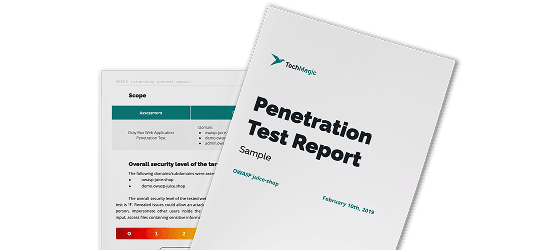
Test report

A report listing every vulnerability we find, classified by severity (critical, high, medium, low) and by its potential impact on your app and its users.

List item image
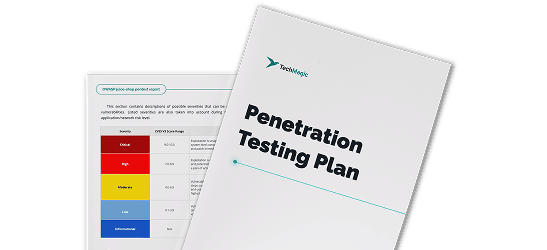
Remediation plan

Practical, prioritized guidance on how to fix each security-critical vulnerability, written for your developers.

List item image
Confirmation of testing (if needed)

A signed attestation letter confirming an independent mobile app penetration testing service was performed, which you can share with enterprise customers, auditors, and partners during procurement.

Benefits of TechMagic as a Reliable Mobile App Penetration Testers Team

CREST-accredited, with certified mobile specialists

TechMagic's penetration testing application services are CREST-accredited, and our engineers are certified specifically in mobile security, holding eMAPT (eLearnSecurity Mobile Application Penetration Tester) and Certified Mobile Pentester for Android. These are credentials that enterprise buyers and auditors know and trust.

Manual, SAST, DAST & runtime testing combined

We don't rely on a scanner to do the work. Every mobile application penetration testing engagement pairs static and dynamic analysis with manual, engineer-led testing and on-device runtime analysis for full coverage of your app's attack surface.

Developer background

At TechMagic, we build mobile software as well as test it, so we understand mobile architecture from the inside. That context lets us write clear, practical findings your developers can act on without guesswork.

OWASP MASTG & MASVS-aligned findings

Every finding maps to the OWASP mobile security standards, MASTG and MASVS. That keeps results consistent, verifiable, and straightforward for your team and your auditors to validate.

Remediation guidance and re-test

We don't stop at the report. Our security engineers work alongside your team to fix what we find, then re-test critical and high-severity vulnerabilities to confirm each one is fully closed.

Audit-ready reports

Reports are formatted as evidence for compliance audits and enterprise security reviews, meeting PCI DSS's pen testing requirement and supporting the regular testing expected under SOC 2, HIPAA, and ISO 27001, so one engagement covers multiple frameworks.

Let’s safeguard your project

Ross Kurhanskyi
Ross Kurhanskyi

VP of business development

linkedin-icon

Trusted by:

logo
logo
logo
logo

FAQ

cookie

We use cookies to personalize content and ads, to provide social media features and to analyze our traffic. Check our privacy policy to learn more about how we process your personal data.