
 Software Development
 Security Services
 Cloud Services
 AI Services
 Other Services















 TechMagic Academy


Top FinTech Startups in London and the UK to Watch in 2026
Last updated:30 June 2026



FinTech startups and scaleups are still on the rise. London remains one of the best places in the world to build one, and new companies keep emerging across the UK.
The UK is now home to more than 3,000 FinTech firms and dozens of unicorns. The FinTech sector has produced global names like Revolut and Monzo, with a deep bench of newer companies behind them in challenger banking and embedded finance, expanding access to banking products and services.
This guide highlights nine of the top FinTech startups in the UK and London to watch in 2026. Whether you want a FinTech app development company, a new place to work, or just a clearer view of the FinTech sector, it covers both new startups and fast-growing scaleups, in London and across the rest of the UK.
Each company is described with the same structure, so you can compare them on the same terms. Our guide to starting a FinTech company goes deeper on what it takes to build one.
Key takeaways
- The UK is home to more than 3,000 FinTech firms and raised approximately £7.97 billion in 2024, nearly half of all FinTech funding across EMEA.
- B2B infrastructure (banking-as-a-service, open-banking payments, savings platforms) is the dominant growth category in UK FinTech in 2026.
- Holding an FCA/PRA banking licence or building regulatory compliance into the core product has become a durable competitive advantage.
- AI is now embedded into core FinTech operations and the financial services industry, including fraud detection, financial data analysis, credit-risk scoring, and financial reporting.
- UK FinTech investment is concentrating around companies with verified traction, named investors, and confirmed regulatory standing.
- FinTech has expanded access to banking products and services.
Our Methodology
We have built financial products since 2014. Our software development teams ship across payments, lending, savings, investing, and banking infrastructure for founders, product teams, and their clients in the UK and beyond. Working inside payment flows, open banking, and FinTech security and regulatory reviews every day is what shapes the lens we bring to this list.
We spend our days inside the same problems these companies are solving. So we read their products like a practitioner, not like a directory. We know which claims are load-bearing, what a credible funding round looks like, and where an early-stage FinTech tends to strain as it scales.
To create this list of FinTech startups UK, we cross-checked each company against public sources: funding announcements and investor names, Companies House and regulatory records where relevant, and independent customer reviews (Trustpilot and app-store scores) for the consumer-facing products. We did not invent figures or fill gaps with estimates. Where a company is business-facing and has no clean public star rating, we describe its credibility through funding, backers, and disclosed traction instead.
## Top Financial Technology Startups in London and the UK: From Financial Markets to Everyday Bills
Two caveats are worth stating plainly. First, this is a "watch" list, not investment advice; inclusion is not an endorsement to buy, use, or invest. Second, early-stage metrics move fast, so every figure should be rechecked before you act on it.
Bondsmith
Bondsmith is a London savings-as-a-service company founded in 2021. Its "Bondsmith Savings Exchange" lets banks, wealth platforms, and advisers offer savings products, and lets savers spread money across multiple banks for better rates and protection.
Core Services:
- Bondsmith Savings Exchange, a deposit-aggregation platform
- Embedded savings products for banks, wealth platforms, and advisers
- A savings marketplace that spreads deposits across multiple banks
- Competitive-rate access for FSCS-conscious savers
Best suited for: Banks, wealth platforms, and advisers that want to add savings accounts without building the plumbing.
Strengths:
- Backed by FNZ, a major wealth-platform group, which doubles as a strategic distribution partner.
- Addresses a real need: FSCS-conscious savers spreading cash and chasing competitive rates in one place.
Weaknesses:
- B2B infrastructure with little consumer brand recognition.
- Company filings show total assets dipped in 2024, so growth has not been linear.
Funding & signals: Series A led by FNZ in 2024; roughly $14.3M raised to date; incorporated February 2021, status active (Tracxn).
Carmoola
Carmoola is a London consumer car-finance startup founded in 2021. Its app lets buyers get pre-approved for a budget, then pay for a car much like using a debit card, with finance managed entirely in-app.
Core Services:
- App-based car finance for UK consumers
- Instant pre-approval and budget setting
- In-app payment for a vehicle, used much like a debit card
- End-to-end finance management within the app
Best suited for: UK consumers who want fast, transparent car finance and easy access to a pre-approved budget without a dealership middleman.
Strengths:
- Strong funding capacity, including a £300M asset-backed facility with NatWest and Chenavari in 2024, taking total capacity past £450M.
- Excellent customer sentiment and a clear, single-product focus.
Weaknesses:
- Concentrated in one product and one market, exposing it to UK motor-finance regulation and interest-rate cycles.
- Its lending model depends on continued access to wholesale funding.
Rating: 4.9/5 from 3,800+ reviews on Trustpilot.
Griffin
Griffin is a London banking-as-a-service provider that became the UK's first full-stack BaaS platform to hold its own banking licence, after receiving full authorisation from the Prudential Regulation Authority (PRA) and Financial Conduct Authority (FCA) in 2024.
Core Services:
- Licensed bank accounts embedded into other products
- Client-money safeguarding accounts
- Savings products
- Payment processing under its own banking licence
Best suited for: FinTechs and platforms that need embedded accounts and safeguarding under a licensed bank.
Strengths:
- Holds its own full UK banking licence, which is rare and reduces reliance on third-party sponsor banks.
- Backed by established venture investors and built specifically for embedded finance.
Weaknesses:
- Early in commercial scaling after launching as a fully operational bank.
- Competes in a crowded BaaS market against larger, well-funded rivals.
Funding & signals: Full UK banking licence (PRA/FCA) in 2024; $24M raised alongside the launch, roughly $52M in total venture funding (FinTech Futures).
Lightyear
Lightyear is a London investing app founded in 2021 by two former Wise employees. It offers multi-currency access to thousands of stocks, ETFs, and money-market funds, with a focus on low fees and simple design.
Core Services:
- Multi-currency investment accounts
- Access to global financial markets, including thousands of stocks and ETFs
- Money-market funds
- Retail investing across roughly 25 countries
Best suited for: European retail investors who want low-cost, multi-currency investing and simple portfolio management in one app.
Strengths:
- Holds more than $1 billion in customer assets and operates across roughly 25 countries.
- Notable backers, including NordicNinja and high-profile angels from the European tech scene.
Weaknesses:
- Operates in a crowded retail-investing market against Trading 212, Revolut, and Robinhood.
- Revenue tied to interest on customer cash is sensitive to rate cuts.
Rating: 4.7/5 from 2,200+ reviews on Trustpilot.
LiveFlow
LiveFlow was founded in 2021 by former Revolut employees to automate financial reporting. It connects accounting platforms like QuickBooks and Xero to live dashboards and data analytics, and has expanded into reporting and financial planning and analysis (FP&A) tools for accounting firms.
Core Services:
- Live connections to QuickBooks and Xero
- Real-time financial data in dashboards and analytics
- Automated reports and forecasts
- Financial planning and analysis (FP&A) tooling
Best suited for: Accounting firms and finance teams that want automated reporting and analysis.
Strengths:
- Raised a $13.5M Series A in 2024 led by Valar Ventures, funding a move into FP&A and AI features.
- Clear product expansion with the launch of its LiveFlow Next platform.
Weaknesses:
- Now closer to accounting SaaS than consumer FinTech, competing with established FP&A tools.
- Relatively modest total funding (around $17M) for the market it is chasing.
Funding & signals: Series A of $13.5M in 2024 (Valar Ventures); roughly $17.1M raised in total (Crowdfund Insider).
NALA
NALA is a London-headquartered, Africa-focused FinTech. Its consumer app handles remittances into African markets, and its Rafiki platform, launched in 2024, provides B2B payment rails for businesses paying into and out of Africa.
Core Services:
- Consumer app for remittances into African markets
- Rafiki, a B2B payment platform for Africa
- Cross-border payment rails into and out of Africa
Best suited for: Diaspora customers who send money to Africa, and businesses needing reliable African payment rails.
Strengths:
- Raised a $40M Series A in 2024 led by Acrew Capital, with high-profile FinTech angels.
- Reports more than $1 billion moved, around 500,000 users, and strong revenue growth.
Weaknesses:
- Mixed Trustpilot reviews cite occasional transfer delays and slow support.
- Building proprietary payment rails is capital- and operations-intensive.
Rating: App ratings of 4.7/5 (App Store) and 4.8/5 (Google Play); Trustpilot around 3.5/5, which is more mixed (Trustpilot).
Sprive
Sprive is a London personal finance app that helps UK homeowners pay off their mortgages faster. It connects to a user's bank through open banking, sets aside affordable amounts by direct debit, and lets users earn cashback that goes toward overpayments.
Core Services:
- Automated mortgage overpayments via open banking
- Affordable set-asides collected by direct debit
- Retailer cashback applied toward the mortgage
Best suited for: UK homeowners who want to clear their mortgage faster without manual admin.
Strengths:
- Strong customer sentiment for ease of use and the cashback feature.
- A clear, single-purpose product with a tangible financial benefit.
Weaknesses:
- Narrow use case focused on mortgage overpayment.
- Smaller funding base (around £5.5M) and reliance on retailer-cashback partnerships and lender coverage.
Rating: 4.6/5 from 900+ reviews on Trustpilot.
Vitesse
Vitesse is a London treasury and payments platform built for the insurance industry. It helps insurers manage claims funds and make real-time global payouts, and it has been expanding into the US.
Core Services:
- Treasury management for insurers' claims funds
- Real-time global payouts
- Cross-border payments across 200+ countries and currencies
- Payments infrastructure for the Lloyd's market
Best suited for: Insurers and managing agents handling claims funds and cross-border payouts.
Strengths:
- Raised a $93M Series C in 2024 led by KKR to fund US expansion.
- Has processed more than $20 billion in payments across 200+ countries and currencies.
Weaknesses:
- A niche focus on insurance treasury, with long enterprise sales cycles.
- US expansion is still in its early stages.
Funding & signals: Series C of $93M in 2024, led by KKR (TechCrunch).
Volt
Volt is a UK-founded open-banking payments company enabling real-time, account-to-account payments for merchants. It operates across the UK, Europe, and Brazil, with expansion into the Asia-Pacific region.
Core Services:
- Real-time account-to-account (A2A) payment acceptance
- Open-banking connectivity for merchants
- Payment coverage across the UK, Europe, and Brazil
Best suited for: Merchants and payment providers that want A2A payment acceptance across multiple regions.
Strengths:
- Raised a $60M Series B in 2023 led by IVP at a reported valuation above $350M.
- International coverage across the UK, Europe, and Brazil, with further expansion underway.
Weaknesses:
- A2A payment adoption is still maturing relative to card networks.
- Competes in a busy open-banking payments market, and international expansion is capital-intensive.
Funding & signals: Series B of $60M in 2023 (IVP), reported valuation above $350M (TechCrunch).
What This List Says About the UK FinTech Industry in 2026
During the assesment we discover a few patterns that stand out across these companies.
Infrastructure is where a lot of the action is. Half of this list (Bondsmith, Griffin, LiveFlow, Vitesse, Volt) sells to other businesses, not consumers. Several of the top FinTech companies in the UK now sit in this infrastructure camp. UK FinTech in 2026 is increasingly about the rails: banking licences, savings exchanges, A2A payments, insurance treasury. Other FinTech companies, retail banks, and leading financial institutions all build on them.
Open banking has matured into a foundation. Sprive, Volt, and others now treat open-banking connectivity as a starting point, not a novelty. They use it to automate payments, overpayments, account data, and manual processes. Immediate payment settlement is now a baseline expectation for neobanks. These rails are increasingly integrated into other products.
Funding is more selective, but still substantial. UK FinTech investment was near £7.97 billion in 2024, so capital is available. But it is concentrating around companies with clear traction, regulatory standing, or strategic backers. Less of it is spread evenly across pre-seed ideas.
How FinTech Startups Use AI for Fraud Detection
AI models can detect fraudulent activities in near real-time by analysing vast amounts of transaction data. Most of these products run on APIs, mobile apps, and web services.
Regulation is a moat Griffin's banking licence and Vitesse's insurance focus show that the hardest-to-get approvals become durable advantages. In the UK, firms must comply with aggressive Financial Conduct Authority directives, and that compliance takes real resources. Early investment in compliance and risk management tends to pay off.
How to Evaluate Early-Stage FinTechs and Financial Institutions
Whether you are choosing a product, a workplace, or a partner, a few checks separate substance from hype. Public data and digital tools that track market trends offer valuable insights into a company's tech expertise and stability.
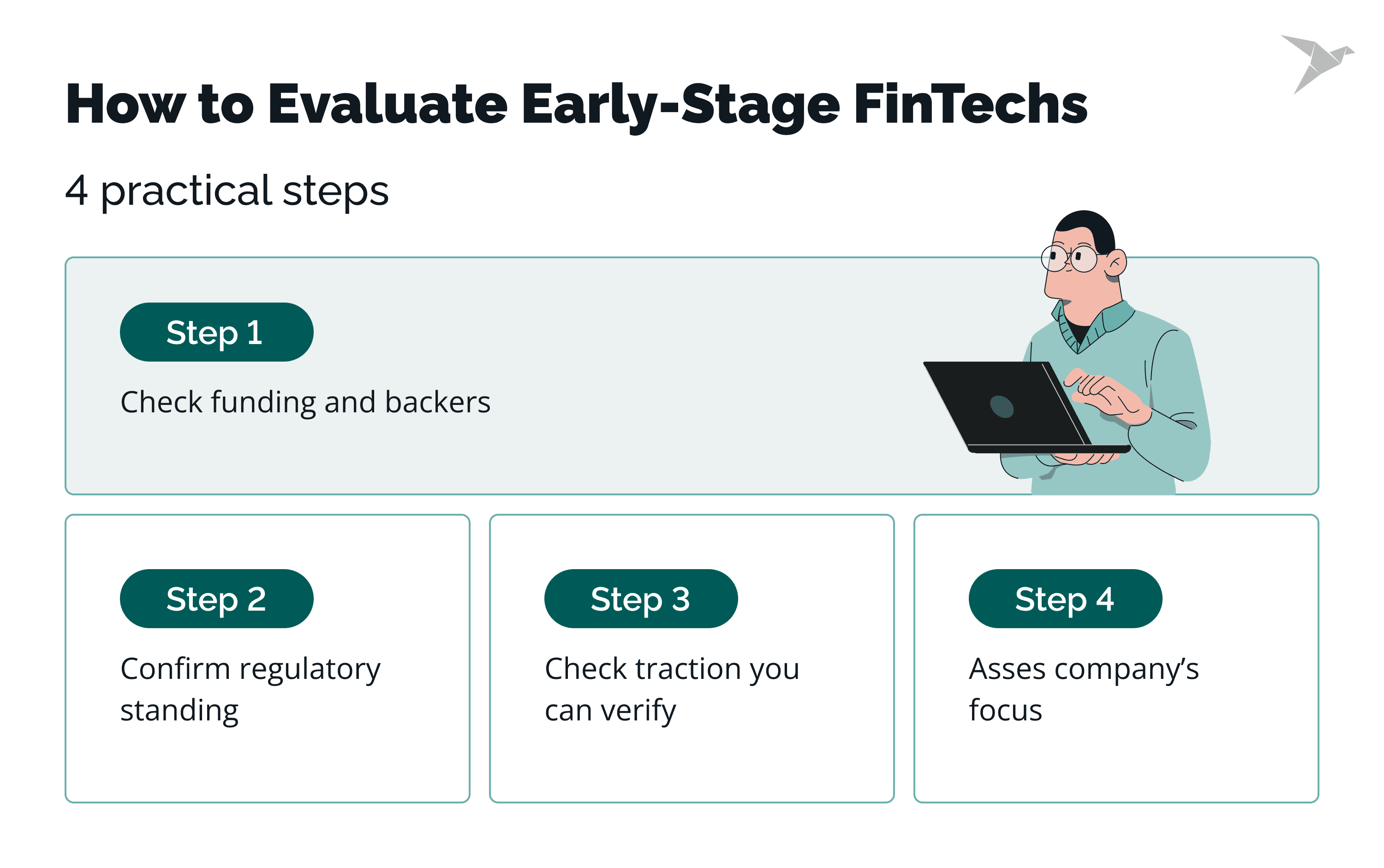
- Funding and backers. Look for disclosed rounds and named, credible investors, not vague "backed by top investors" claims. Strategic investors (like FNZ behind Bondsmith) can matter as much as the money.
- Regulatory standing. Confirm the company holds the licences or authorisations its model requires, and check the regulator's register rather than the company's own claims. (Our guide to FinTech regulation covers the main UK and EU frameworks.)
- Traction you can verify. Customer numbers, payment volumes, and independent review scores are more telling than press-release language.
- Focus. A clear product and market usually beats a sprawling mission statement at this stage.
Our Experience in Developing FinTech Startups

For many years we have been helping fintech firms realise their potential. We go beyond the standard application development service and provide expert and holistic assistance to ensure startups can exceed their goals.
Here at TechMagic we have an experienced team of diverse experts consisting of UI/UX designers, Backend and Frontend Engineers, Cloud Architects, Business Analysts and test automation experts that know how to turn an idea into a complete app. We specialise in helping small and medium businesses get the most out of their apps.
Recently, we have built fintech apps for Tide and Fractal Labs. With Tide, a financial software solution for SMEs, we used technologies, such as Swift, to build a modern and accessible app on mobile and QA platforms. Our expertise and flexible approach enabled Tide to roll out an app that is robust and ready to go. With Fractal Labs, now called tomato pay, we used a different approach and a smaller team to create a modern web application, utilising React, that enabled the startup to become an industry-leading financial intelligence platform.
a BPM app using JavaScript stack and Serverless on AWS

Final Thoughts: Where UK FinTech Goes Next
The era of rapid user acquisition in FinTech is shifting to a focus on profitability. The UK remains a leading global hub for FinTech, home to more than 3,000 firms.
Infrastructure keeps eating the spotlight. The most interesting bets here are not the prettiest apps. They are the rails underneath: Griffin's banking licence, Bondsmith's savings exchange, Volt's account-to-account payments. We expect the next generation of breakout UK FinTech companies to be picks-and-shovels plays. Existing FinTech software and new entrants will quietly build on them, rather than launch another online bank chasing current accounts.
AI moves from feature to foundation. Lightyear already leans on artificial intelligence for investing. LiveFlow uses AI technologies and data analytics for financial reporting. Over the next couple of years, expect AI to run the back office: fraud detection and fraud prevention, credit-risk scoring, and customer support through natural language processing. The best AI-driven FinTech startups treat it as core infrastructure, not a chatbot bolted on. Those are the ones that will pull ahead.
Regulation becomes the real moat. The FCA is tightening scrutiny on consumer credit, crypto and digital assets, and motor finance. Companies that invested early in licences and compliance, like Griffin or Vitesse, will find the hardest approvals are also the hardest for rivals to copy. We think "regulated by design" beats "move fast" as a selling point in 2026.
Our advice if you are tracking this space: treat lists like this as a snapshot. Funding rounds, regulatory registers, and recent reviews tell you more than any ranking. The wealth-management corner is moving fast too, so pair this with our roundup of top wealthtech companies to watch. And if a FinTech idea of your own is taking shape, that is exactly the work our FinTech team lives for. Building FinTech solutions like these takes experienced developers and steady innovation.
Learn about our expertise in the industry and what we have to offer

FAQ

A FinTech startup builds technology that delivers or improves a financial service, such as payments, lending, saving, investing, paying bills, expense management, personal financial management, or insurance, often working alongside established financial services firms. UK examples range from consumer apps like Carmoola (car finance) and Lightyear (investing) to business infrastructure like Griffin (banking-as-a-service) and Volt (account-to-account payments).
Notable UK and London FinTech startups and scaleups in 2026 include Carmoola, Lightyear, NALA, and Sprive on the consumer side, and Bondsmith, Griffin, LiveFlow, Vitesse, and Volt on the infrastructure side. This guide describes each one with the same structure, including its strengths and limitations.
A deep talent pool, proximity to capital and regulators, and supportive frameworks like open banking. UK FinTechs attracted close to £7.97 billion in investment in 2024, keeping London among the world’s leading hubs.
The consumer-facing ones (Carmoola, Lightyear, NALA, Sprive) are downloadable mobile applications. The others (Bondsmith, Griffin, LiveFlow, Vitesse, Volt) are mainly business-to-business infrastructure used inside other products.