















How Outsourcing Software Development in LatAm Will Boost Your Business
Last updated:23 February 2026



When you’re building a product, you often face constraints in time, budget, and team capacity. You need to scale faster, but hiring takes time. You want senior talent, but budgets have limits. Your team is doing their best, yet the backlog keeps growing, and the pressure doesn’t go away.
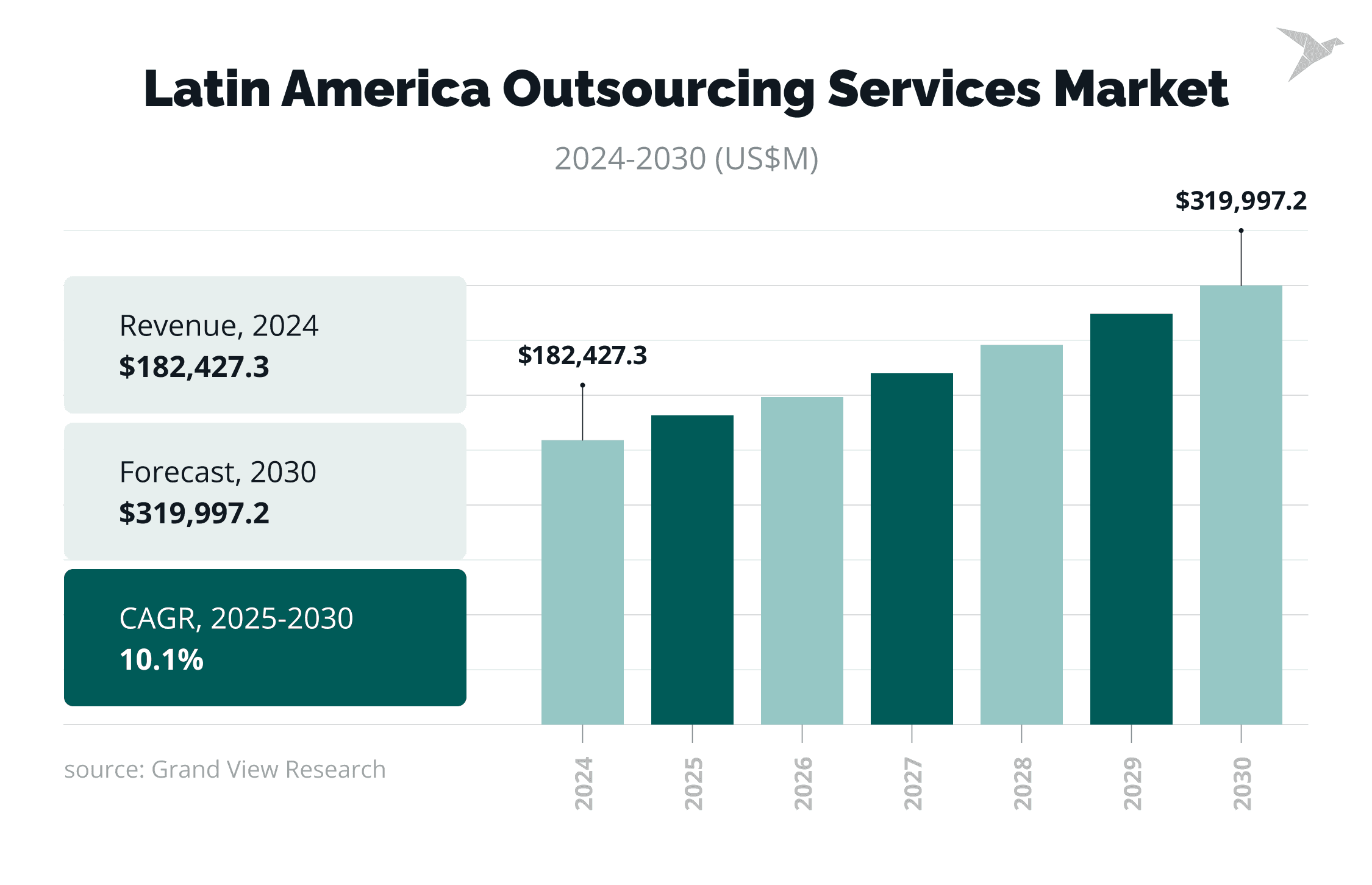
More and more US companies are solving this by expanding their delivery capacity through nearshore partners. In fact, the outsourcing services market in Latin America is projected to reach about $320 million by 2030, growing at around 10.1% CAGR, according to Grand View Research.
Latin America software outsourcing works well for many US companies for practical reasons. Time zones overlap. Collaboration is easier. Talent is strong across modern stacks. Costs are often more manageable than local hiring. At the same time, for many organizations, a hybrid mix of Europe and LatAm can also be an ideal setup because it balances deep expertise with cost efficiency and reduces the risk of reliance on a single region.
In this guide, we explain how software outsourcing Latin America delivers results, how it compares with other regions, which engagement models tend to have the most value, what risks to plan for, and how to start in 2-4 weeks with a clear first sprint. Let's start!
Key Takeaways
- Latin America nearshore outsourcing helps US companies increase delivery capacity without long hiring cycles or permanent headcount expansion.
- Time zone alignment with the US enables real-time collaboration, faster feedback loops, and smoother sprint execution.
- A hybrid Europe + LatAm team model balances cost efficiency with deeper technical expertise and lower regional risk.
- The right outsourcing model depends on your product stage, internal leadership strength, and roadmap horizon.
- Outsourcing delivers the fastest ROI when you target specific gaps, such as feature throughput, DevOps maturity, or QA automation.
- Strong governance, structured vetting, and clear KPIs make outsourcing a predictable extension of your internal team.
- Latin America offers a practical balance between cost, talent depth, and collaboration intensity compared to other global regions.
- A structured 2-4 week onboarding plan with a pilot sprint reduces risk and builds confidence before scaling.
What Is Outsourcing Software Development in Latin America?
Outsourcing software development to Latin America means partnering with engineering teams in Central and South America, including Mexico, Brazil, Colombia, Argentina, Chile, Peru, and Costa Rica, to extend or manage your product delivery.
Many of these markets have strong technical universities, growing developer communities, and solid English proficiency. For US-based companies, the key advantage of a nearshore model is time zone alignment. Most LatAm countries operate within one to three hours of US time zones, which makes daily stand-ups, sprint planning, and live collaboration practical and natural.
In simple terms, Latin America software development outsourcing gives you access to external engineers who work as part of your delivery engine, either under your leadership or through a structured vendor model.
Here are the key engagement formats in software outsourcing Latin America:
✅ Vendor-led delivery
A partner takes responsibility for a defined scope or product area. They provide engineering leadership, manage the team, and report on progress through agreed KPIs. This model reduces your management overhead but requires clear expectations and governance.
✅ Dedicated team model
You work with a stable group of engineers who focus exclusively on your product. The team becomes an extension of your company. You retain strategic control while the partner supports hiring, retention, and operations. This model works well for long-term roadmaps.
✅ Staff augmentation
You add individual engineers to your existing team to fill specific gaps. This is common in outsourcing software development LatAm when you need fast capacity without changing your internal structure. It gives you high control but requires strong internal leadership.
✅ A hybrid team of engineers from Europe and Latin America is also an increasingly effective variation. This setup balances cost efficiency with deep technical expertise. It reduces the risk of relying on a single region, widens the available talent pool, and still keeps collaboration within overlapping US hours. For many scaling companies, this blended approach offers more stability than hiring only in LatAm and more cost control than hiring only in Europe.
In practice, many mature organizations combine models over time. A company might start with augmentation, then move to a dedicated team once collaboration stabilizes.
Throughout this guide, we’ll explore how outsourcing Latin America software can support faster delivery, stronger governance, and predictable growth when structured correctly.

Why Can Outsourcing to LatAm Boost Your Business Outcomes?
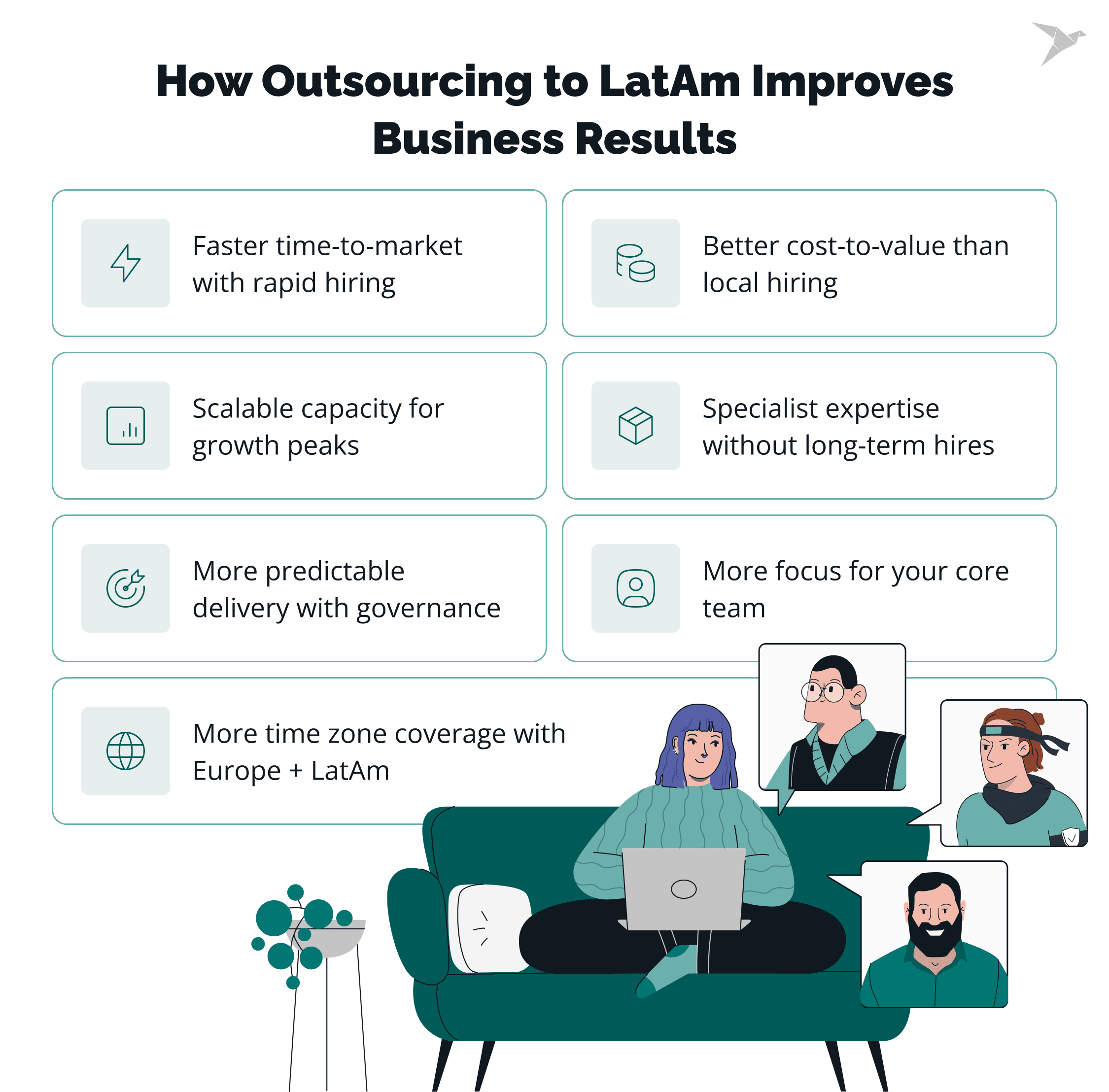
Outsourcing software development to LatAm can improve speed, cost efficiency, and delivery capacity when structured correctly. It works because it directly addresses hiring delays, budget pressure, and execution bottlenecks. Let’s look at the business impact in practical terms.
Faster time-to-market through accelerated hiring and delivery
One of the biggest gains in software outsourcing LatAm is hiring speed. Building a senior team locally can take months. Nearshore partners often provide vetted engineers within weeks. This shortens time to the first commit, first sprint, and first release. It also allows parallel development streams. Instead of waiting for one team to finish, you move multiple roadmap items forward at once. Faster releases mean earlier feedback and earlier revenue impact.
Improved cost-to-value ratio compared to local hiring
The goal is not the lowest hourly rate. The goal is stronger output for the budget you already have. When companies evaluate outsourcing software development Latin America, they often see a meaningful reduction in total employment cost while maintaining high engineering standards. The difference improves margin flexibility and frees budget for product investment.
Scalable delivery capacity for product growth and peak workloads
Roadmaps are not linear. Funding rounds, enterprise deals, or seasonal demand can suddenly increase pressure on delivery. With LatAm software development outsourcing, you can expand the team during peak periods and scale down when intensity drops. This protects your core team from burnout and avoids long-term headcount commitments that may not match future demand.
Stronger focus on strategic work for your core team
Your internal leaders should focus on architecture, product direction, and customer value. When senior engineers spend time on routine backlog items or maintenance, strategy slows down. When outsourcing software development to LatAm for execution-heavy tasks, you allow your in-house team to concentrate on high-impact work. This often improves decision speed and long-term product quality.
Higher delivery predictability with the right governance model
Predictability is often more important than speed. Missed deadlines damage trust with stakeholders and customers. A structured outsourcing setup introduces clear sprint planning, defined ownership, shared KPIs, and transparent reporting. With proper governance, software development outsourcing LatAm can improve release planning accuracy and reduce last-minute surprises.
Access to specialized expertise without long-term hiring commitments
Many companies need niche expertise, but not permanently. DevOps hardening. Cloud migration. Data engineering. Security audits. Through outsourcing Latin America software, you can engage experienced specialists for defined periods. This avoids expanding permanent headcount while still raising your technical maturity.
Greater time zone flexibility with a hybrid Europe + LatAm team model
A blended Europe + LatAm team extends your effective coverage window while keeping real-time collaboration with US stakeholders. LatAm provides nearshore alignment. Europe contributes deep technical specialization and additional daily coverage. This hybrid structure reduces dependence on a single hiring market and balances cost efficiency with senior expertise. For companies serious about outsourcing software development to Latin America, combining regions often can lead to more stable delivery and broader capability without losing control of communication.
Why Do Companies Choose LatAm Over Other Outsourcing Regions?
Companies choose LatAm because it offers a practical balance of collaboration speed, cost control, and engineering quality for US-based teams. It is not positioned as the cheapest region or the most specialized in every niche. It is chosen because it works well for day-to-day product delivery. Let’s look at how it compares to other common options, and why hybrid teams can be the best solution.
LatAm vs Eastern Europe: time zone overlap vs depth of niche expertise
Eastern Europe has a strong reputation for senior engineering talent, especially in complex backend systems, fintech, and security-heavy domains. The technical depth is real, and many experts bring years of experience with global enterprise products.
The challenge for US companies is time overlap. Most Eastern European teams share only part of the working day with US stakeholders. Sometimes, this can slow live collaboration, especially when fast iteration is required.
This is where a hybrid model can be especially effective. Combining Europe + LatAm allows companies to access deep technical expertise from Europe while maintaining strong time zone alignment through LatAm engineers. The result is a broader capability without sacrificing real-time collaboration. For many organizations, this blended setup delivers more stability and flexibility than choosing only one region.
LatAm vs India: real-time teamwork vs asynchronous delivery
India remains one of the largest global outsourcing markets. The scale is impressive, and many vendors operate mature delivery centers. But a common pitfall is the delivery setup itself. Large teams often run in highly standardized, process-heavy models that can feel less flexible for fast-moving product work. It can take longer to clarify edge cases, adjust scope mid-sprint, or iterate on UX and requirements without extra handoffs. Yes, pricing in India is often lower, but quality can be uneven, and the “savings” may disappear once rework and extra oversight kick in.
Outsourcing software development to LatAm or using a hybrid approach often supports a more integrated way of working. Teams tend to plug into your product rituals more naturally, stay closer to your decision-makers, and adapt faster when priorities shift. For products that change week to week, tighter integration can improve execution rhythm and reduce rework.
LatAm vs local US hiring: faster staffing and lower total cost of ownership
Local hiring offers full proximity and direct employment control. It also comes with higher salary levels and longer recruitment timelines. Median US software developer compensation is comparatively high, and the hiring process can take months.
With software development outsourcing Latin America, companies typically reduce hiring time and total employment cost while keeping close collaboration. The trade-off is the need for structured vendor governance. When managed well, the cost-to-value balance becomes attractive without compromising delivery standards.
Collaboration style and cultural compatibility with US teams
Strong collaboration depends on communication habits and work culture. Many LatAm engineers are experienced in agile delivery, daily stand-ups, and shared product ownership. English proficiency is generally solid in established tech hubs.
Because working hours overlap, meetings do not require unusual schedules. This creates a more natural rhythm for US stakeholders. As always, partner selection and vetting matter more than geography alone.
Cost bands across regions: how to compare beyond hourly rates
The hourly rate is only part of the equation. Real cost includes productivity, rework, communication delays, and management overhead.
Talent depth and specialization by region
India offers scale. Eastern Europe is often associated with deep system-level engineering and complex architecture. The US market provides strong product leadership experience.
LatAm continues to grow rapidly in full-stack engineering, cloud-native development, DevOps, and product-focused teams. Developer communities in Brazil, Mexico, Argentina, and Colombia are expanding, and many engineers work regularly with North American clients.
For most SaaS, platform, and enterprise products, the available talent pool in LatAm is strong enough to support both execution and long-term product evolution. When combined with European expertise in a hybrid model, capability coverage becomes even broader.
When LatAm is not the best option
LatAm may not be the right choice if your only priority is the absolute lowest hourly rate. It may also be less critical if your organization already operates fully asynchronously and does not require time overlap. For highly specialized research-driven domains, companies sometimes combine regions to widen expertise coverage.
For US teams that value daily collaboration, steady governance, and balanced cost control, Latin America software development outsourcing remains one of the most practical and reliable nearshore options available.
What Outsourcing Models in LatAm Bring the Most Business Value?
The outsourcing model you choose directly affects speed, cost efficiency, and management effort. There is no universal “best” option. The right model depends on your roadmap, internal leadership capacity, and risk tolerance. Let’s look at where each approach delivers the strongest return.
Staff augmentation for immediate capacity and fast execution
Staff augmentation works best when you already have strong internal product and engineering leadership. You simply need more hands to move faster.
Engineers join your existing team, follow your processes, and report into your structure. This model is common in outsourcing software development LatAm when companies want to remove delivery bottlenecks without changing governance.
Business impact:
- Fast onboarding
- Direct control over priorities
- Quick backlog reduction
Management effort remains moderate because your leaders must guide the work. ROI appears quickly when execution speed is the primary constraint.
Dedicated team for continuous product development
A dedicated team is ideal for long-term roadmap execution. You work with a stable group of engineers who focus exclusively on your product.
In Latin America software outsourcing, this model creates stronger retention and deeper domain knowledge over time. Governance becomes shared. Your company sets direction. The partner supports hiring, HR, and operational stability.
Business impact:
- Predictable sprint velocity
- Lower turnover risk
- Stronger ownership of product areas
This model requires structured collaboration but reduces daily recruitment pressure and improves long-term delivery consistency.
Project-based outsourcing for defined scope and fixed timelines
Project-based engagement fits well for clearly scoped initiatives such as MVP builds, legacy migrations, or feature modules with defined requirements.
In this setup, the vendor takes responsibility for a specific outcome within an agreed timeline and budget. Internal involvement is lower compared to augmentation.
Business impact:
- Clear cost predictability
- Reduced internal coordination
- Faster execution for isolated initiatives
This model depends heavily on well-defined requirements. If scope changes frequently, flexibility decreases.
Hybrid team model combining Europe and LatAm for balanced risk and expertise
A hybrid team combines engineers from Latin America and Europe under one coordinated structure. This approach balances cost efficiency with deep technical specialization.
For companies evaluating LatAm software outsourcing, this model reduces dependence on a single region. LatAm engineers provide strong nearshore collaboration with US stakeholders. European engineers add niche expertise and extended daily coverage.
Business impact:
- Broader technical capability
- Risk diversification across regions
- Stable time zone alignment with the US
Management effort is moderate but predictable when governance is unified. For many scaling organizations, this structure delivers stronger long-term resilience than relying on only one geography.
Which Roles Should You Outsource First To See ROI Faster?
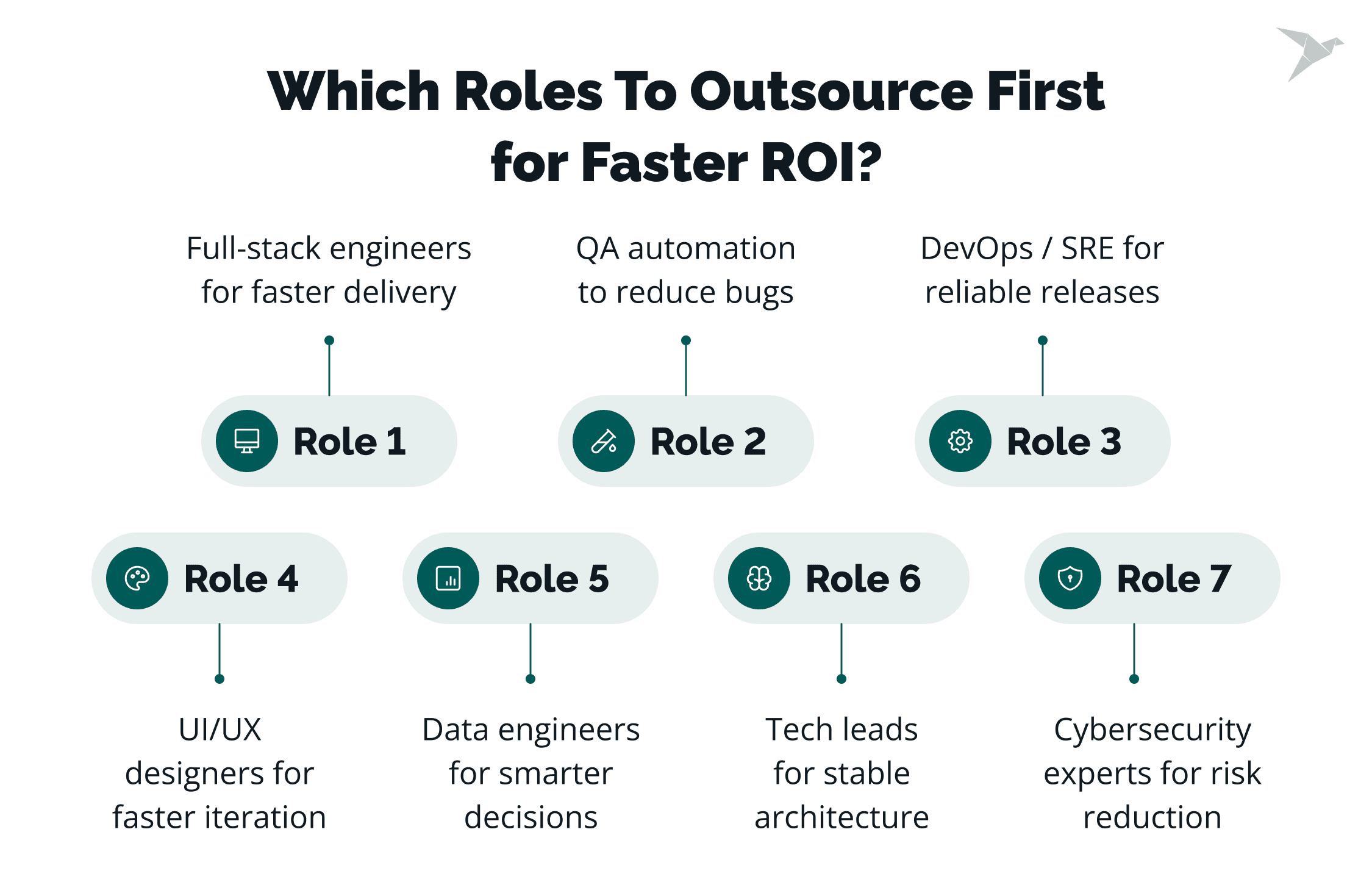
The fastest return usually comes from outsourcing roles that remove your biggest delivery bottleneck. When you match the right role to the right constraint, you improve speed, reduce risk, and free up internal leadership. Let’s look at where most companies see measurable impact first.
Full-stack engineers to increase feature throughput
If your roadmap is slowing down, start here. Full-stack engineers directly increase feature output and reduce backlog pressure. In many cases, outsourcing software development to LatAm begins with adding execution capacity.
When senior internal engineers no longer need to cover routine feature work, delivery speed improves quickly. More tickets move to done. Release cycles tighten. Product progress becomes steadier. This role delivers visible ROI when execution, not strategy, is the main constraint.
If you’re still deciding where outsourcing will create the fastest measurable impact, it helps to align early role selection with a clear outsourced product development strategy from the start.
QA automation engineers to reduce release risk and rework
Bugs and regression cycles quietly drain engineering capacity. Manual testing slows releases and increases last-minute stress. Adding QA automation specialists through Latin America software outsourcing helps build stable regression suites and continuous testing pipelines. This reduces production issues and lowers rework costs. The result is fewer emergency fixes and more predictable release quality. Internal engineers spend less time firefighting and more time building.
DevOps or SRE specialists to accelerate deployments and improve reliability
Infrastructure gaps often limit growth. Slow deployments, unstable environments, or unclear monitoring reduce confidence in every release. DevOps or SRE specialists improve CI/CD pipelines, automate infrastructure, and strengthen system reliability.
In outsourcing software development Latin America engagements, this role often leads to faster and safer deployments. When release confidence increases, product teams move faster. That translates into shorter lead time and stronger operational stability.
Data engineers to enable analytics and decision-making
Many companies collect data but struggle to make it usable. Product decisions then rely on guesswork instead of metrics. Data engineers design pipelines, improve data quality, and enable reporting or AI initiatives.
Through software development outsourcing LatAm, companies can engage data specialists without committing to permanent headcount. Better data improves prioritization. Better prioritization improves ROI across the roadmap.
UI/UX designers to speed iteration and reduce costly rework
Poorly validated designs lead to expensive changes after development begins. That slows delivery and frustrates engineers. UI/UX specialists help test concepts earlier, clarify flows, and reduce ambiguity before code is written.
In outsourcing Latin America software teams, adding design capacity often shortens feedback loops and lowers development waste. When user experience improves early, engineering effort becomes more focused and efficient.
Technical leads or solution architects to stabilize complex delivery
As products grow, architecture becomes more complex. Without strong technical leadership, organizations accumulate technical debt and inconsistency. A technical lead or solution architect stabilizes system design, defines standards, and aligns distributed teams. This is especially valuable in larger Latin America software development outsourcing structures where multiple squads collaborate. The ROI appears in fewer refactors, stronger scalability, and smoother cross-team coordination.
Cybersecurity specialists to protect product integrity and ensure compliance
Security risks are expensive. Breaches damage trust, trigger regulatory consequences, and consume leadership attention. This matters even more in regulated products, where healthcare software development outsourcing requires strict access control, secure SDLC practices, and a partner who understands compliance expectations.
Cybersecurity specialists strengthen secure SDLC practices, harden cloud environments, and support compliance readiness for standards such as HIPAA, SOC 2, or ISO 27001. Engaging this expertise through outsourcing software development to LatAm allows companies to improve security posture without building a full internal security department.
What Are the Risks of Outsourcing to LatAm and How Do You Mitigate Them?
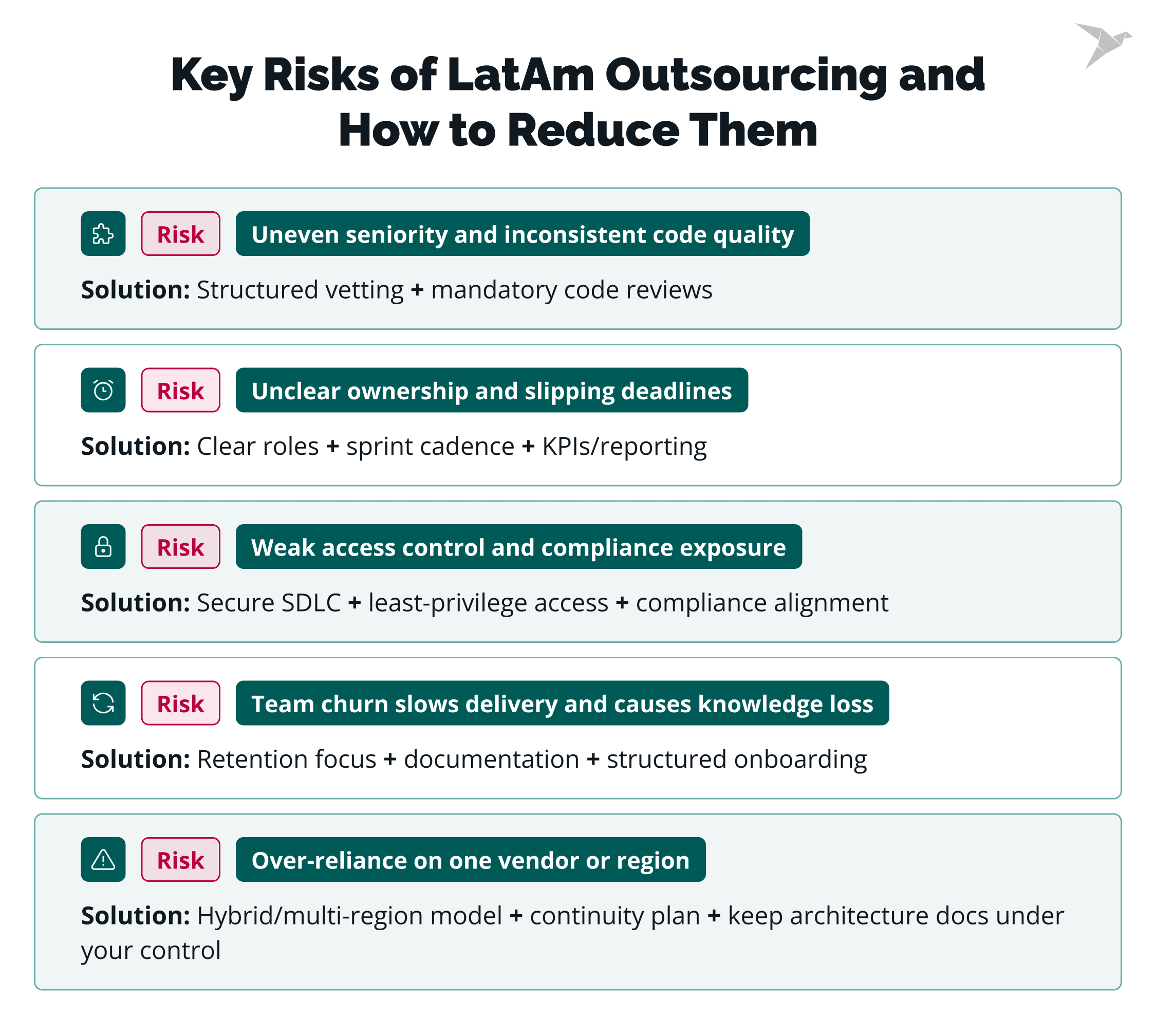
The main possible risks of outsourcing to LatAm are quality inconsistency, delivery slippage, security exposure, team turnover, and over-dependence on a single vendor or region. The good news is that each of these risks is manageable with clear controls and early validation. Let’s go through what to watch for and how to reduce risk in practice.
Quality inconsistency due to weak vetting processes
Risk: If hiring standards are unclear or superficial, seniority levels may be overstated and code quality may vary across engineers.
Solution: Work with partners that use structured technical interviews, live coding sessions, architecture reviews, and peer-based evaluation. Coding standards and mandatory code reviews should be documented and enforced. Ask to review anonymized scorecards or sample repositories. In mature Latin America software outsourcing engagements, engineering leadership is directly involved in technical validation.
What to verify:
- Transparent hiring pipeline
- Clear seniority criteria
- Documented code review process
Delivery delays caused by unclear ownership and governance
Risk: Projects slow down when roles are undefined, and accountability is blurred. Without a clear sprint cadence and reporting, deadlines slip quietly.
Solution: Define ownership from the start. Assign a product owner, tech lead, and delivery manager. Establish sprint rituals, track measurable KPIs such as velocity and lead time, and maintain transparent reporting dashboards. In software development outsourcing LatAm partnerships, structured governance is often the difference between predictable growth and frustration.
What to verify:
- Documented delivery framework
- Clear escalation path
- Regular reporting cadence with visible metrics
Security and compliance exposure in distributed environments
Risk: Distributed access to code and infrastructure increases exposure if security controls are weak.
Solution: Implement secure SDLC practices, enforce least-privilege access, and require NDA and IP agreements. Align with relevant compliance frameworks such as SOC 2, ISO 27001, or HIPAA when needed. In outsourcing Latin America software engagements, security maturity should be documented through written policies.
What to verify:
- Formal security policies
- Access control and credential management process
- Audit readiness documentation
Team continuity and knowledge loss due to turnover
Risk: High turnover disrupts velocity and creates recurring onboarding cycles that slow delivery.
Solution: Choose vendors with strong retention programs and stable engineering culture. Require standardized documentation, shared knowledge bases, and structured onboarding playbooks. In Latin America software development outsourcing, average team tenure is an important indicator of long-term stability.
What to verify:
- Average engineer tenure
- Onboarding and knowledge transfer process
- Documentation standards
Over-dependence on a single region or vendor
Risk: Relying on one geography exposes your delivery engine to regional market shifts or talent shortages.
Solution: Adopt a hybrid or multi-region model when appropriate. Combining Europe and LatAm reduces geographic concentration risk while preserving US time zone alignment. This approach strengthens resilience in outsourcing software development to Latin America by widening expertise coverage and creating built-in redundancy.
What to verify:
- Multi-region scaling options
- Business continuity planning
- Clear architectural documentation under your control
Risks in Latin America software outsourcing are manageable when approached with discipline. Clear governance, technical validation, and regional diversification help address potential concerns and create structured advantages.
What Is a Practical Step-by-Step Plan to Start Outsourcing in LatAm?
You can start outsourcing in LatAm within 2 to 4 weeks if you follow a structured plan: define your goals, identify bottlenecks, choose the right model, validate the partner, and begin with a controlled pilot sprint. Here is a practical sequence you can follow.
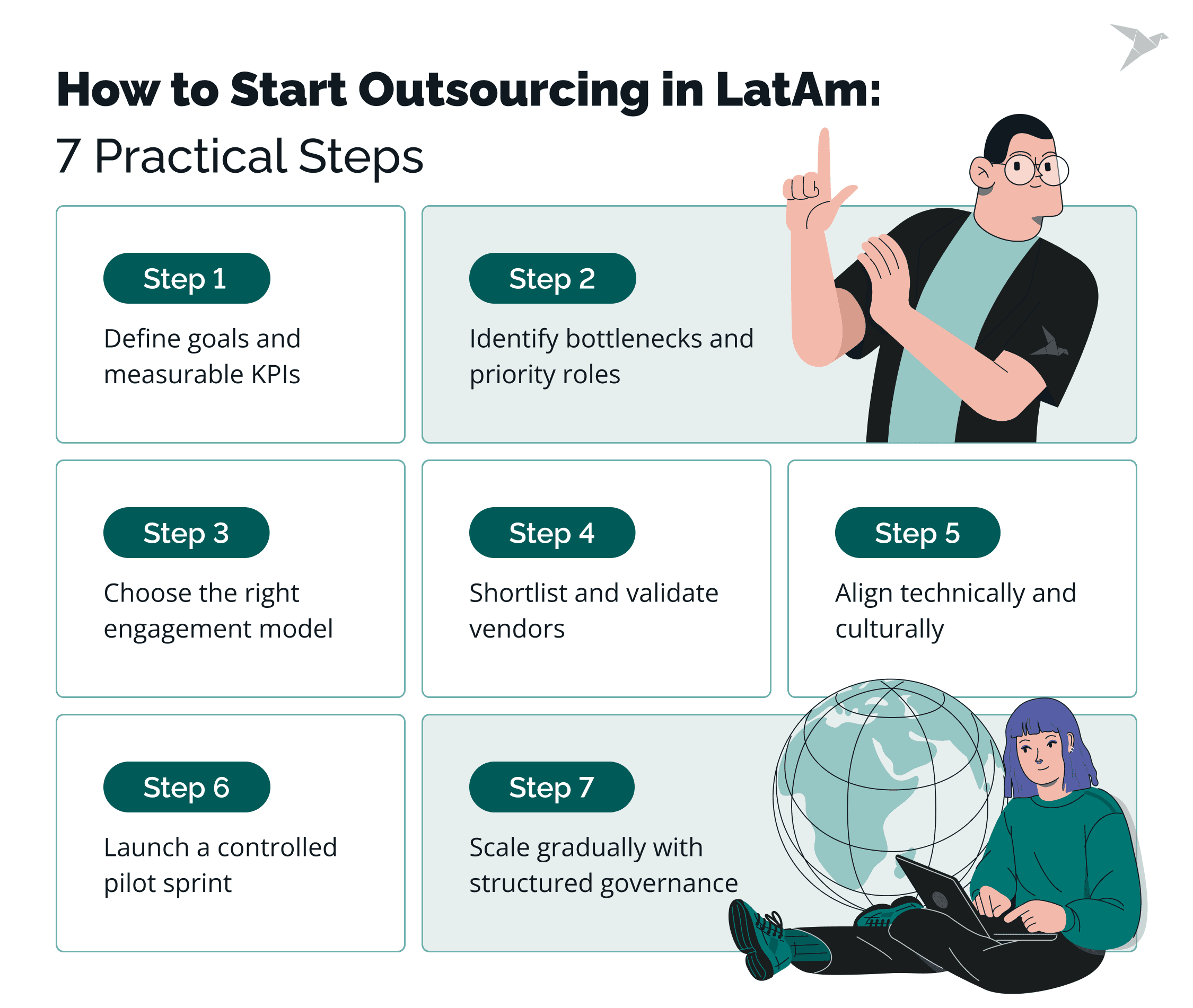
Step 1: Define business goals and success metrics
Start with clarity. Why are you considering outsourcing software development to LatAm? Speed. Cost control. Access to specific expertise. Capacity for growth.
Define measurable KPIs before engaging any vendor. Examples include:
- Sprint velocity increase
- Reduction in release cycle time
- Cost per feature delivered
- Defect rate or production incidents
Without clear metrics, it is difficult to evaluate whether Latin America software outsourcing is delivering real value.
Step 2: Identify delivery bottlenecks and prioritize roles
Look at your current roadmap. Where is work slowing down? Is it feature execution, infrastructure, testing, architecture, or security?
Match the role to the constraint. If feature delivery is slow, add full-stack engineers. If releases are unstable, add QA automation or DevOps. In outsourcing software development Latin America, ROI appears fastest when you target the real constraint. This step prevents over-hiring and keeps expansion focused.
Step 3: Choose the right engagement model
Select the model that matches your management capacity and roadmap horizon.
- Staff augmentation if you have strong internal leadership and need speed.
- Dedicated team for long-term product evolution.
- Project-based engagement for defined scope.
- Hybrid Europe and LatAm model if you want balanced expertise and risk diversification.
The wrong model increases friction. The right one reduces coordination effort and improves predictability in software development outsourcing LatAm partnerships.
Step 4: Shortlist vendors and validate technical maturity
Do not evaluate vendors based only on rate. Assess how they hire, how they manage sprints, and how they handle security.
Request:
- Description of technical screening process
- Sample sprint reporting dashboards
- Security policy summary
- Client references
In mature Latin America software development outsourcing engagements, governance documentation should be readily available.
Step 5: Conduct technical and cultural alignment interviews
Interview engineers directly. Evaluate not only coding ability but communication clarity and ownership mindset.
Confirm:
- Seniority level
- English proficiency
- Experience with similar tech stacks
- Comfort with agile rituals
Cultural alignment reduces friction more than most companies expect. Strong collaboration habits are essential in outsourcing Latin America software setups.
Step 6: Launch a pilot sprint with clear evaluation criteria
Begin with a limited 2 to 3 week sprint. Avoid scaling immediately.
Define success criteria before the sprint starts. For example:
This pilot phase gives you real data on performance before committing to expansion.
Step 7: Scale gradually with structured governance and reporting
If the pilot meets expectations, scale in phases. Increase team size incrementally while maintaining documentation standards, reporting cadence, and architectural oversight.
Formalize:
- KPI dashboard reviews
- Monthly performance checkpoints
- Clear expansion plan
- Cross-team documentation practices
Gradual scaling reduces risk and strengthens stability in outsourcing software development Latin America partnerships.
Ready to Build Your Nearshore Team in LatAm?
Outsourcing is a big decision. You’re trusting someone with your roadmap, your quality bar, and often your reputation. It makes sense to be careful, especially if you have been burned before or you simply can’t afford surprises.
At TechMagic, we help US companies scale delivery with strong engineers in Latin America, supported by clear governance, reliable communication, and security-first practices. When it’s the right fit, we also build hybrid teams that combine LatAm talent with senior European experts. That gives you time zone alignment, deeper technical coverage, and less risk than relying on one region alone.
If you want to explore what this could look like for your product, you can hire software developers in Latin America and talk through team structure, timelines, and the best starting point.

Summing Up: Why Latin America Is Becoming a Strategic Nearshore Choice
Outsourcing software development to Latin America works best when it’s approached as a structured business decision. With the right model, clear governance, and smart role choices, it helps you ship faster, protect quality, and scale capacity without overloading your core team.
The market is moving in this direction. Grand View Research projects the outsourcing services market in Latin America will reach about $320 million by 2030, growing at roughly 10 percent annually. And US developer costs remain high. Those two realities are pushing more US teams to treat nearshore as a long-term strategy.
Three near-term shifts are likely:
- More hybrid teams combining Latin America and Europe to balance expertise, cost, and resilience
- Higher expectations for security, compliance, and measurable governance
- Tighter integration between nearshore teams and in-house product leadership
When you set it up with discipline, LatAm becomes a reliable way to build and grow without losing control.
FAQ

Outsourcing software development in LatAm boosts growth by increasing delivery capacity without long hiring cycles or permanent headcount expansion. It helps you release features faster, respond to market feedback sooner, and protect your internal team from overload. It also supports digital transformation initiatives by giving companies access to skilled engineers working with emerging technologies, including cloud-native architecture and machine learning. When structured well, it improves speed and cost control at the same time.
Yes. TechMagic works with talented developers across Latin America, including South and Central America, operating within a fast-growing IT sector and tech industry. We can also pair them with senior European engineers, which gives you stronger technical depth, stable delivery, and lower regional hiring risk. We combine strong engineering standards with Western business practices, which helps US companies collaborate smoothly. Our teams bring experience across various programming languages and modern stacks, backed by a proven track record of delivering complex software solutions.
Yes. In fact, a hybrid LatAm + Europe team is often the most effective setup for scaling companies. It combines nearshore collaboration and cost efficiency from Latin America with deeper specialized expertise from Europe, reduces regional dependency risk, and creates a more stable and resilient delivery structure than relying on a single location. This approach helps companies reduce development costs without compromising quality. It also enables delivery based on cutting-edge technologies and cutting-edge solutions, depending on your product needs.
The biggest benefits are a highly skilled workforce and engineers, time zone alignment, and cost effectiveness. Nearshore collaboration enables real-time communication with US teams, improving iteration speed and reducing delays. Many tech companies also value cultural compatibility and the growth of technical expertise across the region. As a result, Latin America has become an attractive outsourcing destination for companies that need both collaboration speed and engineering quality. Latin America is also known for innovative solutions that support industries worldwide, especially in fast-scaling product teams.
In most cases, you can start within 2 to 4 weeks. The timeline depends on role complexity and vetting requirements. A structured onboarding process and a short pilot sprint help you validate performance before scaling the team. The exact pace also depends on the local IT market and role availability in specific countries.
It depends on your goals and internal capacity. Staff augmentation works best when you need immediate execution support under your leadership. A dedicated team suits long-term product development. Project-based outsourcing fits clearly defined initiatives with a stable scope. Some companies combine models or adopt a hybrid structure for broader coverage. The best choice usually comes down to your roadmap horizon and the maturity of your tech landscape.
LatAm outsourcing costs are typically lower than US local hiring when you factor in salary, benefits, recruitment, and retention expenses. At the same time, rates are often higher than in some offshore regions. Many companies find that the balance between cost, productivity, and real-time collaboration makes Latin America a strong nearshore option for custom software development services. From a budgeting perspective, many companies compare regions through total value in the broader IT industry rather than just hourly rates.