
 Software Development
 Security Services
 Cloud Services
 AI Services
 Other Services















 TechMagic Academy


DevSecOps Best Practices: How to Secure CI/CD Pipelines Step-by-Step + Checklist
Last updated:13 January 2026


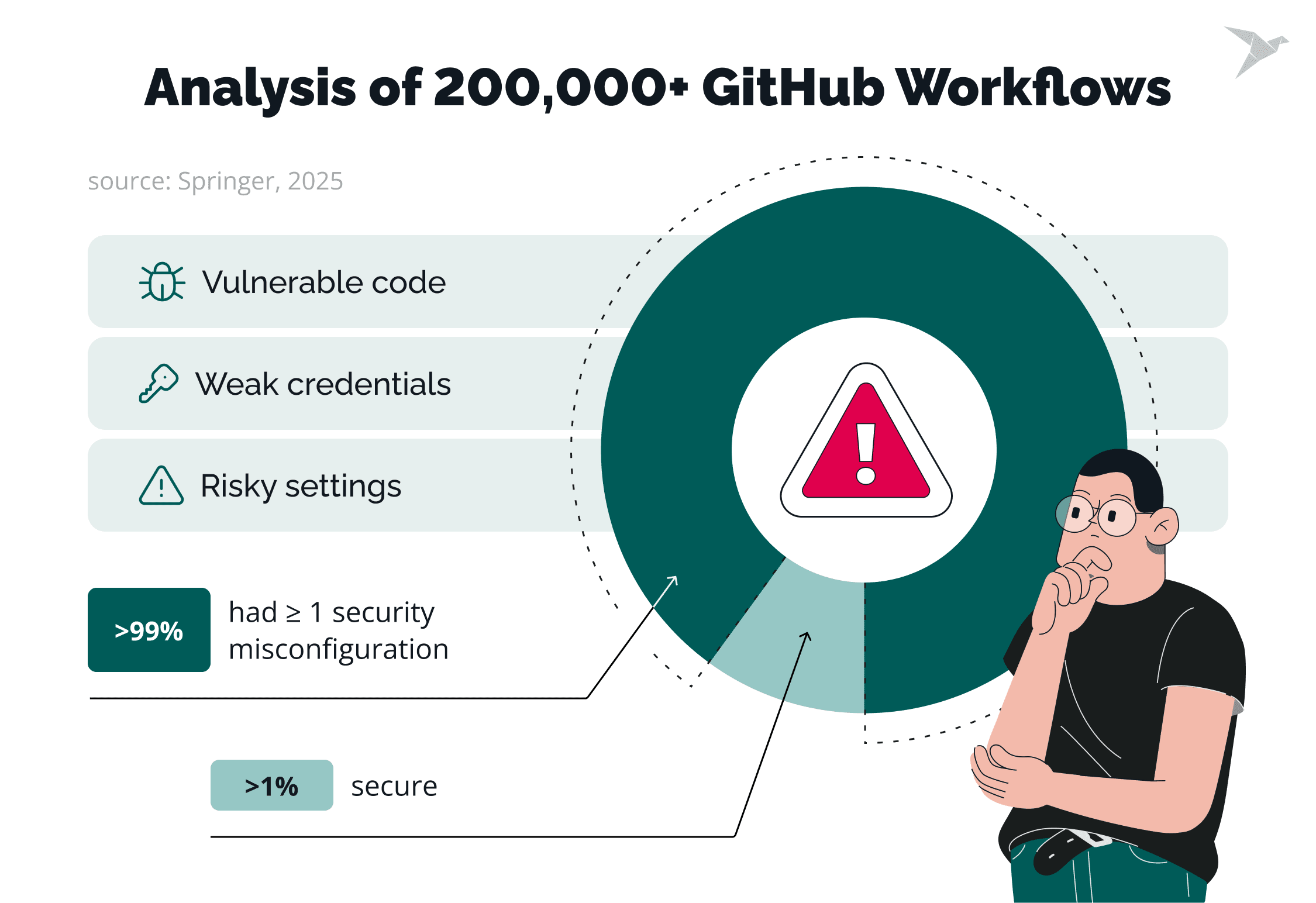
In a large-scale analysis of over 200,000 GitHub workflows published by Springer in 2025, researchers found that more than 99% contained at least one security misconfiguration. This explains why CI/CD pipelines are among the most attractive targets for attacks and supply chain compromises.
If you’re here, chances are your CI/CD pipeline moves fast, which increases exposure. The rise of AI-assisted “vibe coding” further accelerates this pace and increases the volume of changes entering delivery workflows. Pipelines now hold production credentials, automatically deploy code, and pull in third-party components at scale. A single weak link can cause a serious security incident during a routine build.
You’re not overthinking it. The tension between velocity and safety is familiar to many teams: fast delivery and effective CI/CD security don’t always align. The solution is a deliberate DevSecOps approach built into the pipeline itself.
This article is a practical guide to DevSecOps best practices for real CI/CD environments. We’ll walk through how to build security into your pipeline step by step, where teams usually get it wrong, and how to fix it in a way that fits your day-to-day engineering. By the end, you’ll have a clear path forward and a detailed CI/CD security checklist you can act on. Let’s start!
Key Takeaways
- CI/CD pipelines are a high-value target for attackers. With 99% of pipelines containing at least one misconfiguration, CI/CD security now matters as much as application and infrastructure security.
- DevSecOps builds security into the delivery process from the start. Embedding security into everyday workflows keeps pipelines fast and reduces late-stage failures and rollbacks.
- Early security checks save time and effort later on. Catching issues in pull requests and CI helps teams avoid release blockers and expensive rework near production.
- Identity, access, and secrets are the most common weak points. Least privilege, short-lived credentials, and centralized secrets management dramatically reduce blast radius.
- Pipelines themselves must be treated as production infrastructure. Securing runners, hardening Infrastructure as Code, and protecting pipeline configurations help close attack paths.
- Visibility and ownership determine how well teams respond to incidents. With centralized logging, monitoring, and defined responsibilities, security events become manageable incidents rather than uncontrolled disruptions.
- Strong CI/CD security is an ongoing practice. Companies that regularly review and refine their pipelines are better prepared to keep up as tools, teams, and threats change.
- TechMagic helps teams secure CI/CD pipelines end-to-end. Our engineers assess pipelines, close security gaps, and support secure delivery as systems grow.
What Is DevSecOps and Why Is It Important for CI/CD Pipelines?
DevSecOps is the practice of building security directly into how software is designed, built, tested, and deployed without slowing delivery.
In CI/CD pipelines, it means security checks run continuously and are largely automated, side by side with development and operations.
Put simply, DevSecOps shifts security from a late-stage review to an everyday part of delivery. Instead of waiting for a security team to “check” releases, engineers design pipelines where code changes, dependencies, infrastructure, and deployments are evaluated as they move forward.
Why does this matter so much for CI/CD? Because pipelines ≠ just delivery tooling. They hold cloud credentials, signing keys, deployment permissions, and access to production. When pipelines move fast, but security lags behind, teams either ship risk or slow everything down with manual gates. DevSecOps addresses this through security controls built directly into the pipeline, without sacrificing speed or trust.
Security as an afterthought vs. Security embedded in CI/CD pipelines
CI/CD makes delivery continuous by design. DevSecOps makes security continuous too. Here’s what changes when security moves from “later” to “built in”:
For modern delivery pipelines, DevSecOps for CI/CD security is the most scalable approach to keep automation safe as systems grow and release cycles accelerate. If you’re aligning delivery speed with stronger security controls, our breakdown of DevSecOps vs DevOps clarifies where the approaches diverge and why that gap matters in CI/CD.
Next, we’ll get specific and look at the core best practices for securing CI/CD pipelines.
What Are the Core Best Practices for Securing CI/CD Pipelines?
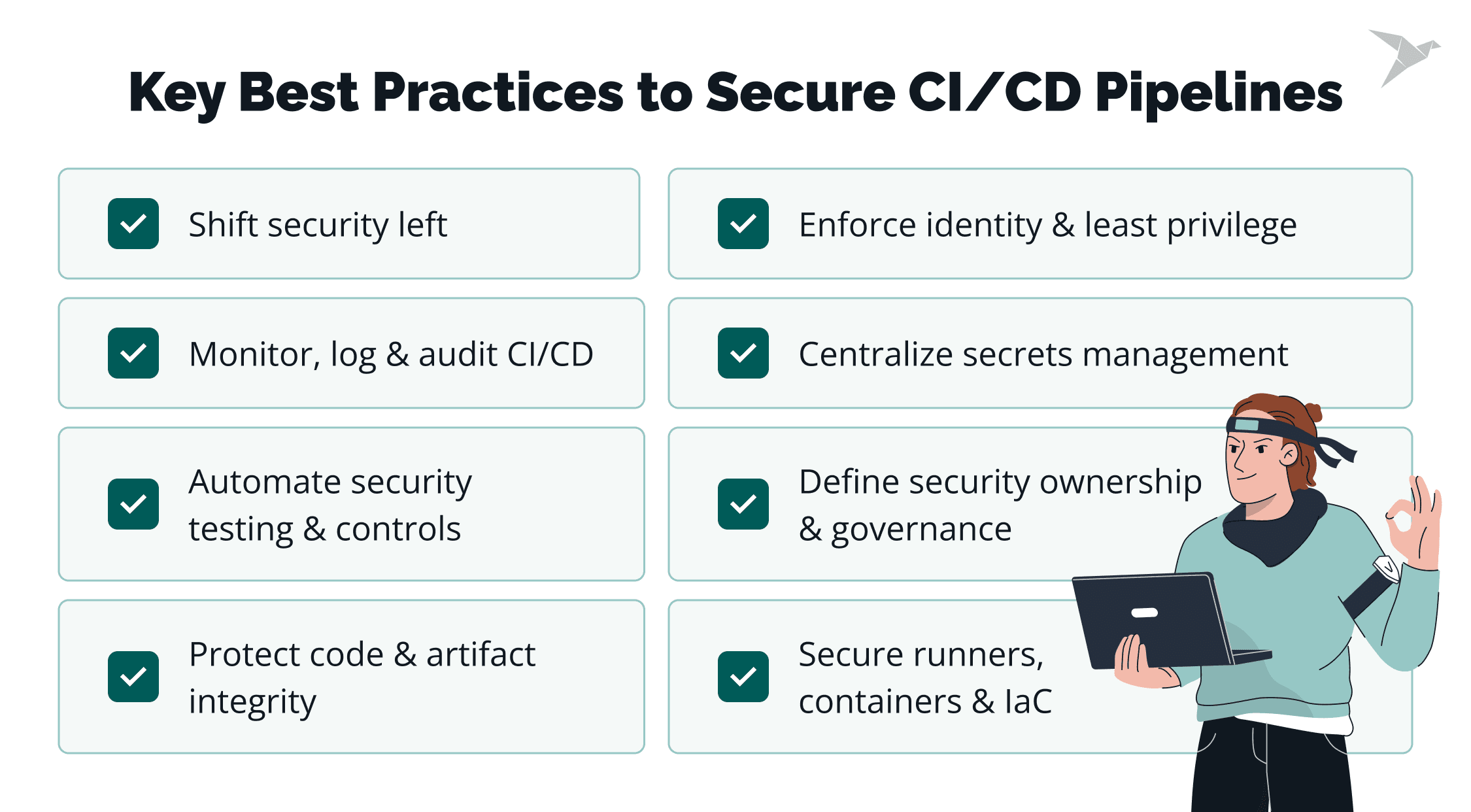
The core best practices for securing CI/CD pipelines focus on embedding security into daily workflows, controlling access and secrets, hardening pipeline infrastructure, and enforcing automated guardrails end-to-end. These practices reduce risk without slowing delivery. Now let’s explore what that looks like in real CI/CD environments.
Shift security left in CI/CD workflows
Security works best when it starts before code ever reaches the pipeline. That means not waiting for CI or staging to catch issues, but baking security checks into pull requests, mandatory code reviews, and version control. Early checks flag risky patterns, insecure dependencies, or misconfigurations while changes are still easy to fix. This is the foundation of implementing security in CI/CD pipelines without friction.
The key advantage: issues are cheaper to fix early and less likely to block releases later.
Enforce strong identity, access, and least-privilege controls
CI/CD systems are powerful, and that power must be tightly controlled. Limit who can modify pipelines, approve releases, and access production credentials. Use role-based access control, short-lived tokens, and clear separation of duties between developers, pipeline admins, and release owners. Least privilege reduces blast radius when something goes wrong. Datadog reported that about 37% of companies still use long-lived cloud IAM credentials in GitHub Actions workflows, which increases the risk of credential theft and reuse.
The key advantage: compromised credentials don’t automatically lead to full pipeline or production access.
Secure CI/CD infrastructure, containers, and Infrastructure as Code
Runners, build agents, container images, and IaC definitions are all part of your attack surface. Harden runners, isolate untrusted builds, and treat pipeline infrastructure as production-grade systems. Scan container images and IaC templates early so insecure base images or cloud misconfigurations never make it to deployment.
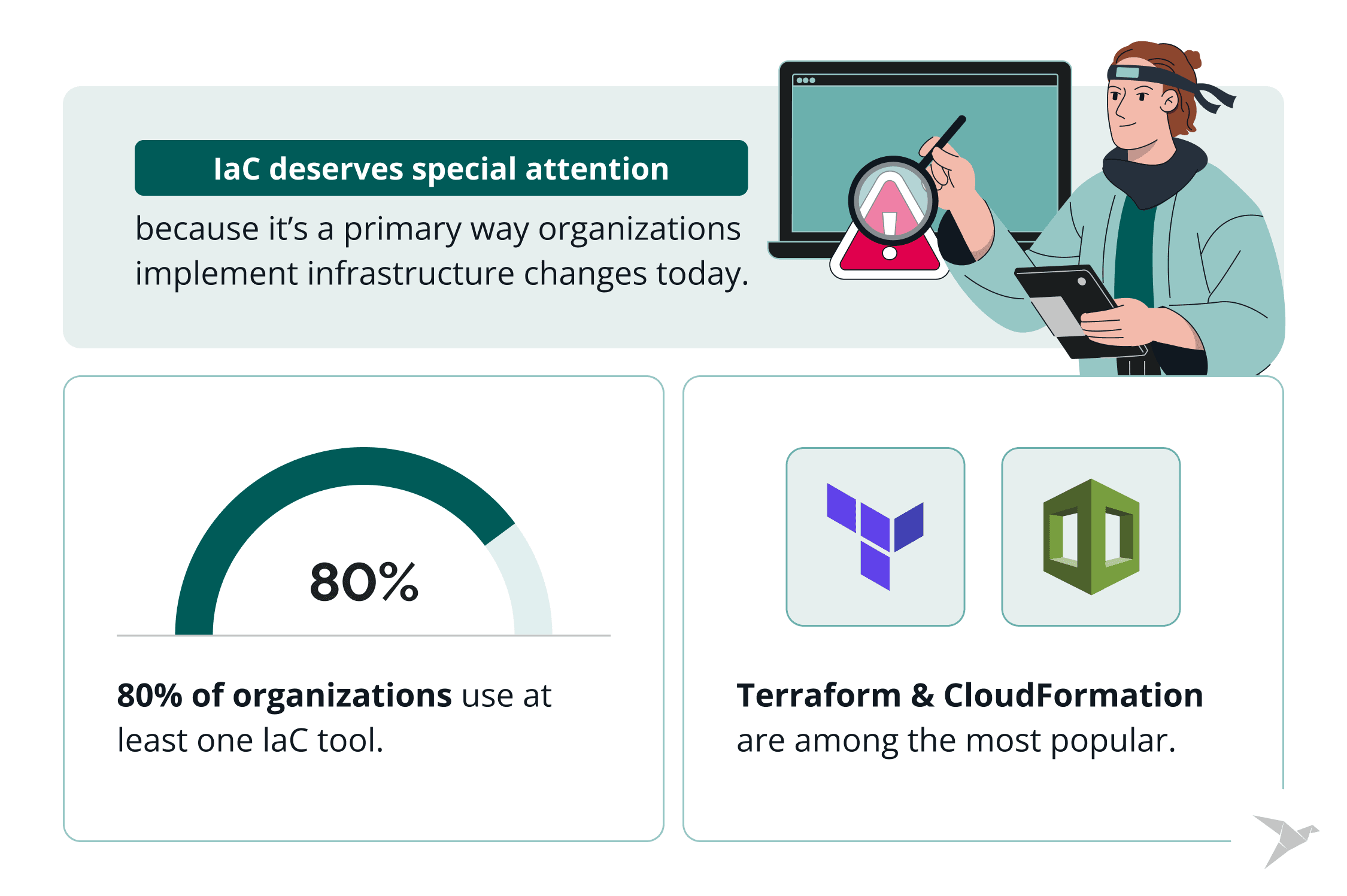
IaC deserves special attention because it now drives most infrastructure changes. According to Datadog, 80% of organizations use at least one IaC tool, and in AWS environments, Terraform (59%) and CloudFormation (57%) are widespread. That’s why IaC scanning is one of the highest-leverage ways to reduce deployment misconfigurations.
The key advantage: addresses attack paths that target CI/CD infrastructure rather than application code.
Implement centralized secrets management
Hardcoded secrets are one of the fastest ways to lose control of a pipeline. Store credentials in a centralized secrets manager, inject them only at runtime, and rotate them regularly. Keep secrets out of code, logs, and pipeline definitions. This single practice reduces a large class of CI/CD security breaches.
The key advantage: leaked secrets become isolated incidents rather than a systemic risk.
Automate security controls and testing within the pipeline
Manual security reviews are still essential, especially for high-risk or complex changes. But they don’t scale on their own in fast CI/CD workflows. Automated checks, run consistently on every change, are what make CI/CD pipeline security with DevSecOps sustainable. Define clear policies, run security tests automatically, and fail builds when risk thresholds are exceeded. Automation keeps standards high without adding delays.
The key advantage: security standards stay consistent without slowing delivery.
Ensure code, dependency, and artifact integrity
Pipelines pull in code and dependencies from many sources. Protect that chain. Validate commits, control dependency sources, generate SBOMs, and ensure build artifacts can’t be altered after creation. Integrity controls are essential for defending against supply chain attacks and unauthorized changes.
The key advantage: reduced risk of supply chain attacks and silent tampering.
Enable continuous monitoring, logging, and auditing of CI/CD activities
You can’t protect what you can’t see. Log pipeline executions, permission changes, secret access, and deployments. Monitor for unusual behavior, such as unexpected runner activity or changes to protected branches. Some teams also add deception controls, like canary tokens or decoy credentials, to trigger high-signal alerts if someone probes the pipeline or attempts to exfiltrate secrets. Visibility supports faster incident response and makes audits far less painful.
The key advantage: suspicious activity is detected early, not after damage is done.
Define clear DevSecOps security ownership and governance
Security breaks down when “everyone” owns it and no one really does. Define who is responsible for CI/CD security decisions, exceptions, and reviews. Security champions, shared ownership models, and lightweight governance keep pipelines safe without blocking teams. This balance is central to DevSecOps for secure CI/CD.
The key advantage: security decisions are clear, consistent, and don’t stall delivery.

Common CI/CD Security Gaps (and What DevSecOps Fixes): Quick Look
CI/CD can be configured extremely well for speed and reliability. But without security built into the workflow, the same automation can amplify common risks: broad access, secrets sprawl, limited visibility, and late vulnerability discovery. Here are the most common CI/CD security gaps and what DevSecOps practices do to solve them:
These security best practices form the basis of any effort to protect CI/CD pipelines at scale. Next, we’ll look at how to apply them across the development, testing, and deployment stages step by step.
How to Integrate Security into the Development, Testing, and Deployment Stages of CI/CD?
You can integrate security into CI/CD if you place the right controls at each stage: development, CI, testing, and deployment. This way, risks are caught early and enforced automatically before anything reaches production. This is how to secure CI/CD with DevSecOps without slowing delivery. Let’s walk through each stage and what “good” looks like in practice.
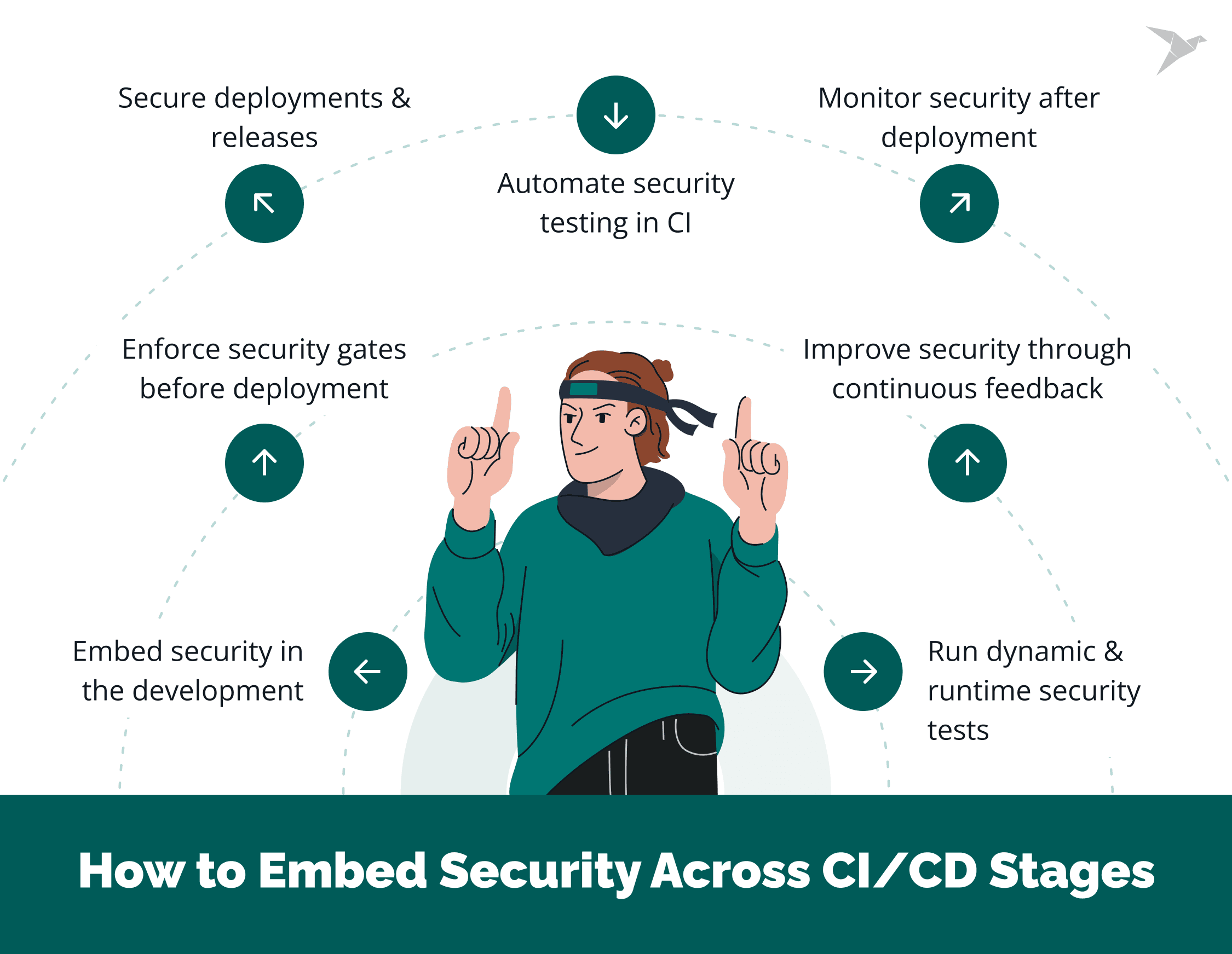
Embed security controls in the development stage
Security should start where changes begin: with developers. That means using secure coding practices, dependency hygiene, and lightweight checks before code ever enters CI. Pre-commit hooks, dependency pinning, and security-aware code reviews identify risks early, when fixes are fast and low-friction.
What this enables: fewer security failures downstream and less rework late in the pipeline.
Integrate automated security testing into the CI stage
CI is where security becomes consistent. Static analysis, dependency scanning, and Infrastructure as Code checks should run automatically on every build. Results need to be fast, repeatable, and tied to clear policies, so teams know what fails a build and why. This is the backbone of CI/CD security with DevSecOps.
The practical impact: security checks scale with automation instead of relying solely on manual reviews.
Apply dynamic and runtime security testing during the testing stage
Some issues only show up when the software is running. Dynamic application security testing, API security checks, and container security validation belong in test environments that closely resemble production. These tests surface misconfigurations, authorization flaws, and runtime behavior that static application security testing can’t see. If you want a structured way to validate these risks beyond automated pipeline scans, a focused vulnerability assessment can help identify exploitable issues in realistic environments.
The risk it reduces: security vulnerabilities that slip through CI and surface after release.
Enforce security gates and policy checks before deployment
Before anything ships, security decisions must be enforced, not debated. Risk-based gates block releases that exceed defined thresholds, such as critical vulnerabilities or forbidden configurations. The goal isn’t perfection, but consistency and clarity.
Why teams rely on this: releases stay predictable, and security stops being subjective.
Secure the deployment and release process
Deployment pipelines deserve the same protection as production systems. Use dedicated credentials, validate signed artifacts, restrict who can deploy, and protect environments with approval rules where needed. Accidental or unauthorized releases are as damaging as malicious ones.
What this protects: production access and the trustworthiness of every release.
Monitor and validate security post-deployment
Security doesn’t stop at deployment. Monitor logs, configuration changes, and runtime signals to confirm that what was released behaves as expected. Post-deployment validation helps teams catch drift, misconfigurations, or suspicious activity early.
The operational impact: faster detection and cleaner incident response.
Continuously improve security through feedback loops across pipeline stages
Findings from testing, monitoring, and incidents should feed back into development and CI. Over time, this tight loop strengthens controls where they matter most and removes noise where they don’t. This is how DevSecOps for CI/CD security matures beyond one-off fixes.
Why this pays off: security improves continuously instead of resetting with every release.
To see how controls typically map across stages, here’s a simplified view:
With these controls in place, teams move from reactive fixes to predictable, automated protection. Next, we’ll look at the most common challenges teams face when securing CI/CD pipelines and how to overcome them.
What Are the Common Challenges in Securing CI/CD Pipelines and How to Overcome Them?
Securing CI/CD pipelines is rarely blocked by a lack of tools or knowledge. The real challenges come from day-to-day engineering pressure, growing system complexity, the rapid adoption of AI-assisted coding, and unclear decision-making. These issues are common, predictable, and solvable when addressed deliberately. Let’s walk through them one by one.
Balancing pipeline security with delivery speed
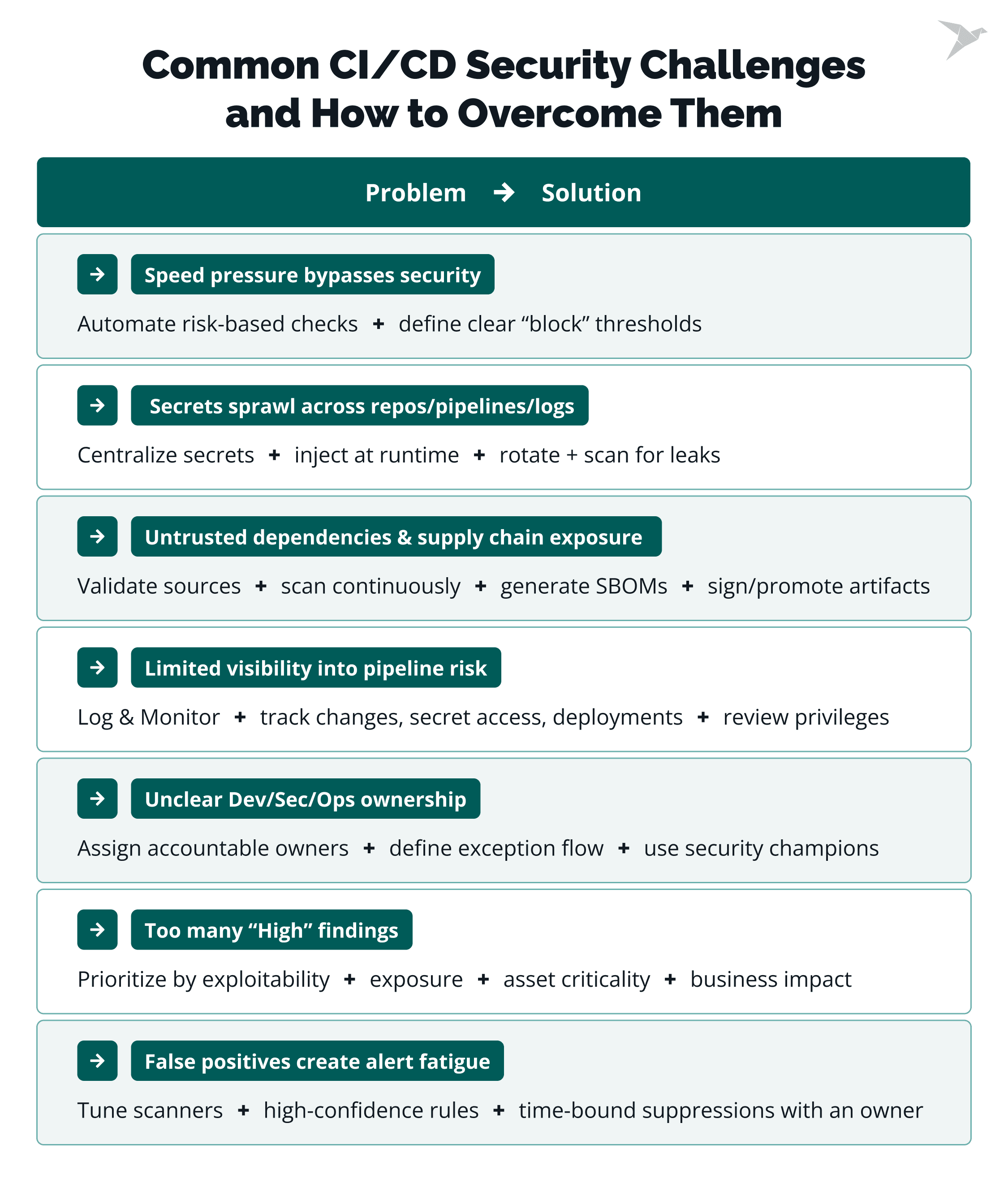
The problem: Teams are under constant pressure to ship. When security checks slow down builds or block releases, they’re often bypassed, weakened, or postponed. Entirely manual approvals become bottlenecks, and security starts to be something that competes with delivery instead of supporting it.
The solution: Where possible, replace manual controls with automated, risk-based enforcement. Define clear thresholds for what must block a release (for example, critical vulnerabilities or forbidden configurations) and enforce them consistently through the pipeline. When releases are frequent, teams can tailor enforcement by risk level: require full controls for High and Critical changes, and apply lighter gates for Low and Medium changes, with deeper review only on demand. Lower-risk findings should surface early in pull requests or CI, where developers can fix them without derailing releases. This makes security predictable and preserves speed because decisions are made before pressure peaks.
Managing secrets sprawl across CI/CD systems
The problem: Secrets tend to spread quietly. A token added to fix a failing job, a credential reused across environments, a variable copied between pipelines. Over time, secrets live in repositories, CI configs, logs, and scripts, with no clear ownership or rotation, including values like API keys that may get reused far longer than intended.
The solution: Centralize secrets in a dedicated secrets management system and inject them only at runtime. Scope credentials per environment, rotate them regularly, and audit access. In addition, enforce secret detection in pre-commit or CI checks so code changes can’t be merged if scanners detect hardcoded credentials (for example, TruffleHog or GitLeaks). Remove hardcoded secrets entirely. This brings order back to credential handling and ensures that a single leaked secret doesn’t cascade into a broader pipeline or production compromise.
Securing third-party dependencies and the software supply chain
The problem: CI/CD pipelines depend heavily on third-party code, such as libraries, container images, plugins, and actions. Most teams trust these components implicitly because tracking and validating them feels overwhelming, especially at scale.
The solution: Narrow the trust boundary. Validate dependency sources, continuously scan for known risks, and generate SBOMs to understand what’s actually in each build. Ensure artifacts are built once, signed, and promoted across environments rather than rebuilt. This creates a verifiable chain from source code repositories to deployment and reduces exposure to supply chain attacks, including attempts to inject malicious code via compromised dependencies.
Gaining visibility into CI/CD pipeline security risks
The problem: When pipelines grow organically, visibility often lags behind. Teams struggle to answer basic questions: who changed a pipeline, which credentials were used, or why a release behaved differently. Investigations become guesswork.
The solution: Centralize logging and monitoring for pipeline executions, access changes, secret usage, and deployments. Focus on high-signal events rather than raw volume. Review CI/CD privileges regularly to catch access drift and ensure only the right roles can modify pipelines or access sensitive credentials. With consistent visibility, teams can identify vulnerabilities and anomalies earlier, investigate incidents faster, and support audits without scrambling for data.
Defining clear ownership in shared DevSecOps environments
The problem: CI/CD security sits between Dev, Sec, and Ops. Without clear ownership, decisions stall, exceptions pile up, and security gaps persist because everyone assumes someone else is responsible.
The solution: Define ownership explicitly. Assign responsibility for pipeline security standards, exception approvals, and incident response. Introduce security champions within delivery teams and keep governance lightweight but visible. Clear ownership doesn’t slow teams down, but removes ambiguity and keeps security decisions moving.
Prioritizing security findings when everything looks “High”
The problem: Security tools often surface dozens of High-severity findings across code, dependencies, and infrastructure. When teams face constant delivery pressure, large backlogs don’t get reduced, but get ignored. The result is a “high severity fatigue” effect, where genuinely critical risks compete with noisy or low-impact findings.
The solution: Use a risk prioritization matrix that doesn’t rely on scanner severity alone. Factor in exploitability, exposure, asset criticality, and business impact, and agree on what truly needs to block releases. This helps teams focus on the fixes that reduce real risk instead of generating an endless backlog of “urgent” tasks.
Managing false positives and alert fatigue from security scanners
The problem: Security scanners can generate high volumes of findings, including false positives. When developers repeatedly investigate low-signal alerts, they lose trust in the tooling and start ignoring results, which defeats the purpose of automation.
The solution: Tune scanners to your environment. Start with high-confidence rules, calibrate thresholds by repo and risk level, and treat suppression as a controlled exception (with an owner and an expiration date). Over time, this reduces noise, improves the signal, and helps security automation remain effective rather than become background clutter.
These challenges are part of nearly every organization working toward DevSecOps for CI/CD security. Teams that address them make their delivery process more stable, predictable, and easier to operate. Next, we’ll look at the essential tools that support secure CI/CD pipelines and how they fit into these solutions.
What Are the Essential Tools for Securing CI/CD Pipelines?
The essential tools for securing CI/CD pipelines are those that automate security checks, provide visibility across the pipeline, and enforce policies from code changes through deployment. Rather than stacking tools, the goal is to cover the most critical risk areas so security runs continuously and predictably. Now, let’s explore how mature teams approach tooling for CI/CD pipeline security with DevSecOps.
Source code and dependency security tools
These tools focus on what enters the pipeline first: code and third-party dependencies. Static analysis helps catch insecure patterns early, while dependency scanning identifies vulnerable or risky libraries before they become release blockers. Used correctly, these tools integrate into PRs and CI jobs to provide fast, actionable feedback developers can act on immediately.
Examples: Semgrep, CodeQL, SonarQube, Checkmarx (SAST); Snyk, OWASP Dependency-Check, Dependabot, Renovate (SCA).
Key value: issues are found when fixes are fast and inexpensive.
Container and artifact security tools
Once code is built, containers and artifacts become the unit of delivery, but also a common attack target. Scanning tools analyze images and artifacts for known vulnerabilities, misconfigurations, and policy violations before they’re promoted or deployed. This ensures what gets released matches security expectations, not just functional ones.
Examples: Trivy, Grype, Anchore, Clair (container/image scanning).
Key value: prevents insecure or tampered builds from reaching production.
Infrastructure as Code (IaC) security tools
IaC security tools review cloud and platform configurations defined in code. They flag risky settings such as overly permissive access, exposed services, or missing encryption. When integrated early, these tools stop insecure infrastructure before it ever exists.
Examples: Checkov, tfsec, Terrascan (Terraform/CloudFormation/Kubernetes policy checks).
Key value: eliminates entire classes of cloud misconfigurations by design.
Secrets management and credential security tools
Secrets management tools securely store credentials, inject them at runtime, rotate them automatically, and log access. This removes the need for hardcoded secrets in repositories or CI configurations and limits how far a leaked credential can be used.
Examples: GitLeaks, TruffleHog, GitGuardian (secret scanning); Vault or cloud-native secrets managers for storage and rotation.
Key value: drastically reduces the blast radius of credential exposure.
CI/CD pipeline security and policy enforcement tools
These tools secure the pipeline itself. They validate pipeline configurations, enforce security policies, and apply risk-based gates before deployment. Rules are defined once and enforced consistently, regardless of who triggers a release.
Examples: Open Policy Agent (OPA), Conftest, GitHub/GitLab CI security controls, Sigstore policy validation patterns.
Key value: keeps release decisions consistent and removes human guesswork.
Monitoring, logging, and audit tools for CI/CD
Monitoring and audit tools collect signals from pipeline runs, access changes, secret usage, and deployments. They provide the context teams need to detect anomalies, investigate incidents, and meet audit requirements without scrambling for data.
Examples: AWS Security Hub, Prowler, ScoutSuite (cloud posture + visibility); plus SIEM/log aggregation for pipeline/audit trails.
Key value: faster detection and clearer accountability when something goes wrong.
CI/CD Security Tooling Matrix: What Each Tool Protects
To make tooling decisions easier, here’s a quick matrix showing what each tool category protects, where it fits in the CI/CD lifecycle, and how it typically impacts builds or releases.
Used together, these tools support DevSecOps for CI/CD security by making protection continuous, automated, and measurable. Next, we’ll bring everything together with a step-by-step CI/CD security checklist you can use to assess and improve your pipeline.
DevSecOps Checklist for Securing CI/CD Pipelines
A DevSecOps checklist for securing CI/CD pipelines covers the essential steps for protecting source control, identities and secrets, build infrastructure, pipeline configuration, artifact integrity, deployments, and post-release monitoring. It provides concrete, verifiable actions that teams can assess and improve over time.
Let’s walk through each step and what “secure by design” looks like in practice.
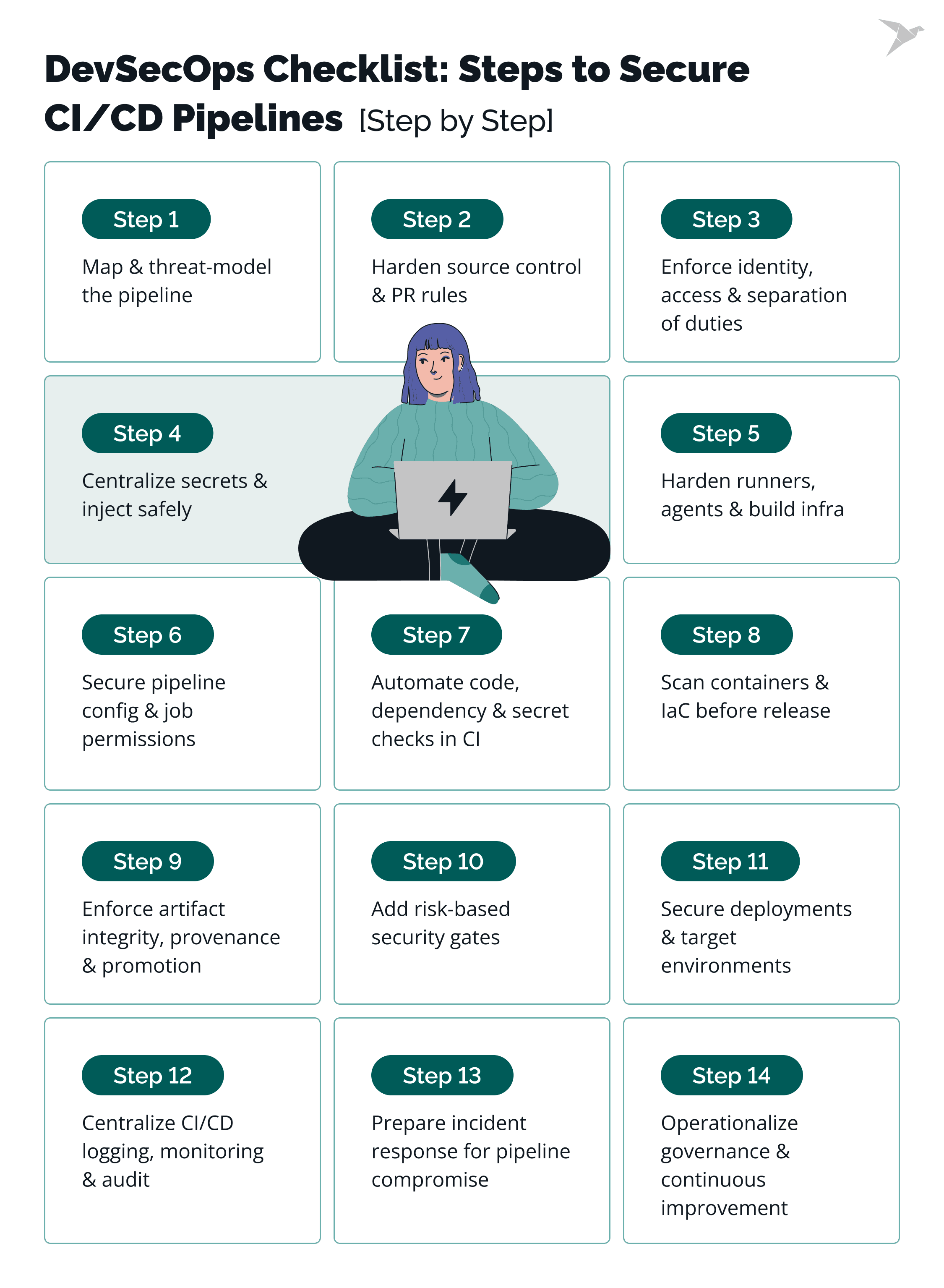
Step 1. Inventory and threat-model your CI/CD pipeline
Start by documenting every component involved in your CI/CD flow: source control, CI servers, runners, artifact and container registries, IaC repositories, secrets stores, deployment tooling, and cloud infrastructure components. Identify trust boundaries: who or what can commit code, trigger builds, push artifacts, and deploy. Define your crown jewels, such as production credentials, signing keys, registry admin access, and deployment tokens.
Outcome: a complete, shared map of your CI/CD pipeline and its critical assets.
Value: security efforts focus on real risk instead of assumptions or blind spots.
Step 2. Lock down source control and PR workflows
Protect your source of truth by enforcing pull requests for protected branches and blocking direct pushes to main or release branches. Require mandatory reviews and CODEOWNERS for sensitive paths like pipeline configuration, IaC, and Kubernetes manifests. Enforce branch protection rules, status checks, and signed commits or tags where feasible.
Outcome: only reviewed and verified changes can affect builds and releases.
Value: many common compromise paths are mitigated early.
Step 3. Establish strong identity, access, and separation of duties
Use SSO and MFA across source control and CI/CD platforms. Apply least privilege to developers, CI administrators, release managers, and service accounts. Separate approval authority from deployment authority, and eliminate shared or long-lived credentials in favor of short-lived access.
Outcome: clearly defined roles and scoped access across CI/CD systems.
Value: compromised accounts have limited reach instead of full pipeline control.
Step 4. Implement centralized secrets management and safe injection
Store secrets exclusively in a centralized secrets manager. Inject them only at runtime, ensure they never appear in logs, and rotate them regularly, especially after personnel changes. Scope secrets by environment and apply tighter controls to high-value credentials like signing keys and registry tokens.
Outcome: no hardcoded or unmanaged secrets in code or pipelines.
Value: credential leaks stop being systemic and become manageable events.
Step 5. Harden CI/CD runners, agents, and build infrastructure
Prefer ephemeral runners created per job and isolate untrusted workloads. Keep runner images and VMs patched, disable privileged execution unless explicitly required, and restrict network access to only what jobs need. Separate runners for forks, internal branches, releases, and production deployments, especially where runners sit near critical components.
Outcome: isolated, hardened build infrastructure with minimal attack paths.
Value: attackers can’t easily pivot from a single job to the wider environment.
Step 6. Secure pipeline configuration and reduce build-time privileges
Treat pipeline configuration as code with review and change control. Minimize permissions granted to CI jobs and scope access per job, stage, and environment. Avoid all-powerful tokens, pin pipeline actions and plugins to trusted versions, and prevent arbitrary script execution at runtime, since misconfigurations here are one of the fastest ways attackers can gain access.
Outcome: predictable, controlled pipeline behavior across environments.
Value: pipeline abuse and configuration drift become far harder to exploit.
Step 7. Add automated code and dependency security checks in CI
Run fast static analysis on every pull request and deeper security scans on main or scheduled builds. Continuously scan dependencies, generate SBOMs, and enforce failure policies for critical security issues. Detect secrets early in code changes and manage exceptions with clear ownership and expiration, which strengthens end-to-end vulnerability management.
Outcome: consistent, automated security feedback built into CI.
Value: vulnerabilities are fixed early instead of blocking releases later.
Step 8. Scan containers and IaC before anything reaches release
Scan container images before push or promotion and block known critical vulnerabilities based on policy. Analyze IaC for insecure cloud and Kubernetes configurations. Enforce baseline hardening such as minimal base images, non-root execution, and removal of build tools from runtime images. Lock down dependency pull behavior so the package manager can’t silently introduce unexpected risk during builds.
Outcome: only hardened images and infrastructure reach release stages.
Value: entire classes of deployment-time security failures are eliminated.
Step 9. Enforce artifact integrity, provenance, and promotion controls
Produce immutable artifacts, sign images and binaries, and verify signatures before deployment. Separate build from deploy so releases come only from trusted registries. Promote artifacts across environments instead of rebuilding them.
Outcome: a verifiable chain from source code to production deployment.
Value: supply chain tampering and build drift become detectable and preventable.
Step 10. Put risk-based security gates in the delivery flow
Define clear pass/fail thresholds for vulnerabilities, licenses, and policy violations. Enforce gates automatically and consistently. Place them early enough to stop unsafe changes before deployment, reserving manual approvals for clearly defined high-risk cases.
Outcome: consistent, automated release decisions under all conditions.
Value: security enforcement no longer depends on timing or pressure.
Step 11. Secure deployment targets and environment configuration
Restrict who and what can deploy to production using protected environments, approvals, and dedicated credentials. Validate deployment manifests against policy and ensures secrets are isolated per environment. Audit all production changes.
Outcome: controlled, auditable access to production environments.
Value: accidental or unauthorized deployments are significantly reduced.
Step 12. Centralize logging, monitoring, and audit for CI/CD actions
Collect logs for pipeline executions, permission changes, secret access, artifact publishing, and deployments. Alert on high-signal events such as new runner registrations or disabled security gates. Retain logs securely for audit and investigation.
Outcome: full visibility into CI/CD activity and security-relevant events.
Value: incidents are detected and investigated faster, with less disruption.
Step 13. Validate incident readiness for CI/CD compromise scenarios
Define response playbooks for token revocation, secret rotation, runner isolation, software deployment freezes, and rollbacks. Maintain a tightly controlled break-glass process and test readiness with regular tabletop exercises focused on CI/CD and software supply chain security attacks.
Outcome: documented, tested response procedures for pipeline incidents.
Value: teams respond decisively instead of improvising during crises.
Step 14. Operationalize governance: ownership, reviews, and continuous security improvement
Assign clear owners for CI/CD security controls with shared responsibility between DevOps and Security. Review exceptions regularly, track remediation time, and reassess emerging threats as systems, dependencies, and teams evolve. This is what helps maintain a resilient security posture over time.
TechMagic’s DevSecOps services support companies in operationalizing these controls and improving delivery security as pipelines grow.
Outcome: sustained ownership and continuous pipeline security improvement.
Value: CI/CD security matures over time instead of eroding with change.
Need Expert Help Securing Your CI/CD Pipelines?
CI/CD security usually fails because pipelines become complex, shared across teams, and hard to reason about as they grow. At TechMagic, we help organizations deal with this complexity.
TechMagic’s DevSecOps specialists work directly inside your delivery process. We help you set up secure, reliable CI/CD pipelines while your team stays focused on building the product and running the business.
In practice, that means we help you:
- Review your existing pipelines and uncover real security gaps that matter
- Design and implement secure-by-default pipelines that fit how your teams already work
- Put the right security checks, controls, and monitoring in place without slowing releases
The focus is always practical and hands-on:
- Lower risk of pipeline takeover and supply chain compromise
- More predictable releases with fewer late-stage surprises
- Less time spent firefighting CI/CD issues and more time shipping value
You don’t need to untangle CI/CD security on your own. If you want a clear, honest assessment of where your pipelines stand and what’s worth fixing first, we’re ready to help.
Let’s start with a conversation.

Summing Up: Securing CI/CD Today and What Comes Next
CI/CD pipelines have become core infrastructure. They hold credentials, control deployments, and tie the entire delivery process together. When they aren’t secured deliberately, small gaps quickly become significant security risks.
The security practices, tools, and checklist in this guide point to a simple truth: CI/CD security works best when it’s part of everyday delivery. Early checks, clear access management, hardened infrastructure, and automated enforcement make pipelines easier to operate and more reliable at scale.
Looking ahead, CI/CD security considerations will continue to move toward deeper automation and stronger guarantees. Policy-as-code, artifact signing and provenance, and tighter identity controls will become standard as pipelines take on more responsibility. Teams that treat CI/CD as critical infrastructure and secure it accordingly with robust security measures will be best positioned for what’s next.
FAQ

DevSecOps is an approach where security is built into the software development lifecycle and software delivery process from the start. In CI/CD (Continuous Integration/Continuous Delivery or Deployment) pipelines, it allows security checks, proper access controls, and policy enforcement to run automatically as part of the pipeline itself. This is important because modern pipelines handle production credentials and deployments, which makes them a critical part of an organization’s security posture.
Security processes are most effective in CI/CD when embedded across the development process, integration, and deployment stages. Automated checks in pull requests and CI jobs, combined with clear policy gates before deployment, allow development teams to identify and address risks early while keeping software solution delivery fast and predictable.
Container security in DevSecOps focuses on controlling what gets built and deployed. This typically includes validating base images, scanning containers during CI, enforcing secure runtime settings, and ensuring that only trusted, verified images are promoted to production through the pipeline.
Tool overload is common, especially when teams run separate scanners, secret detection, and policy tools that don’t share context. A practical way to reduce this is security orchestration, where alerts, policies, and response actions are centralized so teams can focus on high-risk issues instead of constant manual triage.
Even if production is locked down, weaknesses in the development environment can leak secrets, allow unintended access, or introduce risky changes into builds. Insecure runners, misconfigured CI jobs, and over-permissive pipeline roles are just a few examples of how pipeline security can be undermined long before deployment.