















AI Development: Trends and Best Practices To Look For in 2026
Last updated:19 December 2025


AI is moving faster than most companies can map their risks. Models now help write code, approve transactions, route workloads, and make predictions that shape real products and decisions. Yet few teams fully understand what these systems do under the hood.
As cloud platforms, data engines, Machine Learning algorithms, and Generative AI keep evolving, the gap between what AI can do and what organizations are ready to control is widening.
For businesses, the main question is how to implement AI responsibly and effectively. In our new article, we discuss the main AI development trends and their impact on your business operations, security, and outcomes.
Key takeaways
- Synthetic data becomes essential for safe and scalable AI training, helping teams work around privacy limits and scarce real-world examples.
- Generative AI drives hyper-personalization, lifting revenue and marketing efficiency while requiring stronger data governance.
- Memory-enabled AI systems improve continuity and trust, making AI a long-term partner rather than a one-off assistant.
- Autonomous AI agents evolve into operational team members, handling workflows, detecting threats, and reducing manual effort.
- Machine Learning, NLP, and Computer Vision anchor enterprise AI, supporting decision-making, automation, and real-time insight across industries.
AI Development Trends for 2026
Let's take a closer look at the main AI development trends and why they are so important.
Synthetic data becomes a strategic advantage
Training modern AI models often runs into the same roadblocks: limited real-world data, strict privacy rules, and gaps in rare or high-risk scenarios. Synthetic datasets generated by GenAI are now moving into mainstream AI pipelines because they solve these constraints without exposing customer data.
In 2024, several industries accelerated adoption. Autonomous driving teams now generate most of their edge-case scenarios synthetically, and financial and healthcare organizations use synthetic data to test risk models without touching regulated records. Gartner expects synthetic data to surpass real data for AI training by 2026. This is a sign of how central it is becoming to enterprise AI strategies and the tech stack that supports them.
Synthetic datasets give teams the freedom to test models on conditions that rarely appear in production, uncover blind spots, and iterate faster. They also help AI engineers train systems that depend on high-quality data, but can’t always access it due to compliance or fragmentation across an organization’s operating system of tools and workflows.
Why is this important?
Synthetic data creates a controlled, scalable way to improve model reliability. Engineers can generate balanced datasets, simulate edge cases, and stress-test systems without risking data exposure.
For teams working in regulated environments, it offers a practical path to develop and refine AI systems while staying compliant. And for organizations pushing AI into new products, synthetic data becomes a foundation for safer experimentation, better coverage, and a measurable competitive advantage.
Hyper-personalization accelerated by Generative AI
Generative AI is reshaping personalization from static segments to real-time, adaptive experiences. Modern models adjust content, offers, and interactions based on user intent, behavior, and context. Then, generate the exact messaging or visuals needed in that moment.
This shift now sits at the center of marketing automation, where AI dynamically optimizes experiences instead of relying on predefined rules. In 2024, McKinsey reported a 5–15% revenue lift from real-time personalization and 10–30% gains in marketing efficiency.
- Adobe found that 45% of enterprises use GenAI to produce and test content variants at scale.
- Retail platforms saw up to 20% higher conversions with AI-generated product descriptions.
- Healthcare systems also reported 17–25% improvements in risk-stratification accuracy when personalization models were integrated with signals derived from decision trees and other predictive methods.
As market trends point toward more context-aware systems, organizations are increasingly using fine-tuning to adapt foundation models to their specific audiences and workflows. These systems learn continuously, turning digital experiences into responsive, evolving journeys.
Why is this important?
Hyper-personalization changes how organizations deliver value:
- More relevant experiences: Content, recommendations, and workflows adapt instantly to user needs.
- Higher performance: AI-generated variants improve engagement and conversion without manual effort.
- Better outcomes in regulated sectors: In healthcare and finance, personalization strengthens risk detection and decision support.
- Operational shift: Teams move from static campaigns to dynamic systems that learn in real time.
This capability becomes a strategic differentiator. However, it also requires strong data governance and safeguards to ensure transparency, accuracy, and trust.
Learn how we built an AI-powered recruitment assistant using OpenAI stack

Memory-enabled Artificial Intelligence systems
AI systems are moving beyond single-task interactions toward long-term, context-aware engagement. New platforms, like ChatGPT, Claude, and enterprise conversational engines, now use persistent memory to retain user preferences, project details, past conversations, and evolving goals.
Instead of restarting from zero, these systems build continuity over time and expand their ability to support complex work. This shift turns AI from a reactive tool into a stable digital partner. Memory-enabled models can:
- follow ongoing coaching programs;
- adapt therapy interactions as needs change;
- support enterprise training over extended periods;
- and maintain organizational knowledge that typically fades as teams transition.
As AI-generated content becomes more embedded in operations, these systems tailor outputs with increasing accuracy and relevance.
Why is this important?
Memory reduces cost by eliminating repetitive setup and preventing information loss across projects and roles. It strengthens decision-making by keeping long-term context intact, and it supports smoother collaboration as AI maintains shared understanding across teams.
Most importantly, it creates the trust and reliability needed for widespread adoption, giving organizations a path toward AI systems that learn, adapt, and become more valuable the longer they are in use.
Autonomous AI agents become operational team members
AI agents have moved beyond basic automation. New systems can plan, reason, and complete tasks with little oversight.
Gartner expects most companies to test or use agentic automation by 2026. These agents now connect to CRMs, ERPs, and productivity tools, where they support model development, improve data collection, and help teams working with machine learning models. They operate in real-world scenarios and take on work that previously required human input.
Many industries are already adopting them. Salesforce’s 2024 State of Service report shows that 60% of service teams plan to expand autonomous workflows. In cybersecurity, early 2025 reports highlight growing use of agentic tools to detect AI-driven threats, such as deepfake phishing and automated credential attacks.
Why is this important?
Autonomous agents help teams work faster and with fewer errors. They reduce repetitive tasks and provide support that grows with the business. Agents scan systems continuously and spot issues that traditional tools often miss. As companies scale, they also help reduce the time spent managing data across platforms.
They also fit into a modern deployment strategy, where AI becomes part of everyday operations instead of a separate tool. As adoption increases, these agents will form a reliable layer of workforce augmentation that helps organizations stay efficient and adaptable.
Machine Learning growth and its strategic role
Machine Learning remains a core part of AI, powering predictive modeling, natural language processing, and deep learning. As organizations work with larger data sets and stronger cloud infrastructure, ML now supports everything from operations to web development and advanced analytics.
Gartner reported in 2025 that 70% of enterprises have operationalized machine learning workflows, showing how quickly adoption is spreading across industries. Teams use ML to automate tasks, identify patterns, and support data-driven decision-making.
Data Science provides the foundation by analyzing complex information and helping organizations improve accuracy in forecasts and recommendations. It also ensures systems stay reliable as business needs shift and project requirements evolve.
Why is this important?
Machine Learning gives companies a practical way to act early, scale insights, and make informed decisions rooted in Big Data. As adoption grows, ML becomes a strategic capability that strengthens operations, reduces manual work, and builds products that learn and adapt over time.
Natural Language Processing and Computer Vision
Natural Language Processing (NLP) and Computer Vision help organizations process data from text, images, and video in a faster, more consistent way. NLP uses neural networks to understand and generate language, which supports tasks like customer support automation, sentiment analysis, and content reviews.
These capabilities connect to existing systems and can run on a standard web server, making them easy to deploy across products and workflows. People can use them without learning a new programming language, and a clear interface helps teams work with AI features confidently.
Computer Vision applies similar intelligence to visual content. It can verify identities, read documents, and spot defects in healthcare, finance, and manufacturing. Full-stack developers often use an AI studio to train models, link APIs, and ship features that save time and improve accuracy. These tools also support business intelligence by turning images and text into structured data that teams can analyze and act on.
Why is this important?
NLP and Computer Vision help organizations automate manual reviews, reduce errors, and deliver faster responses. They turn unstructured information into reliable insight and make AI features easier to add to new and existing products. As adoption grows, these technologies will play a key role in building systems that work smoothly across tools, teams, and applications.
AI-Powered Applications Across Industries
AI-powered applications now support core work in healthcare, finance, retail, transportation, manufacturing, and education. Modern AI tools use machine learning, NLP, and predictive analytics to automate repetitive tasks, improve workflows, and help teams make proactive decisions.
These systems fit into production environments through API integrations that let them operate smoothly with user interactions and other software components. In customer-facing products, a clear user interface helps teams deploy AI features that provide users with more natural experiences, whether they are asking questions, navigating services, or completing tasks.
AI also supports content creation, lead generation, and other marketing efforts, making it easier for teams to move quickly and personalize communication at scale.
Across industries, organizations rely on AI systems for analysis, forecasting, and performance monitoring. These capabilities strengthen decision-making and allow teams to adapt products and processes as conditions change. With careful deployment and alignment to real business needs, AI-powered applications become reliable tools that help teams deliver better results with less effort.
What Are The Top Sectors With Significant AI Adoption?
Ethical and Security Considerations of AI Development
Organizations integrating AI must align with new regulatory frameworks that set expectations for transparency, safety, and accountability. The EU AI Act, evolving U.S. federal guidance, and international standards from ISO and NIST now shape how companies evaluate risk, document system behavior, and maintain compliance across jurisdictions.
Ethical responsibilities
Ethical development extends beyond following laws. It includes ensuring high-quality data, reducing bias, and responding to stakeholder concerns. These steps help AI systems behave fairly and predictably, supporting long-term trust and responsible use.
Security practices
Modern AI systems must be resilient to real-world threats such as data leaks, model manipulation, and misuse. Strong security practices protect sensitive information, safeguard model behavior, and keep systems reliable as environments change.
Clear ethical foundations and strong security allow organizations to innovate with confidence. When AI systems are safe, transparent, and well governed, teams can deploy them at scale while protecting users and meeting regulatory expectations.
AI Security Testing Objectives
Results and Outputs of Security Testing
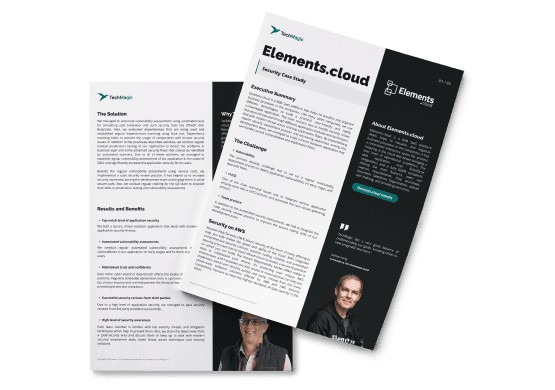
CyberSecurity services for Elements.Cloud
How We Ensure Your AI Solution Is Ready for Execution
Preparing an AI system for production requires careful testing and clear safeguards. We review the full solution to identify risks, validate behavior, and confirm that it meets current security and regulatory expectations. This process helps ensure the system performs reliably in real-world conditions.
We use structured testing, security checks, and version control to track changes and protect model integrity throughout development. This approach supports consistent, predictable performance when the solution is deployed and keeps the system stable as it evolves.
Our AI expert team can assess your opportunities, refine your roadmap, and accelerate your transformation

FAQ

It helps organizations train and test models without exposing sensitive information and allows them to simulate rare or high-risk scenarios that are difficult to collect in real life.
AI agents automate tasks, monitor systems, and support complex workflows, allowing teams to work faster and focus on higher-value activities.
Generative AI enables real-time content and experience adjustments, improving engagement, accuracy, and user outcomes across sectors.
They should focus on governance, security testing, regulatory alignment, and a structured rollout plan that ensures models perform reliably in production.