












Build vs Buy vs Partner: Making the Right AI Development Decision
Last updated:19 February 2026


AI budgets are rising fast. Global AI spending is expected to pass $500 billion within the next few years, yet most organizations still struggle to turn pilots into real business value. Many projects stall. Some never reach production. Others launch but fail to scale.
The problem usually isn’t the model. It’s the decision behind it.
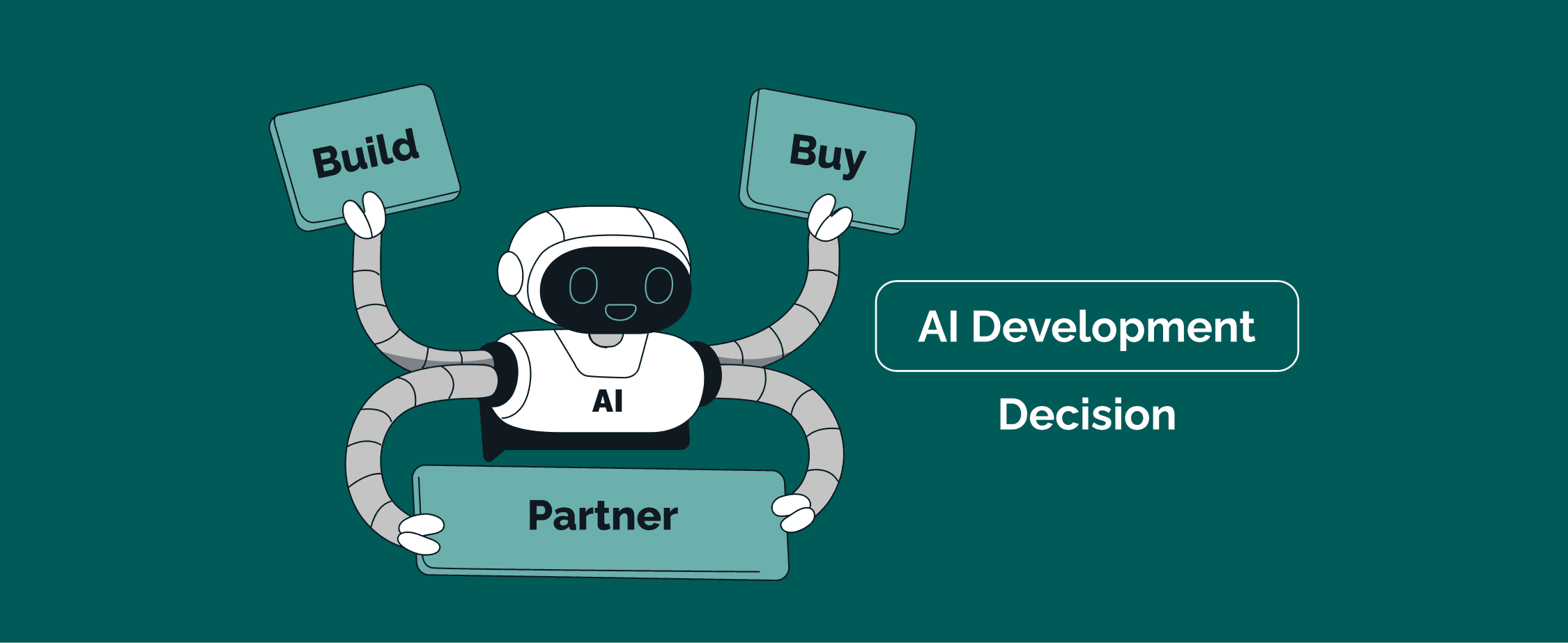
When AI moves from experiment to strategic investment, leaders face a critical choice: should we build it ourselves, buy an existing solution, or partner with an external expert? The build vs buy AI decision shapes far more than delivery speed. It affects cost structure, ownership of data and IP, regulatory exposure, talent strategy, and long-term flexibility.
In our blog post, we break down what each path really means in practice. You’ll learn how “build,” “buy,” and “partner” differ in control, cost, and risk. You'll also discover who typically faces this decision and competitive differentiation, what questions executives ask before committing budget and resources, and when each model makes sense based on strategy, internal capability, and timeline.
Key takeaways
- The AI operating model you choose directly affects speed, cost, governance, and long-term scalability, and ultimately, whether you see real ROI.
- Building is often the best path when AI supports strategic goals, depends on unique processes, and you can justify the required engineering time and capability.
- Buying fits standardized use cases where speed and predictable cost matter more than deep control, and where the business needs are stable.
- Partnering balances customization and risk reduction without expanding permanent headcount, while keeping delivery aligned to strategic goals.
- Treat this decision as a long-term commitment shaped by your target state and how quickly new technology and each new model may change what’s possible.
What Does “Build vs Buy vs Partner” Mean in AI Development?
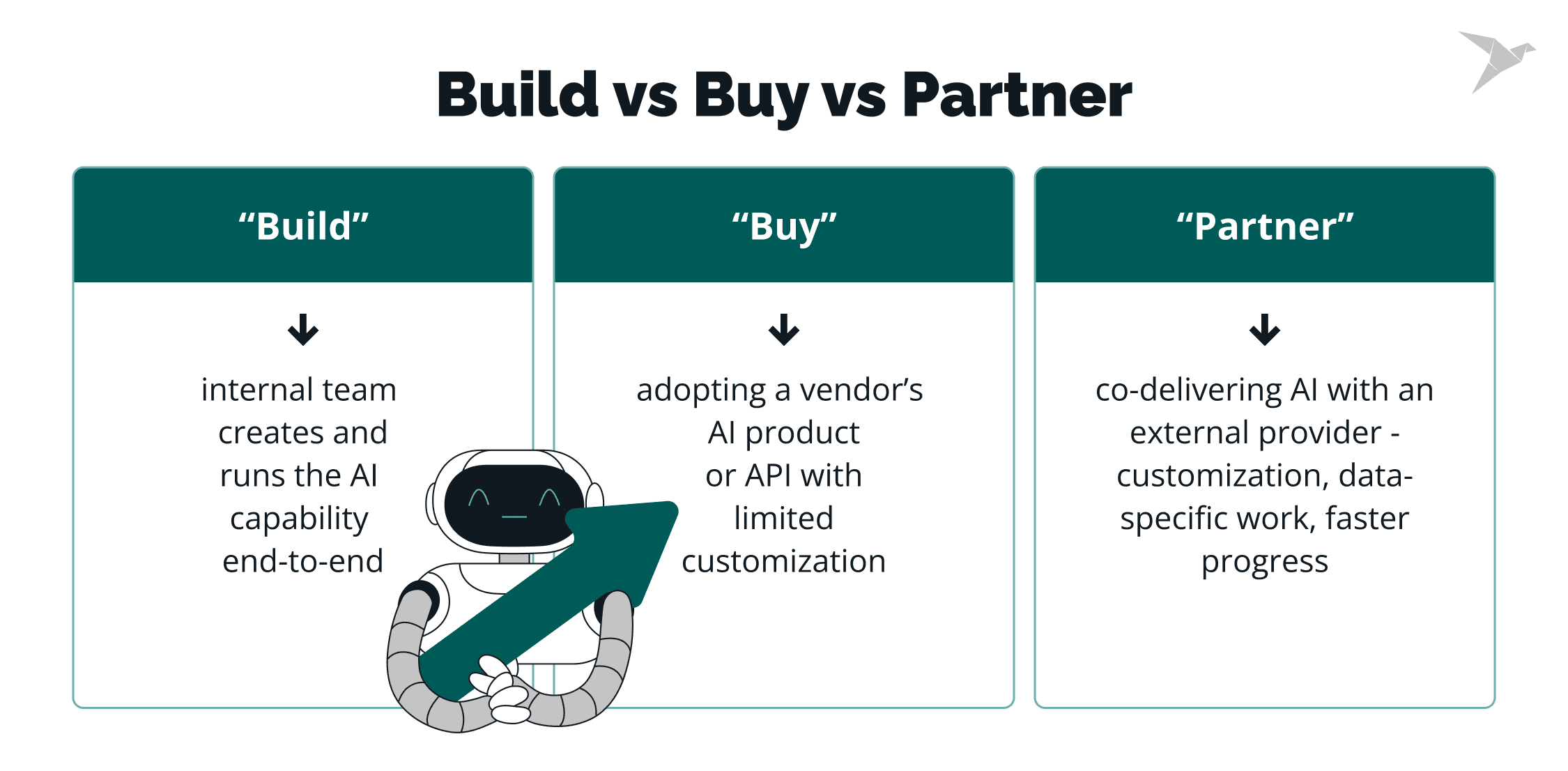
“Build vs buy vs partner” in AI development defines three adoption strategies: develop AI internally, purchase an existing solution, or partner with an external provider to design and deliver it.
What does “build” mean?
“Build” means your teams create and run the AI capability end-to-end. You own the roadmap, data workflows, governance, and ongoing maintenance. This fits when AI is a core differentiator, and you can sustain hiring, tooling, and oversight.
What does “buy” mean?
“Buy” means you adopt a vendor’s AI product or API with limited customization. It can speed up rollout and reduce internal load. In the buy AI solution vs find partner choice, “buy” fits best for standard use cases where time matters more than control.
What does “partner” mean?
“Partner” means you co-deliver AI with an external provider. You keep strategic ownership while sharing delivery work, integration, and scaling. IPartnering fits when you need customization, data-specific work, or faster progress than your team can support alone.
Who Typically Faces The Build Vs Buy Vs Partner Decision For AI?
Enterprises, startups, and data-rich organizations typically face the build vs buy vs partner decision for AI. Teams make this decision when AI shifts from pilot projects to strategic investment, usually to scale models into production, control AI development cost and risk, meet security and compliance needs, and accelerate time-to-value.
Enterprises adopting AI at scale
Large organizations adopting AI across multiple departments frequently face this choice.
Common triggers include:
- Standardizing AI governance across business units.
- Integrating AI into core systems such as ERP, CRM, or data platforms.
- Managing regulatory and compliance risks.
- Scaling pilots into production environments.
In these cases, leaders such as CIOs, CTOs, and enterprise architects assess whether internal teams can support long-term scale or whether external support is required.
Startups launching AI-powered products
Startups building AI-driven products must decide early how much to develop internally.
The choice affects:
- speed to market;
- product differentiation;
- capital allocation;
- technical debt.
Founders, heads of AI, and VPs of engineering often weigh buy vs develop AI solution when internal AI talent is limited, but product timelines are tight.
Companies modernizing legacy systems with AI
Organizations updating legacy platforms often introduce AI during modernization.
This creates questions about:
- Integrating AI into existing architecture.
- Replacing manual processes with intelligent automation.
- Managing data quality across old systems.
Here, CIOs and digital transformation leaders evaluate whether to embed vendor tools or work with a partner who can redesign workflows and data pipelines.
Organizations with internal data but limited AI expertise
Many companies hold valuable operational or customer data but lack internal AI capability.
They typically face the decision when:
- Business teams identify high-value AI use cases.
- Internal IT teams lack machine learning experience.
- Leadership wants measurable outcomes without building a full AI department.
In these scenarios, executives must decide whether to invest in hiring, work on a tailored AI solution with a partner, or combine approaches.
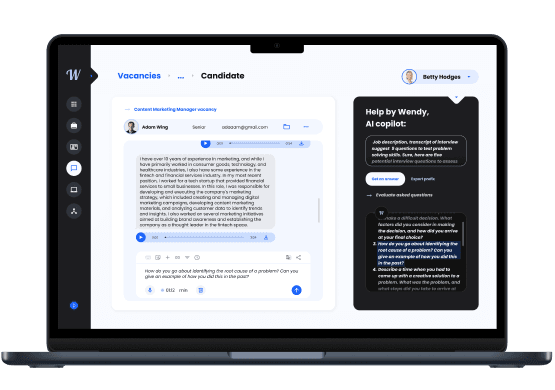
Learn how we built an AI-powered recruitment assistant using OpenAI stack
What Questions Do Decision-Makers Ask Before Choosing An AI Approach?
Decision-makers focus on capability, risk, timing, and ownership before committing to an AI path. The discussion usually centers on long-term impact rather than technical features.
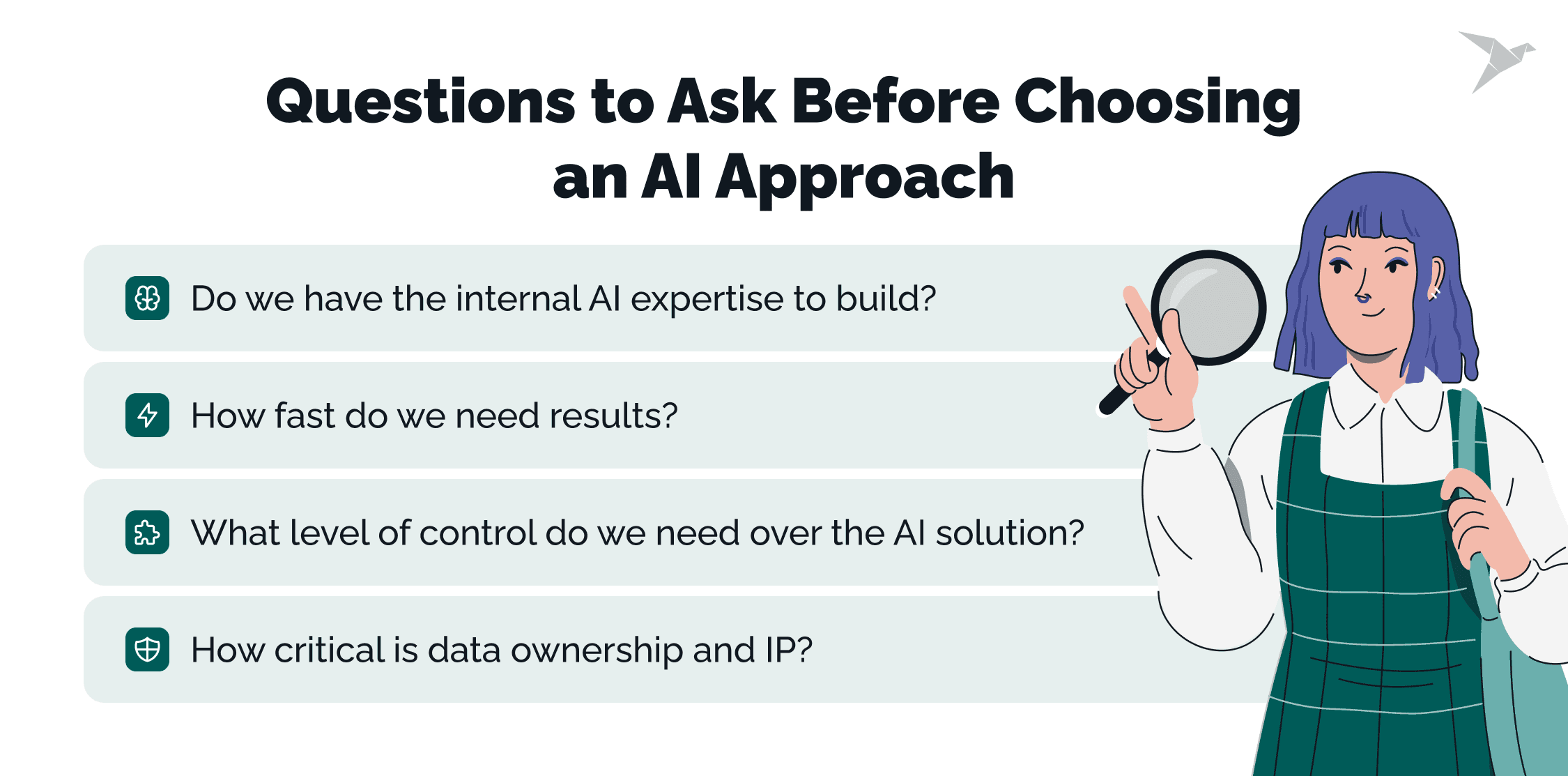
Do we have the internal AI expertise to build?
Leaders assess whether their organization can design, deploy, and maintain AI systems responsibly.
Key considerations include:
- Availability of experienced data scientists and ML engineers.
- MLOps and model governance maturity.
- Ability to monitor performance and manage model risk.
- Capacity to support AI long term, not just launch it.
The question is less about starting a project and more about sustaining it.
How fast do we need results?
Timelines influence how much internal development is realistic.
Executives examine:
- market pressure or competitive dynamics;
- regulatory deadlines;
- investor expectations;
- internal transformation roadmaps;
If a measurable impact is required within months, the approach may differ from a multi-year capability build.
What level of control do we need over the AI solution?
Control affects flexibility, risk exposure, and strategic positioning.
Leaders evaluate:
- How tightly AI must align with internal processes.
- The need to adjust models as business conditions change.
- Dependence on third-party roadmaps.
- Transparency requirements for regulators or customers.
Higher control often requires greater internal responsibility.
How critical is data ownership and IP?
Data and intellectual property shape long-term value.
Decision-makers consider:
- Whether proprietary data drives competitive advantage.
- Where data is stored and processed.
- Who owns trained models and derived insights.
- How IP protections affect valuation or partnerships.
For many organizations, data ownership is not a technical issue but a strategic one that influences future growth and risk.
When Does It Make Sense To Build AI In-House?
Building AI in-house makes sense when AI is central to your strategy and you can support it over time. This path usually reflects a deliberate choice to invest in ownership, differentiation, and control rather than treating AI as a short-term initiative.
Strong internal data and ML teams
In-house development is justified when you already have capable data science, ML engineering, and operational support to deliver and run models in production. This includes reliable data pipelines, clear governance, and teams that can monitor performance and manage model risk after launch.
Core AI as a competitive differentiator
Building internally fits when AI directly shapes what makes your product or operations distinct. If model behavior, iteration speed, and domain-specific performance define your market position, internal development gives you more room to adapt as strategy, customers, and competitors change.
Long-term AI roadmap and budget
Internal AI requires sustained investment beyond the first release. Teams need time to iterate, retrain, respond to drift, and meet new compliance and business requirements. When leadership treats AI as a multi-year program with stable funding, the build path becomes a practical option rather than a risky bet in a buy vs AI development decision.
Need for full control over models and IP
Some organizations need full control over how models are trained, how data is used, and who owns the resulting intellectual property. This is common when AI influences high-impact decisions, when data sensitivity is high, or when model ownership affects partnerships, valuation, or regulatory exposure.
When Is Buying an AI Solution the Better Option?
Buying an AI solution is the better option when use cases are standardized, internal AI expertise is limited, timelines require deployment within 3-6 months, and leadership demands predictable costs and fast ROI. In a buy vs develop AI decision, buying reduces implementation risk, shortens time-to-value, and stabilizes budget forecasts.
Standardized AI use cases
Buy when the use case is common, such as customer support chatbots, document processing, fraud detection, or CRM automation. These products are typically designed for repeatable workflows, so they’re often cost-effective and deliver strong cost effectiveness. Vendors offer pre-trained models and proven workflows that deploy 40–60% faster than custom builds, saving time and reducing delivery risk.
Limited internal AI expertise
Buy when you don’t have the in-house data scientists, ML engineers, or MLOps setup to run and improve models. Vendors cover maintenance and updates, and some also support light fine-tuning so the system performs better without hiring a full team.
Tight timelines and fast ROI expectations
Buy when leadership needs measurable ROI within 6–12 months and doesn’t want to revisit the same question every quarter. Prebuilt platforms shorten cycles and help you move faster while your business grows.
Preference for predictable costs
Buy when you want fixed subscription pricing instead of variable R&D spend. This can be the most cost-effective path for near-term goals, especially if your future state doesn’t require deep differentiation. If you expect evolving needs, consider a hybrid approach: start with a platform, then build around it as requirements become clearer.
When Should You Partner With An AI Development Company?
Partnering with an AI development company makes sense when you need tailored AI capabilities but do not want to build and scale a full internal function. This approach often serves as a strategic middle ground between full internal ownership and adopting a fixed external product.
Need for custom AI without building a full team
Some organizations require AI solutions shaped around their data, workflows, and constraints, yet do not plan to hire a complete AI department. In this case, partnering allows access to engineering, data science, and MLOps capabilities without long-term headcount expansion. The organization keeps a strategic direction while sharing execution.
Lack of internal AI leadership
AI initiatives often stall when there is no experienced leader to define architecture, governance, and delivery standards. A partner can bring structured processes, technical oversight, and proven implementation patterns. This reduces uncertainty during early stages, and supports informed decisions around develop AI vs find partner scenarios.
Complex or domain-specific AI use cases
Certain AI use cases demand specialized expertise, such as regulated environments, advanced modeling techniques, or integration with legacy systems. Internal teams may understand the business context but lack exposure to similar technical challenges. Partnering helps combine internal domain knowledge with external implementation experience.
Desire to reduce delivery and technical risk
AI projects carry operational and compliance risks, especially when moving from prototype to production. Organizations that want to shorten learning cycles and avoid architectural mistakes often work with partners who have managed similar deployments. In develop AI solution vs find partner discussions, risk mitigation and predictable delivery frequently shape the final choice.
HIPAA-compliant portal for secure medical data records and exchange
How Do Build, Buy, And Partner Compare Across Key Criteria?
Build, buy, and partner differ in speed, cost structure, control, risk allocation, and long-term sustainability. Each model shifts responsibility and trade-offs in different ways.
Time to market
Buying an existing solution typically delivers the fastest initial deployment because core functionality is already built. Partnering with AI development companies can also accelerate timelines, especially for custom use cases, since experienced teams reduce trial-and-error cycles. Building in-house often takes longer at the start due to hiring, architecture design, and governance setup.
The fastest option in the short term may not always provide the right foundation for future changes.
Cost and total cost of ownership
Buying typically comes with predictable subscription or licensing fees, and many off-the-shelf products or pre-built solutions keep upfront costs low. Long-term spend can grow with usage, integrations across business processes, or feature expansion.
Building requires a higher initial resource commitment for hiring, infrastructure, and tooling, and it depends heavily on internal resources and specialized talent. Over time, costs shift toward maintenance, retraining, and compliance.
Partnering spreads cost across phases and brings deep expertise, but still requires budget for collaboration, integration, and ongoing support. The total cost depends on how long the solution will run, how often it must evolve, and where your AI journey is headed as AI continues to change.
Control and flexibility
Building provides the highest control over models, data flows, and roadmap decisions, which can protect a competitive edge and support long-term strategic advantage. It also requires strong internal expertise and day-to-day technical expertise to adapt quickly when needs shift.
Buying limits flexibility to the vendor’s release cycle and feature set, even if the platform is stable. Partnering offers shared control: you keep direction tied to business objectives and business goals, while the delivery benefits from AI experts who shape implementation. The right path forward should match how central AI is to your competitive edge.
Risk and responsibility
When building internally, your organization owns architecture decisions, compliance, model performance, and operational stability, so your risk depends on the available internal resources and maturity.
Buying transfers some technical burden, but you still own outcomes against business objectives, and you must confirm proven reliability in your real environment. Partnering distributes responsibility: AI experts bring external expertise for design and deployment, while internal leaders keep governance aligned to business goals. Risk tolerance and regulatory exposure often decide what’s practical for the vast majority of teams.
Scalability and long-term maintenance
Building supports deep customization and integration, but scaling demands ongoing monitoring, retraining, and infrastructure management, plus sustained resource commitment and specialized talent. Buying can scale within platform limits, but growth may be constrained by pricing tiers or technical boundaries.
Partnering can support structured scaling from pilot to rollout, especially when knowledge transfer strengthens internal expertise. In some cases, no-code platforms help validate workflows early, but long-term scalability still depends on ownership, governance, and fit with core business needs.
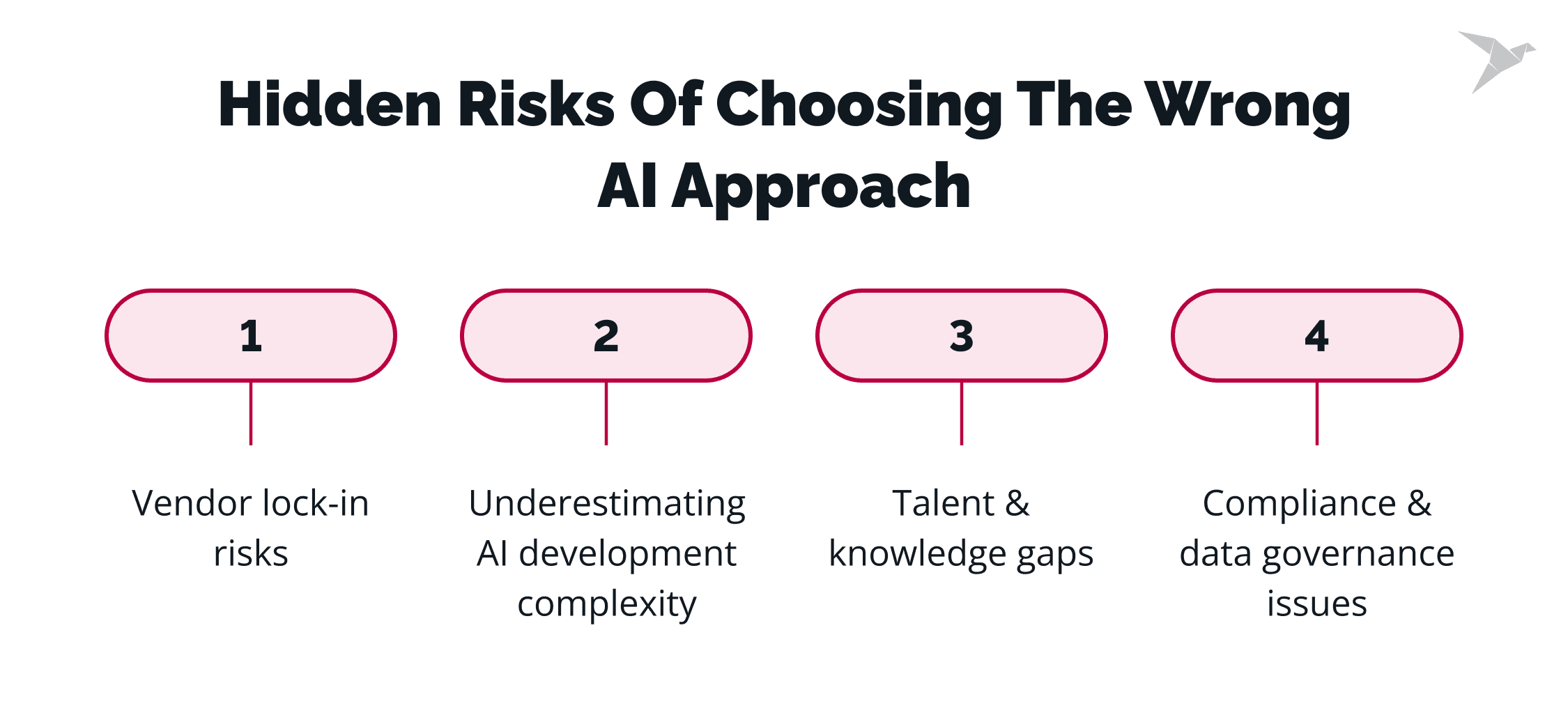
What Are the Hidden Risks of Choosing the Wrong AI Approach?
Choosing the wrong AI approach increases costs by 30–50%, delays deployment by 6–18 months, and exposes the organization to security, compliance, and scalability failures. Companies must evaluate build, buy, or partner decisions carefully, especially when investing in generative AI software development services that affect core systems and data infrastructure.
Underestimating AI development complexity
Underestimating AI complexity is a common reason projects stall when implementing AI. Unlike off-the-shelf solutions or simple ai powered tools, custom development often requires data engineering pipelines, model training cycles, MLOps infrastructure, integration layers, monitoring systems, and continuous retraining. Teams that ignore these requirements face budget overruns and failed production launches.
Vendor lock-in risks
Choose the wrong vendor's solution, and switching costs can rise by 20–40%. Proprietary APIs, closed model architectures, and restrictive contracts limit flexibility in a fast-moving AI market. Organizations lose negotiation leverage and struggle to migrate models or data without significant downtime and re-engineering costs.
Talent and knowledge gaps
Ignore talent gaps and performance declines. Successful AI initiatives need data scientists, ML engineers, DevOps specialists, domain experts, and consistent internal ownership with deep AI expertise. Without oversight, teams lose strategic control and become dependent on external providers to update and optimize models, workflows, and supporting AI tools, including emerging AI agents.
Compliance and data governance issues
Neglect compliance, and penalties follow. AI systems often process sensitive data and must align with GDPR, HIPAA, SOC 2, or industry-specific standards. Weak governance increases legal exposure, reputational damage, and operational disruption, especially when teams try to create solutions by stitching together multiple third-party AI-powered tools without clear controls.
Final Thoughts
The build vs buy AI solution decision shapes cost structure, risk exposure, speed of execution, and long-term competitive positioning. There is no universal answer. The right choice depends on how central AI is to your strategy, how mature your internal capabilities are, and how much control you need over data and intellectual property.
AI investment is accelerating. Analysts estimate global AI spending will exceed $500 billion by 2027, with enterprise adoption expanding beyond pilots into production-scale systems. At the same time, industry research shows that up to 80% of AI projects fail to reach full deployment, often due to governance gaps, unclear ownership, or underestimated complexity. The operating model you choose directly affects these outcomes.
Several AI development trends reinforce the need for structured decision-making:
- AI is moving from experimentation to regulated, auditable production systems.
- Generative AI is increasing infrastructure demands and compliance scrutiny.
- Boards are treating AI governance as a risk management issue, not just an innovation topic.
- Talent shortages in ML and MLOps remain persistent across markets.
Building makes sense when AI defines your differentiation, and you can support it for years. Buying works when the use case is standardized, and speed is critical. Partnering offers a balanced path when customization, expertise, and risk reduction are required without scaling a full internal AI department.
Executives should treat the build vs buy AI solution choice as a long-term operating decision, not a procurement shortcut. The organizations that align their AI model with strategy, governance, and internal capability are more likely to scale successfully as AI becomes embedded in core business systems over the next decade.

FAQ
Build AI in-house when AI drives real competitive advantage, and the organization has strong data, ML, and governance capabilities. Outsource or partner when the organization needs delivery within 8–16 weeks, specialized expertise, or lower execution risk without adding permanent headcount. The decision depends on strategic importance, internal maturity, budget horizon, and risk tolerance.
Buying AI is usually cheaper in the first 3-12 months because subscription platforms reduce upfront spend and accelerate deployment. Building AI costs more upfront because it requires hiring talent, provisioning infrastructure, and maintaining tooling before the first production release.
Over the long term, costs depend on scale, customization needs, and maintenance. High-usage scenarios or deep customization can shift the financial balance toward internal development.
Partner-led AI delivery fails when expectations misalign, IP ownership stays unclear, knowledge transfer stays shallow, and teams depend on the partner for every change.
Reduce these risks by defining IP terms in the contract, setting governance and decision rights, locking deliverables to acceptance criteria, enforcing documentation standards, and assigning internal product and engineering leaders to own outcomes.
A production-ready custom solution typically takes 6 to 18 months, depending on data readiness, integration complexity, regulatory requirements, and team maturity.
Projects move faster when high-quality data is already available, and decision-making processes are clear. Delays often result from data preparation, compliance reviews, and integration with legacy systems.