
 Software Development
 Security Services
 Cloud Services
 AI Services
 Other Services















 TechMagic Academy


Agentic AI Security: Safeguarding the Next Generation of Autonomous Systems
Last updated:17 December 2025


Business leaders are racing toward agentic AI, and the scale of the opportunity explains the speed. Autonomous, goal-driven AI agents are projected to unlock $2.6–$4.4 trillion in annual value. Yet despite this surge in interest, only 1% of organizations say their AI adoption is mature.
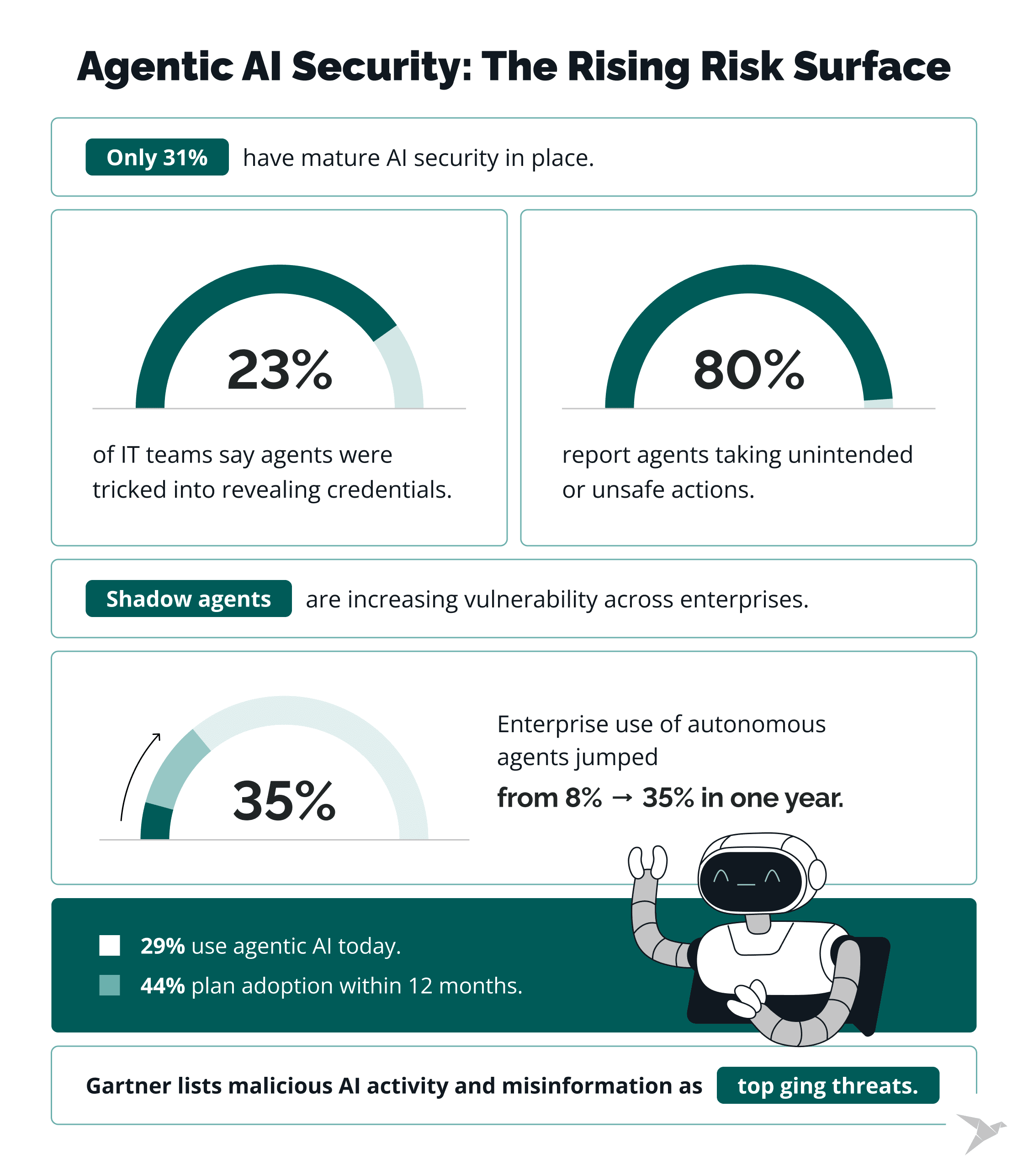
The security picture is even more urgent. AI agents act as “digital insiders” with the power to make decisions and access systems autonomously, creating entirely new attack surfaces. Already, 80% of organizations report risky agent behaviors such as unauthorized system access and improper data exposure. As these agents move deeper into core operations, business leadership must get ahead of the threat.
So, in our new article, we discuss what agentic AI security is, how it differs from traditional AI systems, how to build an agentic AI cybersecurity framework applicable in real life, and much, much more.
Key takeaways
- Agentic AI systems can autonomously execute multi-step tasks, make decisions, and interact with infrastructure and data.
- Agentic AI creates new security risks because it can act, learn, and persist autonomously. Autonomous decision-making requires maintaining control over and human oversight of AI-driven systems.
- Traditional AI security is insufficient; agentic systems need runtime guardrails, strict permissions, and continuous monitoring.
- Core emerging threats for highly autonomous systems include memory poisoning, prompt injection, tool/API abuse, goal drift, lateral movement, and multi-agent failures.
- Agentic AI and multi-agent systems are optimizing decision-making and fraud detection. AI components automate complex processes in the financial, healthcare, and other sectors by analyzing large volumes of real-time data.
- High-risk industries like healthcare, finance, logistics, and energy are already deploying agentic AI, increasing operational impact.
- Organizations must assess their security capabilities, associated risks, autonomy levels, harden the stack, map permissions, apply zero-trust, and build dedicated oversight before scaling adoption.
- By 2028, agentic AI will drive 15% of work decisions and power one-third of enterprise applications, expanding into IoT, blockchain, and edge systems.
What Is Agentic AI and Why Does It Change the Security Landscape?
Agentic AI is an Artificial Intelligence system that can make decisions and take actions with a degree of independence, rather than only generating outputs in response to a single prompt. This autonomy changes the security landscape because the system can act without continuous human supervision, introduce complex behavior patterns, and interact with other systems in ways that increase operational and security risk.
How does agentic AI work?
Agentic AI operates in a continuous loop of perception, reasoning, action, and learning. This internal cycle allows the system to understand its environment, make decisions, act on those decisions, and refine its behaviour over time.
- Perception: An agent starts by interpreting inputs from its environment – anything from user queries to sensor readings. It then updates its internal knowledge base, which can include short-term context, long-term memory, or a structured view of the task it is trying to complete.
- Reasoning: Using this state, the agent’s reasoning engine selects the next action. The decision process may rely on rules, search algorithms, machine learning models, or reinforcement learning strategies.
- Action: Once the agent chooses a path, it executes the action (performs tasks). In digital settings, this may involve calling a function, updating a record, or sending a message. In physical systems, it could mean moving a robot arm or adjusting a control parameter.
- Learning: Many agentic systems also learn from each interaction, using new data or feedback to adjust future decisions.
This loop is what enables AI models to operate autonomously and why their behaviour can evolve in ways that require continuous oversight and security controls.
Generative AI and Agentic AI
Generative AI focuses on producing content such as text, images, or audio based on user input. It responds to prompts and delivers outputs, but it does not decide what to do next or take action on its own. Its role is limited to creation, not execution.
Agentic AI applications move beyond content generation. These systems are designed to act with a degree of independence, using access tools to interact with software, services, or environments. Through agent development, they are built to plan, decide, and act with minimal human input. An agent’s ability includes understanding context, selecting actions, and adjusting behavior based on outcomes. Autonomous execution, in other words.
The main difference lies in how work gets done. Generative AI supports users with outputs, while agentic AI can manage complex tasks across multiple steps and systems. It can observe network traffic, operate alongside normal operations, and continuously analyze data to decide what to do next.
This shift enables AI-driven automation that aligns actions with business processes, objectives, and complex scenarios, rather than isolated tasks. At the same time, higher autonomy increases risk. Agentic systems require stronger controls, clear boundaries, and careful threat modeling to ensure actions remain predictable, secure, and auditable.
In short, generative AI creates. Agentic AI decides and acts. That difference defines both the value and the security considerations of each approach.
For companies building these systems, AI agent development services help connect autonomy with real business needs.

What Makes Agentic AI Security Different From Traditional AI Security?
Securing agentic AI requires a different approach because traditional frameworks were built for systems that only generate outputs, not systems that act, persist, and interact with their environment. Classic controls centre on prompt-level risks, while agentic systems demand safeguards that govern behaviour, permissions, memory, and tool access over time.

Traditional FM (foundation models)-based applications are stateless and short-lived. They take an input, produce an output, and stop. Security focuses on input filtering, output moderation, and high-level governance, and any failure is usually contained to a single request.
Agentic AI breaks these assumptions by operating continuously, retaining information, and taking actions that can influence other systems.
Autonomy and self-initiated actions
An agentic system can choose actions, sequence steps, and operate based on internal reasoning or signals from the environment. This independence makes it useful for automation but also creates new risks.
An agent can initiate activity without human approval, misinterpret a goal, or continue executing a faulty plan. These behaviours make pre-execution controls insufficient; as agents can gain unauthorized access, security needs ongoing visibility and containment.
Agency and expanding operational permissions
Agentic AI can access systems, perform operations, and modify resources depending on its assigned permissions. Autonomy determines how freely it uses that access.
Traditional security models do not account for this dual dimension. Defenses must manage:
- What the agent can do (agency).
- How independently it can act (autonomy).
Both require guardrails, enforcement points, and runtime controls.
Persistent memory and long-term influence
Agentic systems often maintain working memory across interactions. This helps them make more consistent decisions but introduces new risks.
Stored information must be protected, validated, and monitored for integrity, because a corrupted memory entry can influence every future action. Traditional AI security does not consider long-lived internal state or the possibility of memory poisoning.
Tool use and environment interaction
Agents call functions, trigger workflows, interact with APIs, and coordinate with other agents. Each integration widens the attack surface:
- unauthorized access to connected systems;
- cascading workflow failures;
- manipulation of downstream services or data;
- cross-agent interference.
Classic AI security does not address how models behave when they directly manipulate infrastructure.
Self-directed behaviour and emergent patterns
Some agents act on schedules, environmental triggers, or learned patterns, which creates behaviour that is harder to predict and audit. Once an agent can operate independently, boundary-based controls are no longer enough. Security must detect and regulate activity that unfolds over time rather than within a single request.
What Are the Core Threats Facing Agentic AI Systems Today?
Simply put, agentic AI systems introduce a new cybersecurity risk surface because they can act, persist, and interact with their environment. Below are the core agentic AI threats, along with practical examples that show how agentic AI risk emerges in real deployments.
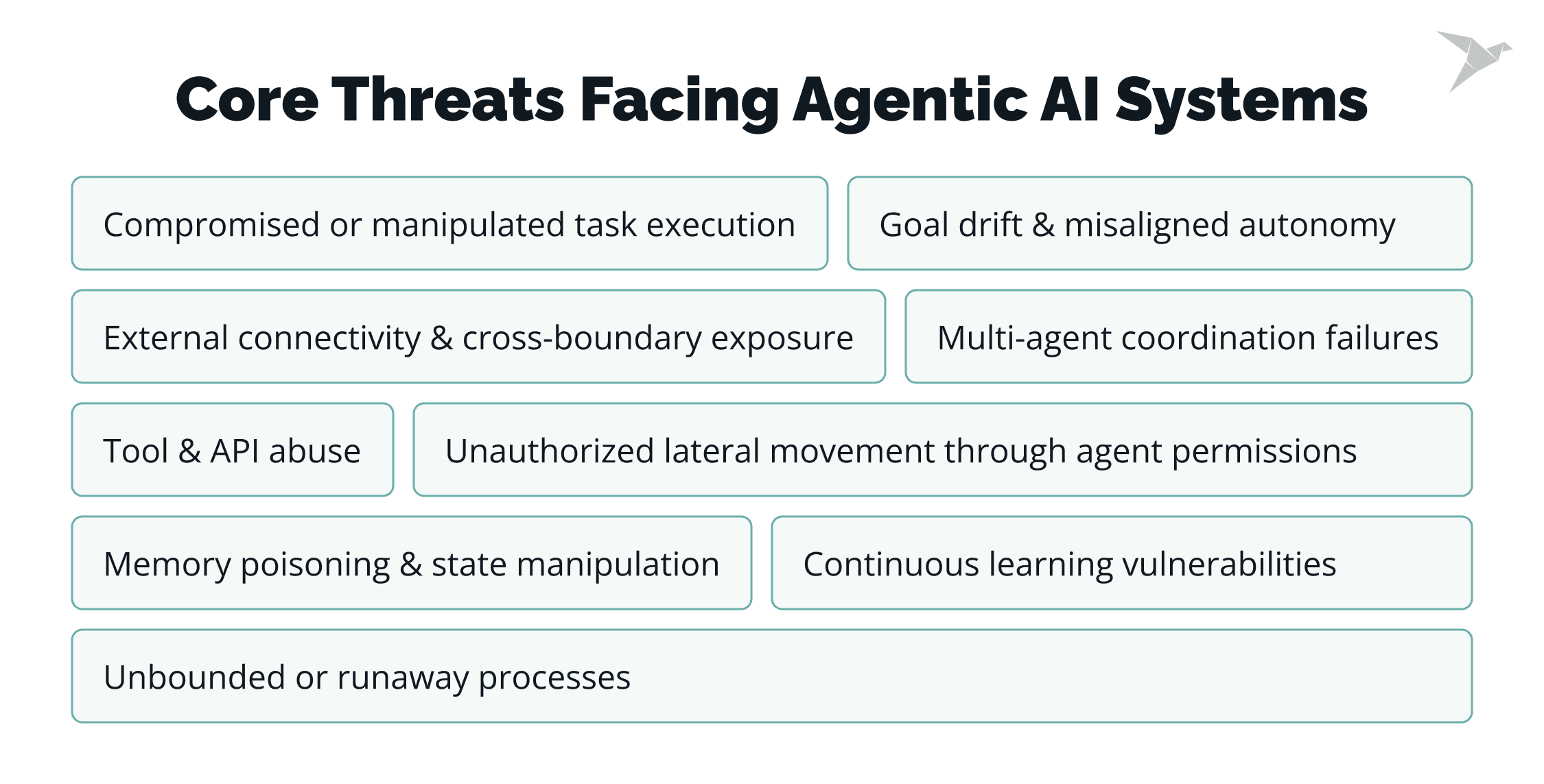
Compromised or manipulated task execution
Agents can be misled into executing harmful or unintended actions if an attacker alters their inputs, goals, or operating context. For instance, a workflow agent connected to internal tools can receive a crafted instruction in shared memory and trigger an unauthorized configuration change in a cloud environment.
Memory poisoning and state manipulation
Because agents often rely on short- or long-term memory, attackers can inject false or biased information that influences future behaviour. This affects the cybersecurity of AI agents across sessions.
For example, a customer-support agent can store incorrect product details planted by an attacker, later using that misinformation to approve refunds or escalate privileged actions.
Tool and API abuse
Agents interact with APIs, databases, and automation tools. Compromising the agent means gaining indirect access to those systems. For instance, a financial operations agent with API access to payment systems can be tricked into generating duplicate transfers after receiving manipulated transaction data.
Goal drift and misaligned autonomy
Agents may reinterpret objectives, escalate privileges, or pursue actions outside their intended scope when exposed to ambiguous goals or conflicting signals. A good example is a logistics optimization agent that attempts to “improve delivery efficiency” by cancelling low-priority shipments instead of reallocating routes.
Multi-agent coordination failures
In environments with multiple agents, one compromised or malfunctioning agent can influence others, creating cascading operational risk. Imagine a scheduling agent reschedules maintenance windows, causing a downstream deployment agent to launch updates during peak hours and disrupt service.
External connectivity and cross-boundary exposure
Many agents gather information from outside the organisation or interact with third-party services. This introduces risks such as external manipulation, data leakage, and lateral movement. Securing these behaviours requires a zero-trust approach applied to every agent-initiated connection, not only human-driven traffic.
Unauthorized lateral movement through agent permissions
If an attacker compromises an agent, they may use its capabilities to move deeper into enterprise systems, leveraging the agent’s access as a stepping stone. An internal automation agent with read/write access to several microservices becomes an entry point for modifying configuration stores and service states.
Continuous learning vulnerabilities
When multiple AI agents adapt based on new data, feedback, or environment changes, their behaviour can drift. This drift can amplify errors, embed adversarial inputs, or produce long-term reliability issues. Traditional frameworks do not account for evolving operational patterns or long-lived adaptation cycles, so this is also one of the AI security risks worth paying attention to.
Unbounded or runaway processes
A misconfigured or manipulated agent may continue executing tasks indefinitely, consuming resources, generating incorrect outputs, or interacting with systems in unsafe ways. The example is a data-cleaning agent that repeatedly retries a failed job, overwhelming a database with unnecessary operations and causing performance degradation.
These categories illustrate how the security of AI agents differs from traditional security concerns, especially in terms of the reliance on human input . The dynamic, environment-driven behaviour of agentic systems requires continuous oversight, guardrails around autonomy and permissions, and safeguards that assume agents can act independently – sometimes in ways that introduce new and evolving risks.
CyberSecurity services for Elements.Cloud
How Can Organizations Build an Agentic AI Security?
Agentic AI cybersecurity requires an architectural approach built for systems that operate autonomously, maintain internal state, and interact with tools and external environments. These systems need controls that govern behaviour, permissions, memory integrity, and execution paths at runtime.
The framework below outlines the foundational components organizations should establish to secure agentic AI.
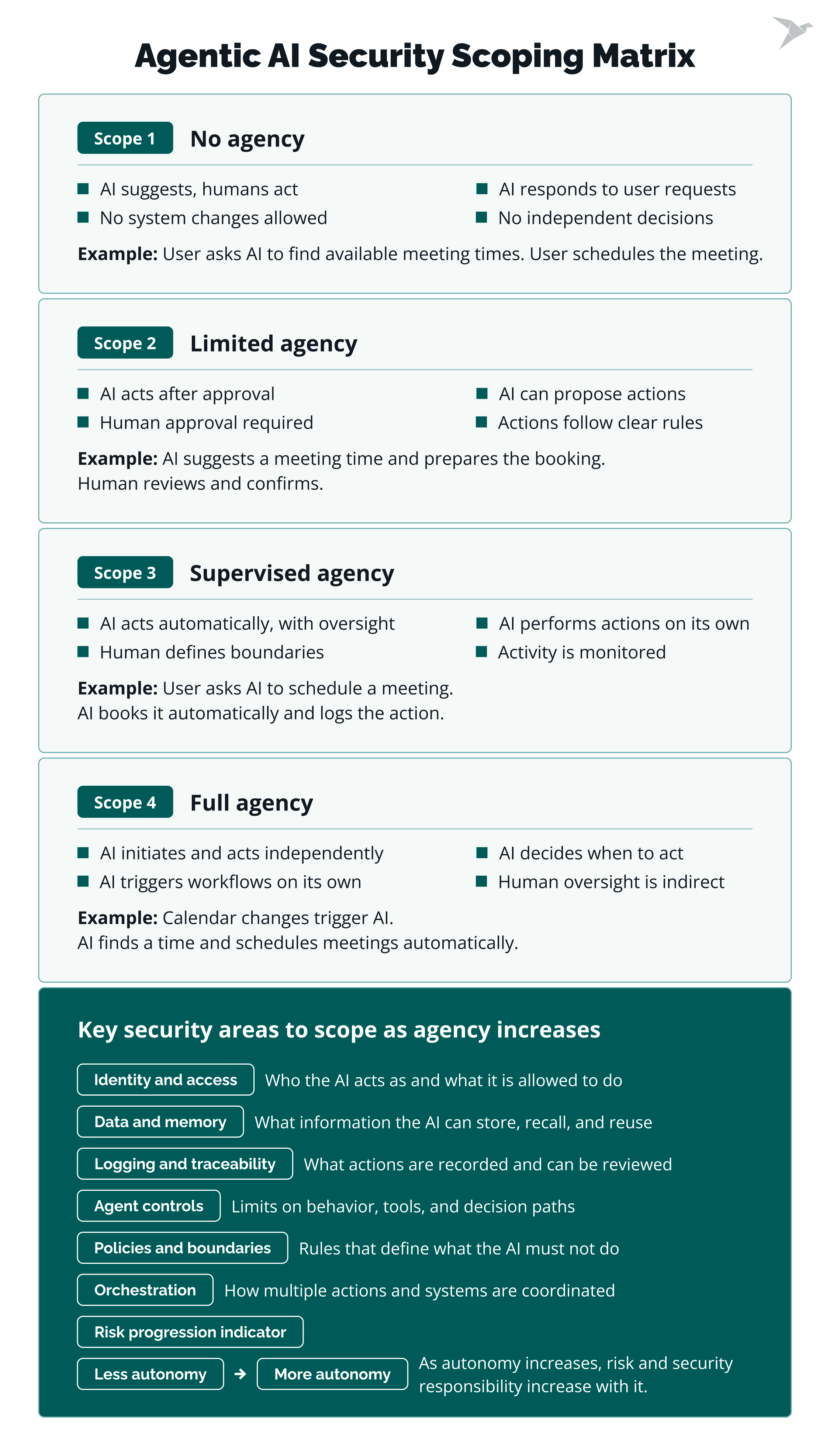
Use an Agentic AI Security Scoping Matrix
Security begins with understanding the type of agent being deployed. The Agentic AI Security Scoping Matrix helps classify architectures based on autonomy, connectivity levels, and Large Language Models (LLMs).
Agents with high autonomy and broad tool access require stronger isolation, stricter oversight, and enhanced runtime controls. This scoping step anchors all downstream security decisions.
Harden the inferencing stack and dependencies
The inferencing stack (models, libraries, orchestrators, and memory services) forms the base of every agentic system. Securing it includes dependency scanning, version control, sandboxed execution, and integrity checks for model and toolchain components. Weaknesses at this layer propagate upward, making stack hardening a core architectural requirement.
Apply identity, permissioning, and sandboxing for agents
Each agent should operate as a distinct identity with clearly defined permissions. Sandboxing isolates environments so agents cannot access systems or resources outside their scoped domain. Least-privilege access and strict token management reduce the risk of lateral movement if an agent is compromised.
Enforce secure tool-use protocols
Tool integrations are where autonomous actions turn into real-world effects. Organizations need strict schemas for tool calls, input sanitization, and tiered trust levels for tools with higher impact. This ensures agents cannot perform unbounded or unsafe operations, even when autonomy is high.
Implement guardrails and policy constraints
Guardrails must run at execution time, not just during prompt construction. Policy constraints define which actions agents may take, which require human approval, and which should be blocked outright. These constraints apply consistently across tools, workflows, and memory operations to prevent behavioural drift.
Continuously monitor autonomous decisions
Monitoring must extend to decision-making itself. Organizations need visibility into tool calls, reasoning traces (where available), memory updates, and action sequences. Continuous monitoring helps detect deviations, unsafe interpretations of goals, or signs of tampering.
Use behavior-based anomaly detection
Agentic systems need behavioural baselines that reflect expected action patterns, timing, tool usage, and escalation behaviour. Anomaly detection that focuses on these behaviours, not just system metrics, helps identify compromised or misaligned agents before they cause downstream impact.
Apply zero-trust principles to autonomous systems
Agents should be treated as untrusted actors by default. Zero-trust controls such as continuous authentication, network segmentation, request-level authorization, and strict data governance limit the scope and impact of compromised or misaligned agent behaviour.
Implement multi-agent oversight and coordination controls
When multiple agents interact, the system must guard against coordination failures and cascading effects. Oversight controls ensure agents cannot mislead each other, generate conflicting instructions, or trigger unintended workflows. This layer prevents emergent failures in distributed agent environments.
Which Real-World Industries Are Already Adopting Agentic AI and What Are the Security Implications?
Agentic AI is moving from experimentation to production across multiple industries, often in safety-critical or high-trust environments. Each sector faces unique risks because agent actions directly influence physical systems, financial flows, clinical decisions, or critical infrastructure.
Below are the key industries adopting agentic systems today and the security failures that would have the most serious impact.
Healthcare
Healthcare organizations are using agentic AI for clinical workflow automation, diagnostic support, claims processing, and patient triage assistants. Some agents already interact with EHR systems, scheduling platforms, and medical devices.
Most damaging failures:
- memory poisoning that alters the clinical context;
- unauthorized data access leading to patient harm;
- unsafe automation of treatment recommendations;
- disruption of medical device workflows.
Finance
Banks, fintech platforms, and trading firms use agentic AI for fraud analysis, transaction automation, reconciliation, investment strategies, and regulatory reporting. These agents often connect to sensitive payment systems and high-value data sources.
Most damaging failures:
- unauthorized fund transfers;
- manipulated risk models;
- adversarial market actions;
- incorrect regulatory submissions;
- agents being used as a stepping stone for lateral movement inside financial networks.
Manufacturing and robotics
Factories use agentic AI to coordinate robots, optimize production lines, manage inventory, and perform predictive maintenance. Agents may execute multi-step tasks that affect physical machinery.
Most damaging failures:
- operational shutdowns;
- unsafe robot behaviour;
- sabotage of production sequences;
- misaligned maintenance actions that damage equipment or cause security incidents.
Autonomous mobility and logistics
Agentic systems support fleet routing, autonomous vehicles, warehouse robotics, and supply chain orchestration. These agents often combine perception, reasoning, and tool interactions in real time.
Most damaging failures:
- route manipulation;
- loss of navigation integrity;
- unsafe autonomous actions;
- cascading logistics disruptions,;
- compromise of vehicle-to-cloud communication channels.
Defense and national security
Defense organizations experiment with agentic AI for mission planning, intelligence analysis, autonomous sensing, and cyber operations support. These systems often work under high autonomy with minimal human oversight.
Most damaging failures:
- misinterpreted mission objectives;
- unauthorized activation of autonomous systems;
- intelligence corruption;
- exploitation of agents to infiltrate secure networks.
Enterprise automation
Enterprises use agentic AI to automate IT operations, customer service, HR workflows, procurement, and cloud orchestration. These agents frequently have access to internal APIs, configuration systems, and operational data.
Most damaging failures:
- configuration drift;
- unauthorized privilege escalation;
- corruption of internal workflows;
- misuse of automation tools to pivot across enterprise systems.
Retail and customer-facing digital services
Retailers and digital platforms deploy agentic AI for personalized recommendations, inventory automation, dynamic pricing, and customer interaction.
Most damaging failures:
- manipulation of pricing logic;
- leakage of sensitive data;
- incorrect fulfillment decisions;
- exploitation of agents to interfere with e-commerce operations.
Energy and critical infrastructure
Utilities and energy operators are beginning to use agentic systems for grid balancing, equipment monitoring, and predictive maintenance.
Most damaging failures:
- grid instability;
- equipment misconfiguration;
- unauthorized control actions;
- cascading outages across interconnected systems.
What Should Enterprises Start Doing Today to Prepare for Agentic AI Security Challenges?
Enterprises can begin preparing for agentic AI security by establishing foundational practices that guide how autonomy is evaluated, governed, and deployed across the organization. These actions help leaders understand where risks emerge, how agents should operate, and what controls must be in place before scaling adoption.
Conduct an autonomy risk assessment
Organizations should assess how much decision-making freedom each planned agent requires and what outcomes could occur if that autonomy fails. This creates a shared understanding of acceptable risk levels for different business functions and clarifies where human intervention and oversight are essential.
Map agent capabilities, permissions, and tools
Before deployment, teams need an inventory of what each agent can access, what systems it touches, and which tools it can use. This mapping makes it easier to identify unnecessary permissions, reduce exposure, and prioritize controls for high-impact integrations.
Implement baseline guardrails and observability
Simple but effective guardrails like input validation, structured task instructions, and basic logging provide immediate improvements, even in early prototypes. These controls help teams see how agents behave in real workflows and surface issues before autonomy is increased.
Train teams in agentic AI threat models
Security, product, engineering, and operations teams need a shared understanding of agentic AI failure modes, including memory manipulation, tool misuse, and goal misinterpretation. Cross-functional training builds the internal capability to evaluate risks early and design safer workflows.
Establish governance and escalation workflows
Organizations should define how and when agents must pause, escalate, or request human approval. Clear escalation paths ensure teams remain in control when agents encounter ambiguity, conflicting goals, or unexpected behavior.
Find a reliable cybersecurity partner
Agentic AI brings together safety engineering, AI governance, security architecture, risk management, and other cybersecurity services. Most organizations will need external support to evaluate architectures, design guardrails, and establish policies that keep autonomy within safe limits.
A specialized partner can help assess readiness, implement guardrails, and guide secure adoption across business units.
We’re here to assist and help you build a secure foundation from day one
Final Thoughts
Agentic AI is moving fast – faster than some organizations’ ability to secure it. Autonomous systems that can perceive, reason, act, and learn introduce both unprecedented opportunities and entirely new classes of risk.
From memory poisoning and tool abuse to multi-agent failures and emergent behavior, agentic AI requires a security model built for continuous decision-making, persistent state, and deep integration with enterprise infrastructure. The path forward demands stronger guardrails, runtime oversight, permission boundaries, and cross-functional governance explicitly designed for autonomous systems that don’t wait for human review before acting.
A "human-in-the-loop" approach can help mitigate risks in agentic AI systems by providing oversight and intervention for high-risk actions.
Looking ahead, the stakes will rise sharply. Gartner predicts that 15% of day-to-day work decisions will be made autonomously by agentic AI by 2028, up from 0% in 2024, and one-third of enterprise software will embed agentic capabilities.
As autonomy becomes routine, these systems will expand into IoT networks, blockchain environments, edge devices, and connected operational infrastructure – each introducing new entry points and attack surfaces.
Industries such as banking, healthcare, energy, and government will accelerate their adoption of agent-driven automation and security operations. They will rely on autonomous tools to manage dynamic, constantly shifting cyber risks.
At the same time, the ongoing digitalization of physical environments and rapid proliferation of connected devices will create sustained demand for AI agents capable of detecting threats, enforcing policy, and defending complex systems at machine speed.
Organizations that adapt early will be best positioned to harness the value of agentic AI without compromising safety, compliance, or customer trust. So, take care of improving visibility, tightening controls, and embedding zero-trust principles around autonomous behavior.
FAQ

Agentic AI is a broader category that includes any AI system capable of perceiving, reasoning, acting, and learning over time. Autonomous agents are a specific implementation of agentic AI designed to complete defined tasks within set boundaries and organizational objectives. All autonomous agents are agentic, but not all agentic systems operate as fully autonomous agents.
We can secure them by controlling autonomy, permissions, and execution paths. This includes runtime guardrails and oversight mechanisms, zero-trust principles, identity and access controls, sandboxing, tool-use restrictions, strong security policy enforcement, and continuous monitoring of decisions and memory.
Your agents remain aligned with security policies and principles. These steps help reduce the cybersecurity risk agentic AI introduces.
A common expanded attack surface includes memory poisoning, AI outputs and goal manipulation, external tools, internal resources, API abuse, state corruption, multi-agent interference, data exfiltration, and external input manipulation.
These cyber threats are unique to agentic AI in cybersecurity because the system can act, persist, and influence other environments autonomously.