
 Software Development
 Security Services
 Cloud Services
 AI Services
 Other Services














 TechMagic Academy


Top Application Security Companies: Up-to-Date Analysis
Last updated:9 November 2025

The average cost of a data breach in the United States is now $10.22 million, and roughly 74% of applications contain at least one security vulnerability. We can spend hours discussing potential cyber threats and the emerging attack vectors. However, one thing is clear: every business, regardless of its industry or size, needs professional protection and effective security solutions.
However, one thing is clear: every business, regardless of its industry or size, needs professional protection and effective security solutions.
There are numerous application security companies. But how do you choose a vendor you can trust with your digital assets and security posture? We’ve put together a list of 10 security leaders: 5 for mid-sized organizations, start-ups, and scale-ups; and 5 for enterprises with complex security needs.
A note on transparency: We grouped and ordered providers by fit rather than brand, and we describe every company, including our own, with the same structure and a limitations section. We have tried to be objective, but we recommend choosing a partner based on your needs rather than its position here.
- TechMagic
- Armor
- Cobalt
- Netragard
- BreachLock
- IBM Security
- Mandiant (part of Google Cloud)
- Palo Alto Networks
- Rapid7
- NCC Group
Key takeaways
- Application cybersecurity is essential as breaches become more costly and frequent.
- A strong AppSec partner combines automation with expert manual testing.
- Mid-sized companies need flexible, DevSecOps-ready security services.
- Enterprises require large-scale, compliance-focused solutions.
- Continuous testing, monitoring, and clear remediation are key to lasting protection.
Our Methodology
At TechMagic, we deliver application security as a service (CREST-accredited penetration testing, SAST/DAST, threat modeling, and DevSecOps) for product teams in regulated industries such as FinTech and HealthTech. That hands-on delivery is the lens we used here: we know what separates a vendor that produces an actionable, low-false-positive report from one that hands over a raw scanner dump.
Because we are included in this list, we applied the same structure and the same scrutiny to our own entry, including its limitations. The goal is a comparison that reads as fair even to someone who does not know we compiled it.
How we built this list
We grouped providers into two tiers, one for mid-sized businesses, startups, and scale-ups, and one for enterprises with complex needs, because the right AppSec partner depends heavily on your size and compliance load.
Within each tier, we assessed providers on the criteria we apply in real engagements: breadth and depth of testing (SAST, DAST, SCA, and manual penetration testing), certifications and compliance coverage, CI/CD and DevSecOps integration, testing accuracy, and remediation support.
We cross-referenced our own delivery experience with public reviews on Clutch, G2, and Gartner Peer Insights and with each vendor's published service information. The order within each tier reflects fit for execution-focused application security, not size or brand.
What Are the Top 10 Application Security Companies?
We've created a list of top mobile application security testing companies based on their services and reputation. You can find providers for businesses of different scales.
AppSec companies for mid-sized businesses and startups
1. TechMagic
TechMagic delivers tailored application security services designed to protect web, mobile, API, cloud environments, and AI integrations from evolving threats. The company holds CREST accreditation for penetration testing, combining advanced testing techniques with a deep understanding of each client’s business context.
Rather than relying on off-the-shelf templates, TechMagic begins by analyzing the client's infrastructure, business model, and compliance needs – then designs a solution aligned with those specific requirements.
From architecture reviews and threat modeling to manual and automated testing, as well as DevSecOps implementation, TechMagic supports application resilience at every stage. The company also provides advisory and implementation services to help clients prepare for standards such as ISO 27001, SOC 2, HIPAA, and PCI DSS.
With extensive experience working in regulated industries such as FinTech and HealthTech, TechMagic’s full-lifecycle approach ensures audit readiness and helps maintain a strong, compliant security posture tailored to each organization’s goals.
Core services:
- Application security as a service (ASaaS).
- DevSecOps integration and security consulting.
- Static and dynamic application security testing (SAST & DAST).
- Penetration testing, threat modeling, and risk assessment.
- Compliance and audit support (ISO 27001, SOC 2, HIPAA, PCI DSS).
Best fit for: Scale-ups, startups, and mid-sized businesses that want product-focused, execution-driven AppSec.
Strengths:
- CREST-accredited manual penetration testing combined with automated SAST/DAST.
- Full-lifecycle coverage, from architecture review through DevSecOps and remediation.
- Strong compliance support for regulated FinTech and HealthTech work (ISO 27001, SOC 2, HIPAA, PCI DSS).
Limitations:
- Smaller than the global enterprise providers on this list, with a narrower geographic footprint.
- Best fit for product, startup, and scale-up security rather than very large multinational programs or always-on enterprise SOC/MDR.
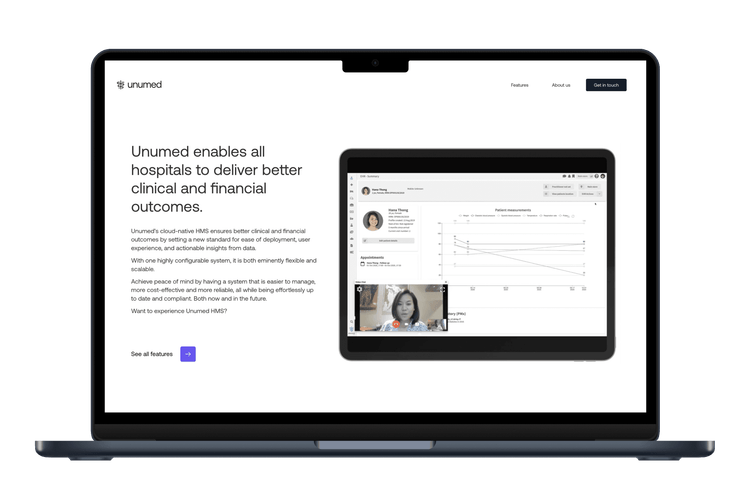
Penetration testing of a cloud-native hospital management system before the annual ISO 27001 audit
2. Armor

Armor is a managed security services provider (MSSP) that delivers comprehensive protection for applications, workloads, and data across cloud and hybrid environments. The company focuses on managed detection and response (MDR), cloud security, and compliance enablement, helping organizations maintain visibility and control over their digital assets.
Core services:
- Managed detection and response (MDR).
- Cloud security posture management.
- Vulnerability management.
- Compliance and audit support.
- Threat intelligence and advisory.
Best fit for: Mid-sized businesses that want managed, always-on protection across cloud and hybrid environments.
Strengths:
- Managed detection and response with continuous cloud and hybrid visibility.
- Built-in compliance enablement alongside monitoring.
- Reduces the need for an in-house security operations team.
Limitations:
- An MSSP/MDR focus means less depth in deep, manual application penetration testing.
- Oriented to ongoing managed monitoring rather than one-off, bespoke AppSec assessments.
3. Cobalt
Cobalt is a cybersecurity services provider that offers Penetration Testing as a Service (PtaaS). The company delivers scalable, on-demand security testing for web, mobile, and API applications. Cobalt’s model connects clients with a vetted community of ethical hackers and security professionals to ensure deep, real-world testing coverage.
Core services:
- Penetration testing (web, mobile, and API).
- Continuous vulnerability assessment and management.
- Remediation guidance and risk reporting.
- DevSecOps integration and security consulting.
Best fit for: Startups and mid-sized technology companies that want fast, on-demand, repeatable pentesting.
Strengths:
- Scalable, on-demand PtaaS with quick turnaround.
- Access to a large, vetted community of testers.
- Integrates testing into DevSecOps workflows.
Limitations:
- A crowd-sourced model means consistency can depend on the specific testers assigned.
- Less suited to a long-term, embedded advisory relationship than a dedicated consultancy.
4. Netragard

Netragard is a cybersecurity company that provides manual, research-based penetration testing and vulnerability assessment services. The firm uses realistic attack simulation to identify weaknesses in web, mobile, and network environments that could lead to sensitive data exposure . Its testing approach focuses on understanding how real-world threats could exploit systems and providing practical remediation steps.
Core services:
- Web, mobile, and API penetration testing.
- Vulnerability assessment and risk analysis.
- Exploit development and proof-of-concept testing.
- Security auditing and remediation guidance.
Best fit for: Mid-sized businesses that want deep, manual, attacker-realistic testing.
Strengths:
- Deep manual, research-based testing rather than scanner-led results.
- Realistic attack simulation and exploit development.
- Practical, context-rich remediation guidance.
Limitations:
- Boutique scale, with less capacity than larger firms for very large or distributed programs.
- A manual-first approach is less suited to high-frequency, automated CI/CD scanning needs.
5. BreachLock
BreachLock is a cybersecurity services provider that offers a mix of automated and manual application security testing. The company focuses on helping organizations identify vulnerabilities in web, mobile, and API applications through regular, repeatable testing cycles. Its service model combines technology with human verification to deliver reliable results and remediation guidance.
Core services:
- Web, mobile, and API penetration testing.
- Vulnerability scanning and assessment.
- Remediation validation and reporting.
- Cloud and infrastructure security testing.
- Compliance and audit readiness.
Best fit for: Startups and mid-sized businesses that want repeatable, platform-driven testing with human verification.
Strengths:
- Blends automated scanning with human verification.
- Repeatable testing cycles suit continuous assurance.
- Built-in compliance and audit readiness support.
Limitations:
- A platform-driven model can feel less bespoke for complex, custom architectures.
- Depth of manual testing may be lighter than specialist manual-first firms.
AppSec companies for complex enterprises
1. IBM Security
IBM Security provides a broad range of cybersecurity services for enterprises across cloud and on-premise environments. Its focus is on identifying, managing, and remediating risks through automation, analytics, and expert support.
Core services:
- AppScan application security testing.
- Cloud and threat management.
- Vulnerability management.
- Penetration testing and red teaming.
- Security consulting.
Best fit for: Large enterprises and global organizations needing broad, integrated security coverage.
Strengths:
- Broad enterprise coverage spanning AppScan, cloud, vulnerability management, and red teaming.
- Strong automation, analytics, and global support.
- Deep experience in large, regulated environments.
Limitations:
- Enterprise scale and cost make it likely over-scoped and expensive for startups and mid-market teams.
- Engagements can carry significant onboarding and configuration overhead.
2. Mandiant (part of Google Cloud)
Mandiant is a leading provider of enterprise-level application and infrastructure security services backed by real-time threat intelligence and incident response expertise. The company focuses on helping large organizations test, detect, and mitigate risks in response to sophisticated cyber threats across complex digital ecosystems and cloud native platforms. Its consulting teams work closely with enterprises to assess security posture, improve resilience, and align with global compliance standards.
Core services:
- Application and cloud security assessments, API testing.
- Red teaming and adversary emulation.
- Threat intelligence and incident response.
- Security program development and validation.
- Compliance and risk management consulting.
Best fit for: Large enterprises, government agencies, and organizations in highly regulated industries.
Strengths:
- Elite threat intelligence and incident-response pedigree.
- Strong red teaming and adversary emulation.
- High credibility for high-stakes, board-level engagements.
Limitations:
- Premium, enterprise- and incident-response-oriented, so it is not aimed at routine AppSec for smaller teams.
- Cost and engagement model are a poor fit for startups and mid-market budgets.
3. Palo Alto Networks
Palo Alto Networks is a global cybersecurity leader offering unified protection across applications, networks, and cloud environments through cybersecurity services and its Prisma Cloud|Cortex application security platform.
Core services:
- Prisma Cloud (cloud-native application protection for workloads, APIs, and data).
- Cortex XDR/XSIAM (AI-driven detection, response, and threat automation).
- Application and API security.
- Next-Generation Firewall (NGFW).
- Security consulting and managed services.
Best fit for: Medium to large enterprises and public sector organizations consolidating on a unified platform.
Strengths:
- Unified platform spanning cloud, network, and application security.
- AI-driven detection and response via Cortex.
- Strong fit for organizations standardizing on one security ecosystem.
Limitations:
- Platform-centric, so value is highest when you consolidate on Palo Alto rather than mix tools.
- Enterprise pricing and complexity can be heavy for smaller teams.
4. Rapid7
Rapid7 is a cybersecurity services provider delivering managed application security, vulnerability management, and penetration testing. The company helps organizations strengthen their security posture across web, mobile, and cloud environments.
Core services:
- Managed application cybersecurity services.
- Penetration testing.
- Vulnerability management (InsightVM).
- Cloud and container security.
- Compliance and risk advisory.
Best fit for: Complex enterprise organizations that want managed AppSec plus integrated vulnerability management.
Strengths:
- Managed application security combined with InsightVM vulnerability management.
- Broad posture coverage across web, mobile, and cloud.
- Established platform with strong analyst recognition.
Limitations:
- Enterprise-oriented, so smaller teams may not need the full platform.
- Getting full value depends on adopting the wider Rapid7 toolset.
5. NCC Group
NCC Group provides extensive application security and risk management services for enterprise and critical infrastructure organizations. Its consultants perform in-depth testing and security assessments across complex systems and global operations.
Core services:
- Application, network, and cloud penetration testing.
- Secure architecture review.
- Threat modeling and risk assessment.
- Continuous security monitoring and program development.
Best fit for: Large enterprises and regulated industries, including finance, energy, and telecommunications.
Strengths:
- Deep, expert-led testing and secure architecture review.
- Experience with critical infrastructure and complex global operations.
- Strong research reputation and credibility.
Limitations:
- Consultancy pricing and lead times suit large enterprises more than fast-moving startups.
- Engagements can require more planning and budget than on-demand PtaaS models.
What to Look for When Choosing an App Security Company?
The ultimate goal in choosing the right app security partner is to find a provider that can protect your web apps, mobile apps, APIs, and cloud platforms. Top companies in application security can also perfectly match your development speed and business goals. How to do this? How to find this perfect match? From our perspective, these are the most important factors to consider.
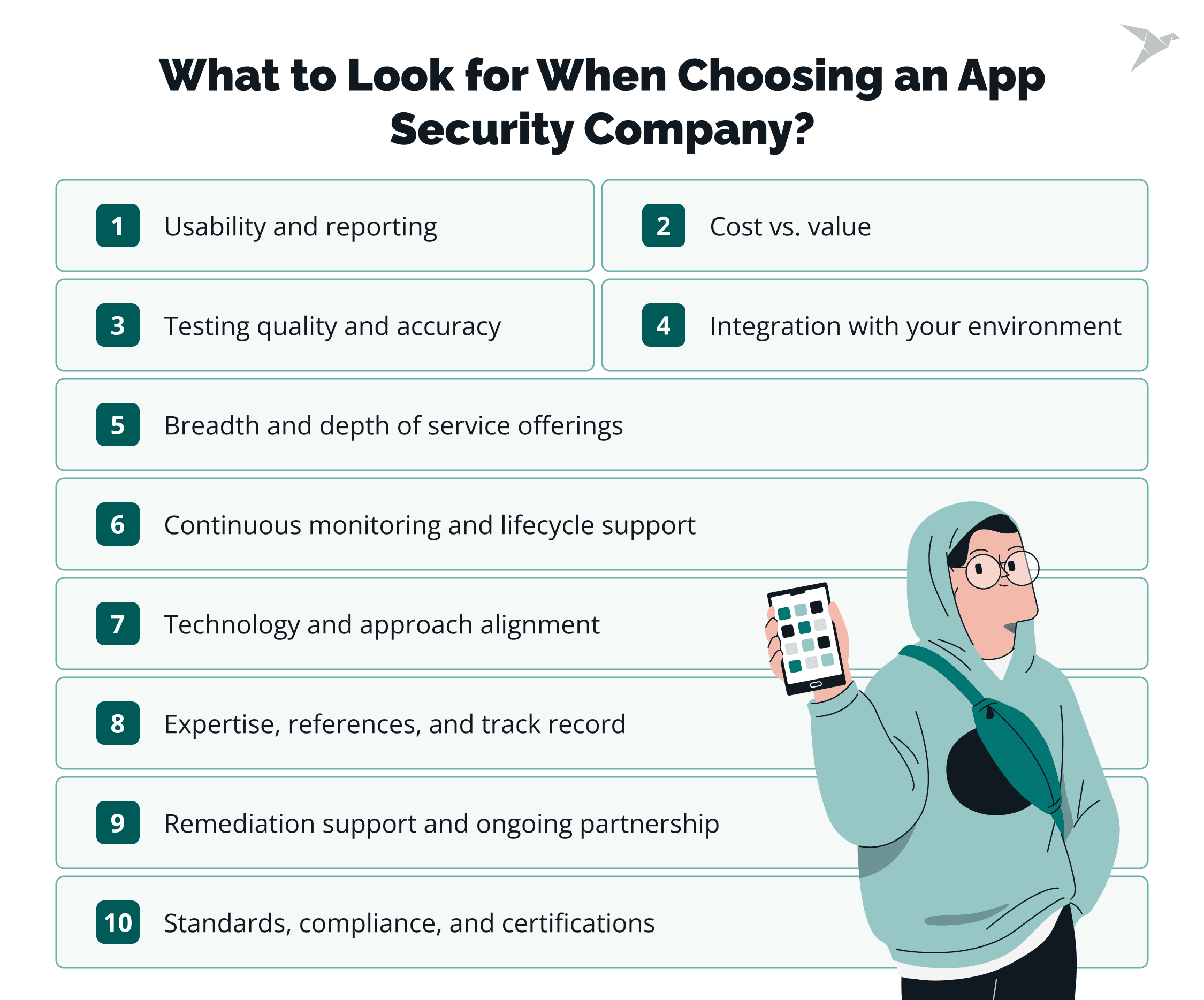
Breadth and depth of service offerings
A mature security company should cover all key testing methods: static app security testing (SAST), dynamic application security testing (DAST), and software composition analysis (SCA).
Each technique targets a different attack surface:
- SAST detects flaws in source code before deployment.
- DAST identifies vulnerabilities in running applications.
- SCA reveals risks in open-source dependencies.
When your provider offers a full range of application security services and combines automated scanning and manual penetration testing, it gives a more complete view. Manual expertise is especially valuable for complex logic flaws or misconfigurations that tools often miss.
Standards, compliance, and certifications
Look for companies that align with established security frameworks such as ISO 27001, SOC 2, NIST, OWASP Top 10, and more. Compliance shows the provider follows consistent processes for data protection, incident management, and continuous improvement.
In regulated industries like healthcare or fintech, certifications can be mandatory for meeting HIPAA, PCI DSS, or GDPR requirements. All reliable app security companies have the necessary certifications in place.
Integration with your environment
Professional security testing shouldn’t interrupt development. The top application security companies offer solutions that integrate directly into CI/CD pipelines, issue trackers, and IDEs, so vulnerabilities are flagged early in the lifecycle.
This approach aligns with DevSecOps, where security becomes part of the delivery process instead of a separate bottleneck.
CyberSecurity services for Elements.Cloud
Testing quality and accuracy
The effectiveness of your security testing depends on the signal-to-noise ratio. Excessive false positives waste time, while false negatives leave critical gaps.
Choose vendors who provide validated testing results, explain vulnerabilities in context, and maintain a reputation for accuracy. Many advanced providers combine AI-based prioritization with human verification to balance speed and reliability.
Usability and reporting
Security insights are only valuable if they’re easy to act on. A strong AppSec partner delivers intuitive dashboards, risk-based prioritization, and clear remediation guidance.
Reports should be tailored to different audiences, like executive summaries for management and technical details for engineers. This clarity helps teams focus on fixing the most critical issues first.
Continuous monitoring and lifecycle support
Application cybersecurity is always a continuous effort. The threat landscape changes daily, and new vulnerabilities emerge with every code update, especially in the context of mobile applications . So, look for providers offering ongoing assessments, real-time monitoring, and vulnerability management dashboards. Continuous testing ensures your applications stay compliant and protected over time to prevent data breaches.
Tech alignment
Technology and approach alignment is crucial for seamless integration with business operations. Your security partner should align with your technologies, whether you run cloud-native microservices, hybrid infrastructures, or legacy monoliths. The right security teams will support containerized environments, modern frameworks, and your preferred cloud provider (AWS, Azure, or GCP).
They should also share your philosophy: automation-first, developer-centric, or compliance-driven.
Expertise, references, and track record
AppSec is a trust-based partnership. Application security testing vendors are the ones who build an application security strategy for your organization, so look for someone with proper expertise and a good reputation.
Review the provider’s case studies, client references, and industry experience. A proven history in penetration testing, red teaming, or vulnerability management reflects maturity and reliability. Independent reviews, analyst mentions, and public security contributions (like CVEs) also signal credibility.
Cost vs. value
When evaluating proposals, compare not only the price but also the return on risk reduction. How quickly are issues identified, prioritized, and resolved? A vendor offering better accuracy and faster turnaround often saves far more in remediation costs.
Remediation support and ongoing partnership
A detailed report is useful, but it’s only the beginning. Top-tier AppSec providers offer guided remediation, developer training, and retesting after fixes.
This collaborative approach helps teams strengthen secure coding practices and maintain resilience long-term. A partner committed to knowledge transfer ensures security improvements persist even after the engagement ends.
Why Partner with TechMagic for Application Security Services
Choosing the right application security testing companies is only half the battle. What matters is finding one that truly understands your business.
At TechMagic, we deliver a full range of application cybersecurity services tailored to your tech stack, risk profile, and regulatory landscape. Our team helps you select and integrate the most effective security toolset from the market, covering SAST, DAST, SCA, and beyond. Our security experts ensure that every layer of your application is highly protected.
We’ve worked with regulated industries like FinTech and HealthTech, helping clients such as Mamo and Unumed strengthen their compliance posture. No matter if you’re preparing for ISO 27001, SOC 2, or HIPAA audits, or embedding security into a DevSecOps workflow. We support you through every step of the process: from assessment to continuous monitoring.
Our approach is simple: we combine proven testing methods with advisory expertise to make security practical, measurable, and aligned with your business goals.
We have a proven track record and are happy to assist

Wrapping Up
App cybersecurity has become a continuous and strategic part of modern software development. The companies highlighted in this analysis represent different strengths within the same mission: protecting applications across web, mobile, API, and cloud environments. Each provider demonstrates that true effectiveness comes from combining automation, human expertise, and compliance readiness.
What to look for in a cybersecurity provider?
Selecting the right partner goes beyond comparing tools. The best app cybersecurity companies integrate seamlessly with your workflows, adapt to your tech stack, and maintain accuracy with minimal false results. A reliable provider supports you through every phase.
An ideal partner acts as an extension of your team: identifies risks early, explains vulnerabilities in context, and helps developers remediate issues quickly without slowing delivery.
What to consider for the future?
The future of application cybersecurity is defined by Artificial Intelligence and Machine Learning in close combination with rare human expertise. Cloud native solutions or business networks: all security risks will be remediated with automation, intelligence, and collaboration.
Security testing will move even further left, embedding into the earliest stages of development through AI-assisted analysis and automated code scanning. Context-driven risk visibility will help security and development teams focus on the most critical issues rather than volume.
As businesses continue migrating to cloud-native architectures, application, API, and configuration security will converge into unified programs. Yet even as automation advances, human expertise (manual validation, incident response, and developer education) will remain crucial for accuracy and trust.
It is the only way to ensure comprehensive visibility in your security processes. So look for a partner who can offer both: AI and automation tools and unparalleled human expertise.
FAQ

Application security is the practice of protecting software applications (web services, mobile, API, and cloud) from threats and vulnerabilities that could lead to data breaches or service disruptions.
It’s important because most cyberattacks on enterprise security now target the application layer, where sensitive data and business logic reside. Strong security measures, incorporated into the app development cycle, help prevent financial loss, reputational damage, and compliance failures.
Application security companies help identify and fix vulnerabilities before attackers can exploit them. They use both automated testing and manual penetration testing to find security flaws early in the software development lifecycle.
Beyond threat detection and secure software development, they assist with remediation, compliance readiness, and continuous monitoring. Their services may include api security testing, endpoint security testing services, application security posture management, and more. Ultimately, they are building long-term resilience against evolving threats.
Top application security testing companies secure a wide range of digital assets, including web applications, mobile apps, APIs, and cloud-native systems. They can cover network security, software supply chain, and more. With organizations increasingly shifting to cloud services and mobile environments, comprehensive protection across platforms has become a business-critical priority.
Application security testing is a broad, ongoing process that includes multiple testing types (like SAST, dynamic analysis, and SCA), functional testing, secure coding practices, and lifecycle support
Penetration testing, by contrast, is a focused assessment simulating real-world attacks to uncover vulnerabilities at a specific point in time. While pen testing is one part of app cybersecurity, a full AppSec strategy integrates testing continuously across development, deployment, and software innovation.