
 Software Development
 Security Services
 Cloud Services
 AI Services
 Other Services















 TechMagic Academy


Top EHR Development Companies: How to Choose the Right Partner for Your Healthcare Project
Last updated:12 June 2026


Choosing an EHR development partner affects compliance, clinical workflows, and long-term operational success. If you choose wisely, you get a stable platform that clinicians trust, and your IT team can grow with. If you choose poorly, you inherit technical debt and frustration that lasts for years.
Most U.S. hospitals and physician practices already rely on EHRs. In 2024, 95% of office-based physicians in the United States used an EHR system, and more than 80% used certified EHR technology, according to the CDC.
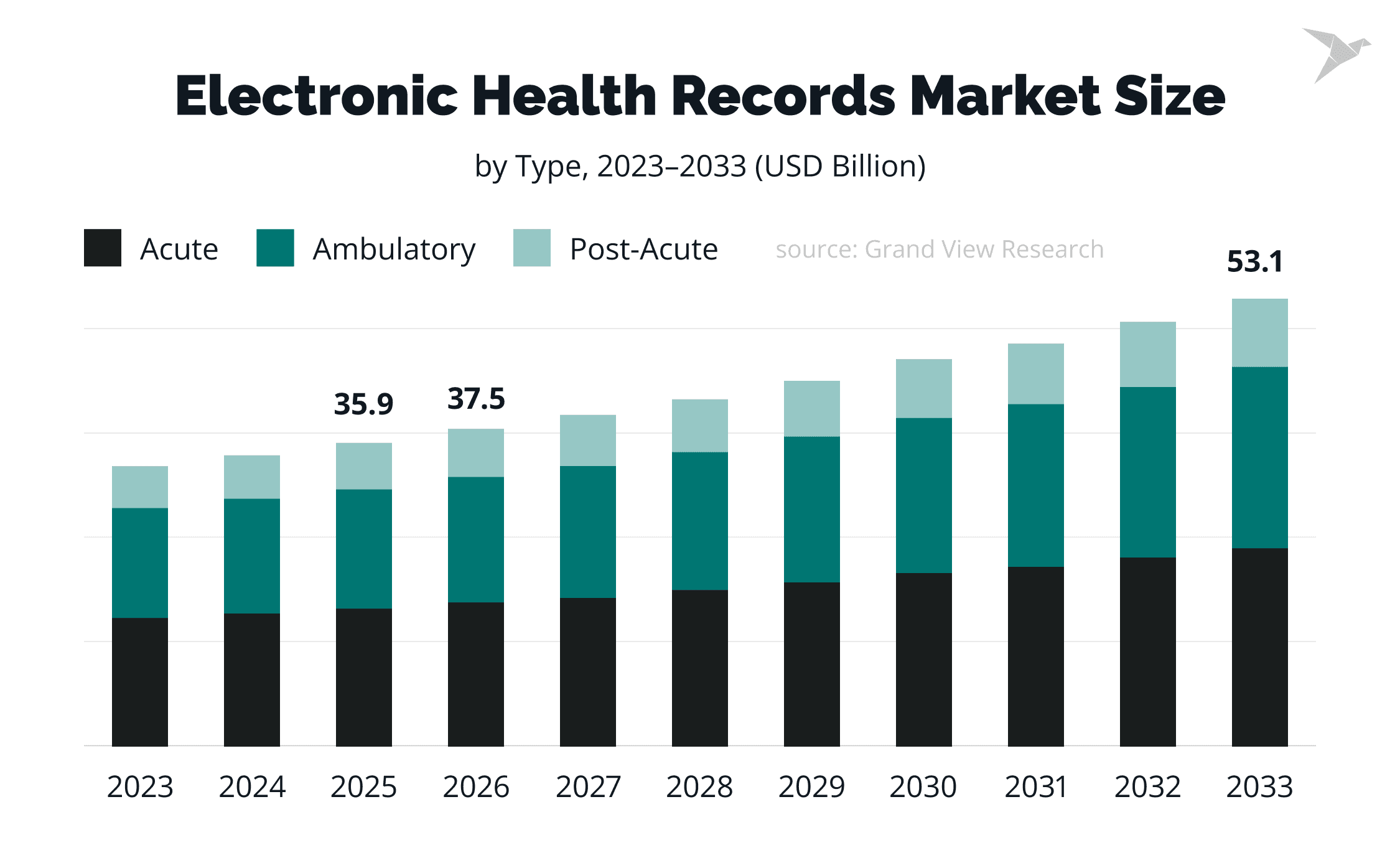
In addition, Grand View Research reported that the global electronic health records market was valued at $35.89 billion in 2025 and is expected to grow to $53.11 billion by 2033, reflecting a CAGR of 5.10% between 2026 and 2033. The facts show how deeply these platforms are embedded in care delivery.
At the moment, you might be replacing a rigid legacy EHR that slows clinicians down. You might be building a specialty-specific system from scratch. Or you may be expanding across locations and need your EHR to handle higher patient volumes, new integrations, and stricter compliance demands. When you’re at this point, every decision carries weight.
The market is crowded with EHR software development companies, and many position themselves among the top EHR development companies. In this guide, we break down the criteria that truly matter, the services strong partners provide end-to-end, and how to compare vendors effectively before making a final decision.
Key Takeaways
- Choosing the right partner among EHR software development companies directly impacts compliance, clinician efficiency, and long-term system stability.
- Strong interoperability capabilities ensure your EHR integrates smoothly with labs, pharmacies, billing platforms, and patient health information exchanges.
- The best EHR development companies show proven experience with real clinical workflows and production EHR systems.
- Security architecture, including encryption, access controls, and audit logging, must be built into the system from the start.
- Strong knowledge of HIPAA, GDPR, FHIR, and HL7 is critical when comparing top EHR system development companies.
- Full-cycle service delivery separates leading vendors from limited-scope providers.
- Clear answers about scalability, ownership, and total cost help you evaluate the best EHR system development companies objectively.
- It is smart to choose from EHR development companies that design cloud-ready, integration-focused systems built for future growth.
Why Trust the List in This Article
At TechMagic, we have built healthcare software since 2014, including custom EHR and EMR platforms, legacy modernization, and FHIR and HL7 integrations for providers in the US and Europe. That work runs into the constraints that decide real EHR projects: HIPAA and NHS requirements, clinical workflows, data migration, and audit readiness.
Our security specialists hold CREST accreditation and a Certified AI/ML Pentester credential (The SecOps Group), so we read a vendor's security claims against how the work actually holds up. We have sat on both sides of these projects, which is why we weigh companies on delivery evidence rather than reputation alone.
We did not test every vendor ourselves. We reviewed companies that offer EHR or healthcare software development as a named, active service, and looked past those that mention healthcare only in passing. Our sources: verified client reviews on Clutch and Google, public case studies, market and regulatory research, company documentation, and our own experience delivering and comparing healthcare systems.
How we selected companies: evidence of healthcare and EHR delivery, relevant compliance and interoperability work, and enough public information to assess fit.
Timing: reviewed June 2026. Services, pricing, and team size change often, so confirm current details with each company before you decide.
Our company is included in this list, ordered by the criteria below; we have tried to be objective, but encourage you to form your own opinion.
What Criteria Should You Use to Evaluate EHR Development Companies?
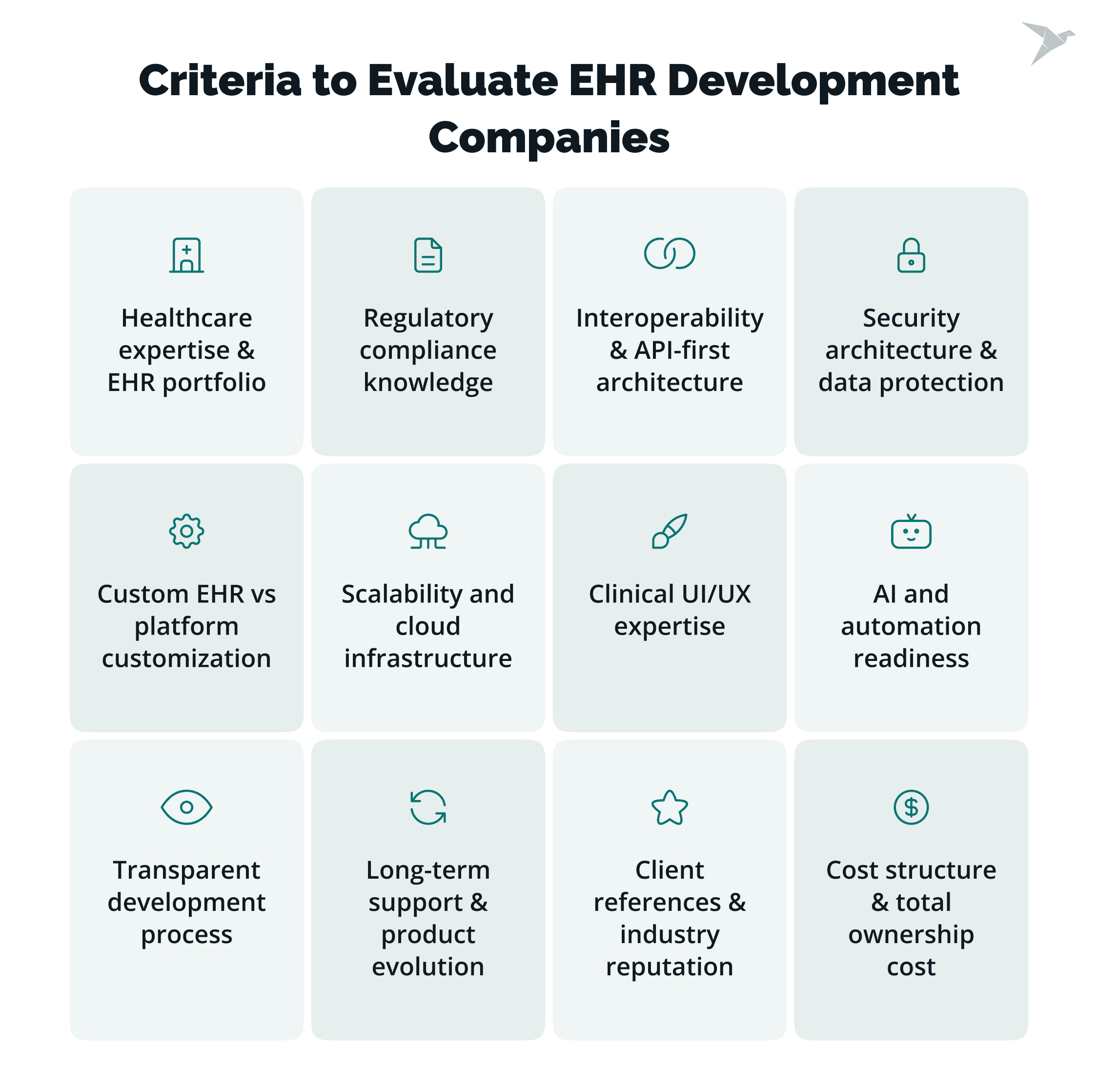
You should evaluate EHR development companies based on healthcare expertise, compliance depth, interoperability strength, security architecture, scalability, and long-term partnership readiness. The right criteria reduce risk, protect patient data, and ensure your system can evolve with your organization. Let’s break down what truly matters.
Proven healthcare domain expertise and EHR portfolio
Not every healthcare app developer can build an EHR. When evaluating any EHR software development company, ask for real examples of production EHR systems. Look for experience with clinical documentation, scheduling, billing integration, and multi-role access. Complex workflows in real environments matter more than polished demos.
Ask what specialties they’ve supported, how they handle high-volume documentation, and whether they’ve worked with real constraints like legacy systems, downtime procedures, and data migration. A strong vendor can explain how their EHR decisions improved adoption, reduced friction, or supported safe care delivery.

Regulatory compliance knowledge (HIPAA, GDPR, HL7, FHIR)
Compliance should be embedded in the development process, not added at the end. Strong EHR software development companies can explain how they implement HIPAA safeguards, manage data residency, and apply FHIR or HL7 standards in real integrations. Today, EHR platforms are increasingly adopting 'FHIR-first' approaches using modern FHIR APIs for data exchange. Practical experience beats theoretical familiarity.
Look for specifics: encryption in transit/at rest, audit logging design, access controls aligned with workforce roles, and how they manage vendor risk (BAA support, subprocessors, environment segregation). Weak compliance and security discipline carry financial consequences. IBM’s 2025 Cost of a Data Breach Report concluded that the average healthcare breach cost reached $7.42 million, the highest of any industry.
Interoperability capabilities and API-first architecture
Your EHR will not operate in isolation. Vendors should demonstrate hands-on experience integrating labs, pharmacies, HIEs, billing platforms, and third-party healthcare systems. An API-first mindset makes future integrations easier and lowers long-term costs, especially when you add new sites, specialties, or partner systems.
Statistics prove the importance of interoperability. In 2024, 70% of U.S. hospitals enabled FHIR-based app access, according to ONC data. At a national scale, TEFCA now connects over 70,000 sites and has facilitated more than 474 million document exchanges. The ecosystem is expanding rapidly.
Security architecture and data protection practices
Security must always be structural. Evaluate encryption standards, role-based access control, audit logs, secure cloud configuration, and incident response processes. Ask how security reviews and penetration testing are handled during development, and whether they do threat modeling for EHR-specific risks like improper access, over-privileged roles, and insecure integrations.
Also, validate operational security: secrets management, logging/monitoring coverage, least-privilege cloud IAM, and how they handle break-glass access and auditability in clinical scenarios. If you operate in the cloud and your environment is hybrid, this significantly increases complexity. IBM reports that breaches involving hybrid cloud architectures cost an average of over $5 million and take nearly 283 days to identify and contain.
Custom EHR development vs. product customization approach
Some vendors build EHRs from scratch. Others customize an existing platform. Both can work, but they lead to different outcomes in flexibility, ownership, and long-term control. Custom builds are best when you need specialty workflows, deep integrations, or full influence over roadmap and architecture.
Product customization can speed up delivery if your processes match standard care workflows. The tradeoff is constraints: limited API depth, harder upgrades, licensing dependencies, or vendor-controlled data models. Ask who owns the code and schema, how upgrades work, and what happens if you later need to migrate or rebuild modules.
Scalability and cloud infrastructure expertise
Your EHR should support growth without performance issues. Assess cloud architecture design, load handling, high availability, and multi-location deployments. Scalability planning separates mature vendors from short-term builders.
Global cloud spending reached $723.4 billion in 2025, according to Gartner. Healthcare systems increasingly rely on scalable cloud infrastructure. That's why your vendor should demonstrate proven experience in this environment.

UI/UX expertise in clinical workflows
In an EHR, UX directly affects clinician time, documentation quality, and adoption. The best EHR development companies design around real tasks like charting during visits, medication workflows, orders/results review, and handoffs between roles. They reduce clicks, clarify information hierarchy, and make common flows fast and consistent.
Look for vendors that validate designs with healthcare professionals. They should run workflow mapping, usability testing, and iterative pilots, then measure impact (time to document, error reduction, satisfaction). Good EHR UX also covers role-based views and device realities: desktop for admins, tablets for bedside, mobile for quick review.
AI and automation readiness
Modern EHR and EMR software systems increasingly rely on automation. Vendors should understand AI-assisted documentation, clinical decision support, predictive analytics, and workflow automation. Modern AI-driven EHR software usually uses adaptive learning to recognize each provider's unique workflow and improve documentation speed, accuracy, and clinical efficiency over time. Even if you do not implement AI immediately, the architecture should allow it.
In fact, AI is already embedded in many hospital environments. ONC reported that in 2024, 71% of U.S. hospitals used predictive AI integrated into their EHR systems. At the same time, 82% reported formally evaluating AI tools for accuracy and 74% for bias.
Transparent development process and communication model
EHR projects involve clinical, IT, security, and compliance stakeholders. A transparent vendor runs structured sprints, clear demos, written decisions, and predictable reporting. You should always know what’s shipping, what’s blocked, and what risks exist before they become production incidents.
Ask how they manage requirements changes, approvals, and documentation. For EHRs, transparency should include integration specs, audit-related artifacts, and security checkpoints built into delivery. A mature vendor can show how work moves from discovery to build to validation without “black box” delivery.
Long-term support, maintenance, and product evolution strategy
An EHR is a living system: regulations evolve, standards change, and integrations break when external systems update. Evaluate how the vendor handles patches, monitoring, incidents, performance tuning, and uptime commitments. For clinical systems, support is part of safety and continuity.
Also, check product evolution. Do they offer roadmap planning, capacity to add modules, and a clear release process that won’t disrupt clinics? Ask how they handle FHIR/HL7 updates, security testing cadence, and how they keep the EHR stable as usage scales across sites.
Client references, case studies, and industry reputation
For EHR work, references matter more than marketing. Ask for healthcare-specific case studies with similar settings (specialty, region, care model) and evidence of production use. Look for outcomes like better adoption, faster workflows, smoother integrations, or successful audits.
When speaking to references, ask what went wrong and how it was handled. Did the vendor understand clinical reality? Were timelines predictable? How did they perform during go-live, post-launch support, and change requests? In EHR projects, reliability under pressure is the real differentiator.
Cost structure, engagement model, and total cost of ownership
EHR cost isn’t just build hours. TCO includes hosting, integrations (labs, pharmacies, HIEs), security, compliance updates, support, and future enhancements. Vendors should be transparent about what’s included vs. extra: discovery, QA, DevOps, monitoring, and regulatory documentation.
Clarify engagement model (fixed price vs T&M, dedicated team vs milestones) and ownership terms. Who owns the code and data model? Are there licensing dependencies that create lock-in? A lower initial quote can become expensive if upgrades, scaling, or integrations are constrained later.
To help structure vendor comparisons, here is a simplified evaluation overview:
These criteria will help you objectively compare top EHR software development companies and narrow your shortlist.
What Services Do Top EHR Development Companies Typically Offer?
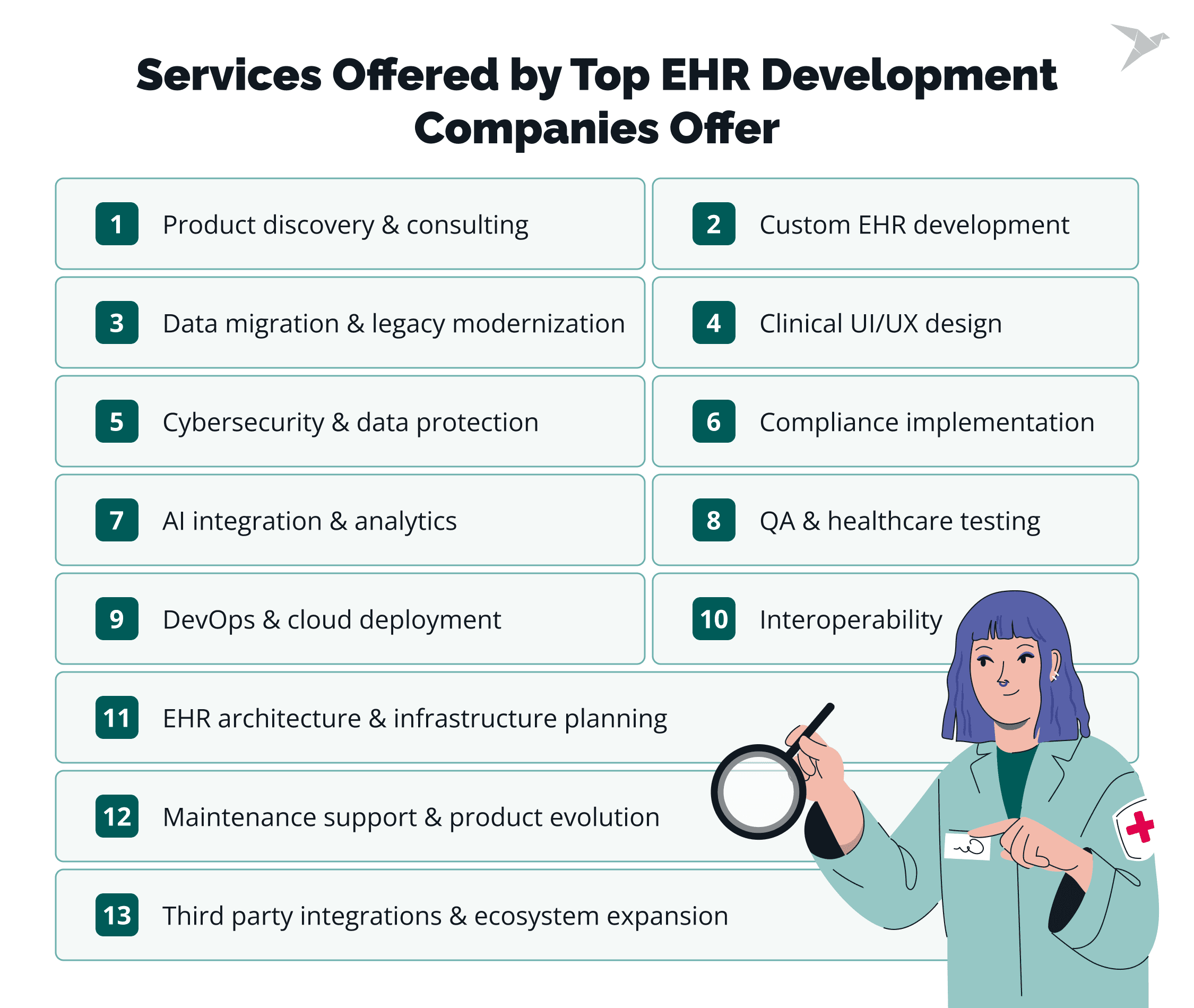
Top EHR development companies provide full-cycle services that cover strategy, architecture, development, compliance, integration, and long-term support. A strong partner stays involved from early discovery through post-launch optimization. Here’s what that looks like in practice.
Healthcare product discovery and technical consulting
Every successful EHR project starts with clarity. The discovery phase includes business analysis, clinical workflow assessment, regulatory gap review, and technical feasibility planning. Experienced EHR development companies invest time here to reduce rework and control risk later. This early stage is especially important if you plan to build a custom EHR aligned with long-term clinical and operational goals. Strong discovery also defines user roles, integration touchpoints, data structures, and compliance scope before architecture decisions lock you in.
EHR system architecture design and infrastructure planning
Architecture decisions shape performance, security, and scalability for years. Vendors should design cloud infrastructure, data models, interoperability layers, and high-availability environments that support growth. Clean architecture reduces operational friction over time. A reliable partner will also plan for multi-location deployments, disaster recovery, performance under peak clinical loads, and future module expansion without disrupting core workflows.
Custom EHR software development
This is the core build phase. It includes web and mobile EHR platforms tailored to specialties, care models, and compliance requirements. The best EHR software development companies structure development in iterations, with continuous feedback from clinical stakeholders. If your scope is still evolving, clarifying EHR vs EMR expectations helps define integration depth and feature complexity. Mature vendors also align development with documentation standards, billing logic, and structured data capture from the beginning.
Interoperability implementation (FHIR, HL7, APIs)
Modern healthcare depends on connected systems. Vendors should implement FHIR APIs, HL7 messaging, and integrations with labs, pharmacies, billing systems, and HIEs. Solid interoperability ensures the EHR fits into the broader healthcare ecosystem. Beyond basic connectivity, competent partners manage data normalization, terminology standards, patient identity matching, and reliable bidirectional data exchange across environments.
UI/UX design for clinical and administrative workflows
Adoption depends on usability. Real experts should analyze real workflows and design interfaces that reduce clicks and cognitive load. Thoughtful UX improves documentation speed and overall patient satisfaction. Effective EHR UX also accounts for role-based access, specialty-specific templates, and device contexts such as desktop charting, bedside tablets, and remote access scenarios.
Healthcare cybersecurity and data protection engineering
Patient data demands strong safeguards. This includes encryption in transit and at rest, identity management, access controls, audit logging, and secure cloud configuration. Security engineering must be woven into architecture and delivery practices. Ideally, vendors should also incorporate secure coding standards, penetration testing, continuous monitoring, and structured incident response planning.
Interestingly, AI-related security is emerging as a risk vector. In 2025, IBM reported that 13% of organizations experienced AI-related breaches, with 97% lacking structured AI access controls.
Compliance implementation and regulatory alignment
Compliance work includes policy mapping, documentation, risk assessment, and audit preparation. Vendors must understand HIPAA, GDPR, and regional regulations in practical terms. Regulatory alignment protects both patients and organizations. Skilled EHR partners embed compliance checkpoints into development cycles and maintain documentation that supports internal reviews and external audits.
Data migration and legacy EHR modernization
Many projects involve replacing outdated systems. Vendors should manage structured data migration, mapping, validation, and system refactoring. Clean migration prevents data loss and preserves clinical continuity. Experienced EHR software solution engineers also address historical data normalization, integration reconfiguration, and staged rollouts that minimize disruption during transition.
AI integration and healthcare analytics development
Forward-looking EHR systems support automation and analytics. This includes AI-assisted documentation, clinical decision support, predictive modeling, and reporting dashboards. Even early-stage systems benefit from analytics-ready architecture. Vendors should ensure clean, structured data capture, integration with external models, and governance mechanisms to evaluate model performance and bias.
Quality assurance and healthcare-specific testing
Testing must reflect clinical realities. Teams should conduct functional testing, performance benchmarking, security validation, and interoperability testing. Reliable QA reduces production incidents and protects patient safety. Mature vendors also simulate real user loads, validate clinical logic, and test integrations in sandbox environments before live deployment.
DevOps and DevSecOps, cloud deployment, and infrastructure management
Continuous integration and secure deployment pipelines improve delivery speed and stability. Vendors should configure secure cloud environments, monitor system health, and manage backups and disaster recovery. Operational discipline keeps systems stable under load. Automated testing, logging, and infrastructure-as-code practices further reduce configuration drift and deployment risk.
Ongoing maintenance, support, and product evolution
An EHR evolves with regulations and clinical needs. Long-term support includes monitoring, compliance updates, feature enhancements, and performance tuning. Sustainable partnerships are common among the best EHR development companies. Experienced vendors provide structured SLAs, proactive monitoring, and roadmap collaboration to keep the platform aligned with growth.
Third-party platform integration and healthcare ecosystem expansion
EHR systems often connect to integrated telehealth services, remote patient monitoring devices, and revenue cycle tools. Vendors should support ecosystem expansion through structured APIs and scalable integration frameworks. This flexibility future-proofs your investment. A well-designed integration layer makes it easier to add new partners, specialties, or digital health tools without rebuilding core functionality.
To visualize how full-cycle services compare to limited-scope vendors, consider this simplified overview:
When reviewing top EHR system development companies, ensure the service model matches your long-term vision. A fragmented approach increases coordination burden and slows progress.
Which Companies Are Best for EHR Development?
The best EHR development companies combine healthcare expertise, regulatory understanding, and long-term engineering discipline. Below is a curated list of EHR software development companies serving US and European healthcare organizations, with a focus on custom EHR system development, interoperability, and compliance. Each brings different strengths depending on your goals.
TechMagic
TechMagic is a full-cycle software company founded in 2014, building custom EHR and EMR platforms, modernizing legacy systems, and delivering integrations aligned with HIPAA and NHS requirements. It serves HealthTech providers and digital health startups from offices in New York, London, Kraków, and Lviv.
- Core services: custom EHR/EMR platforms; cloud and mobile EHR; FHIR and HL7 interoperability; patient portals and e-prescription; analytics and population health reporting.
- Best suited for: startups, scale-ups, and providers that want one partner to own delivery from discovery through production, where security and compliance are hard requirements.
- Strengths: CREST accreditation and a Certified AI/ML Pentester credential (The SecOps Group), rare in this field; official Medplum partner, useful for FHIR-native builds; full-cycle model that removes handoffs.
- Weaknesses: less globally recognized than large companies.

Chetu

Chetu is a US-based software company founded in 2000, with established experience in healthcare IT and EHR customization. It works with providers, medical billing companies, and software vendors to extend or tailor existing EHR and EMR systems.
- Core services: EHR/EMR customization; practice management integrations; revenue cycle workflows; interoperability support; specialty module development.
- Best suited for: mid-sized organizations that need structured customization of an existing platform rather than a greenfield EHR build.
- Strengths: deep bench of 2,800+ developers across the US, Europe, and Asia; client-owned source code and IP on completion; broad industry experience including healthcare, finance, and retail.
- Weaknesses: reviews are mixed on project management, with some clients citing delays and communication gaps; a broad generalist rather than a healthcare specialist; a work-for-hire staffing model that needs in-house oversight.
Globant

Globant operates globally and brings enterprise-scale engineering and digital transformation expertise. In healthcare, it supports large modernization initiatives, including cloud migration, interoperability platforms, and integration-heavy transformations that may include EHR ecosystems.
- Core services: enterprise modernization; cloud migration; interoperability platforms; AI and data delivery; system integration.
- Best suited for: large provider networks and health systems running infrastructure transformation across multiple systems and stakeholders.
- Strengths: scale of around 28,000 employees in 33 countries for complex multi-team programs; strong enterprise governance and delivery discipline; partnerships across major cloud and AI platforms.
- Weaknesses: not an EHR specialist, so depth in clinical systems is lighter than focused vendors; size can mean less personalized engagement for mid-market clients; a 2025 securities fraud lawsuit over Latin American performance adds governance uncertainty buyers should assess.
Orases
Orases is a US-based custom software firm founded in 2000, with experience building HIPAA-compliant healthcare systems. It focuses on tailored engineering, including custom platforms that integrate with or extend EHR functionality.
- Core services: custom software development; healthcare platform builds; API and system integration; application support; AI development.
- Best suited for: organizations that prioritize structured custom builds and clear project governance over off-the-shelf adaptation.
- Strengths: more than two decades and 750+ clients, with healthcare among its top sectors; strong project ownership cited consistently in reviews; Clutch Premier Verified status for financial stability.
- Weaknesses: a general custom shop rather than a dedicated EHR specialist; US-only delivery puts it at a higher price point; EHR work tends to extend systems rather than build full clinical platforms.
Future Processing

Future Processing is a European engineering company founded in 2000 in Gliwice, Poland, supporting healthcare organizations through secure software development and modernization. Its work often touches legacy replacement, cloud migration, and interoperability around core clinical systems.
- Core services: custom software delivery; cloud and modernization; system integration; data and AI solutions; cybersecurity consulting.
- Best suited for: organizations modernizing aging platforms or strengthening integration layers, where scalable architecture and data security matter.
- Strengths: 750+ specialists and 25 years of end-to-end delivery, with around 90% of reviewers citing on-time delivery; strong focus on code quality and long-term partnership; EU-compliant delivery and time-zone fit for European clients.
- Weaknesses: core sectors are finance, insurance, and utilities rather than healthcare; Poland-based, so US clients work remotely; its healthcare arm changed ownership in late 2024, worth confirming for continuity.
ELEKS
ELEKS is a full-cycle software and consultancy company founded in 1991, delivering enterprise software across industries including medical software and life sciences. In healthcare it supports data platforms, interoperability, and complex system integrations that may involve EHR ecosystems.
- Core services: full-cycle product development; data platform engineering; interoperability and integration; AI and analytics; technology advisory.
- Best suited for: healthcare enterprises seeking structured digital transformation alongside EHR modernization at a system level.
- Strengths: 2,000+ specialists across 17 offices on three continents; strong engineering governance and a 2024 Clutch Global Award; long-running client relationships, several spanning 5 to 20 years.
- Weaknesses: a broad enterprise generalist, with healthcare one of many sectors rather than a core EHR specialty; cost is the most frequent below-average sub-score in reviews; large-transformation focus can be heavy for a single EHR build.
Intellectsoft

Intellectsoft is a digital transformation consultancy founded in 2007, headquartered in New York, working with healthcare and life sciences on digital platforms and IT modernization. Its EHR-related work usually involves integrations and workflow extensions rather than standalone EHR products.
- Core services: custom software and AI engineering; system integration; mobile health applications; cloud platforms; dedicated teams.
- Best suited for: organizations enhancing patient-facing apps and connected health solutions alongside EHR connectivity.
- Strengths: 500+ specialists and 300+ clients across healthcare, fintech, and other sectors; architecture discipline noted across a long review history; recognized in multiple Clutch B2B rankings.
- Weaknesses: a multi-industry generalist, so EHR is not a core product; a share of reviews date to 2016-2017, with isolated cost and schedule sub-rating dips; healthcare work leans toward integration over full clinical builds.
BairesDev

BairesDev is a large nearshore engineering firm founded in 2009, providing scalable development teams to US healthcare companies. In EHR-related work it often supports cloud migration, system extensions, and interoperability.
- Core services: nearshore software development; staff augmentation; cloud migration; system integration; QA and DevOps.
- Best suited for: healthcare companies that need flexible engineering capacity to support EHR customization or integration without building in-house teams.
- Strengths: 4,000+ engineers for rapid ramp-up and a 4.9 Clutch average; nearshore delivery aligned to US time zones; a client roster spanning Fortune 500 brands.
- Weaknesses: a staff-augmentation model that favors capacity over end-to-end product ownership; healthcare is one of many verticals rather than a specialty; mixed employee feedback on third-party sites.
Epic Systems Corporation
Epic Systems is a US-based EHR product vendor founded in 1979, used by many of the largest US health systems and academic medical centers. It provides comprehensive EHR modules and the widely used MyChart patient portal, with extensive customization for enterprise clients.
- Core services: enterprise EHR platform; specialty clinical modules; MyChart patient portal; revenue cycle and analytics; HIE and interoperability network.
- Best suited for: large hospitals, academic medical centers, and integrated delivery networks adopting a proven enterprise platform.
- Strengths: the dominant US EHR, with roughly 36% hospital market share and 325M+ patient records; ranked #1 by KLAS for large health systems; deep clinical integration and a large partner ecosystem.
- Weaknesses: very high cost and 12 to 24 month implementations, with large deployments running $50M to $500M; not a fit for small practices outside its Community Connect program; a product vendor rather than a custom-development partner.
Arkenea
Arkenea is a dedicated custom EHR and EMR development company founded in 2011, focused exclusively on HIPAA-compliant healthcare software. It works as a custom engineering partner end to end, tailoring systems to specific clinical workflows rather than selling a ready-made product.
- Core services: custom EHR/EMR development; product discovery and UX/UI; EHR integrations (Cerner, Epic, Athena, Redox); compliance engineering; ongoing maintenance.
- Best suited for: HealthTech founders and providers that want a healthcare-only partner for focused custom builds and MVPs.
- Strengths: 14+ years exclusively in healthcare, with broad compliance coverage (HIPAA, HITRUST, HL7, FDA); a 4.9 Clutch rating with a 5.0 referral score; honest scoping and paid discovery that limits scope bloat.
- Weaknesses: a small team of around 50, which caps capacity for large enterprise programs; a North America plus India offshore delivery model; a modest Clutch review base of around 14.
Empeek
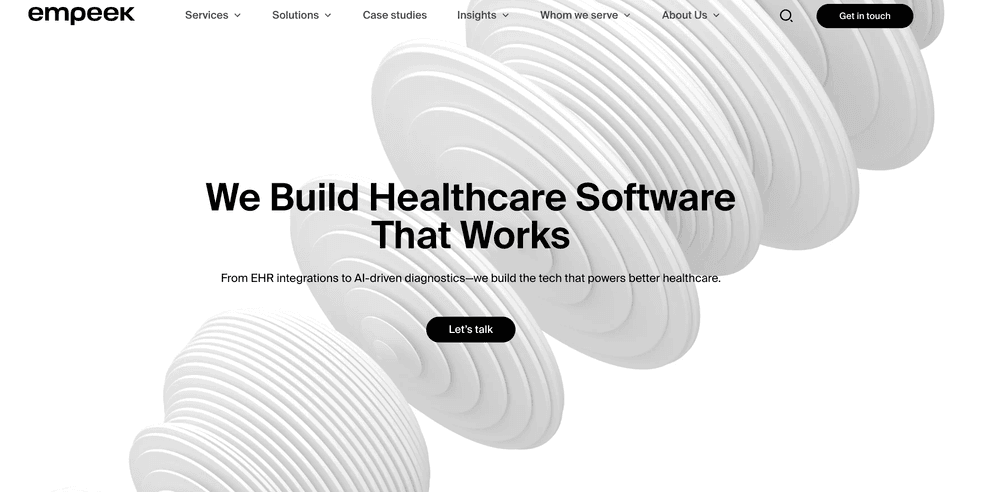
Empeek is a healthcare-focused software company founded in 2015, headquartered in Leander, Texas, with delivery teams in Ukraine and Estonia. It supports custom platforms, EHR modules, telehealth integrations, and workflow automation for providers and startups.
- Core services: custom healthcare software; EHR modules and integrations; telemedicine and remote monitoring; AI-driven tools; legacy modernization.
- Best suited for: startups and providers seeking a healthcare-specialized partner for focused EHR-related development and clinical workflow tools.
- Strengths: ISO 9001 and ISO 27001 certified, with HIPAA, HITECH, and GDPR coverage; strong communication and responsiveness cited consistently in reviews; healthcare-only focus across 150+ specialists.
- Weaknesses: a smaller team oriented to startup, PoC, and MVP work rather than large hospital-scale builds; a modest Clutch review base of around 20; an offshore delivery model across time zones.
Netguru
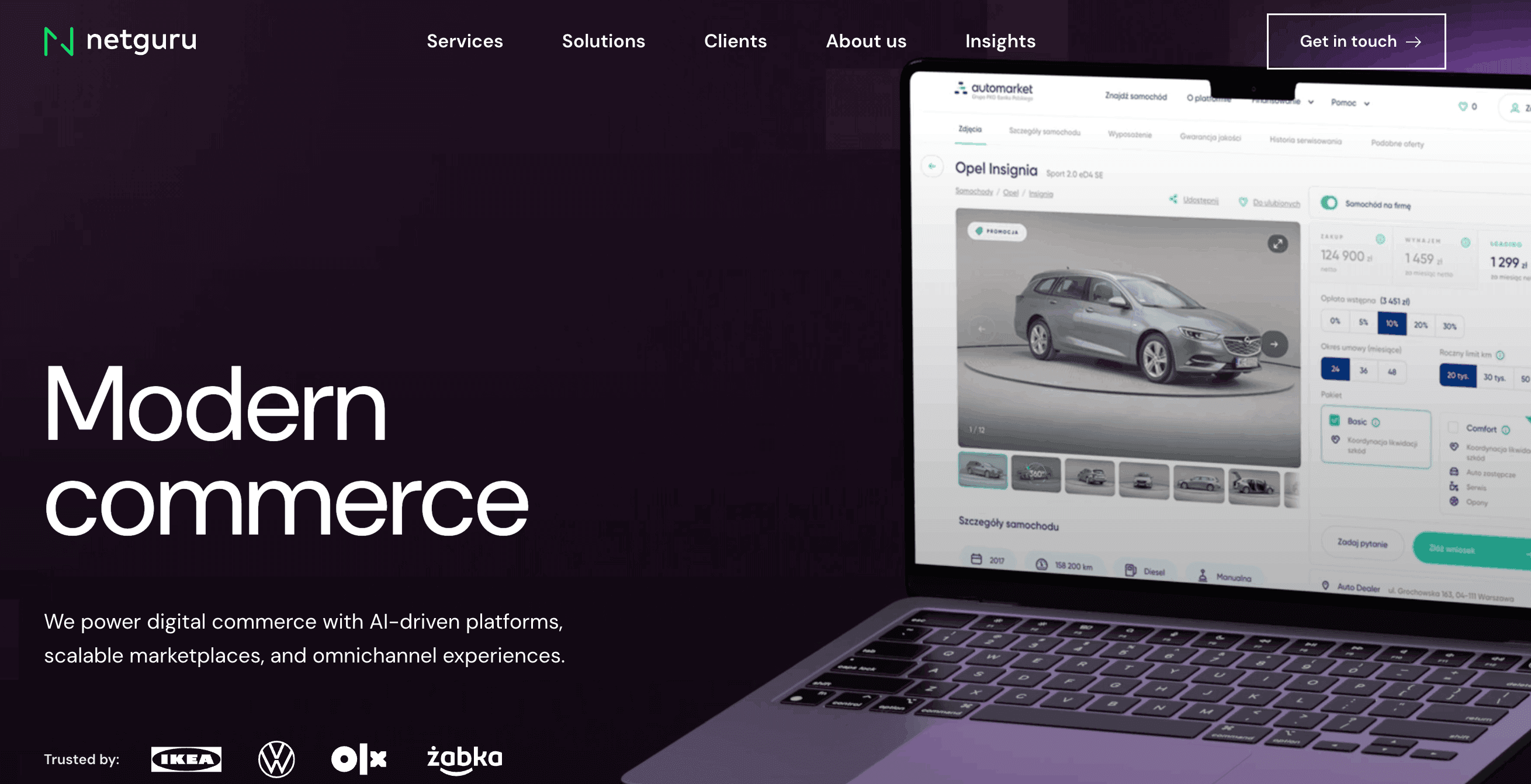
Netguru is a European software consultancy founded in 2008, combining product design and engineering across industries including healthcare. In EHR-related contexts it supports digital health platforms, integrations, and cloud-based healthcare applications.
- Core services: digital health platform development; system integration; cloud healthcare apps; UI/UX design; product strategy.
- Best suited for: healthcare organizations seeking design-driven digital health solutions connected to EHR systems.
- Strengths: 4.8/5 on Clutch across 73 reviews, the largest verified base in this list; strong product design as a core competency; B Corp certification signaling transparency and quality.
- Weaknesses: more design-led than a deep healthcare or EHR engineering specialist; pricing higher than comparable Eastern European vendors; healthcare is one of several industries it serves.
Learn about our expertise in the industry and what we have to offer
What Questions Should You Ask Before Hiring an EHR Development Company?
Before hiring an EHR development company, you should ask focused questions that reveal real experience, compliance maturity, architectural thinking, and long-term commitment. The goal is simple: reduce risk before you sign. Here are the questions that matter most and why they deserve clear answers.
What experience do you have building custom EHR systems similar to ours?
This question helps you separate general healthcare vendors from true EHR specialists. Ask for live systems, specialty-specific platforms, and production environments serving real users. Experience with complex documentation, billing integration, and multi-role access tells you far more than a portfolio of generic health apps.
How do you ensure HIPAA compliance and regulatory alignment throughout development?
Compliance must be structured into planning, architecture, and delivery. Ask how they document safeguards, manage risk assessments, and prepare for audits. Mature EHR software development companies can walk you through their compliance process step by step.
What interoperability standards and integrations have you successfully implemented?
An EHR must connect to labs, pharmacies, HIEs, and payer systems. Ask about hands-on FHIR and HL7 implementations, API integrations, and data exchange workflows. Practical integration experience reduces surprises during deployment.
How do you design EHR architecture for scalability and long-term growth?
Growth changes system demands quickly. Explore their cloud strategy, performance planning, and ability to support multi-location operations. A thoughtful architecture today prevents performance issues tomorrow.
What security practices are embedded into your development lifecycle?
Patient data requires strong protection at every stage. Ask about encryption, access control, audit logging, secure code reviews, penetration testing, and DevSecOps practices. Clear, structured answers show operational maturity.
How do you approach clinical workflow analysis and UX design?
Poor usability leads to clinician frustration. Ask how the team studies workflows, gathers feedback, and validates interface decisions with medical staff. A vendor who involves clinicians early often delivers better adoption outcomes.
What does your post-launch support and maintenance model include?
An EHR continues evolving after release. Clarify SLAs, monitoring processes, compliance updates, and roadmap collaboration. Long-term support often defines whether a partnership succeeds. A structured EHR implementation plan reduces operational disruption and improves adoption across clinical teams.
What is the total cost of ownership, and who owns the intellectual property?
Initial development cost is only part of the picture. Ask about infrastructure expenses, scaling costs, integration maintenance, and ownership of source code. Clear IP terms protect your flexibility and future strategy.
These questions help you evaluate the best EHR system development companies with discipline. When vendors answer confidently and transparently, you gain clarity. When answers feel vague, that is useful information too.
Looking for a Reliable Partner for Your EHR Project?
If you’re still weighing options, that’s normal. Choosing among top EHR software development companies takes time, and the risks are real. You want compliance certainty, stable architecture, clean integrations, and a system clinicians will actually use.
TechMagic works with healthcare organizations and digital health startups that need clarity and control. We design and build custom EHR and EMR platforms, modernize legacy systems, and deliver secure integrations aligned with HIPAA and NHS requirements. Our teams focus on scalable architecture, strong cybersecurity, and practical interoperability using FHIR and HL7 standards.
We help solve common pain points:
- Outdated EHR systems that cannot scale
- Fragmented integrations across labs, billing, and telehealth
- Compliance pressure and audit readiness concerns
- Poor usability slowing down clinicians
- Limited visibility into long-term infrastructure costs
For organizations seeking a cost-effective path, Medplum is a strong option. Medplum enables the development of efficient, FHIR-native custom EHR solutions on a modern foundation while keeping it flexible and cost-controlled. At TechMagic, we are official Medplum partners, and we perfectly know that it is a great solution if you want to move faster and avoid rebuilding core components from scratch.
If you are hesitating between several EHR development companies and need a second opinion, we offer a free consultation. We can review your current architecture, discuss compliance requirements, and outline a realistic roadmap. No pressure. Just practical guidance to help you move forward and grow.

Final Thoughts and What’s Next for EHRs
Choosing the right partner among the best EHR development companies comes down to clarity. You need healthcare expertise, compliance discipline, strong interoperability, and a service model that supports you long after launch. When those elements align, your EHR becomes an asset instead of a burden.
The direction of the market is clear. EHR systems are becoming more interoperable, more cloud-native, and more analytics-driven. FHIR-based ecosystems are expanding. AI-assisted documentation and decision support tools are moving from pilot projects into daily practice.
The movement toward template-free EHR systems is also a defining trend, allowing for more natural documentation and reducing cognitive load for healthcare professionals. Next-generation EHR systems will analyze patterns, context, and meaning to refine notes and help physicians work more efficiently.
Security expectations continue to rise as regulatory scrutiny increases across the US and Europe. Emerging EHR platforms leverage advanced encryption, secure cloud storage, and adherence to standards like FHIR and HL7 to ensure seamless communication between providers while safeguarding patient privacy.
The top EHR system development companies are already building with these shifts in mind. They design flexible architectures, support API-first integrations, and prepare systems for automation and data-driven care models. That forward-thinking approach protects your investment.
If you’re evaluating top EHR software development companies today, focus on long-term fit, not just delivery speed. The right decision now will shape your clinical efficiency, compliance posture, and growth potential for years to come.
FAQ

A custom EHR system typically takes 3 to 12 months, depending on scope, integrations, and compliance requirements. A focused MVP with core clinical features may launch faster, while enterprise-grade platforms with complex interoperability can take longer. Timelines also depend on data migration and regulatory preparation. To keep an EHR development project on track, teams usually define early workflow priorities like patient intake and set non-negotiables for operational efficiency from the first release.
Start with structured criteria: healthcare experience, compliance maturity, interoperability expertise, security architecture, and long-term support model. Request real case studies and speak to healthcare clients. Comparing custom EHR development companies using the same evaluation framework helps you avoid bias and marketing noise. This approach is especially useful for many healthcare organizations seeking clear vendor differentiation in the EHR market because it forces each software development company to show proof of real experience.
It depends on your goals. Off-the-shelf systems work well for standardized workflows and faster deployment. Custom solutions offer greater flexibility, ownership, and scalability. Many organizations turn to the best EHR system development companies when they need specialty features, deeper integrations, or full architectural control. In practice, custom builds are often chosen when electronic medical records workflows must match how medical practices and ambulatory practices actually operate.
The best EHR software development companies are those with proven healthcare expertise, strong compliance practices, and long-term partnership capability. The right choice depends on your size, budget, regulatory environment, and growth plans. Evaluate experience, interoperability depth, and support structure before making a decision.
The best EHR software development companies have proven healthcare expertise, strong compliance practices, and long-term partnership capability. A reliable partner should support clinicians in real healthcare delivery, which is why organizations prioritize workflow-fit over generic “platform” claims. The best EHRs are easy to use, helping doctors work more manageably with intuitive and flexible programs. A high-quality EHR system is made up of a reliable, high-performing, and user-friendly program that prompts better quality care from its users. The best EHR systems should also have an AI system that learns and adapts based on a doctor's practice preferences and gets faster and smarter as it is used.
Features like an integrated patient portal improve self-service and reduce support load. When designed well, they become patient engagement tools that raise satisfaction. They let users access patient records, review a patient's medical history, and interact with medical data securely.
Interoperability matters when it supports real workflows and stable data exchange, so many teams build around fast healthcare interoperability resources and validate integrations end-to-end. Done well, it strengthens care coordination, supports population health management tools and population health tools, improves insight into patient populations, and drives enhanced patient care.
In behavioral health, teams often need flexible documentation and privacy-aware workflows that reflect real practice. For mental health and chronic care management, the EHR should support longitudinal patient management and reporting tied to patient outcomes and overall health outcomes.
For rural healthcare providers, reliability and support are critical to keep workflows stable with lean teams. Priorities usually include lowering administrative burden, supporting healthcare services, and keeping billing and revenue cycle management integrations dependable.
Electronic medical records (EMRs) are digital versions of paper charts used within a single clinical practice and primarily support diagnosis and treatment in that specific setting. Electronic health records (EHRs) go further and include a more comprehensive, longitudinal patient history and are designed to be shared with other healthcare providers across organizations. EHRs typically support broader interoperability and system-level coordination, offering a more holistic view of a patient’s care. They often include features such as patient portals, e-prescribing, and integration with other healthcare systems. EHRs are essential for effective, patient-centered care and are increasingly being adopted across various healthcare settings.