
 Software Development
 Security Services
 Cloud Services
 AI Services
 Other Services















 TechMagic Academy


Secure Code Reviews: What Most Teams Overlook (and How to Fix It)
Last updated:26 January 2026


Vulnerabilities often slip through, and the reason is not the sloppy code. It happens because reviews stay surface-level. Checks exist, tools are green, and the pull request gets approved, while broken trust boundaries, weak authorization logic, or unsafe assumptions remain untouched.
By the time these flaws show up in production, fixing them is slow, expensive, and disruptive.
In our new source code review guide, we explain what separates a real review from a routine one, why common review processes fail to catch high-impact issues, and how teams can make reviews practical under delivery pressure. You’ll see where automation helps, where it falls short, and how human judgment makes the difference.
So, if you’re looking for a clear, experience-based view on how to check secure source code**,** this guide focuses on what actually works in day-to-day engineering.
Key takeaways
- Secure code reviews fail when they focus on style and tooling instead of threat impact and trust boundaries, leaving the development team less able to identify potential vulnerabilities that matter.
- Human judgment is essential because real security issues depend on context, intent, and business logic, which often determines whether critical vulnerabilities are reachable or contained.
- Clear ownership and risk-based depth make reviews scalable without slowing delivery, especially when the development team aligns on access controls and review standards.
- Automation works best as a filter and signal, not as a decision-maker, even when using advanced tools to surface patterns and anomalies.
- A practical external review helps teams catch real issues earlier and reduce costly fixes later, supporting data protection and giving security professionals a stronger basis for prioritization.
What Is a Secure Code Review?
A secure code review is a focused, manual examination of source code to identify security risks, misuse patterns, and design decisions that could lead to vulnerabilities in real-world use and should be treated as a core part of an overall application security strategy.
Unlike general code reviews, which concentrate on readability, maintainability, and correctness, this type of review looks at code through an attacker’s lens. Their goal is to understand how data flows, where trust boundaries break, and how assumptions made by developers could be abused.
Automated scanners also play a different role. They flag known patterns at scale but do not reason about business logic, architecture, or context.
Source code reviews require judgment
Reviewers must decide whether a pattern is acceptable in a given context, whether a mitigation is sufficient, and how small changes can alter the system’s security posture. That judgment does not come from checklists alone.
Teams can review their own code, and many do. The limitation appears when familiarity hides blind spots or when time pressure turns reviews into a formality. Bringing in specialists who conduct secure source code review as a dedicated practice often leads to deeper findings, clearer risk explanations, and more practical remediation guidance.
The difference is not ownership but perspective. Writing code and breaking it safely are related skills, yet rarely mastered to the same depth by the same people.
We are here to help

Why Do Most Secure Code Reviews Fail to Catch Real Security Issues?
As we see in our practice, most secure code reviews miss real security issues because the process is treated as a formality, not as a focused security exercise with clear goals, time, and ownership.
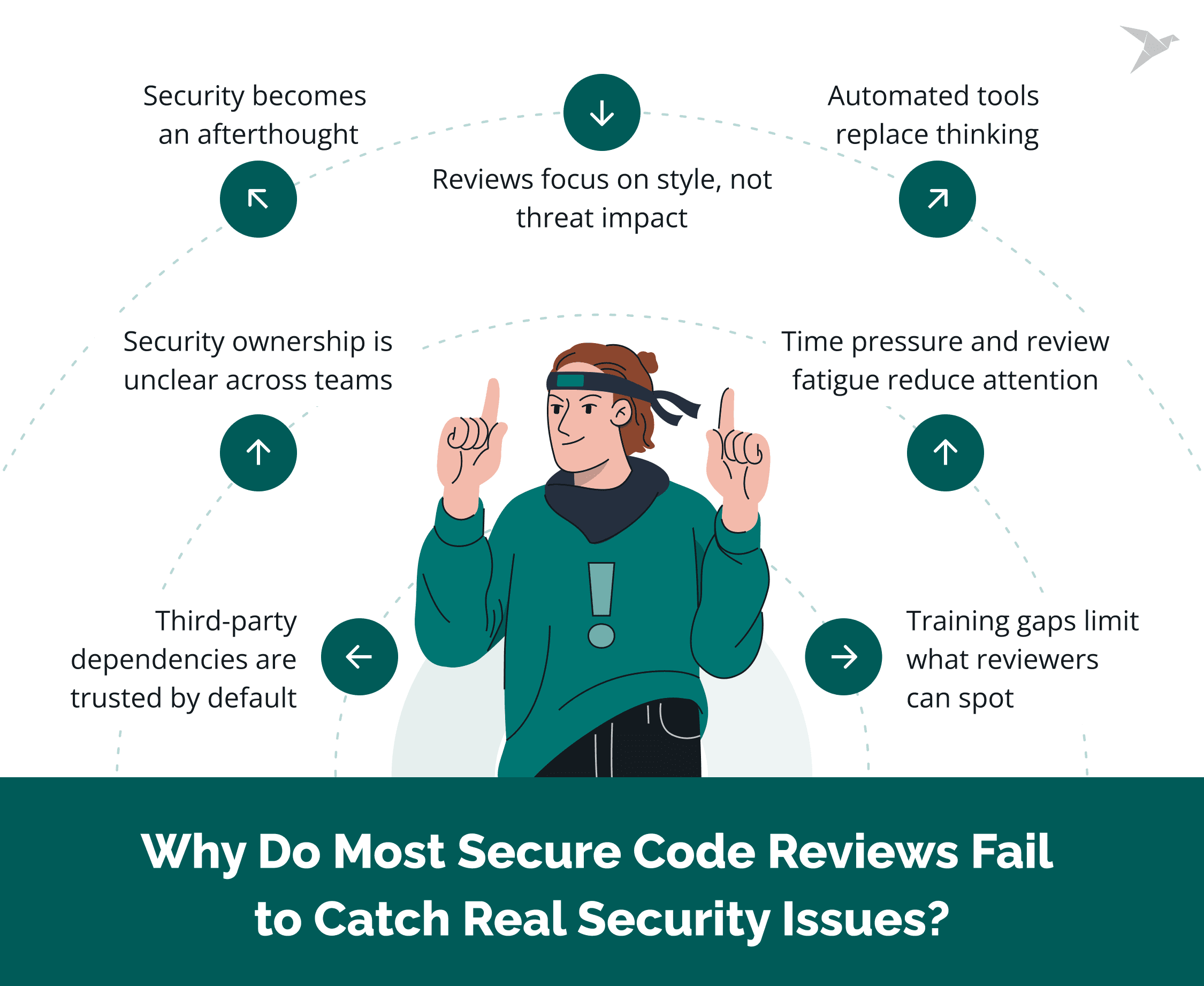
Security becomes an afterthought
Security often shows up late, when the change is already "done” and the main goal is to merge. In that mode, reviewers look for obvious mistakes instead of challenging assumptions, data flows, and trust boundaries.
Reviews focus on style, not threat impact
Many teams review for readability, naming, and patterns that keep the codebase consistent. That work matters, but it rarely answers the security questions: what can be abused, what can be bypassed, and what happens when inputs are hostile.
Security ownership is unclear across teams
When security is framed as "everyone’s job,” it can turn into "someone else will catch it.” Reviewers may avoid raising security concerns because they don’t feel empowered to block a release or because escalation paths are vague.
Automated tools replace thinking
Scanners help spot known patterns, but they can’t reason about intent, business logic, or how features combine into an attack path. Overreliance on tools can also narrow attention to tool output, while higher-risk issues remain in secure source code that looks "clean” on the surface.
Time pressure and review fatigue reduce attention
Large pull requests, tight release cycles, and constant context switching encourage skimming. Fatigue makes it harder to trace execution paths, follow permission checks, or validate error-handling behavior.
Third-party dependencies are trusted by default
Reviews often focus on first-party changes and assume libraries are safe. That misses risks in how dependencies parse input, handle auth, store secrets, or surface errors, especially when upgrades pull in breaking or vulnerable behavior.
Training gaps limit what reviewers can spot
People can’t reliably catch issues they were never trained to recognize. Regular refreshers help teams keep up with evolving threats and establish a shared baseline for how to review secure source code in day-to-day work.
These are systemic issues: unclear goals, limited time, and mismatched expectations. Fixing them improves review quality without placing the blame on individual developers.
What Critical Security Issues Are Most Commonly Overlooked in Code Reviews?
From our experience across different projects, the issues most often missed are those that look correct in a small diff but break when real requests, identities, and data cross boundaries.
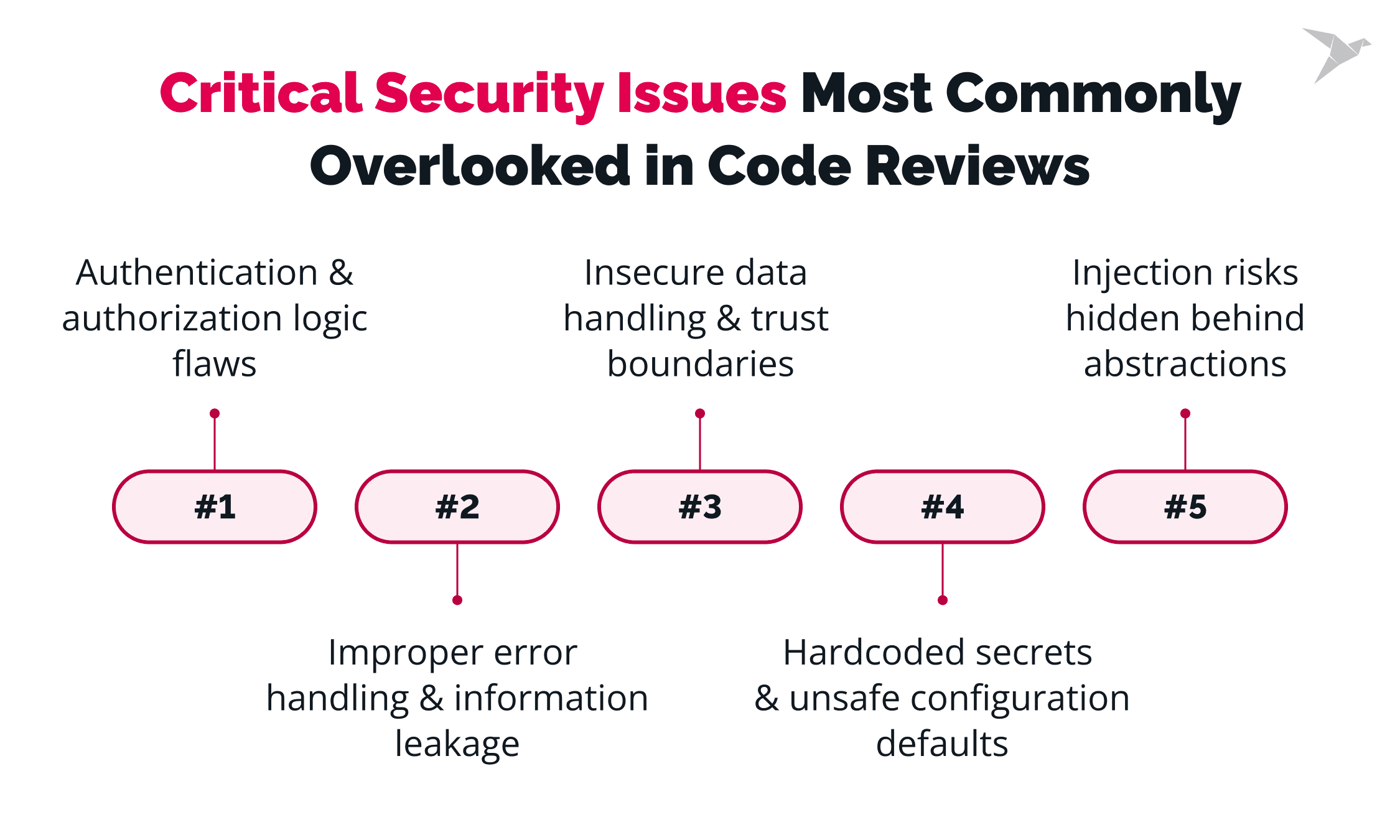
Authentication and authorization logic flaws
Secure source code checking often confirms that a check exists, but misses whether it protects the right action across all entry points. Gaps show up when authentication is mistaken for authorization or when "secondary” paths bypass the usual permission checks.
Insecure data handling and trust boundaries
Values get treated as trusted because they come from an internal service, a token claim, or a client field that "should be safe.” Reviewers miss these issues when they don’t trace data origin and how it’s validated at each boundary, including how malicious input can cross service boundaries.
Injection risks hidden behind abstractions
A clean helper call can still produce unsafe SQL, templates, or command arguments under the hood. These issues slip through when reviewers trust wrappers and don’t check how user-controlled input is combined in the final operation, which is a common way unauthorized users gain leverage.
Improper error handling and information leakage
Error handling is skimmed, so detailed messages and inconsistent responses end up exposing internals. Attackers use this signal to map systems, enumerate accounts, and refine exploit attempts, which can also increase the chance of compliance failures.
Hardcoded secrets and unsafe configuration defaults
Secrets and weak defaults often enter through "temporary” configs, scripts, or environment-specific branches and then stay. Reviews miss them because they sit outside the main logic, and the app still works, even when protections are effectively off, including missing multi-factor authentication in sensitive flows.
Many teams bring in DevSecOps services to help close these gaps with consistent review practices, clearer ownership, and a security context that’s hard to maintain under delivery pressure.
Who Should Be Responsible for Security During Code Reviews?
Security during code reviews works only when responsibility is shared, explicit, and supported by the organization, not delegated to a single role or team.
Developer responsibility with security team support
Developers are responsible for the security of the code they write because they make the design and implementation decisions. Security teams support this work by defining expectations, reviewing higher-risk changes, and helping teams reason about threats they don’t encounter every day.
The role of senior engineers and tech leads
Senior engineers and tech leads act as the first line of security judgment during reviews. They set the bar for what "good enough” looks like, challenge risky shortcuts, and make trade-offs visible instead of letting them slip through unexamined.
Why centralized security review models break down
A model where a separate security team reviews everything does not scale with growing codebases and release velocity. It creates queues, delays feedback, and disconnects security decisions from the engineers who understand the code’s intent and constraints.
How leadership decisions influence review quality
Leadership defines whether security reviews have time, priority, and authority. Release pressure, staffing choices, and incentive structures directly affect whether reviewers can slow down, ask hard questions, and block changes when risk is unclear.
Clear ownership, supported by expertise and reinforced by leadership, allows teams to improve security reviews without turning them into a bottleneck.
CyberSecurity services for Elements.Cloud

How Can Teams Make Secure Code Reviews Practical and Scalable?
Here is how we see it from our perspective.
Defining security-focused review checklists
Short, focused checklists help reviewers stay consistent without turning reviews into audits. The key is limiting them to questions that surface real risk, such as trust boundaries, permission checks, and data exposure, rather than broad or theoretical concerns.
Risk-based review depth
Not every change deserves the same level of scrutiny. Teams scale reviews by spending more time on code that handles identity, permissions, data storage, or external integrations, while keeping low-risk changes lightweight and fast.
Standardizing patterns and secure defaults
Reusable patterns reduce the need for repeated judgment. When authentication flows, input handling, and error responses follow well-known defaults, reviewers can focus on deviations instead of re-evaluating the basics every time.
Reducing cognitive load for reviewers
Reviews become more effective when they are easier to reason about. Smaller pull requests, clear ownership, and predictable structure help reviewers trace execution paths and spot security issues without mental overload.
Practical secure reviews rely on habits that repeat across teams and projects. It makes security part of normal engineering work rather than a separate process.
Where Do Automated Tools Help – and Where Do They Fail – in Secure Code Reviews?
Automated tools help teams catch common issues early, but they cannot replace human judgment about intent, context, and real-world impact.
What static analysis tools reliably detect
Static tools are effective at finding repeatable patterns that map cleanly to known weaknesses. They catch issues like unsafe API usage, missing input validation, insecure crypto primitives, and vulnerable third-party dependencies before code is merged. When integrated into IDEs and CI pipelines, they shorten feedback loops and prevent obvious mistakes from spreading.
Why business logic vulnerabilities evade automation
Business logic flaws depend on how features are supposed to work, not just how the code is written. Tools cannot infer whether a discount can be abused, whether a workflow can be bypassed, or whether an authorization check is missing for a specific role. These issues require understanding user intent, system rules, and how multiple components interact.
Tool noise and alert fatigue problems
Automated scans often produce large volumes of findings with uneven relevance. When alerts lack context or prioritize theoretical risk over practical exploitability, teams start ignoring them. Over time, this reduces trust in tooling and pushes real issues into the background.
How to align tooling output with human review
Automation works best when its output feeds human decision-making instead of trying to replace it. High-signal findings should guide reviewers toward risky areas, while low-confidence results should stay informational. When teams treat tools as filters rather than judges, reviews stay focused without slowing delivery.
Used this way, automation supports secure code reviews by handling scale and repetition, while people handle reasoning, trade-offs, and accountability.
Penetration testing for Coach Solutions web application

What Are the Most Effective Ways to Fix Common Secure Code Review Gaps?
Teams close review gaps by changing how people learn, document decisions, and give feedback. These are the best practices for fixing review gaps.
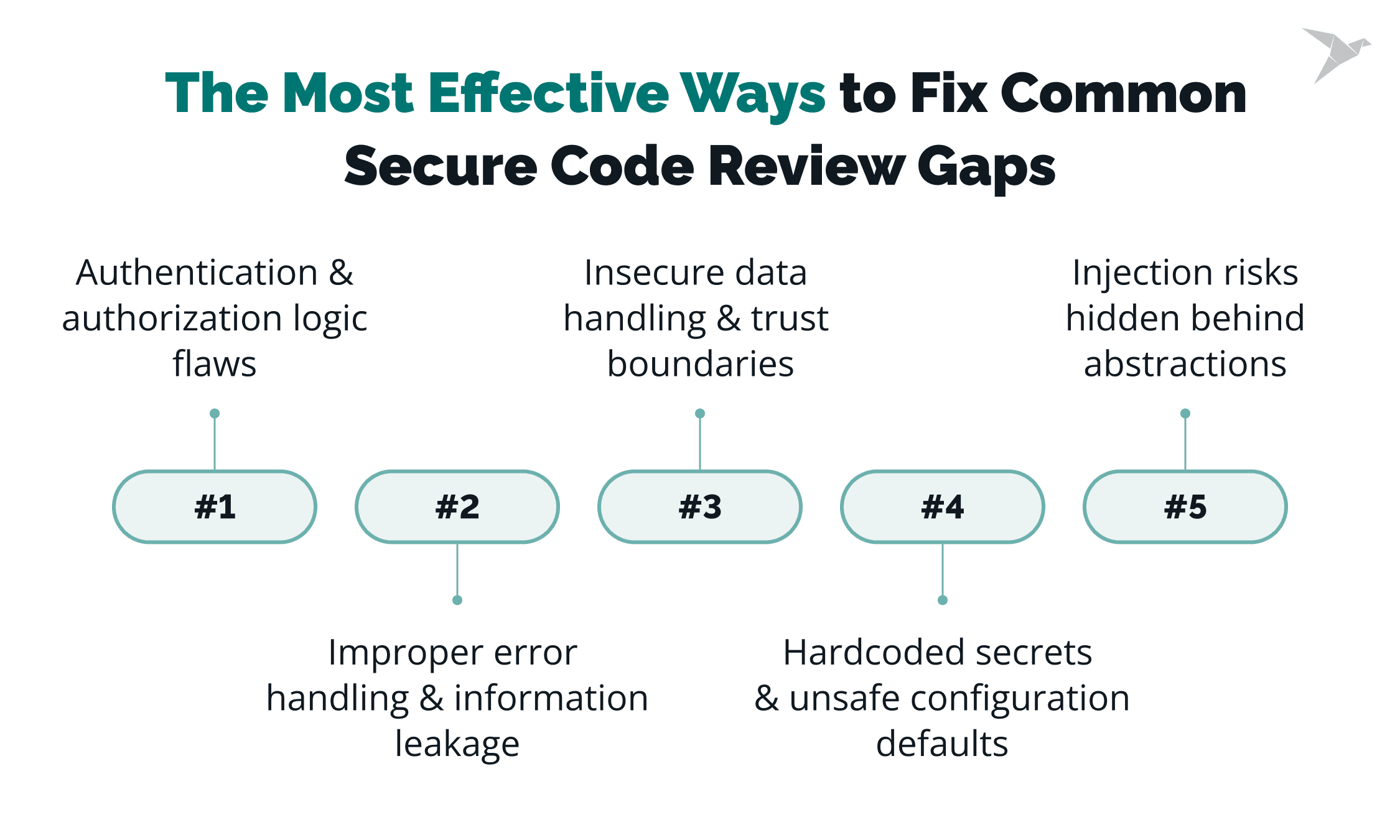
Security training tailored to real codebases
Generic training rarely maps to the risks teams face day to day. Training works when it uses the team’s own code, past incidents, and real pull requests to show how vulnerabilities actually appear and how they could have been prevented.
Living secure coding guidelines
Static documents go stale quickly. Effective guidelines evolve with the codebase and capture decisions teams have already made, such as how to handle auth checks, input validation, and error responses in practice.
Examples of good vs bad review comments
Clear examples raise the quality of reviews faster than rules alone. Showing how to explain risk, suggest fixes, and block unsafe changes without bikeshedding helps reviewers focus on impact instead of opinion.
Measuring improvement without vanity metrics
Counting findings or scan results says little about real progress. More useful signals include fewer repeated issues, earlier detection in the review cycle, and faster, clearer remediation when problems are found.
Bring in people who do this work every day
Internal teams can run secure reviews, but specialists in cybersecurity services often spot patterns and edge cases that are easy to miss when you’re deep in delivery work. Bringing in experienced reviewers for high-risk changes, periodic audits, or "review the reviewers” sessions helps reset standards, transfer practical habits, and raise consistency across the team.
Final Thoughts
Secure code reviews fail less because teams lack tools and more because the work is treated as a secondary concern. Throughout this article, one pattern repeats: reviews work when they are intentional, scoped to real risk, and supported by people who have the time and authority to ask hard questions that uncover potential security flaws and hidden vulnerabilities.
The teams that improve fastest do not try to review everything the same way. They focus on security-critical paths, standardize safe defaults, and reduce cognitive load so reviewers can reason instead of skim, lowering the attack surface and catching insecure code. They also accept a practical limit: writing code and reviewing it for abuse require different perspectives, and expecting one role to master both equally does not scale.
Looking ahead, several trends are becoming clear
Secure code reviews will become more selective, not more frequent. As systems grow, teams will apply deeper review only where risk justifies it, rather than spreading attention thin across every change, including areas like session management, where mistakes can help attackers gain unauthorized access.
Automation will narrow its role. SAST tools and enterprise tools will increasingly act as early filters and context providers that analyze source code through source code analysis, while human reviewers handle logic, intent, and trade-offs, supported by comprehensive documentation.
Security knowledge will move closer to the delivery teams. Centralized review models will continue to break under speed and scale, pushing expertise into senior engineers and shared practices, especially around security controls and reducing common vulnerabilities.
External reviewers will be used more strategically. Instead of one-off audits tied to dynamic testing, teams will rely on specialists to recalibrate standards, review high-risk areas, and help train internal reviewers, combining manual reviews with targeted testing.
Secure code reviews are not a control you “install.” Look at them like a habit that improves when teams invest in clarity, shared responsibility, and the right expertise at the right time, including strong practices that prevent security breaches and reduce input validation errors.

FAQ

A code review checks whether software source code works as intended and is easy to maintain, while a security code review examines how the same code could be misused or attacked.
The focus shifts from correctness and style and overall code quality to trust boundaries, permission checks, user input, sensitive data exposure, and failure behavior, using secure coding practices as part of a secure software development and software security mindset.
No, secure code review tools and penetration testing address different stages and risks. Reviews catch design and implementation issues early in the development process, while penetration tests validate how a running system behaves under attack. One reduces risk before release; the other tests what still made it through, often alongside static application security testing and static and dynamic analysis.
The time depends on risk, not code size. Low-risk changes may need only a few targeted checks with code review tools, while security-critical logic can require deeper analysis across multiple files and flows, including manual code review and static code analysis.
A successful secure code review varies in depth intentionally instead of applying a fixed time limit, helping identify potential security vulnerabilities and security flaws such as SQL injection and cross-site scripting.
Yes, smaller teams often carry higher risk because fewer people review each change, and roles overlap. Secure reviews help these teams avoid repeating the same mistakes, reduce security vulnerabilities, and establish shared practices for how to secure source code as the system grows, identifying vulnerabilities and strengthening software security as the system grows, while also helping improve code quality.