
 Software Development
 Security Services
 Cloud Services
 AI Services
 Other Services














 TechMagic Academy


Best HIPAA Consulting Firms in 2026: Choosing the Right Partner for Compliance Readiness
Last updated:12 June 2026



Since early 2025, enforcement actions by the U.S. Department of Health and Human Services’ Office for Civil Rights (OCR) have increasingly cited inadequate HIPAA Security Rule risk analysis as a core failure. Penalties have ranged from tens of thousands to several million dollars in every case.
Many teams that get flagged for HIPAA violations aren’t uninformed. They have policies and training. The issue is execution: outdated risk analyses, controls that don’t work in production, and inconsistent or undocumented remediation. That’s why the right HIPAA consulting firm matters.
A strong consultant clarifies scope and data flows, assigns ownership, and helps you make defensible security decisions you can explain to regulators, auditors, and enterprise customers.
In this article, we explain how to evaluate consulting firms, what differentiates effective advisors from policy-only providers, and how to choose a partner that fits your organization’s risk profile and operating reality.
A note on transparency: TechMagic publishes this list and is included in it, at the top. We have ordered firms by fit for healthtech product teams that need execution-driven HIPAA compliance, not by size or brand, and we describe every firm with the same structure, including a limitations section for our own. We have tried to be objective, but we encourage you to choose a partner based on your needs rather than its position here.
Key takeaways
- HIPAA enforcement is increasingly focused on risk analysis quality and execution, not just the existence of HIPAA policies and training.
- Many violations stem from controls that don’t work in real systems, outdated assessments, and inconsistent or undocumented policies and procedures.
- The right consulting partner provides practical implementation guidance to protect patient data, turning requirements into controls that teams can run and defend.
- Strong HIPAA experts support risk analysis, remediation, privacy workflows, and ongoing compliance using industry best practices, not one-time assessments.
- The best firms deliver customized solutions that fit the operating reality of healthtech companies, providers, and health plans, while reducing exposure to federal fines.
How We Select the Best HIPAA Consulting Firms
At TechMagic, we build and deliver HealthTech products like platforms that handle protected health information across cloud-native architectures, third-party service integrations, and distributed engineering teams. HIPAA compliance is a non-negotiable delivery condition for us. When a consulting firm's risk analysis misses a gap in a vendor's BAA scope or leaves remediation ownership unclear, we see the consequences during customer security reviews and enterprise procurement cycles.
This list reflects what we've learned from working inside that process as a HealthTech product team that depends on compliance work holding up under real scrutiny.
To keep the evaluation grounded beyond our own project experience, we cross-referenced findings against OCR enforcement data (the HHS Office for Civil Rights publishes enforcement actions and settlement details that reveal which compliance gaps regulators actually pursue), KLAS Research ratings for healthcare compliance vendors, and practitioner feedback aggregated on G2 and Clutch.
Where a firm's reputation in analyst coverage conflicted with what we've observed in delivery contexts, we weighted practical implementation evidence over brand recognition.
Evaluation criteria
We evaluated each consulting firm across five core dimensions.
Risk analysis depth
A HIPAA risk analysis is a critical component of compliance and one of the first areas regulators examine during enforcement actions. We prioritized firms that conduct organization-specific risk analyses, apply a clear methodology to identify vulnerabilities across systems, vendors, and workflows, and focus on risk prioritization rather than documentation alone.
Remediation support
Identifying compliance gaps is only half the problem. Many organizations fail HIPAA reviews because gaps are documented but never closed.
We favored firms that:
- Provide hands-on support to remediate compliance gaps, not just describe them.
- Clearly explain which remediation tasks they support directly and which require internal ownership.
This distinction matters because unclear remediation responsibility is one of the most common causes of delayed or failed compliance efforts.
HealthTech experience
HIPAA compliance looks very different in modern, cloud-based environments than it does in traditional healthcare settings. We evaluated whether firms had meaningful experience working with cloud-native architectures, third-party service providers, distributed engineering teams, and patient data environments where protected health information flows across multiple systems.
Privacy coverage
HIPAA compliance extends beyond security controls. The HIPAA Privacy Rule and breach notification rules impose operational and legal obligations that many organizations underestimate. We assessed whether firms support real-world privacy workflows, have experience guiding organizations through breach notification scenarios, and understand how privacy and security requirements intersect in day-to-day operations.
Ongoing compliance support
HIPAA compliance is not a one-time effort. Organizations that treat it as such often fall out of compliance within months.
We prioritized firms that support:
- Continuous monitoring and periodic readiness reviews
- Annual training and security awareness programs
- Long-term maintenance of HIPAA compliance as systems, teams, and vendors change
TOP 10 HIPAA Consulting Companies in 2026
The order reflects fit for healthtech product teams that need execution-driven HIPAA compliance, as explained in the transparency note above. It is not a claim that the first firm is best for every organization.
- TechMagic
- Clearwater
- Coalfire
- RSI Security
- Kroll
- RSM US
- Compliancy Group
- BerryDunn
- HALOCK
- LBMC
TechMagic
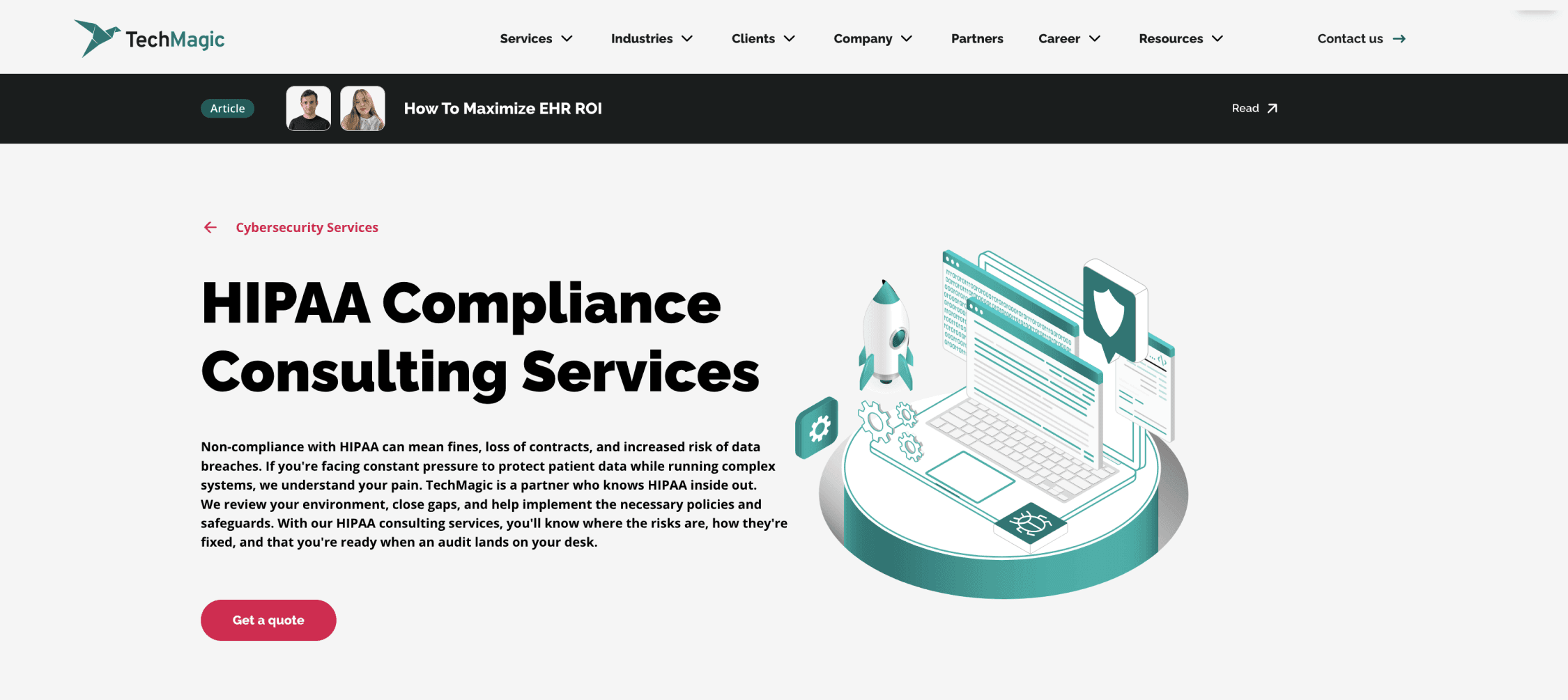
TechMagic provides execution-driven HIPAA consulting for digital health and healthcare technology companies, covering Security Rule and Privacy Rule readiness, risk analysis, remediation, and audit support. It focuses on how PHI moves through real systems and how controls operate day to day, not on documentation alone.
Core services:
- HIPAA Security Rule and Privacy Rule readiness.
- Security risk analysis.
- Remediation planning.
- Audit support.
Strengths:
- Hands-on HIPAA risk analysis that goes beyond templates to identify real security and compliance gaps.
- Ability to translate HIPAA safeguards into concrete technical and operational controls that engineers can realistically maintain.
- Clear emphasis on maintaining HIPAA compliance over time through ongoing support, readiness reviews, and security awareness training.
- Tool-agnostic consulting approach aligned with business goals, internal capacity, and budget constraints.
Limitations:
- Smaller and less brand-recognized in HIPAA consulting than the long-established advisory firms on this list.
Best fit for:
- Healthtech and digital healthcare companies building software products that process or store PHI.
- Organizations that need HIPAA compliance grounded in real engineering, data protection, and operational execution, rather than policy-only documentation.
We are here to assist

Clearwater
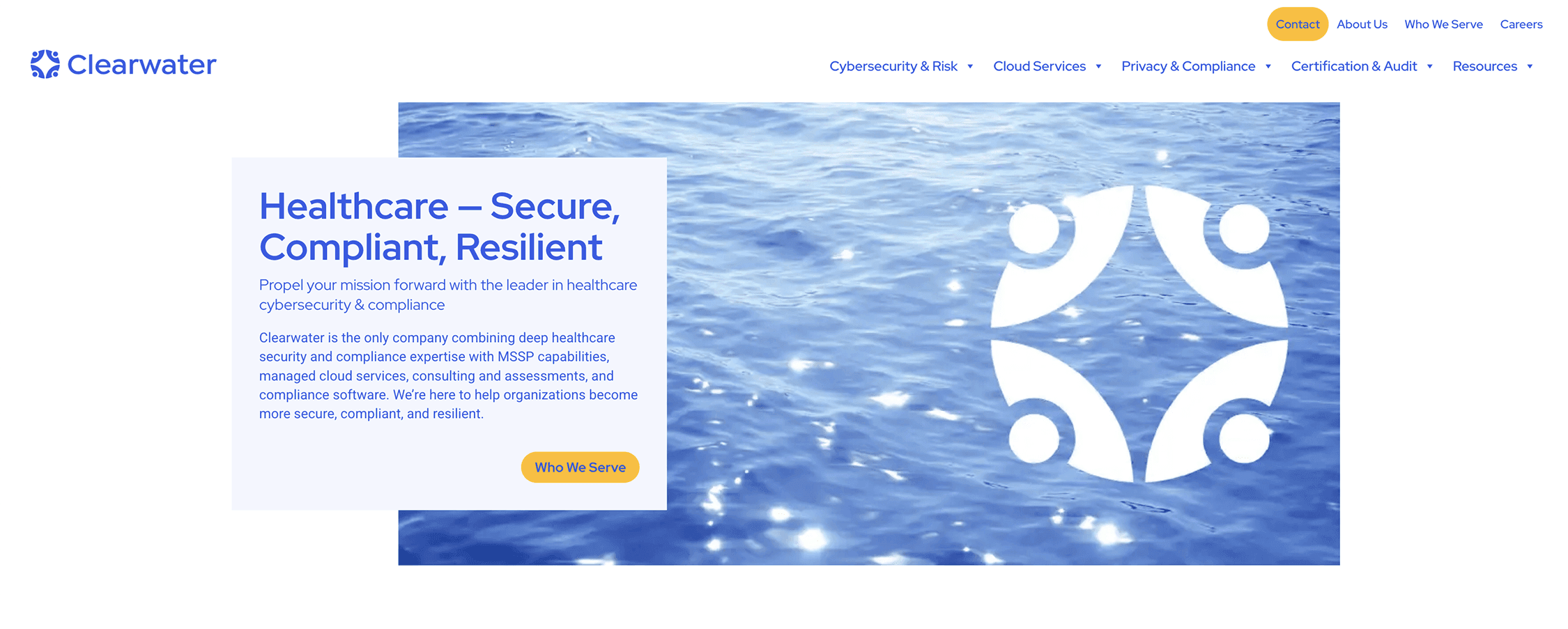
Clearwater is a healthcare-focused cybersecurity and compliance consultancy with HIPAA compliance services at the core of its offering. The firm is widely recognized for its work in HIPAA Security Rule risk analysis and remediation planning, particularly in environments subject to high regulatory scrutiny.
Clearwater's approach emphasizes defensibility and audit readiness, with structured methodologies designed to withstand regulator and auditor review.
Core services:
- HIPAA Security Rule risk analysis.
- HIPAA Privacy Rule compliance.
- Remediation planning.
- Audit-readiness and defensibility assessments.
Strengths:
- Deep specialization in HIPAA Security Rule and HIPAA Privacy Rule requirements.
- Mature, well-documented risk analysis methodologies.
Limitations:
- Geared to mid-market and enterprise programs under heavy scrutiny, so smaller or early-stage healthtech teams may find the engagement heavier than they need.
Best fit for:
- Mid-market to enterprise healthcare organizations.
- Healthtech companies operating under board-level oversight or frequent regulatory review.
Coalfire

Coalfire delivers HIPAA compliance consulting through a security-first lens, often integrating HIPAA rules into broader cybersecurity and regulatory compliance programs. Their work is typically well-suited for organizations that already have security capabilities in place and need help aligning HIPAA obligations with existing controls and frameworks.
Core services:
- Security-first HIPAA compliance consulting.
- Mapping HIPAA requirements to technical safeguards.
- Security risk management.
- Cloud environment security assessments.
Strengths:
- Strong credibility in security engineering and risk management.
- Clear mapping of requirements to technical safeguards and security controls.
- Experience operating in complex, cloud-based environments.
Limitations:
- Assumes you already have security capabilities in place, so teams without an existing security function may need more foundational support than the security-first model provides.
Best fit for:
- Healthtech companies with established security teams.
- Organizations with non-trivial infrastructure and existing security programs.
RSI Security
RSI Security provides HIPAA consulting focused on readiness reviews, gap analysis, and hands-on remediation support. Their work emphasizes execution and clarity, helping organizations move from assessment findings to concrete corrective actions.
Core services:
- HIPAA readiness reviews.
- Gap analysis.
- Hands-on remediation support.
- Corrective action planning.
Strengths:
- Practical, execution-oriented compliance consulting.
- Clear engagement structure with defined responsibilities.
Limitations:
- Less analyst and peer-review coverage than the largest firms here, so independent benchmarking is harder.
Best fit for:
- Digital health platforms.
- Business associates that need direct, hands-on HIPAA support.
Kroll
Kroll offers HIPAA consulting as part of a broader cyber risk and regulatory advisory practice. The firm is often involved in high-stakes situations where independent assessment, defensibility, and credibility with regulators are critical.
Their HIPAA consulting work frequently intersects with incident response, investigations, and post-breach analysis.
Core services:
- HIPAA compliance assessments.
- Incident response.
- Breach investigations.
- Post-incident and regulatory advisory.
Strengths:
- Defensible compliance assessments suitable for external scrutiny.
- Experience supporting organizations following security incidents or breaches.
Limitations:
- Built around high-stakes, post-incident, and investigative work, which can be more than organizations needing routine program build-out require.
Best fit for:
- Organizations requiring breach support or post-incident review.
RSM US
RSM provides HIPAA compliance consulting through governance, risk management, and compliance frameworks. Their work focuses on structuring compliance programs that can scale across larger organizations and integrate with other regulatory requirements.
Core services:
- HIPAA governance, risk, and compliance program structuring.
- Compliance documentation.
- Scaling compliance across large organizations.
- Integration with broader regulatory requirements.
Strengths:
- Strong program structuring and documentation discipline.
- Ability to scale compliance efforts across large or complex organizations.
- Integration of HIPAA rules and requirements into broader compliance initiatives.
Limitations:
- Structured for larger, multi-regulation organizations, so smaller teams may find the program-heavy approach more than they need.
Best fit for:
- Larger healthcare organizations.
Compliancy Group
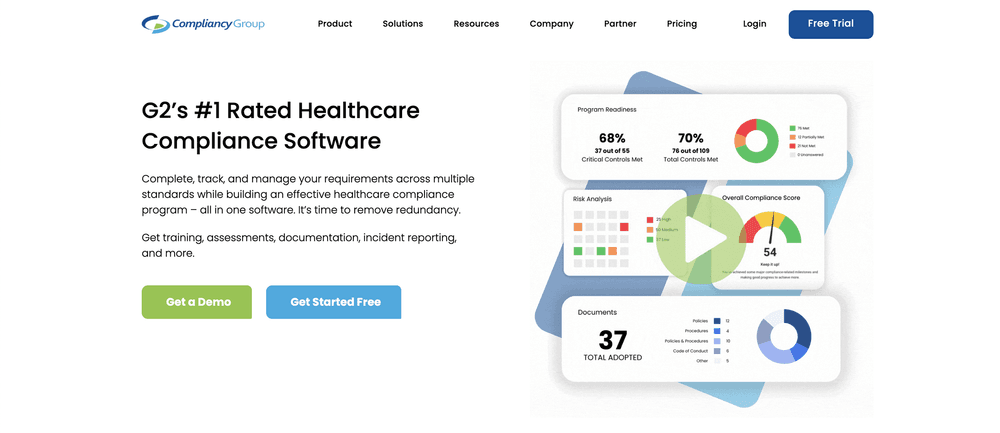
Compliancy Group delivers HIPAA compliance services through a guided, coach-led engagement model. Their approach is structured and prescriptive, helping organizations establish baseline compliance processes and maintain accountability.
Core services:
- Guided HIPAA compliance program setup.
- Policies and procedures development.
- Accountability tracking.
- Baseline compliance for first-time programs.
Strengths:
- Strong accountability mechanisms and cadence.
- Accessible model for teams without deep HIPAA expertise.
Limitations:
- The guided, prescriptive model suits first-timers; complex or enterprise environments may outgrow it.
Best fit for:
- Smaller healthtech companies.
- Business associates building their first HIPAA compliance program.
BerryDunn

BerryDunn delivers HIPAA compliance services with a strong focus on privacy and operational workflows. Their approach emphasizes how compliance requirements intersect with day-to-day healthcare operations and internal procedures.
They are often involved in aligning privacy practices with security controls and operational realities.
Core services:
- HIPAA privacy program support.
- Operational workflow alignment.
- Privacy and security integration.
- Structured compliance assessments.
Strengths:
- Strong integration of privacy and security programs.
- Clear, structured compliance assessment processes.
Limitations:
- Strongest in traditional provider operations, so cloud-native healthtech teams should confirm modern-architecture depth.
Best fit for:
- Healthcare providers and health care organizations.
- Organizations with complex operational procedures and workflows.
HALOCK
HALOCK provides HIPAA consulting centered on structured risk assessment and long-term compliance sustainability. Their work emphasizes repeatability, prioritization, and predictability rather than one-time compliance efforts.
Core services:
- Structured HIPAA risk assessment.
- Risk prioritization.
- Long-term compliance sustainability.
- Repeatable readiness reviews.
Strengths:
- Methodical, well-documented risk analyses.
- Clear prioritization of compliance gaps based on risk.
Limitations:
- Centered on structured risk assessment, so teams wanting broad hands-on remediation should confirm execution support.
Best fit for:
- Teams looking to move away from reactive compliance cycles.
LBMC

LBMC offers consulting services that span the HIPAA Security Rule, HIPAA Privacy Rule, and breach readiness. Their work balances technical security considerations with leadership-level communication and reporting.
Core services:
- HIPAA Security Rule and Privacy Rule assessments.
- Breach readiness.
- Executive-level reporting.
- Compliance assessment delivery.
Strengths:
- Balanced coverage of privacy and security requirements.
- Clear, executive-friendly reporting.
- Practical compliance assessment delivery.
Limitations:
- Balanced generalist coverage, so highly specialized or cloud-native needs may be better served by a niche partner.
Best fit for:
- Mid-sized health care providers.
- Health care organizations and service providers.
HIPAA-compliant portal for secure medical data records and exchange
HIPAA Consulting vs HIPAA Software Platforms
HIPAA software platforms and HIPAA consulting address different parts of the compliance problem. Understanding where each is effective is essential for building a defensible HIPAA compliance program.
Where HIPAA software platforms help
HIPAA software is designed to support execution and organization. It is most useful for:
- Tracking compliance tasks and ownership across teams
- Managing policies, procedures, and version control
- Organizing evidence for training, vendor management, and internal reviews
- Improving visibility into the overall compliance posture
For organizations with multiple stakeholders involved in HIPAA compliance, software can reduce administrative overhead and bring consistency to recurring activities.
Where HIPAA consultants are essential
HIPAA consultants provide value where experience, judgment, and context matter. They are essential for:
- Conducting defensible HIPAA Security Rule risk analysis and risk management
- Interpreting requirements in the context of real systems and workflows
- Designing administrative, physical, and technical safeguards that teams can realistically maintain
- Advising on remediation trade-offs when resources, timelines, or system constraints conflict
- Preparing organizations for audits, customer reviews, and regulatory scrutiny
These activities cannot be automated without losing the judgment required to make compliance defensible.
Why many healthtech companies use both
Most mature healthtech organizations use HIPAA software and HIPAA consultants together:
- Software supports consistency, tracking, and documentation
- Consultants provide expert guidance, decision-making, and implementation support
In practice, software helps teams stay organized, while consultants ensure the compliance program is credible, realistic, and defensible when it matters most.
How to Choose the Right HIPAA Consultant
Choosing a HIPAA consultant is not about finding someone who can recite the rules. It is about selecting a partner who can help you build a privacy and security program that stands up to audits, customer reviews, and regulatory scrutiny. The wrong choice often results in polished documentation and unresolved compliance gaps. The right one helps translate requirements into controls that your teams can operate and maintain as the business evolves.
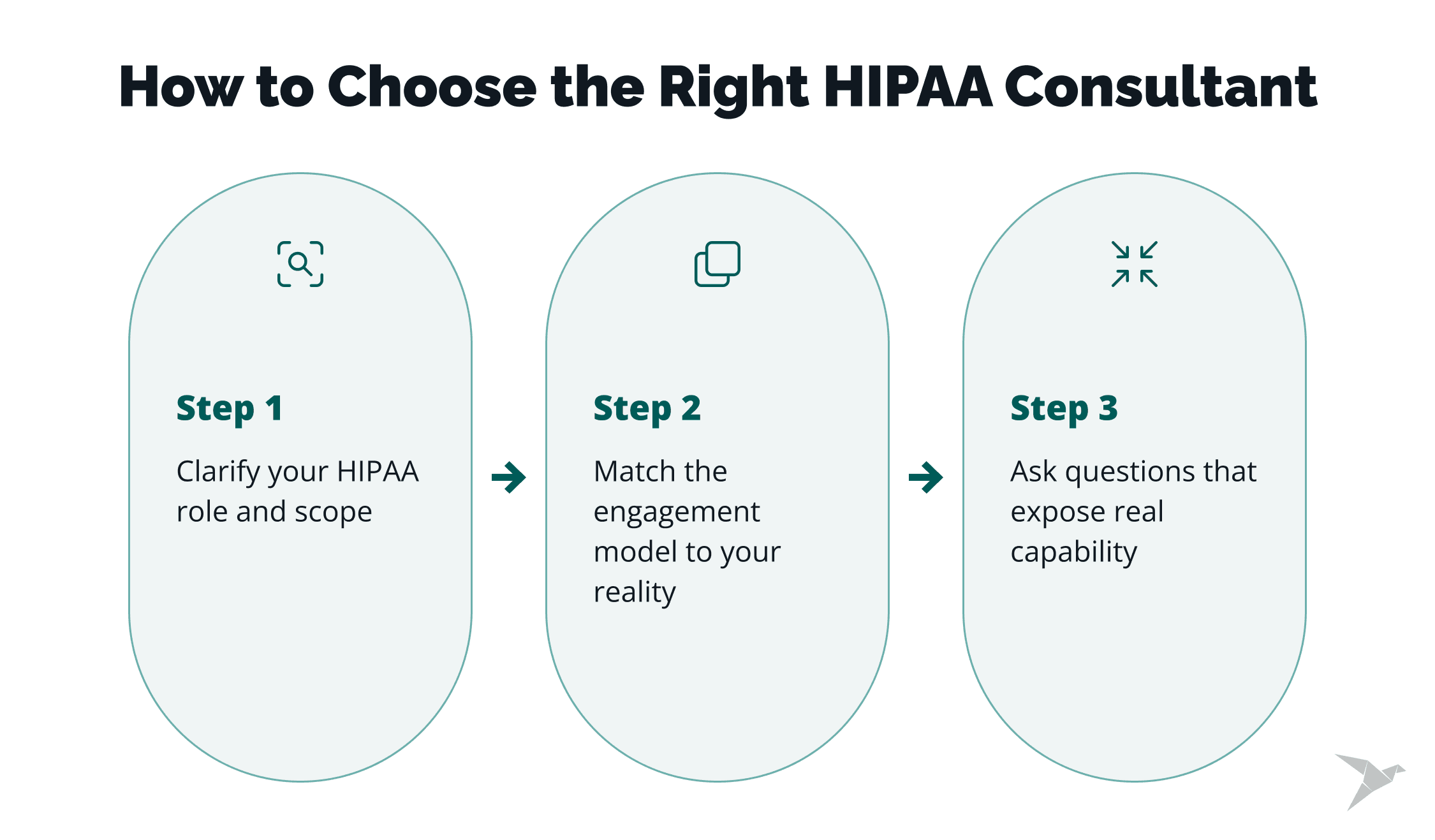
Step 1: Clarify your HIPAA role and scope
Start by aligning internally on your role under HIPAA. Whether you operate as a covered entity or a business associate affects how HIPAA requirements apply, including breach notification obligations, contractual responsibilities, and enforcement exposure.
Next, define the real scope of your patient data environment. In modern healthtech products, protected health information extends beyond primary databases into logs, analytics, support tools, backups, and third-party vendors. A capable HIPAA compliance consultant will help you map PHI flows and define defensible boundaries, rather than defaulting to overly broad or overly narrow scope.
Finally, be explicit about your business objective. Some organizations are preparing for enterprise deals, others are reducing regulatory risk, and others are stabilizing a growing security program. Without this clarity, engagements often drift toward documentation instead of outcomes.
Step 2: Match the engagement model to your reality
HIPAA consulting services differ primarily in how much execution they support. Assessment-only engagements can work when internal teams have time and experience to implement findings. In many cases, readiness plus remediation is a better fit, especially when technical safeguards, procedures, and evidence need to be built or reworked.
Also consider duration. HIPAA compliance does not end after a risk analysis. Systems, vendors, and teams change. Organizations with frequent releases or complex environments typically need periodic reviews, training, and monitoring to avoid falling out of compliance.
The right engagement model depends less on company size and more on how your organization actually operates day to day.
Step 3: Ask questions that expose real capability
Many consultants understand the HIPAA conceptually. Fewer understand how controls behave in real systems. Focus your evaluation on specificity.
Ask for a redacted risk analysis and remediation plan to see how risk is identified and prioritized. Clarify who owns remediation work and how progress is tracked. Discuss how the firm approaches technical safeguards in cloud environments and how it supports HIPAA Privacy Rule workflows, including breach readiness.
Finally, ask what maintaining HIPAA compliance looks like after the initial engagement. If post-engagement support is vague or optional, durability is not the focus.
Final Thoughts: Choosing a HIPAA Consultant You Can Defend
HIPAA compliance is a risk decision with real dollars attached.
Civil penalties are assessed per violation and are inflation-adjusted. Depending on the tier, they can range from hundreds to tens of thousands per violation, with annual caps that can exceed $2 million in the most serious categories.
And fines are only one line item. The average cost of a healthcare data breach reached $7.42M globally, and the U.S. average across all industries hit $10.22M, according to IBM's 2025 report.
That’s why hiring a consultant can be a cost-effective move: not to “outsource HIPAA,” but to build a program you can prove: risk analysis, safeguards that work in real systems, and documented remediation decisions.
What to expect next
- Scrutiny will keep rising in 2026 because HHS OCR has already proposed major Security Rule updates that would make controls more prescriptive.
- If the proposed rule is finalized, teams that relied on “addressable” flexibility will likely need to implement more controls as mandatory and show clearer evidence.
- 12–16 weeks is a common timeline for a consultant-led implementation, but if your risk analysis is outdated or your evidence is thin, expect it to take longer.
Bottom line: covered entities and business associates are expected to comply at all times. The goal is to reduce the chance of painful audits, costly breach notifications, and remediation chaos before an incident forces the issue.
FAQ

HIPAA compliance means being HIPAA compliant with U.S. rules established under the Health Insurance Portability and Accountability Act. It requires safeguards to protect PHI and other sensitive data, using ongoing risk management to meet complex regulations and prevent unauthorized access, use, or disclosure.
They translate requirements into practical steps for your environment, helping identify gaps through Security Rule risk analysis and readiness assessments. Services often include remediation planning, privacy and breach readiness support, policy development, workforce training, and ongoing advisory as systems change.
A risk analysis should show where PHI is created, stored, transmitted, and accessed; the threats and vulnerabilities that could expose it; the likelihood and impact of those risks; how effective current safeguards are; and documented decisions on risk treatment.
Costs depend on PHI scope, systems and vendors involved, and control maturity. Assessment-only work is less expensive but leaves execution to internal teams. Readiness plus remediation costs more but reduces execution risk and exposure from non-compliance.
No. Compliance requires regular updates as systems and vendors change, monitoring of safeguards, and recurring training. Done well, it protects patient trust and keeps organizations defensible under audits and regulatory scrutiny.