















HIPAA Encryption Requirements: What Data Must Be Encrypted & Why It Matters
Last updated:16 February 2026



Healthcare is one of the most targeted industries for cyberattacks. In 2025 alone, hundreds of large breaches exposed tens of millions of patient records. For many organizations, the weak point was unclear or inconsistent encryption.
If you’re responsible for protecting ePHI, you’ve likely asked: Is encryption actually mandatory? What data must be encrypted? Which standards are acceptable? And how do we prove compliance during an audit?
In this article, we break down the real meaning of HIPAA security encryption requirements and how they apply in day-to-day operations. We explain where HIPAA data encryption requirements fit within the Security Rule, what “addressable” truly means in practice, and why risk analysis and documentation matter as much as the algorithm you choose.
Key takeaways
- Encryption under HIPAA is an addressable safeguard, but in most modern environments, it’s treated as a baseline expectation for patient privacy.
- ePHI should be protected wherever it lives or moves, including storage, transmissions, backups, and portable devices, with additional security measures in place where encryption alone isn’t enough.
- HIPAA doesn’t mandate specific algorithms, but using current, widely accepted standards and solid key management is essential.
- Compliance depends on consistent governance: risk analysis, documented decisions, defined responsibilities, and ongoing oversight.
- Audit readiness comes from evidence that encryption is enforced and maintained, not from one-off screenshots or isolated settings.
What Are HIPAA Encryption Requirements?
HIPAA encryption requirements define how electronic protected health information (ePHI) should be safeguarded using technical methods that make data unreadable to unauthorized parties. Under HIPAA, encryption is part of the Security Rule, which focuses on safeguarding ePHI across systems, networks, and processes.
HIPAA does not prescribe specific algorithms or tools. Instead, it describes encryption as a way to protect ePHI at rest (stored data) and in transit (data moving between systems). The goal is risk reduction: if data is intercepted or accessed without permission, encryption limits exposure.
Within the Security Rule, encryption appears under technical safeguards. These safeguards address how systems control access, protect data integrity, and secure transmissions. Encryption supports all three by reducing the likelihood that ePHI can be read, altered, or misused.
Is Encryption Mandatory Under HIPAA?
Encryption is not explicitly mandatory under HIPAA, but it is often expected in practice to meet HIPAA compliance encryption requirements. This confusion comes from how the HIPAA Security Rule defines and enforces safeguards.
Required vs addressable safeguards
Within the Security Rule, encryption appears under technical safeguards. These safeguards address how systems control access, protect data integrity, and secure transmissions. Encryption supports all three by reducing the likelihood that ePHI can be read, altered, or misused.
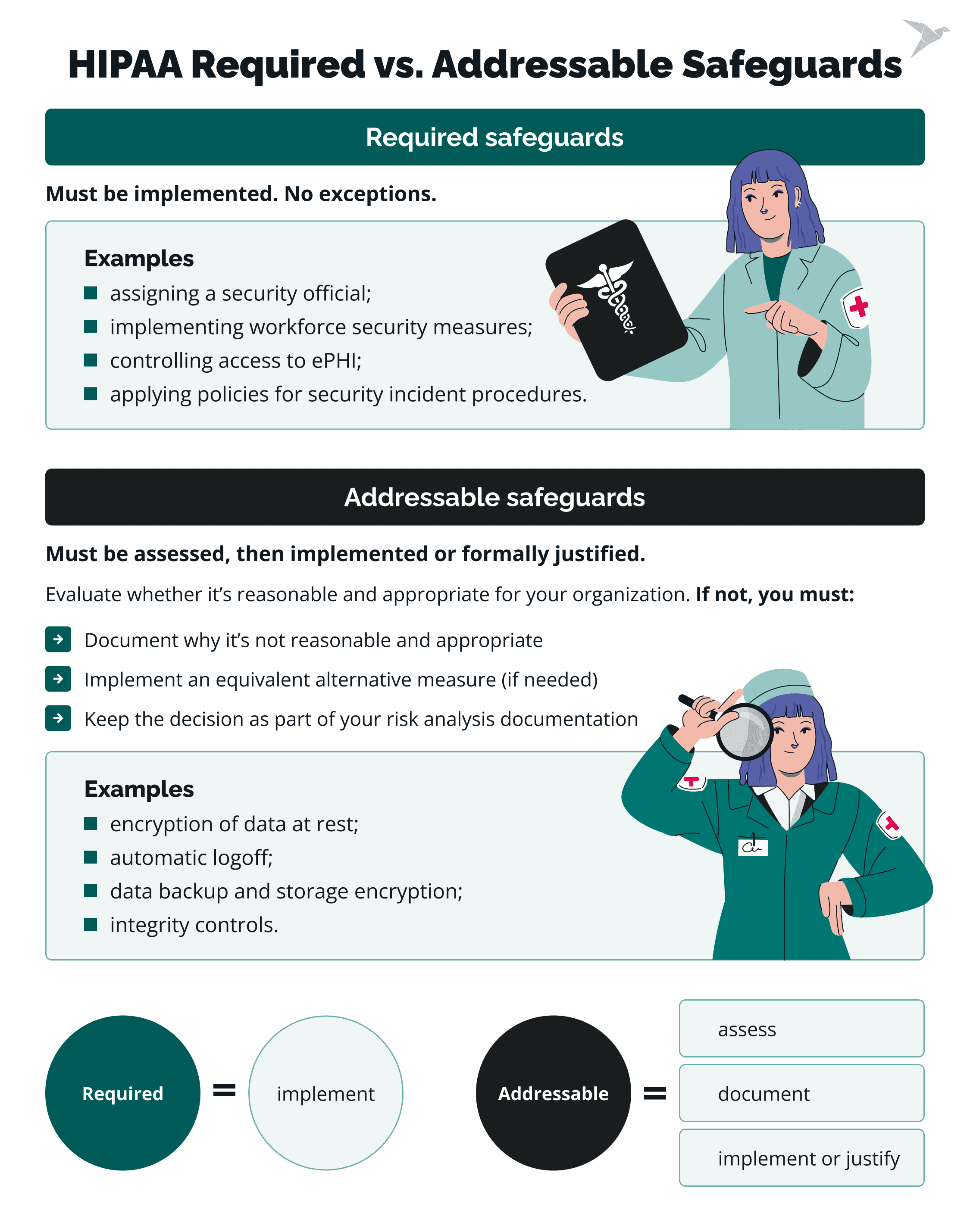
HIPAA distinguishes between required and addressable safeguards.
- Required safeguards must be implemented exactly as stated.
- Addressable safeguards must be assessed and applied based on risk, system design, and operational context.
Encryption falls into the addressable category. This means organizations are expected to evaluate whether encryption is reasonable for their environment. If encryption is not implemented, the organization must adopt an alternative control that provides comparable protection and document the decision.
In practice, most healthcare systems treat encryption as a baseline security control. Modern infrastructure, cloud platforms, and compliance frameworks assume encrypted storage and encrypted communication as standard risk management measures.
When encryption becomes effectively mandatory
Encryption becomes effectively mandatory when handling ePHI in environments where unencrypted access creates a clear risk. This includes cloud infrastructure, mobile devices, remote access, backups, and data exchanges with third parties.
In these scenarios, regulators and auditors generally expect encryption to be in place because widely available technologies make it a practical and reasonable safeguard. Failing to encrypt in such cases often signals a gap in HIPAA compliance encryption requirements, even though the rule itself does not list encryption as a strict legal mandate.
Risk analysis and documentation obligations
HIPAA requires organizations to perform a risk analysis to identify threats to ePHI and document how those risks are managed. Encryption decisions must be part of this process.
If encryption is implemented, documentation should show where and how it protects ePHI. If encryption is not implemented, documentation must explain the risk assessment, the reasoning behind the decision, and the compensating controls in place. In enforcement actions, lack of documentation is often treated as a lack of compliance, regardless of the technical setup.

What Data Must Be Encrypted Under HIPAA?
HIPAA encryption expectations apply to electronic protected health information (ePHI) wherever it is created, stored, processed, or transmitted. The focus is on reducing exposure risk across the full data lifecycle, not on specific file types or systems.
ePHI at rest
ePHI at rest includes data stored in databases, file systems, virtual machines, containers, and cloud storage. This applies to production environments as well as non-production systems such as testing and staging, when they contain real patient data.
Encryption is most critical when storage systems are shared, internet-accessible, or managed by third parties. If unauthorized access occurs, encryption limits the ability to read or misuse the data.
ePHI in transit
ePHI in transit covers data moving between systems, users, or services. Common examples include API calls, system integrations, patient portals, remote access, and data exchanges with vendors or partners.
Encryption protects ePHI from interception during transmission, especially across public or untrusted networks. Secure communication channels are a core expectation when ePHI leaves a controlled internal environment.
Backups and archives
Backups and archives often contain complete copies of ePHI and are frequently overlooked in encryption planning. These datasets may be stored offsite, in the cloud, or on removable media for long periods.
Encryption is critical for backups because access controls alone may not apply once data is removed from primary systems. A lost or exposed backup without encryption can result in broad data exposure.
Portable and mobile devices
Portable and mobile devices include laptops, smartphones, tablets, external drives, and other removable storage that can store or access ePHI. These devices are at higher risk of loss or theft.
Encryption helps ensure that ePHI remains protected even when physical control of the device is lost. In mobile environments, encryption is often the primary safeguard against the impact of breaches.
What Encryption Standards Are Considered HIPAA Compliant?
As we said before, HIPAA does not define specific encryption algorithms, but regulators generally expect the use of widely recognized, industry-accepted standards to meet HIPAA encryption compliance requirements. In practice, this means following guidance from established technical bodies and using encryption methods considered secure at the time.
NIST-approved encryption algorithms
Encryption standards approved by the National Institute of Standards and Technology (NIST) are widely treated as acceptable for HIPAA encryption compliance requirements. NIST publications define cryptographic algorithms, modes, and practices that meet current security expectations.
Using NIST-approved algorithms helps demonstrate that encryption choices are based on recognized technical benchmarks rather than custom or untested methods.
AES encryption for data at rest
Advanced Encryption Standard (AES) is commonly used to protect ePHI stored on disks, databases, and backups. AES is recognized for its strength and efficiency and is included in NIST recommendations.
AES is typically applied to full-disk encryption, database encryption, and file-level encryption to reduce exposure if storage media or systems are accessed without authorization.
TLS for data in transit
Transport Layer Security (TLS) is the standard approach for encrypting ePHI during transmission. It is used to secure web traffic, APIs, system integrations, and remote access connections.
TLS helps protect data from interception and alteration while it moves across internal and external networks. Deprecated or insecure protocol versions should not be used, as they no longer meet current security expectations.
Key length and key management basics
Encryption strength depends not only on the algorithm but also on how encryption keys are created, stored, rotated, and protected. Regulators generally expect key lengths that align with current NIST guidance.
Key management practices should limit access to keys, separate key storage from encrypted data, and support regular rotation. Weak or poorly managed keys can undermine otherwise compliant encryption controls and affect HIPAA encryption compliance requirements.
Who Is Responsible for HIPAA Encryption Compliance?
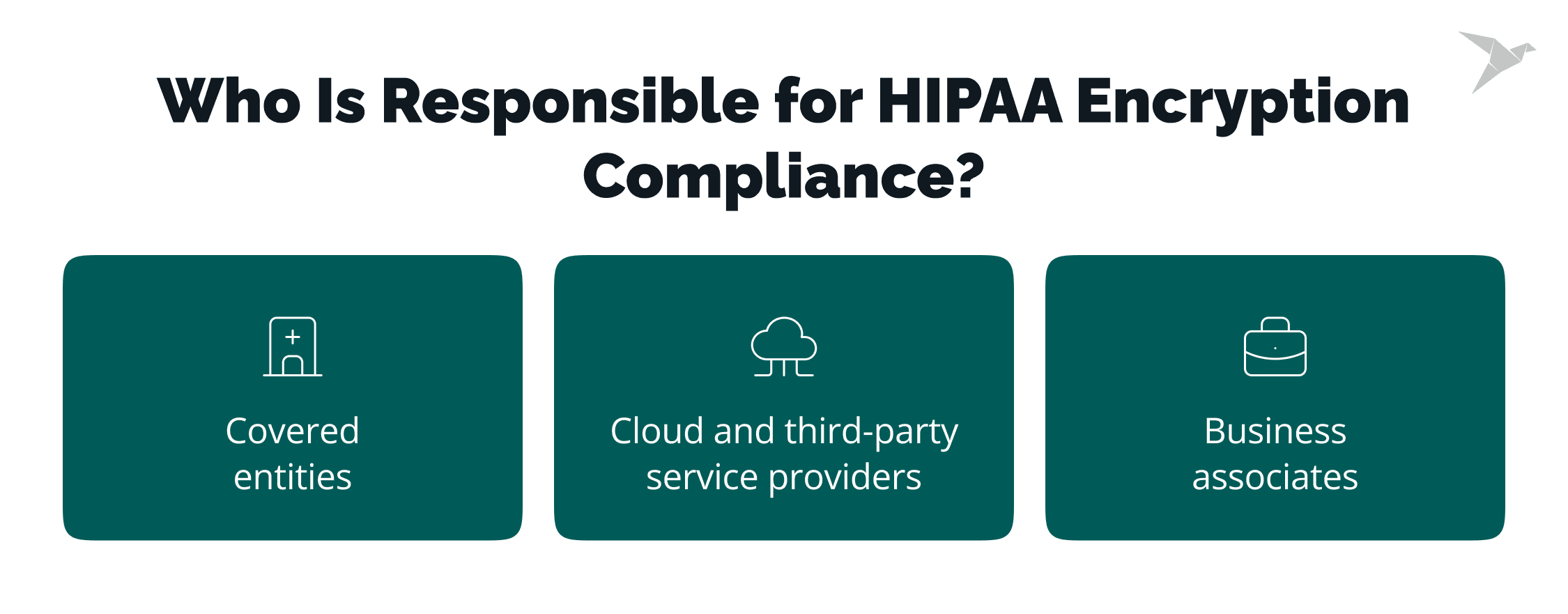
HIPAA encryption compliance is shared between covered entities and business associates based on how ePHI is created, accessed, and managed. Responsibility follows control over systems and data, not organizational boundaries, which is especially relevant in hipaa compliant app development.
Covered entities responsibilities
Covered entities are responsible for ensuring that ePHI under their control is protected throughout its lifecycle and that encryption requirements for HIPAA are addressed. This includes defining security policies, selecting appropriate encryption controls, and verifying that safeguards align with documented risk analysis results.
Covered entities must also ensure that encryption expectations are applied consistently across internal systems and external relationships. Accountability remains with the covered entity even when operations are delegated.
Business associates responsibilities
Business associates are responsible for protecting ePHI they create, receive, maintain, or transmit on behalf of a covered entity. This includes implementing encryption controls within the scope of their services and meeting the security obligations defined in the business associate agreement.
Business associate agreements should clearly define encryption responsibilities, scope of access, and incident response expectations. Clear allocation of duties reduces gaps when multiple parties handle the same ePHI.
Cloud and third-party service providers
HIPAA-certified cloud and third-party service providers typically operate under a shared responsibility model. Providers may secure the underlying infrastructure, while customers control how ePHI is stored, configured, and encrypted.
Encryption responsibility depends on service type and configuration. Even when a provider offers encryption capabilities, the covered entity or business associate remains responsible for enabling, managing, and validating those controls. Misunderstanding shared responsibility does not shift compliance accountability.
HIPAA-compliant portal for secure medical data records and exchange

How Should Organizations Implement HIPAA-Compliant Encryption?
The best way to implement HIPAA-compliant encryption is through a structured security program that ties technical controls to risk management and oversight. From our experience, encryption works best when it is planned, governed, and reviewed as part of a broader security strategy.
Conducting a risk analysis
A risk analysis identifies where ePHI exists, how it flows through systems, and where exposure could occur. This assessment should cover production and non-production environments, integrations, backups, and user access paths.
Encryption decisions should be based on documented risks rather than assumptions. Clear records of findings and mitigation choices support consistent enforcement and compliance reviews.
Selecting appropriate encryption controls
Encryption controls should align with the sensitivity of the data and the operational environment. This includes evaluating where encryption is needed for data at rest, in transit, and in secondary storage such as backups.
Control selection should consider system architecture, access models, and third-party dependencies. Encryption that cannot be consistently enforced or validated introduces operational risk.
Managing encryption keys securely
Key management is central to effective encryption. Keys should be protected from unauthorized access, stored separately from encrypted data, and rotated based on defined policies.
Access to keys should follow the principle of least privilege. Poor key handling can weaken encryption even when strong algorithms are used.
Continuous monitoring and review
Encryption controls require ongoing oversight to remain effective. Monitoring should confirm that encryption is active, configurations remain unchanged, and deprecated protocols or weak settings are not reintroduced.
Regular reviews help ensure encryption practices stay aligned with system changes, threat conditions, and compliance expectations. Encryption should be treated as a living control, not a one-time implementation.
How Can You Prove HIPAA Encryption Compliance During an Audit?
You prove HIPAA encryption compliance by showing clear, consistent evidence that your encryption program is defined, implemented, monitored, and backed by risk-based documentation. Auditors assess how well your controls align with HIPAA regulations and whether they reliably safeguard electronic PHI and other protected health information phi in real workflows.
Policies and procedures
Auditors expect written policies that explain how you protect patient data at rest and in transit, including ownership, enforcement, and review cycles. Procedures should show how encryption is enabled, validated, and maintained, with approvals and version history to demonstrate accountability and repeatability that protect sensitive patient information.
Risk assessments
Because encryption is an addressable security measure, your risk analysis must show why encryption is used where it matters and how it reduces realistic threats. If encryption isn’t used somewhere, you must document the rationale and controls that still qualify as a reasonable and appropriate safeguard.
Encryption configuration evidence
Provide system-level evidence that encryption is active, consistent, and traceable across environments, not just turned on in isolated spots. This can include architecture documentation, configuration baselines, and validation summaries that show which various encryption technologies are in place and how they’re governed.
Training and awareness records
Auditors also look for proof that staff understand encryption-related responsibilities. Training logs, acknowledgements, and recurring awareness activities help show encryption is supported by operations, which reduces gaps during compliance investigations and strengthens HIPAA compliance.
Final Thoughts
Encryption is one of the most practical ways to protect ePHI and stay aligned with HIPAA. It lowers exposure when systems are breached, devices are lost, or data moves across networks, and it’s strongly reflected in health and human services enforcement expectations.
While HIPAA often treats encryption as part of addressable implementation specifications, the message is clear: you should either implement encryption in line with recognized HIPAA encryption standards or be ready to justify an equivalent alternative measure with solid risk-based documentation.
Today’s healthcare environment is high-risk and regulated. For healthcare providers, encryption reduces damage when systems are breached, laptops go missing, or data crosses public networks. The “how” matters as much as the “what”: policies, risk assessment, documentation, and consistent deployment across systems are just as important as the specific encryption technologies you choose.
Under HIPAA, encryption is often treated as part of addressable implementation specifications, meaning you either implement it or document why another control is reasonable or an equivalent alternative measure based on risk.
Stats: why encryption matters
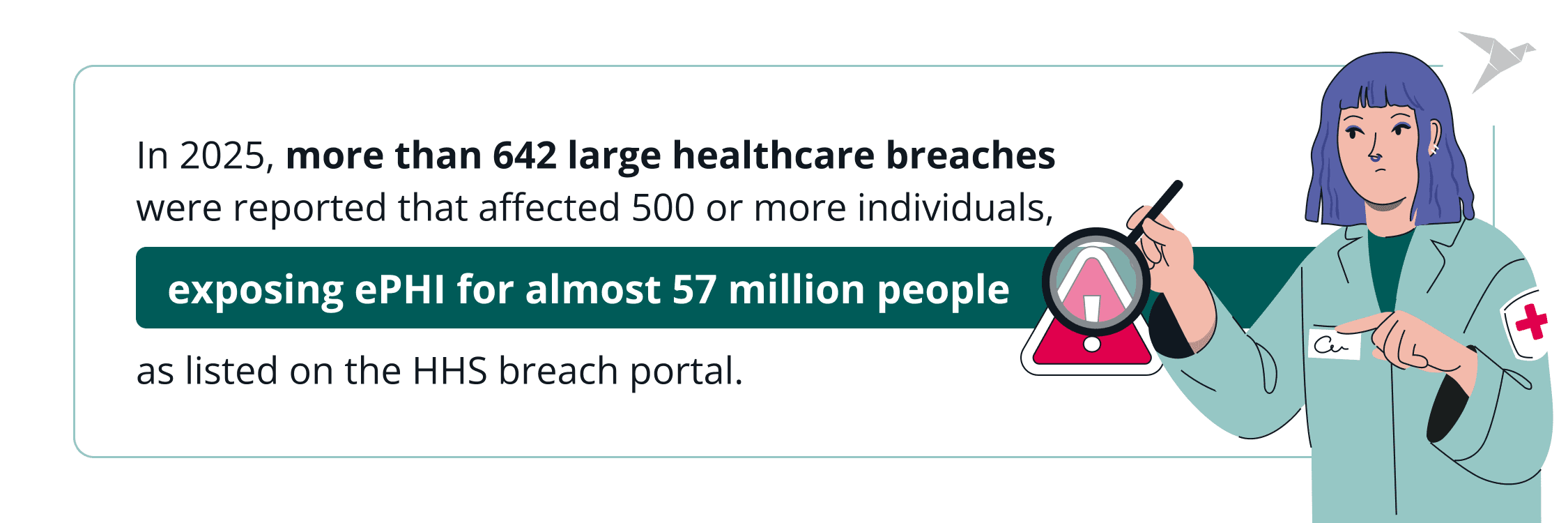
Healthcare data breaches remain frequent and costly. In 2025, more than 642 large healthcare breaches were reported affecting 500+ individuals, exposing ePHI for almost 57 million people on the HHS breach portal.
These numbers connect directly to the breach notification rule reality: when data isn’t protected properly, the operational and reputational impact escalates fast. In many environments, organizations that can meet HIPAA encryption requirements for data at rest and in transit are better positioned to limit disclosure scope when incidents occur.
Predictions for the future
Looking forward, healthcare cybersecurity is likely to shift toward stricter encryption expectations and clearer proof of control. As cloud and hybrid models expand, audits will scrutinize governance across third parties and the consistency of storage encryption technologies in real-world workflows—not just in policy documents.
Practically, that means more emphasis on modern encryption software adoption, tighter key management, and validated configurations for common patterns like virtual disk encryption for endpoints and servers. We’ll also see stronger standardization around procurement and implementation of HIPAA encryption software, with clearer documentation trails to show how specific tools, settings, and operational processes reduce risk over time.

FAQ

HIPAA encryption means using encryption solutions that make ePHI unreadable to anyone who shouldn’t access it. It’s one way to implement technical security measures under the HIPAA Security Rule for data at rest and in transit, so even if data is stolen or intercepted, it’s far less usable without the decryption key.
Done well, encryption supports secure data transfer and strengthens everyday security measures around sensitive patient information.
Encryption is an addressable safeguard under the HIPAA Security Rule. That means you must assess whether it’s reasonable and document what you decide, using a recognized security framework and a risk-based approach.
In reality, most organizations encrypt because it’s hard to defend against not doing so in modern environments. If you don’t encrypt, you need clearly defined, appropriate security measures that provide comparable protection and can still maintain HIPAA compliance.
HIPAA doesn’t name specific algorithms, but regulators generally expect alignment with well-established standards (often NIST-aligned) and strong implementation practices.
Meeting expectations is less about a label and more about whether you hipaa encryption requirements protect ePHI through secure configurations, key management, access control, and monitoring: core security measures that hold up in audits and incident reviews.
HIPAA expects you to evaluate backups that include ePHI and protect them based on risk. While it isn’t a hard “must” in every scenario, backups often include complete copies of patient data, making encryption the most defensible choice.
Unencrypted backups increase exposure if storage media is lost, stolen, or accessed outside primary systems. Backup protection is also closely tied to HIPAA database encryption requirements, since database snapshots and exports often become part of backup workflows.