
 Software Development
 Security Services
 Cloud Services
 AI Services
 Other Services















 TechMagic Academy


What Is the Best AI Company in 2026: Overview of Top Companies
Last updated:14 June 2026
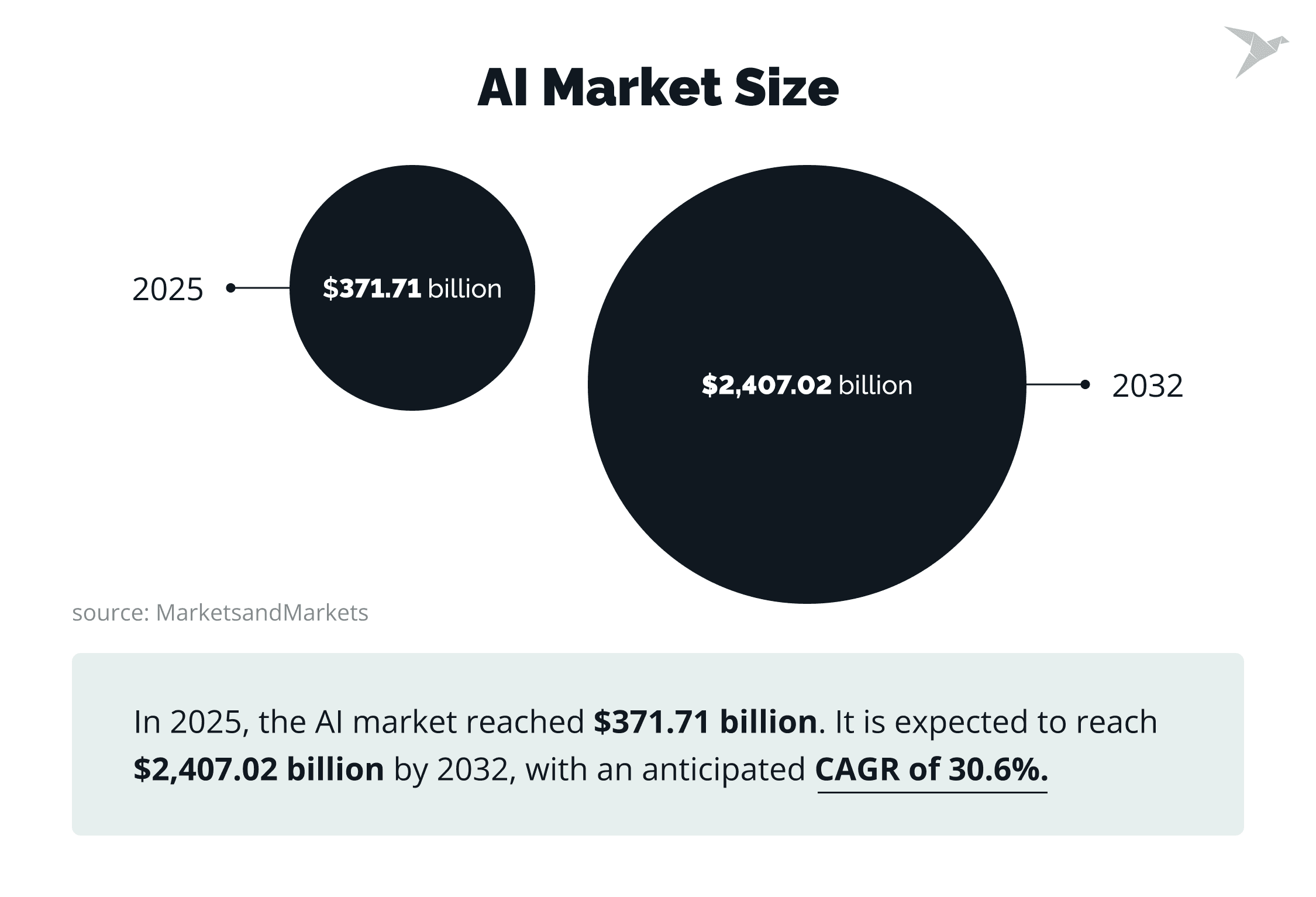
The global AI market was estimated at $371.71 billion in 2025 and is projected to reach $2,407.02 billion by 2032, growing at a 30.6% CAGR, according to MarketsandMarkets. That scale has attracted a large and diverse field of AI development companies, which makes choosing the right partner harder.
Gartner forecasts global AI spending will top $2 trillion in 2026. What's more, AI-driven automation is expected to impact two-thirds of jobs worldwide, according to Goldman Sachs. No surprise that for product and engineering leaders, AI is already part of the plan. The challenge is choosing a partner who can deliver a real, usable system.
AI development services are in high demand, which makes vendor selection harder: many companies can show promising results in isolation, but fewer can work with production data, meet security requirements, and adapt as the project evolves.
In this guide, you’ll find a list of AI development companies to consider in 2026, including global and US options. You’ll also see how to evaluate vendors based on production readiness, security, scalability, and long-term ownership, along with a practical framework for selecting the right AI partner.
Key Takeaways
- Most AI projects fail when they move past the demo and hit real production conditions.
- The strongest vendors own the whole lifecycle: data prep, integration, deployment, and post-launch support.
- Production AI lives or dies on messy data, edge cases, monitoring, and fallback behavior when a model is wrong.
- Security and compliance readiness are non-negotiable when AI touches regulated data.
- Judge vendors on delivery experience, team structure, and proven outcomes rather than the sales pitch.
- The best partners provide businesses with AI-powered software solutions built for real, everyday workflows.
- A short discovery phase or pilot is the cheapest way to test fit before you commit.
Where Our Perspective Comes From
We have built AI-driven software since 2014, across HealthTech, FinTech, and cloud environments where data quality, security, and compliance shape every delivery decision. That work taught us what separates a production AI system from a good demo. It also shapes what we look for in a partner.
Our team includes engineers who compare AI approaches across live projects, and security specialists with CREST accreditation and a Certified AI/ML Pentester credential (The SecOps Group). We have sat on both sides of the buying conversation, so we know which questions matter before a contract is signed.
We did not test every vendor ourselves. We reviewed companies that offer AI software development as a named, active service, and left out teams that treat AI as a passing mention. Our sources: Clutch, G2, public case studies, and industry research, alongside our own experience benchmarking similar vendors.
How we selected companies: demonstrated AI delivery experience, verified or publicly described client outcomes, and enough public information to assess each one fairly.
What we assessed: five things, applied the same way to every company. AI lifecycle coverage. Security and compliance credentials. Verified client reviews. Industry depth. A documented AI track record.
Each company was scored on five criteria:
List of Top AI Companies 2026 Worldwide
- TechMagic
- Thoughtworks
- Endava
- Globant
- Zühlke
- Software Mind
- Netguru
- Altar.io
- Adesso SE
- Objectivity
- Xebia
- Selleo
List of Top AI Companies 2026 in the USA
- TechMagic
- MojoTech
- Diffco
- Azumo
- BlueLabel
- BairesDev
- WillowTree
- DockYard
- Very Good Ventures
- AI Superior
Top AI Software Development Companies Worldwide
If you’re shortlisting partners, here’s the truth: plenty of teams can build a convincing demo. Far fewer can take your idea through security reviews, messy real-world data, and the long tail of fixes that show up after launch.
This list of top AI software development companies focuses on groups with strong engineering foundations and clear delivery models, so you can compare them like a buyer, not like a fan.
You’ll notice these vendors sit in different lanes. Some are software development companies that move fast. Some are large enterprise delivery engines that handle complexity well. If you’re still asking “which AI company is best?” start with the kind of system you need, then match it to the kind of team that can carry it.
Let’s get started!
TechMagic
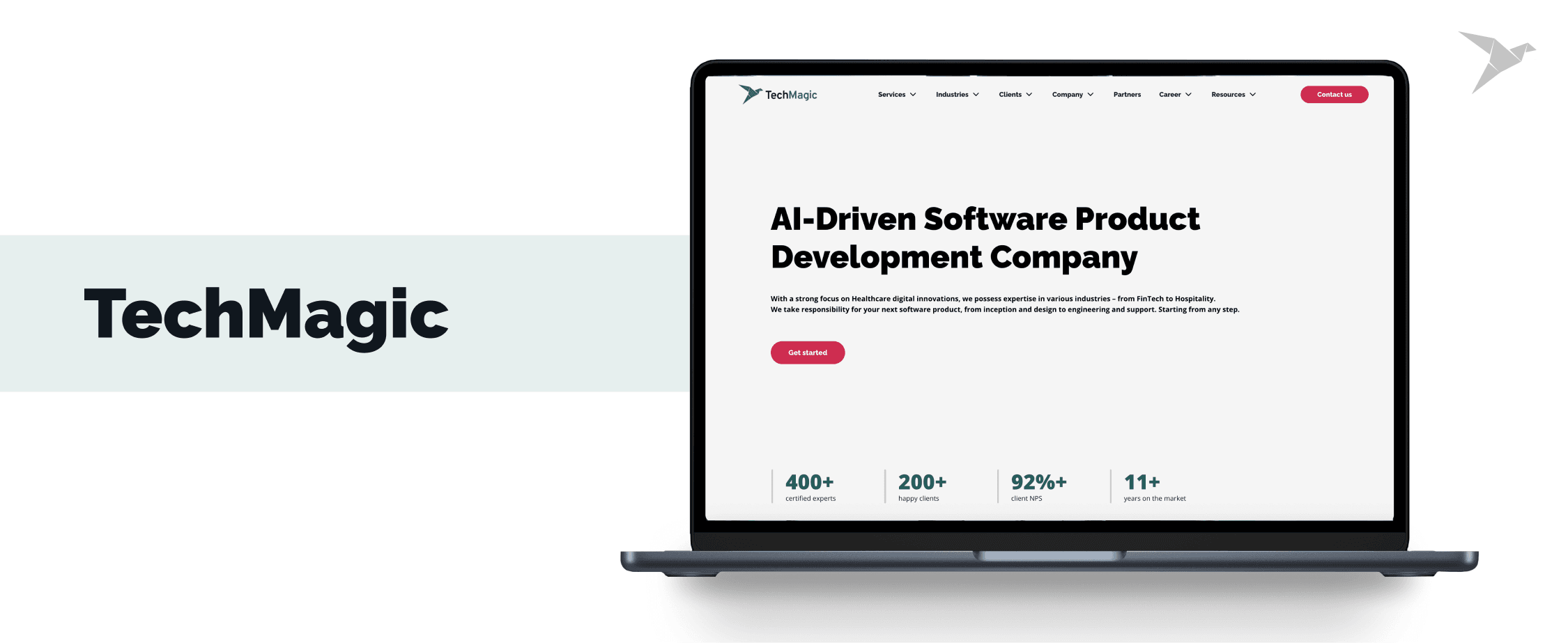
TechMagic is an AI-driven full-cycle software company founded in 2014, building AI products for HealthTech, FinTech, cloud, hospital and other directions.
- Core services: custom and generative AI development; AI integration; data prep and evaluation; monitoring and support; cybersecurity for AI (CREST-accredited).
- Best suited for: HealthTech/FinTech startups and scale-ups wanting one partner to own AI end to end, with security or compliance as a hard requirement.
- Strengths: CREST accreditation and a Certified AI/ML Pentester credential (The SecOps Group), rare among AI vendors; 4.8/5 on Clutch across 52 reviews; full-cycle model removes handoffs.
- Weaknesses: less globally recognized than integrators like Accenture or Thoughtworks, which can matter in enterprise procurement.
- Ratings: 4.8/5 on Clutch, 52 reviews (June 2026).

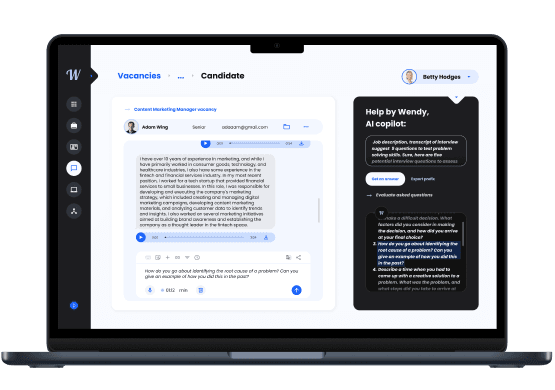
Learn how we built an AI-powered recruitment assistant using OpenAI stack
Thoughtworks
Thoughtworks is a global software consultancy that has a solid reputation for engineering discipline and production delivery. It focuses on platforms, engineering practices, and machine learning and large language models business operations.
- Core services: AI strategy and ML platform design; LLM lifecycle management; data engineering; platform modernization with embedded AI; agile and DevOps transformation.
- Best suited for: large enterprises needing AI managed alongside wider transformation and engineering-culture change.
- Strengths: 30+ years running AI in complex enterprise settings; strong ML lifecycle practices, useful after prototype fatigue; global delivery across time zones.
- Weaknesses: premium pricing rules out budget-constrained teams; enterprise focus slows smaller builds; no verified Clutch reviews.
- Ratings: no verified Clutch or G2 rating (June 2026).
Endava
UK-headquartered services company founded 2000, ~11,000 employees across Europe, Latin America, and North America. Delivers AI within broader transformation work.
- Core services: AI integration in product delivery; data engineering and modernization; cloud-native development (Google Cloud, OpenAI); systems modernization; customer-facing products with AI.
- Best suited for: enterprises needing AI handled alongside digital transformation, especially in financial services, insurance, and media.
- Strengths: Google Cloud and OpenAI partnerships add model breadth; strong record in regulated sectors; large distributed delivery across regions.
- Weaknesses: acquisition-led growth can make delivery inconsistent across centers; broad offering, less specialized than AI-first vendors; no verified Clutch reviews.
- Ratings: no verified Clutch or G2 rating (June 2026).
Globant
Global digital services company founded 2003 in Buenos Aires, ~28,000 employees in 33 countries. Delivers AI through industry-focused "AI Studios."
- Core services: AI Studios for vertical delivery; AI agents and workflow automation; generative AI integration; "AI Pods" packaged delivery; platform modernization, AI agent development.
- Best suited for: large enterprises running scaled AI programs across business lines, where reach and domain capacity matter.
- Strengths: 28,000+ staff support complex multi-team programs; AI Studios add domain context in finance and retail; Google Cloud and OpenAI partnerships.
- Weaknesses: size can mean less personalized engagement for mid-market clients; a 2025 securities fraud lawsuit over Latin American performance adds governance uncertainty; no verified Clutch reviews.
- Ratings: no verified Clutch or G2 rating (June 2026).
Zühlke
Swiss engineering-led consultancy founded 1968, ~1,000 engineers across Europe and Singapore, 10,000+ projects. AI work means integration into product or industrial systems.
- Core services: AI product strategy and feasibility; ML development and integration; IoT and embedded AI; digital product development; data engineering and governance.
- Best suited for: mid-size to enterprise firms in banking, insurance, MedTech, and industry wanting structured, standards-driven delivery.
- Strengths: 55+ years of delivery grounds AI in practical integration; methodical approach covers performance and cost trade-offs; strong European regulatory expertise.
- Weaknesses: premium Swiss pricing narrows the client base; limited presence outside Europe and Singapore; no verified Clutch reviews.
- Ratings: no verified Clutch or G2 rating (June 2026).
Software Mind
Poland-founded engineering company established 1999, ~1,300 employees across Europe, the USA, and Latin America. AI and ML sit within larger programs.
- Core services: predictive modeling and applied ML; computer vision; AI and data analytics integration; staff augmentation for AI/data teams; frontend, backend, mobile.
- Best suited for: organizations running AI within a broader modernization or platform initiative, where scale and team continuity matter.
- Strengths: 58 verified Clutch reviews with consistently positive sentiment; distributed delivery supports time-zone flexibility; flexible staff-augmentation and custom models.
- Weaknesses: strongest in staff augmentation, lighter end-to-end ownership; experience can vary across centers; lower public profile for AI-specific delivery.
- Ratings: 58 verified reviews on Clutch; numeric rating not publicly surfaced (June 2026).
Netguru
Poland-based product company founded 2008, 900+ employees, B Corp certified. Supported by data scientists. Ships AI as features within an iterative product roadmap.
- Core services: generative AI integration (LLMs, RAG); AI product features; data science and predictive modeling; UI/UX for AI interfaces; product strategy.
- Best suited for: startups and scale-ups wanting AI built into their roadmap with iterative releases, not heavy infrastructure work.
- Strengths: 4.8/5 on Clutch across 73 reviews, the largest base in this list; iterative model keeps scope controlled; B Corp signals transparency and quality.
- Weaknesses: pricing higher than comparable Eastern European vendors; some clients noted inconsistency on larger projects; MLOps and ML infrastructure outside its focus.
- Ratings: 4.8/5 on Clutch, 73 reviews (June 2026).
Altar.io
Portugal-based product studio founded 2015, ~45 employees. Helps startups and scale-ups scope, plan, and build AI-integrated MVPs.
- Core services: MVP definition and scoping; end-to-end product development (UX, web, mobile, AI); startup strategy and validation; FinTech, real estate, hospitality products; post-launch iteration.
- Best suited for: early-stage teams needing help defining scope before a full build, where MVP speed matters most.
- Strengths: founded by ex-startup founders, practical on scope and build-versus-buy; 28 verified Clutch reviews with high sentiment; strong fit when requirements are still evolving.
- Weaknesses: ~45-person team caps capacity for enterprise programs; limited experience in heavily regulated fields like pharma; smaller review volume (28) limits validation.
- Ratings: 28 verified reviews on Clutch; numeric rating not publicly surfaced (June 2026).
Adesso SE
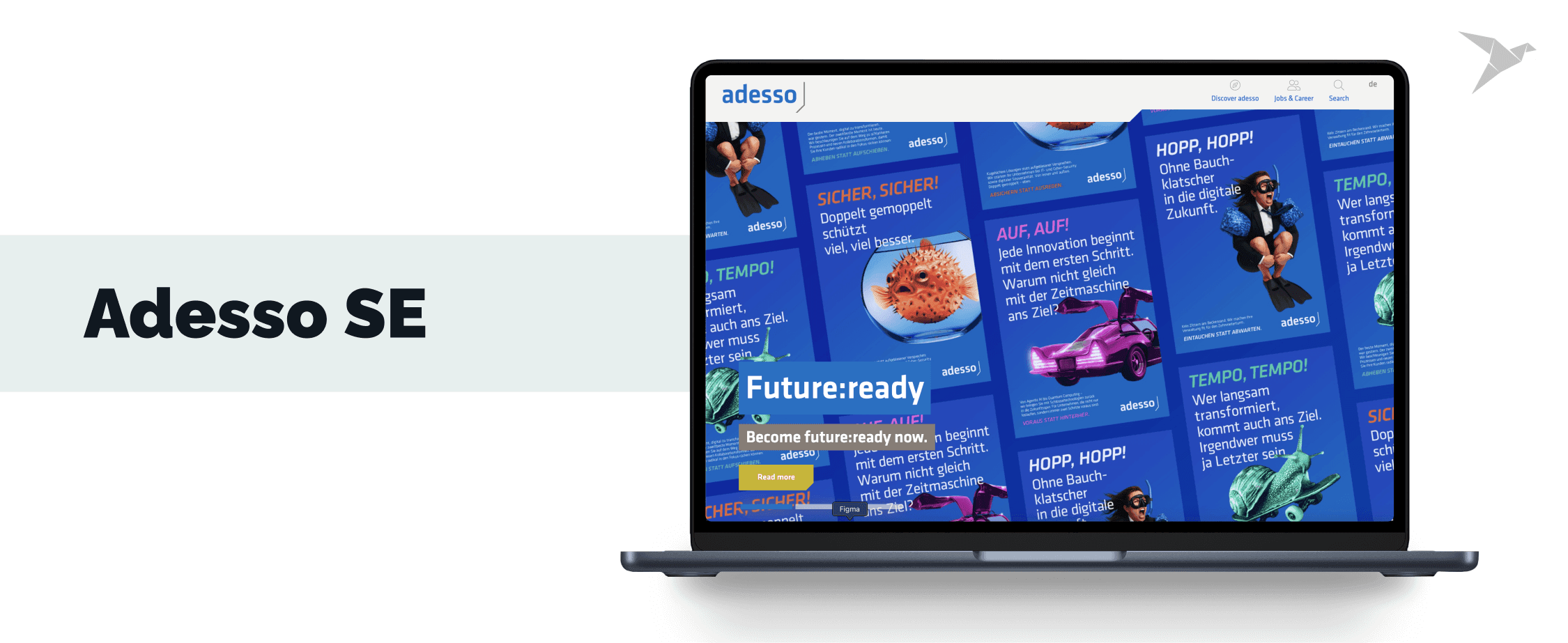
Germany-based IT services firm founded 1997, ~11,000 employees, listed in Frankfurt. AI practice centers on enterprise data strategy, governance, and readiness.
- Core services: AI strategy and data maturity assessment; enterprise AI and automation; industry IT solutions; process intelligence and RPA; data governance frameworks.
- Best suited for: large German and European enterprise level solutions, companies needing structured AI adoption and improving internal operations efficiency.
- Strengths: deep delivery in regulated German industries; upfront readiness work reduces the risk of building on weak data; publicly listed, transparent governance.
- Weaknesses: German-market focus fits US or APAC programs less naturally; no verified Clutch reviews for the main entity; favors governance over prototyping speed.
- Ratings: no verified Clutch or G2 rating for the main entity (June 2026).
Objectivity
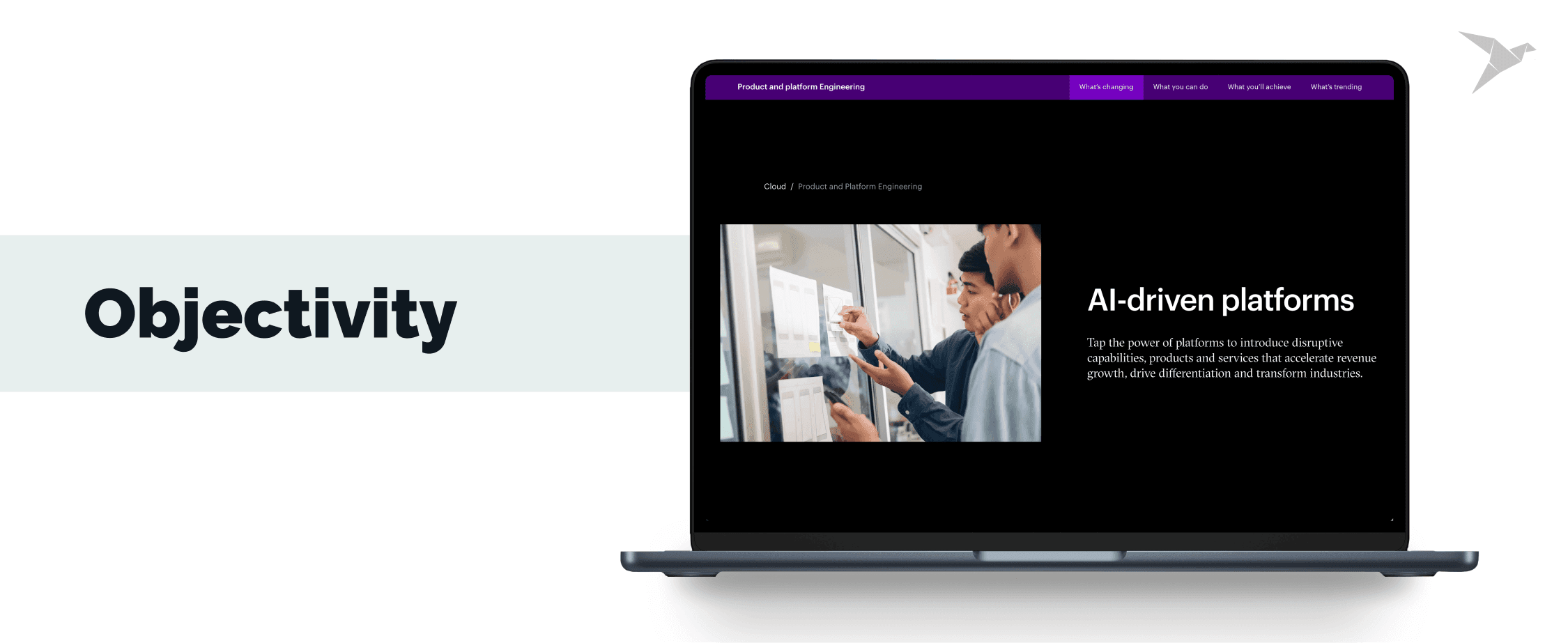
UK-Poland digital engineering firm founded 1991, known for Azure/AWS platform work, bespoke software, and applied AI/ML. Acquired by Accenture in 2023; independent brand now inactive.
- Core services: cloud-native AI integration (Azure, AWS); bespoke AI/ML applications; data pipelines and analytics; low-code AI (Mendix); financial services and public sector engineering.
- Best suited for: organizations needing AI on strong cloud foundations, especially financial services where data maturity precedes deployment.
- Strengths: strong cloud engineering addresses platforms that can't support production AI; UK and Poland centers gave good European time-zone coverage; capability continues within Accenture.
- Weaknesses: independent brand gone, now under Accenture, affecting pricing and access; only 6 reviews predate acquisition, profile now inactive; better as a reference point than an active option.
- Ratings: 4.6/5 on Clutch, 6 reviews; profile inactive post-acquisition (June 2026).
Xebia
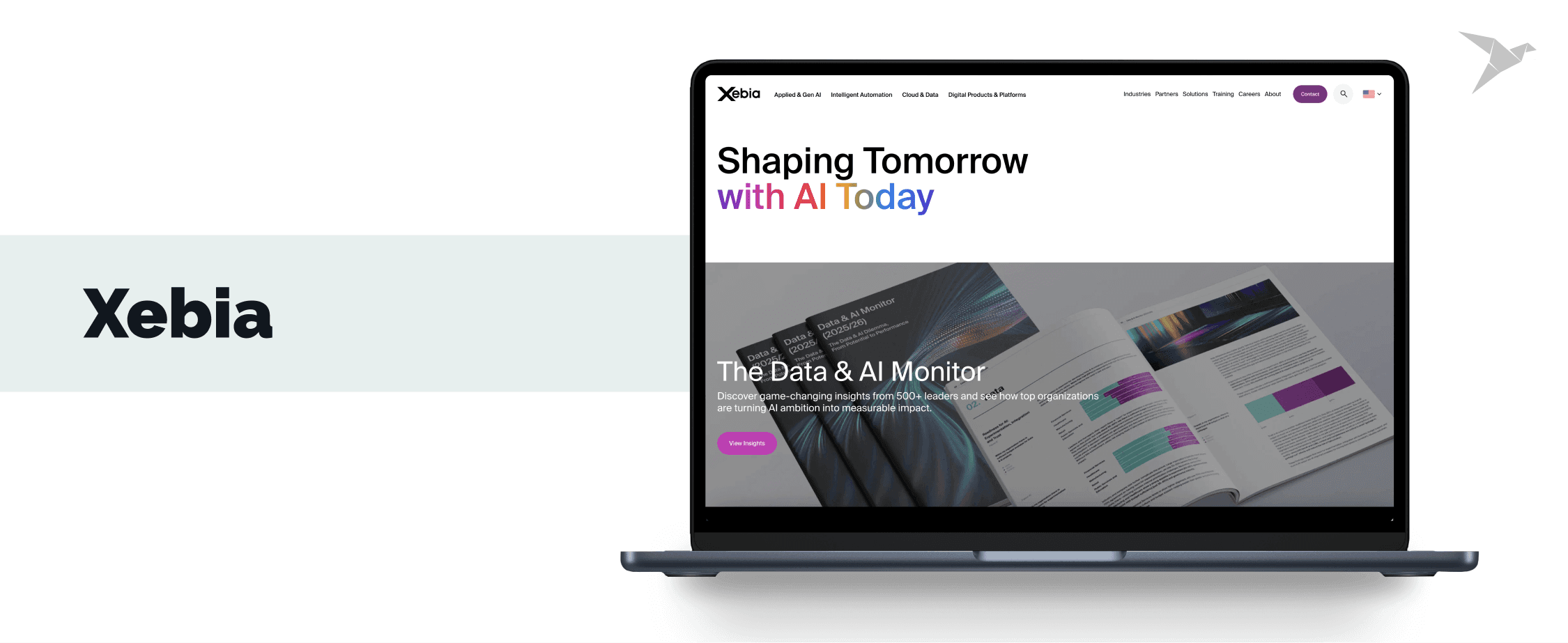
Netherlands-based consultancy founded 2001, ~4,000 employees across 16 countries. Focuses on the operational side of AI: MLOps, governance, AI infrastructure.
- Core services: MLOps consulting and implementation; AI/ML deployment and governance; data engineering (Kafka, Flink); cloud-native development (AWS, Azure); agile coaching.
- Best suited for: teams with data science capability that struggle to move models into reliable production, or need long-term governance.
- Strengths: MLOps focus targets where many projects stall; 4.7/5 on Clutch with a 5.0 "Willing to Refer" score; breadth across data, cloud, and ML.
- Weaknesses: cost scored 4.1/5, its lowest sub-score; some reviewers found processes rigid; small review volume (7) limits assessment.
- Ratings: 4.7/5 on Clutch, 7 reviews; Willing to Refer 5.0/5 (June 2026).
Selleo
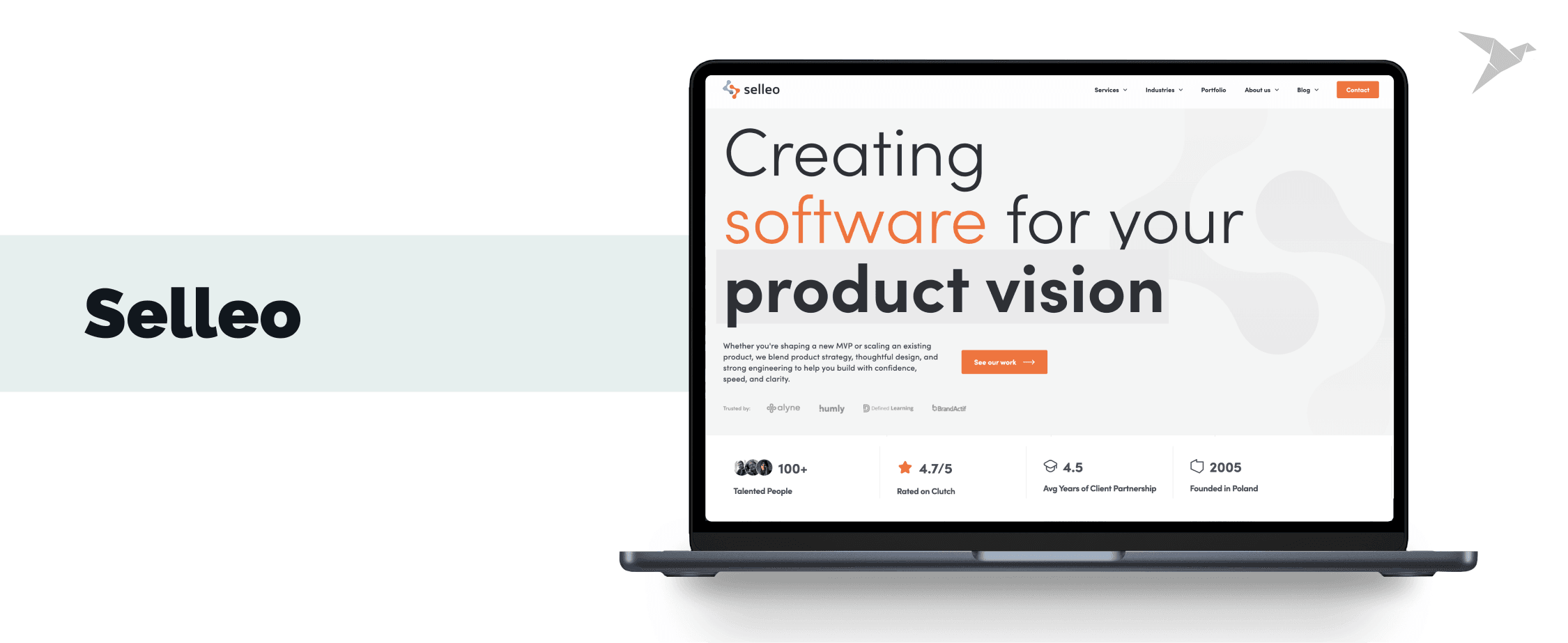
Poland-based software company founded 2005, 60-100 developers. Frames AI in applied terms, adding features that improve workflows within a controlled scope.
- Core services: AI feature integration (LLM, automation, recommendations); Ruby on Rails, React, React Native; SaaS development; QA automation and DevOps; workflow optimization.
- Best suited for: small to mid-size companies adding AI features to an existing product without overcomplicating the build.
- Strengths: practical, outcome-focused integration limits scope creep; 36–37 verified Clutch reviews with strong sentiment; 20+ years of operation provides stability.
- Weaknesses: small team limits capacity for large multi-system builds; one reviewer noted significant delays and quality issues on a redesign; stack (Rails, React, Elixir) narrower than Python-heavy ML work.
- Ratings: 36-37 verified reviews on Clutch; numeric rating not publicly surfaced (June 2026).
When comparing top AI service providers and trying to choose the best AI services company, it helps to match the partner to the delivery style needed.
Next, let’s narrow the focus and look at the top AI development company in USA!
Top AI Software Development Companies in the USA
For the US market, selection usually comes down to two things: speed and delivery confidence. You want a team that moves fast but also understands security reviews, procurement, and the reality of shipping into production. The companies below are commonly considered as top AI development companies in the USA.
TechMagic
AI software development company founded 2014, with a strong US presence and offices in New York, London, Kraków, and Lviv; 350+ staff. Works across HealthTech, FinTech, cloud, and cybersecurity.
- Core services: custom and generative AI capabilities; AI integration into existing systems; data prep and evaluation; monitoring and post-launch support; cybersecurity for AI (CREST-accredited), virtual assistant development.
- Best suited for: US product teams that want a predictable process, clear ownership, and security built in when AI touches sensitive data.
- Strengths: CREST accreditation and a Certified AI/ML Pentester credential (The SecOps Group), rare among AI vendors; 4.8/5 on Clutch across 52 reviews; 220+ projects since 2014, with a full-cycle model that removes handoffs, a trusted partner for long-term delivery focused on ensuring seamless project execution.
- Weaknesses: less globally recognized.
- Ratings: 4.8/5 on Clutch, 52 reviews (June 2026).
MojoTech
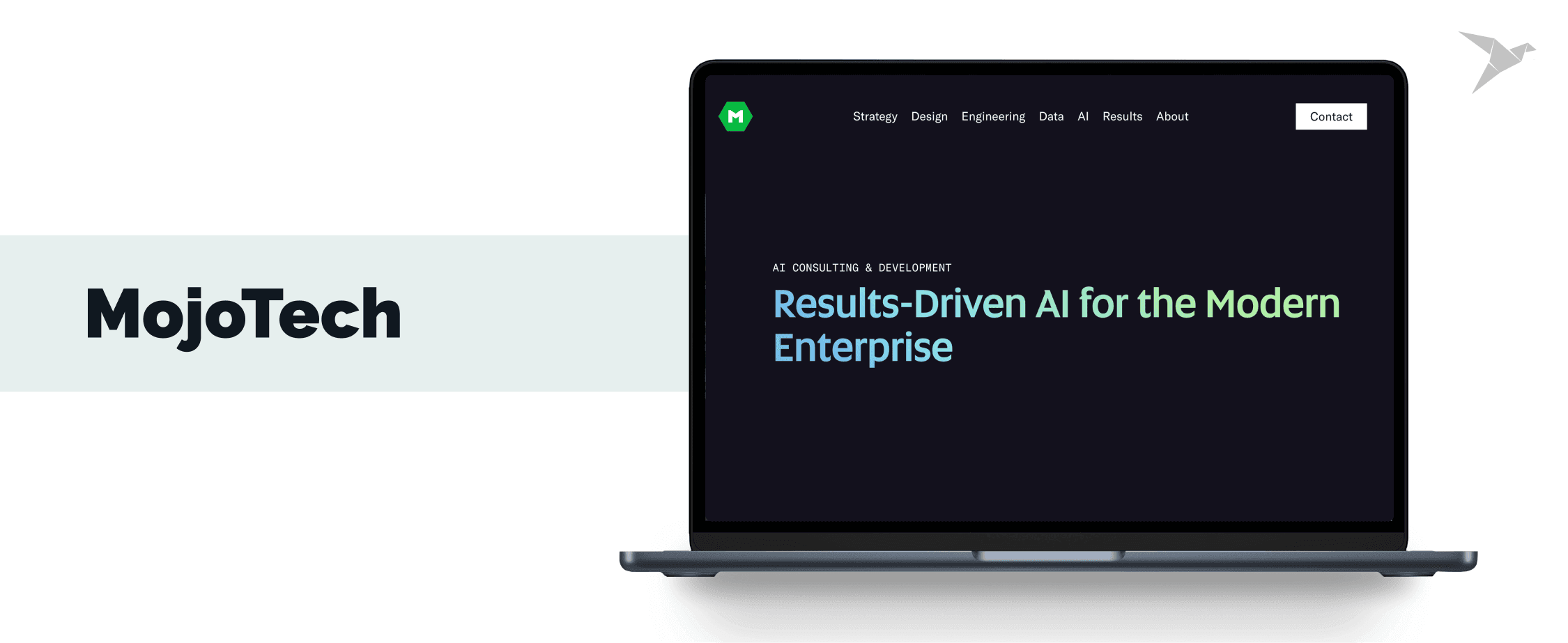
US software firm founded 2008, ~65 staff, fully US-based. Positions itself as an AI consulting and development partner with a strong product-strategy angle.
- Core services: AI/ML strategy and development; LLM-based summarization and workflow tools; custom software; product strategy; fintech consulting.
- Best suited for: teams that want a US-based partner to help shape the use case, then build the product, with strength in regulated work.
- Strengths: 100% US-based team, useful for security and compliance; a strategy program that reaches production-ready clarity in 6–8 weeks; consistently high client satisfaction.
- Weaknesses: a small team raises cost versus nearshore options; limited scale for very large programs; a small public review base.
- Ratings: ~13 verified Clutch reviews, high satisfaction (June 2026).
Diffco
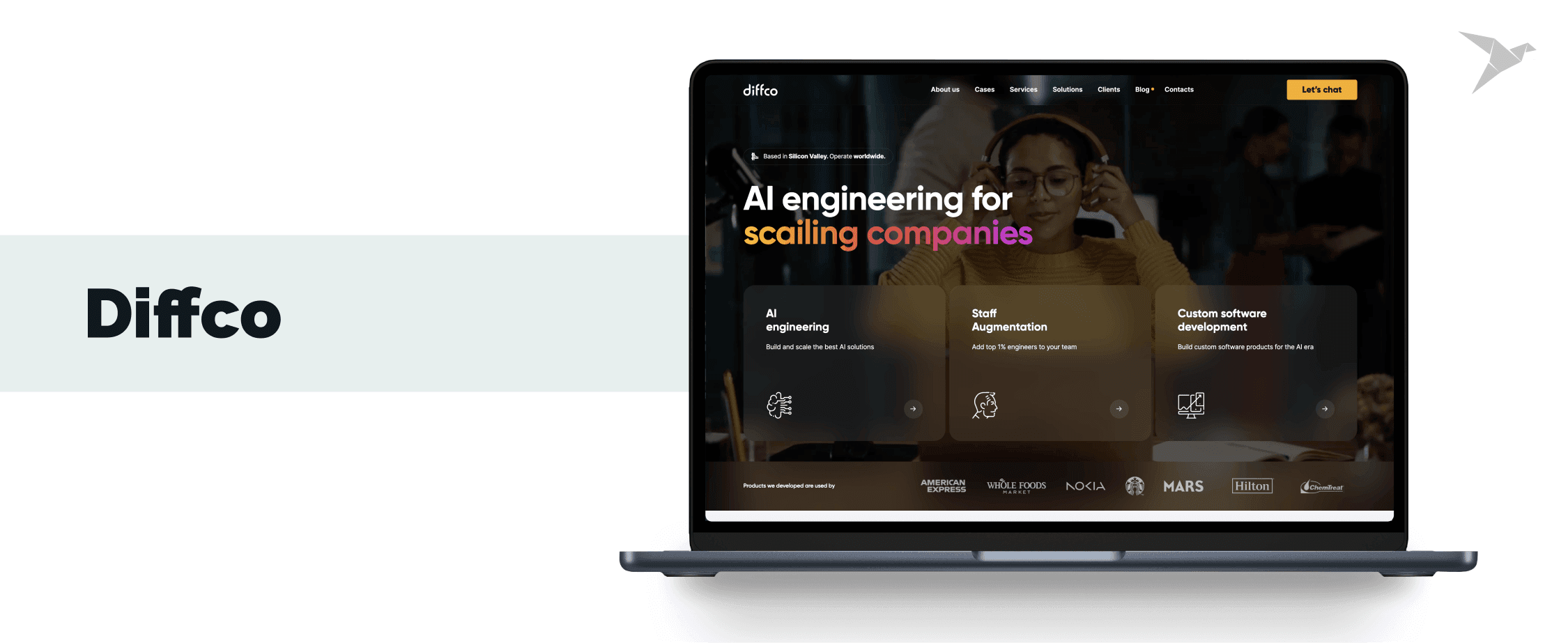
California-based engineering partner founded 2008, positioned as AI-first. Builds end-to-end AI systems that plug into real workflows.
- Core services: LLM and RAG solutions; AI agents and workflow automation; predictive ML; computer vision; mobile and web development.
- Best suited for: teams that want one vendor to cover several AI directions and integrate AI into existing systems.
- Strengths: track record since 2008 across computer vision and LLMs; client work including American Express, Starbucks, and Whole Foods; messaging focused on production readiness over demos.
- Weaknesses: relatively small, with roots in mobile app development and AI as a newer expansion; promotes strong self-ranking claims worth verifying; modest review base for the breadth advertised.
- Ratings: ~31 verified Clutch reviews (June 2026).
Azumo
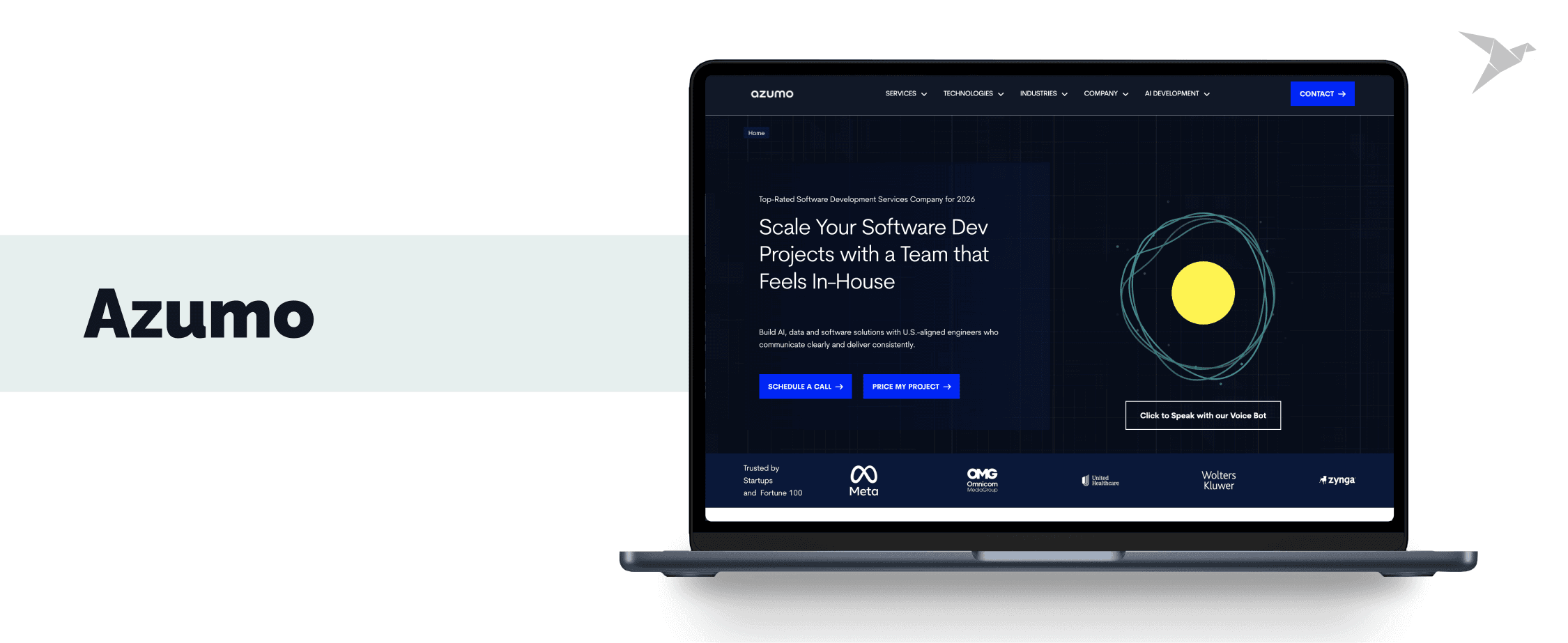
San Francisco-based nearshore company founded 2016, with Latin American delivery. Builds intelligent applications across app engineering, data, and AI-powered solutions.
- Core services: AI and ML development; web and mobile development; data engineering; chatbot development; cloud and DevOps.
- Best suited for: US teams wanting close time-zone alignment and steady capacity, often when AI sits alongside web or mobile work.
- Strengths: 4.9/5 on Clutch; nearshore delivery aligned to US time zones; clients including Facebook, UnitedHealth, and Discovery.
- Weaknesses: smaller scale, with project teams of one to fifteen; a dedicated-team model that can mean less product ownership; some reviews note specific domain gaps.
- Ratings: ~4.9/5 on Clutch, roughly 18–24 reviews (June 2026).
BlueLabel
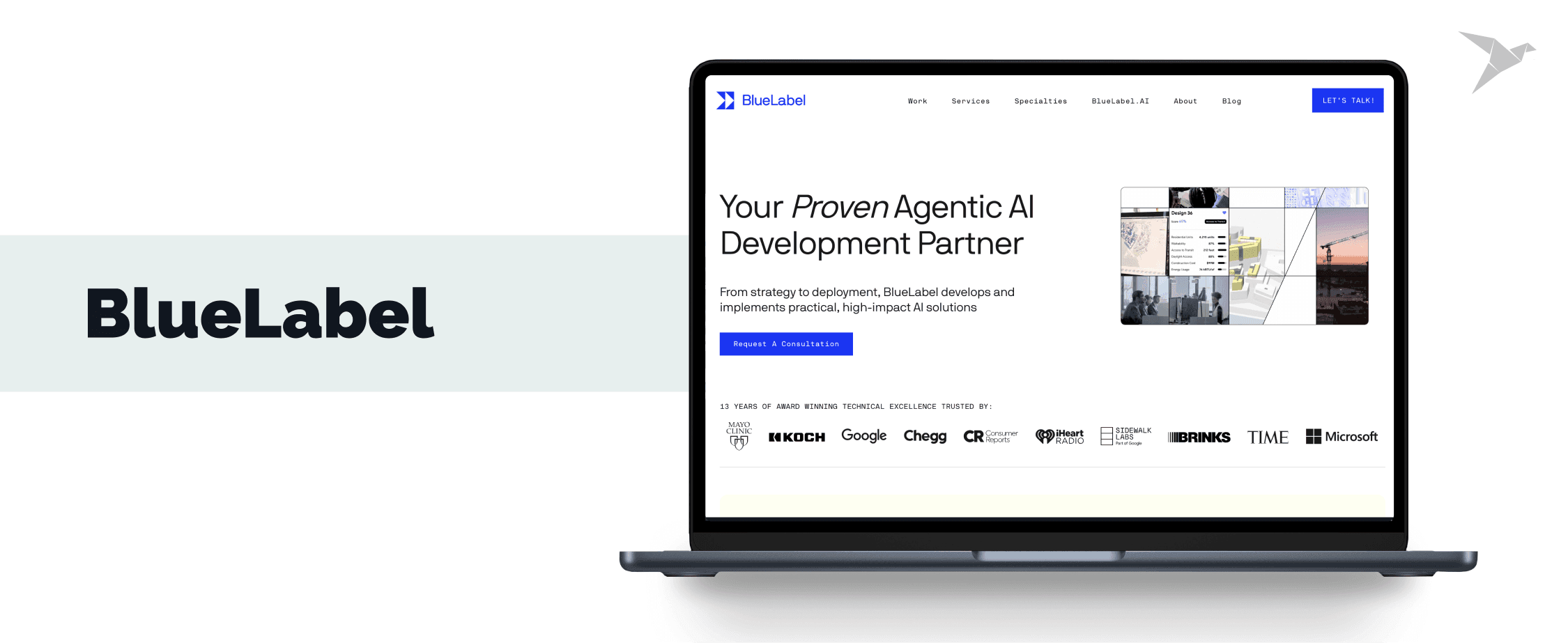
New York generative AI agency (Blue Label Labs), founded ~2011, with strong product and design roots. Reinvented from a top app studio into a GenAI consultancy.
- Core services: generative AI strategy and workshops; agentic and multi-agent systems; tools for customer engagement, RAG platforms; product and UX design; custom software.
- Best suited for: teams wanting a studio-style partner for customer-facing AI where UX and adoption are major risks.
- Strengths: 13+ years of product delivery and a 2025 Clutch Global AI Award; strong product and design craft alongside AI engineering; structured GenAI discovery and sprint programs.
- Weaknesses: higher price point ($75k minimum, $100–149/hr); product-led roots make it newer to deep ML engineering; some reviews note scope and budget changes.
- Ratings: ~68 verified Clutch reviews; 2025 Clutch Global AI Award (June 2026).
BairesDev
Large California-based outsourcing firm founded 2009, 4,000+ engineers, Latin American delivery. Offers a dedicated AI development service.
- Core services: nearshore software development; staff augmentation; AI and ML; mobile and web development; QA and cloud.
- Best suited for: teams that need extra engineering capacity quickly without losing velocity.
- Strengths: 4.9/5 on Clutch with a deep talent pool; clients including Google, Johnson & Johnson, Adobe, and Pinterest; fast, flexible staffing.
- Weaknesses: staff-augmentation model favors capacity over end-to-end ownership; mixed employee feedback on third-party sites; AI is one of many broad offerings.
- Ratings: 4.9/5 on Clutch, roughly 60 reviews (June 2026).
WillowTree
Digital product company founded 2008, now part of TELUS Digital. Built around enterprise product delivery and an enterprise AI platform, Fuel iX.
- Core services: enterprise product delivery; generative AI via Fuel iX; mobile and web development; personalized marketing; data and ML.
- Best suited for: enterprise environments with multiple stakeholders that want business strategy, delivery teams, and structured AI adoption together.
- Strengths: an enterprise-grade GenAI platform with built-in governance and multi-model access; clients including T-Mobile, Marriott, and PepsiCo; the scale of parent TELUS Digital.
- Weaknesses: now part of a large parent, so enterprise pricing and process rather than a boutique feel; often overkill for startups and SMBs; less hands-on for small builds.
DockYard
Massachusetts custom software studio founded 2010. The company specializes in engineering fundamentals and Elixir/Phoenix. Combines AI with product delivery.
- Core services: product strategy and discovery; custom web and mobile development; Elixir and Phoenix engineering; AI and intelligent automation; application maintenance.
- Best suited for: teams wanting high-quality custom execution across both product strategy and hands-on build.
- Strengths: 4.9/5 on Clutch and recognized Elixir leadership, including the LiveView Native framework; client work including Netflix and Apple; a design-led engineering approach.
- Weaknesses: a small studio, so capacity is limited for large programs; an Elixir focus that may not match every stack; more product engineering than a dedicated AI/ML specialist.
- Ratings: ~4.9/5 on Clutch, roughly 40 reviews (June 2026).
Very Good Ventures
The leading Flutter agency, founded 2018, with offices in New York and Chicago and ~150 staff. Now extends into generative and predictive AI.
- Core services: Flutter development across mobile, web, and devices; AI strategy and integration; UX design; enterprise Flutter coaching; product strategy.
- Best suited for: mobile-first products that need deep cross-platform delivery with AI features layered in.
- Strengths: the world's first and most experienced Flutter agency, trusted by Google; clients including Toyota, eBay, and Nubank; deep cross-platform delivery from one codebase.
- Weaknesses: premium pricing ($100k minimum, $150-199/hr); Flutter-centric, so less suited to general AI/ML builds; AI is a newer addition to a mobile-first practice.
- Ratings: ~35 verified Clutch reviews, high scores (June 2026).
AI Superior
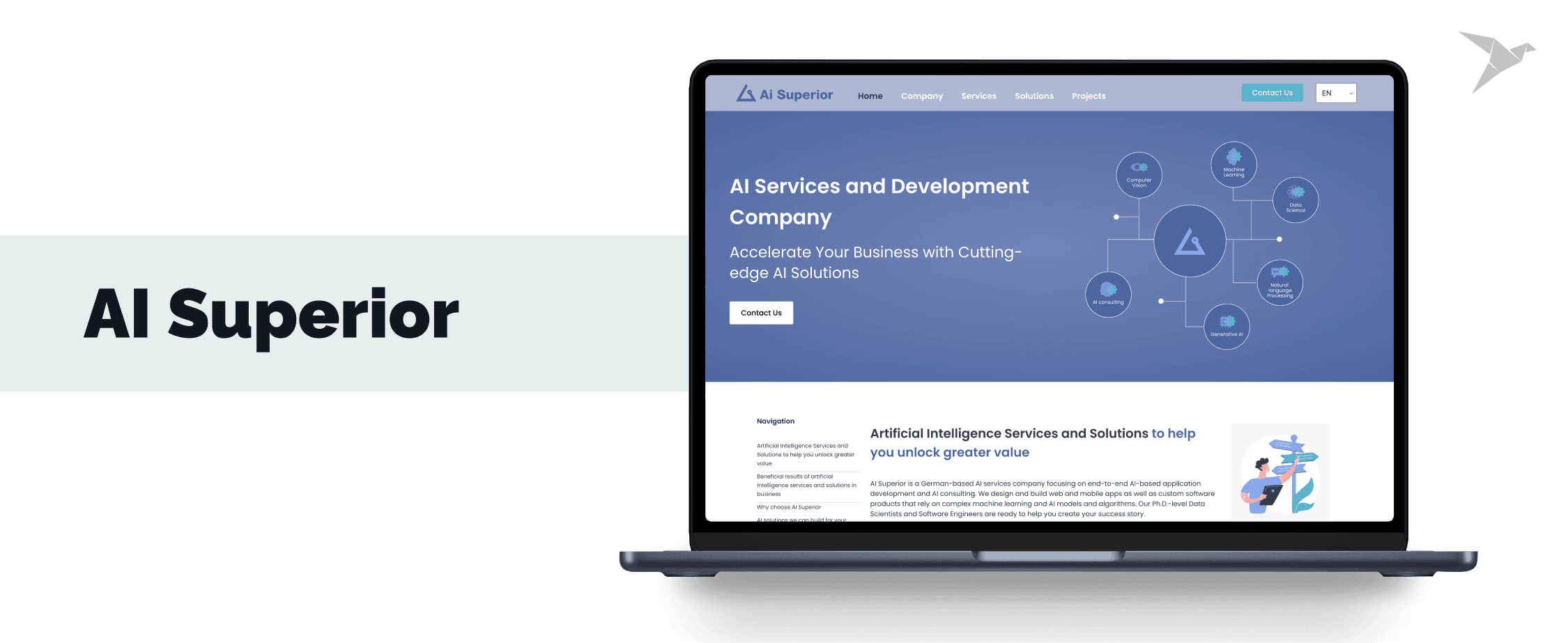
Germany-based AI and data science specialist founded 2019. Often evaluated by US teams open to remote delivery and a specialist-heavy approach.
- Core services: AI consulting; custom AI development; machine learning models; predictive analytics; computer vision; generative AI.
- Best suited for: technically complex problems that need a research-forward build rather than a generic feature.
- Strengths: strong technical depth with a structured, transparent process; member of the German AI Association; consistent on-time, on-budget delivery noted by clients.
- Weaknesses: a small team, with projects run by two to five people; Germany-based, so US clients work remotely; research-forward approach can be heavier than simple builds need.
- Ratings: ~16 verified Clutch reviews, high satisfaction (June 2026).
Next, let’s look at how companies use AI in practice, and where the biggest wins usually come from.
How Companies Use AI
AI technology is reshaping nearly every sector and continues to grow in popularity. After OpenAI introduced ChatGPT free of charge in November 2022, businesses changed how they operate, reducing time spent on routine tasks. OpenAI focuses on large-scale, general-purpose AI models, including natural language understanding, image generation, and conversational AI. Now, companies are using artificial intelligence across a wide range of areas. AI technologies are embedded in how businesses, governments, and consumers interact with the web.
AI is being used for automation in business operations, accurate clinical data analytics, and robust fraud detection. For example, AI can improve a digital marketing platform by automating audience segmentation, content recommendations, and campaign performance analysis. In many organizations, AI is also combined with robotic process automation to streamline repetitive workflows, reduce manual effort, and improve operational consistency.
Companies are leveraging AI for competitive advantage by optimizing internal processes and enhancing customer experiences. In e-commerce, companies often use AI to improve product discovery, personalize recommendations, and optimize demand forecasting. In healthcare, AI supports use cases such as diagnostics, clinical decision support, and precision medicine, where treatment strategies can be better aligned with individual patient characteristics.
More and more companies use conversational AI to enable users to engage. Their solutions include personalized chat interfaces, voice-activated services, and dynamic conversational agents, setting new standards for customer satisfaction.
Generative AI has quickly been adopted by businesses of all sizes to achieve automation and accurate data analytics. Many of these tools rely on natural language processing to understand user intent, summarize information, and generate useful responses in real time.
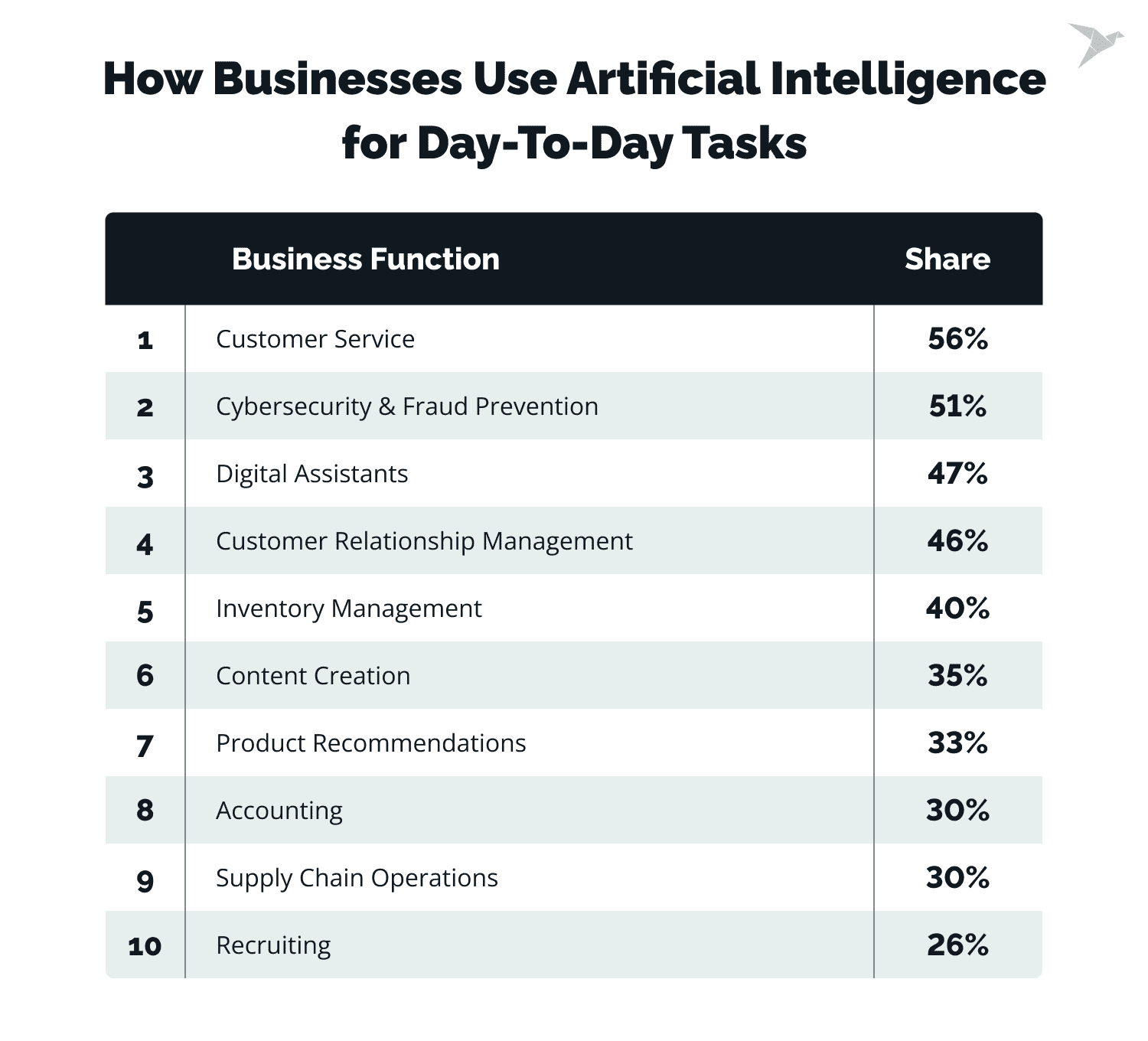
And here is an illustration of AI applications for day-to-day, manual tasks:
- Customer service 56%
- Cybersecurity & fraud prevention 51%
- Digital assistants 47%
- Customer relationship management 46%
- Inventory management 40%
- Content creation 35%
- Product recommendations 33%
- Accounting 30%
- Supply chain operations 30%
- Recruiting 26%
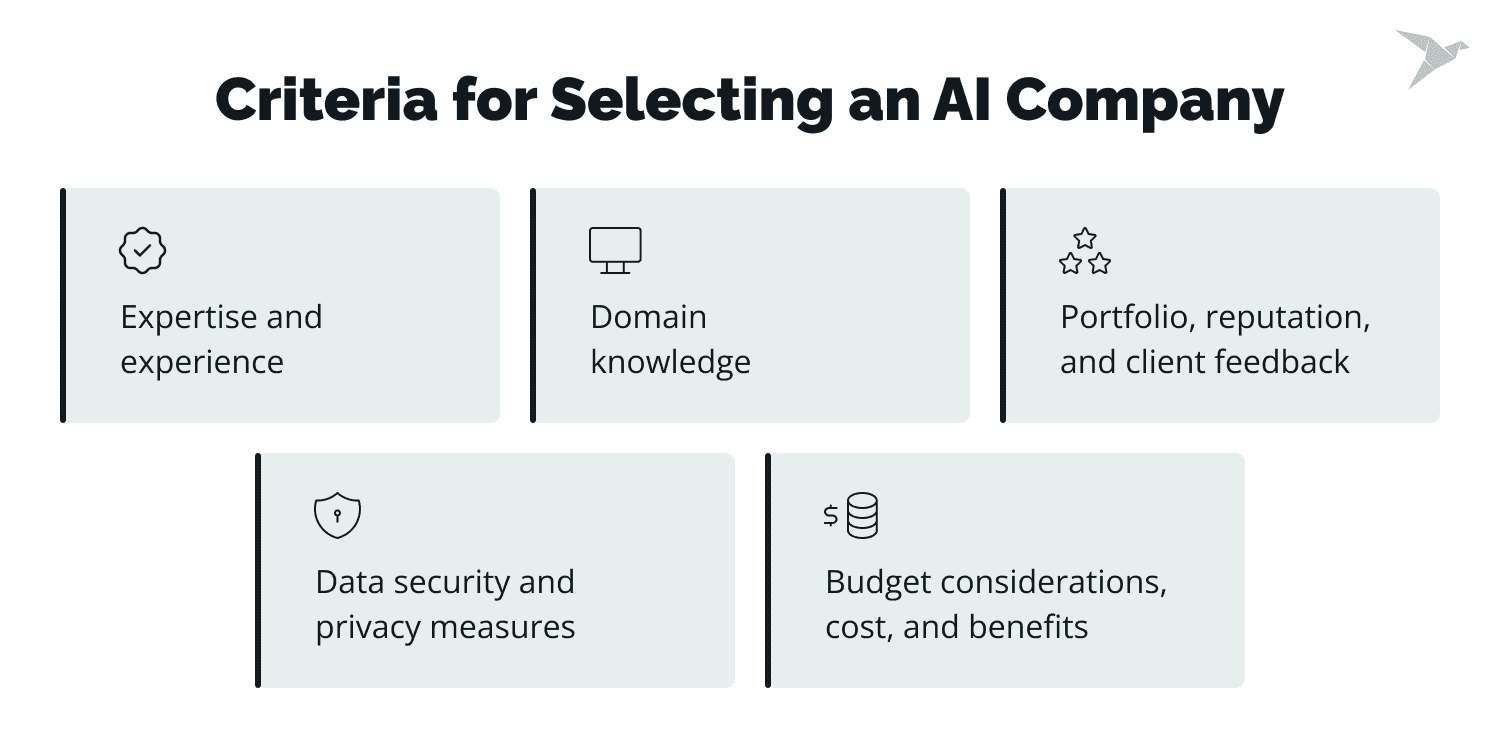
Criteria for Selecting an AI Company
The AI industry moves fast, but delivery fundamentals still win. What matters is a partner that works within your constraints and ships something usable. Weigh these:
- Goals and scope. If a vendor can't map your goal to a concrete plan, that's a warning sign. -** Delivery experience.** Look for a track record shipping AI with messy data, real infrastructure, and real users.
- Domain understanding. Artificial intelligence solutions must fit real workflows and compliance rules, especially when you need tailored solutions, not generic features.
- Evidence. Judge vendors on past projects, repeat clients, and measurable outcomes. Talk to references.
- Security and ownership. Ask how data is handled and who owns the models, pipelines, and integrations.
- **Support.**A strong focus on clear updates and post-launch support signals a mature partner.
These criteria narrow the field, including both a top AI development company in the USA and globally.
How To Choose an AI Company: A Step-by-Step Guide
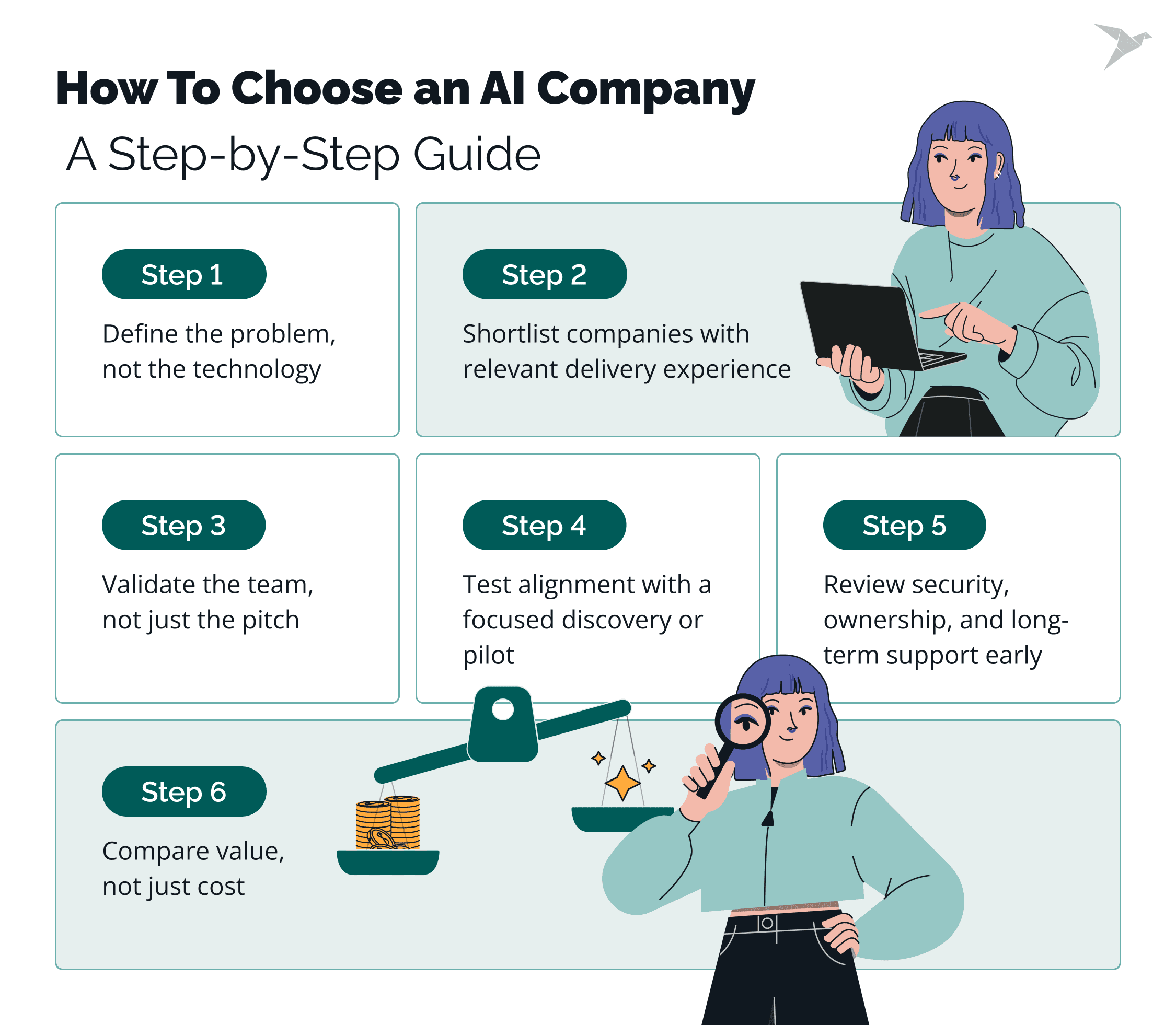
Turn the criteria into a repeatable process:
- Define the problem first. Be specific about the outcome you want rather than the model or tool.
- Shortlist on delivery experience. Favor partners who have shipped similar systems and helped businesses deploy AI solutions in production rather than prototypes.
- Validate the team behind the pitch. Ask who will do the work and how roles and decision-making are structured.
- Test fit with a discovery phase or pilot. Tie it to real data before committing to a full build.
- Confirm security and ownership early. Clarify data handling, post-launch support, and who owns the models and integrations.
- Compare value over cost. The right partner reduces rework over time, even if it isn't the cheapest.
Conclusion and What’s Next
Choosing among top AI development companies shapes how fast you can ship, how safely you can operate, and how much rework you’ll face after launch. The companies on this list are at the forefront of AI innovation, developing foundational models and infrastructure that power the industry.
Over the next few years, AI will move deeper into everyday products and internal workflows, and the bar will keep rising around security, reliability, and measurable outcomes. The teams that stand out will be the ones who can deliver in production and support what they build.
This article gave you a practical shortlist and a clear way to assess fit, from delivery experience and domain understanding to security and long-term ownership. Use it to narrow options with confidence, then apply the step-by-step process to validate the partner in real conditions. That’s how you choose a team that delivers lasting value.
FAQ

When choosing top companies in artificial intelligence, prioritize criteria such as experience and expertise, domain knowledge, portfolio, reputation and client feedback, security measures, cost, and benefits. The best AI development companies often specialize in specific technologies such as machine learning, natural language processing, and computer vision.
AI companies demonstrate excellence across a broad spectrum of industries, such as healthcare for diagnostics and personalized treatment, finance for fraud detection and risk management, retail for personalized recommendations, manufacturing businesses for predictive maintenance, telecommunications for network optimization, automotive for autonomous vehicles, technology for advanced algorithms, energy for grid management, education for personalized learning, and agriculture for precision farming. This is not an exhaustive list, as artificial intelligence continues to make significant impacts in various other sectors, showcasing its versatility and transformative power across industries.
The pricing for top artificial intelligence consulting services can vary significantly based on the project's complexity and the company's pricing model. It's advisable to request a personalized quote from the company you are considering for collaboration.
Doing good research is essential to avoiding common pitfalls when selecting top companies in AI development. Ensure transparent communication and clarify expectations from your potential tech vendor. It's also a good practice to request detailed project proposals, including timelines and costs.
The right choice depends on your goals, data, and how ready the team is to ship and support a secure production system. For end-to-end delivery with strong engineering and cybersecurity, TechMagic is a solid option.
Big tech platforms, specialized AI tech companies, and AI software development companies are all building AI today. Many businesses also work with partners like TechMagic to design, integrate, and maintain AI features without building a full in-house team.