 Software Development
 Security Services
 Cloud Services
 AI Services
 Other Services















 TechMagic Academy


Which Medplum Features Deliver the Highest ROI for Healthcare Products? [Ranked]
Last updated:13 February 2026


![Which Medplum Features Deliver the Highest ROI for Healthcare Products? [Ranked]](/_next/image?url=https%3A%2F%2Ftm-bucket-for-images.s3.eu-west-1.amazonaws.com%2Fcover_Medplum_1_a1c247dbd4.png&w=3840&q=90)
Ever feel like building healthcare software means you’re shipping two products: the one users see, and the compliance-heavy infrastructure underneath?
Most healthcare orgs we work with are in the same spot: they need to move fast, integrate cleanly, and keep risk under control. Audits and PHI don’t leave much room for “we’ll fix it later,” and even small workflow changes can add weeks of engineering time.
At this stage, the product direction is usually clear: a specialty EHR, an internal care ops tool, a portal, an integration layer. What slows delivery is the foundation work: FHIR plumbing, event handling, access control, audit trails, and deployments.
As for the budget impact, even basic healthcare apps often start around $50,000-$250,000, and full-featured EHR systems can easily exceed $500,000 in development and compliance costs.
The solution? Medplum makes the process cheaper and faster by giving you proven building blocks, so you spend less time (and budget) reinventing infrastructure without losing quality.
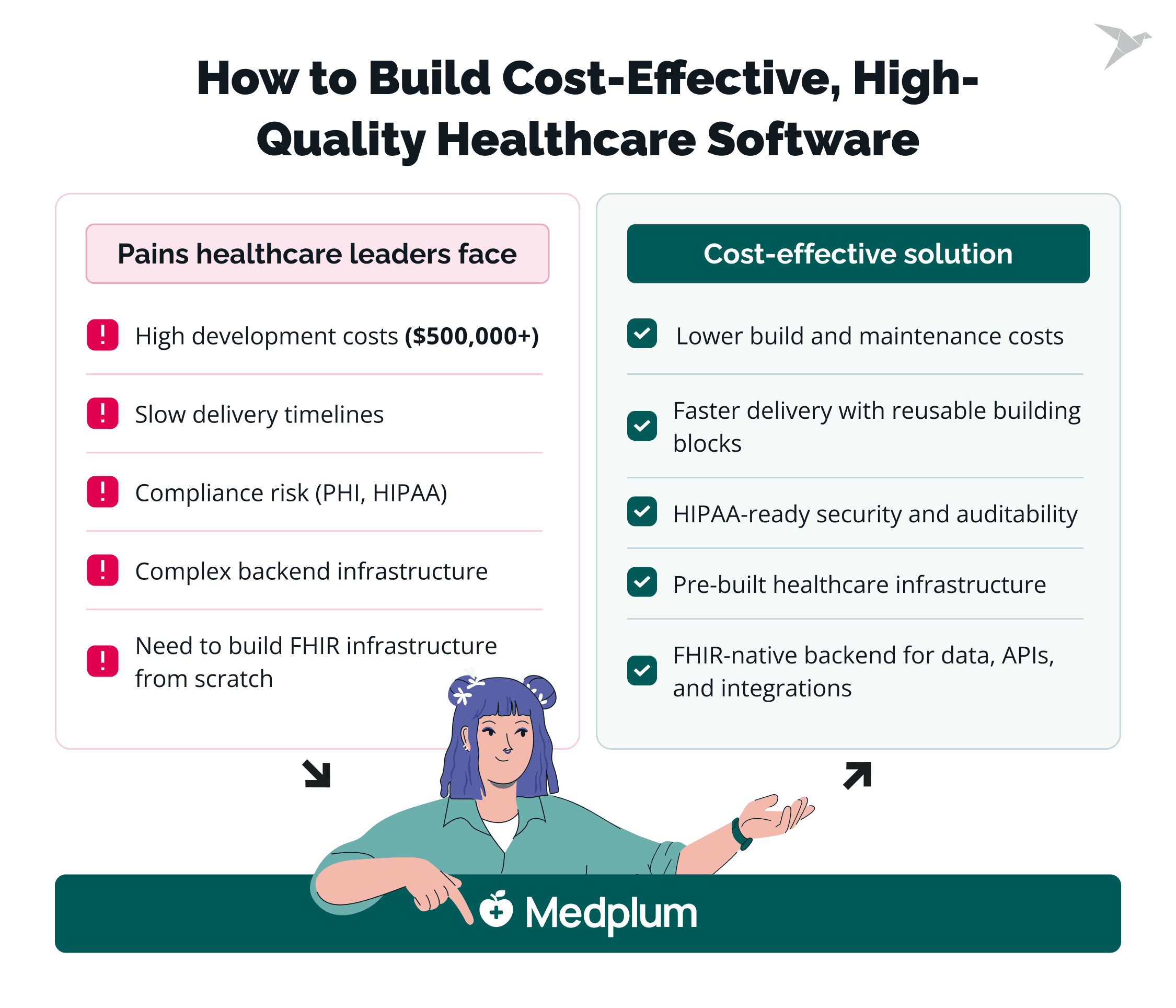
When we say “ROI” of Medplum, we mean practical outcomes: less engineering time and budget spent on foundational infrastructure, lower operational complexity, and fewer internal systems your team has to build, run, and maintain. In this article, we rank the Medplum features with the highest ROI and break down how each one pays off in real implementations. Let's start!
Key Takeaways
- The highest ROI from Medplum comes from reducing foundational infrastructure work instead of rebuilding FHIR storage, search, and event handling from scratch.
- Medplum Bots deliver strong returns by implementing workflow and integration logic close to FHIR events, without standing up separate workflow engines or microservices for every use case.
- Subscriptions enable event-driven automation that replaces polling and reduces background jobs, duplicated state, and integration drift.
- Self-hosting Medplum makes sense when control, data residency, or compliance requirements are real, but ROI depends on an organization’s ability to manage upgrades and incidents.
- Consistent tooling across clients, environments, and internal UIs shortens delivery cycles and lowers risk without compromising product quality.
What Is Medplum and When Is It Useful?
Medplum is an open-source, FHIR-native platform that helps organizations build healthcare applications without starting from zero. It sits below the UI layer and above raw infrastructure, covering the work most companies end up rebuilding: FHIR data storage, search, identity and access control, eventing, and audit-ready foundations.
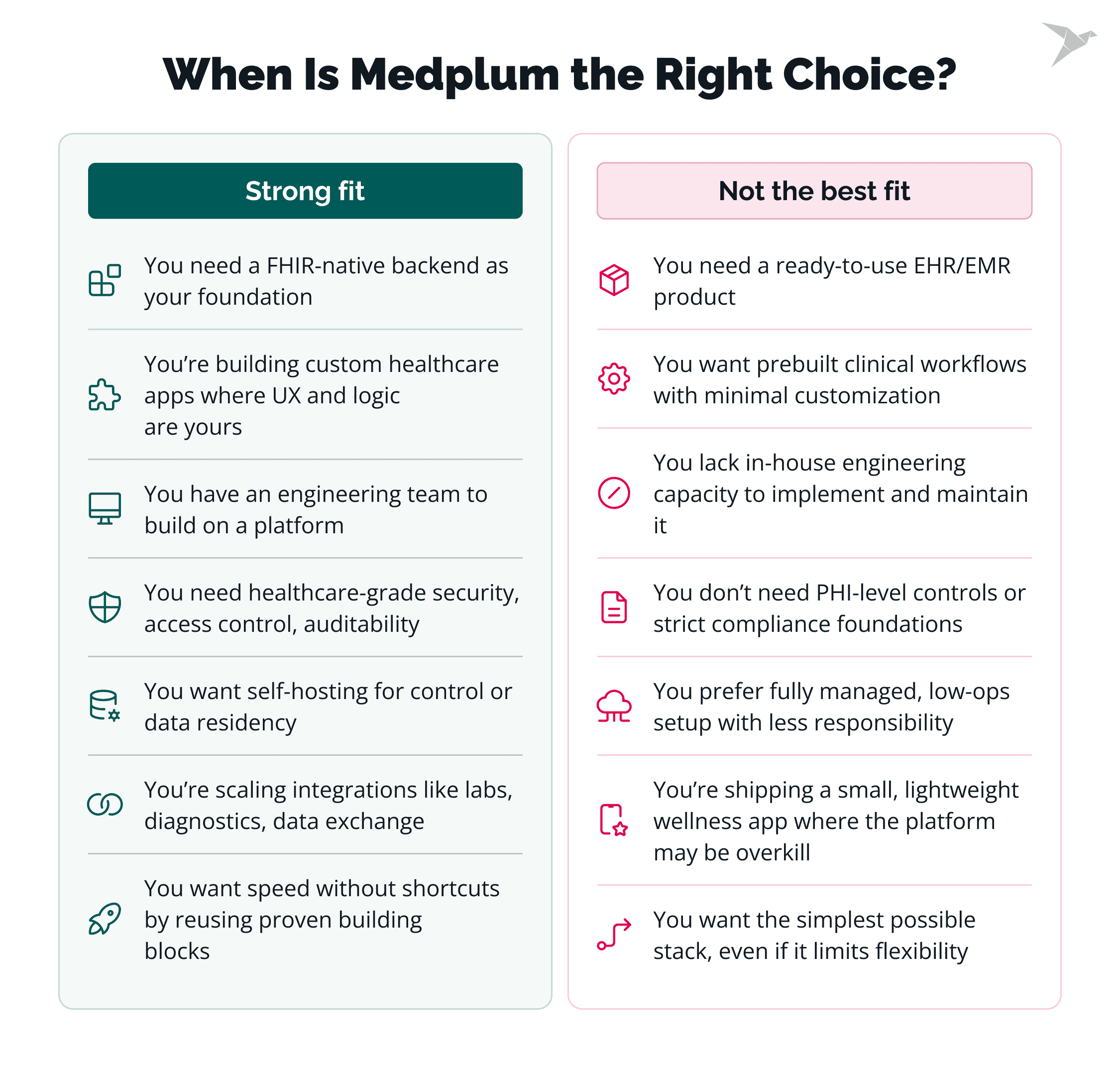
✅ Medplum is the best solution when you need a reliable FHIR backend and want to move quickly without cutting corners. It works especially well for those building virtual care apps, care navigation platforms, health data platforms, custom EHR modules, and lab/diagnostic integrations. These are use cases where the backend needs to be healthcare-grade, but the product logic and UX are still yours to define. If self-hosting matters for control, data residency, or compliance posture, Medplum also supports that path.
❌ It’s also important to be clear about what Medplum is not. If you’re looking for a fully packaged EHR/EMR with complete clinical workflows out of the box, Medplum isn’t trying to be that. It’s a platform for building. Organizations without in-house engineering capacity may find it harder to adopt, and for very small, lightweight wellness apps, the platform can be more infrastructure than you actually need.
All in all, Medplum is most valuable when you want speed without shortcuts: keep the architecture clean, reduce foundational build effort, and spend your time on workflows and integrations that move the business.

How We Ranked High-ROI Medplum Features
We ranked Medplum features based on one simple question: where do organizations save the most effort over time?
The first factor is engineering time saved. Features that replace weeks or months of custom development, especially around FHIR infrastructure, workflows, and integrations, rank higher than those that offer incremental convenience.
Next is the complexity eliminated. Healthcare systems tend to accumulate moving parts quickly: services, queues, cron jobs, access rules, and custom glue code. Features that remove entire layers of this complexity, rather than adding another tool to manage, deliver a higher return.
Finally, we looked at ongoing maintenance and operational burden. Infrastructure that needs constant tuning, monitoring, and on-call support carries a long-term cost. Features that reduce the amount of custom code and infrastructure a team must run and maintain score higher on ROI, even if the initial setup is similar.
Importantly, these gains come without sacrificing product quality or architectural control. The ranking reflects where organizations reduce effort while still meeting clinical, security, and compliance expectations over the life of a healthcare product.
Quick Shortlist: High-ROI Medplum Features at a Glance (Ranked)
Before diving into each feature, here’s a quick view of where Medplum tends to deliver the strongest ROI. This ranking is based on engineering time saved, complexity removed, and reduced long-term operational effort.
The highest-ranked features do save time, but they also replace entire categories of custom infrastructure. Bots and eventing remove the need for bespoke workflow engines. The data store and search engine eliminate the need for foundational FHIR work. Auth, SDKs, and tooling reduce integration and operational friction.
In the sections below, we’ll break down each feature in detail: what it does, why it ranks there, and when it delivers the most value in real healthcare implementations.
HIPAA-compliant app built with Medplum to support early cancer detection

#1 Bots
Why it delivers high ROI
Medplum Bots remove the need to build and operate separate workflow engines or small, single-purpose microservices around FHIR data. Bots run close to the data layer and react directly to FHIR events, which cuts out extra services, queues, schedulers, and glue code. For many organizations, this replaces an entire class of infrastructure that would otherwise require design, deployment, monitoring, and long-term support.
What teams use it for
In practice, Bots are used for automation that follows predictable clinical or operational rules:
- Reacting to FHIR resource changes (create, update, status change)
- Orchestrating multi-step workflows across systems
- Triggering notifications, integrations, or downstream processing
- Enforcing data consistency and validation rules
- Automating operational workflows across the care lifecycle
- Implementing third-party integrations (for example labs, billing platforms, payment providers, clearinghouses)
Because Bots are tightly integrated with FHIR, these workflows stay close to the source of truth and are easier to reason about than distributed logic spread across services.
Pitfalls and best practices
Bots work best for deterministic, event-driven logic. They’re not a replacement for long-running, compute-heavy jobs or complex orchestration across unrelated domains. Organizations should keep Bots focused, well-scoped, and observable, and treat them as part of the core application logic: versioned, tested, and reviewed like any other production code. Used this way, they reduce complexity rather than shifting it elsewhere.
#2 Subscriptions + Eventing
Why it delivers high ROI
Subscriptions give you event-driven behavior around FHIR data without building a polling loop, custom change tracking, or a separate event pipeline from scratch. Instead of repeatedly querying for “what changed,” you can react as changes happen. That saves engineering time up front and avoids long-term complexity (extra schedulers, duplicate state, missed updates, and noisy background jobs).
Common events and triggers
Most real-world triggers map to FHIR resource changes, for example:
- A new resource is created (e.g., Patient, ServiceRequest, Appointment)
- A status change (e.g., Appointment booked/cancelled, Task completed, Observation final)
- A key field is updated (e.g., assigned practitioner, updated contact info, changed priority)
These triggers typically fan out into workflows such as notifying downstream systems, invoking a Bot, updating an internal operations view, or pushing data to analytics and reporting pipelines.
When to use subscriptions vs other approaches
Use subscriptions when you need near-real-time reactions to FHIR changes and want a clean, reliable alternative to polling. They’re great for operational automation, integrations, and workflow steps that should run immediately after a data change.
Consider other approaches when the workload is batch-oriented, doesn’t need real-time behavior, or requires heavy processing that’s better handled outside the transactional flow. In those cases, it’s often cleaner to trigger an external job asynchronously (still initiated by an event), rather than running everything in the same event path.
#3 Self-hosted data store
Why it delivers high ROI
Running Medplum with a self-hosted data store removes the need to design, implement, and maintain your own FHIR storage layer. Building FHIR-compliant persistence, indexing, versioning, and search behavior from scratch is a major engineering effort. Medplum provides this out of the box, which significantly shortens time to production and reduces architectural risk.
When self-hosting makes sense
Self-hosting is a strong fit when organizations need tighter control over their environment. Common reasons include data residency requirements, stricter compliance or security policies, custom networking setups, or deeper control over infrastructure and scaling. It’s also relevant when Medplum is part of a larger platform that must follow established internal deployment standards.
The hidden costs to consider
Self-hosting shifts operational responsibility to your organization. Medplum provides guidance and tooling for production operations (including monitoring patterns), and common cloud setups can include automated backups and baseline observability, but your team still owns upgrades, incident response, and making sure these controls are correctly configured and tested. Organizations should plan for operational maturity at the earliest stages. Otherwise, the ROI can erode over time through firefighting and unplanned maintenance.
#4 Client SDK
Why it delivers high ROI
Medplum’s Client SDK reduces the time it takes to build and maintain the “last mile” between your UI and the FHIR backend. Instead of hand-rolling API calls, request patterns, and error handling across multiple screens and apps, developers can rely on a consistent client layer. That usually means faster delivery, fewer integration bugs, and less rework when the product grows.
What it accelerates
In day-to-day development, the SDK speeds up common frontend and client-side needs:
- Authentication and session handling
- Consistent data access patterns for reading and writing FHIR resources
- Standard request/response handling and validation boundaries
- Wiring UI workflows to backend actions (often alongside Bots and Subscriptions)
- Interoperability workflows, including C-CDA ↔ FHIR conversion utilities for clinical document exchange
For organizations integrating with legacy systems or document-based workflows, built-in C-CDA conversion support can significantly reduce custom parsing and mapping logic.
The SDK also helps keep implementation details consistent across web apps, internal tools, and prototypes, which improves maintainability as systems scale.
Notes for product teams
The biggest product benefit is predictable delivery. When the client layer is standardized, teams spend less time debating patterns and more time shipping workflows. You also get more consistent behavior across features (loading states, error handling, permissions-aware UI), which improves UX and reduces support burden as the product scales.
#5 FHIR search engine
Why it delivers high ROI
Implementing a reliable FHIR search layer is one of the most time-consuming parts of healthcare backend development. Medplum’s built-in FHIR search engine removes the need to design custom query APIs, indexing strategies, and pagination logic from scratch. Organizations get standards-based search behavior early, without months of trial-and-error.
What good FHIR search enables
A solid search layer unlocks many everyday product needs:
- Filtering and sorting across clinical and operational data
- Building patient-centric views that pull related resources into one experience
- Powering lists, dashboards, and work queues
- Supporting cohort-like queries using chained parameters, _include, and _revinclude for related resources
FHIR search also allows filtering on referenced resources, which makes it possible to construct fairly complex operational queries without building a custom query engine. Because the behavior follows FHIR conventions, integrations remain predictable and standards-aligned.
AI assistants (MCP-ready)
If your product roadmap includes AI workflows, Medplum’s MCP integration can expose FHIR search and request capabilities as standardized tools for MCP-compatible assistants, which reduces custom “AI-to-FHIR” integration work and keeps data access aligned with your existing authorization model.
Gotchas to be aware of
FHIR search is powerful, but it’s not a generic analytics engine. Product and engineering groups need to design queries with indexing and access patterns in mind, especially as data volume grows. Complex, ad-hoc reporting and heavy aggregation often belong in downstream analytics systems. Used for operational and clinical workflows, the ROI stays high and predictable.
#6 Auth + Access Policies (RBAC/ABAC)
Why it delivers high ROI
Authentication and authorization are non-negotiable in healthcare, and getting them wrong creates real security and compliance risk. Medplum provides built-in authentication plus a policy-based authorization layer, so organizations don’t have to build custom identity plumbing and permission enforcement from scratch.
How permissions are typically modeled
Access in Medplum is scoped through ProjectMembership, including project admin vs non-admin membership, and then refined with AccessPolicy rules attached to that membership. In practice, “roles” like clinician, care coordinator, or admin are implemented by assigning different access policies (often parameterized by organization or tenant context) rather than relying on fixed roles shipped out of the box.
Auditability and least-privilege guidance
This model supports least-privilege by making access rules explicit and testable, which helps reduce overexposure of PHI. It also makes it easier to explain and review “who can access what” during security reviews and compliance audits, because the enforcement point is centralized in policy.
#7 CLI & deployment tooling
Why it delivers high ROI
Deployment friction is a hidden cost in many healthcare projects. Medplum’s CLI and deployment tooling reduce manual setup and environment-specific drift by automating common operational tasks. This leads to more predictable releases and fewer errors caused by ad-hoc scripts or inconsistent configuration.
What it helps standardize
The tooling helps organizations maintain parity across development, staging, and production environments. Common benefits include repeatable deployments, consistent configuration of services and resources, and clearer separation between environments. This standardization becomes especially important as systems grow and multiple contributors are involved.
Where it saves time in delivery cycles
Time savings become apparent quickly during onboarding, feature rollouts, and iterations. New environments can be created faster, deployments become routine instead of risky, and teams spend less time diagnosing “it works in staging” issues. Over the life of a product, this consistency compounds into faster, calmer delivery.
#8 Built-in UI tools
Why it delivers high ROI
Not every interface needs to be custom-designed. Medplum’s built-in UI tools make it possible to ship internal-facing screens quickly without investing in full frontend builds. For operational and administrative use cases, this often removes weeks of UI work while still providing secure access to FHIR data.
Common use cases
These tools are typically used for:
- Care operations and coordination workflows
- Internal admin panels for managing users, roles, and organizations
- Operational dashboards for monitoring data and system activity
They are especially useful early on or for internal users who need functionality and clarity more than polished UX.
When to build custom UI instead
For patient-facing experiences, clinician workflows with heavy interaction, or products where UX is a key differentiator, a custom UI is usually the better choice. The built-in tools work best as accelerators for internal operations, not as a replacement for thoughtfully designed user experiences.
Step-by-Step Guide: How to Pick the Right Medplum Features for Your Product
Medplum implementation can cover a lot of ground. The fastest way to get ROI is to choose features based on your workflows, risk profile, and operational reality.
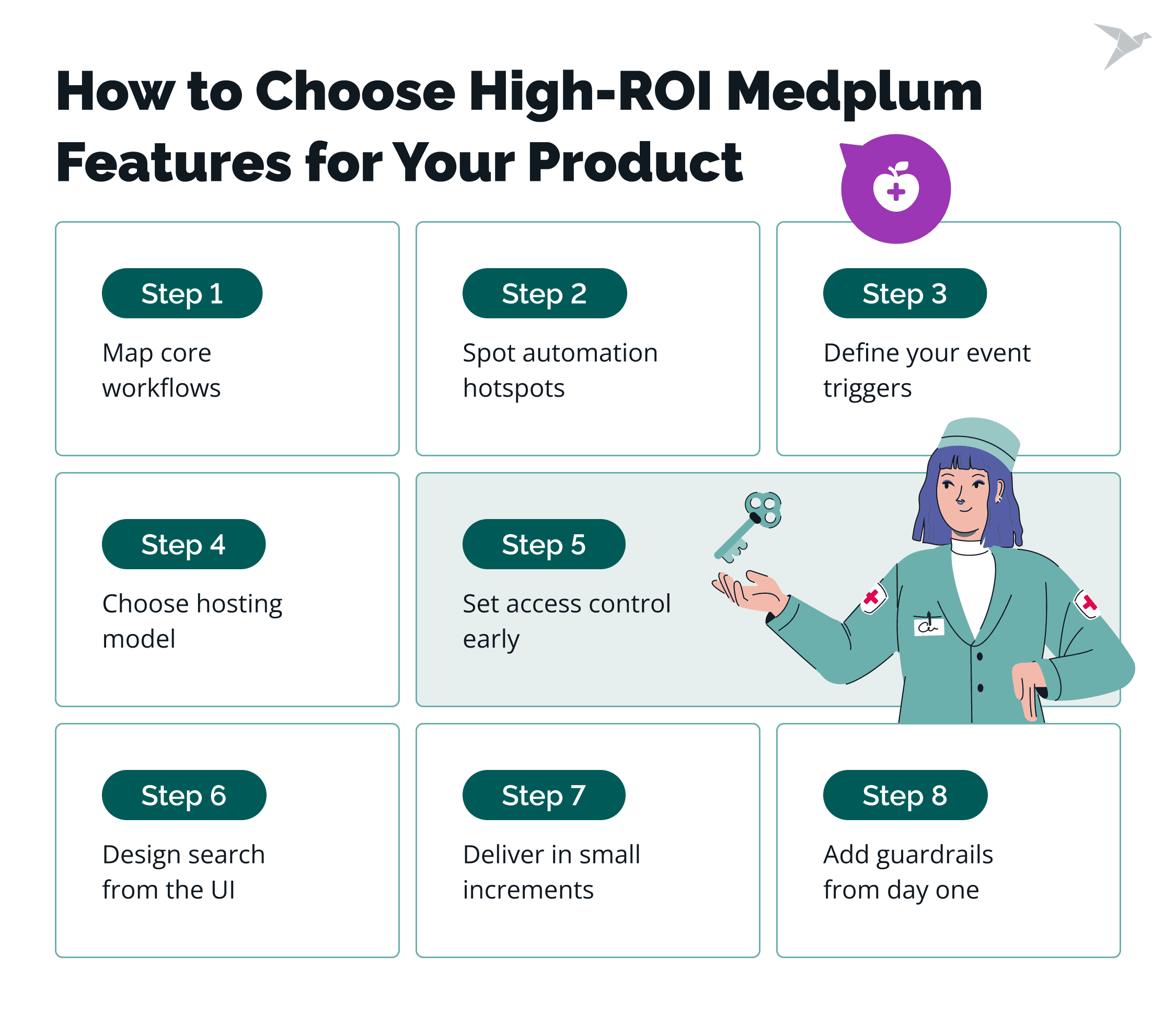
Step 1. Map your core workflows
List the workflows that drive daily work and revenue: patient intake, scheduling, orders, results, care coordination, messaging, and billing handoffs. Be specific about who does what, in what system, and where data enters or changes.
Step 2. Identify automation hotspots
Look for steps that are manual, repetitive, or error-prone: copying data between systems, chasing missing information, updating statuses, routing tasks, and sending reminders. These are usually the best candidates for Bots and event-driven automation.
Step 3. Choose an event model
Define what “something happened” means in your product. In practice, it’s often FHIR resource events: create/update, status transitions, assignments, or completion states. Make triggers explicit and narrow: clear events produce reliable automation.
Step 4. Decide on the hosting model
Pick managed vs self-hosted based on constraints, not preference. If you need tighter control for data residency, security posture, or internal infrastructure standards, self-hosting may be the right call, but only if you can support the operational responsibilities.
Step 5. Define access control early
Don’t treat permissions as a later phase. Define roles, tenant boundaries, and PHI access rules up front. Most security and compliance issues come from vague boundaries, not missing features.
Step 6. Design search needs around real screens
Work backwards from the UI: patient views, work queues, filters, and operational dashboards. Define what users need to find in seconds. This prevents overbuilding search for hypothetical queries and avoids underbuilding the views that matter.
Step 7. Plan delivery in increments
Start with the highest-ROI slice: one or two workflows that benefit immediately from automation, eventing, or standardized access control. Ship, measure, and expand. This keeps architecture cleaner and reduces “big bang” risk.
Step 8. Add guardrails from day one
Treat workflows and integrations as production systems: auditability, monitoring, alerting, and testing strategies matter from the start. In healthcare, reliability is part of the product, and guardrails are how you keep speed without losing control.
Need Help Integrating Medplum? TechMagic is the Best Choice
Medplum is a powerful platform, but real ROI comes from how it’s implemented. Architecture choices, workflow design, and integration decisions matter just as much as the features themselves.
TechMagic is an official Medplum partner and works with healthcare organizations to design, build, and integrate Medplum-based solutions that fit real clinical, technical, and compliance constraints.
We typically help with:
- Solution and data architecture around Medplum and FHIR
- Workflow automation using Bots and event-driven patterns
- Integrations with EHRs, labs, billing systems, and third-party services
- Access control, security boundaries, and compliance-by-design
- Delivery from early MVPs to production-ready platforms
If you’re evaluating Medplum, planning an implementation, or looking to optimize an existing setup, our Medplum Development Services can help you move faster with fewer missteps.
Happy to talk through your use case, share practical trade-offs, or sanity-check architectural decisions: no pressure, just a focused conversation.
FAQ

Medplum is used to build healthcare applications on top of a FHIR-native backend, such as custom EHRs, care operations tools, patient and provider portals, and integration platforms.
Medplum is a platform, not a finished EHR. It provides the backend infrastructure and healthcare primitives needed to build an EHR or related healthcare products.
Medplum Bots are server-side automation scripts that react to FHIR events. They’re best used for event-driven workflows, integrations, and operational logic tied directly to data changes.
Often yes. Subscriptions provide reliable, FHIR-native event triggers, while message queues handle delivery. They solve different problems and are commonly used together.
Managed hosting is usually the fastest path to production. Self-hosting makes sense when you need tighter control over infrastructure, data residency, or compliance, and can support the operational overhead.
Medplum includes built-in authentication and role-based access control aligned with FHIR resources. This allows fine-grained permissions by role, organization, and resource type.
Timelines vary by scope, but using Medplum often reduces MVP delivery to weeks rather than months by removing the need to build core healthcare infrastructure from scratch.