
 Software Development
 Security Services
 Cloud Services
 AI Services
 Other Services















 TechMagic Academy


HIPAA Rules For Protecting PHI
Last updated:30 January 2026


About 190 million people were affected by the Change Healthcare cyberattack in February 2024, according to an updated estimate from its parent company, UnitedHealth.
That kind of scale is exactly why “we have a policy” isn’t enough. When one breach can ripple across payers, providers, pharmacies, and vendors, the priority is protecting PHI everywhere it travels: EHRs, billing platforms, cloud services, support tools, and everyday conversations.
Healthcare organizations struggle because HIPAA is easy to misread. If you’re the person responsible for keeping PHI safe, you’re likely managing policies, vendors, access requests, and “quick fixes”. And you’re doing it while trying not to slow care down. We understand your burden of responsibilities and fears.
This article breaks down HIPAA rules in detail, what counts as PHI, who must comply, and a practical step-by-step path to protect it, plus what to prioritize and document so your next decision is easier.
Key Takeaways
- PHI is health, care, or payment information linked to an identifiable person, in any format (paper, electronic, or verbal).
- Identifiers include direct and contextual details, and combinations can still create PHI even when names are removed.
- HIPAA applies to covered entities and business associates (including subcontractors), with shared accountability where PHI is handled.
- The core HIPAA rule set, including Privacy, Security, Breach Notification, Enforcement, and Omnibus, defines how PHI is used, secured, and governed.
- HIPAA protects electronic PHI through administrative, physical, and technical safeguards, plus secure transmission and encryption practices.
- A reliable PHI protection program is ongoing: identify PHI, assess risk, apply safeguards, limit access, secure vendors, and stay ready for incidents.
What Is HIPAA and Why Does It Protect PHI?
HIPAA, the Health Insurance Portability and Accountability Act, is a U.S. federal law that sets national standards for how protected health information is used, disclosed, and safeguarded. It applies to healthcare organizations and their partners that handle PHI and establishes the HIPAA rules for protecting PHI across people, processes, and systems.
HIPAA protects PHI because patient health data is both sensitive and widely shared in healthcare. Without clear rules, PHI can be accessed, used, or exposed in ways that harm patients and create legal and operational risk for organizations. The rules HIPAA established for protecting PHI are designed to limit unnecessary access, require appropriate safeguards, and hold organizations accountable when data is misused or breached.
From a practical standpoint, PHI protection under HIPAA is a legal requirement, an operational necessity, and a trust obligation. Compliance reduces regulatory risk, strong controls prevent day-to-day breakdowns, and consistent protection helps maintain patient confidence in how their information is handled.

What Is Considered Protected Health Information (PHI)?
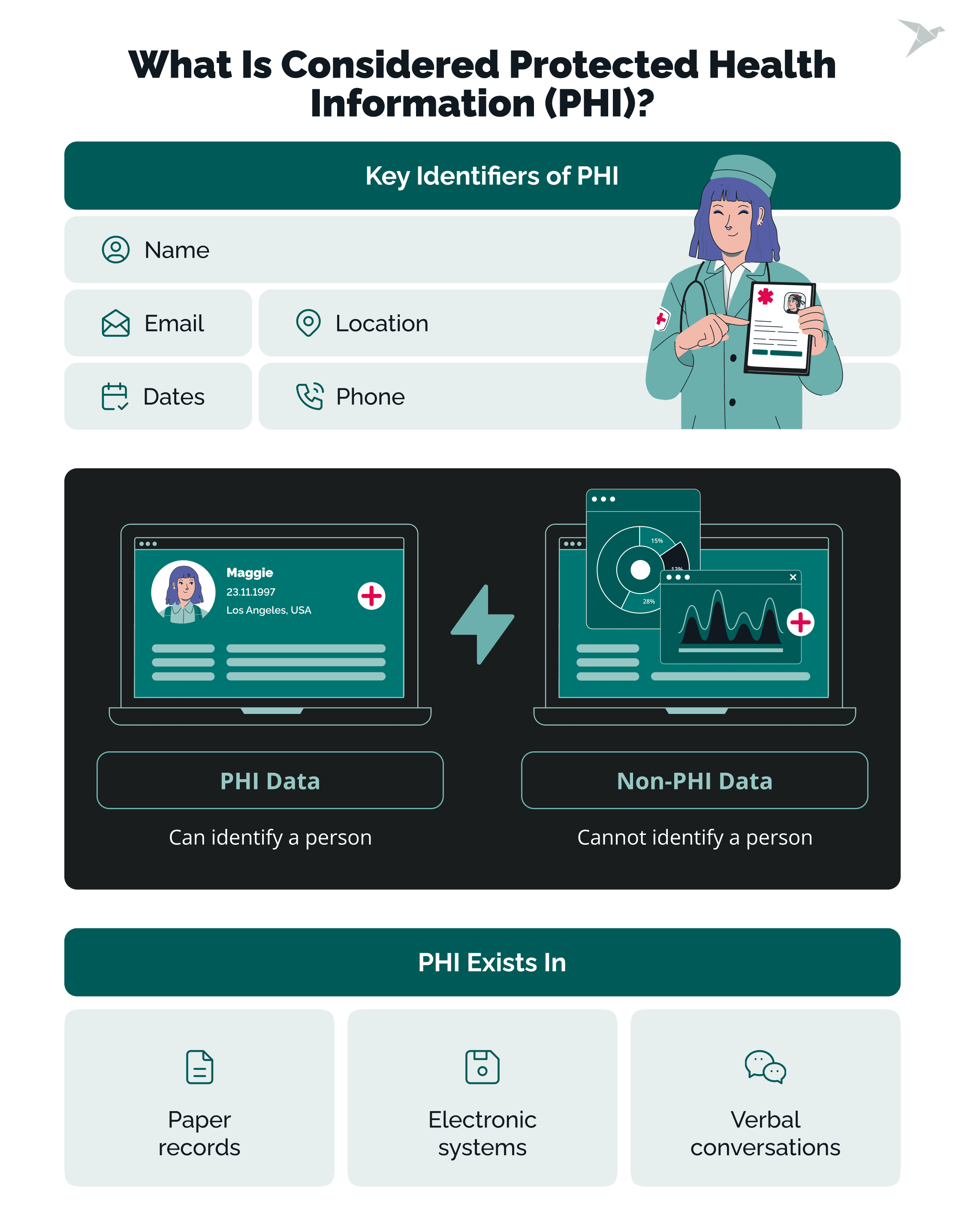
Protected Health Information (PHI) is any health-related data that can be linked to a specific person. Under HIPAA, information is PHI when it connects medical, payment, or care details to an identifiable individual, no matter how or where that data appears. To apply the HIPAA rules for protecting PHI correctly, you first need to spot PHI in everyday work. Let’s see how to distinguish it below.
Identifiers that make information PHI
Health data becomes PHI when it includes identifiers that point to a specific person. Some identifiers are obvious, like names, electronic mail addresses, phone, Social Security or medical record numbers. Others are less direct, such as dates of service, ZIP codes, device identifiers, or internal account IDs.
The main risk is in combinations. Even when names are removed, a few data points together can still identify someone. A common mistake is assuming data is “safe” once direct identifiers are stripped out. In reality, context often fills the gaps.
PHI vs. non-PHI data
Not all health-related data is PHI. PHI includes individually identifiable health information or payment information. De-identified health information removes identifiers in a way that makes re-identification unlikely. Non-health operational data, such as general staffing or financial metrics, is not covered by HIPAA.
In practice, the key question is whether someone can still figure out who the data is about. This is a common problem in analytics, reporting, and product telemetry: data is labeled as non-PHI after a few identifiers are removed, even though it can still be linked back to a specific person.
PHI across paper, electronic, and verbal formats
HIPAA protections are format-agnostic. PHI exists in paper records, such as intake forms and printed charts, in electronic systems, such as EHRs, emails, databases, backups, and logs, and in verbal communication during calls, meetings, or voicemail.
Each format has its own exposure risks. Paper can be misplaced, digital data can be over-shared, and verbal PHI is easy to overlook because it feels informal. HIPAA applies to all three, even when the exchange feels routine.
Examples of PHI in daily healthcare operations
PHI appears throughout normal workflows: appointment scheduling and reminders, billing and insurance communication, patient portals and mobile apps, and support channels. It also appears in less obvious places: data exports, screenshots shared for troubleshooting, support tickets, error logs, and third-party tools like CRMs or analytics platforms.
Who Must Comply With HIPAA Rules?
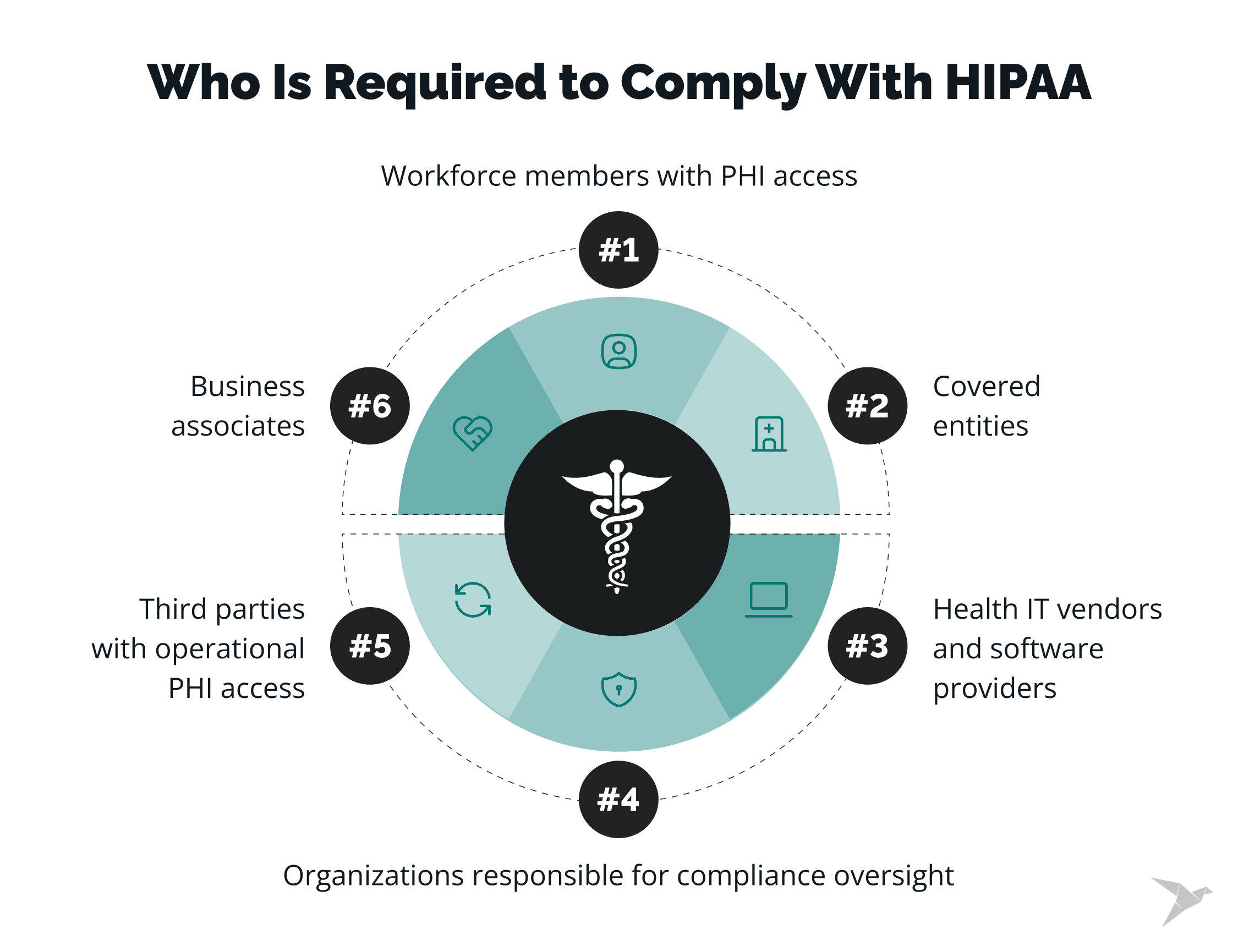
HIPAA compliance isn’t limited to hospitals or clinics. Any organization that handles PHI in regulated healthcare workflows may have legal obligations under HIPAA, whether as a covered entity or a business associate. That scope matters because the HIPAA rules that protect PHI apply across partners, so accountability has to be clear from the very beginning.
Covered entities
Covered entities are the organizations HIPAA directly regulates:
- Healthcare providers and medical professionals that electronically transmit health information in connection with certain transactions (for example, claims)
- Health plans such as insurers, HMOs, Medicare supplement insurers/Medicaid plans, prescription drug insurers, and employer-sponsored group health plans
- Health care clearinghouses that process health information between parties (for example, converting or standardizing data)
Business associates
Business associates are outside organizations that create, receive, maintain, or transmit PHI on behalf of a covered entity.
- Common examples include billing services, cloud hosting providers, outsourced IT, call centers, analytics vendors, and certain software providers
- Subcontractors that handle PHI on behalf of a business associate are also business associates under HIPAA
A common compliance gap: a vendor has PHI access, but the relationship isn’t treated with the same discipline as an internal system.
Workforce members of covered entities and business associates
HIPAA duties also apply to the people who work for these organizations:
- Employees, contractors, trainees, and volunteers with PHI access
- Individual responsibility to follow policies and procedures, access rules, and disclosing PHI limits
Health IT vendors and software providers handling PHI
Many technology organizations fall under HIPAA when their products or support processes involve PHI, including:
- Electronic health record vendors, cloud service providers, and SaaS platforms that store or process PHI
- Product and support roles with access to production data, logs, exports, or customer-reported case data
If a software company can view PHI while troubleshooting, monitoring, or maintaining a system, HIPAA obligations are usually in play.
Third parties with incidental or operational access to PHI
Some organizations access PHI as part of operational work, even if healthcare isn’t their core business:
- Billing companies, legal services/counsel, consultants, IT support
- Data storage, backup, disaster recovery, and managed security providers
“Incidental” access still needs guardrails. The established HIPAA rules for protecting PHI don’t disappear because the access is occasional.
Organizations responsible for HIPAA compliance oversight
HIPAA covered entities remain the primary owners of compliance, but risk and enforcement exposure often spreads across relationships:
- Covered entities must ensure appropriate controls, contracts, and oversight
- Business associates carry direct obligations and can be investigated and penalized for failures
In other words, the rules HIPAA established for protecting PHI require clear ownership, but they also assume shared accountability where PHI is handled by multiple parties.

What Are the Core HIPAA Rules for Protecting PHI?
The core HIPAA rules for protecting PHI are the Privacy Rule, Security Rule, Breach Notification Rule, Enforcement Rule, and the Omnibus Rule. Each one controls a different part of PHI protection: how it’s used, how it’s secured, what happens after an incident, and who is held accountable. Now let’s walk through what each rule covers.
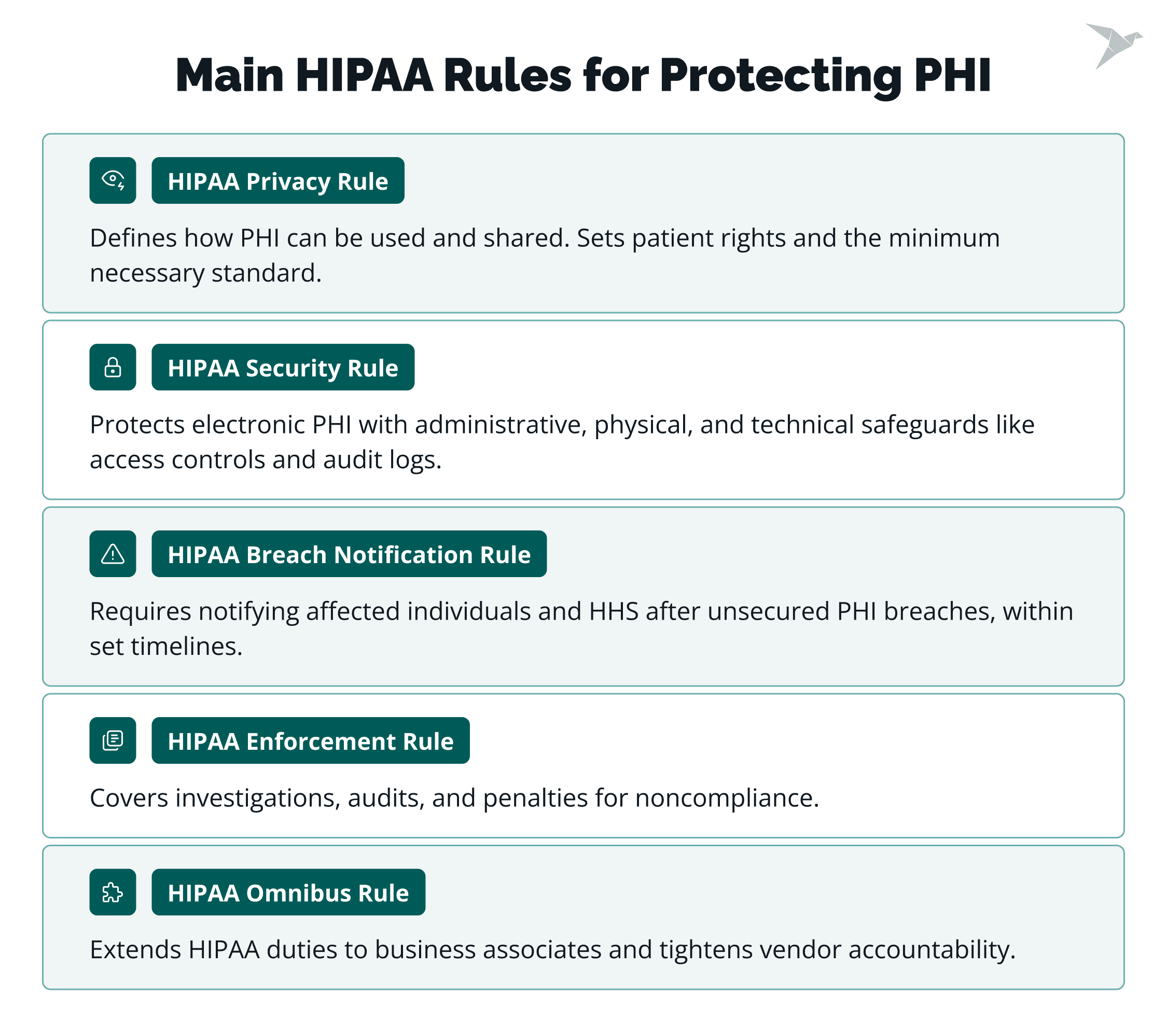
HIPAA Privacy Rule
The Privacy Rule sets the boundaries for the use and disclosure of PHI. The HIPAA Privacy Rule requires that covered entities provide a notice of their privacy practices to individuals. It also defines key patient rights, such as the right to access their records, and introduces the “minimum necessary” standard, which limits access and sharing to what’s actually needed. The Privacy Rule standards address everyday decisions: who can see what, when information can be shared, and how to avoid oversharing in routine workflows.
HIPAA Security Rule
The Security Rule protects electronic protected health information (ePHI). It requires a mix of administrative, physical, and technical controls to protect confidentiality, integrity, and availability. In practical terms, this is where security becomes measurable: access controls, audit logs, system hardening, and ongoing risk management that prevent ePHI exposure through misconfigurations or weak processes.
HIPAA Breach Notification Rule
The Breach Notification Rule requires covered entities to notify individuals and the Secretary of Health and Human Services after a breach of unsecured PHI. It defines what counts as a PHI breach and what must happen next. It sets deadlines and notice requirements for affected individuals and regulators, including health oversight agencies, and it pushes organizations to establish a robust incident response process, including triage, investigation, documentation, and decision-making, before a crisis hits. Breaches affecting 500 or more individuals must be reported to the Secretary of Health and Human Services within 60 days of discovery.
HIPAA Enforcement Rule
The Enforcement Rule explains how compliance is investigated and penalized. It covers audits, investigations, civil penalties, and, when applicable, criminal consequences. Operationally, it’s the reminder that the rules HIPAA established for protecting PHI aren’t optional, and that gaps in controls, documentation, or oversight can become enforcement problems.
HIPAA Omnibus Rule
The Omnibus Rule expanded HIPAA obligations, especially for business associates, and strengthened several privacy protections for patients. It reflects how modern healthcare works: PHI is handled by multiple partners, and accountability must extend beyond the covered entity. For many organizations, this is the rule that forces tighter vendor management and clearer responsibility for protecting PHI end-to-end.
How Does HIPAA Protect Electronic PHI (ePHI)?
HIPAA protects electronic PHI by requiring specific safeguards that reduce the risk of unauthorized access, loss, or misuse of digital health data. These safeguards define how systems are managed, how access is controlled, and how sensitive health information is secured across modern IT and cloud environments. Below is how those requirements take shape in practice.
Administrative safeguards
Administrative safeguards form the foundation for ePHI protection. HIPAA requires organizations to understand where risks exist and to manage them deliberately. Administrative safeguards include workforce training, risk assessments, and appointing a security officer in accordance with the HIPAA Security Rule. Incident response and contingency planning are also required to prevent breaches, outages, or system failures from becoming uncontrolled exposures.
Physical safeguards
Physical safeguards address the environments where ePHI is stored or accessed. HIPAA regulations expect controlled physical access to facilities, secure workstations, and proper handling of devices and media. This applies to data centers, office spaces, and hybrid setups where hardware may exist both on-site and off-site. Lost laptops, unsecured workstations, and improperly disposed drives are still common sources of ePHI incidents.
Technical safeguards
Technical safeguards focus on how systems themselves protect ePHI. HIPAA requires controls such as unique user access, authentication, audit logging, and integrity protections that prevent improper changes to data. These measures help detect inappropriate access, support investigations, and maintain trust in the accuracy of electronic records.
Encryption and secure transmission
While HIPAA doesn’t mandate specific technologies, encryption is widely treated as a baseline safeguard. Encrypting ePHI at rest and in transit reduces exposure if data is intercepted or systems are compromised. Secure transmission channels matter just as much, especially when ePHI moves between systems, vendors, or cloud services.
Cloud and third-party security controls
In cloud and outsourced environments, ePHI protection follows a shared responsibility model. Organizations remain responsible for compliance, even when infrastructure or software is managed by a vendor. That means assessing vendor security practices, clearly defining responsibilities, and ensuring controls such as data isolation, backups, and secure storage are in place. Many of the HIPAA rules that protect PHI become most visible and most tested at this boundary.
Together, these safeguards translate the established HIPAA rules for protecting PHI into concrete controls that fit modern digital health care systems.
What Is the Step-by-Step Guide to Protecting PHI Under HIPAA?
Protecting PHI under HIPAA follows a clear, repeatable sequence. It expects organizations to know where PHI exists, understand risk, apply safeguards, and keep those controls working over time. The steps below reflect how the HIPAA rules for protecting PHI are applied in real healthcare environments.
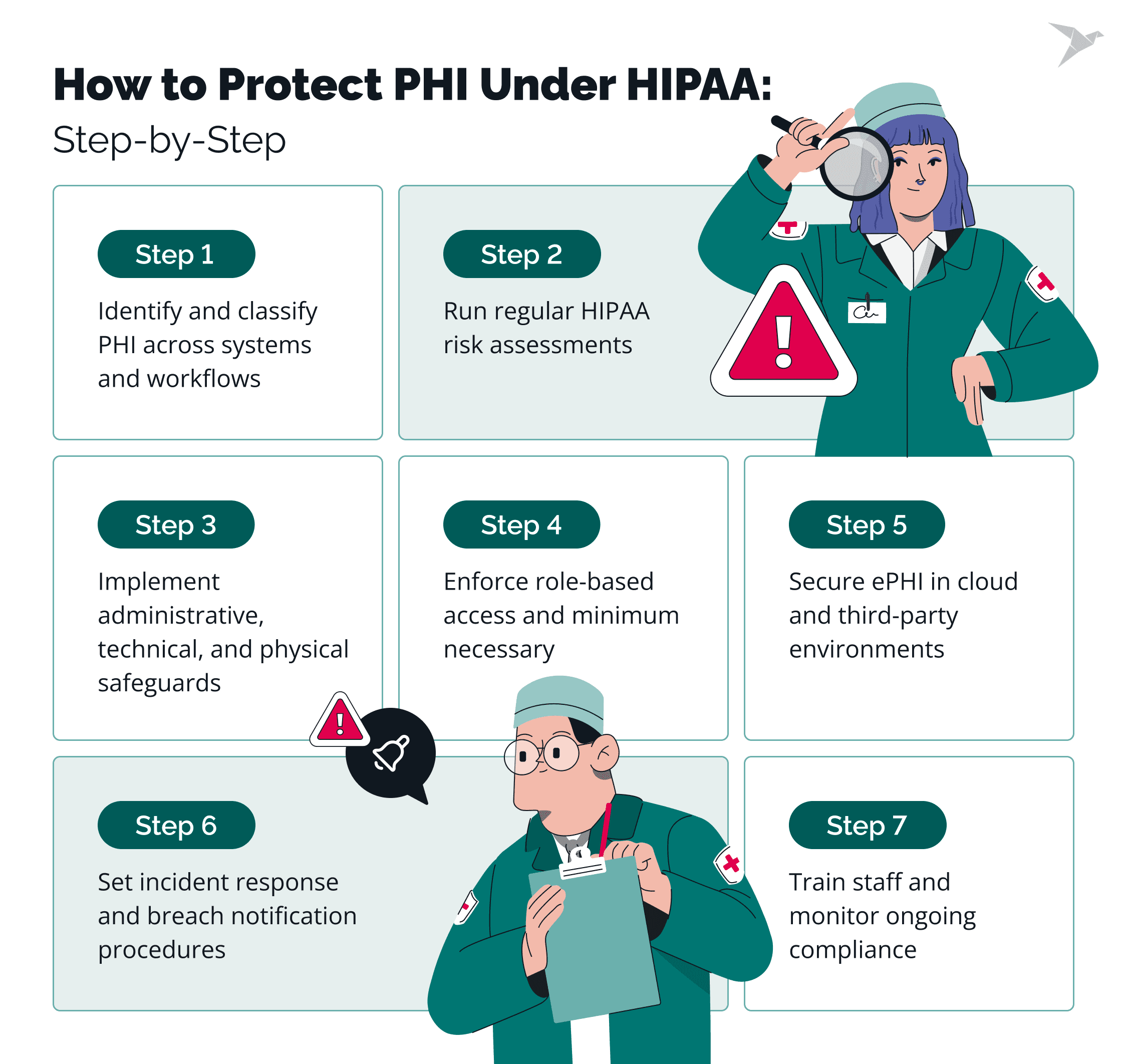
Step 1: Identify and classify PHI across systems and workflows
Start by locating where PHI is created, stored, accessed, and shared. This includes clinical systems, billing tools, cloud platforms, support processes, and data exports. Classification matters because you can’t protect what you haven’t identified, and mislabeling data often leads to gaps later.
Step 2: Conduct regular HIPAA risk assessments
HIPAA requires ongoing risk analysis. Risk assessments help identify where PHI could be accessed improperly, lost, or exposed. This step ties policy to reality by evaluating systems, workflows, and vendors against actual threats and operational behavior.
Step 3: Implement administrative, technical, and physical safeguards
Safeguards are how HIPAA expectations become real controls. Administrative measures define policies and responsibilities. Technical safeguards protect systems and data. Physical safeguards protect the environments where PHI is accessed or stored. Together, these form the core of how HIPAA protect PHI day to day.
Step 4: Enforce role-based access and minimum necessary principles
Access should match job responsibilities: no more, no less. Role-based access and the minimum necessary standard reduce exposure by limiting who can see PHI and under what conditions. Many incidents trace back to excessive access that was never revisited.
Step 5: Secure electronic PHI in cloud and third-party environments
Modern healthcare relies on vendors, cloud platforms, and outsourced services. This step focuses on shared responsibility: defining security expectations, validating controls, and ensuring ePHI remains protected outside direct organizational boundaries. Several of the HIPAA rules that protect PHI are tested most here.
Step 6: Establish incident response and breach notification procedures
Even with strong controls, incidents happen. HIPAA requires documented processes for detecting, investigating, and responding to potential breaches. Clear procedures reduce confusion, support timely notification, and limit regulatory exposure when something goes wrong.
Step 7: Train workforce members and monitor ongoing compliance
PHI protection depends on people as much as systems. Regular training, access reviews, and monitoring help ensure safeguards stay effective as roles, tools, and workflows change. This step keeps the established HIPAA rules for protecting PHI active rather than static.
Taken together, these steps form a practical framework for applying the three rules HIPAA established for protecting PH across everyday health care operations.
Need a Hand Making HIPAA Work in Real Life?
If HIPAA feels clear on paper but messy in day-to-day work, we understand you. PHI lives across products, vendors, cloud services, support processes, and internal tools. Keeping all of that aligned is hard, especially when systems change faster than policies do.
TechMagic can help you close that gap with HIPAA consulting services. We guide health care providers and HealthTech companies in designing and building secure systems, review how PHI is handled across workflows, run risk assessments, and help put practical safeguards in place for modern IT and cloud environments.
If you want a second set of experienced eyes on your architecture, controls, or compliance approach, contact us!

Summing Up and Where PHI Protection Is Headed Next
PHI protection under HIPAA comes down to clarity and consistency: knowing where PHI lives, limiting access, securing systems, and being ready to respond when something goes wrong. The HIPAA rules for protecting PHI work best when they’re built into day-to-day processes, such as access reviews, vendor onboarding, data sharing, and incident handling. When the HIPAA rules for protecting PHI align with how your organization actually operates, compliance feels more predictable and a lot less stressful.
What’s next will test that discipline. In the future, healthcare data will continue to flow through more cloud services, partners, and patient-facing apps. AI and automation will increase the volume of data processed and the speed at which it spreads across tools.
Expect more pressure to prove controls are working: stronger audit trails, tighter vendor oversight, and faster, cleaner incident response. For example, proposed 2026 updates to HIPAA aim to make many addressable specifications mandatory, such as mandatory multi-factor authentication (MFA). Organizations that treat the established HIPAA rules for protecting PHI as ongoing operational work will be better positioned as expectations rise.
FAQ
They include 3 rules HIPAA established for protecting PHI, such as the Privacy Rule, Security Rule, Breach Notification Rule, as well as 2 supporting ones, including the Enforcement Rule, and Omnibus Rule. Together, they set the rules HIPAA established for protecting PHI: how PHI can be used and shared, how ePHI must be secured, what to do after a breach, and who is accountable.
Data isn’t PHI when it can’t reasonably identify a person. This typically includes properly de-identified physical or mental health and operational data with no patient link (for example, staffing or financial summaries). If the data can’t be tied back to an individual, the HIPAA rules that protect PHI generally don’t apply.
Enforcement is led by the Health and Human Services Office for Civil Rights (OCR), which investigates complaints, runs audits, and issues penalties. The Department of Justice may get involved in cases with potential criminal violations.