
 Software Development
 Security Services
 Cloud Services
 AI Services
 Other Services















 TechMagic Academy


Top Benefits of IT Outsourcing to Latin America
Last updated:8 April 2026



Hiring great engineers is not getting any easier.
You’re competing for the same talent as everyone else. Costs keep rising. Hiring takes months. And even when you find the right people, scaling fast without breaking your process becomes another challenge.
So many companies start exploring options outside their local hiring market.
Latin America is often one of the first regions considered. Close time zones. Strong engineering talent. More manageable costs. But if you’re here, you’re likely asking deeper questions:
- Is it really as efficient as it sounds?
- What are the real trade-offs?
- How does it compare to other regions?
- And what’s the most reliable way to build a team long term?
These questions matter even more now, as the region continues to grow quickly. The Latin American IT outsourcing services market reached about $182.4 million and is expected to grow to almost $320 million at an annual rate of 10.1% by 2030, according to Grand View Research.
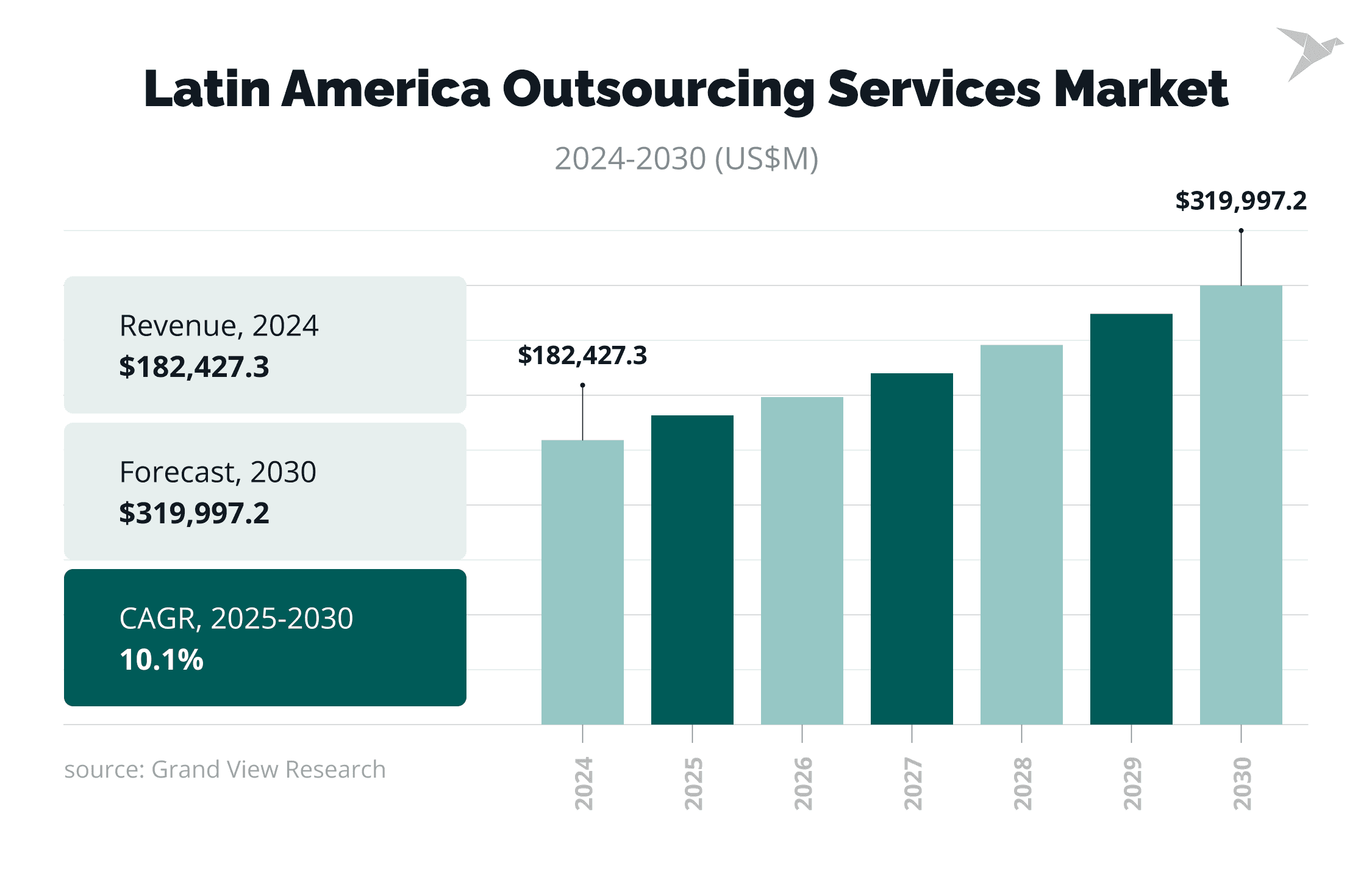
This growth points to a clear trend: Latin America earned a strong position in the outsourcing market. At the same time, choosing a region is only part of the decision. The real question is how you structure your team to make it work.
In this guide, you’ll see where Latin America delivers real value, where challenges tend to appear, and how to approach outsourcing in a way that stays stable as you scale.
Key Takeaways
- The pros of IT outsourcing to Latin America include faster hiring, better cost control, and easier collaboration with US-based stakeholders.
- Latin America gives companies access to strong engineering talent in nearshore time zones.
- The benefits of outsourcing to Latin America are strongest when speed, flexibility, and real-time communication matter.
- Good results depend on partner quality, clear processes, and strong vetting.
- A hybrid model with LatAm and European experts can give more stability and deeper technical coverage.
- The best software outsourcing setups support consistent delivery and make it easier to scale over time.
Is Outsourcing Software Development to Latin America Popular?
Outsourcing software development to Latin America is popular and steadily growing, especially among US-based companies. The region has become a key nearshore outsourcing destination for building engineering teams.
One of the main drivers is that companies struggle to hire locally. Talent is limited. Costs are high. Hiring takes too long. Latin America offers a practical alternative that improves cost efficiency (labor costs in Latin America are often much lower than in the U.S. and other high-income countries) and solves all three problems at once.
At the same time, the global shift toward nearshore outsourcing has made proximity more important. Companies want real-time collaboration without overnight delays. That puts Latin America in a strong position compared to more distant regions.
For a deeper look at the region, our overview of Latin America software outsourcing breaks down how the market works and what to expect.
Here’s how the market looks today:
The growth is not evenly spread. A few countries lead the market:
✅ Brazil offers the largest talent pool in the region, with strong enterprise experience and mature delivery capabilities.
✅ Mexico is one of the most popular destinations for nearshore outsourcing due to its geographical proximity to the United States.
✅ Argentina is known for its high education levels and extreme English fluency, making it a top outsourcing destination.
✅ Colombia is recognized as a top outsourcing destination in Latin America, supported by a government dedicated to science, technology, and innovation.
✅ Costa Rica provides a stable business environment, strong English proficiency, and consistent delivery for long-term partnerships.
✅ Chile is also becoming a popular outsourcing location, especially for IT services, due to its lower costs and highly motivated workforce.
✅ A hybrid model combining Latin America with Europe gives companies broader talent access, extended working hours, and more stable delivery.
Another important factor is maturity. Ten years ago, outsourcing to Latin America was still developing. Today, many Latin American countries operate with established processes, experienced engineers, and long-term delivery models.
Latin America is home to approximately 2.8 million tech professionals, which contributes to its status as a hub for high-value services. LatAm has a rapidly growing workforce, particularly in tech, customer support, and creative industries. The region has a large, skilled, and educated workforce proficient in programming languages and modern technologies.
For companies at scale, this changes the conversation. Latin America is not a “secondary” option in the IT industry. It’s part of the main outsourcing landscape, alongside Eastern Europe and Asia.
At the same time, popularity alone doesn’t guarantee results. The real value comes from how companies use the region and how they structure their teams. That’s what we’ll break down next.

What Are the Pros of IT Outsourcing to Latin America?
The pros of IT outsourcing to Latin America are closer collaboration, faster access to engineering talent, and better cost control without giving up delivery quality. Let’s look at the main advantages more closely.
Time zone alignment with North America
One of the biggest benefits of outsourcing to Latin America is the ability to work in overlapping time zones and business hours with US stakeholders. This improves response time across product, engineering, QA, and delivery. Stand-ups happen live. Feedback comes on the same workday. Issues get resolved before they slow down a sprint. For US companies that rely on fast iteration, this is a major operational advantage.
Access to a large and growing talent pool
Latin America gives companies access to a broad engineering market across Brazil, Mexico, Argentina, Colombia, and other established outsourcing hubs. This matters when local hiring stalls or when internal recruiters cannot fill roles fast enough. Instead of competing in one overheated market, companies can tap into a wider pool of software developers, backend and frontend engineers, DevOps specialists, QA engineers, and other skilled professionals with strong technical skills.
Competitive costs with solid engineering quality
Cost is part of the equation, but the real value comes from the cost-to-output ratio. One of the strongest benefits of IT outsourcing to LatAm is the ability to control development spend while still working with experienced software engineers who can contribute to production systems, platform modernization, and long-term product delivery. For many companies, that creates a healthier balance than hiring only in the US, with lower labor costs, more predictable budgets, and significant cost savings over time. It also helps companies save money without sacrificing quality.
Easier communication and cultural compatibility
Latin American specialists often work in a communication style that feels familiar to North American companies. Expectations around meetings, ownership, business culture, collaboration, and reporting are usually easier to align than in more distant offshore models. That does not remove every communication challenge, but it does reduce friction in daily work and speed up onboarding. Broader cultural similarities often make collaboration easier. The work ethic, professionalism, and adaptability of LatAm developers make them strong partners for long-term projects.
Faster scaling and more delivery flexibility
Hiring in-house can take months, especially when multiple roles need to be filled at once. Outsourcing to Latin America gives companies more room to scale engineering capacity up or down based on roadmap needs, release pressure, or funding stage. The flexibility of outsourced product development is especially valuable for tech startups, scale-ups, larger tech companies, enterprise programs, and other businesses seeking adaptable capacity with changing delivery and software development needs.
Better fit for Agile and real-time collaboration
Nearshore delivery works especially well for Agile environments. Sprint planning, backlog grooming, code reviews, release coordination, and cross-functional problem solving all become easier when people are available during the same working day. This is one of the most practical pros of outsourcing to Latin America. The same setup also improves business operations as it makes cross-functional decisions faster and supports a smoother outsourcing experience.
Lower hiring and operational burden
Recruitment, human resources, onboarding, retention, local compliance, and people operations all take time away from product execution. Working with the right outsourcing partner reduces that load. Internal leaders can spend less time on staffing logistics and more time on roadmap priorities, architecture decisions, customer needs, and delivery oversight.
Nearshore advantages over offshore models
Compared with offshore locations that sit many hours away from the US, Latin America supports a much more connected working model. There is less waiting, less handoff friction, and less pressure to stretch meetings outside normal working hours. That is why many companies and emerging tech hubs see the benefits of outsourcing IT services to Latin America not only in cost, but also in delivery speed and day-to-day control.
More stable delivery through a hybrid model
For some companies, Latin America works even better as part of a broader delivery setup. A hybrid model that combines LatAm engineers with European experts can add deeper technical coverage in areas such as system architecture, cloud engineering, platform work, or complex product builds. This approach also reduces dependence on one region and gives companies more flexibility as delivery needs change.
Geographic diversification and lower delivery risk
Relying on a single hiring market can create risk over time. A more distributed setup of outsourced teams gives companies access to a broader talent base and more resilience if market conditions shift. For growing organizations, that can mean better continuity, easier scaling, and fewer bottlenecks in long-term delivery. If you’re comparing regions for tech services, this guide to nearshore outsourcing explains why geographic proximity often matters more than cost alone.
Now that we’ve covered the main advantages, the next step is to look at the challenges companies should plan for before outsourcing to the region.
What Are the Main Challenges of Outsourcing to Latin America?
While the benefits of IT outsourcing to Latin America are strong, companies still face risks around talent consistency, scaling, and long-term delivery stability. The key is understanding where issues typically appear and how to address them early. Let’s go through the most common ones.
Variability in talent quality across the region
Not all engineers or vendors offer the same level of expertise. Skill levels can vary by country, company, and seniority. This becomes a problem when expectations are high, but vetting is shallow.
What helps: structured technical evaluation, clear hiring standards, and working with partners that have proven screening processes.
Strong competition for top engineers
The best developers in Latin America are already working with international companies. This increases competition, affects availability, and can push rates higher for senior roles.
What helps: partners with established hiring pipelines and access to pre-vetted talent, rather than relying on the open job market.
Limited availability of highly specialized expertise
For advanced roles such as solution architects and AI engineers on projects involving data analytics, AI, or complex platform work, the skilled talent pool is smaller. Relying on a single region can slow hiring for these positions.
What helps: extending the model beyond one geography. A hybrid setup that includes European expertise can fill these gaps without losing collaboration speed.
Differences in engineering standards and delivery maturity
Processes around code quality, documentation, testing, and ownership can differ between outsourcing companies. Without alignment, this leads to inconsistent delivery and technical debt.
What helps: defining engineering standards early and choosing software development outsourcing providers with mature delivery practices.
Communication gaps despite general cultural alignment
Even with cultural proximity, differences in communication style or expectations can create friction. Misalignment often results in unclear ownership, delayed escalation, or assumptions. Navigating local business practices can be difficult for foreign companies in Latin America due to cultural differences.
What helps: clear communication rules, defined responsibilities with Latin American developers, and regular sync points across all roles.
Vendor reliability and transparency risks
Some vendors overpromise or lack visibility in delivery. This becomes critical as projects scale and dependencies grow.
What helps: selecting partners based on delivery track record, transparency, and a long-term collaboration approach.
Legal, compliance, and operational complexity
Legal and regulatory environments in Latin America can be complex and bureaucratic, making compliance challenging for foreign investors. Working across countries involves contracts, IP protection, data security, and compliance considerations. These details can slow down setup if not handled properly.
What helps: structured legal frameworks, vendors experienced in international engagements, and technical support from local legal experts when needed.
Overdependence on a single region or delivery model
Relying entirely on one region creates long-term risk. Skilled workforce shortages, market shifts, or scaling limits can affect delivery. This is where some companies hit a ceiling with a pure nearshore model. High inflation and currency devaluation can also affect business contracts and operations in Latin America.
What helps: diversification. Combining Latin America with another region, such as Europe, creates a more stable and flexible setup for foreign companies while still preserving the core pros of outsourcing to LatAm.
These challenges don’t cancel out the pros of outsourcing to Latin America, but they do shape how successful the outcome will be. The difference usually comes down to how the model is set up from the start.
Main outsourcing challenges in Latin America and how to reduce them
Next, let’s look at how to approach outsourcing in a way that avoids these issues and keeps delivery stable as you scale.
Tips and Best Practices for Outsourcing to Latin America
To get the full benefits of outsourcing to Latin America, you need more than just the right region. The setup, partner choice, and delivery model all play a role in how stable and scalable your results will be. Here are the key practices that make a real difference.
Choose the right partner rather than the lowest cost option
Focusing only on rates often leads to delivery issues later. The stronger approach is to evaluate technical expertise, domain experience, business processes understanding, and delivery track record. This is one of the most important pros of outsourcing to Latin America when done right, but only if the outsourcing partner can actually support long-term delivery.
Validate talent quality through a structured vetting process
Do not rely only on CVs or vendor promises. Technical interviews, coding tasks, and real-case discussions help confirm whether engineers meet your standards. This step protects the value behind the benefits of IT outsourcing to LatAm and avoids costly mistakes later.
Align on processes, expectations, and ownership from day one
Many issues come from unclear roles and inconsistent workflows. Define how work moves, who owns what, and how success is measured. This helps implement the pros of IT outsourcing to Latin America into consistent delivery.
Build strong communication and collaboration practices
Regular syncs, clear reporting, and fast feedback loops keep delivery on track. Even with time zone alignment, structure matters. Strong communication is what makes the benefits of outsourcing IT services to Latin America visible in daily work. In addition to software development outsourcing, companies also outsource tasks like cloud management, cybersecurity, QA testing, and system support. Make sure collaboration is synced and effective.
Start with a pilot and scale gradually
Instead of committing to a large team immediately, begin with a smaller scope. This allows you to test collaboration, validate quality, and adjust before scaling. It reduces risk and improves long-term outcomes.
Consider a hybrid model to increase stability and flexibility
For more complex needs, combining Latin America with European expertise can strengthen delivery. This model helps cover advanced technical roles, reduces dependency on one region, and keeps collaboration within overlapping hours. It is a practical way to extend the benefits of IT outsourcing to Latin America while improving stability. In many cases, it also leads to lower operational costs over time.
When these practices are in place, outsourcing becomes more predictable and easier to scale. The next step is choosing a model and partner that can support this approach long-term.
Why Companies Choose TechMagic for Latin America Outsourcing
Finding developers in Latin America is one thing. Building a setup that actually works long term is another.
That’s where TechMagic can help.
We build dedicated engineering teams in Latin America for companies that need strong delivery, smooth collaboration, and room to scale. We have a strong focus on careful vetting, clear communication, and delivery standards that hold up in real product work.
And when a project needs deeper technical coverage, we can strengthen the model with European experts. This hybrid approach gives you the cost and time zone advantages of LatAm, with added seniority, broader expertise, and more delivery stability.
If you want a team that fits your product and growth plans, explore how to hire developers in Latin America with TechMagic.

Final Thoughts
Latin America stands out as a strong outsourcing option for companies that need faster hiring, better cost control, and closer collaboration with US-based stakeholders. The benefits of outsourcing to Latin America are clear, especially for product organizations that want real-time communication and more flexibility.
Still, good results depend on the setup. Partner quality, vetting, and delivery structure matter as much as the region itself.
Looking ahead, a few shifts are likely:
- Nearshore demand will keep growing
- Competition for strong engineers will get tougher
- Hybrid models will become more common, especially for companies that need both scale and deeper expertise
So the real decision is not only where to outsource in the tech industry. It is how to build a model that stays reliable as your needs change. TechMagic can be a reliable partner in this.
FAQ

To hire faster, control costs, and work in overlapping US hours. The benefits of outsourcing IT services to Latin America also include access to skilled engineers, smoother day-to-day collaboration, and support for projects like web and mobile app development. In some cases, companies also use the region for business process outsourcing.
For companies that need real-time collaboration, often yes. Many pros of outsourcing to Latin America come from time zone alignment, faster communication, and easier integration with internal stakeholders. Stronger digital infrastructure across parts of South America also makes collaboration more reliable. Governments in Latin America are offering supportive policies and incentives, such as tax benefits and streamlined regulations, to attract foreign investment.
Yes. One of the main pros of IT outsourcing to LatAm is a better balance between cost and delivery quality than many companies get with local hiring. In some countries, government support, tax benefits, and growing foreign investment also contribute to economic growth and help make the region more attractive for outsourcing.
It can improve both. With the right setup, you get faster collaboration, easier scaling, and access to experienced engineers. The benefits of IT outsourcing to Latin America are more than just lower cost when delivery is structured wisely from the start.
Yes. We often combine Latin America engineers with European experts. This hybrid model gives you stronger technical coverage, more stability, and keeps collaboration within overlapping US hours.
Yes. We work with healthcare products that require compliance, data security, and stable architecture. The team is built with the right seniority and experience for regulated environments.
Yes. We focus on long-term delivery, clear processes, and consistent engineering standards. That’s essential when working with critical systems where reliability and security matter.
Work happens during your business day, so feedback, reviews, and fixes land on the same workday instead of the next one. That means less handoff friction and faster resolution than distant offshore models, without trading away quality.
Strong protection comes from clear contracts, defined IP ownership, and data security agreed before work starts, but the bigger factor is partner choice. At TechMagic, we build these safeguards into every engagement and bring in local legal expertise when a project needs it.
Faster than in-house hiring, which often takes months. With pre-vetted talent, we can typically assemble a team in a few weeks, depending on roles and seniority.
