 Software Development
 Security Services
 Cloud Services
 AI Services
 Other Services















 TechMagic Academy


AI Automation in Healthcare: Reducing Administrative Burden and Improving Operational Efficiency
Last updated:5 June 2026



Your clinicians didn't go to medical school to fight with insurance forms. Yet that's where a huge share of their day goes.
AMA data shows that physicians work an average of 57.8 hours a week, but only 27.2 of those hours go to direct patient care. The rest gets eaten by EHR documentation, order entry, prior authorization, insurance forms, and inbox management.
This is the problem we'll dig into in this article: administrative work pulls your most skilled, most expensive people away from the work only they can do. And it's not just clinicians. Front-desk teams, billing staff, and care coordinators feel the same drag.
This post is for healthcare leaders weighing where AI actually creates measurable value. We'll cover key domains where it earns its keep: documentation, scheduling, billing and revenue cycle, prior authorization, and patient communication.
One promise upfront: AI reduces the burden. It doesn't replace clinical judgment or run your organization without skilled people. Anyone who says otherwise is selling something.
Key Takeaways
- AI automation in healthcare pays off most on high-volume, rule-based admin work.
- The biggest wins come from documentation, revenue cycle, and prior authorization.
- AI drafts and flags, but a human makes every call that affects patient care.
- Compliance is non-negotiable: AI can't be the sole basis for a denial.
- Clean, connected data has to come before any automation.
- Done right, AI gives your skilled staff their time back.
What Is AI Automation in Healthcare?
AI automation in healthcare is the use of AI-powered tools to handle repetitive, rule-based, or data-heavy administrative tasks, without a person managing each step. That means machine learning, natural language processing, and robotic process automation doing the routine work so your staff doesn't have to.
The key word is administrative. This article stays in the operational layer: paperwork, scheduling, billing, patient communication, and workflow coordination. We're not covering clinical AI in this post, the kind used for diagnostics or reading scans. Our focus is the back-office and front-desk work that quietly drains your team's hours.
So how does it work? AI systems take in your data, both structured (patient records, insurance rules) and unstructured (clinical notes, faxes, emails). AI tools apply learned patterns or fixed rules, then carry out the task: routing a request, filling a form, submitting a claim, or flagging something for a human. And they do it inside the systems you already run, your EHR, scheduling, and billing tools.

What Is the Administrative Burden Costing Healthcare Organizations?
The administrative burden is the accumulated cost, in staff time, delayed care, errors, and burnout, of running manual or fragmented processes at scale. It comes from clinical documentation, insurance verification, prior authorization, billing and coding, scheduling, patient communication, and compliance reporting.
For healthcare providers, every one of these is required, operationally and legally, and in most organizations, every one is poorly optimized. Here's what some of it adds up to:
Clinical documentation overload
Documentation is the biggest driver of clinician burnout, and it's not close. AMA data shows physicians spend more of their EHR time on charting than on care. When your best people spend their evenings finishing notes, two things happen: care quality slips, clinical outcomes suffer, and good clinicians start looking for the exit. The cost of losing them dwarfs the cost of the paperwork itself.
Revenue cycle inefficiencies
Manual billing creates bottlenecks at every step, and poor data quality at intake makes it worse. Claims go out late. Denials climb. Appeals pile up. Each denied claim costs around $57 to rework, and that's before you count the revenue stuck in limbo. Multiply that across thousands of claims, and the costs escalate rapidly. None of this work adds clinical value. It simply consumes time and resources that could be better spent elsewhere. CAQH estimates the industry still leaves about $20 billion a year on the table by handling administrative work manually.
Staffing pressure and turnover
Here's the part that compounds. Administrative drag burns out clinical staff and front-desk teams alike. People leave. You backfill with expensive temporary labor or leave roles open, which loads more work onto the people who stayed. It's a loop that feeds itself.
How AI Automation Reduces Administrative Burden in Healthcare
Healthcare AI workflow automation takes over the repetitive, high-volume work that clogs your day and hands the judgment calls back to your people. The highest return comes from three areas: documentation, revenue cycle, and prior authorization. Let's walk through how each one works.
Ambient AI for clinical documentation
The task is the clinical note. Today, a clinician sees a patient, then types up the visit, often after hours, in what doctors grimly call "pajama time."
Ambient AI scribes change the flow. They listen to the visit through speech recognition and natural language processing, then generate a structured draft note in real time, written straight into the EHR. The healthcare professional reviews it, edits what's off, and signs.
That's the key line: the AI drafts, the clinician approves. Accuracy remains a human responsibility. The payoff is fewer evenings lost to charting, more time for direct patient care, and a real chance to improve patient outcomes, which is exactly where burnout starts to ease.
The Permanente Medical Group reported that ambient AI scribes saved physicians nearly 15,800 hours of documentation time over a year, and 84% of doctors said it improved how they connect with patients.
Automated patient scheduling and no-show reduction
Scheduling looks simple and isn't. Front-desk staff manage provider availability, patient preferences, and a phone that won't stop ringing, and they still lose slots to no-shows. AI-driven scheduling matches the right appointment to the right slot, sends reminders, and handles rescheduling without a human touching it.
Predictive AI models flag high-risk patients more likely to miss a visit. These AI algorithms in healthcare use predictive analytics on past no-show patterns in your training data, so staff can reach out before the gap appears. The result: lighter front-desk load, smoother patient flow, and more usable capacity from the schedule you already have.
Medical billing, coding, and claims automation
This is where AI for automation in healthcare pays for itself fastest. Manual revenue cycle work is slow and error-prone: someone verifies eligibility by hand, assigns codes, and submits, then waits to find out what bounced. AI tightens every step. It runs automated eligibility checks, assists with coding, and validates claims before they go out, catching the errors that trigger denials.
Predictive denial management uses data analysis to flag risky claims early, and AI can draft the documentation needed for appeals. The operational goal is straightforward: lift your first-pass acceptance rate so fewer claims come back, and free your billing team from the grind of resubmissions. That's a big part of how AI reduces costs in healthcare.
Prior authorization workflow automation
Prior authorization is one of the most hated tasks in healthcare, and one of the best fits for AI in healthcare automation, with an important limit. On the provider side, AI works within your existing healthcare systems, pulling the relevant clinical data from the EHR and checking it against payer criteria.
AI pre-populates the authorization form, submits it electronically, and tracks status so nothing gets missed. That removes hours of manual lookup and faxing. According to the CAQH Index, providers spend about 14 fewer minutes per request when prior authorization is electronic rather than manual.
Here's the line you can't cross. AI can prepare, flag, and submit, but it can't be the one to deny care. For instance, Texas passed a law in 2025 barring utilization review agents from using an automated system to issue an adverse determination without human oversight, and Arizona and Maryland have adopted similar rules: AI can't be the sole basis for a medical-necessity denial. A licensed clinician has to review and sign off on any denial. That means AI is a workflow accelerator, not a decision-maker. Build it that way, and you stay compliant; build it any other way, and you're exposed.
At the federal level, the CMS prior authorization rule (effective January 2026) now requires Medicare Advantage, Medicaid, and CHIP plans to support electronic prior authorization and answer urgent requests within 72 hours.
Patient engagement and communication automation
The patient inbox has quietly become a major source of staff fatigue. Refill requests, reminders, follow-up questions, and FAQs pile up in the portal and on the phone lines, and clinical staff absorb the overflow. AI handles the routine layer: appointment reminders, pre-visit intake, post-visit follow-up, refill requests, and common questions answered by a healthcare AI assistant chat or voice. These virtual assistants, sometimes called virtual health assistants, work around the clock.
The complex, sensitive, or personalized care conversations still route to a human. Done well, this cuts inbound call volume, lifts patient satisfaction, and keeps the portal inbox from burying your team, which is one of the clearest benefits of AI in healthcare workflow automation you'll feel day to day.
Limitations of AI Automation in Healthcare: Where It Should Not Be the Primary Decision-Maker
Healthcare AI automation handles volume, repetition, and data processing reliably. What it can't do is replace clinical judgment, reason through context, or carry accountability for decisions that affect patient care. Knowing that line is where we at TechMagic spend a lot of our time with clients. Here's where we draw it.
Clinical and medical necessity decisions
AI can surface the right information and flag what looks off, like possible drug interactions, but it shouldn't own clinical decision making or decide whether care is medically necessary. That call needs a clinician who can weigh a patient's medical history, treatment plans, and circumstances. Used well, AI acts as clinical decision support, not the decision itself. At TechMagic, we design systems that put the data in front of the right person, fast, and stop there. The model assists the decision; it never owns it. Clinical care stays with people.
Complex and exception-heavy workflows
AI thrives on patterns. It struggles with the messy edge cases, the unusual payer rule, the patient who doesn't fit the template, the claim with five things wrong at once. Used within its limits, automation is great at reducing errors; pushed too far into these, error rates climb quietly. At TechMagic, we develop AI solutions for routine tasks and route the exceptions to humans, with clear handoffs so nothing gets stuck in a gray zone.
Relationship-sensitive patient communication
A refill reminder can be automated. A conversation about a hard diagnosis cannot. Patients can tell the difference, and getting it wrong erodes trust you can't easily rebuild. We map which messages are safe to automate and which must stay human, so sensitive moments always reach a person.
Regulatory accountability and legal liability
When something goes wrong, "the AI did it" is not a defense. Accountability stays with the organization and its licensed staff, and several states now require a clinician to sign any adverse determination. At TechMagic, we treat compliance as a design input, building audit trails, human-review checkpoints, and clear records of who approved what. That's central to responsible AI administrative automation in healthcare.
Low-quality or fragmented data environments
AI and data analytics are only as good as the data feeding them. If your records are scattered or your data collection is inconsistent, automation amplifies the mess instead of fixing it. This is the limitation organizations underestimate most. Before we automate anything, we assess the data, clean and connect what's needed, and tell you honestly if a workflow isn't ready. A shaky foundation costs far more than waiting to fix it.
The honest takeaway: AI and automation in healthcare work best as a force multiplier for skilled people, not a substitute. Now let's get specific about what that looks like in real projects.
Our Experience With AI Automation in Healthcare Projects
At TechMagic, we've built HIPAA-compliant platforms for healthcare organizations where the real work wasn't flashy AI, it was untangling the manual processes and messy data underneath. That pattern holds across almost every engagement: the hard part comes before any automation, and the teams that respect that get results that last.
Project overview
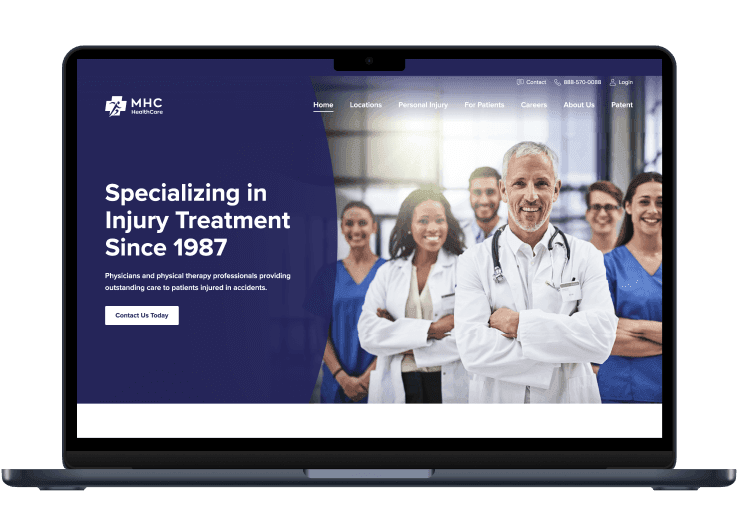
Let’s take our work with MHC HealthCare, a provider of injury-treatment services. The starting point was painfully manual. Medical record management was painful: pulling a patient's records meant retrieving paper files or wrestling with scattered datasets. Communication between medical staff and the legal teams who needed those records was fragmented, so information moved slowly and sometimes not at all. Repetitive manual data entry ate hours and invited errors. And there was no clean way to track who changed what, a real problem when compliance depends on it.
The job was to digitize and automate the core workflow: secure, centralized access to records, smooth patient data sharing between medical and legal staff, and a complete audit trail behind every modification.
Challenges we faced
The harder-than-expected part is almost never the automation itself. It's the data. Surfacing the right records without burying users in noise took real work, deciding what each user actually needs to see and filtering out the rest. On the audit side, we had to isolate the tracking process from core services so it stayed reliable and tamper-evident under load. These are the unglamorous problems that decide whether a project works in practice.
Project results and takeaways
The portal went live with centralized record access, automated data sharing, and an audit trail covering every change. Manual retrieval dropped away, collaboration between medical and legal teams got faster, and the regulatory compliance picture became far cleaner. We've kept it running with ongoing support since.
Here's what we'd tell any client. Fix the foundation before you automate. Where the data is clean and the workflow is mapped, layering AI agents in healthcare on top becomes realistic, with AI algorithms flagging records for review, drafting routine correspondence, and scoring tasks by priority. We've built exactly that kind of artificial intelligence decision-support in other products, always keeping a human in control of the call. The order matters: get the plumbing right, then add the intelligence. Skip that and you automate a mess.
HIPAA-compliant portal for secure medical data records and exchange
How We Can Help You
If you're weighing AI adoption, we'll help you decide which AI initiatives are worth funding. Our AI development services cover the full lifecycle, including data cleanup, deployment, and monitoring, so your tools optimize workflows inside the systems you already run. TechMagic is a Clutch-recognized AI company with 200+ projects, focused on measurable outcomes, compliance, and security.
We're most useful on the groundwork others skip: checking whether a workflow is ready to automate, fixing the data first, and keeping a human in the loop wherever decisions touch patient care. If a proof of concept isn't worth pursuing, we say so early. The goal is real cost savings, not AI for its own sake.
Need a compliant foundation? Our Medplum development services are a fast, cost-effective start. Medplum is an open-source, FHIR-native platform with built-in security, audit logging, and access controls, so you skip rebuilding the compliance plumbing. We can ship a secure, working app in around six weeks, starting near $30K, with core EHR features, payments, and a clean interface. AI add-ons like chart summarization, patient chat, and smart triage to prioritize urgent cases are optional and shaped around your workflow.

The Bottom Line
AI automation in healthcare pays off most on high-volume, rule-based work: documentation, billing, scheduling, prior authorization, and patient communication. That's where the hours pile up, and where automation gives them back.
It won't replace clinical judgment or skilled staff. The real value of AI in administrative automation healthcare is simpler than the hype: it clears the busywork so your people can do the work only they can. Get the data right first, keep a human on every decision that affects care, and the rest follows.
Over the next two to three years of AI transforming healthcare operations, the winners won't be the ones automating fastest, but the ones automating most deliberately.
FAQ
It depends on scope and data readiness. A focused proof of concept usually takes a few weeks, while a full production rollout integrated with your health systems takes a few months.
Yes. Well-built tools connect to your EHR, scheduling, and billing systems through secure APIs, and most healthcare automation is designed to layer onto what you already run rather than replace it.
Most organizations see returns first in documentation and revenue cycle, often within months, through recovered staff hours, higher first-pass claim acceptance, and fewer denials to rework.
Your organization and its licensed staff do. AI assists and flags, but accountability for any decision affecting patient care stays with a human, which is why human review is built into every responsible workflow.
AI automation in healthcare uses tools like machine learning and natural language processing to handle data-heavy administrative tasks on their own. Traditional software follows fixed rules and waits for input; AI adapts to context and acts with far less manual direction.
It absorbs the repetitive tasks, drafting notes, sending reminders, prepping forms, and managing the inbox, so clinicians spend less time on paperwork and more on patients. That directly eases the documentation overload driving burnout.
Yes, for extracting data, checking payer criteria, pre-populating forms, and submitting requests. To stay compliant, a licensed clinician must review any denial, since states including Texas, Arizona, and Maryland bar AI from being the sole basis for an adverse determination.