 Software Development
 Security Services
 Cloud Services
 AI Services
 Other Services















 TechMagic Academy


Understanding the Cloud Adoption Framework AWS: What Is an AWS CAF?
Last updated:9 March 2026

Cloud adoption often starts with speed in mind, but many teams run into the same issue later: a lack of structure. According to recent industry reports, over 70% of cloud initiatives face delays or cost overruns due to unclear processes and misalignment between teams.
This is where the Cloud Adoption Framework AWS becomes relevant. It helps organizations move from ad hoc decisions to a structured approach that connects technology with real business operations.
In this article, you will find an AWS Cloud Adoption Framework overview, including its stages, perspectives, and how it supports cloud adoption in practice. You will also see how it helps teams plan migration, manage risks, and get more value from a cloud computing services provider without losing control over costs or processes.
Key takeaways
- AWS CAF groups its capabilities into six perspectives: Business, People, Governance, Platform, Security, and Operations.
- Aligning cloud adoption with specific business outcomes helps organizations make better decisions and reduce waste during the implementation process.
- AWS CAF provides a structured approach to cloud adoption across business and technical areas, including data and analytics platforms.
- It helps align cloud decisions with real business goals and operational needs through a clear transformation roadmap.
- The framework improves visibility into costs, risks, and performance.
- It helps teams prioritize transformation opportunities and focus on what delivers the most value.
- It supports gradual adoption with measurable results at each stage and clearer responsibility across teams.
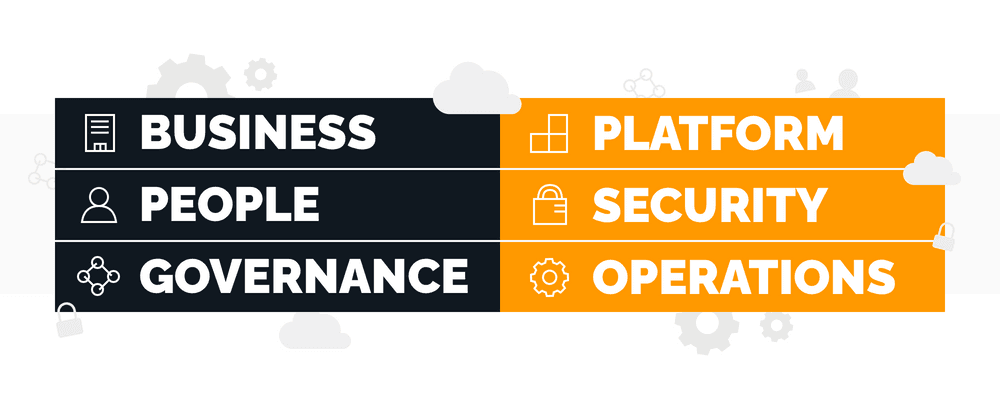
Read on to learn about what is AWS CAF and the role of the AWS Cloud Adoption Framework in enterprise software deployment.
What Is an AWS CAF?

Let’s start with an overview of the AWS Cloud Adoption Framework from several definitions. Amazon Web Services (AWS) gives you instant access to your web services from anywhere in the world with an internet connection. Leveraging this highly scalable platform enables companies to deploy applications in minutes. At the same time, the created solutions can be centrally reconfigured, updated, and deactivated (both temporarily and permanently in order to optimize the company's costs). In this case, you will always pay only for the resources that you use.
In turn, the AWS Cloud Adoption Framework (AWS CAF) provides a comprehensive list of recommendations for implementing, adapting, configuring, and maintaining workflows associated with already deployed software. Thousands of enterprises leverage AWS CAF today, and more plan to use them soon to migrate to the cloud.
With the help of AWS Cloud Adoption Framework (AWS CAF), organizations can build a road map to cloud migration, quickly bridge in-house IT knowledge gaps and deploy software in different environments.
Note that the guide, compiled within the AWS Cloud Adoption Framework, affects absolutely all departments of the company — from IT specialists to human resources. This systematic approach helps to complete the migration process with minimal downtime, to an already prepared environment, with already trained employees.
You can also check out the Amazon whitepaper which details the main aspects of entering the cloud.
What are the benefits of AWS CAF?
To answer fully what is the AWS Cloud Adoption Framework, it is important to understand how it helps organizations plan and manage cloud transformation across business, people, governance, and technical delivery.
Better alignment across the organization
AWS CAF helps business and technology teams work toward the same cloud goals. It gives both sides a shared structure for planning, priorities, and decision-making.
Higher operational efficiency
The framework supports operational efficiency by helping teams standardize processes, reduce duplication, and build a more consistent approach to delivery and governance.
Stronger support for cloud operations
AWS CAF is not limited to migration planning. It also helps teams organize cloud operations, including management practices needed after adoption.
A clearer approach to workloads and modernization
The framework helps organizations evaluate data and cloud workloads and decide how to move, optimize, or redesign them in a controlled way.
Better conditions for long-term success
By connecting strategy with execution, AWS CAF creates a stronger foundation for successful cloud transformation instead of isolated cloud projects.
More value from delivery teams
The framework helps technology teams create customer value faster by reducing confusion around roles, priorities, and cloud adoption steps.
AWS Cloud Adoption Framework Overview: Main Phases
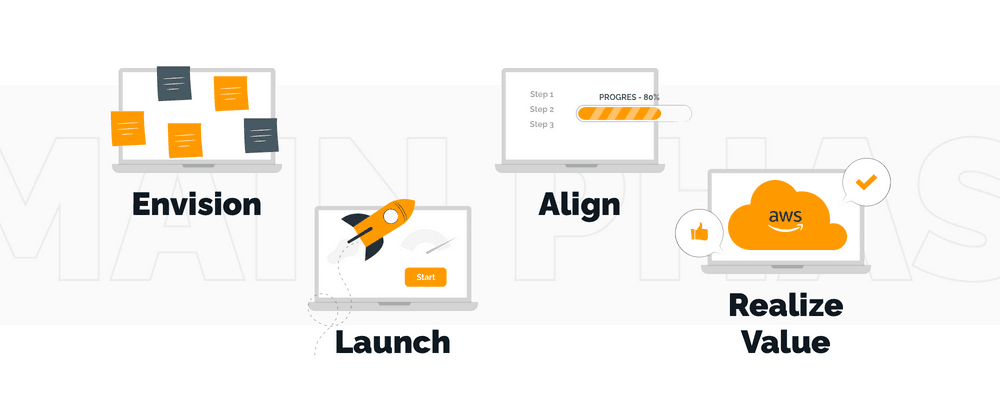
Let's see what AWS Cloud Adoption Framework phases are. Each phase focuses on improving cloud readiness and aligning cloud initiatives with real business outcomes.
Envision
At this stage, you will be able to build a competent strategy for AWS cloud migration, the implementation of which will require a minimum of time and money investment. You can also build long-term prospects for your business by choosing the optimal technology stack.
It focuses on defining goals and direction. Teams identify expected business outcomes, assess current capabilities, and start shaping a cloud strategy. It also supports early business forecasting, helping estimate value, costs, and long-term impact.
Align
In this phase, organizations create a clear action plan for migration and adoption. It includes defining responsibilities, identifying risks, and choosing the right approach. The goal is to improve cloud readiness across teams, processes, and technology before execution begins.
Launch
This is one of the AWS Cloud Adoption Framework stages that helps you build the workflows needed to deploy cloud services and add value to your business. As a result, you can quickly integrate new web services into your existing network infrastructure and benefit from them immediately after deployment.
Realize Value
This phase involves evaluating the effectiveness of innovations and planning a further strategy for your business. With its help, you can regularly compare the results of the updated workflows with the expected plans and adjust the chosen strategy.
AWS Cloud Adoption Framework Capabilities and Perspectives
Each AWS CAF Perspective is a list of responsibilities that specific employees in the company must perform. In essence, it is the standard that defines the safety and cost-effectiveness of migrating to the Amazon cloud. We see it in practice, in our AWS consulting for companies of different sizes and industries.
Let’s study the main AWS Cloud Adoption Framework perspectives in detail.
Business perspective
The business perspective in AWS CAF focuses on aligning cloud adoption with long-term strategy rather than isolated initiatives. It helps business stakeholders define priorities, evaluate opportunities across different market segments, and build foundational capabilities that support growth.
This perspective allows organizations to:
- plan initiatives with a long-term view, business benefits in mind, and influence future direction;
- improve customer service experience by aligning technology with user needs;
- distribute financial resources more effectively;
- maintain better visibility and control over business risks and business model.
By connecting cloud decisions to business goals, this perspective ensures that cloud adoption supports measurable outcomes rather than standalone technical changes.
Governance perspective
The governance perspective focuses on organizing and coordinating both technical and business processes around cloud adoption. It helps define specific organizational capabilities needed to support transformation initiatives and align them with the company’s organizational structure.
This perspective supports teams in:
- scheduling workloads and prioritizing AWS services based on business needs;
- selecting appropriate cloud migration approaches;
- managing costs and improving financial control;
- handling licenses and usage policies consistently.
Clear rules and accountability ensures that cloud adoption remains structured, controlled, and aligned with business objectives.
Operations perspective
The operations perspective focuses on running and supporting cloud workloads in line with current and future business objectives. It helps teams maintain stable systems while adapting to change with minimal risk.
This perspective supports:
- monitoring services to assess performance and ensure compliance with internal requirements;
- managing resource inventory to optimize usage and support cost management;
- handling release and change processes, including CI/CD practices;
- using reporting and analytics to track performance, align with business strategy, and identify capability gaps;
- maintaining backups and evaluating downtime to support continuous operations.
It also helps teams iteratively evolve their processes over time, improving reliability and delivering consistent customer value as systems grow and change.
Security Perspective
AWS Cloud Adoption Framework security perspectives provide the recommendations for the right structure for management points and help reduce IT workloads for the Network Security team. Here are the AWS Cloud Adoption Framework security benefits they get:
- Identity and Access Management (IAM), which provides extensive guidance on integrating AWS into user authentication and authorization processes.
- Detective control, which is responsible for detecting suspicious network activity.
- Infrastructure security, responsible for drafting regulations and security requirements.
- Data protection, which helps you develop correct strategies to protect data during transfer and storage processes.
- Incident response service that helps you instantly respond to abnormal network activity.
Learn more AWS security best practices
People Perspective
The People Perspective of the AWS CAF focuses on organizational change management and building a culture of continuous learning. It gives:
- the ability to predict new vacancies due to the modernized network architecture;
- creating a common list of skills for cloud migration;
- building a training plan for employees to carry out their usual tasks in an updated environment.
The People perspective serves as a bridge between technology and business, focusing on culture, organizational structure, leadership, and workforce.
Platform perspective
The platform perspective serves to enhance the network infrastructure built with AWS. It plays a key role for network architects, CTOs, and managing members of the IT team. Here are the benefits they get:
- understanding what requirements the design of the future system should meet;
- the vision of prospects for scaling and building new workflows in the cloud;
- aligning new business goals in the context of new computing power offered by the cloud.
All the above is part of the focus of AWS infrastructure audits, and must be considered seriously.
What to Do After?
After working through all six perspectives, the next step is to turn insights into action and structure the implementation process.
This includes:
- identifying who is responsible for cloud adoption across teams;
- outlining key questions and potential challenges that may affect progress;
- defining the skills and tasks needed to support implementation;
- creating a clear plan to address knowledge and workflow gaps.
This stage helps organizations stay customer-centric while building processes that support increased operational efficiency as cloud adoption moves forward.
Our Experience

For several years we have specialized in the development and implementation of serverless solutions based on AWS tools such as AWS Lambda, API Gateway, AWS DynamoDB, AWS Step Functions, and more, providing our clients with cost-effective, scalable, and reliable products.
Our experts can offer you, depending on your needs, deploying both a traditional cloud application based on AWS EC2 (EC2 is a virtual hosting, which helps to launch a new server within 5 minutes) and a serverless application based on AWS Lambda, so you can focus on writing code that serves your customers.
Cloud deployments can reduce the upfront cost of launching a product because teams pay only for the resources they actually use. With an existing Amazon account, it is possible to provision infrastructure quickly and start running workloads without a large initial investment. That makes cloud adoption a practical option for startups that need flexibility and support for continuous growth.
Security is also a core part of the setup. Services such as AWS WAF, AWS Shield, and AWS Cognito help strengthen protection across applications and user access flows, while integrations with HPC, IoT, blockchain, or ML systems can support more complex use cases in areas such as industrial operations. This approach helps maintain enhanced security without slowing down delivery.
To support availability and stability, cloud architectures often rely on Elastic Load Balancing, Availability Zones, database replication, and Auto Scaling Groups. These services help keep applications responsive and accessible under changing demand.
The broader value of cloud migration is not only lower cost. It also supports a clearer strategic intent by giving teams infrastructure that can scale, adapt, and align with business needs over time.
To get more info, we also recommend that you study our cases, such as Elements.cloud, Acorn-i, and Etergo.

Conclusion
AWS CAF helps organizations approach the cloud transformation journey in a structured way. Instead of isolated changes, teams can move step by step, aligning technology decisions with business priorities and moving away from rigid legacy infrastructure toward more flexible systems.
From strategy to measurable results
By organizing work across AWS CAF groups, companies can connect planning with execution and track measurable business outcomes. This approach supports incremental business value, where each phase delivers visible progress rather than waiting for a full transformation to complete.
Impact on operations and experience
Cloud adoption, when guided by AWS CAF, helps improve both employee and customer experience. Standardized processes, automation, and better use of services like machine learning can increase employee productivity and support more efficient operations. At the same time, clearer processes and reporting contribute to corporate transparency.
Trends and future direction
Recent reports show that over 70% of organizations are actively working on digital transformation, with cloud as a core driver. More companies aim to digitally transform key processes, reduce reliance on fixed infrastructure, and improve flexibility. In this context, AWS CAF helps teams accelerate business outcomes while maintaining control and alignment.
Long-term value
A structured cloud approach also helps reduce business risk by introducing governance, clear responsibilities, and continuous evaluation. Over time, this creates a foundation where cloud adoption is not just a technical upgrade, but a way to support sustainable growth and long-term business goals.
FAQ

AWS Cloud Adoption Framework includes perspectives and phases that guide organizations through the cloud journey. Perspectives focus on capabilities such as business, governance, and operations, while phases (Envision, Align, Launch, Realize Value) define how to move from planning to results.
AWS CAF helps align cloud initiatives with strategic objectives by connecting business goals with technology decisions. It ensures that cloud adoption is not isolated but supports long-term priorities and measurable outcomes.
The framework improves visibility into operating costs and helps plan cloud investments more effectively. It provides structure for tracking usage, optimizing resources, and avoiding unnecessary spending.
AWS CAF helps modernize enterprise infrastructure and supports leveraging agile methods. It also helps teams create actionable insights from cloud operations, enabling better decisions and continuous improvement.