 Software Development
 Security Services
 Cloud Services
 AI Services
 Other Services















 TechMagic Academy


Building and Validating Digital Therapeutics Software and Prescription Apps in Healthcare
Last updated:30 December 2025


Software is now prescribed alongside pills and therapy. However, most digital health products never make it that far. They stall at regulatory review, fail to prove clinical value, or get rejected by clinicians who cannot fit them into daily practice.
For healthcare teams and founders, the hardest part is no longer building software. It is turning software into something that can be trusted, prescribed, and sustained in real care.
Digital therapeutics and prescription apps work under strict rules. They must show clinical value, meet medical device requirements, protect patient data, and fit into everyday care. This often raises practical questions: what makes software a medical treatment, when should regulatory planning start, and how do you design something patients will actually use?
This article explains those questions step by step. It covers what digital therapeutics and prescription apps are, how they differ from wellness tools, and how digital therapeutics software is built, validated, and integrated into healthcare systems. You’ll also see practical guidance on how to develop digital therapeutics apps that can move beyond pilots and into routine care.
Key takeaways
- Digital therapeutics and prescription apps are regulated medical products, not wellness tools, and must meet clinical and regulatory requirements from the start.
- Successful solutions combine clinical evidence, patient-centered design, regulatory compliance, and system integration.
- Regulators increasingly expect security measures such as encryption, role-based access, and multi-factor authentication. Any weakness in this area undermines trust and compromises the safeguarding of patient data.
- Validation through testing, user feedback, and clinical studies is essential for trust, prescribing, and reimbursement.
- Integration with existing healthcare systems directly affects safety, adoption, and long-term use. It becomes difficult when systems rely on incompatible standards for data exchange.
- Emerging trends, including AI-driven personalization and tighter regulation, will shape how these products are built and approved in the future.
What Are Digital Therapeutics and Prescription Apps?
Digital therapeutics and prescription apps are software-based medical interventions used as part of clinical care. They deliver treatment through digital channels and are prescribed by a licensed healthcare professional to prevent, manage, or treat a medical condition.
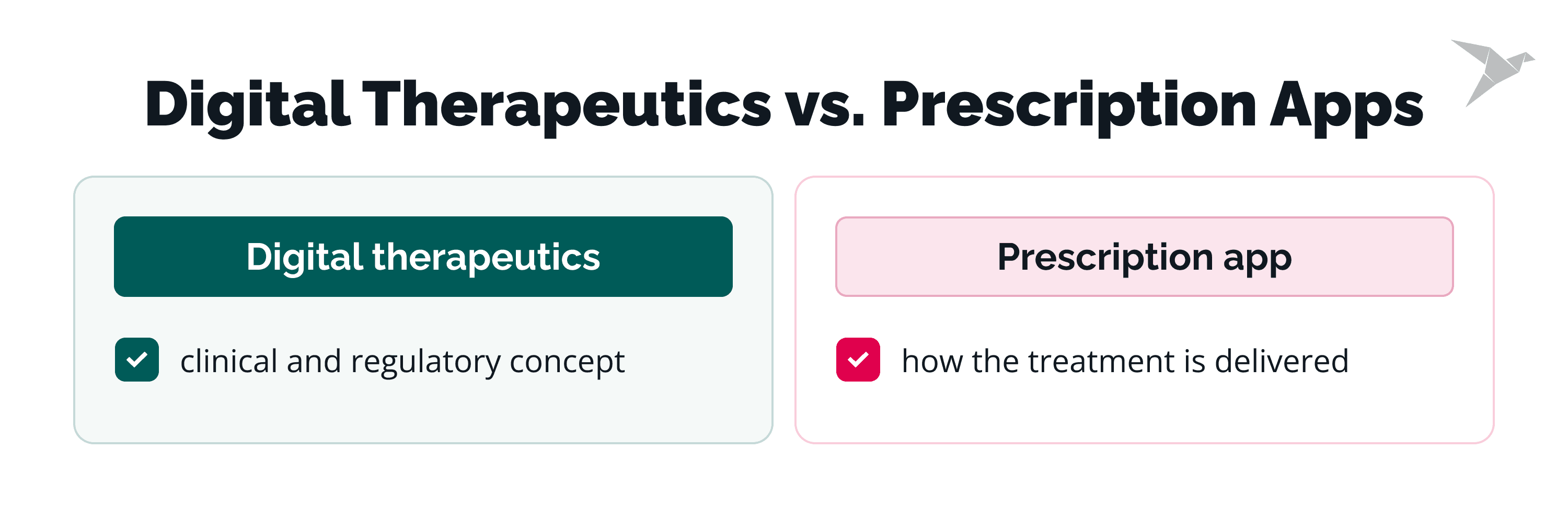
In everyday use, the terms often refer to the same type of product. Digital therapeutics describes the clinical and regulatory concept, while a prescription app focuses on how the treatment is delivered. In both cases, the software acts as a medical treatment, not a general wellness or lifestyle application.
How do digital therapeutics and prescription apps work?
These solutions use evidence-based methods, such as cognitive behavioral therapy, medication adherence support, or symptom monitoring, delivered through software. Clinical validation is a core requirement to develop a prescription application, ensuring patient safety and regulatory readiness. Outcomes are measured, monitored, and documented in a way that supports regulatory review and clinical use.
Most prescription apps operate within a defined treatment pathway. A clinician prescribes the software, the patient uses it under guidance, and the data generated can inform follow-up care alongside prescribed medications.
How are they different from health and wellness apps?
Digital therapeutics and prescription apps differ from wellness apps in three key ways:
- Clinical purpose: They address a diagnosed condition, not general well-being.
- Regulatory oversight: They are reviewed and approved by health authorities, similar to other forms of electronic prescription software.
- Clinical evidence: Their effectiveness is supported by clinical studies or trials.
Wellness apps may track habits or provide education, but they do not replace or deliver medical treatment.
How do they fit into the healthcare ecosystem?
Digital pharmacy services are becoming part of everyday care. Patients, clinicians, and multiple pharmacies now use digital channels to manage prescriptions, track treatments, and stay connected between visits. This shift explains the steady growth of e-pharmacy platforms and pharmacy apps worldwide.
Current projections estimate the e-pharmacy segment will reach $130.46 billion by 2029, with a 7.64% CAGR. Pharmacy apps follow a similar pattern, growing from $50 billion in 2018 to an expected $178 billion by 2026.
Within this landscape, digital therapeutics and prescription apps complement traditional care. They are used alongside medications, therapy, and medical devices, not as replacements. Clinicians prescribe them, patients follow them as part of treatment, and health systems monitor outcomes.
At a practical level, these solutions depend on smooth integration with electronic health records, clear prescribing and onboarding workflows, and compliance with medical and data protection rules. For development teams, this means treating clinical needs, compliance with medical regulations, and patient data protection rules, and day-to-day healthcare operations as core design inputs from the very beginning.

We are here to make it real

What Are the Key Features and Benefits of Digital Therapeutics and Prescription Apps?
Digital therapeutics and prescription apps support clinical treatment through regulated software. Their features are designed to improve medication management, reduce clinical risk, and fit into existing care workflows.
What core features do digital therapeutics and prescription apps include?
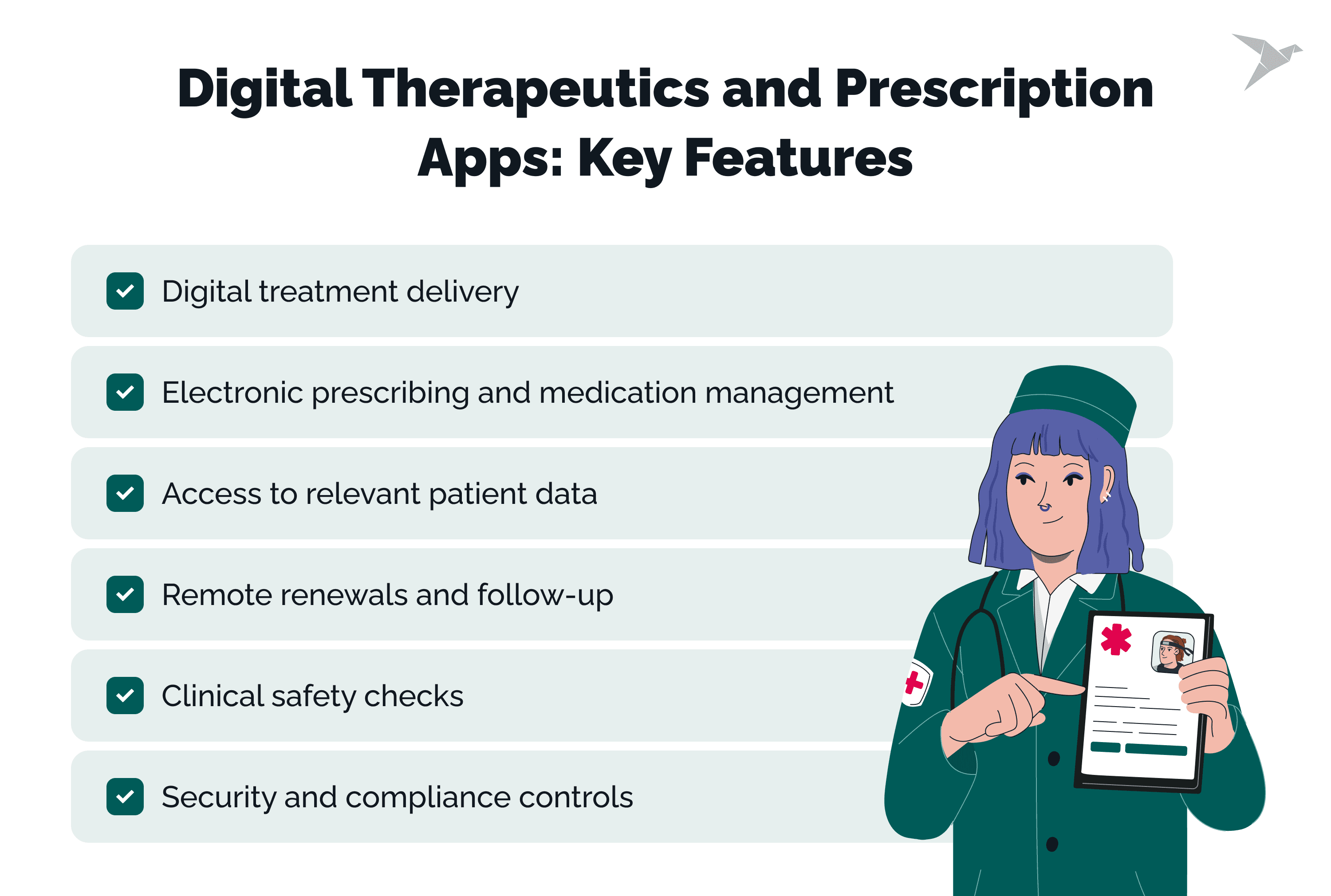
Here is the list of the main features we developed in our practise.
Digital treatment delivery
Digital therapeutics deliver treatment through software in a structured and repeatable way. Instead of relying on written instructions or occasional sessions, patients receive guided interventions that follow a clear clinical logic. This matters because consistent treatment improves outcomes, especially for chronic conditions where care continues between visits.
Electronic prescribing and medication management
E-prescribing lets clinicians create and send prescriptions digitally, without paper or manual steps. This reduces common errors linked to handwritten prescriptions and missing information. In the United States, medication errors affect millions of patients each year, and removing paper from the process helps lower that risk.
Access to relevant patient data
When clinicians can see medication history, allergies, and other key details at the point of prescribing, decisions become safer and more informed. Missing or incomplete information increases the chance of adverse drug events, especially for patients taking multiple medications. Easy access to the right data helps prevent avoidable mistakes.
At the same time, systems must limit unnecessary exposure to protect user data.
Clinical safety checks
Safety checks alert clinicians to possible drug interactions, duplicate treatments, or contraindications before a prescription is finalized. These checks act as a second layer of review and help catch risks that may be hard to spot during a busy clinical day. Many medication-related hospitalizations are preventable, and early warnings play an important role in reducing them.
Remote renewals and follow-up
Remote renewals allow patients to continue prescribed treatments without unnecessary in-person visits, when it is clinically appropriate. This supports continuity of care and reduces missed refills. Since about half of patients with chronic conditions struggle with long-term adherence, removing access barriers can make a meaningful difference.
Security and compliance controls
Digital therapeutics and prescription apps include safeguards to protect patient data, such as access controls, encryption, and activity logs. Healthcare data is highly sensitive, and breaches can lead to serious legal and operational consequences. Strong security supports patient trust and is essential for long-term use in clinical care.
How do these features reduce medication errors?
By replacing handwritten or disconnected workflows, prescription apps reduce common sources of prescribing errors. Automated validation checks help detect issues early, before prescriptions are dispensed or therapies are continued incorrectly.
These safeguards support the prevention of avoidable medication errors and contribute to safer treatment pathways, especially for patients using multiple therapies.
How do they benefit healthcare providers and patients?
For healthcare providers, digital therapeutics and prescription apps streamline prescribing and monitoring workflows. Automation reduces administrative tasks and improves the flow of clinical information across care teams.
For patients, these tools improve access, clarity, and continuity of care. Prescriptions and digital treatments are easier to manage, renew, and follow over time, supporting better adherence and more consistent clinical outcomes.
How do these features reduce medication errors?
By replacing handwritten or disconnected workflows, prescription apps reduce common sources of prescribing errors. Automated validation checks help detect issues early, before prescriptions are dispensed or therapies are continued incorrectly.
Electronic prescribing systems and their advanced features must also comply with regulations for controlled substances, such as the U.S. SUPPORT Act and state-specific mandates, to help prevent misuse and enhance patient safety.
These safeguards support the prevention of avoidable medication errors and contribute to safer treatment pathways, especially for patients using multiple therapies.
How do they benefit healthcare providers and patients?
For healthcare providers, digital therapeutics and prescription apps streamline prescribing and monitoring workflows. Collaboration with healthcare professionals is essential to enhance the credibility and effectiveness of these apps, ensuring that clinical expertise is integrated into digital solutions. Automation reduces administrative tasks and improves the flow of clinical information across care teams.
For patients, these tools improve access, clarity, and continuity of care. Prescriptions and digital treatments are easier to manage, renew, and follow over time. It supports better adherence and more consistent clinical outcomes while safeguarding patient data.
HIPAA-compliant portal for secure medical data records and exchange

How to Build Digital Therapeutics and Prescription Apps?
We know from our own experience that developing such apps requires a structured process that combines clinical evidence, user-centered design, regulatory compliance, technical integration, and, in the case of online pharmacy app development, a focus on secure, user-friendly solutions that meet modern healthcare demands. Each step affects whether the product can be prescribed, adopted by patients, and used safely in clinical care.
Here is the best roadmap from our perspective.
Identify the medical need
The process starts with a clearly defined medical problem that can be addressed through software. This need should be grounded in clinical practice, supported by evidence, and aligned with an unmet gap in care.
Clinical experts typically define the condition, target population, and expected outcomes. This step clarifies whether the solution qualifies as a digital therapeutic and shapes early decisions about scope, validation, and regulatory classification. Without a validated medical use case, it is not possible to determine how to develop prescription app solutions that meet clinical standards.
Online pharmacy app development allows users to manage prescriptions, order medications, and have them delivered to their doorstep.
Design for patient engagement
Patient engagement is addressed through usability, accessibility, and relevance to the treatment context. UX design decisions focus on helping patients follow prescribed interventions, understand their progress, and use the app consistently over time.
This includes clear language, simple navigation, and interaction patterns that match patient capabilities and health conditions. Engagement features must support treatment goals rather than distract from them, as clinical effectiveness depends on sustained and correct use.
Compliance and regulatory requirements
Digital therapeutics and prescription apps are subject to healthcare and medical device regulations in many regions. Compliance requirements influence product architecture, documentation, data handling, and validation methods.
Regulatory planning typically covers clinical evidence generation, risk management, data protection, and post-market monitoring. These requirements should be addressed early, as they affect timelines and development priorities. Understanding how to develop digital prescription apps includes mapping regulatory expectations to technical and clinical workflows from the start.
These standards are often applied together rather than in isolation. For example, software lifecycle controls under IEC 62304 are typically implemented alongside quality management requirements from ISO 13485 and risk controls from ISO 14971.
For teams planning how to develop digital prescription apps, aligning regulatory expectations with technical and clinical workflows from the outset helps ensure the product can be validated, prescribed, and maintained in real-world healthcare settings.
Integrate with other healthcare systems
Integration helps digital therapeutics and prescription apps work as part of everyday care. Most solutions connect with electronic health records, e-prescribing systems, telemedicine platforms, and clinician dashboards.
When telemedicine is linked with e-prescribing, clinicians can issue prescriptions during a remote visit. Patients then access their prescriptions in a secure area of their telehealth account, without repeating information or switching tools.
EHR integration gives clinicians a full view of medication history, allergies, and potential interactions. This reduces prescribing errors and supports safer decisions. For providers, automated e-prescribing simplifies workflows and saves time. For patients, features like refill tracking and reminders support medication adherence.
From a technical standpoint, integrations must follow interoperability standards, protect patient data, and fit smoothly into existing clinical workflows.
Testing and clinical validation
We will discuss this step in more detail later, but for now, in our practice, testing ensures the app works safely, reliably, and as intended in real clinical use. This includes functional testing, usability testing with patients and clinicians, and validation against clinical requirements.
Clinical validation, on the other hand, focuses on whether the software delivers the expected health outcomes. Depending on the product and region, this may involve pilot studies, real-world evidence collection, or formal clinical trials.
Testing also supports regulatory compliance. Evidence from verification and validation activities is used to demonstrate safety, effectiveness, and risk control. Without structured testing, it is difficult to support regulatory review or long-term use in clinical care.
The development process for an online pharmacy app includes market research, feature planning, UI/UX design, and compliance checks.
How to Validate Digital Therapeutics and Prescription Apps?
Validation is where digital therapeutics and prescription apps either earn clinical trust or fail to move forward. This is a critical process as it confirms that the product is safe, effective, and ready for use in real healthcare settings. It combines clinical evidence, real user input, and regulatory review into a single, structured process.
Clinical trials and efficacy testing
Validation starts with proving that the software delivers measurable clinical outcomes, particularly when the software supports treatment decisions involving prescription drugs. Depending on the risk class and intended use, this may involve pilot studies, real-world evidence collection, or formal clinical trials.
In our work, early feasibility studies help confirm assumptions before larger trials begin. These studies focus on treatment effectiveness, patient adherence, and potential risks. The results shape both product refinement and regulatory strategy.
Gathering user feedback
User feedback plays a practical role in validation. Patients and clinicians help confirm that the app is usable, understandable, and suitable for daily clinical use. A user-friendly interface is essential to ensure the app is accessible and easy to navigate for both patients and clinicians, making it more likely to be adopted and effectively used in real-world settings.
We typically gather feedback through usability testing, monitored deployments, and structured interviews. This input often reveals workflow issues that, if unaddressed, could increase the risk of medical errors in daily clinical use. Addressing these findings helps refine the product and improve patient outcomes over time.
Regulatory approval
Regulatory approval confirms that the product meets safety, quality, and evidence requirements. As healthcare technology rapidly evolves, regulatory approval processes must keep pace with these advancements to ensure new digital therapeutics solutions are integrated safely and effectively. This step brings together clinical data, risk management, software documentation, and post-market plans.
Based on our experience working alongside clinicians, regulators, and healthcare IT companies, preparing for regulatory review early reduces delays and rework. Clear documentation, traceable requirements, and validated testing results help ensure that digital therapeutics apps can be prescribed, maintained, and scaled within healthcare systems.
a Care home management app for E-type Care
What Are the Challenges in Building Digital Therapeutics and Prescription Apps?
Building and validating digital therapeutics and prescription apps involves more than software development. Successful solutions often focus on only what is necessary for medication management or clinical workflows, avoiding unnecessary complexity and streamlining user experience. From our experience, the main challenges sit at the intersection of regulation, clinical practice, technology, and patient behavior.
Regulatory hurdles
Regulation is one of the biggest challenges. Regulatory requirements vary by region and often evolve over time. Teams must determine whether the product qualifies as a medical device, define its risk class, and align development with applicable standards.
This is especially true for digital therapeutics software and e-prescribing software development, where building secure, compliant, and integrated solutions is critical. Delays often occur when regulatory planning starts too late or is disconnected from product design.
Regulators are working to keep frameworks consistent and up to date. At the same time, enforcement is tightening: under the European Union’s GDPR, fines can reach up to €20 million or 4 % of a company’s global turnover, whichever is higher, for serious data protection breaches. In the United States, healthcare organizations have faced multi-million-dollar penalties under HIPAA for improper handling of protected health information.
For development teams, this means navigating changing rules, different regional requirements, and detailed documentation expectations. When a regulatory strategy is not defined early, it often leads to delays, rework, or expensive compliance gaps. So, in our healthcare app development services, we pay special attention to this matter.

Data privacy and security concerns
Digital therapeutics and e-prescription apps handle highly sensitive health data. As more products enter the market, the number of systems processing patient information continues to rise. Ensuring data privacy and security across various mobile devices, such as smartphones and tablets, is crucial to protect user information and maintain trust.
Compliance with data protection laws and security standards affects system design, access controls, and infrastructure choices. Any weakness in this area can slow approval and reduce trust from both clinicians and patients. These requirements also directly influence access controls, infrastructure, and long-term data storage strategies
Integration with existing healthcare systems
Prescription apps must work with electronic health records, e-prescribing systems, and telemedicine platforms. Integration is challenging when systems use different standards or workflows. Poor interoperability can disrupt clinical workflows and slow prescription fulfillment across connected systems.
Patient engagement and adherence
Clinical outcomes depend on consistent use. Yet adherence remains a known challenge in healthcare. According to the World Health Organization, only about 50% of patients with chronic conditions follow prescribed treatments as intended, even outside digital settings.
Drop-off is also common in digital health. Studies show that more than 70% of health app users stop using an app within the first 30 days. For digital therapeutics and prescription apps, this risk is often higher. Patients may stop using an app due to unclear instructions, poor accessibility, or a lack of perceived value over time.
Designing for people with different health conditions, abilities, and levels of digital literacy requires careful UX decisions. Low engagement or poor adherence can undermine even clinically sound solutions. From our experience, usability testing, clear onboarding, and ongoing feedback loops are essential to support long-term use and meaningful clinical outcomes.

Clinical validation and efficacy testing
Proving clinical value takes time and resources. Clinical studies must be well-designed, ethically approved, and properly documented to support regulatory and clinical use.
Industry data shows that clinical validation is one of the most time- and cost-intensive phases of digital therapeutics development. Depending on study design and risk class, validation can take 12 to 36 months and account for a significant share of total product investment. Many digital health products fail to progress beyond pilots because evidence is insufficient for regulators, clinicians, or payers.
Inadequate validation can limit prescribing, delay regulatory approval, or block reimbursement. From our experience, aligning study design, product functionality, and regulatory expectations early helps avoid repeating trials or collecting evidence that cannot be reused across markets.
Reimbursement and insurance coverage
In practice, only a limited number of digital therapeutics achieve reimbursement. For example, in Germany’s DiGA program, one of the most structured reimbursement pathways for digital health, only a few dozen applications have been approved, despite hundreds of products entering the market. In other regions, reimbursement decisions are often handled case by case, with no formal pathway at all.
This uncertainty affects long-term sustainability and influences how to develop prescription apps for healthcare that can be realistically adopted in clinical practice. Without predictable reimbursement, providers may hesitate to prescribe, and developers may find it difficult to scale beyond pilot programs or funded trials.
Final Thoughts: Future Overlook
Digital therapeutics and e-prescription software development have moved from early experimentation to everyday clinical use. One clear takeaway is that these products succeed when they are treated as medical interventions from the start. A successful pharmacy app must function as a clinical tool, not just a digital user interface.
Clinical alignment, regulatory planning, system integration, and ongoing validation are not separate steps. They shape the product together and determine whether it can be prescribed, trusted, and sustained in real-world care.
Digital health is evolving quickly, bringing both opportunity and added complexity. As online pharmacy apps and e-prescription systems become standard, they must do more than process prescriptions. They need to integrate with EMRs and electronic medical records, reduce errors, and stay easy to use.
Data security is central to the adoption of electronic prescriptions in the healthcare industry. Protecting patient data through encryption, secure storage, and strong two-factor authentication is how trust is built and maintained.
The growing e-prescribing market also raises expectations for functionality. Features like medication reminders, push notifications, prescription refills, and insurance support help patients stay on track and simplify everyday care.
In short, modern pharmacy app development requires a careful balance of security, usability, and compliance. When done right, it streamlines prescription management and supports better patient outcomes in an increasingly digital healthcare system.
Where digital therapeutics and prescription apps are headed
The next phase of growth will be shaped by technology, regulation, and payer expectations. Artificial Intelligence is already being used to personalize treatments, support clinical decisions, and detect risks earlier in the care process.
At the same time, regulators are increasing oversight. Both the FDA and European authorities are introducing more detailed guidance for AI-based medical software, with a strong focus on transparency, explainability, and continuous performance monitoring. A successful online pharmacy app integrates seamlessly with EMRs while remaining intuitive for patients.
Another important shift is the growing emphasis on real-world evidence. Regulators and payers are looking beyond clinical trials to understand how digital therapeutics perform once they are prescribed at scale. This makes post-market monitoring, outcome tracking, and data quality essential parts of product design. As online pharmacy services become standard, expectations for reliability and compliance continue to rise.
Regulatory frameworks themselves are also evolving. Upcoming initiatives, such as the EU AI Act, are expected to place additional requirements on high-risk healthcare software, particularly where automated decision-making affects patient care. These changes will likely increase development effort but also bring more clarity to expectations over time.
What this means in practice
Reimbursement remains uneven, but progress is visible. Early national programs show that coverage is possible when clinical benefit and safety are clearly demonstrated. As more evidence becomes available, reimbursement models are expected to mature, especially for solutions that show measurable impact on outcomes and care efficiency.
From our experience, the most resilient digital therapeutics and prescription apps are built with long-term use in mind. They are designed to adapt to regulatory change, support continuous validation, and integrate smoothly into clinical workflows. As AI and regulation continue to evolve together, teams that plan for both early will be better positioned to deliver solutions that last in real clinical practice.
We are here for you

FAQ

Digital therapeutics are designed to treat or manage a medical condition and are used as part of clinical care. They are part of a global e-prescribing market and are created based on clinical evidence and follow medical device regulations. Regular mobile health apps focus on wellness or education and do not provide treatment or require regulatory approval or health insurance portability.
In the United States, many digital therapeutics are regulated as Software as a Medical Device (SaMD) and require FDA review before they can be prescribed. The exact pathway depends on the intended use, risk level, healthcare delivery, insurance providers, and clinical claims. Some products may qualify for clearance, while others require more extensive review.
They support long-term care by delivering structured interventions, monitoring symptoms, and helping patients follow treatment plans between clinical visits. This is especially important for chronic conditions, where consistent daily management has a direct impact on outcomes.
Costs vary widely based on clinical scope, app complexity and essential features, regulatory requirements, and validation strategy. Development typically includes product design, software development, clinical studies, regulatory preparation, and post-market monitoring. Understanding how to create digital therapeutics app solutions early helps teams plan budgets and timelines more realistically.