
 Software Development
 Security Services
 Cloud Services
 AI Services
 Other Services















 TechMagic Academy




In FinTech, bank-grade security scrutiny starts years before a company would normally hire a full-time CISO. A sponsor bank sends a 200-question review while an enterprise prospect freezes a deal pending SOC 2, and an investor wants to know who owns risk. All of it lands while your security team is one engineer who also owns the deploy pipeline.
That gap is what a FinTech virtual CISO is built to close. You get senior security leadership on a fractional basis, from someone who has already sat through a bank-grade review. The job is to keep deals and funding moving while the scrutiny gets heavier.
In our new article, we cover what a FinTech vCISO is, why financial products need a specialist, when to hire, what drives the cost, and how a real engagement runs.
Key Takeaways
- A FinTech vCISO is an outsourced senior security leader who runs your security program part-time/on-demand, with hands-on experience of financial-services regulation, banking-partner reviews, and payment data.
- A vCISO gives you leadership and accountability. A managed security service provider gives you tools and monitoring. Buying one when you needed the other is the costliest mistake in this category.
- Most FinTechs hire at a trigger rather than on a schedule. The usual ones are a banking-partner questionnaire, a first SOC 2 or PCI DSS demand, a funding round, or a deal stuck in vendor review.
- The FinTech framework set is SOC 2 Type II, PCI DSS, and ISO 27001, plus GLBA and NYDFS Part 500, with GDPR wherever EU personal data is in scope.
- You pay a monthly fee sized to your stage, so it sits in the budget like any other running cost instead of a full executive salary.
What Is a FinTech Virtual CISO (vCISO)?
A FinTech virtual CISO is an outsourced senior security leader who runs your information security program part-time, with specific experience in financial-services regulation. It covers strategy, governance, compliance, and board reporting, without a full-time executive on payroll.
How a vCISO differs from a full-time CISO
The difference is time, cost structure, and scope; the seniority is the same. A vCISO works across a client portfolio on a fractional basis, so you get the same strategic leadership a full-time hire brings, sized to your stage.
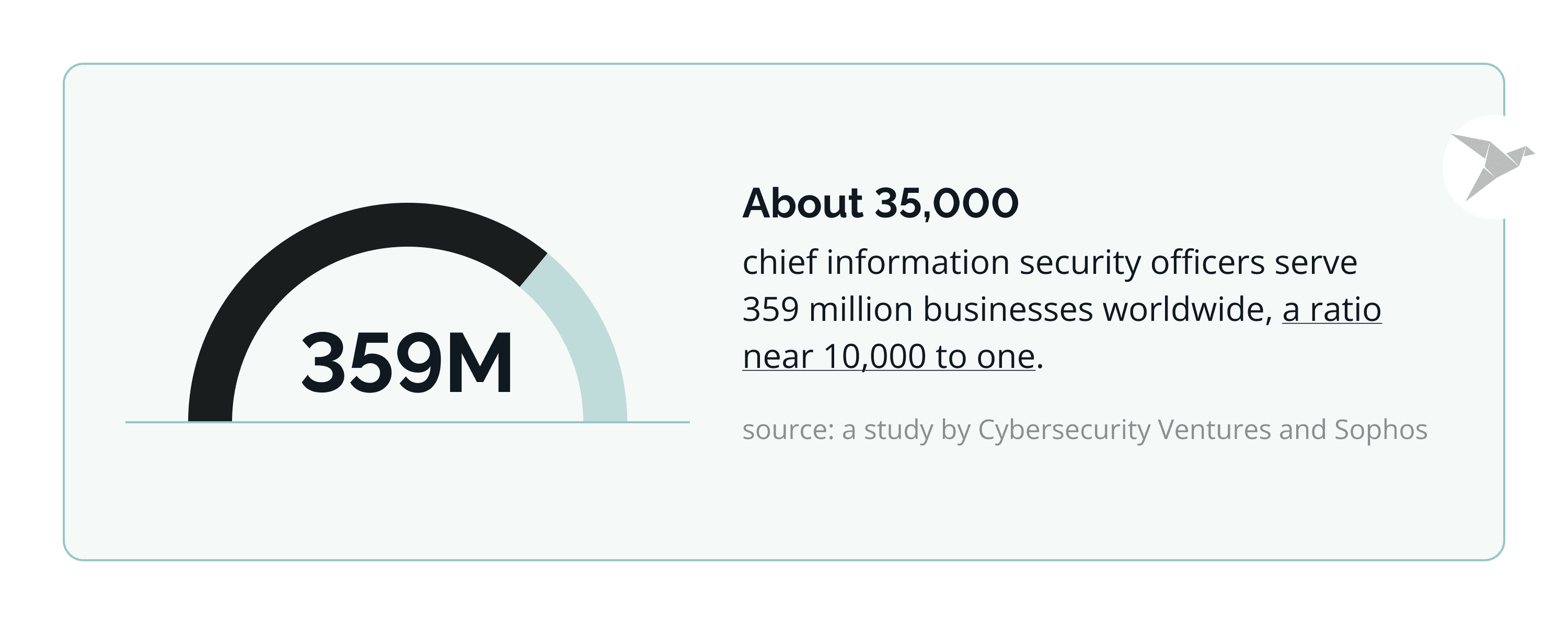
Supply explains the appeal. About 35,000 chief information security officers serve 359 million businesses worldwide, a ratio near 10,000 to one, according to Cybersecurity Ventures and Sophos.
A vCISO you can start in two weeks is worth more than the perfect hire who lands in six months.
vCISO vs. fractional CISO vs. an MSSP
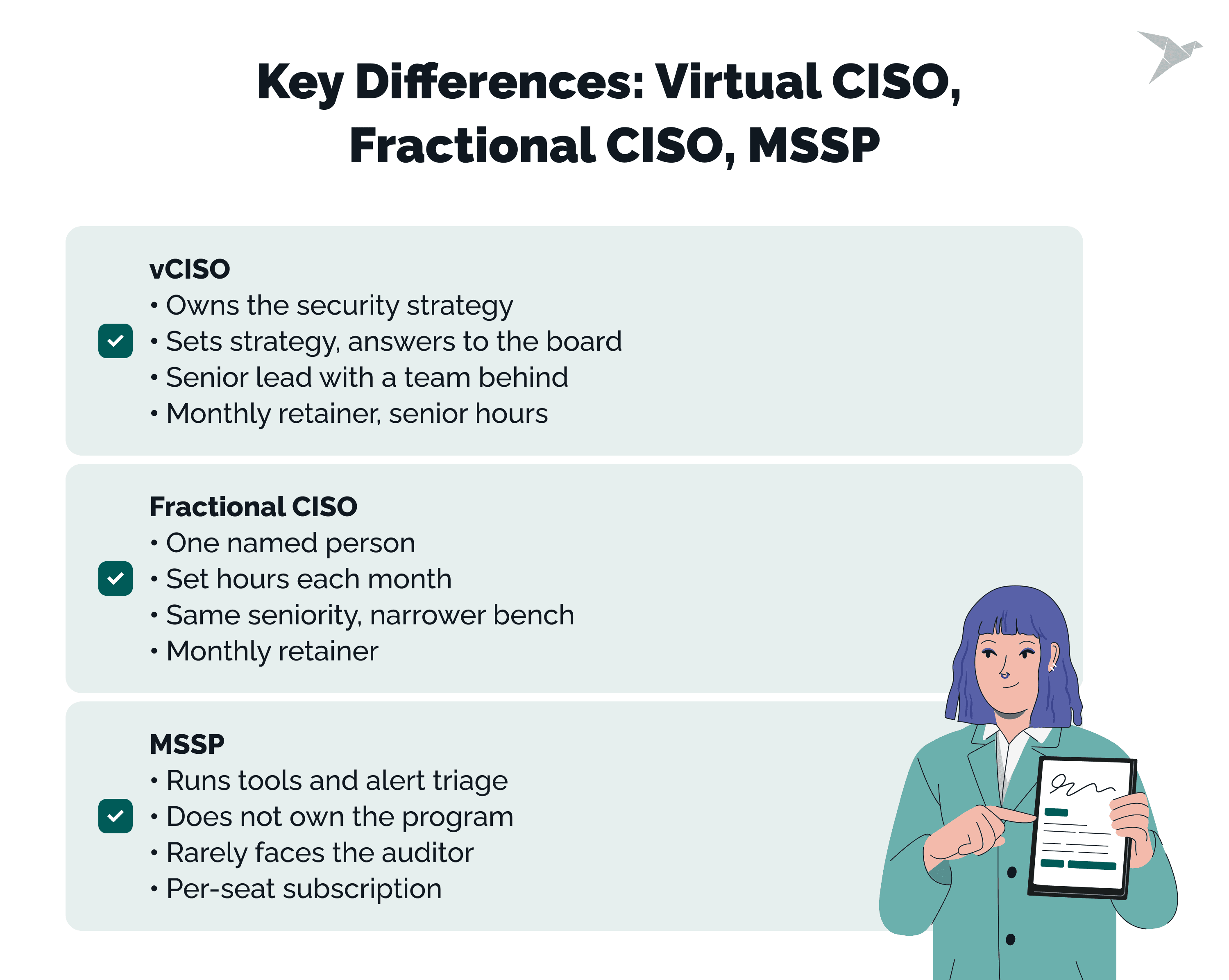
Virtual CISO services are known as CISO as a service, and those two labels do mean the same thing. Most providers use fractional CISO interchangeably as well, though some reserve it for one named person on set hours, while a vCISO may arrive as a service with a team behind the lead.
An MSSP, or managed security service provider, is a different purchase: it runs tools and triage, while a vCISO sets the security strategy and answers for it to your board.
An MSSP will monitor an environment with no risk register and no owner for the SOC 2 evidence, so dashboards look healthy while the program does not exist.
Why Do FinTech Companies Need a Virtual CISO Specifically?
Because a virtual CISO in FinTech carries a compliance load general SaaS never faces. Let's look at each pressure in detail.
FinTechs are high-value targets for data and money
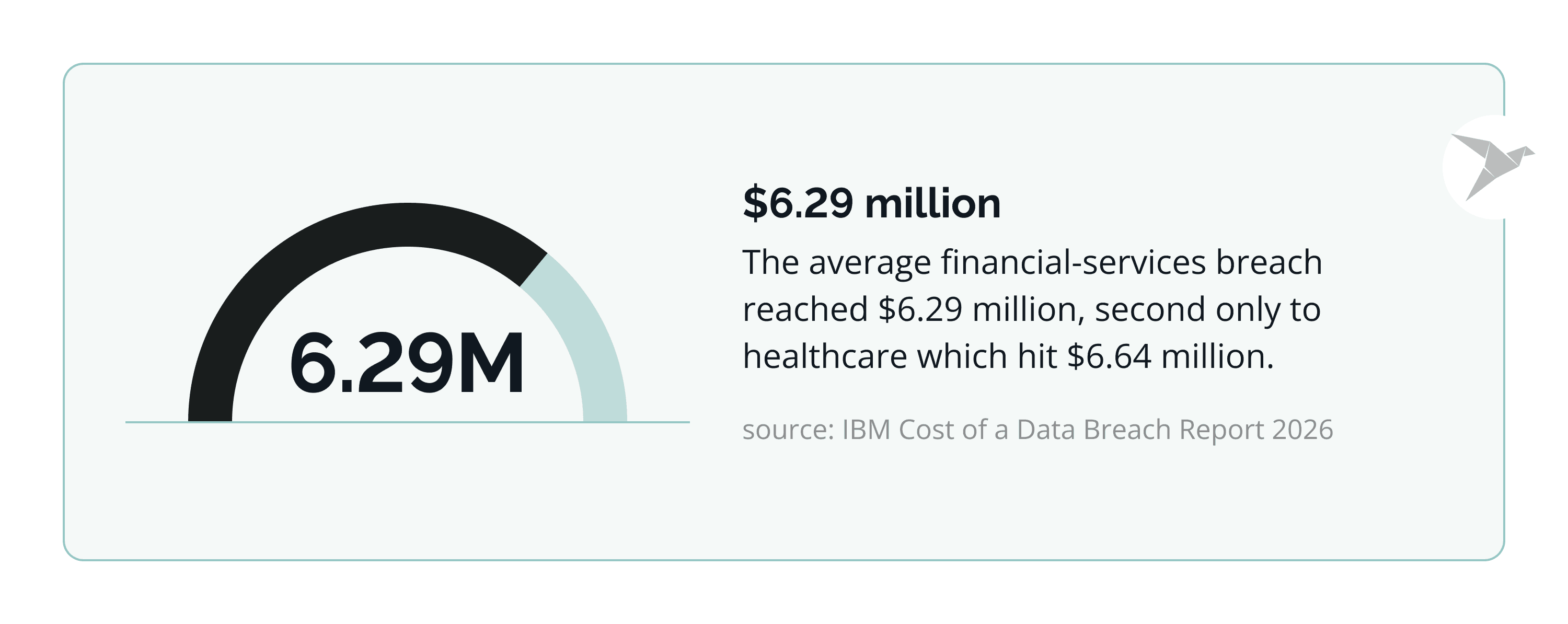
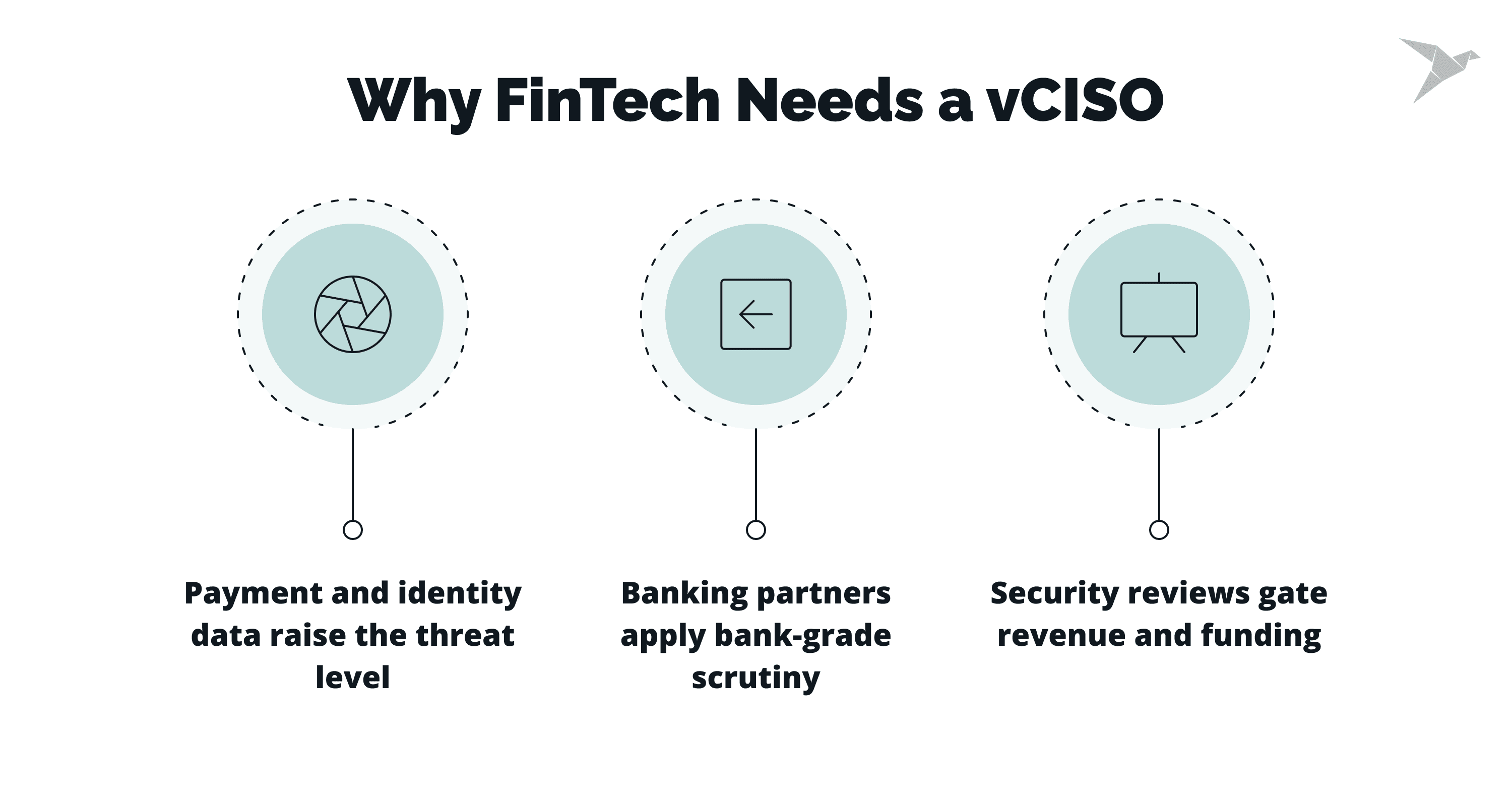
Identity data, account numbers, and transaction access sit in one place. This makes financial products priority targets for ransomware crews, fraud rings, and nation-state actors. In its Cost of a Data Breach Report 2026, IBM puts the average financial-services breach at $6.29 million, second only to healthcare at $6.64 million. Data breaches here trigger regulator notification and banking-partner escalation at once, and the cyber threats behind them are ordinary digital threats aimed at a rich target.
Banking-partner and sponsor-bank due diligence
Most FinTechs depend on a sponsor bank or banking-as-a-service provider, and that carries bank-grade due diligence: long, evidence-heavy, annual. Someone who has been through those reviews knows which answers get challenged; a first-timer can be correct and still fail. The evidence pack almost always includes a current third-party test report, which makes FinTech penetration testing one of the first artifacts to line up.
Investor diligence and enterprise security reviews
Investors ask security questions with real teeth now, and a weak answer affects the valuation. They want a named owner of risk, a documented cybersecurity program, and risk assessments on a cadence, so diligence stalls without a gap assessment.
Enterprise buyers apply the same pressure: a security questionnaire arrives, an engineer loses two weeks to it, the buyer asks about business continuity, and the deal slips. Your cyber insurer wants it too, since a tested incident response plan sits on the renewal form.

What Does a FinTech vCISO Actually Do?
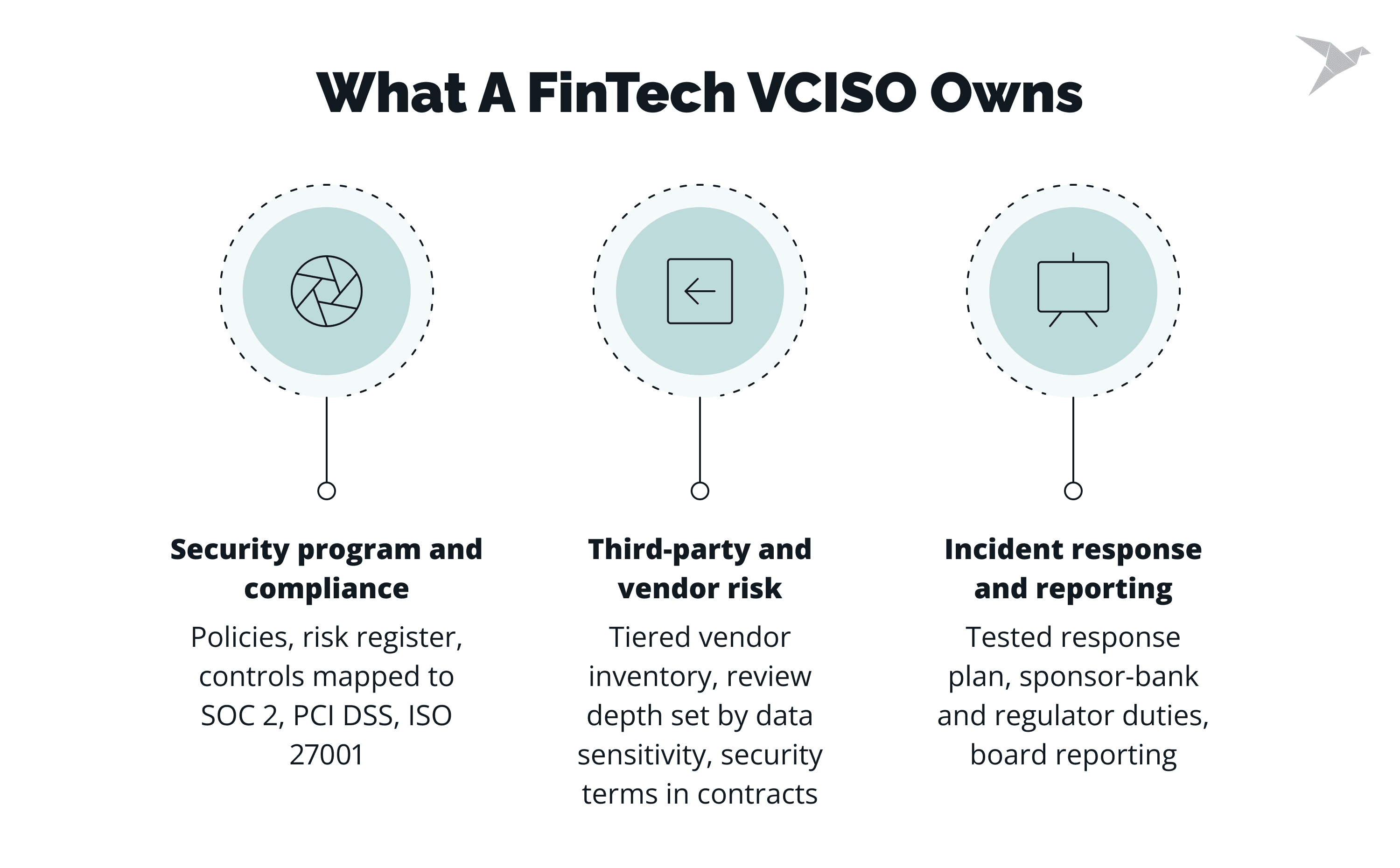
A FinTech vCISO owns the security program end-to-end, tuned to financial-services compliance requirements. When comparing vCISO engagements, ask whether the provider commits to outcomes or attendance. In practice, the work splits into three areas.
Builds the program and drives compliance
First, they build what an auditor will ask to see. A comprehensive cybersecurity strategy comes down to three artifacts: a policy set that matches how your engineers actually work, a risk register somebody reviews, and controls mapped to the framework you are certifying against.
Then, they keep it alive, running the risk management activities on a schedule so your cybersecurity posture holds steady between audits. That cadence is where many organizations slip: current until the certificate lands, then untouched for a year.
They also sequence frameworks so those do not collide. SOC 2 compliance requirements run to policies and a full audit period, while a PCI compliance checklist turns on where card data flows. On top of both sit the financial industry regulations: the Gramm-Leach-Bliley Act (GLBA), NYDFS Part 500, and GDPR.
A platform automates evidence collection, and it will not ensure compliance when the auditor asks for your exception log. The quieter part is security culture: making the secure path the easy one, and translating decisions out of technical jargon so whoever signs off understands the risk.
Manages third-party and vendor risk
A FinTech stack is mostly other people's software. Your card processor, know-your-customer (KYC) provider, analytics tool, and their subprocessors all sit inside your risk surface. So the vCISO keeps a tiered vendor inventory, sets review depth by the data each vendor touches, and writes security terms into the contracts.
The breach that hits you may never touch your systems. As TechCrunch reported, Marquis, an analytics vendor used by hundreds of banks, notified 672,075 people in March 2026 that names, bank account numbers, card numbers, and Social Security numbers had been stolen. None of those banks were breached directly.
Plans incident response and reports upward
They write the incident response plan, then rehearse it, because a plan nobody has tested is still just a document. FinTech versions need sector specifics: sponsor-bank notification timelines, regulator duties, card-brand obligations under PCI DSS, and a decision tree for freezing transactions.
The same person then explains it upward. Your board wants one honest read on your organization's security posture, and your executive team needs it in language it can act on.
That expectation comes from the world your partners live in. Deloitte notes banks in the USA filed a record 2.6 million suspicious activity reports last year, 7,100 a day, and your sponsor bank brings the same culture to every review.

When Should a Growing FinTech Hire a vCISO?
Hire when security demands outgrow your team but do not yet justify a full-time executive. Deciding to get serious about security rarely leads anywhere; the reliable trigger is an external event with a date. Here are the events that usually start the conversation, and how the role changes as you scale.
Trigger signals that usually prompt the hire
Most conversations about vCISO services start with one of these:
- A sponsor bank or banking-as-a-service partner sends a security questionnaire.
- An enterprise prospect makes SOC 2 Type II a condition of signature.
- Card volume grows until PCI DSS scope is unavoidable.
- Funding-round diligence asks who owns security risks.
- A near-miss incident or leaked credential exposes thin coverage.
- Security drifts between the CTO and whoever has time.
If two or more are true today, you are probably already late: hiring a vCISO takes weeks, and a stuck deal rarely waits.
Talk to our security team

What a vCISO focuses on at each stage
Match the engagement to your cybersecurity needs now, not the largest package. Growing organizations overspend on enterprise playbooks; mid market organizations underspend by running a seed-stage program too long.
At that stage the role includes succession, planning for the day you hire an in-house CISO.
How Much Does a FinTech vCISO Cost?
A FinTech vCISO is priced as a monthly retainer for agreed senior hours, so the vCISO cost scales with scope rather than headcount. Ranges move by region and provider, so confirm numbers in a scoping call.
Three things drive virtual CISO cost most:
- How many frameworks you certify against.
- How complex your architecture and vendor chain are.
- How much delivery you need.
The engagement is services-based, so a retainer can become a fixed fee on specific projects such as audit prep. vCISO pricing covers the models, including where a cost-effective solution stops being cost-effective. But here is also a quick look at the full-time CISO VS vCISO retainer cost:
The cost savings come from buying high level cybersecurity expertise on an as needed basis, not from paying a senior person less. A retainer too small to do the work is no saving; size it to your compliance calendar.
How Do You Choose the Right vCISO for Your FinTech?
Prioritize financial-services experience over generic credentials, because a strong CV from a bank does not transfer to a 60-person FinTech. vCISO providers range from solo consultants to large advisory arms, and screening them means asking for artifacts, as how to hire a vCISO sets out.
Must-have criteria
- Programs they carried to audit close, and how many of those clients renewed a year later. Logos prove they can sell; renewals prove the program held.
- Engagements where customer financial data or a live payment flow sat inside the assessment boundary, rather than a FinTech logo on a slide.
- Who writes the questionnaire answers. Ask to see a completed evidence package; if your engineers fill it in, you have bought a reviewer rather than an owner.
- SOC 2 Type II and ISO 27001 end to end, plus a straight answer on where they stop with PCI DSS. Anyone claiming every framework is selling.
- Certifications they hold themselves, alongside the ones they sell. A provider who has never been the auditee is guessing at your evidence timeline.
- Engineers to close the gaps they find. Advice without delivery capacity stalls at remediation, where your in-house teams absorb the work.
Red flags to watch for
Some patterns should make you pause:
- A product recommendation as the first deliverable instead of a security strategy or a risk register.
- Only general enterprise clients, no financial-sector work.
- A template program that ignores your organization's size and architecture.
- Slideware where artifacts belong. Ask to see a policy set, risk register, and evidence package.
- Enterprise playbooks such as threat hunting or a SOC build-out, draining security budgets on work you do not need yet.
How Does a FinTech Virtual CISO Engagement Work?
Engagements run in four phases, with the vCISO working inside your team instead of handing over a report and stepping back. The first 30 days set direction, and fixes start landing around month three.
- Assess. A gap assessment across your frameworks, data flows, cloud access, and vendors, ranked by the data each one touches.
- Roadmap. What "done" means for each framework, with owners, dates, and an order of play. Chasing PCI DSS and SOC 2 at once at Series A usually sinks both.
- Execute. Policies rolled out, controls built with your engineers, evidence collected, and the vCISO on the auditor calls beside you.
- Oversee. Quarterly risk reviews, vendor reassessments, board reporting, and tracking the latest cybersecurity threats and industry trends.
In our experience the most common finding is a document describing a process nobody follows. That is why execution is the phase where expert guidance without engineers stalls.
Assess → Roadmap → Execute → Oversee
How TechMagic approaches FinTech virtual CISO work
We have a vCISO team with a FinTech background. We help growing financial companies pass banking-partner reviews, get through SOC 2 Type II and PCI DSS, and keep the program current once the certificate lands. Behind the leadership sits hands-on security engineering and DevSecOps, so findings get fixed instead of logged.
We own the program rather than advising on it. We define what "done" looks like for your compliance target, build a timeline that holds under auditor scrutiny, sit on the auditor calls beside you, and act as the senior security voice for board updates, investor diligence, and enterprise questionnaires. We stay until the audit closes, and usually through the next cycle.
Our cybersecurity expertise here is hands-on: penetration tests for Mamo, a FinTech company, an ISMS internal audit for Quizrr, and features for the Bamboo micro-investment app.

“TechMagic quickly became a reliable part of our team, helping us achieve ISO 27001 certification, prepare for SOC 2, run audits and penetration tests, harden our cloud, and share security incident stories that are much funnier when they happen to someone else.” – Yurii, Lead Engineer, Haiqu
The real test of an engagement is whether your second review goes faster than your first.
Read more about our
Final Thoughts: FinTech Security Leadership in 2026 and Next
A vCISO for FinTech engagement buys accountability. Frameworks and tooling are commodities; what stays scarce is a senior person who owns the outcome in front of a bank, a board, and an auditor.
Where to expect in the future?
- Artificial Intelligence governance is turning into a hard compliance requirement. Gartner predicts that through 2027, manual Artificial Intelligence compliance will expose 75% of regulated organizations to fines above 5% of global revenue.
- Shadow AI is the next thing your sponsor bank will ask about. In a Gartner survey of 175 employees, 57% said they use personal generative Artificial Intelligence accounts for work and 33% admitted entering sensitive information into unapproved tools. At a FinTech that is customer financial data leaving through a browser tab, and once AI agents call APIs and move money, the unique challenges of scoping an agent's spending limit land on whoever owns risk.
- Scale keeps raising the stakes. Statista projects digital payments transaction value to reach $37.45 trillion in 2026, and mid-sized organizations feel it first, because volume outgrows headcount.
One person who owns the program beats a bigger team. Work your limited resources in a clear order, be honest about the resource constraints, and focus on mitigating cyber risks that reach your money.
FAQ

A FinTech virtual CISO is an outsourced senior chief information security officer who runs a financial technology company's security and compliance program part-time. The role brings financial-services regulatory experience plus frameworks such as SOC 2 and the Payment Card Industry Data Security Standard (PCI DSS).
A FinTech vCISO is priced as a monthly retainer for agreed senior hours, a fraction of a full-time chief information security officer once bonus, equity, benefits, and recruiting fees are counted. TechMagic recommends confirming current pricing during scoping.
A FinTech startup should hire a virtual chief information security officer when security demands outgrow the engineering team but do not yet justify a full-time executive. Common triggers are a sponsor-bank questionnaire, a first SOC 2 Type II or PCI DSS requirement, or funding-round diligence.
A FinTech virtual chief information security officer typically covers SOC 2 Type II, the Payment Card Industry Data Security Standard (PCI DSS), and ISO 27001, plus the Gramm-Leach-Bliley Act (GLBA), New York Department of Financial Services (NYDFS) Part 500, and the General Data Protection Regulation (GDPR). Sequencing them is core to the job.
A virtual chief information security officer with financial-services experience is specifically useful for banking-partner due diligence. The vCISO owns the questionnaire responses, assembles evidence a bank's risk team accepts, and closes the gaps it surfaces.
A virtual chief information security officer provides security leadership, strategy, and accountability, while a managed security service provider (MSSP) operates tools, monitoring, and alert triage. Growing FinTechs need leadership first, because monitoring an unmanaged program yields clean dashboards and unresolved risk.
