














Medplum Explained for Founders: What It Solves, What It Costs, and What to Ask a Dev Partner
Last updated:31 July 2026



Every healthcare product rests on one early decision: where its clinical data lives. Get that foundation wrong, and the bill arrives later as a stalled launch, a failed audit, or a rebuild that swallows a funding round. The hard part is that this call often lands on a founder who is not an engineer, at the very moment there is no time to become one.
Medplum is the shortcut through that problem: an open-source, FHIR-native backend that hands you a compliance-ready clinical foundation to build your product on. We have shipped it in production for healthcare clients, so we asked our Senior Business Analyst, Oleksandra Polotniuk, what she warns founders about first. Her answer is: “Assuming the clinical workflow instead of mapping it. The workflow is the foundation the whole system sits on; it dictates how the EHR has to behave.”
This is Medplum for founders in business terms rather than a tutorial, written for people who weigh cost, risk, and speed before architecture diagrams. In this Medplum for founders guide, we answer three questions in plain language: what Medplum solves, what it costs to build with it versus from scratch, and how to choose a partner who has run it in production.
Key takeaways
- Medplum is an open source developer platform for healthcare. It is a SOC 2 Type II-compliant, Fast Healthcare Interoperability Resources (FHIR)-native, headless electronic health record you build your product on top of.
- The benefits Medplum for founders come down to three things: you reach a compliant foundation faster, you carry less rebuild risk, and you get standards-based data interoperability from day one.
- Medplum rarely changes what your product costs. It changes what your foundation costs, by removing months of backend and compliance work.
- Building on Medplum does not make you HIPAA-compliant on its own. It helps you get HIPAA-ready, and formal certification comes from an accredited body.
- The single thing to check in a partner is real Medplum production experience. Documentation familiarity is not enough.
What Is Medplum, in Plain Terms?
Medplum is an open-source, FHIR-native, “headless” electronic health record: a compliance-ready backend for storing and exchanging clinical data, so you build your product on top instead of building the foundation yourself.
So what is Medplum for founders who are not engineers? It is the plumbing under a healthcare app, ready-made. The practical meaning of Medplum for founders is less about code and more about time and risk: you skip the part of the build that is slow to get right and dangerous to get wrong. As an open source developer platform, it gives you a working clinical data layer on day one instead of an empty database and a long list of compliance requirements.
Medplum gives you the backend and data layer, and you bring your own frontend. The company behind it is based in San Francisco, and because its source code is open source, you sidestep the vendor lock-in of a closed system and can self-host or use its hosted service. That gives you a solid foundation to build on. ONC certification, if the programs you sell into require it, stays a separate process that you own.
What Does Medplum Actually Solve for a Founder?
Medplum removes the need to build, secure, and maintain a compliant clinical data backend from scratch, which is the slowest, riskiest, and most expensive part of a healthtech build. Healthcare software development carries compliance weight from the first line of code, in a way ordinary web development does not, and that weight is where the critical challenges sit. Medplum absorbs most of that complexity so your team does not have to.
 The line items that shrink dramatically or disappear on Medplum are the foundational ones: the compliant data store, the audit trail, clinical note immutability and record-level permissions, resource versioning, and the clinical coding scaffolding for things like ICD-10 and CPT. On a scratch build, each of those is a project in itself.
Founders come to us wanting a product their clinicians and patients will actually use, without a two-year detour through infrastructure first. Patient engagement and patient communication are won in the product, and that is where the startups and healthcare providers we work with would rather spend their money. Building custom healthcare applications on top of Medplum still leaves you in full control, and it points your first year of engineering at better outcomes for patients instead of at plumbing.
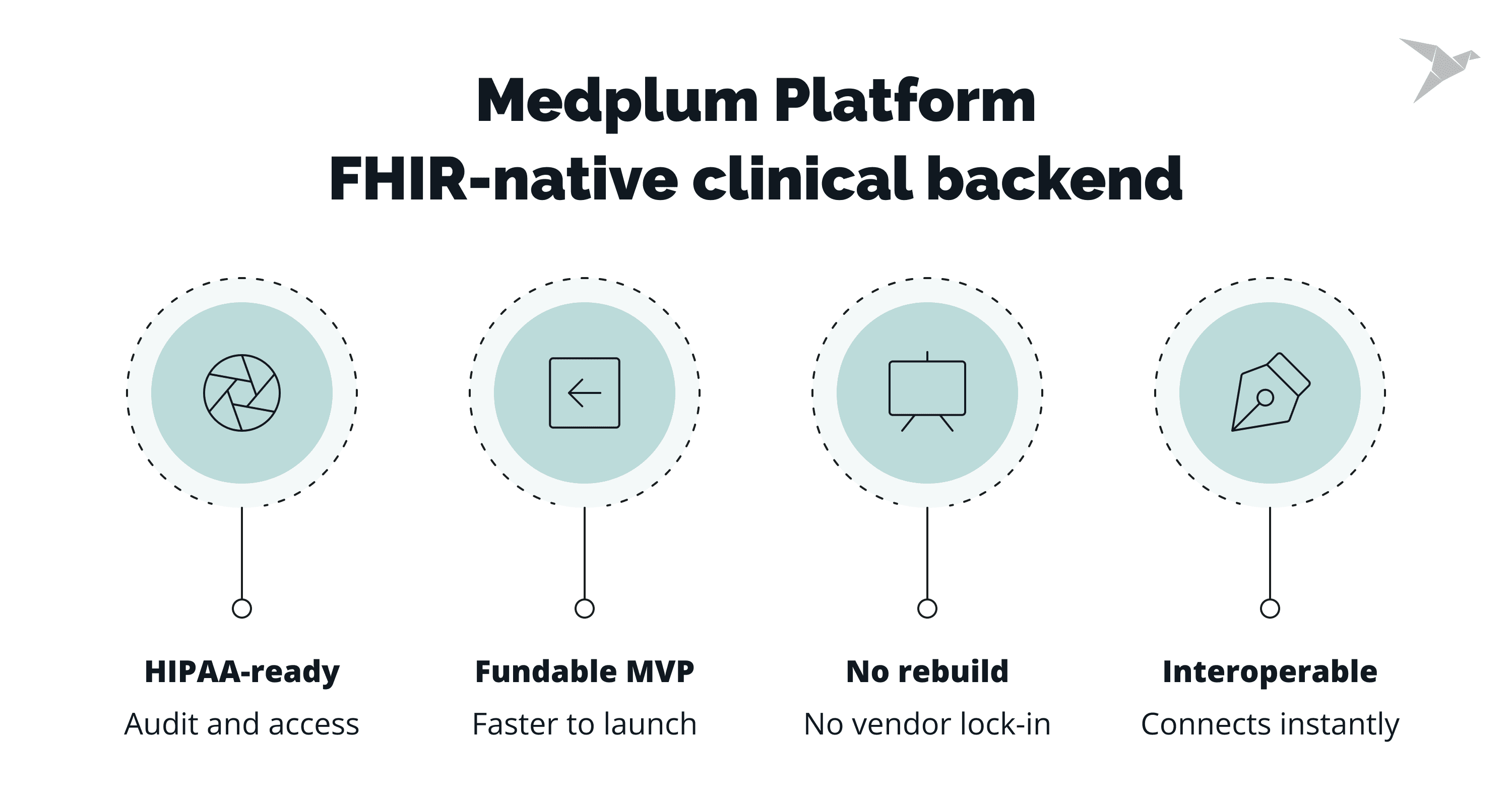
A HIPAA-ready foundation without a year of backend work
HIPAA (the Health Insurance Portability and Accountability Act) is the US law governing how health data is protected, and getting it wrong is costly. Healthcare has been the most expensive industry for data breaches for 14 years running, at an average of $7.42 million per breach in 2025, down from $9.77 million a year earlier, according to IBM’s Cost of a Data Breach report.
Medplum ships the building blocks that a HIPAA-ready system needs: an access-policy engine, audit events, and record-level permissions with secure authentication. You still run the compliance program around it, but you are not inventing the plumbing, which is one less place for an expensive mistake to hide.
Faster to a fundable MVP
A ready foundation means you reach a working product sooner, which matters when a launch or a demo day is on the calendar. Investors are still writing big checks in healthcare: among the new unicorns minted in the first half of 2026 was Forus, founded in 2023 to automate benefit verifications and appeal letters, now valuedat $1.01 billion. Getting to your initial customers and a growing customer base is what makes a build fundable, and that is far easier when your team can focus on product rather than infrastructure.
Less risk of an expensive rebuild later
For years, healthcare software development meant closed systems from a handful of major EHRs, where switching vendors meant a painful rewrite. Traditional EHRs still work that way, and a custom backend nobody documented carries the same risk from the other direction.
Because Medplum is standards-based, it scales without a rewrite, and you are not locked into one vendor's roadmap to get there. The days when a clinical product had to own every layer of its own stack ended a long time ago. Teams that later need custom EHRs or custom applications for a second product line start from the same foundation rather than a blank page, which is why we build most custom healthcare solutions this way now, and why the foundation still fits the future roadmap you have not written yet.
Standards-based interoperability from day one
Being FHIR-native means labs, other EHRs, and partners connect more cleanly, because everyone speaks the same data format. As Oleksandra explains, “Medplum is a FHIR-native platform: at its core it stores and serves standardized clinical data on FHIR R4, which is what makes the interoperability they want achievable."
Standardized data is what lets us integrate cleanly with other health-tech systems." In practice that built in interoperability is there on day one, across different systems, instead of being retrofitted the week a hospital asks you to connect to their healthcare systems. It is also what lets you add telehealth visits, lab feeds, or billing later without reopening the foundation, which is the practical way software gets to transform healthcare rather than just digitize paperwork.
Check our

What Does It Cost to Build With Medplum vs Without It?
The honest answer is that Medplum rarely changes what your product costs. It changes what your foundation costs, by removing months of backend and compliance engineering you would otherwise pay for.
Let's talk

"From scratch, before you build a single patient-facing feature, you're hand-building the parts that make a system compliant and reliable: a clinical data model, resource versioning, an audit trail, and an access-control engine that can enforce who sees which record. That foundational layer alone typically runs three to six months of backend work, and it's the part most likely to fail an audit later if it's rushed.
On Medplum, that layer largely already exists. The FHIR data model, versioning, audit events, and the access-policy engine ship with the platform, so you're configuring and extending rather than inventing. A compliant foundation you can start building features on is a matter of weeks, not quarters."
For the full early-stage build on Medplum – scheduling, charting, communications, medication tracking, self-pay billing, telehealth, and a client portal – a realistic range is roughly five to ten months with a small team. A leaner MVP compresses to three to seven months.
Where the money still goes
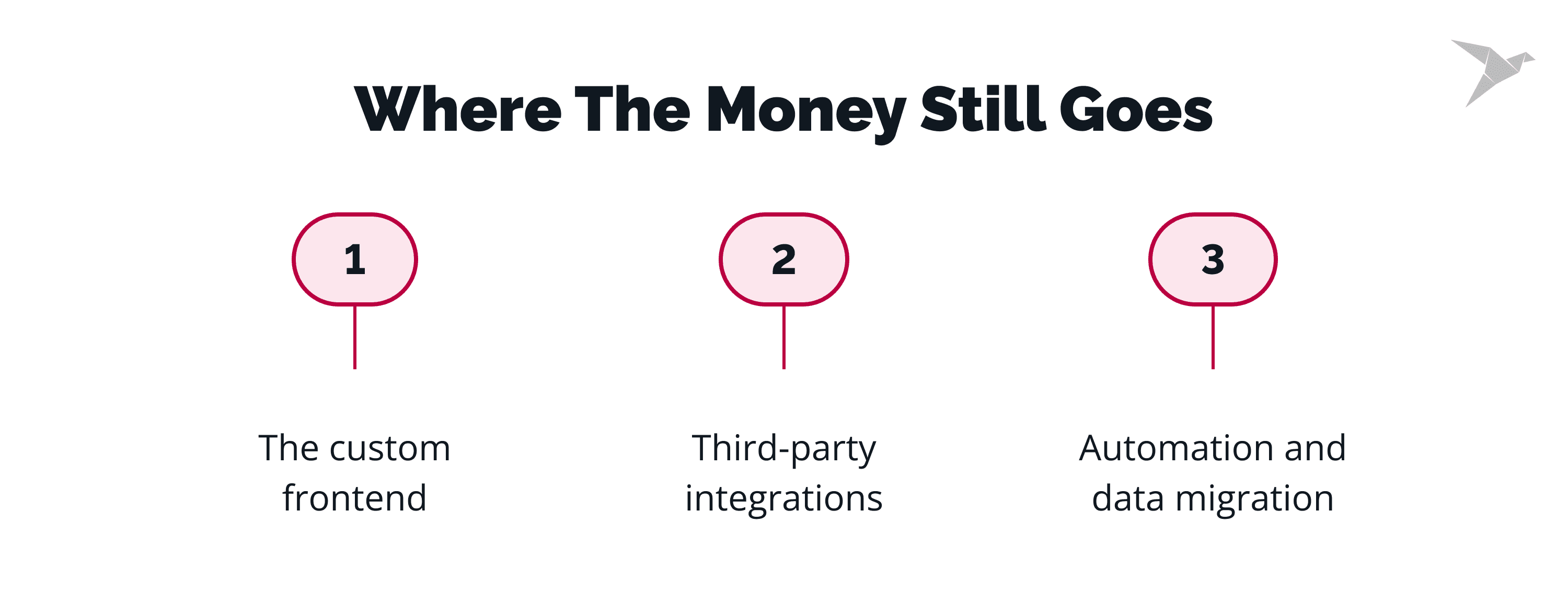
Medplum removes the cost of building and hosting a compliant backend. It does not remove the cost of building your actual product on top. Three line items stay, whichever platform sits underneath.
-
The custom frontend. Every screen a clinician or patient touches is a full design and development effort, and your branded, workflow-specific experience is yours to build.
-
Third-party integrations. Payment processing, telehealth, an insurance clearinghouse, transactional email, and calendar sync are each real backend work, and each external service still bills you for its own API.
-
Automation and data migration. The server-side jobs that run nightly invoicing and reminders are their own scope, and so is importing a clinician’s existing client data from whatever system they used before. These are the jobs that streamline operations once you are live, so treat the operational efficiency they deliver as part of the build rather than an afterthought.
Asked where cost reductions would come from in 2026, 64% of health system executives told Deloitte that AI could cut costs by standardizing and automating workflows, and this is the layer where that happens.
 "Integrations are the big one. If you use a service that exposes an API – Stripe for payments, say – Medplum gives you the data structures and backend scaffolding to work with it, but the processing and API fees are still owed to Stripe, and the integration work itself is still a real build on your side. Medplum hands you the compliant building blocks; it doesn’t assemble the house for you."
Self-host vs the hosted cloud
Medplum publishes its cloud pricing openly: a Free plan, a Production plan at $2,000 per month, a Premium plan at $6,000 per month, and a quote-based Enterprise plan (Medplum pricing). Two details matter for planning: server-side automation, called Bots, is not enabled on Free, and outbound email turns on only at the Premium tier. A production setup that uses automation capabilities and email realistically sits on a higher tier, not the entry one.
Self-hosting can lower that subscription line, but it moves real work onto your team.
"To stay compliant, you own every infrastructure decision against HIPAA or GDPR requirements, and you own keeping up with new compliance guidance, security patches, and platform releases.Those are exactly the things that slip when a product is growing fast. For most early-stage founders, the hosted service is the better trade until the team has the operations maturity to carry that weight."
When Is Medplum the Right Call? A Quick Gut-Check
Choose Medplum when you want speed, standards, and optionality, and your clinical workflow fits a configurable platform. Consider building from scratch only when you have unusual requirements a platform genuinely can’t meet. That is the whole gut-check.
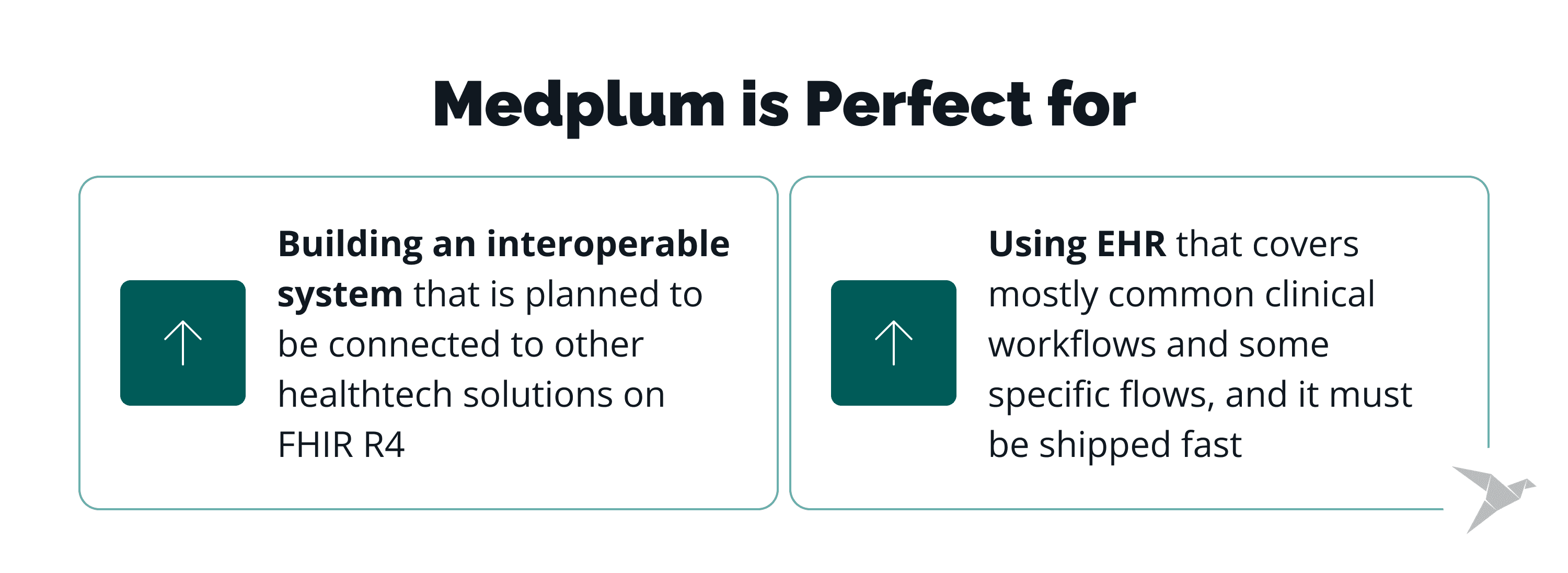
"Medplum is a great idea when there is a need to:
1. Build an interoperable system that is planned to be connected to other healthtech solutions on FHIR R4
2. EHR covers mostly common clinical workflows and some specific flows, and it must be shipped fast."
When should you consider other options?
"Building from scratch fits better in cases when the entire ecosystem is not using FHIR R4 resources. However, this case becomes more and more rare with the general move towards interoperability across the globe.
We recommend not to use Medplum when it appears that the solution that covers actual business needs is not an EHR or EMR and actually will not operate with data that can be classified as PHI. For example, when the product needs deep, non-clinical custom data models where FHIR resources would be forced or limited."
PHI (protected health information) is the clinical, identifiable data the whole system exists to protect. When your product does not center on it, building from scratch or picking a different tool makes sense.
What Should You Ask a Medplum Development Partner?
The single most important question is whether the partner has run Medplum in production for a real client. Reading the documentation is not the same as shipping. The rest of the checklist tells you how to read their answers.
“Show me a Medplum build you’ve run in production”
"The clearest red flag is a partner who talks about Medplum only as ‘a FHIR database’ and can’t go deeper. Someone who has actually shipped will bring up features that ensure compliance or interoperability beyond Medplum being a FHIR-native platform, like audit trailing and access controls. If a partner can’t explain how they’d lock a note or register patient visits at the data layer, they’ve built demos, not production systems. A real production answer sounds specific. They name resources without prompting, and talk about what went wrong and how they handled it."
“How will you handle FHIR data modeling and access control?”
Getting the data model and permissions wrong early is costly to fix later. You want a partner who talks about FHIR resources by name and can describe how they enforce who sees which record.
“What will you tell me not to build yet?”
A partner who scopes down is a good sign. It is appropriate to hear “you may not need that yet,” because it means they are pricing your economics, not just the build.
“How do you keep us HIPAA-ready?”
Compliance is an ongoing process. A good partner consults and engineers for HIPAA readiness and is clear that the formal sign-off comes from the accredited body, never from the development team. Ask who holds the BAAs and who is accountable when you are audited.
“Who is senior on this, and do they stay past launch?”
You want a senior-led expert team that stays through the roadmap, with support and maintenance past the first release. Oleksandra suggests three questions founders rarely ask:
-
“What will my monthly running cost look like at ten clinicians versus five hundred?” It forces the partner to think about your economics and growth.
-
“Who holds the BAAs, and who is accountable when we’re audited?”
-
“What will we own and maintain forever, versus what does the platform give us for free?”
That last question surfaces the long-term operational weight founders most often forget to price in.

What Production Medplum Experience Looks Like
Here is what “run it in production” looks like in practice. For one of our cases, a telemedicine platform, TechMagic built on the Medplum and FHIR foundation and connected it to Health Gorilla for clinical data exchange. The product could handle real patients and real records rather than a demo dataset.
That kind of work is still rare on the open market. In our experience, the hard part is rarely the platform itself. It is the data layer and the integrations, and that is where a team either has scars or does not.
Plenty of companies list Medplum on a services page; far fewer have run it for medical practices with real patients on it. TechMagic is one of very few outsourced teams with active Medplum production experience, which is the difference between a partner who has read the docs and one who has kept a live clinical system running.

Wrapping Up
For most healthtech founders, Medplum removes the most expensive and riskiest part of the build, but the outcomes depend on a partner who has run it in production. For a non-technical founder, the takeaway is simple: you buy speed and safety on the foundation, and you spend your budget on the product and integrations that make you different. For a technical co-founder, the takeaway is that a FHIR-native, standards-based core keeps your options open and your rebuild risk low as you scale.
Statista projects the global electronic health record market to pass $47 billion by 2027, and the buyers inside that market increasingly expect your product to connect to their systems before they will sign. Larger healthcare organizations now treat that as table stakes in procurement, which turns healthcare development on open standards into a commercial decision rather than a technical preference.
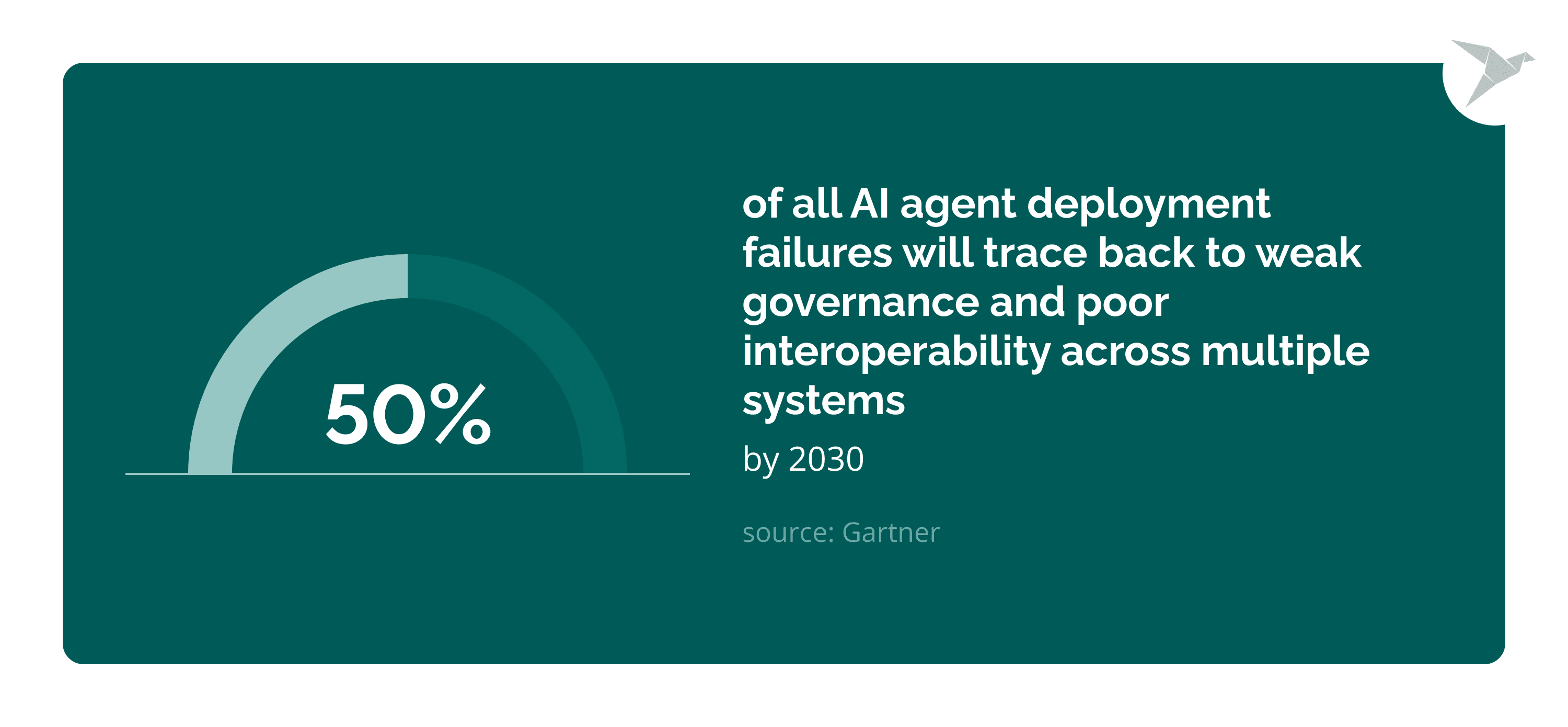
Healthcare leaders backing digital health innovation ask the same question early: will this connect to what we already run? Patient-centered care depends on the answer, because a clinician cannot coordinate care around data they cannot see. That pressure is set to grow. Gartner predicts that by 2030, half of all AI agent deployment failures will trace back to weak governance and poor interoperability across multiple systems, which is a useful warning for anyone choosing a data foundation in 2026.
FAQ

Medplum is an open-source, FHIR-native, headless electronic health record: a compliance-ready backend for storing and exchanging clinical data. Founders use Medplum so they can build their product on top of a ready clinical foundation instead of building that foundation from scratch. Medplum supports over 20 million active patient records, and supports integration with external systems like Epic and DoseSpot.
Building on Medplum reaches a compliant foundation in weeks, where a from-scratch backend typically takes three to six months before any patient-facing feature exists. Medplum changes mainly what the foundation costs, because the custom frontend, integrations, and the Medplum subscription are still yours to pay for.
Medplum is a strong fit for an early-stage healthcare startup that wants speed, standards, and interoperability (Medplum follows all OWASP security guidelines) and whose workflows fit a configurable platform. It is a weaker fit when the product is not really an EHR and does not handle protected health information (PHI), where forcing data into FHIR resources would limit you.
Self-hosting Medplum can lower the subscription cost but moves infrastructure, security patching, and compliance upkeep onto your own team. For most early-stage founders, the Medplum hosted cloud is the better trade until the team has the operations maturity to carry self-hosting.
Building on Medplum does not by itself make a company HIPAA-compliant. Medplum gives you a HIPAA-ready foundation, and formal HIPAA certification is issued by an accredited body, while staying compliant means running BAAs, audits, and security reviews on your side.
A development partner with real Medplum experience can point to a live build for a real client and talk in the platform’s actual vocabulary, naming FHIR resources, access controls, and Bots without prompting. A partner who describes Medplum only as a “FHIR database” and treats automation as an afterthought has likely built demos rather than production systems.