
 Software Development
 Security Services
 Cloud Services
 AI Services
 Other Services















 TechMagic Academy


Open-Source EMRs Explained: The Best Systems and How to Pick Yours
Last updated:12 December 2025


Choosing the right EMR can feel like navigating a maze for healthcare providers. Hundreds of options. Confusing feature lists. Big promises that don’t always match real clinical needs.
And then there’s the hidden struggle every healthcare organization faces: finding a system that’s flexible, secure, affordable, AND actually works the way your team works.
That’s why more practices are turning to open-source EMR solutions. In fact, over 40% of healthcare organizations worldwide now use at least one open-source health IT component, and that number is growing fast. The shift is driven by the desire to gain control, improve interoperability, provide clinical decision support, and finally have technology that adapts to your workflows rather than forcing you into someone else’s mold.
In this open-source EMR software review, we’ll explore what open-source EMRs really are, how they differ from EHRs, why healthcare teams choose them, and which platforms stand out today. You’ll learn how to compare systems that enhance patient care and medical practice management solutions, what to consider before adopting one, and when a custom-built solution might serve you better.
Key takeaways
- Open-source EMRs give healthcare organizations more flexibility, control, and customization than traditional proprietary systems.
- EMRs focus on single-practice workflows, while EHRs support multi-organization data sharing.
- Many of the top open source EMR systems now rival commercial platforms in stability, usability, and interoperability. They are safe for data records and medical practice.
- Choosing the right EMR requires evaluating compliance, different licenses, security, integrations, scalability, overall satisfaction, and long-term maintenance needs.
- Custom EMRs are a strong option for organizations with specialized workflows, complex integrations, or unique care models. Open-source electronic medical records are perfect for smaller practices and those who do not need many customizations.
- Open-source adoption is rising fast, with more than 40% of healthcare organizations now using at least one open-source health IT component.
What is an open-source EMR system?
An open-source EMR system is an electronic medical record software whose source code is publicly accessible, allowing healthcare organizations to use, modify, and extend it freely. It differs from commercial EMR/EHR systems by offering more flexibility, lower upfront costs, and the ability to adapt the software to unique clinical workflows.
How do open-source EMR systems work?
Open-source EMR software is built to run reliably even in low-resource environments. Many are optimized for clinics and hospitals in low-resource settings that face limited budgets, spotty internet connectivity, or unstable power supplies. They allow teams to work offline, sync data when connectivity returns, and provide patient support while staying operational without relying on expensive infrastructure.
EMR vs. EHR: what’s the difference?
In short, an electronic medical record captures patient information created and used within a single practice, while electronic health records gather patient information across multiple providers and care settings. Patients usually cannot access EMR systems directly.
Let’s take a closer look at other key differences in EHR vs. EMR.
Why choose an open-source EMR?
Organizations choose open-source EMR systems because they offer flexibility, control, and long-term value that enhance administrative processes and improve efficiency beyond what traditional proprietary systems can provide. Below are the key reasons decision-makers look to open source when modernizing their clinical operations.
Lower cost and freedom from vendor lock-in
You’ve probably heard about open source electronic health records and headless EHRs like Medplum. Open-source EMRs offer long-term cost savings in the same way: there are no hefty licensing fees and no obligation to follow a vendor’s pricing model.
You can use the software, modify it, and scale it without being locked into contracts for updates or support. This level of independence is especially valuable for startups, clinics with tight budgets, and hospitals planning a multi-year digital transformation that can handle increased patient visits.
Full control of patient data and privacy
Open-source EMR systems give organizations full ownership of their data. Because the code is transparent, your team can audit how data is stored, processed, and secured – something proprietary systems rarely allow.
This control helps you respond quickly to compliance requirements, implement custom security measures, and build trust with patients and partners.
Flexible integrations and better interoperability
Open-source EMRs are designed to play well with other systems and other tools . Most support standards like FHIR, HL7, REST APIs, and SMART on FHIR.
This makes it easier to integrate with labs, pharmacies, electronic billing systems, scheduling tools, medical imaging, patient portals, and external EHRs. Their open architecture reduces traditional interoperability barriers and enables smoother data exchange across departments and partners.
Strong community support and continuous innovation
Behind most open-source EMR systems is a global community of developers, clinicians, researchers, and implementers.
This community contributes updates, extensions, language packs, bug fixes, and new features, often faster than proprietary vendors. They provide documentation, forums, and real-world implementation advice that help teams troubleshoot challenges and keep improving their systems over time.

Top Open-Source EMR Systems
Open-source EMR platforms come from diverse communities, each built with different goals and strengths.
Below you can find a list that we formed based on our hands-on experience and expertise as an EMR software development company. We hope it will help you compare usability, functionality, and suitability for your healthcare environment.
OpenEMR
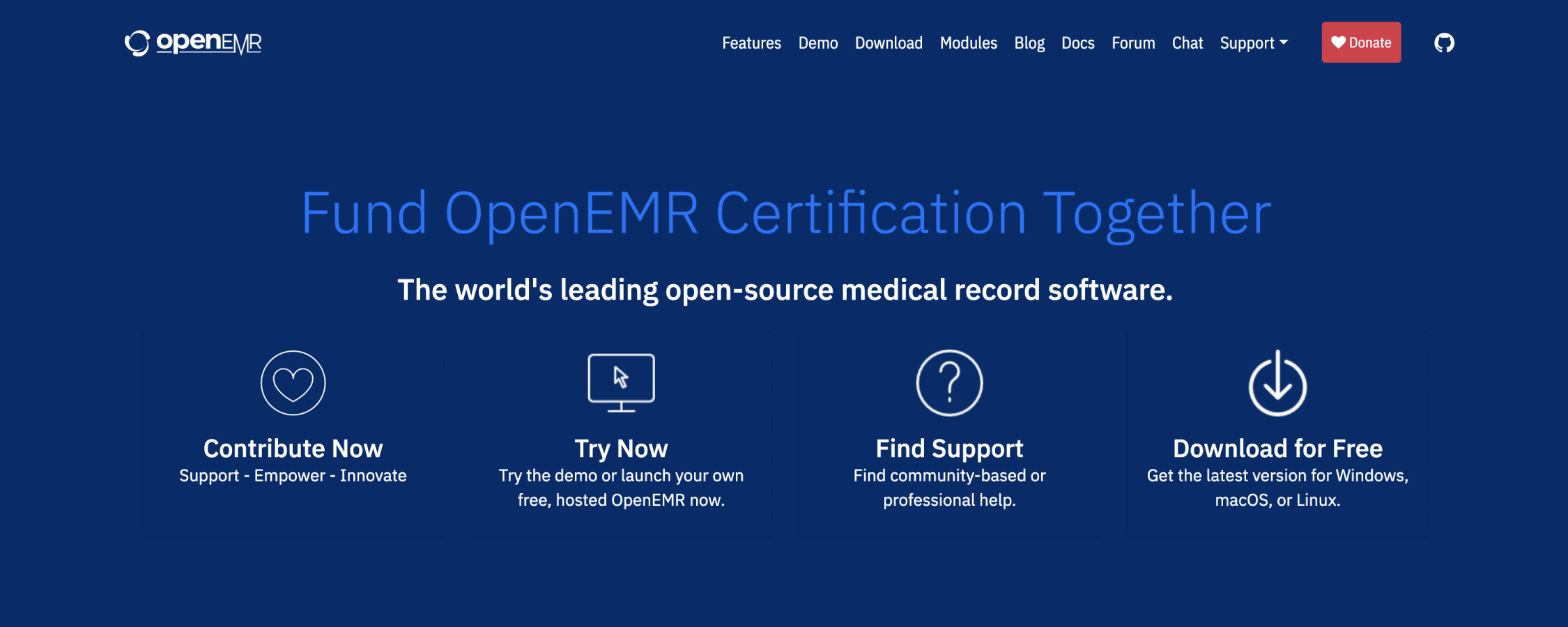
OpenEMR is one of the oldest and most widely used open-source EMR/EHR systems worldwide. Founded in the early 2000s in the United States, it grew from a small community project into a mature EMR used across clinics, ambulatory practices, telehealth groups, and small hospitals.
Its mission is to provide a fully functional, affordable, and accessible platform for practices that need a complete clinical and practice management solution without licensing fees.
Core features
- Comprehensive clinical charting;
- patient records;
- e-prescribing;
- appointment scheduling;
- billing (including insurance support);
- reporting;
- custom forms;
- lab integrations;
- optional patient portal capabilities.
Tech stack and deployment
OpenEMR is built with PHP and MySQL. It supports Linux, Windows, Mac OS X, and cloud deployments. Docker images simplify installation for technical teams.
Community support and updates
This open source EMR system is supported by a large, long-standing community that’s very active and approachable. The OpenEMR Foundation helps guide development, while contributors from around the world share modules, fixes, and advice.
Updates come out regularly, and the documentation and forums make it easy for both new and experienced users to get help when they need it.
Pros: OpenEMR provides a deep feature set, strong reliability, and broad documentation, making it accessible for small or growing practices.
Cons: Its interface feels dated to some users, and more advanced customization requires PHP expertise. Larger hospitals may need external support or additional configuration.
OpenMRS
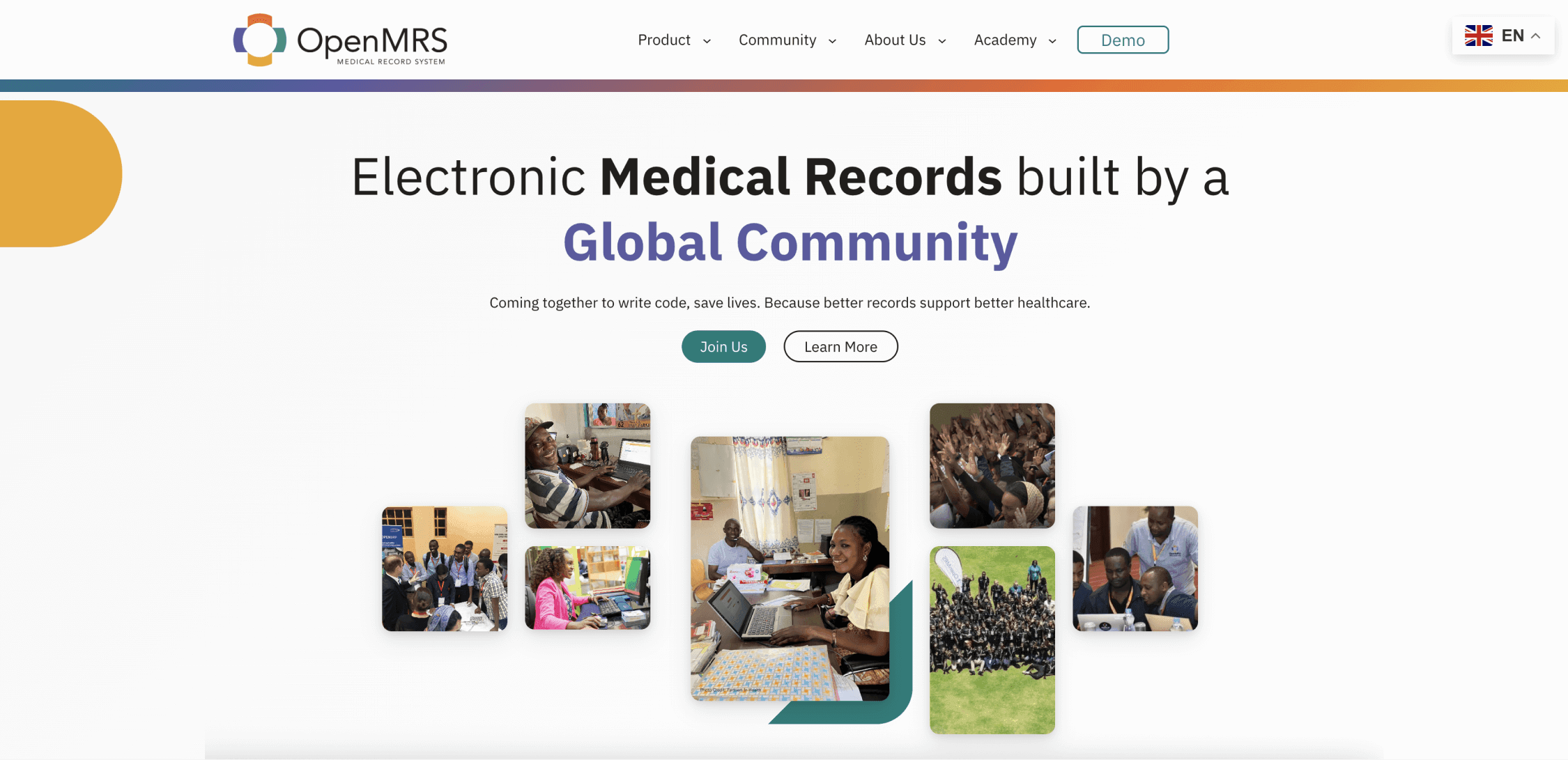
OpenMRS was founded in 2004 by Regenstrief Institute (USA) and Partners In Health (USA), with a mission to improve care in low-resource countries. It became a cornerstone EMR for national health programs, HIV/AIDS initiatives, and public hospitals across Africa and Asia, addressing their local needs.
OpenMRS focuses on creating a robust, modular medical record system rather than a full practice management suite, thereby enhancing care delivery in low-resource countries.
Core features
- Patient registration;
- encounters;
- clinical documentation;
- form creation;
- data dictionaries;
- reporting tools;
- strong support for longitudinal patient histories.
It emphasizes medical data over financial or administrative workflows.
Tech stack and deployment
OpenMRS has a Java-based modular architecture. Often deployed on-premise, optimized for intermittent connectivity and resource-limited environments. Supports offline-first workflows.
Community support and updates
OpenMRS has one of the most welcoming and collaborative communities in global health tech. Developers, clinicians, NGOs, and government teams work together closely, sharing lessons from real-world projects across dozens of countries.
The project releases updates on a steady schedule, and its forums, Slack channels, and implementer groups offer hands-on support for teams working in challenging environments.
Pros: OpenMRS is extremely flexible, stable, and ideal for large-scale public health programs. It is best suited for environments prioritizing medical records over administrative tools.
Cons: It requires engineering expertise, has limited billing features, and may feel more complex to configure than all-in-one EMRs.
Bahmni

Bahmni launched in 2012 as a Thoughtworks-led open-source project built on top of OpenMRS to create an easy-to-use EMR + Hospital Management System for low- and middle-income countries. It is widely adopted across India, Bangladesh, Nepal, Sri Lanka, and parts of Africa.
Its goal is to deliver a clean UI and an integrated experience for hospitals needing both clinical and operational tools.
Core features
- Clinical records;
- labs;
- radiology;
- pharmacy;
- billing;
- inventory;
- scheduling;
- patient registration;
- dashboards.
Bahmni provides an intuitive UI suitable for clinicians and support staff.
Tech stack and deployment
This open medical record system combines OpenMRS (clinical), OpenELIS (labs), and Odoo (billing + inventory). Runs on Linux and supports local servers or cloud deployments.
Community support and updates
Bahmni’s community is active, supportive, and deeply engaged in real-world healthcare projects. Thoughtworks and many nonprofit partners continue to maintain the platform, contribute improvements, and help guide new implementers. The documentation, training materials, and discussion channels are practical and friendly, making it easier for teams to get started.
Pros: Bahmni offers a complete EMR + hospital management suite with a modern interface, making it attractive for small and mid-sized hospitals. It is best suited for facilities needing integrated clinical and operational systems.
Cons: Its multi-component architecture can increase deployment and maintenance complexity.
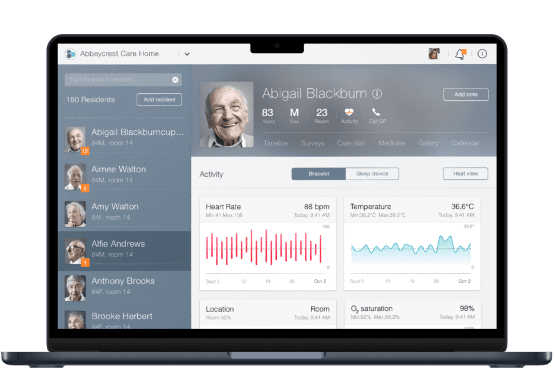
a Care home management app for E-type Care
GNU Health
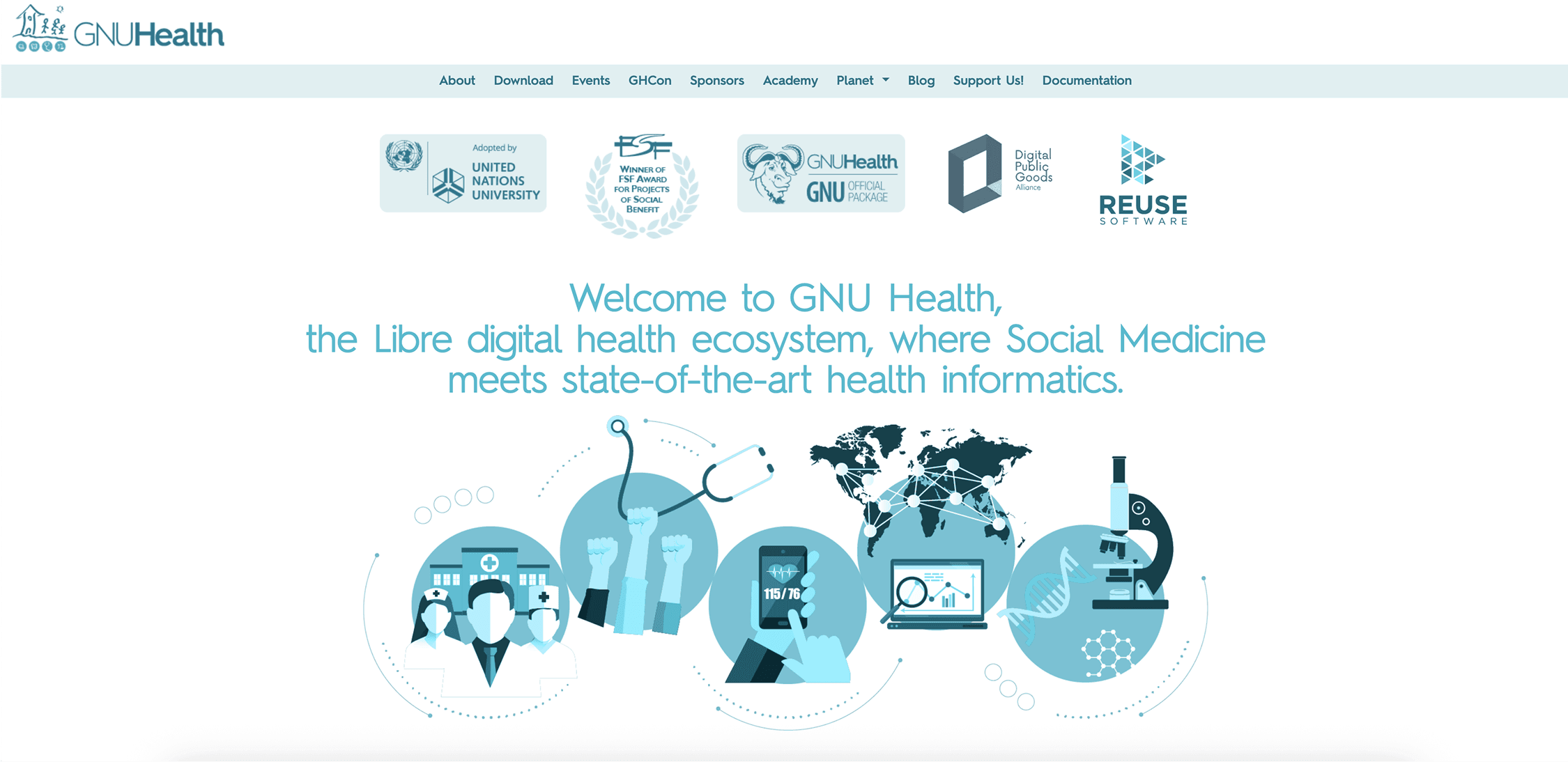
GNU Health, created by GNU Solidario in 2008, is a global free software project with a mission to improve public health and social medicine. Governments, academic institutions, and research centers across Latin America, Europe, and Africa use it, often benefiting from its free support and its global reach in addressing health challenges.
Its core value lies in combining clinical care with public health, epidemiology, and social determinants of health tracking.
Core features
- Patient records;
- demographics;
- social determinants mapping;
- lab management;
- hospital workflows;
- billing;
- statistical dashboards;
- public health analytics (epidemiology, outbreaks, population health indicators).
Tech stack and deployment
GNU Health is built on the Tryton framework (Python) with PostgreSQL. It supports local servers, government-scale deployments, and multi-node configurations.
Community support and updates
GNU Health is backed by a passionate global community and open source developers led by GNU Solidario. Contributors include public health experts, researchers, and technologists who care about equitable healthcare access.
The community is approachable and quick to share guidance, while regular releases keep the system aligned with evolving public health needs.
Pros: This system excels in public health and research environments. Not as smooth for private outpatient clinics but powerful for large-scale programs.
Cons: It is modular but complex, and its interface may require more training. Not as smooth for private outpatient clinics yet powerful for large-scale programs.
LibreHealth
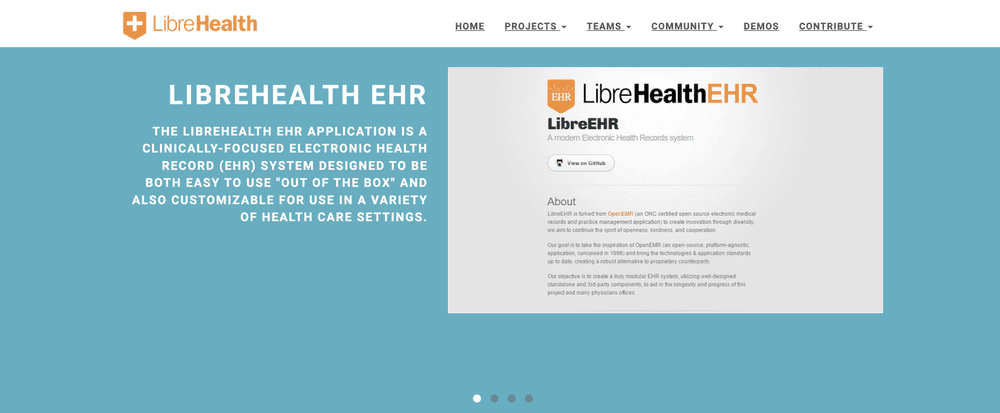
LibreHealth emerged in 2016 as a modernized fork of OpenMRS and OpenEMR components, built to accelerate innovation and academic research. It is supported by developers, researchers, and contributors focused on creating modular, interoperable health IT tools using modern standards.
Core features
- Patient records;
- forms;
- clinical workflows;
- scheduling;
- custom modules;
- strong focus on FHIR-based interoperability and component-based development.
Tech stack and deployment
Modern web technologies with support for cloud or on-premise hosting. LibreHealth is designed to be modular and developer-friendly for research pilots and custom builds.
Community support and updates
LibreHealth is supported by a tight-knit, developer-friendly community, with strong involvement from universities and research groups. The project’s contributors are enthusiastic about innovation and happy to help newcomers explore the platform. Updates and discussions tend to be open, transparent, and collaborative, reflecting the project’s academic roots.
Pros: LibreHealth is flexible, modern, and ideal for R&D, interoperability projects, and academic initiatives.
Cons: It requires engineering effort for production use and has a smaller ecosystem. Most suitable for teams building custom extensions or exploring new health IT standards.
What Are the Key Factors to Consider When Choosing an Open-Source EMR?
The best open source EMR must be your strategic decision in the first place. The right system should support your clinical workflows today and scale with your operations tomorrow. Here’s a simple checklist to help you compare options and choose a solution that fits your organization’s needs.
Compliance and security
Every EMR must follow healthcare regulations such as HIPAA, GDPR, and local privacy laws. Look for systems that offer encryption, role-based access, audit trails, and secure data storage. Strong security reduces organizational risk and protects patient trust.
Ease of deployment
Open-source EMRs vary widely in how easy they are to install and configure. Some are cloud-ready, while others require more local infrastructure or technical skills. Understanding deployment needs helps you plan timelines, staffing, and go-live readiness.
Integration
Just as important is integration: support for FHIR, HL7, REST APIs, and third-party apps ensures smooth connections with hospital information systems, labs, billing systems, patient portals, and partner organizations. Together, UX, customization, and interoperability shape everyday usability and long-term efficiency in the healthcare industry.
Community and support
A strong open-source community often signals a healthy, evolving product. Active contributors, documentation, support forums, and optional commercial support can make troubleshooting and implementation much easier. A vibrant community keeps the software improving.
Scalability and long-term maintenance
Your EMR should be able to grow with your practice. Choose solutions that can handle greater patient volumes, multiple sites, and new clinical modules without performance issues.
Also consider long-term maintenance costs:
- hosting;
- updates;
- patches;
- integrations;
- optional external support.
Even without licensing fees, these factors define your true total cost of ownership.
digital platform for medical form management
What Are Custom EMR Systems and When Should You Choose One?
A custom EMR system is software built specifically for your organization’s workflows, clinical processes, and long-term goals. Unlike open-source or off-the-shelf options, a custom EMR is designed from the ground up to reflect exactly how your team works.
No unnecessary features, no awkward workarounds, and no limits on how the system can grow.
What makes custom EMRs different?
Custom EMRs offer complete control over how the system looks, feels, and functions. Everything from intake forms and clinical workflows to billing, reporting, and analytics can be shaped around your model of care.
This level of flexibility is especially helpful for organizations with unique specialties, advanced interoperability needs, or innovative care approaches that traditional systems don’t fully support.
When is a custom EMR the better choice?
A custom-built EMR becomes the smarter option when your organization:
- Has complex or highly specialized workflows that generic systems can’t support without heavy modification.
- Requires deep, seamless integrations with devices, diagnostic tools, AI models, or legacy systems.
- Wants full ownership of the codebase and data, without relying on vendors for roadmap decisions or pricing.
- Needs a scalable foundation that can grow with new clinical services, expansion to multiple sites, or new digital products.
- Is building a unique patient or provider experience that can’t be achieved with a standard interface.
The trade-off: flexibility vs. investment
While custom EMRs deliver unmatched adaptability, they come with several important trade-offs. The first is investment. Building a system from scratch requires more time, resources, and technical expertise than adopting an existing open-source or commercial platform.
Also, custom EMRs demand a strong engineering foundation and a partner who understands both healthcare workflows and regulatory requirements. Without the right expertise, development can slow down, integrations may break, and the system may struggle to meet security or interoperability standards that affect patient outcomes . This makes vendor selection and architectural decisions critical early in the process.
Long-term ownership introduces another layer of responsibility. Once the system is live, your team or your technology partner is accountable for updates, patches, new features, regulatory changes, and keeping integrations stable. Unlike off-the-shelf systems, there is no external vendor automatically pushing updates. This independence is powerful, but it requires commitment.
Despite these challenges, many organizations see custom EMRs as a strategic, long-term investment. They gain full control, the freedom to innovate, and a system that can evolve with their care model rather than limit it.
Ready to Build a Secure, Future-Proof EMR That Fits Your Practice?
Choosing the right EMR is to find a solution that protects your data, supports your growth, and reflects the way your team delivers care. That’s where a trusted technical partner makes all the difference.
At TechMagic, we help healthcare organizations design, build, and integrate open source EHR software and EMR systems that are secure, compliant, and tailored to real clinical workflows. Our team understands the regulations you operate under, from HIPAA and GDPR to local health data laws. We bake compliance into every stage of development, from architecture to deployment.
Whether you’re implementing an open-source EMR, customizing an existing one, or building a new system from the ground up, we can guide you through the entire journey. We help you avoid common pitfalls, strengthen interoperability, ensure long-term maintainability, and create an EMR that feels intuitive for both clinicians and patients.
We’d be happy to talk
Wrapping Up
The best open source EMR systems have become a powerful force in modern healthcare. They offer flexibility, transparency, and affordability that traditional proprietary systems often can’t match.
Such solutions are especially useful for organizations with unique workflows, limited resources, or ambitious digital transformation goals. As the healthcare landscape continues to shift toward interoperability and patient-centric care, open-source platforms are playing an increasingly important role.
Industry analysts predict that the open-source healthcare software market will grow by over 13% annually through 2030. It is driven by the need for customizable solutions, cost-effective infrastructure, and more responsive data-sharing capabilities.
Many national health systems in Africa and Asia now rely on medical practice management applications and platforms like OpenMRS and Bahmni as core digital health infrastructure. This is a trend expected to continue as governments push for scalable, open standards.
What’s clear is that open-source EMRs are no longer niche alternatives in healthcare delivery. They’re becoming strategic tools with significant benefits that support innovation, real-time care coordination, and deeper interoperability through standards like FHIR, HL7, and SMART on FHIR.
However, choosing the right EMR, whether open-source or custom-built, requires thoughtful evaluation. You need to consider compliance, data protection, integration needs, scalability, and your long-term digital roadmap. And in many cases, organizations benefit from working with a partner who understands both the technical and regulatory sides of healthcare.
FAQ

Open-source EMR systems give you a ready-made foundation with publicly available source code that you can use, modify, and extend. A custom-built EMR, on the other hand, is created entirely around your organization’s workflows, integrations, and long-term strategy, differentiating it from typical open source software.
If you’re evaluating both paths, an open source EMR comparison helps reveal whether flexibility, speed, cost, or full ownership matters most for your project.
Yes, open-source EMRs can be secure when configured and maintained properly. Their transparency allows teams to audit how data is stored and protected, and many systems follow best practices for encryption, access control, and logging.
Security depends less on whether the system is open source and more on implementation, hosting, updates, and adherence to healthcare standards. Yet, open source software always has specific risks.
Costs vary widely. Customizing an EMR open source solution is typically more affordable upfront because there are no licensing fees, but expenses can arise from integrations, hosting, UI improvements, workflow changes, and long-term support.
Building a fully custom EMR requires a larger investment, covering design, engineering, compliance, testing, and ongoing maintenance. But it is better in terms of the effect on healthcare services and final value. The right choice depends on your budget, scale, and workflow complexity.
Yes, open-source EMRs can support HIPAA, GDPR, and other healthcare regulations or population health management standards. Compliance depends on how the system is deployed, configured, and secured.
This includes encryption, access controls, audit logs, secure hosting, business associate agreements, and proper data governance. With the right implementation partner, open-source solutions can meet or exceed regulatory requirements to improve patient care and the work of healthcare professionals.