
 Software Development
 Security Services
 Cloud Services
 AI Services
 Other Services















 TechMagic Academy


Hospital Data Integration: How to Connect Disparate Systems for Better Patient Care
Last updated:19 December 2025


Hospitals run on data, yet most of that data lives in systems that don’t naturally integrate with one another. Clinicians jump between screens. Administrators reconcile reports by hand. Critical details hide in data silos.
And as new tools, devices, and workflows appear in healthcare organizations, the gaps only widen. The information needed to deliver safe, timely care often isn’t where it should be.
At the same time, the demands on hospital IT are rising. AI needs clean, structured data. Telehealth expands the number of systems in play. Leadership expects real-time insights, not end-of-month spreadsheets. The pressure to connect it all and make it meaningful has never been greater, especially due to the increasing number of data sources .
In our new article, we discuss what healthcare data integration really means, why it matters, the barriers hospitals face, and how to integrate data in healthcare to build a cohesive, future-ready data foundation.
Key takeaways
- Integration creates a unified view of clinical and administrative data, reducing errors and helping clinicians make faster, safer decisions.
- It goes beyond interoperability by cleaning, aligning, and structuring data so hospitals and healthcare companies can rely on it for reporting, analytics, and automation.
- Integrated systems cut manual work by eliminating duplicate entry, streamlining workflows, and improving handoffs across departments.
- A strong integration layer enables future innovations, including AI-driven insights, predictive analytics, and scalable digital tools.
- Understanding what is data integration in healthcare helps leaders plan strategically, treat integration as a long-term investment, and build a foundation for better patient outcomes and operational efficiency.
What Does Hospital Data Integration Actually Mean?
Hospital data integration is the process of collecting information from different clinical and administrative systems and bringing it together in one place where it can be used consistently. It focuses on clinical data integration in healthcare, not just systems, so teams can see a complete picture of a patient, a workflow, or an operational process.
In most hospitals, data sits in many tools: EHRs, lab systems, imaging systems, billing platforms, and various departmental applications. Each system stores information in its own format.
Data integration solves this by pulling that information into a unified structure. This can happen through interfaces, APIs, data pipelines, or integration engines, but the goal is always the same: make the data usable across the organization and eliminate data duplication .
Hospital data integration vs. interoperability
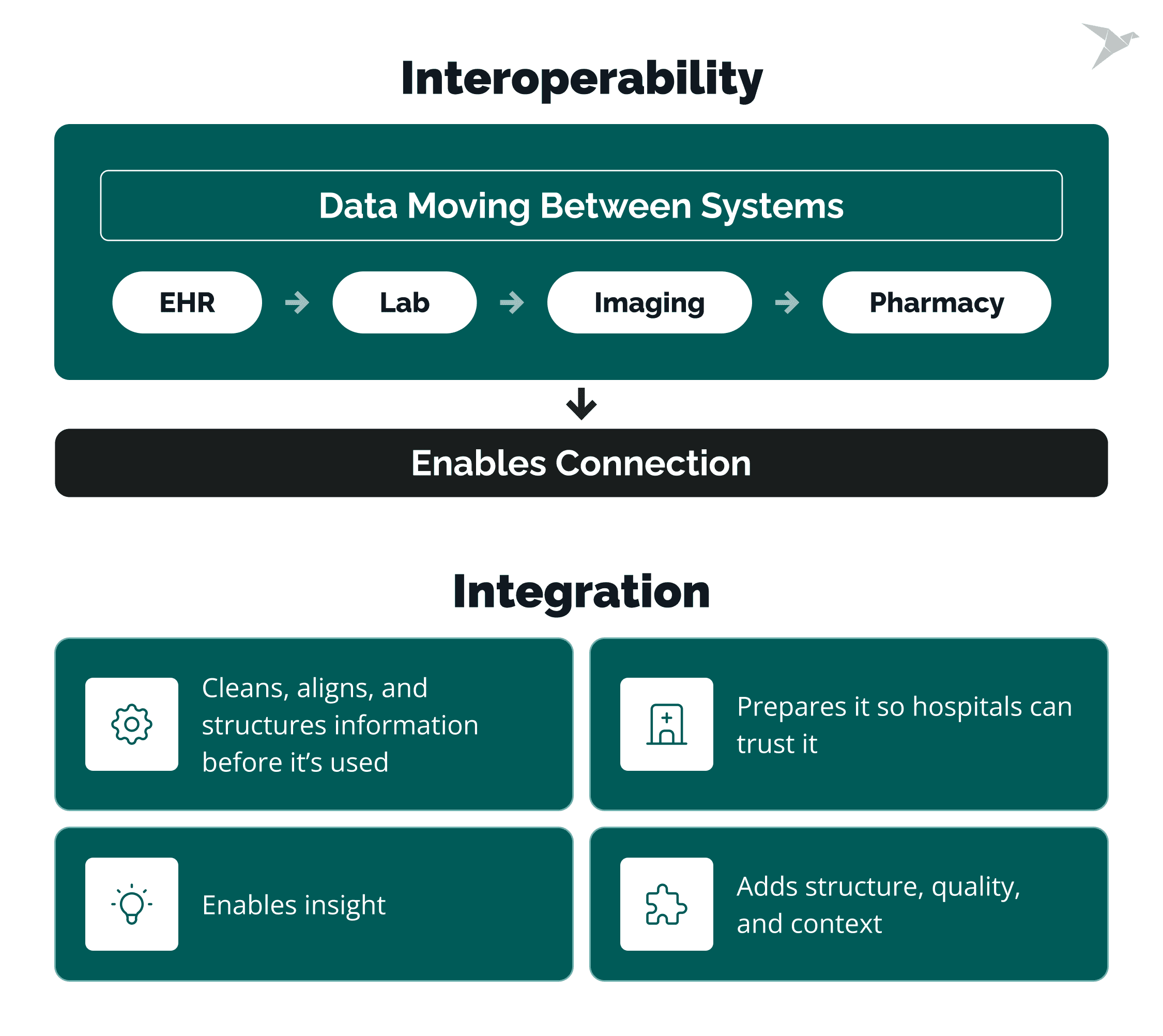
Data integration is not the same as interoperability. Interoperability, especially with electronic health records, is about systems communicating with each other in real time. It ensures data accuracy and can move between tools without losing meaning. Data sharing refers to giving access to information between teams, departments, or external partners.
Data integration goes a step deeper. It aligns formats, cleans inconsistencies, and creates a single source of truth that supports analytics, reporting, decision-making, and automation. In other words, interoperability moves the data, but integration prepares it so people and systems can rely on it.
Why Is Data Integration Critical for Modern Hospitals?
Health data integration is critical because it helps hospitals deliver safer care, reduce manual work, and make better decisions. When information from multiple systems comes together in a clear and consistent way, teams can gain clinical insights and work faster with fewer errors.
Let’s take a closer look at how it affects hospitals and healthcare providers in practice.
Better care and stronger clinical decisions
Integrated data gives clinicians a full view of the patient. Lab data, imaging, medications, and notes appear in one place instead of being scattered across systems. This reduces missed information about the patient's medical history nd helps avoid unnecessary repeat tests.
Integrated records also support early detection. When data from different sources, including remote monitoring devices, is combined, analytics can highlight patients at risk of complications, allowing teams to intervene sooner rather than react later.
Smoother hospital operations
Most hospitals rely on many systems across clinical, administrative, and diagnostic departments. Without clinical data integration, staff spend time entering the same patient data in different places or reconciling mismatched records. Integration removes this manual work, as it automates updates and keeps data consistent across platforms.
Streamlined data flows also reduce common delays. Tasks like scheduling, billing, and discharge move faster because the right information reaches the right teams without extra steps. In this regard, proper data integration is one of the most important parts of the healthcare software development services.
Clear insights for planning and improvement
When data is integrated, hospital leaders gain a single source of truth for key metrics. They can track readmissions, length of stay, bed usage, costs, and patient health information without collecting data manually. This creates a reliable foundation for identifying bottlenecks, improving workflows, and planning resources.
Medical data integration also supports advanced analytics, such as demand prediction, population health trends monitoring, or high-risk patients identification. As hospitals adopt telehealth, remote monitoring, or new service lines, integrated data ensures these additions fit into the broader picture.
How integration improves daily operations: practical examples
- Avoiding duplicate tests: When labs and imaging systems feed results directly into the EHR, clinicians can see what has already been done and avoid repeating tests.
- Safer handoffs: When a patient moves from the emergency department to radiology or surgery, all teams see the same updated chart, reducing communication gaps. A surgeon, anesthesiologist, and nursing team access the same updated chart. Allergies, recent labs, and vital signs are already synced, reducing manual checks and lowering the risk of error.
- Better operational awareness: Integrated dashboards show real-time bed availability, patient flow, and discharge progress, helping teams manage capacity and reduce wait times.
Overall, hospital data integration strengthens every part of hospital operations from bedside care to long-term planning.

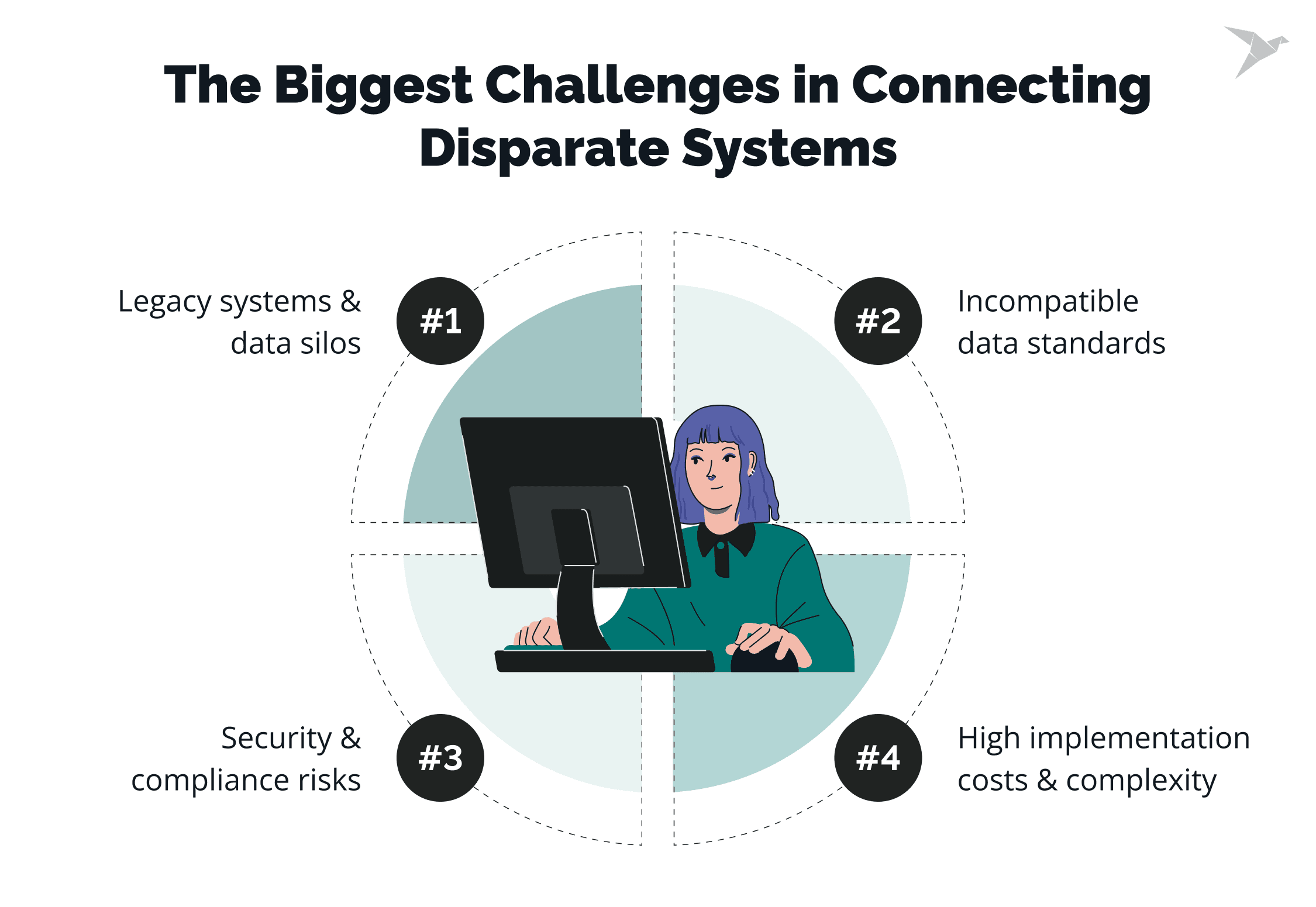
What Are the Biggest Challenges in Connecting Disparate Systems?
Hospitals depend on many systems to run clinical, administrative, and financial operations. Connecting them isn’t simple. The challenges span technology, workflows, culture, and regulation. Below are the most common barriers health care providers face when trying to bring healthcare systems data, including health information exchanges, together.
Legacy systems and data silos
Many hospitals still rely on older systems built long before interoperability was a priority. These systems store data in isolated databases that don’t communicate with anything else. As a result, teams work with duplicate records, incomplete histories, or information that can’t be shared in real time.
On top of that, data integration in healthcare often requires change across departments. Resistance is common when teams are used to working in silos. Shifting to shared data and shared workflows becomes not just a technical project, but a cultural shift that needs alignment and clear communication, especially considering various data integration challenges .
Incompatible data standards
Healthcare data comes in many shapes: structured fields, free-text notes, images, PDFs, lab formats, device outputs, and more. When systems use different standards or no standards at all, data is hard to exchange or interpret.
This fragmentation leads to issues such as duplicate records, missing context, or inaccurate insights. Without consistent formats (like HL7 FHIR), data heterogeneity leads providers to struggle to consolidate data across EHRs, labs, imaging, and third-party tools.
Security and compliance risks
Every integration step introduces new security considerations. Healthcare data is highly sensitive, and any weak point in electronic health data can expose Protected Health Information (PHI). Poorly configured interfaces or data transfers increase the risk of breaches, which can lead to patient harm and significant penalties.
Hospitals must apply strict controls: access management, encryption, audit trails, and monitoring. At the same time, they must ensure regulatory compliance with HIPAA and other regional regulations. The challenge is balancing smooth data flow with strong, reliable safeguards.
High implementation costs and complexity
Integration projects require time, budget, and specialized expertise. Older systems may need custom interfaces. Newer systems may require workflow redesign. Teams must align policies, map data between systems, and establish governance rules that define who owns what and how information should be used.
This coordination is often one of the biggest hurdles. Without clear data governance, integration efforts slow down or produce inconsistent results. Hospitals must invest in planning, communication, and cross-functional collaboration to ensure long-term success.
HIPAA-compliant portal for secure medical data records and exchange
What Are the Main Approaches and Technologies for Hospital Data Integration?
Below are the best practices on how to integrate healthcare data based on our experience, as well as the approaches most teams rely on today, along with examples of how modern platforms fit into the picture.
HL7 and FHIR standards
HL7 has been the backbone of clinical data exchange for decades. It supports essential workflows such as admissions, electronic health records, orders, and results. Fast Healthcare Interoperability Resources builds on this foundation with a modern, web-friendly design. It uses REST APIs and structured resources, which makes data easier to share across EHRs, electronic medical records, mobile apps, and analytics tools.
FHIR-native platforms like Medplum use these standards by default. In the healthcare industry, this helps teams move toward cleaner, more consistent data flows without building everything from scratch.
API-based integration
APIs allow systems to communicate directly and exchange data in real time. They simplify how hospitals connect internal systems, partner platforms, and patient-facing tools.
Proper hospital data integration solutions provide an API-first environment where teams can build custom applications, automate workflows, or integrate medical devices using a FHIR-compliant API layer. This reduces custom development work and speeds up integration projects.
Middleware and integration engines
Integration engines (such as Mirth Connect, Rhapsody, or Cloverleaf) act as translators between systems that use different formats or protocols. They manage message routing, transformation, and error handling, which helps reduce complexity in multi-system environments.
Here is the real example from our own experience in Medplum-based app development. Integration engines are often used alongside modern API platforms. For example, an integration engine may handle HL7 v2 feeds, while a Medplum exposes the same data through a clean API for application development.
Cloud-based integration platforms
Cloud platforms offer scalable and managed environments for healthcare data exchange. They reduce the need for on-premises hardware and provide built-in tools for security, auditing, and compliance.
FHIR-native cloud platforms allow hospitals to standardize data formats, integrate systems faster, and support new digital tools without rebuilding their infrastructure. This is especially useful for organizations moving toward modular, service-based architectures.
Event-driven architectures
Event-driven patterns support real-time updates across systems. When a patient is admitted, discharged, or receives a new lab result, an event triggers an automatic update in connected applications.
This reduces manual work and supports faster clinical decision-making. Platforms that support FHIR subscriptions or webhooks can help teams implement event-driven workflows more easily.
Healthcare data warehouses and lakes
For analytics and population health, hospitals often consolidate data into centralized repositories. These environments support large-scale reporting, predictive modeling, and quality dashboards.
While not an integration method on their own, they rely heavily on standardized, well-structured data coming from API platforms and integration engines.
digital platform for medical form management
How to Plan and Implement a Hospital Data Integration Project Successfully
A successful integration project is less about a single tool and more about a clear plan, shared goals, and disciplined execution. The steps below offer a practical framework hospitals can follow.
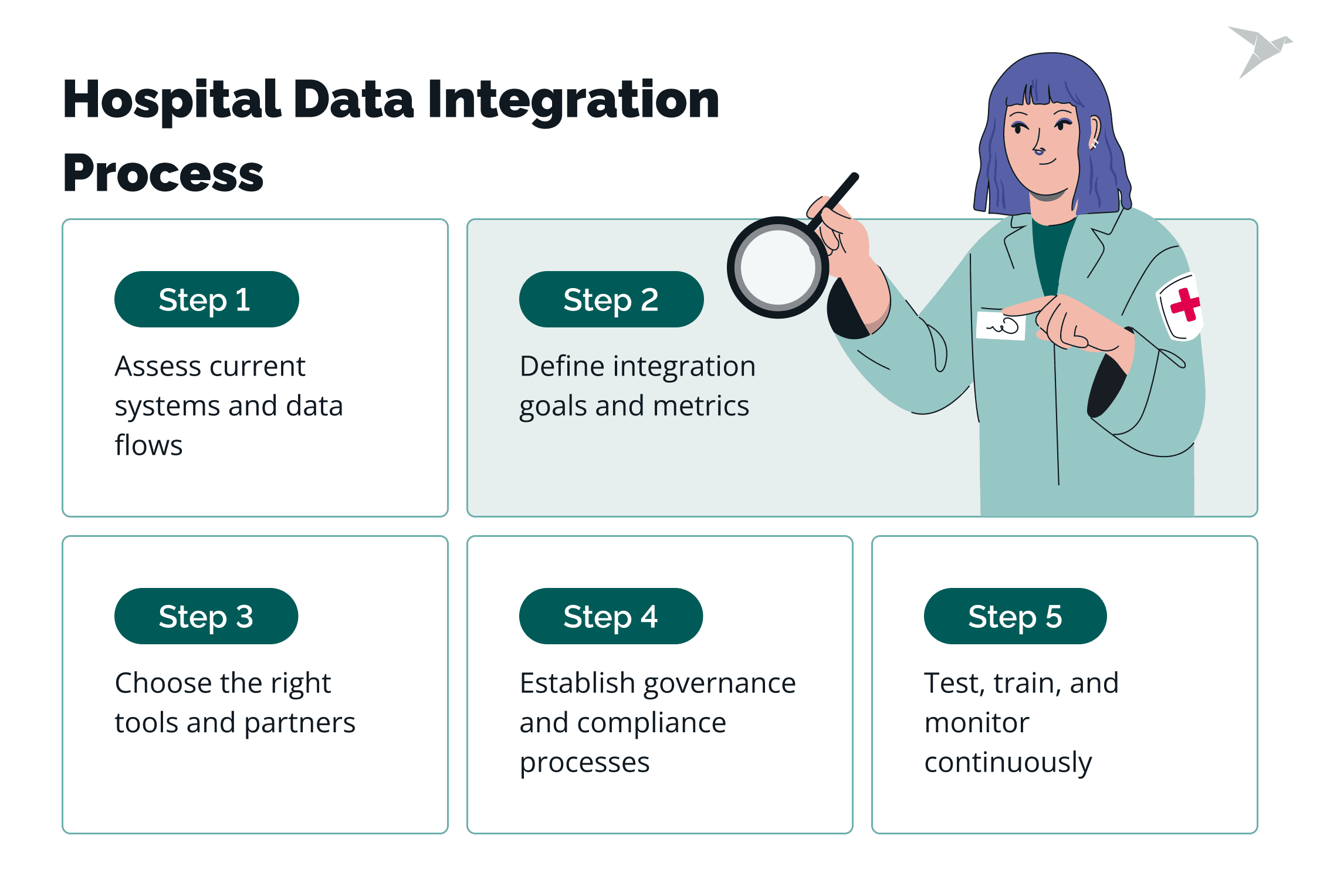
Assess current systems and data flows
Start by understanding what you already have.
- Map all core systems: EHR, LIS, RIS/PACS, billing, scheduling, CRM, patient apps, and any shadow IT tools.
- Document how data moves today: interfaces, file transfers, manual exports, spreadsheets, paper workflows.
- Identify pain points: duplicate data entry, delays, missing fields, inconsistent patient IDs, reporting gaps.
- Note technical constraints: legacy systems, unsupported standards, limited vendor access, bandwidth, or storage limits.
This assessment becomes your baseline. It shows where integration will bring the most value and where risks are highest.
Define integration goals and metrics
Next, translate problems into specific, measurable goals for the data integration process.
Examples:
- Reduce duplicate patient records by X%.
- Cut time to access lab results across systems from hours to minutes.
- Improve data completeness for key fields (e.g., allergies, problem list) to a defined target.
- Shorten report preparation time for clinicians or management.
Agree on a small set of KPIs for clinical, operational, and technical outcomes. These metrics will guide design decisions and help you show progress over time.
Choose the right tools and partners
With goals set, you can select the technical and delivery approach that fits your context and data integration strategies.
Consider:
- Standards support: HL7, FHIR, DICOM, and other required formats.
- Integration model: API-based, integration engine, cloud platform, or a hybrid approach.
Existing ecosystem: what your EHR vendor supports, what your IT team already uses. - Scalability and maintenance: how easy it is to add new systems, update mappings, and monitor flows.
You may combine an integration engine (for legacy HL7 feeds and message routing), a FHIR-native platform such as Medplum (as an API layer for new apps and services), vendor APIs, and cloud services (for partner tools and analytics).
Technical tools are only part of the picture. You will often need external partners (system integrators, vendors, or consultants) to cover specialized skills and accelerate delivery.
Establish governance and compliance processes
Data integration without clear rules quickly becomes unmanageable.
Set up:
- Data ownership: who is responsible for each data domain (patients, orders, results, billing, etc.).
- Access policies: who can see and change what, across systems and roles.
- Data quality rules: required fields, validation rules, master data management, deduplication policies.
- Security controls: encryption, identity and access management, audit logging, incident response.
- Compliance checks: HIPAA and regional regulations, vendor BAAs, data processing agreements.
Create a cross-functional governance group (IT, clinical, operations, compliance) that reviews changes, approves new integrations, and monitors risks.
Test, train, and monitor continuously
Integration is not finished when interfaces are live. We recommend focusing on three ongoing activities that support data-informed decision-making.
Test thoroughly
Validate data mappings, edge cases, and error handling. Run scenarios across systems: admissions, transfers, discharges, order-to-result flows, billing cycles. Also, involve end users early to catch workflow issues, not just technical bugs.
Train users
Your task here is to explain what changes, where data will now appear, and how to handle exceptions. We always provide simple guides and quick-reference materials, not just long manuals. Collecting feedback and adjusting workflows as people start using the new setup is also integral.
Monitor and iterate
Do not forget about one of the best practices: track your KPIs and technical metrics (throughput, error rates, retry counts, latency). Also, review logs and dashboards regularly to spot integration issues before they affect care.
Again, plan small, regular improvements instead of big, infrequent changes. We always treat data integration as an ongoing program, not a one-time project. The hospital’s systems, regulations, and priorities will keep evolving, and your integration layer should evolve with them.
How Can Integration Support Future Healthcare Innovations?
Strong data integration creates the foundation hospitals need to adopt new tools, improve decision-making, and support emerging care models. When systems work together, innovation becomes possible at scale.
AI diagnostics and clinical decision support
AI tools depend on complete, reliable, and well-structured data provided by healthcare organizations. Without integrated systems, models receive partial information or outdated records, which limits their accuracy.
Integrated data enables:
- real-time access to labs, vitals, imaging, and notes;
- consistent patient identifiers across systems;
- standardized formats that AI models can process.
This allows hospitals to use AI for triage support, imaging analysis, clinical documentation assistance, and early detection of deterioration. Integration ensures the right data reaches the right model at the right time.
Enabling predictive analytics and population health
Predictive models need long-term, cross-system data to spot trends and risks. When EHRs, labs, devices, and scheduling tools all feed into a unified environment, hospitals can move from reactive care to proactive planning.
Integrated data supports:
- early identification of high-risk patients;
- better forecasting of staffing and bed demand;
- more accurate chronic disease management;
- insights for community health interventions.
These capabilities rely on interoperability: not as an end goal, but as the engine that makes analytics trustworthy.
Supporting value-based care models
Value-based care requires a full picture of a patient’s journey. That includes clinical outcomes, social factors, costs, follow-ups, and readmissions. Many of these data points live in different systems or even with different providers.
Integration helps hospitals:
- track outcomes more accurately;
- coordinate care across departments and partners;
- reduce duplicated work;
- measure performance against quality benchmarks.
As payment models evolve, integrated data becomes essential for both clinical improvement in health systems and financial sustainability.
Accelerating the adoption of new digital tools
When hospitals already have a clean integration layer, adding new apps, devices, or services becomes far easier. This reduces onboarding time, lowers risk, and helps teams experiment with innovation without major disruptions.
Platforms built on standards like FHIR make it easier to plug in new capabilities or develop custom solutions aligned with future needs.
Final Thoughts
Hospital data integration is a technical upgrade and a foundational strategy for safer care, smoother operations, and informed decision-making. Integrated critical data enables future innovations such as Artificial Intelligence-assisted diagnostics, predictive analytics, valuable insights, and value-based care.
Across all these areas, one theme stays consistent: integration turns scattered information into a reliable asset and ensures data quality. It connects clinical and administrative systems, reduces manual work, supports early detection, improves coordination, and gives leaders a clearer view of hospital performance. It strengthens everything from point-of-care decisions to long-term planning.
Looking ahead, the importance of integration will only grow. Hospitals and many healthcare organizations will rely on richer datasets, more connected devices, personalized patient care, and increasingly advanced analytics.
AI models will require clean, structured, real-time data. Telehealth, home monitoring, and community-based care will expand the number of systems that need to work together. Regulatory expectations for data sharing will continue to rise. In this environment, data scientists leverage integration as the backbone that allows hospitals to adapt, innovate, and scale new capabilities safely.
The most successful organizations will treat integration as a continuous program. They will align their teams around shared standards, invest in clean patient data, and build flexible architectures that support future tools without major disruption.
In the end, data integration is a long-term investment in patient safety, hospital efficiency, and clinical excellence. Every step toward cleaner, more connected data strengthens the care experience today and opens the door to what healthcare can achieve tomorrow.
We are here to help

FAQ

Data integration focuses on bringing raw data from different systems into a single, consistent view so teams can use it for workflows, reporting, or analytics.
Interoperability is the ability of systems to exchange information and understand it in a usable way. In short, integration combines data, and interoperability enables integrated data systems to talk to each other.
When information from laboratory information systems, imaging, EHRs, and monitoring devices comes together, clinicians see a complete picture of the patient.
This reduces duplicate tests, speeds up decisions, and lowers the risk of medical errors. Integrated high-quality data also supports healthcare professionals in decision-making, care coordination, early detection of issues, and more personalized treatment plans.
Many smaller hospitals start with a phased approach. They focus on the most critical connections first, such as linking the EHR systems with labs or billing, and expand over time.
Modern options like cloud platforms, open-source tools, standards-based application programming interfaces, and shared services reduce upfront costs. This is where data integration in healthcare often becomes more flexible: teams can scale as their needs and budgets grow.