 Software Development
 Security Services
 Cloud Services
 AI Services
 Other Services















 TechMagic Academy


Healthcare Integration: Ensuring HL7 FHIR Standards
Last updated:14 March 2025


Imagine a patient being rushed into an emergency room. The doctors instantly access their medical history from multiple providers – medication records, allergies, recent lab results – enabling swift, life-saving decisions.
This seamless information exchange is the result of effective healthcare integration.
According to a 2024 HIMSS report, 78% of healthcare providers using HL7 FHIR experienced faster care coordination. Yet, achieving such interoperability isn't easy; it requires robust standards, such as HL7 FHIR, and secure healthcare system integrations.
In our new blog post, we’ll discuss what is integration in healthcare, why it is important, and what are the main types of integrations and their features. Also, we'll discuss the role of regulations in healthcare integration services, and HL7 FHIR in particular.
Key takeaways
- Healthcare integration links EHRs, labs, telehealth, and devices so patient data flows automatically. This, in turn, reduces errors, delays, and duplicate testing.
- HL7 FHIR is the modern standard built on REST/JSON; it's faster to implement than HL7 v2 or CDA and is already used by Cleveland Clinic, Epic, Apple Health, and Amwell.
- Security must be layered: encryption, zero-trust architecture, RBAC, MFA, and compliance audits (HIPAA/GDPR).
- Main adoption barriers are legacy tech, inconsistent data standards, vendor interoperability gaps, and limited budgets/IT staff. You can address them via middleware, phased modernization, and FHIR standardization.
What is Healthcare Integration?
Healthcare integration connects different systems – like electronic health records (EHRs), lab software, and telehealth platforms – so they can share patient information. With proper integration, doctors, nurses, and pharmacists get the data they need, when they need it, leading to better patient care.
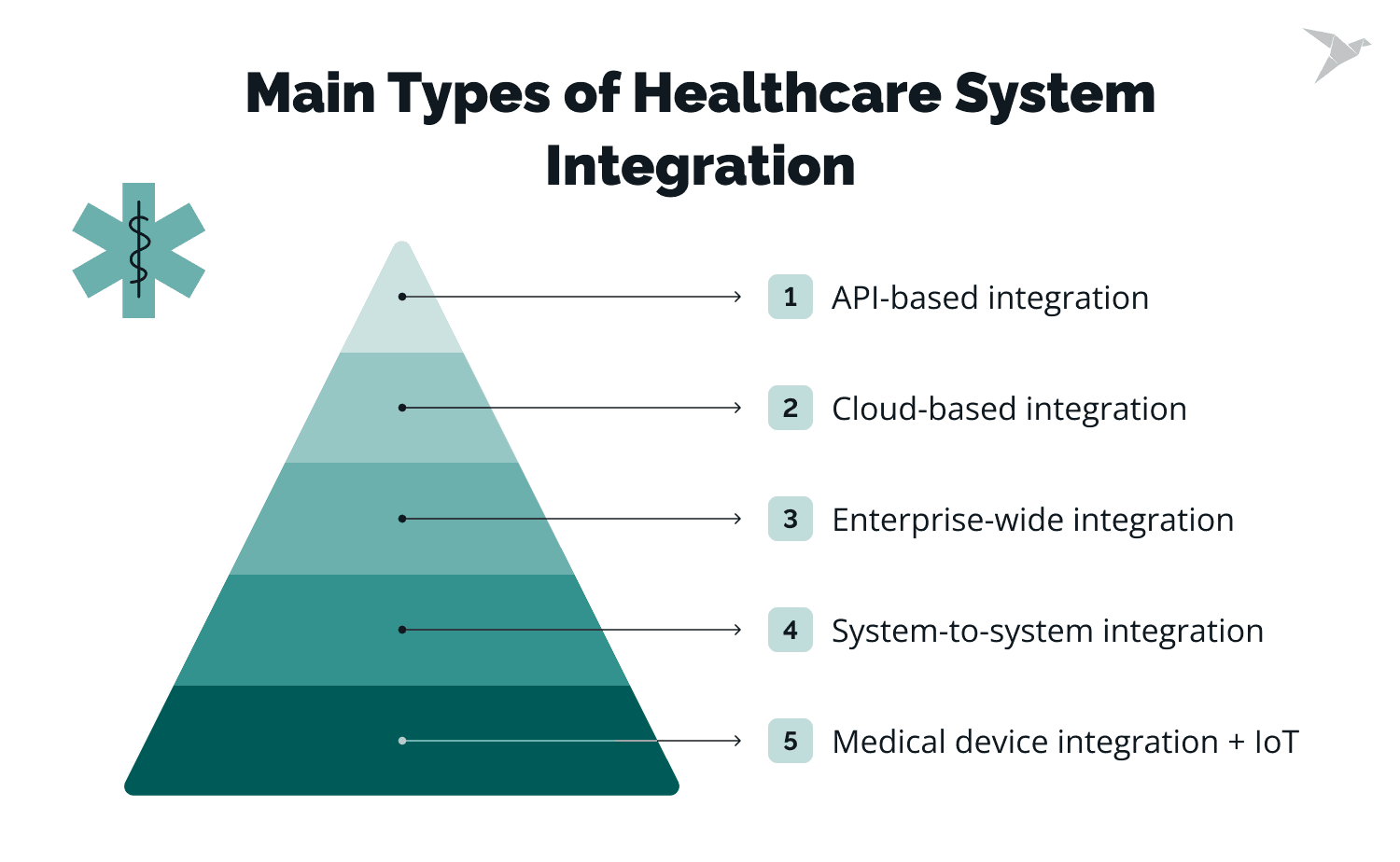
What are the Main Types of Healthcare System Integration?
Healthcare integration, in all its forms, makes patient care faster, safer, and more connected. Each type plays a crucial role in creating a seamless healthcare experience.
System-to-system integration in healthcare
This kind of health systems integration connects the systems you rely on most: EHRs, lab databases, and billing platforms. They share information automatically. For example, when a lab test is done, the result shows up in the patient's record right away, with no phone calls in between.
That cuts down paperwork, prevents mistakes, and gets patients to a diagnosis faster. One 2024 study linked emergency-department access to shared patient data with a 34% to 63% lower risk of a code blue (a life-threatening emergency, such as cardiac arrest) for higher-acuity patients.
API-based integration
APIs act like bridges between apps, and it lets them pass information back and forth in real time. It's the same thing your calendar does when it syncs with the reminders on your phone. In healthcare, APIs allows a patient portal update an appointment slot or fire an e-prescription straight to the pharmacy. They earn their keep in telehealth most of all, where a provider needs the patient's history in front of them the moment the call starts.
Medical device integration + IoT
Wearables and in-hospital equipment, from heart monitors to glucose sensors, are all part of the Internet of Things (IoT). They can push live health data straight into a patient's record, which lets a doctor track how someone's doing from a distance and spot trouble early. Connect the devices this way and alerts reach the right person faster than a nurse rounding on schedule ever could.
Cloud-based integration
Cloud-based integration keeps patient information stored securely online, so your providers can reach it wherever they happen to be. That suits multi-location health systems, integrated health services, and telehealth providers especially well. When the records live in the cloud, two or three specialists can open the same file at once instead of waiting their turn, and coordination stops being a bottleneck.
Enterprise-wide integration
Enterprise-wide integration ties together every system in a healthcare organization, from the front desk booking appointments to the specialist clinics down the hall. Everyone ends up working from the same current view of the patient.
Repeat tests drop off, and departments that used to trade phone calls start actually collaborating. Organizations that get this far tend to notice it first in the small things: fewer errors, less rework, a workflow that stops fighting them.
Why Does Healthcare Software Integration Matter for Healthcare Organizations?
Healthcare is a team effort. When the systems can't talk to each other, though, it can feel like everyone's playing a different game. In this context, integration puts providers on the same page, and patient care gets smoother as a result.

You get better patient care and outcomes
When systems connect, a doctor sees the whole picture. Past treatments, allergies, the last set of test results, all in one place, with no digging through scattered records for something that should already be there. With it laid out, they diagnose faster, make better-informed calls, and tailor the care to the person in front of them.
Communication between healthcare providers becomes clearer
When primary care healthcare professionals, medical services providers, and labs share updates as they happen, tey don't have to guess. There's less back-and-forth and less repeat testing, and the whole thing feels calmer from the patient's side.
Smoother operations and less busywork
Nobody loves paperwork. When systems update each other on their own, your team spends less time typing and more time with patients, and the errors that sneak in with manual data entry mostly disappear.
Stronger security and privacy
Integrated systems are built to keep data safe. Secure logins and encryption do the heavy lifting, audit trails catch the rest, and providers meet privacy standards without breaking a sweat.
You are ready for future innovations
Good integration makes it easy to add new tech later. Telehealth, remote mental health services, wearables, AI diagnostics, whatever comes next, none of it lands well without the right foundation underneath.
Rather than bolting on separate tools one at a time, you get everything in one consistent form from day one. When your systems work together, your people do too. And that's exactly where HL7 integration comes in. It gives healthcare systems a shared, standardized way to talk to each other and exchange data securely.
What is HL7 FHIR: Details and Benefits
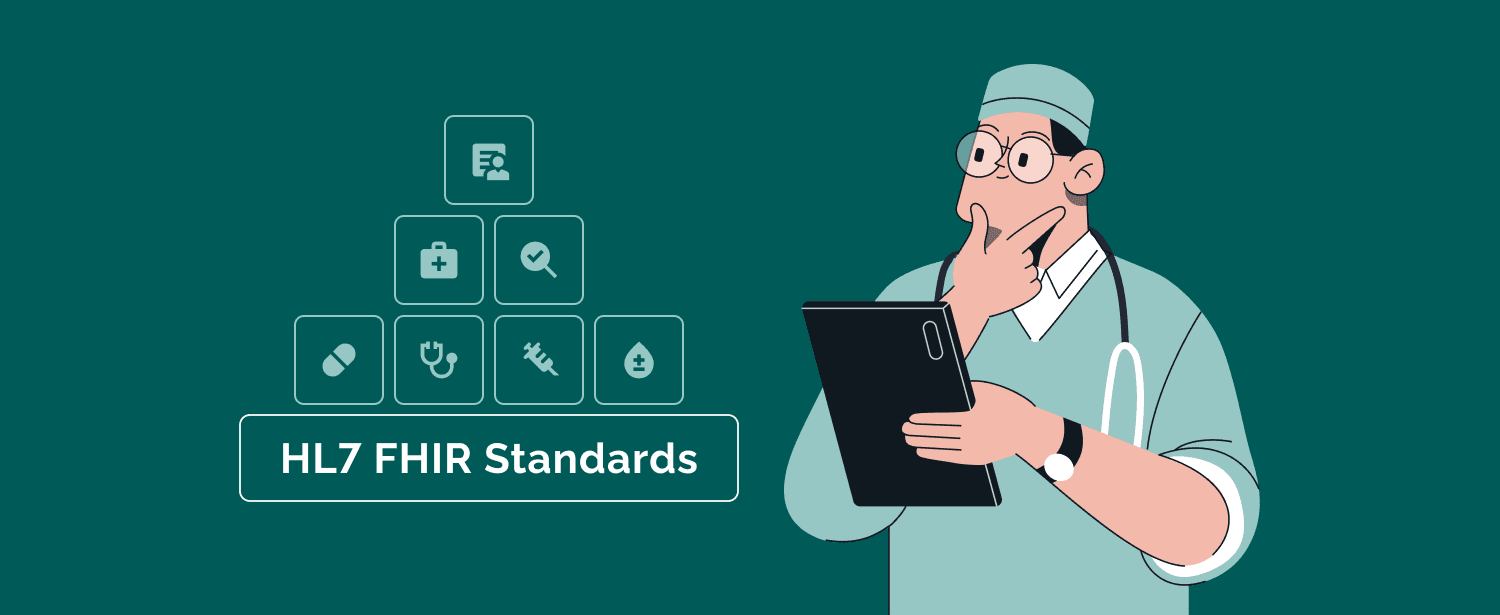
HL7 FHIR (Fast Healthcare Interoperability Resources) is a standard that helps healthcare systems share and access patient information easily and securely. It uses everyday web technologies to organize healthcare data into structured formats, so different platforms can read and exchange it without custom work.

What are the main benefits of the HL7 FHIR standard?
The main reason to adopt HL7 FHIR is to make healthcare systems work together with far less friction. That's not the whole story, though. Here are the benefits that matter most for data integration in healthcare.

Interoperability across systems
Put simply, FHIR gives different healthcare systems a common language. Platforms that once stayed walled off can now share patient information in real time. For example, with the right EHR software development services, a patient's lab results from one hospital can update their electronic health record at another clinic automatically. That speeds up treatment decisions.
Scalability and flexibility
FHIR has a modular design, so it fits a small clinic and a large hospital network alike. Your organization can grow without overhauling its systems. A small clinic might use FHIR to connect to a regional health information exchange, and a large hospital network can bring many specialized departments under one system.
Patient access and control
FHIR gives patients easy access to their medical records through apps and patient portals. That kind of transparency helps them stay informed and take an active part in their own care. For example, someone managing diabetes can pull blood sugar readings from a wearable and share them straight with their doctor.
Faster integration and development
FHIR is built on familiar web standards like RESTful APIs and JSON. That means that developers can connect new tools to existing healthcare systems and do not reinvent the wiring. You can roll out new digital services, like mobile health apps or telehealth platforms, without long development cycles.
Key Examples of Healthcare Integration with HL7 FHIR
HL7 FHIR is a powerful technical standard, and it solves real-world problems in healthcare thanks to making data sharing easier, faster, and more secure. From our experience, these areas are the most prominent examples of improved patient care and operations.
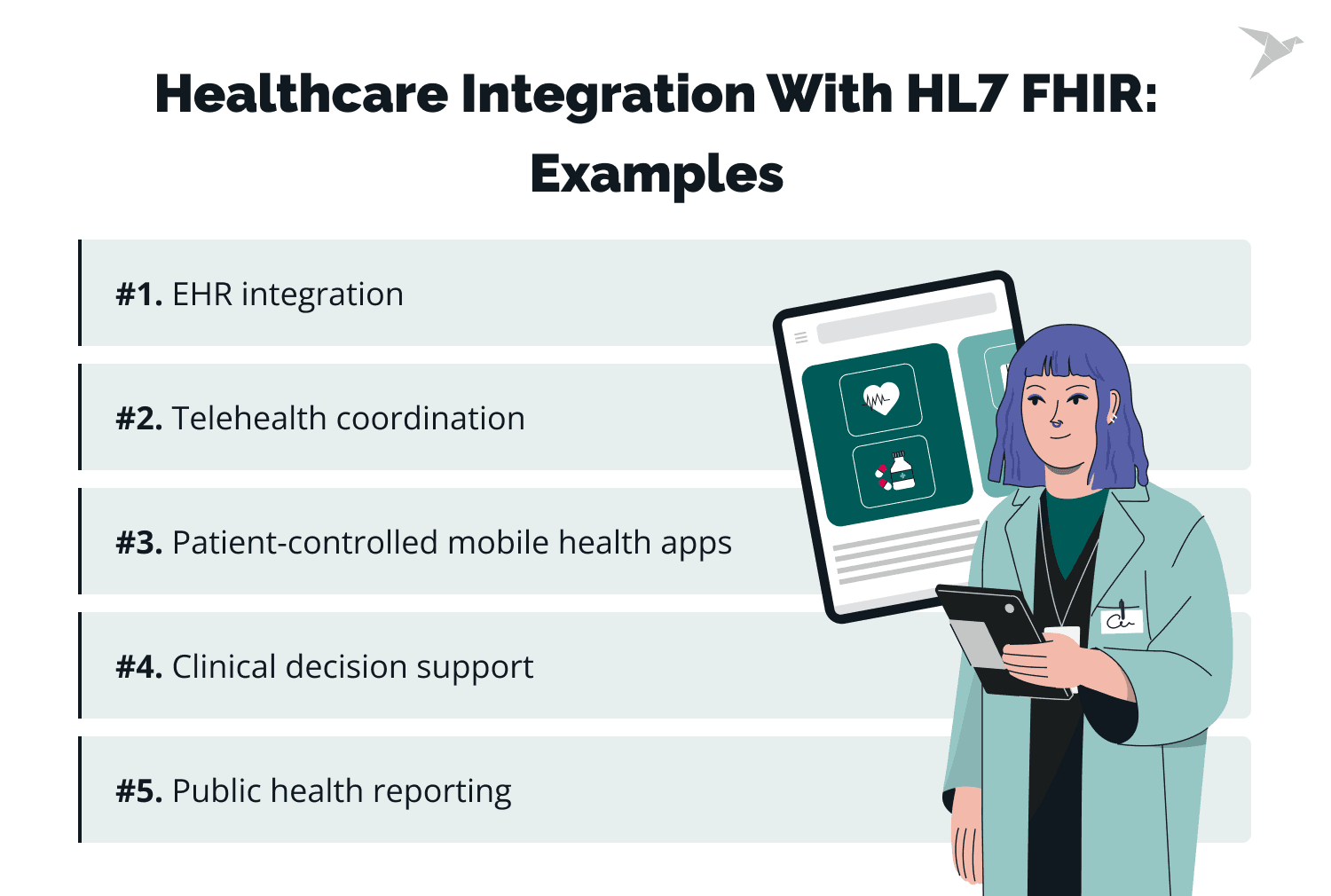
Seamless EHR integration
One of the biggest challenges in healthcare is that hospitals and clinics often use different Electronic Health Record (EHR) systems that don’t "communicate" with each other. FHIR helps bridge this gap.
Real-world example: Cleveland Clinic uses FHIR to sync patient records across its entire network. This means that when a patient moves from one facility to another, doctors can instantly access their history, reducing unnecessary tests and improving treatment decisions.
Better telehealth coordination
Telehealth has become a key part of healthcare, but without integration, virtual visits can leave gaps in a patient’s medical history.
Real-world example: Amwell, a popular telehealth provider, uses FHIR to update patient records in real-time. During the COVID-19 pandemic, this ensured that primary care physicians had immediate access to virtual visit summaries. This was critical for keeping treatment plans consistent, whether care was delivered online or in person.
Patient-controlled mobile health apps
FHIR lets patients access and manage their health data through mobile apps.
Real-world example: Apple Health, for instance, lets users securely pull medical records from several providers onto their iPhones. A patient can check lab results, track medications, and share key health information with specialists, all without logging into a stack of separate hospital portals.
Smarter clinical decision support
FHIR can power real-time alerts and recommendations for clinicians.
Real-world example: Take Epic, one of the most widely used EHR systems. Integrated with FHIR, it can flag potential drug interactions on the spot. If a doctor prescribes something that clashes with a patient's allergies or current prescriptions, Epic alerts them right away, which lowers the risk of medication errors.
Faster public health reporting
FHIR also helps health departments collect and analyze data more quickly.
Real-world example: During the COVID-19 crisis, New York State used FHIR-based reporting systems to track case numbers in real time. That gave public health officials a clearer view to allocate resources, monitor outbreaks, and make quicker policy calls, so they could respond sooner.
How to Ensure Data Security During Integration
Healthcare providers need to pull data from different sources to see a patient's full health picture. That matters even more as care shifts toward outcome-based models.
Yet digitizing health data brings real risk along with it. A breach doesn't just cost money, it costs patient trust, and that's harder to rebuild than a server. So security can't be an afterthought bolted onto integration once everything else works. It has to be there from the first design decision.
Secure system architecture
We always start with the architecture itself. Network segmentation keeps critical patient data walled off from less sensitive systems, so a compromised front-end doesn't hand an attacker the whole database. Zero-trust goes a step further: nobody is trusted by default, not even someone already inside the network, and every request gets checked on its own merits.
Data encryption
Say a laptop with patient records gets stolen from a clinic. If the data's encrypted with something like AES-256, whoever took it is looking at unreadable noise, not a medical record. That protection needs to hold in two states: sitting on a server (at rest) and moving between systems (in transit, usually over TLS). Miss either one and you've left a door open.
Access control and identity management
A billing clerk, for instance, doesn't need to see psychiatric notes. A radiologist, at the other hand, doesn't need payroll data.
Role-based access control (RBAC) draws that line by job function, and multi-factor authentication backs it up: a stolen password alone shouldn't be enough to get anyone in.
Threat monitoring and incident response
This part is especially uncomfortable. Most organizations don't know they've been breached until weeks or months later.
Round-the-clock monitoring shortens that window, catching the odd login or unusual data pull while it's still happening. And because something eventually gets through no matter how good the defenses are, an incident response plan decides whether a breach costs you a bad afternoon or a bad year.
Compliance and risk assessments
Healthcare organizations have to follow strict rules like HIPAA, GDPR, and HITECH to protect patient data. Regular security audits and risk assessments help you find vulnerabilities and stay compliant. They also show you where to tighten your security policies.
Secure API and third-party integrations
APIs are the connective tissue between systems, and connective tissue is exactly where attackers probe first. Authentication tokens, rate limits, and monitoring keep that surface small.
The same goes for vendors. If a third party touches your data, they need to clear a real security review.
Top 5 Challenges and Solutions in Healthcare Integration
Integrating healthcare systems gets complicated fast. But most projects run into the same handful of obstacles, and once you know them, they're much easier to plan around. From our experience, the challenges below are the ones that come up most often, so we have paired each with a practical fix you can use for secure, effective integrations.
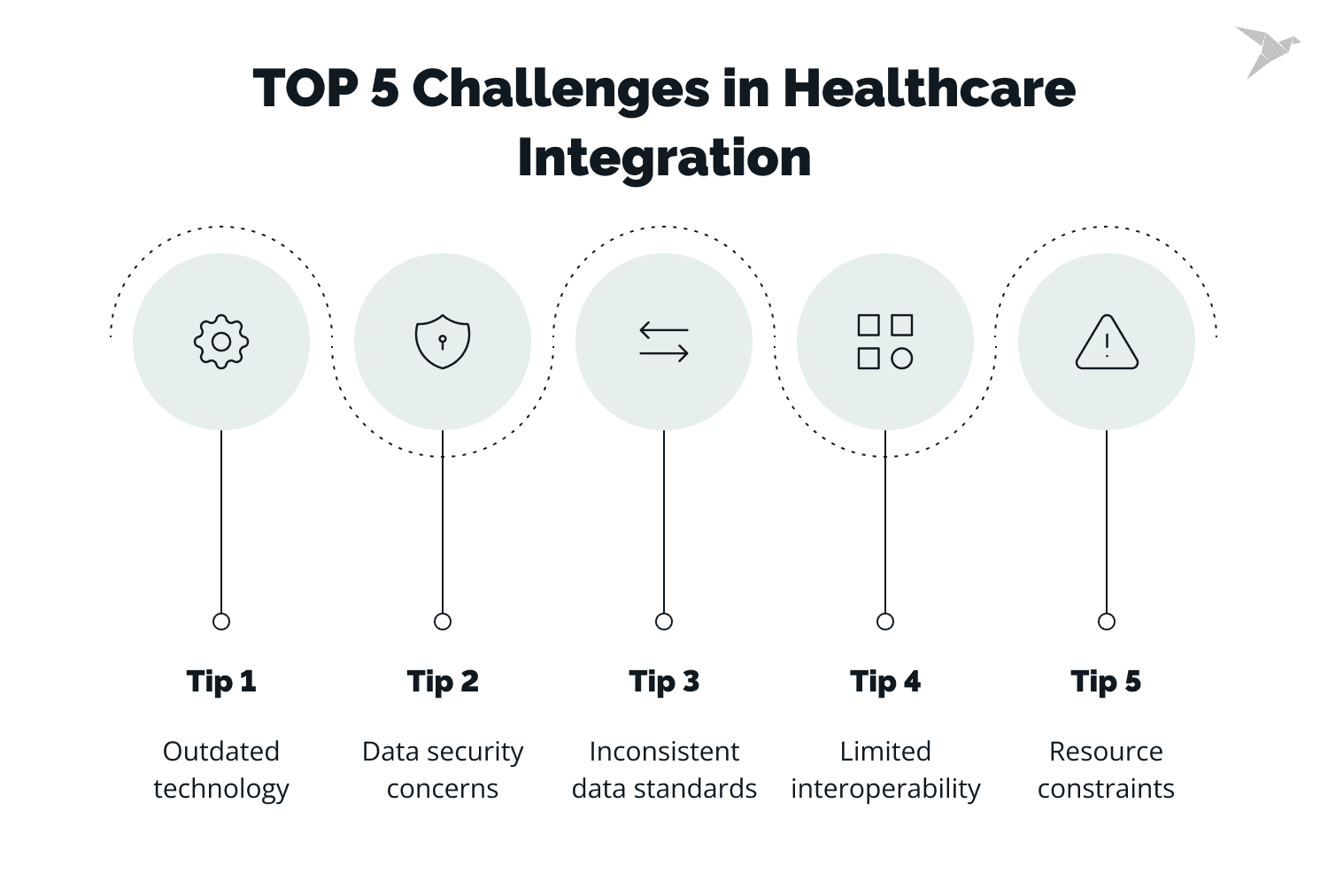
1. Outdated technology
Many hospitals and clinics still rely on legacy systems – some developed decades ago – that were never designed for seamless data sharing. These outdated systems often use proprietary formats, making integration with newer software extremely difficult.
According to a Grand View Research report, the lack of modernization in healthcare IT infrastructure slows down digital transformation efforts, increasing operational costs and administrative burdens.
Why it matters:
- Outdated systems create data silos, so no one gets a complete view of a patient's records.
- Manual data entry, forced by poor compatibility, raises the risk of medical errors.
- Legacy software doesn't support modern security protocols, which widens your cybersecurity exposure.
The solution:
In this case, аor integration in healthcare, you can start with middleware, software that sits between old and new systems and lets them communicate without an immediate overhaul. The longer-term fix is gradual modernization: replace outdated components step by step to limit disruption and keep costs under control.
2. Data security concerns
When you integrate healthcare data, patient information moves across a lot of systems at once, and each hop is another opening for an attacker. Healthcare data breaches rose 25% in 2023, exposing over 133 million patient records. Ransomware, insider threats, and weak spots in cloud-based services account for most of it.
Why it matters:
- A single data breach costs healthcare organizations $9.77 million on average, more than any other industry.
- Weak security invites HIPAA violations, which bring fines on top of the breach itself, and patients don't forget it either, once their data's been exposed, trust doesn't come back easily.
- Patients lose trust in their providers once sensitive data is exposed.
The solution:
Healthcare organizations need security in layers, and no single layer covers it alone: end-to-end encryption, multi-factor authentication (MFA), regular audits and penetration testing, and a zero-trust architecture (ZTA) that assumes no request is safe until it's checked.

3. Inconsistent data standards
Healthcare data often lives in incompatible formats, so it's hard to move between systems. One provider runs HL7 v2, another uses CDA (Clinical Document Architecture), a third has something proprietary, and without a shared standard you get mismatches: missing history, workflows that never quite line up.
Why it matters:
- Physicians often work from incomplete or outdated records, which affects patient care.
- Formats that don't match mean a lab or pharmacy can misread a result or a prescription, and on a larger scale.
- Interoperability gaps slow down the research that depends on complete data in the first place.
The solution: FHIR standardizes how data gets formatted and shared, so systems can read each other without custom translation work every time. Epic and Cerner have both built FHIR into their platforms for real-time exchange, among other EHR vendors doing the same.

4. Limited interoperability
Vendors build proprietary systems, and proprietary systems don't always play well with anyone else's. When they don't, someone on staff ends up moving the information by hand, and hand-entry is where errors creep in and speed disappears.
Why it matters:
- Delayed decisions: critical health data can take hours, sometimes days, to reach the team that actually needs it.
- Heavier admin load: staff spend that time entering and checking data instead of with patients.
- Higher costs: organizations locked into one vendor pay steep fees just to integrate or change anything down the line.
The solution:
Open-source APIs and vendor-neutral integration platforms are the way out of that particular trap. They lower the walls between tools, so systems end up talking to each other without one vendor holding the keys.
5. Resource constraints
Plenty of providers are working with tight budgets and a thin IT bench, and that's often the real obstacle, more than any technical one. Buying, setting up, and maintaining integrated systems adds up fast, and it hits smaller hospitals and clinics hardest. Understaffed IT teams mean timelines slip, sometimes by months, before a project even gets to the hard part.
Why it matters:
- Tight finances leave rural and small facilities struggling to adopt modern IT systems.
- Too few IT specialists slow integration down, leaving critical systems disconnected.
- It's hard to justify ROI on integration when the payoff isn't immediate.
The solution:
To work within a tight budget and limited resources, you can do three main things:
- You can start with the integration projects that do the most for efficiency and patient care.
- Then roll out in phases, upgrading systems gradually instead of all at once.
- And tap government grants and health IT funding programs to offset costs.
Also, you can train your existing IT team to level up, this is a good practice.
Wrapping Up
Healthcare integration is about more than plugging systems into each other. Done well, it improves patient care, cuts errors, and makes daily operations run smoother. A solid plan gets your EHRs talking to each other, keeps data exchanges secure, and puts HL7 FHIR to work for real interoperability.
Security carries just as much weight. Protecting patient data takes encryption, access controls, real-time monitoring, and compliance with strict regulations. Skip those safeguards, and even the most advanced integration turns into a liability.
Adoption is climbing, but slowly. In a 2025 KLAS review, only 49% of clinicians said they expect their EHRs to connect with outside systems, barely up from 46% in 2023. Meanwhile the market keeps growing. Statista projects the global health IT market will reach about $140 billion in 2026. The tools are maturing fast, and the organizations that sort out integration now will be the ones ready for what comes next.
So the right integration really can pay off. If you're after a secure, scalable setup, or you just want expert eyes on your healthcare integration, let's talk. Our team has been through these challenges before and can help you build a system that actually works for you.

FAQ

Healthcare integration, or healthcare IT integration, connects different systems and applications to ensure seamless data exchange. It enables hospitals, clinics, labs, and pharmacies to share patient information securely, improving care coordination and efficiency.
Examples include EHR systems sharing patient records, telehealth platforms updating medical histories in real-time, and pharmacies receiving digital prescriptions directly from doctors. Remote monitoring devices also sync health data with medical records, while public health agencies use integration for real-time disease tracking.
Interoperability remains the biggest challenge, as many healthcare systems use different technologies and data formats that don’t communicate effectively. Security risks, outdated infrastructure, and high costs also make integration difficult, but adopting HL7 FHIR and open APIs can help streamline the process.