
 Software Development
 Security Services
 Cloud Services
 AI Services
 Other Services















 TechMagic Academy


How To Maximize EHR ROI Through Better Data Interoperability and Integration
Last updated:23 December 2025



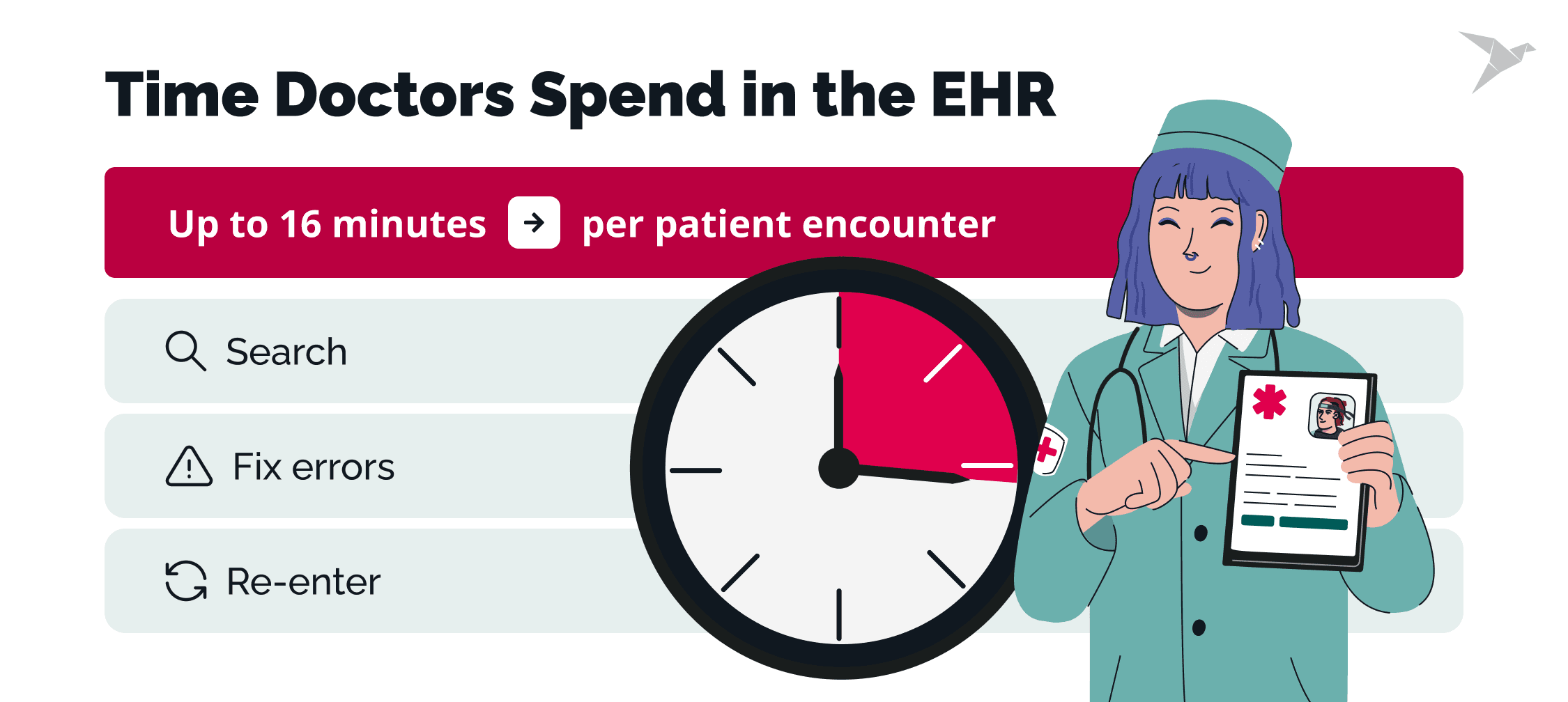
Clinicians spend up to 16 minutes per patient encounter inside the EHR, according to JAMA Internal Medicine. Much of this time is tied to searching for, correcting, or re-entering information that should already flow between systems.
Your system only creates value when the data around it moves freely. Most healthcare leaders feel the burden of this every day. You invest millions into an EHR, yet fragmentation slows teams down, revenue disappears into inefficiencies, and clinicians still fight data instead of using it.
Hidden costs in EHR adoption, such as unexpected expenses for hardware, software upgrades, training, and ongoing maintenance, can even further decrease your return on investment and make it harder to realize the full value of your system.
If you’re reading this, you’re likely trying to understand how to maximize EHR ROI without adding more tools, more cost, or more frustration. We see this pattern often. Leaders want smoother workflows, steadier revenue, fewer manual fixes, and a system that finally “just works.” But interoperability gaps make everything harder. And when data doesn’t connect, ROI stalls.
The good news: improving interoperability is one of the fastest, most predictable ways to reverse that trend and improve ROI of an EHR system.
In this article, you’ll learn what EHR ROI actually includes, why interoperability carries so much financial weight, and how organizations can maximize EHR ROI with data interoperability through the right strategy, architecture, automation, and measurement. Let’s get into it.
Key Takeaways
- Interoperability is the most reliable way to maximize EHR ROI. Clean data flow reduces manual work, speeds decisions, and stabilizes revenue.
- Fragmented systems drain performance. Missing data, rework, and duplicate tasks slow clinicians down and increase avoidable costs.
- EHR ROI touches five areas: financial health, staff productivity, patient experience, compliance, and long-term scalability.
- Automation and AI amplify the benefits. They reduce coding errors, prevent denials, cut administrative time, and strengthen decision-making.
- High-value integrations deliver the biggest impact. Billing, labs, pharmacy, referrals, patient portals, RPM, and analytics are the core ROI drivers.
- A strong strategy is ROI-driven, not IT-driven. Clear baselines, mapped data flows, and prioritized use cases guide measurable improvement.
- Governance and adoption matter. Interoperability succeeds when IT, clinical, operations, and revenue cycle teams share accountability.
- Interoperability is ongoing work. Continuous monitoring and small improvements keep the organization improving the ROI of its EHR system over time.
- TechMagic accelerates results with deep EHR integration expertise. We help healthcare organizations reduce complexity, modernize data flows, enhance key integrations, and achieve measurable ROI faster.
What Does Maximizing EHR ROI Really Mean?
Maximizing EHR ROI means getting measurable financial, operational, and clinical value from every part of your system. Implementing an EHR system requires a significant financial investment, so organizations must carefully consider the expected benefits, both tangible and intangible, such as improved efficiency, cost savings, and enhanced patient care.
Organizations increase ROI when staff work faster, revenue becomes more accurate, patients move through the system with fewer delays, and leaders make decisions based on clean, connected data.
The common thread behind all of these gains is interoperability. When systems talk to each other, the EHR becomes an engine for efficiency.
Simply put, EHR ROI reflects how well your system contributes to financial health and quality of care. To accurately assess this, organizations should identify ROI indicators and calculate ROI by gathering operational and financial data before and after EHR implementation.
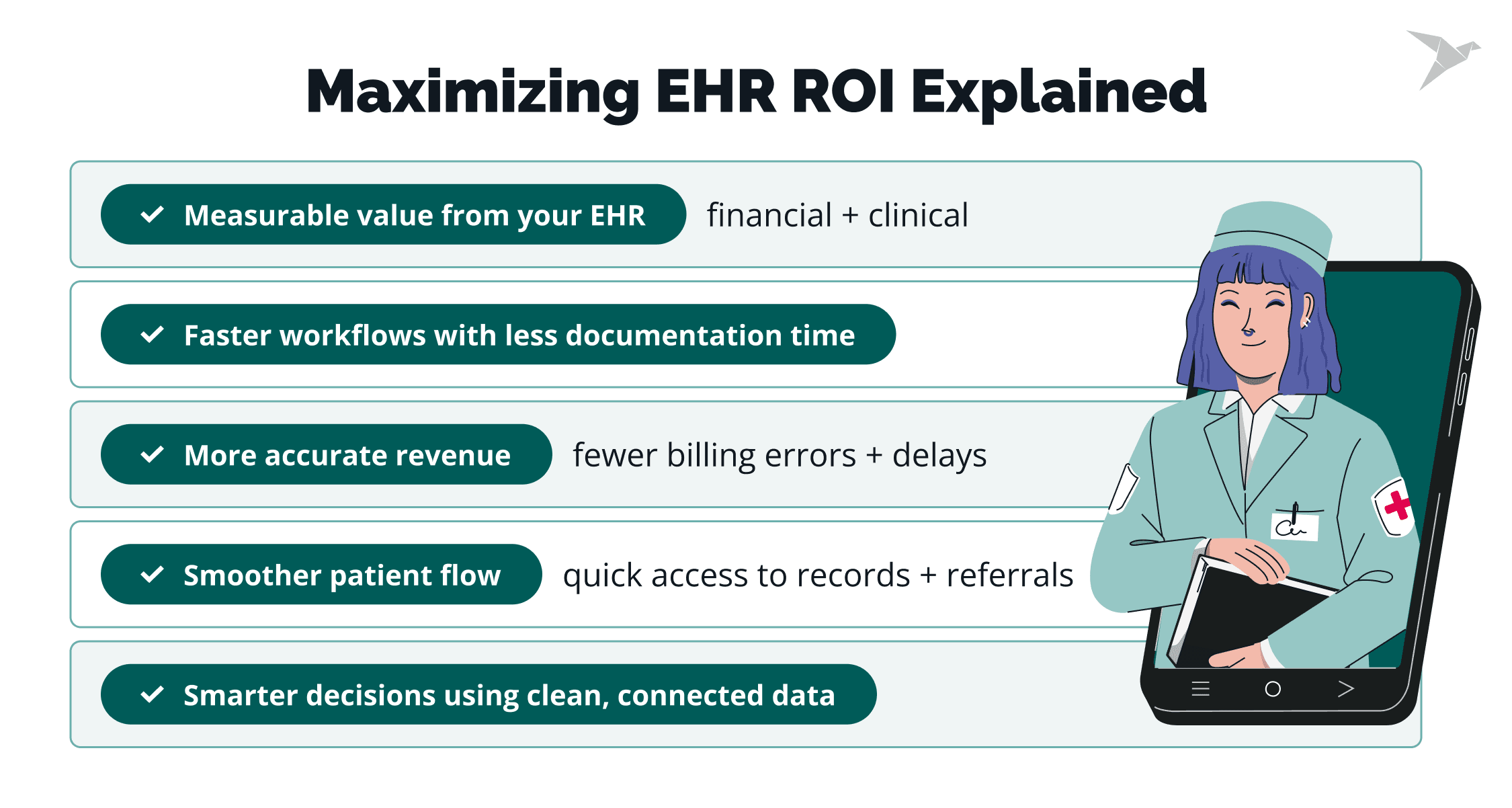
“EHR ROI” typically spans five dimensions that leaders track over time:
- Cost savings. Fewer manual tasks, reduced duplication, and lower IT maintenance.
- Productivity. Smoother workflows, shorter documentation time, faster scheduling, and billing cycles.
- Patient satisfaction. Quicker access to patient records, smoother referrals, and more coordinated care.
- Compliance and risk reduction. Cleaner, more standardized templates of documentation, fewer errors, better audit readiness.
- Long-term operational value. The ability to scale, open new services, grow partnerships, and support value-based care.
ROI is a calculation of the most tangible financial benefits that can be expected from a project versus the costs of implementing the solution. To determine how long it takes to recover the initial costs, use the payback period formula: Cost of Investment divided by Average Annual Cash Flow.
Here’s a simple way leaders often visualize the components of ROI:
Why Does Data Interoperability Matter for EHR ROI?
Data interoperability matters for EHR ROI because clean, consistent data exchange removes the manual work, delays, and revenue gaps that quietly drain budgets. When systems talk to each other, teams move faster, patients move smoothly, and leaders finally see the value they expected from their EHR investment. Organizations should also consider interoperability costs, such as expenses associated with secure communication and data exchange between various medical entities.
This is one of the clearest ways of how to improve EHR ROI. Let’s explore in detail the “how” in the next section!

How Does Improved Interoperability Directly Impact ROI?
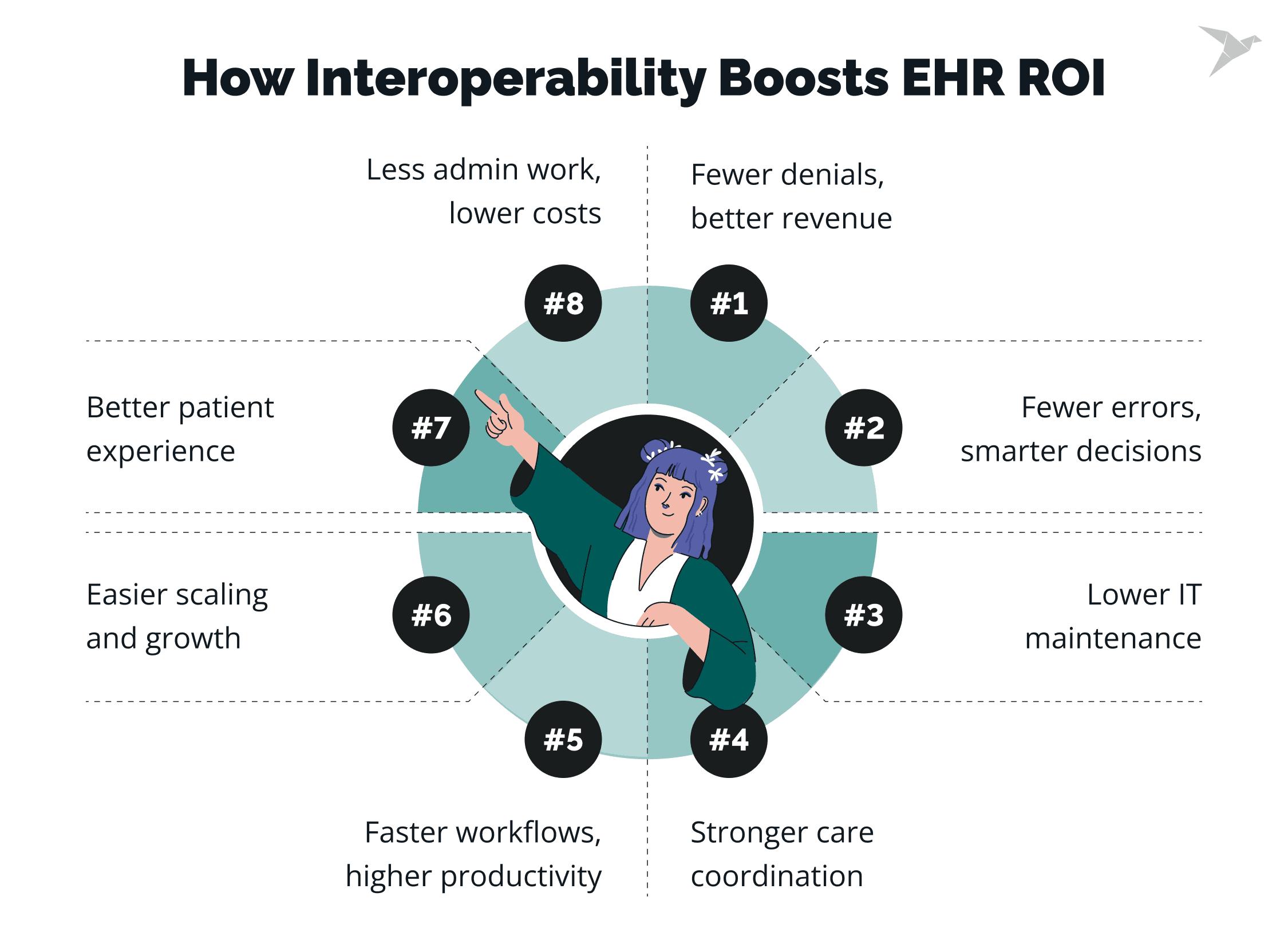
Improved interoperability impacts ROI by cutting unnecessary costs, reducing claim denials, and removing delays that slow down clinical and operational work. When the EHR, billing, labs, pharmacy, referral networks, and patient portals share data cleanly, organizations see fewer errors, faster cash flow, and better patient experiences.
Improved interoperability is one of the most dependable ways to maximize EHR ROI. Now let’s look at how that plays out in practice.
Reduced manual administrative work and operational costs
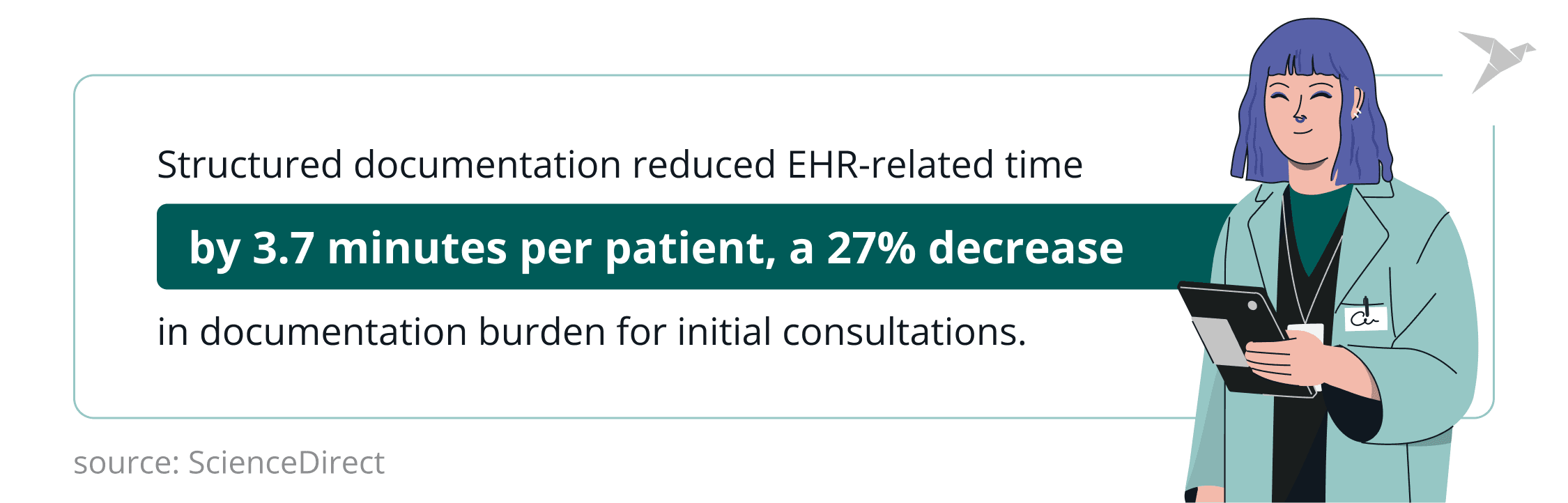
Interoperability replaces repeated data entry, fax chasing, and spreadsheet reconciliations with automated data flow. A study published in ScienceDirect showed that implementing structured documentation reduced EHR-related time by 3.7 minutes per patient, a 27% decrease in documentation burden for initial consultations. That’s time staff can reinvest into care or revenue-generating tasks. For many TechMagic clients, this becomes an early visible win in how to improve EHR ROI.
By the way, when adopting an EHR system, organizations must consider implementation costs, which include hardware upgrades, EHR software licensing, staff training, and ongoing maintenance. Data migration is also a significant component of total costs and a critical step in transitioning to new systems, as it ensures patient records are accurately transferred and compliant.
Improved revenue capture from cleaner, more complete data
Revenue leakage is often tied to claim denials. Many providers see rejection rates between 10% and 15% due to missing or incorrect data, according to a 2024 State of Claims 2024 report from Experian.
When systems are integrated, documentation, orders, codes, and charges flow consistently to billing. This reduces denials, cuts rework, and improves cash flow. That’s a strong lever for how to maximize EHR ROI with data interoperability.
Faster clinical workflows and higher staff productivity
Clinicians shouldn’t have to dig through multiple portals or call external sites to find labs, imaging, or medication histories. When systems are well integrated, key information loads in the EHR at the point of care. That shortens documentation time, reduces interruptions, and lets teams see more patients per day without burnout. Streamlined workflows and improved efficiency also contribute to greater job satisfaction for clinicians, as they experience less frustration and more professional fulfillment.
In a 2025 study published in the MDPI Journal, 85% of surveyed patients reported using an integrated patient portal, with most frequently using it to schedule appointments and view lab results, and reporting high satisfaction when they could easily update personal and clinical information.
Stronger care coordination across providers and care settings
Referrals, consult notes, discharge summaries, and external results often live in separate systems. Interoperability makes them feel like one record. Implementing EHR systems with other healthcare entities, including medical offices, hospitals, labs, and pharmacies, facilitates secure communication and interoperability across providers and care settings. Care teams stay aligned, follow-ups happen on time, and patients experience fewer handoff issues. That smoother flow improves quality of care and operational efficiency.
Fewer clinical errors and better decision-making
Missing or fragmented data raises the risk of duplicate tests, medication conflicts, and missed follow-ups. Most EHR systems can provide real-time alerts and warnings for medication interactions to help prevent adverse drug events and improve patient safety. When data from different sources is consistently available and reconciled, clinicians see the whole story at once. That supports safer decisions and reduces avoidable costs tied to complications or readmissions.
Lower IT maintenance costs through modernized integrations
A lot of hidden cost sits inside legacy point-to-point interfaces that need constant patching. Modern, standards-based interoperability (including API-based integrations) is easier to monitor, scale, and support. IT teams spend less time firefighting and more time improving systems. While most EHR systems are generally safe, there are still prevalent concerns about cybersecurity threats and privacy risks that practices need to address. This “quiet saving” becomes an important lever in how to increase EHR ROI over a multi-year horizon.
Higher patient satisfaction and retention through data transparency
Patient expectations are rising. When portals, engagement tools, and EHRs are tightly integrated, patients get timely results, clear communication, and smoother experiences. That drives better satisfaction scores, fewer no-shows, and stronger retention.
Greater scalability for new services, sites, and partnerships
Interoperability also determines how easy it is to grow. Adding a new clinic, connecting a partner lab, or launching a new service line becomes far easier and less expensive.
For organizations working with TechMagic, this often shifts the EHR from a “necessary cost center” to an integrated platform that genuinely supports growth. This is a key outcome when you want to improve ROI of an EHR system long term.
Data Interoperability Impact on ROI: Snapshot
Here’s the quick contrast based on our experience:
From a business perspective, interoperability is a financial foundation. Organizations that invest in it consistently maximize EHR ROI with data interoperability and build an EHR ecosystem that keeps delivering value long term.
Language-first interoperability can also help resolve data inconsistencies at the source and make every exchange more reliable.
With the impact clear, the next step is to understand how to build an interoperability strategy that reliably increases EHR ROI. We cover this in the next section.
How to Build an Interoperability Strategy That Improves EHR ROI
You improve EHR ROI if you build an interoperability strategy that ties every integration to a financial or operational outcome you can measure. When interoperability becomes a business decision instead of a technical chore, the EHR shifts from a cost center to a growth engine.
This is also where many organizations bring in a partner like TechMagic: not to add complexity, but to avoid it. Now let’s walk through the steps and what they look like in practice.
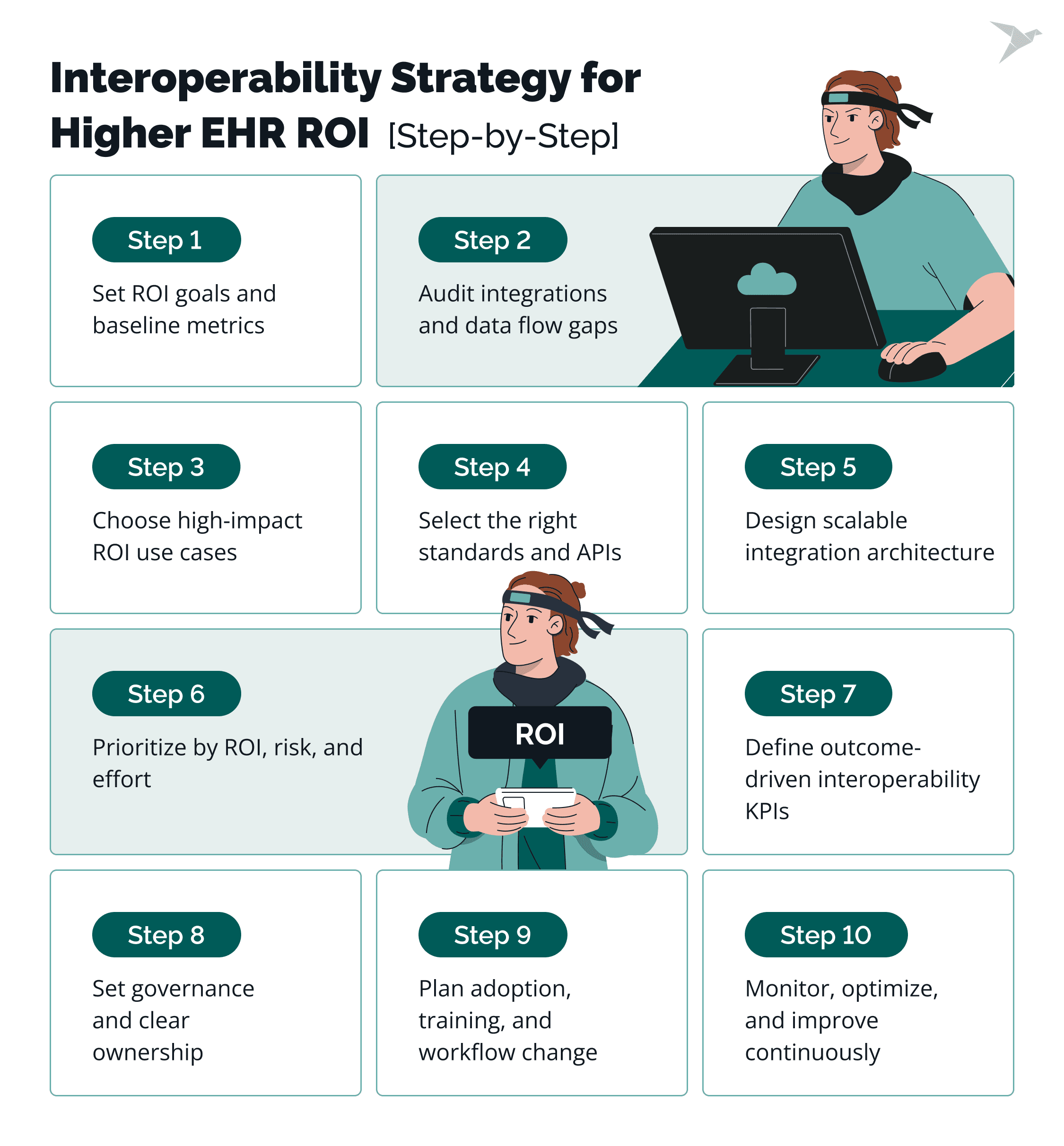
Step 1: Define ROI goals and establish a clear baseline
Start by naming the specific results you want to change. ROI isn’t abstract. It’s denial rates, admin hours, documentation time, referral delays, patient throughput, and IT maintenance costs. Measure where each stands today.
When establishing baselines, it is crucial to compare financial performance across the pre-EHR period, peri-EHR periods, and post-EHR periods. This approach allows you to evaluate the impact of EHR implementation before, during, and after EHR adoption.
Practical example: A multispecialty medical practice found that 18% of its denials were caused by incomplete clinical data. That single number became the baseline metric that shaped its interoperability roadmap. Thus, their ROI goal was to reduce data-related denials enough to recover the revenue lost each month and stabilize cash flow.
Step 2: Audit current integrations, data flows, and interoperability gaps
Create a map of every system that touches your EHR: billing, labs, imaging, pharmacy, scheduling, care coordination tools, analytics platforms, and patient-facing apps. Then pinpoint where data stalls or breaks.
Common gaps include:
- Results that don’t auto-post to the EHR
- Patient demographics mismatched between systems
- Manual PDF uploads for referral summaries
- Medication lists inconsistent between the EHR and pharmacy systems
This audit becomes your blueprint. You’re not guessing but solving documented gaps.
Step 3: Map high-value use cases that directly impact revenue and cost
Focus on use cases that change financial performance or reduce labor. Not everything needs fixing; only what moves ROI.
High-impact examples:
- Integrating documentation with billing so charges flow automatically
- Auto-extracting clinical summaries for referrals to remove manual prep time
- Connecting labs to reduce order-entry errors and result delays
These are the use cases that maximize EHR ROI fastest.
Step 4: Select interoperability standards and APIs that fit your ecosystem
Choose standards based on what systems already support and how future-proof you want your architecture to be.
- FHIR APIs for patient-facing tools, mobile apps, care summaries
- HL7 v2 for orders, results, ADT feeds
- X12 for claims, eligibility, remittance
- SMART on FHIR for embedded apps directly inside the EHR
Practical example: A health system upgrading its patient portal chose SMART on FHIR so the portal could read and write data directly within the EHR. This reduced portal support tickets by 40%.
Step 5: Design an integration architecture aligned with your EHR and vendor landscape
Think about how data will move across your organization and what will scale over the next 3-5 years.
Architecture choices include:
- Direct point-to-point interfaces
- Integration engines (like Mirth or Rhapsody)
- API gateway models
- Hybrid approaches
Example: A network opening several satellite clinics chose an API gateway to “plug in” new services quickly without rebuilding interfaces each time.
Step 6: Prioritize initiatives based on ROI potential, risk, and implementation effort
Rank each initiative by:
- Expected financial impact
- Workflow friction
- EHR system implementation complexity
- Operational risk
This prevents teams from spending months on low-impact integrations while high-value ones wait.
Example: One organization realized its fax-to-referral workflow was costing over 400 staff hours per month. That integration jumped to the top of the list.
Step 7: Set measurable interoperability KPIs tied to financial and operational outcomes
Choose KPIs that show real movement.
Examples include:
- Reduction in denial rate tied to missing data
- Decrease in manual reconciliation hours
- Faster referral loop closure
- Higher completeness of external electronic medical records
- Fewer duplicate tests
This is where leaders begin to improve ROI of EHR systems with clarity and accountability.
Step 8: Establish governance, data ownership, and clinical/IT accountability
Successful interoperability requires clear roles:
- IT owns interface uptime and data routing
- Clinical teams own documentation quality
- Revenue cycle owns coding completeness
- Operations owns workflow consistency
Example: A radiology integration succeeds only if IT ensures real-time results delivery, clinicians enter clean orders, and billing aligns CPT/ICD codes with the incoming data feeds.
Governance turns integration from “IT’s job” into a shared responsibility.
Step 9: Plan change management, training, and clinician adoption strategies
New integrations fail when teams don’t adopt them. Create simple, task-based training. Remove steps that no longer matter. Celebrate time saved.
Example: When a cardiology group automated result imports from an external imaging center, documentation time dropped by 2-3 minutes per encounter. Clinicians noticed the improvement immediately.
Step 10: Implement ongoing EHR optimization and ROI monitoring
Monitor interface uptime, latency, failure rates, patient data completeness, and workflow impact. Fix small issues early so they don’t become operational fires. Add new connections as your organization grows. The organizations that consistently improve ROI of an EHR system treat interoperability as ongoing work.
Example: A large clinic added a dashboard for monitoring integration failures and reduced downtime by 60% in the first quarter.
Learn about our expertise in the industry and what we have to offer
Weak vs. Strong Interoperability Strategy: Snapshot
A quick way to see the impact of a well-built strategy is to compare how organizations operate with weak interoperability versus a strong, ROI-driven approach.
How Can Automation and AI Multiply the ROI of Interoperable EHR Systems?
Automation and AI multiply EHR ROI in the following way: they remove the manual work, data errors, and revenue-blocking gaps that persist even after systems are integrated. Interoperability ensures data can move, automation ensures it does move consistently, and AI ensures it moves correctly.
Together, they reduce administrative costs, prevent revenue leakage, and dramatically improve accuracy across clinical and billing workflows. Now let’s break down where the gains come from.
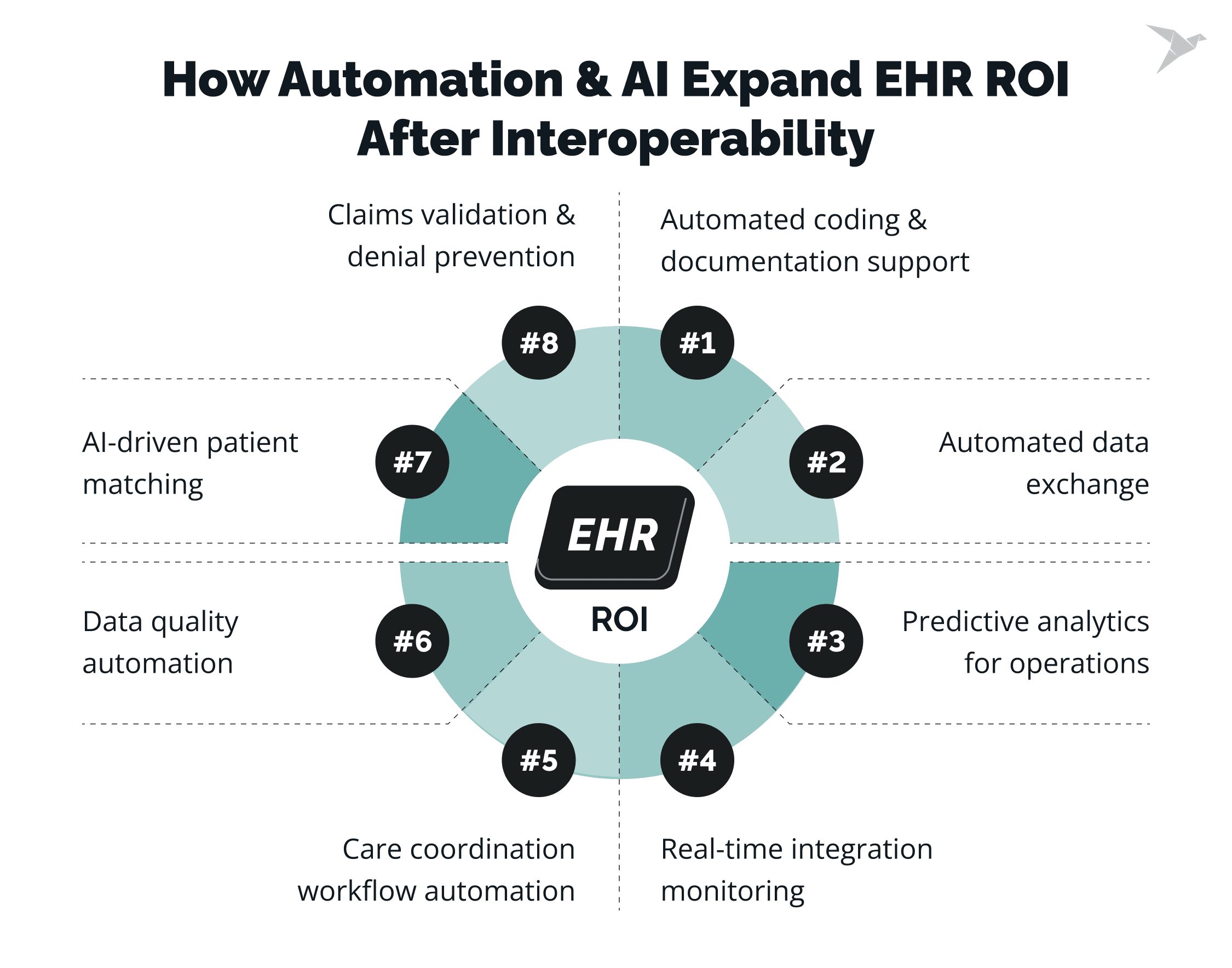
Automated data exchange
Automated interfaces take over the repetitive tasks that drain staff time: re-entering demographics, uploading PDFs, reconciling orders, or keying lab results into the EHR. When the data exchange is automated, administrative workload drops, and so do transcription errors. Teams spend less time correcting information and more time on care or revenue-driving work.
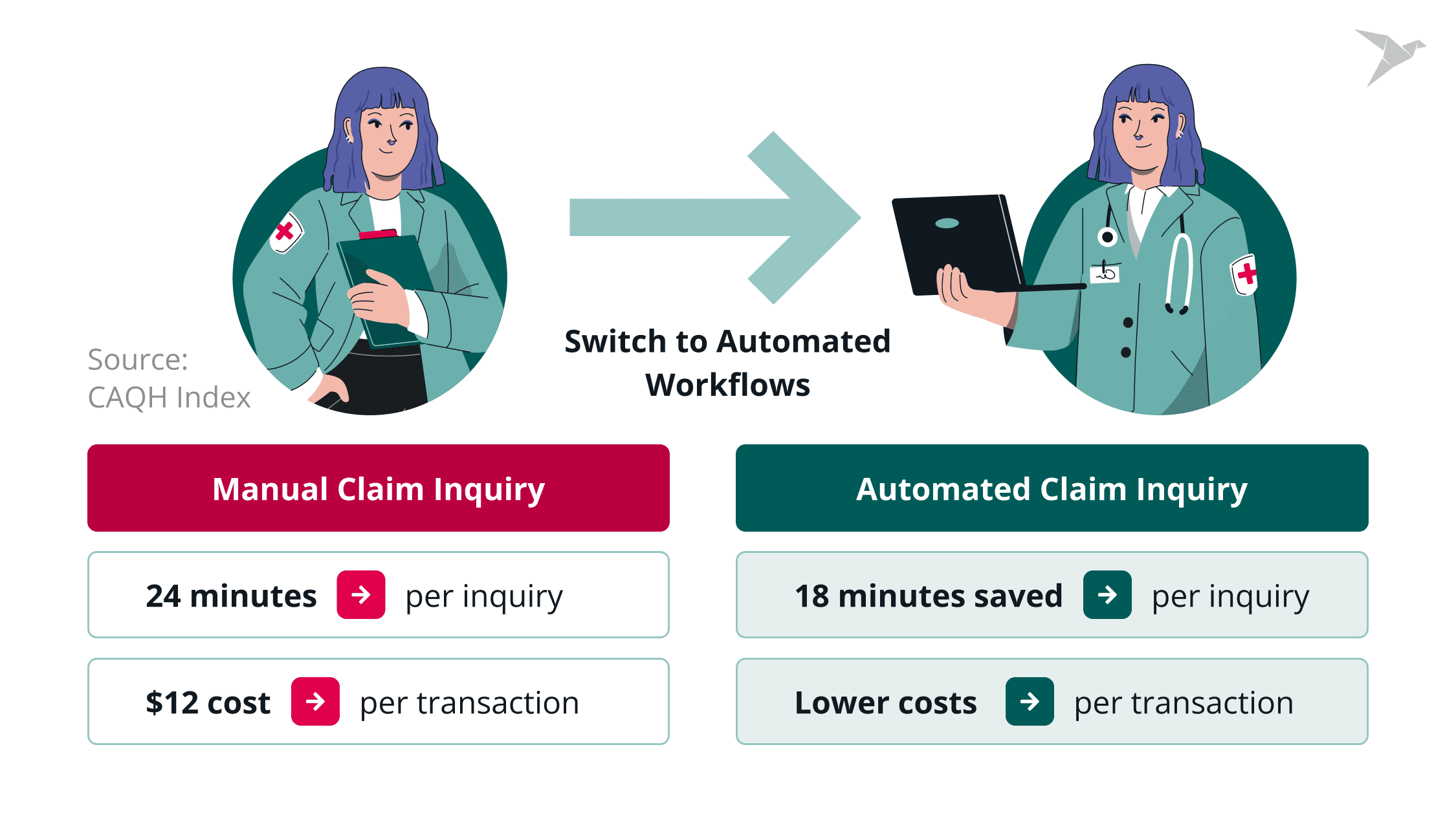
According to the CAQH Index, healthcare providers spend around 24 minutes on a manual claim status inquiry, at an average cost of $12 per transaction. Moving to electronic, automated workflows offers an estimated time savings of up to 18 minutes per transaction.
Example: A clinic integrating lab results through automated HL7 feeds eliminated roughly 20 hours per week of manual result entry. That alone made a noticeable dent in operational costs.
AI-driven patient matching
Identity errors create duplicate charts, mismatched billing records, and patient safety risks. AI-driven matching uses probabilistic and deterministic algorithms to align patient identities across electronic systems, even when names or demographics don’t match perfectly.
This reduces:
- Duplicate records
- Lost historical data
- Claim rejections tied to demographic inconsistencies
It strengthens the integrity of both clinical and financial data: a key lever in how to maximize EHR ROI.
Automated coding and documentation support
AI helps clinicians capture accurate codes without slowing them down. It surfaces relevant CPT/ICD codes based on the documentation, flags missing details, and fills small gaps that lead to undercoding or overcoding.
This improves ROI by:
- Reducing missed revenue
- Speeding documentation
- Lowering the need for coding rework
- Supporting cleaner claims from the start
Up to 80% of medical bills are estimated to contain errors, and 42% of claim denials are linked to coding issues, according to Healthtech Magazine. Given that, AI-powered coding and accuracy checks become a strong defense against revenue leakage. Moreover, AI-driven coding systems have been shown to cut coding errors by up to 35%, MedTech Intelligence reported.
Example: Organizations adopting AI-assisted coding often see a meaningful reduction in their “send-back” rate from billing teams.
Claims validation and denial prevention
AI is a real-time defense against revenue leakage. It scans claims before submission, checking for missing data, mismatched codes, invalid modifiers, or non-standardized documentation. Issues surface before the claim goes out, not weeks later when payment is delayed.
This improves:
- Clean claim rate
- Payment velocity
- Denial rate tied to bad data
Experian 2025 Health’s 3rd Annual State of Claims survey found that 41% of providers now face denial rates of 10% or higher, and 67% believe AI can improve the claims process.
Predictive analytics for operations
Predictive tools help leaders anticipate staffing needs, appointment demand, equipment utilization, and patient volumes. Instead of reacting to bottlenecks, operations teams can plan ahead.
Practical impacts:
- Lower overtime costs
- Better appointment slot utilization
- Improved resource allocation
- Smoother patient flow across clinics
A McKinsey analysis of AI opportunities for payers estimated that using current AI capabilities could deliver 13-25% net savings in administrative costs, 5-11% savings in medical costs, and 3-12% increased revenue.
Forecasting turns interoperability data into operational efficiency, which is the basis of how to improve EHR ROI.
Data quality automation
AI continually checks for incomplete, duplicated, or inconsistent data flowing between healthcare systems. It can auto-correct formatting issues, match records, or flag items that need review. Clean data supports safer care, stronger analytics, and more reliable reporting.
Example: A health system using AI-based data cleansing cut its duplicate rate in half and strengthened both clinical quality and revenue accuracy.
Care coordination workflow automation
Automated routing, referrals, notifications, and task assignment keep patients from getting stuck between care settings. Instead of nurses or referral coordinators tracking everything manually, the system does the heavy lifting.
This improves:
- Throughput
- Referral completion
- Continuity of care
- Patient satisfaction
It also removes hours of administrative work every week.
Real-time integration monitoring
AI monitors integration health around the clock. It looks for interface failures, latency spikes, missing data segments, and abnormal patterns. AI alerts IT before downtime affects clinicians or revenue cycle teams.
This prevents:
- Delayed results
- Interrupted workflows
- Claim errors caused by missing documentation
- Costly downtime during peak hours
Business Insider reported that automating document and transaction handling with AI allowed one large revenue-cycle vendor to process over 100 million transactions, saving more than 15,000 employee hours each month, cutting documentation time by 40%, halving turnaround time, and achieving 99.5% accuracy while delivering around a 30% ROI for clients.
Organizations that adopt real-time AI monitoring typically recover ROI through reduced interruptions alone.
How To Measure ROI After Interoperability Improvements
You assess ROI after interoperability improvements by tracking how much time, money, and operational friction you’ve removed and how much more clinical and financial value the organization can produce as a result. The gains show up in labor hours saved, denials prevented, throughput increased, and data quality strengthened.
These KPIs give leaders a clear picture of how interoperability helps improve ROI of EHR systems and where to optimize next. Now let’s walk through the metrics that matter.
Reduction in administrative labor costs
Interoperability reduces manual data entry, reconciliation, and double work. To measure improvement, track:
- Minutes per encounter spent on data entry before vs. after integration
- FTE hours previously used for manual reconciliation
- Changes in overtime tied to administrative backlog
- Volume of manual tasks eliminated through automated interfaces
Many organizations quantify ROI by calculating labor hours removed from workflows such as lab result entry, referral processing, or chart correction. This directly reflects how to maximize EHR ROI through reduced operational overhead.
Decrease in claim denials and billing errors
Cleaner data means cleaner claims. Key metrics include:
- Denial rate before vs. after interoperability improvements
- Percentage of claims rejected due to missing or mismatched data
- Clean claim rate growth
- Average days in A/R
- Revenue recovered from previously denied or undercoded claims
These financial indicators show how improved data flow strengthens revenue integrity and stabilizes reimbursement timelines.
Improvement in clinician productivity
Productivity improves when clinicians spend less time searching, correcting, or re-documenting patient information. Measure:
- Documentation time per visit
- Click reduction or fewer screens per workflow
- Time spent locating external results or reports
- Change in patient encounters per clinician per day
- Reduction in time spent correcting data errors
When interoperability reduces friction inside the EHR, clinicians regain time that directly improves capacity and satisfaction.
Higher patient throughput and service capacity
Interoperability shortens cycle times and removes bottlenecks across scheduling, triage, diagnostics, and follow-up. Track:
- Visits per provider per day
- Average cycle time per patient
- Utilization rates for appointment slots or service lines
- Completion time for labs, imaging, or consult steps
- Wait times for follow-ups and new appointments
These metrics help leaders understand how to improve EHR ROI by increasing operational capacity without adding staff.
Increase in patient satisfaction and retention
Patients notice when their information moves smoothly between care settings. Evaluate:
- Patient portal adoption and repeat usage
- Time from test completion to result availability
- Smoothness of care transitions (measured through feedback or surveys)
- NPS or CAHPS improvements tied to communication and transparency
- Appointment no-show rate changes due to better information flow
Stronger transparency and coordination translate directly into better retention and long-term revenue stability.
Reduction in IT integration and maintenance costs
Modern integrations reduce support needs, patching efforts, and interface failures. To measure improvement, track:
- Hours spent on interface troubleshooting before vs. after modernization
- Vendor support ticket volume for integration issues
- Cost savings from retiring outdated custom interfaces
- Decreases in maintenance fees or third-party connector costs
- Uptime and latency improvements across the integration layer
These metrics show how to increase EHR ROI by lowering ongoing technical overhead.
Faster referral processing and care coordination
Interoperability accelerates how information moves between departments and external partners. Key indicators include:
- Referral loop closure rate
- Time from referral creation to appointment scheduling
- Turnaround time for labs, consults, and imaging
- Reduction in leakage to out-of-network providers
- Percentage of referrals supported by structured, interoperable data
Improved coordination strengthens both patient experience and financial retention.
Improved data quality and analytics readiness
High-quality data is the foundation for analytics, population health, and AI tools. Measure improvements in:
- Duplicate record rate
- Completeness of key data fields
- Frequency of mismatched demographic or clinical information
- Data standardization across systems
- Accuracy and reliability of reporting used for quality programs or forecasting
Reliable data makes it easier to maximize EHR ROI because analytics, automation, and clinical decision support become far more effective.
What Core Integration Areas Have the Biggest Impact on ROI?
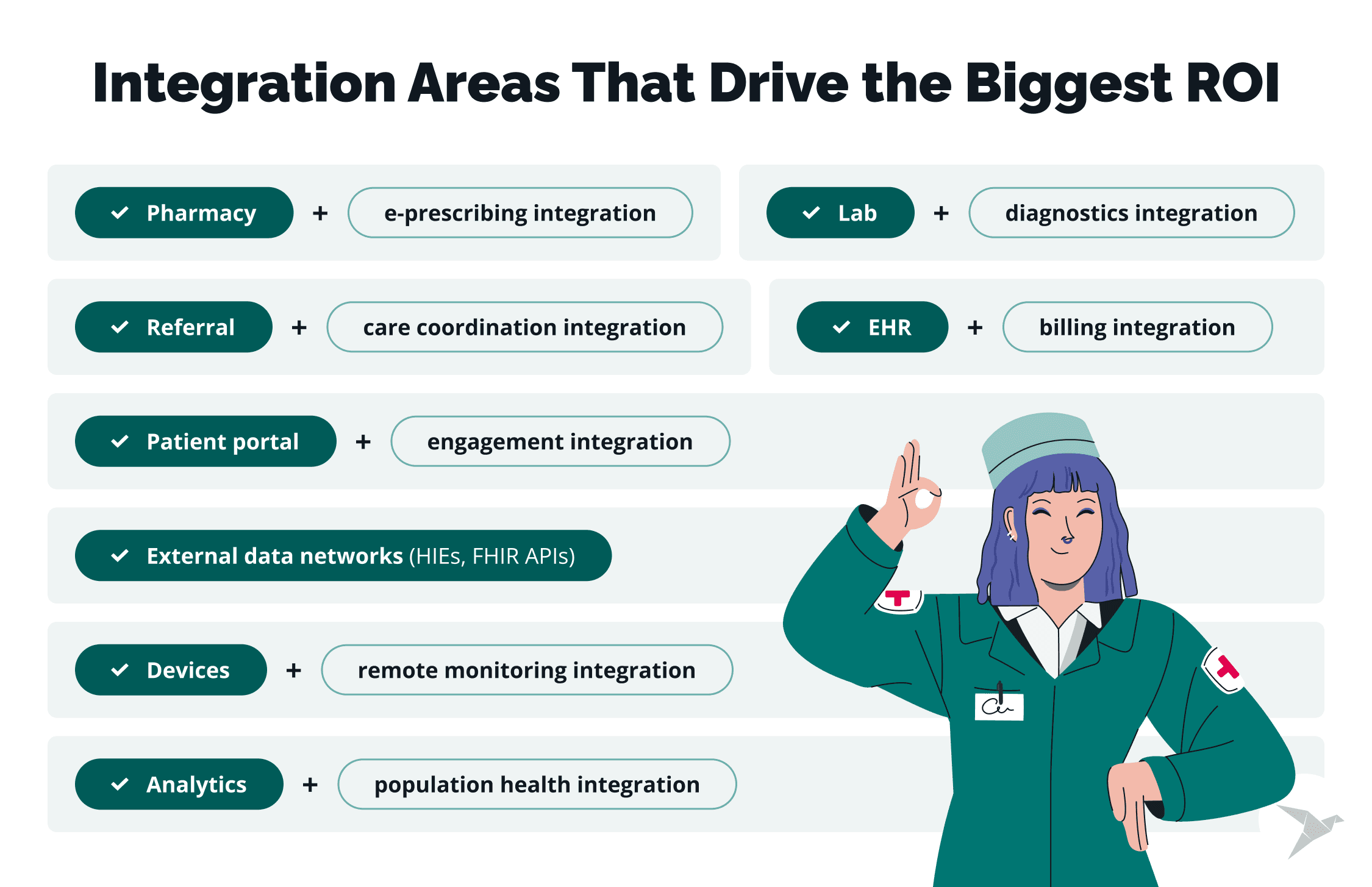
Core integration areas impact ROI by tightening the connection between clinical work, financial processes, and operational flow. When the EHR exchanges data smoothly with billing, diagnostics, pharmacy, referral networks, devices, and analytics platforms, revenue becomes more accurate, care moves faster, and clinicians work with fewer interruptions.
These integrations form the foundation of how organizations maximize EHR ROI and build a system that scales. Now let’s break down the areas that deliver the strongest measurable gains.
EHR–billing system integration
Synchronizing clinical and financial data creates a direct path from documentation to reimbursement. When diagnoses, procedures, charges, and encounter details flow automatically into the billing system:
- Charge capture becomes more complete and accurate
- Coding errors decrease because data arrives structured and consistent
- Claims go out faster with fewer manual edits
- Reconciliation tasks reduce significantly
This integration prevents revenue leakage tied to missing codes or delayed documentation and improves reimbursement velocity.
Lab and diagnostic system integration
Automated order entry and results delivery eliminate the delays and inconsistencies that occur when clinicians rely on manual workflows or disparate portals. With integrated lab and imaging systems:
- Orders transmit without re-entry errors
- Results appear in the EHR as soon as they’re finalized
- Duplicate tests decrease because clinicians see the full picture
- Turnaround time shortens, supporting faster clinical decisions
Better flow in diagnostic data directly contributes to smoother patient movement and operational efficiency.
Pharmacy and e-prescribing integration
Accurate and timely medication information reduces safety risks and accelerates treatment. Integrated pharmacy and e-prescribing systems support:
- Real-time medication histories that reduce reconciliation errors
- Automated formulary checks that prevent coverage issues
- Electronic refill requests that eliminate phone calls and manual tasks
- Fewer prescription errors and callbacks
These improvements strengthen clinical safety and reduce administrative overhead.
Referral management and care coordination integration
When referrals, consult notes, and summaries move seamlessly between providers, care continuity improves and revenue leakage drops. Strong integration enables:
- Faster referral processing and confirmation
- Closed referral loops with documented follow-up
- Better retention of patients within the network
- Smoother handoffs that reduce unnecessary delays
Strong referral pathways help organizations keep care inside their system, which naturally improves ROI.
Patient portal and engagement tool integration
When scheduling, messaging, results, and record access are integrated into one experience, patients stay more engaged, and clinics operate more efficiently. Benefits include:
- Lower no-show rates due to automated reminders and easy rescheduling
- Fewer inbound calls for routine questions
- Faster access to test results and visit summaries
- Higher satisfaction and retention driven by transparency
This integration improves financial, patient experience, and clinical benefits.
External data networks (HIEs, FHIR APIs) integration
Access to external records prevents unnecessary diagnostics and speeds up care decisions. With strong HIE or FHIR-based connectivity:
- Clinicians see relevant history even if care occurred outside the system
- Redundant or unnecessary tests are avoided
- Diagnosis and treatment decisions happen sooner
- Care coordination becomes smoother across organizations
Better external data flow directly reduces the total cost of care.
Device and remote monitoring integration
Connected RPM devices create a continuous picture of patient health without requiring constant in-person visits. When this data integrates cleanly into the EHR:
- Clinicians catch deterioration earlier and adjust treatment proactively
- Readmissions and emergency visits decrease
- Chronic condition management becomes more efficient
- Staff no longer manually enter or track device data
Automation in remote monitoring supports improved patient outcomes, clinical gains, and long-term cost reduction.
Analytics and population health platform integration
High-quality, unified data fuels more accurate analytics and forecasting. When analytics platforms sync cleanly with the EHR and operational systems:
- Risk stratification becomes more precise
- Value-based care metrics are easier to track
- Forecasting for revenue, staffing, and resource needs improves
- Decision-makers get a reliable foundation for strategic planning
Integrated analytics directly support how to improve EHR ROI by connecting daily operations to long-term organizational goals.
ROI Impact by Integration Type
To see how these integration points differ in impact, here’s a quick comparison of where organizations most often see measurable positive ROI gains.
How TechMagic Helps You Sustain and Grow EHR ROI
Interoperability only delivers lasting ROI when it’s designed, implemented, and refined with a clear understanding of how EHRs actually function in real clinical and financial workflows. At TechMagic, we perfectly know how this works.
We specialize in developing and integrating custom EHR systems, which gives us a practical view of how data, revenue cycle processes, and clinical work intersect. We help organizations design integration strategies that are tied to measurable outcomes, build reliable EHR-centered integrations, and guide internal teams through each stage of the EHR journey.
Because we’ve worked hands-on with EHR platforms and complex healthcare ecosystems, we know how to remove friction, reduce hidden costs, and turn interoperability into sustained ROI. If you’re looking to make your EHR work harder for your organization, not just function, TechMagic can help you get there. Let’s talk!

Final Thoughts: How Interoperability Becomes a Sustainable ROI Engine
Interoperability is one of the most dependable ways to maximize EHR ROI. It streamlines daily work, reduces errors, and gives teams the information they need without the usual friction. When data moves cleanly, revenue steadies, clinicians work faster, and patients feel the difference. Add automation and AI, and those gains grow even more: cleaner data, better claims, faster decisions.
The real value comes when interoperability becomes ongoing work. Small fixes, better monitoring, and steady data-quality improvements keep ROI rising. Staff adoption matters too. When workflows feel natural, the EHR stops being a cost center and becomes a real support system for care and operations.
Looking ahead, AI will surface issues before humans notice them. Data will follow patients across systems with less effort. Regulations will demand more openness and standardization. Organizations with strong integration ecosystems will adapt faster and grow with fewer barriers.
Interoperability is the engine that strengthens everything around it. And when you keep improving it, you continually improve the ROI of your EHR system year after year.
FAQ

Interoperability optimizes data flow across systems, reduces manual tasks, lowers errors, and stabilizes revenue, leading to measurable operational and financial gains.
Interoperability improves the return on investment (ROI) because it ensures complete, accurate data reaches the right other systems on time, which speeds clinical work, reduces denials, prevents duplicate efforts, and improves overall performance.
To calculate ROI for an implemented electronic health record (EHR) system, clinics should collect operational and financial data such as changes in labor hours, denial rates, reimbursement speed, and patient throughput. Use ROI indicators, such as cost recovery, ensuring compliance improvements, and financial impact. Then apply the formula: (Total financial gains + cost savings - project cost) ÷ project cost to determine ROI.
Healthcare organizations maximize EHR ROI with interoperability when integrations reduce manual work, improve data accuracy, and directly support revenue and clinical workflows. When interoperability follows clear ROI goals and continuous optimization, EHR data delivers lasting financial, operational, and clinical value.