













How to Implement SOC 2 Automation: What to Automate and What Still Needs Human Oversight
Last updated:27 August 2026


Getting a SOC 2 report used to mean a year of screenshots, spreadsheets, and chasing control owners before an auditor ever showed up. SOC 2 automation promises to cut that work roughly in half, and buyers have noticed.
The compliance automation market was worth $11.44 billion in 2025 and is projected to reach $50.73 billion by 2034, a compound annual growth rate of 18%. Yet the same vendors selling that speed will quietly tell you the tool can’t make you compliant on its own.
SOC 2 (System and Organization Controls 2) is an attestation that you actually follow your own security controls to protect customer data, verified by an independent auditor. Automation software handles the repeatable part of that work: it collects compliance evidence, watches controls continuously, and flags gaps.
In this guide, we answer five questions: what SOC 2 automation actually is, which parts of the process you can automate, how to implement it step by step, how it helps you keep your audit scope tight, and which controls still need a person to own them.
Key takeaways
- SOC 2 automation is software that handles the repeatable parts of the audit: continuous control monitoring, automated evidence collection, control testing, and gap detection.
- SOC 2 audit process automation can roughly halve audit prep time and keep you audit ready year-round, but it cannot issue your report. Only an independent CPA (Certified Public Accountant) firm can do that.
- You can automate mechanical, recurring work. Judgment-based controls like risk acceptance, board reviews, and disaster-recovery testing stay manual. Unified compliance dashboards can consolidate the status of all controls and requests.
- Automation does not shrink your audit scope by itself. Your decisions about systems, data, and Trust Services Criteria do.
- A platform that runs on default settings can pass an audit while leaving real security gaps. Security leadership is what closes them.
What Is SOC 2 Automation?
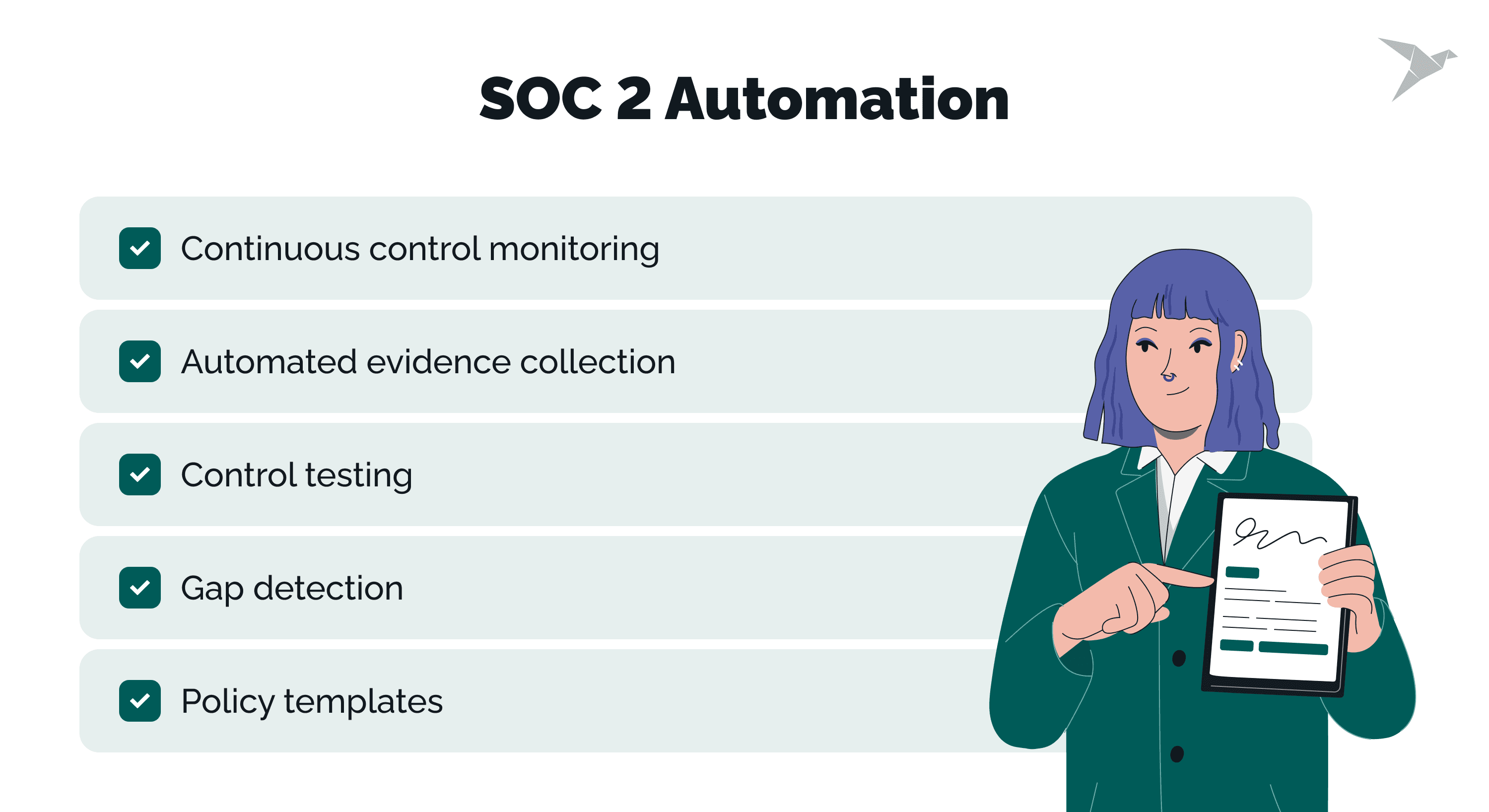
SOC 2 automation, sometimes labeled SOC 2 process automation, is the use of specialized software to run the repeatable, system-driven parts of the compliance process, including:
- continuous control monitoring;
- automated evidence collection;
- control testing;
- gap detection;
- policy templates.
The value for a decision-maker is faster time-to-report and continuous readiness. The report itself still needs a person and an independent auditor to sign off.
Put plainly, the software does the busywork so your team stops exporting logs and updating tracking sheets by hand. It connects to your cloud, identity, and code systems, checks whether your controls are in place, and stores the results as audit evidence.
A schedule does not forget, so good tooling reduces human error in that collection. That shifts a once-a-year scramble into a steady state of continuous compliance, and it keeps your information security program in view all year.
Teams often call this SOC 2 compliance automation. At TechMagic, we run SOC 2 and ISO 27001 compliance programs for cloud SaaS teams.
SOC 2 automation vs. manual compliance
In manual compliance, people gather evidence by hand: screenshots of settings, exported access logs, updated spreadsheets, and a round of chasing every control owner before each audit. With automation, integrations pull that evidence and monitor controls on a schedule, so the record builds itself throughout the year, and audit preparation becomes mostly review.
The difference shows up most in time and repeatability. Automating the audit process is also how a smaller team reaches audit readiness without a dedicated compliance hire. Here is how the same work compares across the two approaches.
Cost tracks the same pattern, since manual hours are the expensive part of any audit cycle and the biggest driver of your SOC 2 audit cost.
Why automation can’t produce a SOC 2 report on its own
Automation cannot produce a SOC 2 report because an independent auditor must validate the evidence and issue it. A licensed CPA firm attests to your controls, and the automation vendor cannot be your auditor. That separation, called auditor independence, is the point of the report.
The tool’s output also needs human review before it reaches the auditor. Integrations pull evidence from many systems, and inconsistent inputs produce errors, false passes, and missing context. Someone has to confirm the evidence is right. The platform builds the file; a person still signs off on what goes in it.
Check our
Which Parts of the SOC 2 Process Can You Automate?
You can automate the repeatable, evidence-heavy tasks: the mechanical, recurring work. Judgment-based work stays manual. A simple way to sort your controls is to ask whether a control produces the same evidence every time or requires a decision.
Evidence collection and continuous control monitoring
Automated tests query your cloud, identity, and code tools on a schedule, checking things like encryption at rest or enforced MFA (multi-factor authentication), and they log the results as audit evidence. These are the data security checks that show you protect sensitive data, including sensitive customer information.
The same integrations can track vendor risk management, pulling third-party vendor management evidence into the record. Because the checks run continuously, you stay audit-ready year-round instead of only in the weeks before an audit. Here, automated evidence collection and continuous control monitoring replace the most tedious manual effort.
Gap analysis and control testing
Compliance automation platforms scan your systems against the relevant controls, surface misconfigurations as they happen, and flag compliance gaps before they become audit exceptions.
Catching a disabled log or an over-privileged account in real time surfaces compliance risks early, which is far cheaper than explaining them to an auditor later. This continuous testing keeps your compliance posture honest between audits.
Policy templates and task tracking
Pre-built, auditor-reviewed policy templates give you a starting point for security policies and security documentation, so your team does not write every document from scratch. Task dashboards track recurring compliance tasks and assign owners, which keeps routine work from slipping. Templates speed up the writing. They do not decide what your policy should say.
Multi-framework control mapping
One control often satisfies several frameworks at once, so evidence you collect for SOC 2 can be reused across overlapping standards. SOC 2 shares many controls with ISO 27001, HIPAA, and PCI DSS, which means mapping once and reusing that work reduces duplicate effort as you add additional compliance frameworks.
One evidence set can then feed several compliance reports. For teams scaling toward multiple frameworks, that reuse is one of the strongest returns on a compliance automation platform, and the overlap our ISO 27001 vs SOC 2 guide walks through is the clearest example.
How to Implement SOC 2 Automation Step-by-Step
Implementing SOC 2 automation is a project you run over several weeks, and the aim is to automate SOC 2 audit prep while a person still owns the outcome. It works best as a sequence of scoping, tooling, and ownership decisions led by that person, with the software doing the mechanical work at each stage. If you have wondered how to automate SOC 2 without handing the whole program to a tool, this is the sequence we use.
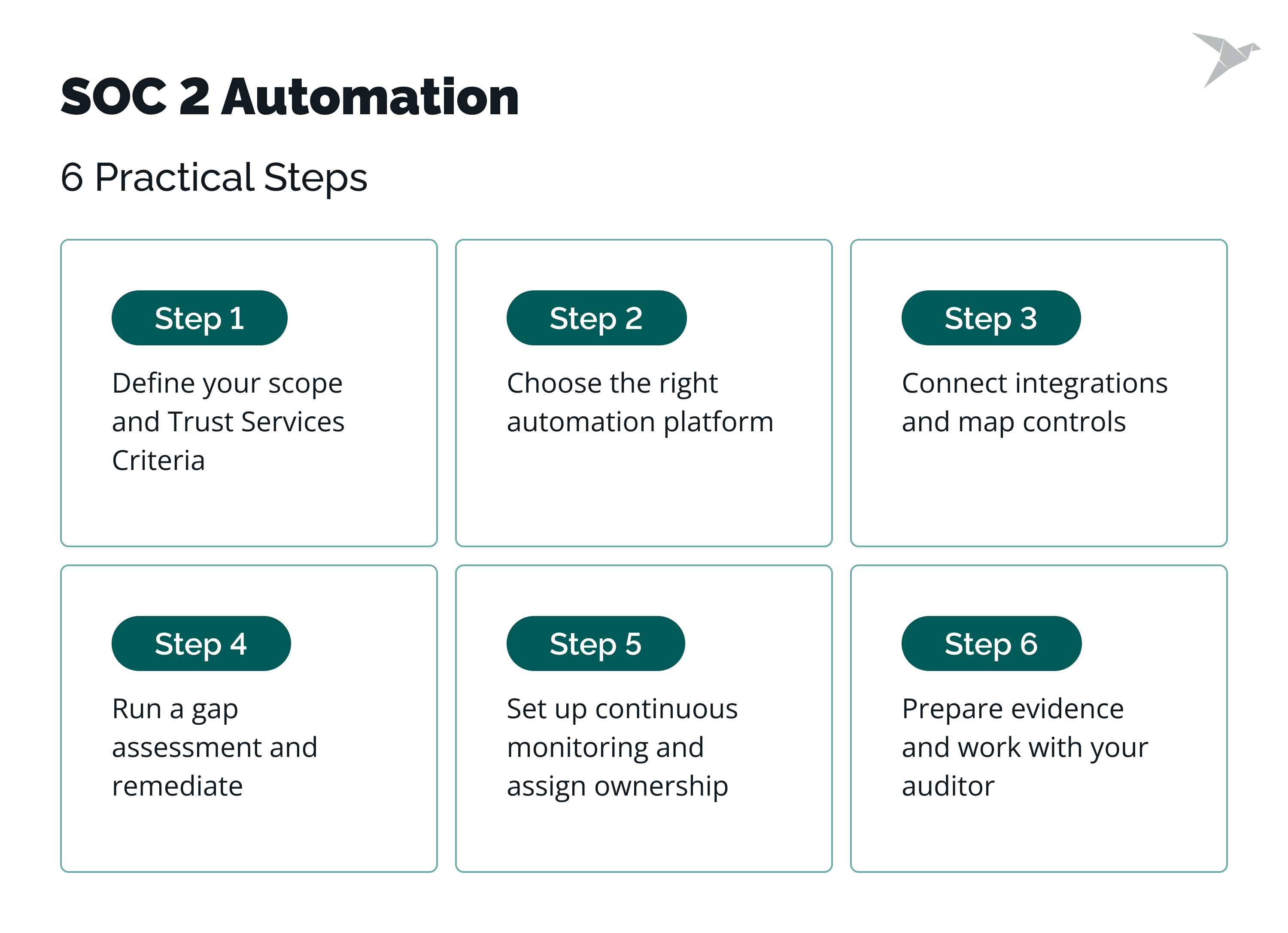
Scope → Tool → Integrate → Assess → Monitor → Audit
Step one: Define your scope and Trust Services Criteria
Decide which systems, products, and Trust Services Criteria (TSC) are in scope before you buy anything, working from the SOC 2 compliance requirements that apply to you. Security is the mandatory criterion; Availability, Processing Integrity, Confidentiality, and Privacy are optional and depend on what you promise customers.
Scope drives cost, timeline, and effort downstream, so this decision belongs to a person who understands the business. A setup wizard cannot make it for you.
Step two: Choose the right automation platform
Evaluate platforms on how well they fit your stack. Feature counts matter far less than fit. The criteria that matter are:
- integration capabilities with your existing systems;
- genuine continuous monitoring;
- support for multiple frameworks;
- scalability as you grow;
- and whether expert help is included or you are buying software alone.
A shallow compliance platform slows your compliance efforts instead of speeding them, because compliance automation software with weak integrations leaves you collecting evidence by hand anyway. Comparing the Top Vanta competitors and alternatives helps you judge that fit before you commit.
Step three: Connect integrations and map controls
Connect your cloud, identity, HR, and code tools so the platform can pull evidence automatically, then map each control to your chosen criteria. The depth of these integrations decides how much evidence collection is truly automated. Weak connections mean the tool reports a gap where none exists, or misses one that matters.
Step four: Run a gap assessment and remediate
Use the automated gap assessment to find non-compliant areas, then assign owners and fix them. This is usually the most time-consuming and judgment-heavy phase, because remediation touches real engineering work: tightening access controls, fixing logging, and reworking change management. The tool finds the gaps. Your team closes them.
Step five: Set up continuous monitoring and assign ownership
Turn on continuous tests and alerts, then give every control a named human owner so failing tests get resolved. Good platforms wire these into compliance workflows, which is how you maintain compliance between audits. Automation surfaces the issue; a person fixes it. Without clear ownership, alerts pile up, and your compliance status drifts even though the dashboard is green.
Step six: Prepare evidence and work with your auditor
Use the platform’s auditor workflow to share organized evidence through a single portal, which cuts the back-and-forth. Expect to supply manual evidence too, and to answer auditor walkthroughs yourself. The auditor tests your controls and asks questions no dashboard can answer for you.
We are here to assist

How Can You Reduce SOC 2 Audit Scope With Automation?
Automation does not shrink your scope by itself, because scope is set by the decisions you make about systems, data, and criteria. Scope is a clear example of how the way you manage compliance shapes the outcome more than any tool does.
Automation helps you define a tight scope and keep it honest over time. Knowing how to reduce SOC 2 audit scope with automation and security tools starts with separating the decisions you make from the work the tool tracks.
Scoping decisions automation supports vs. decisions you own
Scoping surveys inside a platform can auto-build a list of relevant policies and controls from your answers, which saves time. A person still decides which products, environments, and Trust Services Criteria to include or exclude. That choice is a business and risk decision, and it sets the boundary the tool then monitors.
Using system boundaries and segmentation to limit scope
Clear system boundaries and segmentation reduce the number of in-scope systems, which shrinks the evidence you need and the surface an auditor reviews. If you isolate a single product or backend that handles customer data, you can often keep unrelated internal systems out of scope. Continuous monitoring then guards that boundary, alerting you when a new integration quietly pulls an out-of-scope system back in. That is how automation prevents scope creep between audits.
What Can’t Be Automated in SOC 2?
The parts that require context, interpretation, and accountability cannot be automated, and these are often the controls auditors scrutinize most. A tool can prove a control ran. It cannot decide whether the control was the right one. The SOC 2 controls hardest to automate all share that trait.
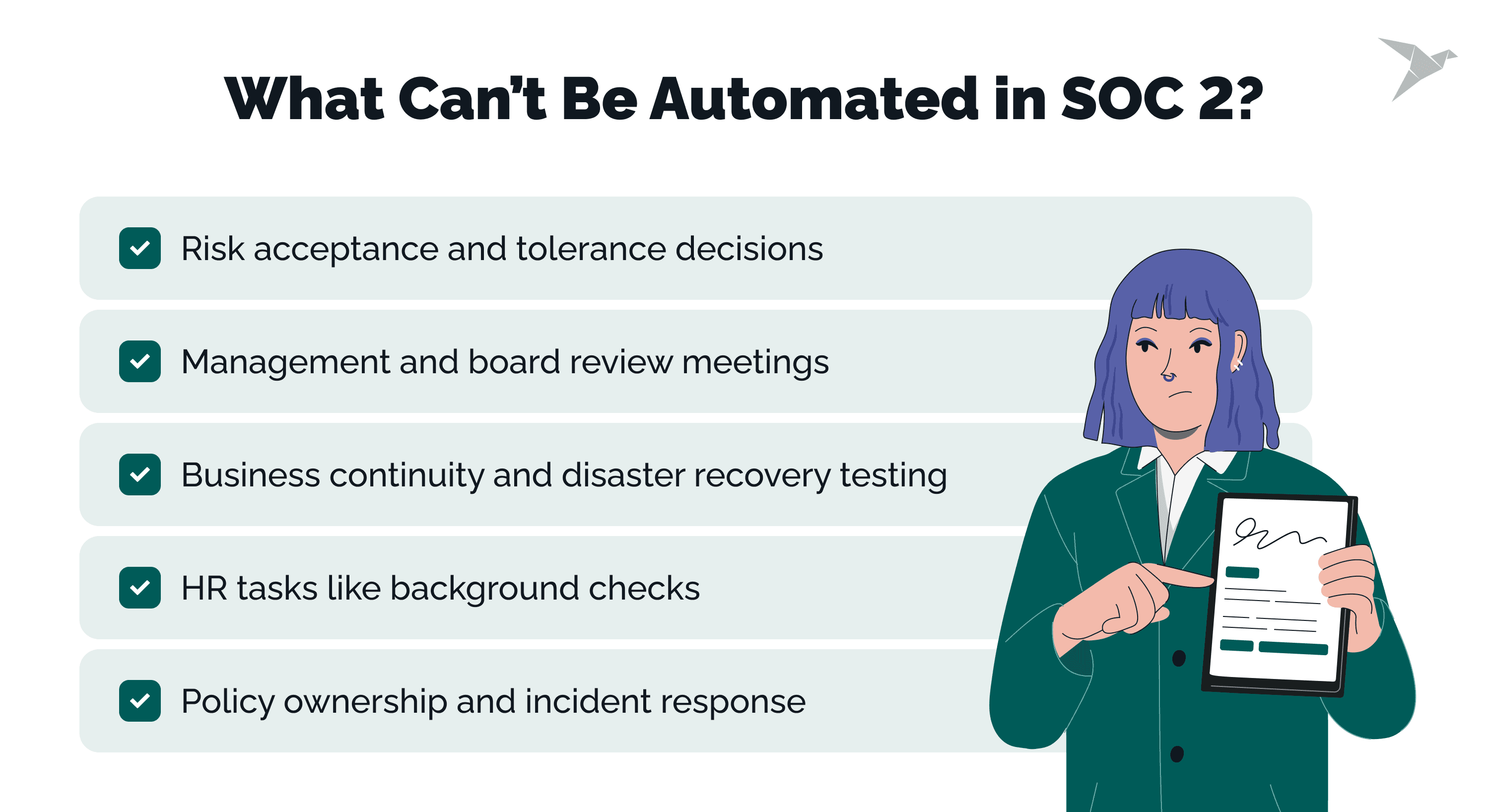
Risk acceptance and tolerance decisions
Management must decide which risks to accept, transfer, or mitigate, and that judgment maps to the common criteria for risk assessment (CC3.1 through CC3.4). Automated scans can feed your risk assessments, but the decision of how to manage risks stays with people. No tool knows your risk appetite or your business context. Risk management is a leadership call, and an auditor expects to see that a person made it.
Management and board review meetings
Quarterly and board security reviews, their minutes, and the decisions they produce are created by people and recorded by hand. An integration cannot pull this evidence, because it does not exist in a system. These reviews are also where leadership demonstrates real oversight of the security program.
Business continuity and disaster recovery testing
Business continuity and disaster recovery (BC/DR) plans, and their annual real-scenario tests, require people to run the exercise and document what happened. Restoring from backup, failing over, and coordinating across teams are human activities. The evidence is the record of a test that people actually performed.
HR tasks like background checks
Background checks run through third parties and contain sensitive personal data that auditors do not want to see. You provide proof that the check happened while keeping its contents private, so this evidence stays manual and redacted. Handing raw HR files to a tool would create a data protection problem instead of solving a compliance one.
Policy ownership and incident response
Templates help you draft a policy, but leadership has to own, approve, and enforce it for the policy to be real. The same is true of incident response: a documented plan means nothing until a named owner runs it under pressure. Auditors can tell the difference between a signed template and a program people follow.
Why Does SOC 2 Automation Still Need Security Leadership?
Automation generates evidence, but security leaders decide what that evidence should be, what risk is acceptable, and whether the controls actually protect the business. That judgment is exactly what software cannot supply.
Gartner found that 80% of chief audit executives want to increase the impact of data analytics in their function, yet the analytics improved outcomes only about half the time. More data does not make better decisions on its own.
The "false sense of security" risk of full automation
Relying on a platform’s default controls and template policies can let a team pass an audit while leaving real security risks in place, including exposure to data breaches. SOC 2 attests that you follow your own controls. It does not certify that you are secure. If the controls you adopted were the tool’s defaults rather than a response to your actual threats, a clean report can hide genuine exposure. Closing that gap is leadership work.
What a security leader owns that software can’t
A security leader owns control design, interprets auditor findings, aligns controls to the threats your product actually faces, and treats SOC 2 as an operating program rather than a checkbox. Here, an experienced partner earns its place, and the Top SOC 2 compliance companies are the ones that shape the program so the report reflects real protection.
Strong security compliance comes from that ownership, with the automation supporting it. The automation alone will not produce it.
Need Help Implementing SOC 2 Automation?
If you are standing up a SOC 2 program and want the automation working with your architecture instead of against it, this is the part where a partner helps most. TechMagic pairs your compliance automation tools with human-led control design, so you enter the audit with systems that are genuinely ready.
Our experience implementing SOC 2 automation
We approach SOC 2 the way we would a product build: start with a clear gap assessment, then work down a practical readiness roadmap. Our engagements begin by mapping your current controls against the criteria in scope, so you can see the real distance to audit ready before committing budget. From there we assign ownership across Security, Engineering, IT, and Operations, because a control with no owner fails quietly.
We implement the controls teams tend to struggle with most: access management, change management, and incident response. These are where automated evidence collection either works cleanly or produces noise, and getting the underlying process right is what makes the platform’s output trustworthy. We treat Vanta, Drata, or whichever platform you run as the evidence engine, and we provide the human layer that customizes the program and knows what auditors expect.
The balance we argue for in this article is the one we work to in practice: automation tooling for the repeatable parts, human-led design for the rest, and ongoing support so continuous compliance stays continuous. See it in practice in our ISMS internal audit work with Quizrr, where we ran the internal audit that a real compliance program depends on. A green dashboard is where the real security work starts.
Wrapping Up: What’s Next
SOC 2 automation handles the repeatable roughly 80% of the work, evidence, monitoring, testing, and framework mapping, and it can halve your audit prep. The remaining controls, from risk acceptance to BC/DR testing to policy ownership, still need people. The teams that get the most from automation are the ones that use it to support security leadership rather than replace it.
Where is this heading?
Continuous compliance stops being a differentiator and becomes the default. Point-in-time evidence is fading as buyers and auditors expect controls monitored year-round, and platforms are converging on that model.
Multi-framework reuse gets more valuable as regulation grows. As teams add ISO 27001, HIPAA, and newer AI standards, the ability to map one control to several frameworks turns from a nice-to-have into a scaling requirement.
Automation shifts human effort toward judgment. As tools absorb the mechanical work, the scarce skill becomes deciding what to monitor and why, which is a leadership problem rather than a tooling one.
Security posture becomes the real prize, above the certificate. The compliance automation market was worth $11.44 billion in 2025 and is projected to reach $50.73 billion by 2034, a compound annual growth rate of 18%. Yet the same vendors selling that speed will quietly tell you the tool can’t make you compliant on its own.
The value is in the protection the program builds, and the report is evidence of it.

FAQ
SOC 2 cannot be fully automated. Automation software handles the repeatable work, such as evidence collection and continuous control monitoring, but judgment-based controls like risk acceptance, board reviews, and disaster-recovery testing require people. An independent auditor issues the final report, and a tool cannot.
You can automate most of the repeatable, evidence-heavy work in SOC 2, which teams often estimate at around 80% of the effort. Automated evidence collection, continuous monitoring, control testing, gap detection, and multi-framework mapping are all well suited to software. The remaining controls that need human judgment stay manual.
SOC 2 automation does not reduce your audit scope on its own. Scope is set by your decisions about which systems, data, and Trust Services Criteria are included. Automation helps you define a tight scope through scoping surveys and then keeps it honest with continuous monitoring that catches scope creep between audits.
You still need security leadership even with a SOC 2 automation platform. The platform generates evidence, but people must design the controls, decide which risks are acceptable, interpret auditor findings, and own incident response. A platform running on default settings can pass an audit while leaving real security gaps in place.
A SOC 2 automation tool cannot issue your audit report. Only a licensed CPA (Certified Public Accountant) firm can validate your evidence and issue a SOC 2 report, and the automation vendor cannot act as your auditor. This separation, known as auditor independence, is a core requirement of the framework.
The time to SOC 2 compliance with automation depends on your scope and starting maturity, and vendors commonly claim automation cuts preparation time by roughly half. A SOC 2 Type I report can follow a shorter readiness period, while a Type II report requires an observation window, often three to twelve months, during which controls are monitored. Automation shortens preparation. It does not shorten the observation period an auditor requires.