 Software Development
 Security Services
 Cloud Services
 AI Services
 Other Services















 TechMagic Academy




We hear the same question more and more often from clients: how do people at TechMagic actually use AI, and how do I know it is safe on my codebase?
It is a fair question. Every vendor now claims to use AI in software development, and far fewer can show you who approves what, who reviews the output, and what happens when the model is confidently wrong. So here is our answer, in full.
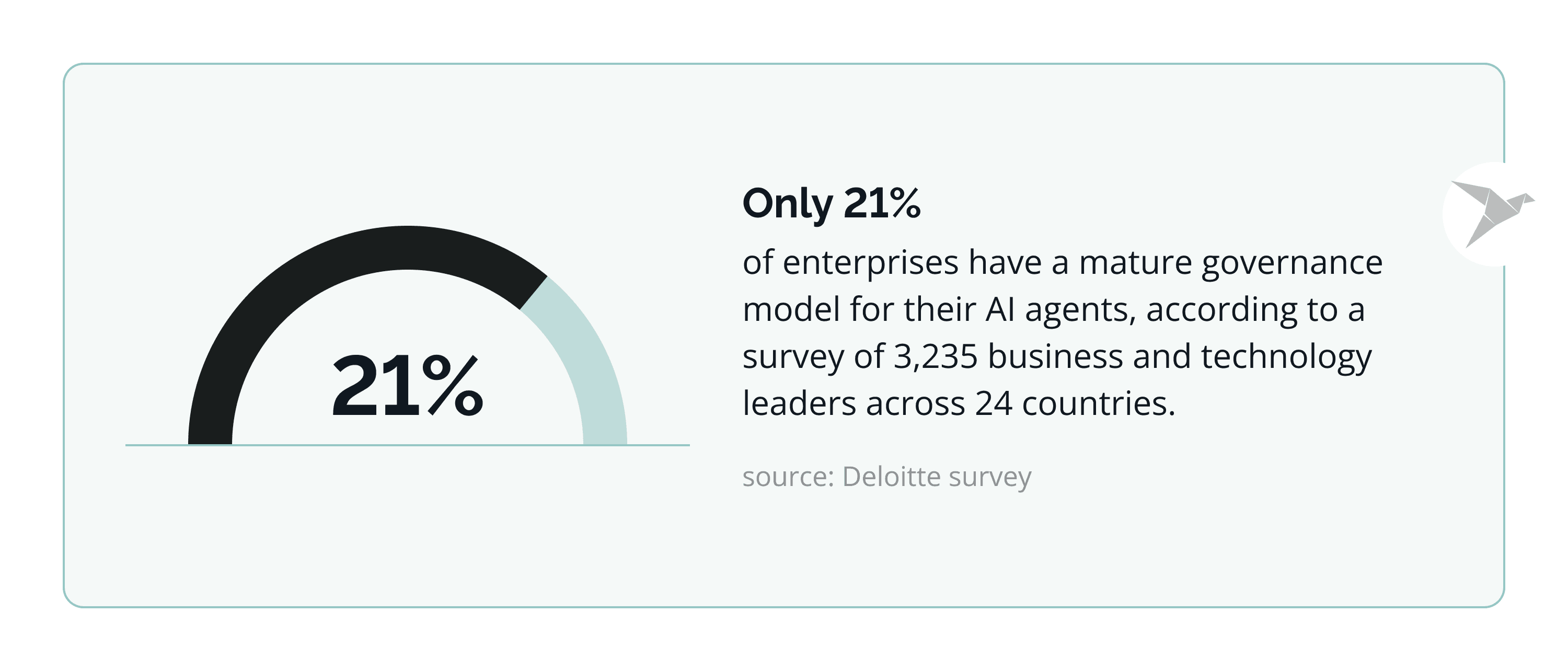
The concern behind the question is grounded: only 21% of enterprises have a mature governance model for their AI agents, according to a Deloitte survey of 3,235 business and technology leaders across 24 countries.
In our new article, we cover how TechMagic funds AI expertise, how our engineers stay accountable for every AI-assisted output, how we handle security, and what the whole system changes for your budget, your quality bar, and your timeline.
Key Takeaways
- AI at TechMagic is funded, governed, and tracked centrally, so consistency does not depend on which team you get.
- A person writes and approves the specification before an agent implements against it. The role of AI in software development here is execution, and people keep the decisions.
- Nothing merges until three independent review lanes pass: functional, product, and technical.
- Every specialist works inside one AI usage policy, a mandatory security course, and an approved-tools allowlist.
- The impact of AI in software development reaches you as more delivered inside the same scope and budget.
How Does TechMagic Set Its AI Strategy?
AI strategy at TechMagic is set at the company level, and its adoption is measured. It started as a founder decision, and it has structure behind it.
Underneath all of it sits one test: does this produce a measurable result on a client project? We adopt AI where it shortens a timeline, cuts cost, or improves the product you are shipping. Rollouts get planned around the problems our teams actually hit on delivery, so tools that only impress in a demo never make the list.
We hold an enterprise-level Claude license, and a dedicated AI Center of Excellence (CoE) sets our tooling standards and works alongside teams applying AI on live client projects. One strategy, one set of standards, across every business unit.
We also run regular AI adoption checks with every Business Unit Director and their managers, and read the results next to standard delivery metrics. AI and Large Language Model (LLM) excellence sits in every employee's personal growth plan as a core requirement, so professional development here depends on it.
You do not have to hope your particular team happens to be AI-savvy.
What AI Tools and Training Does TechMagic Pay For?
TechMagic funds AI tools and training centrally, so specialists work with vetted, paid tooling instead of whatever free service they found last week. That matters for your data as much as for their coding efficiency.
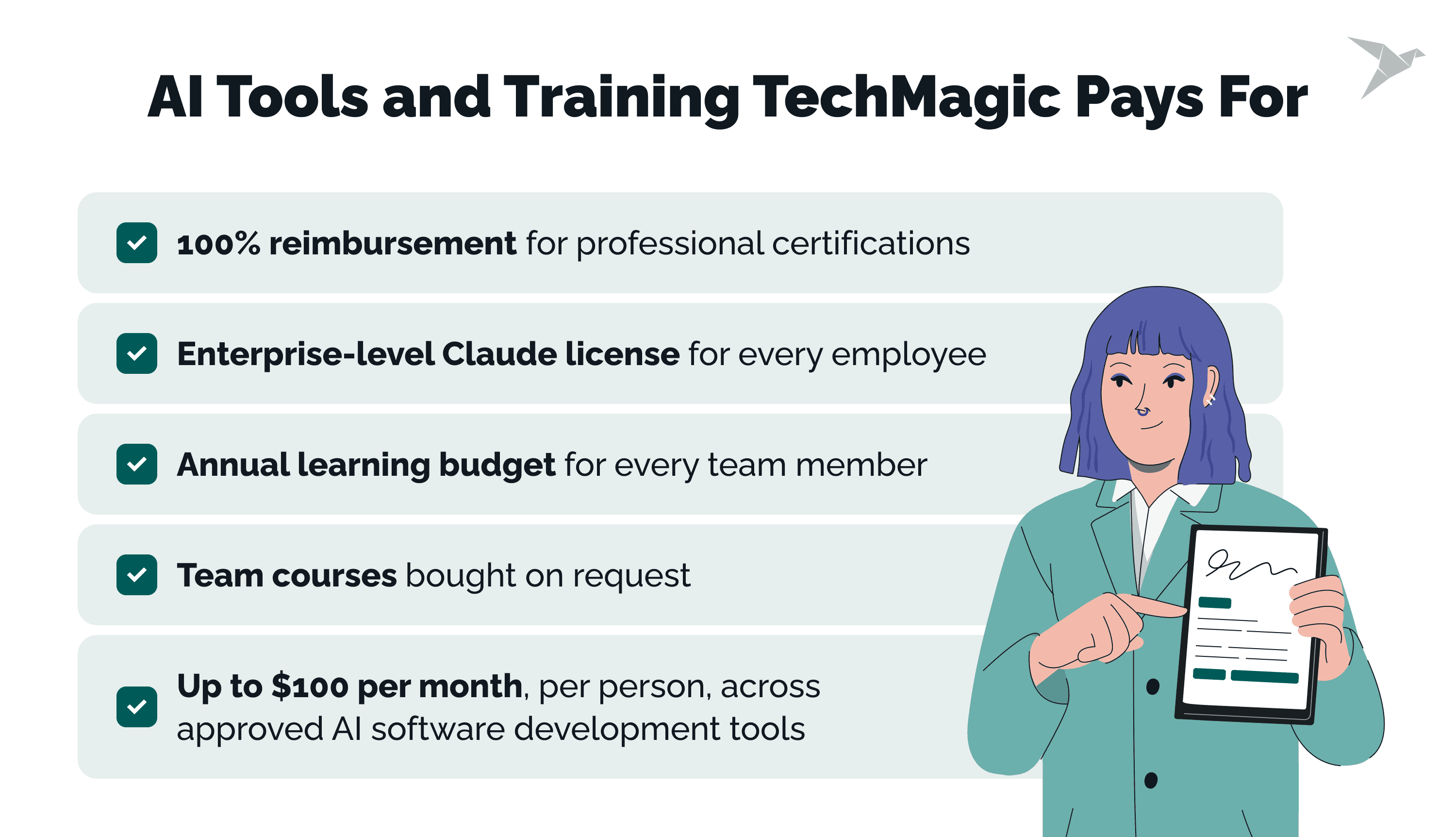
- 100% reimbursement for professional certifications, at any level
- An enterprise-level Claude license available to every employee
- An individual annual learning budget for every team member
- Team courses bought on request from leads and managers
- Up to $100 per month, per person, across approved AI software development tools such as Cursor and GitHub Copilot, including usage-based and premium charges
Every software development AI tool on that list is vetted before anyone uses it. The people on your project are trained and equipped on our timeline, and they arrive ready to work.
How Do We Keep People in Control of AI-Generated Code?
A person writes, reviews, and approves the specification. AI implements against it. The engineer accountable for the delivery owns the result, including anything an agent produced along the way.
This is spec-driven development, and it is the part of our software development process that a skeptical CTO should press us hardest on. Here is how it runs.
How spec-driven development works at TechMagic
Spec-driven development is a way of working where an approved written specification is the source of truth for a feature. The spec settles the what and the why. Only then does an agent touch the how.
Every unit of work travels the same path:
Brainstorm → Spec → Plan → Execute → Verify → Ship
Intent gets captured, turned into an approved spec with architecture and acceptance criteria, then decomposed into a numbered task plan. Before writing code, the agent reads our rulebook: access-control decisions, error-handling patterns, data conventions, and security rules. Generated code stays inside a definition a human owns.
We run this on client projects for two reasons:
- You reach something demonstrable sooner. Implementation starts against an approved plan, so the first working increment arrives earlier in the schedule.
- It rules out vibe coding. Code that appears quickly, and that nobody can explain afterwards, never reaches your codebase.
The expertise of our engineers and their accountability stay at the center of the method. The specification is what makes both visible before any code exists.
Where AI shows up in our software development lifecycle
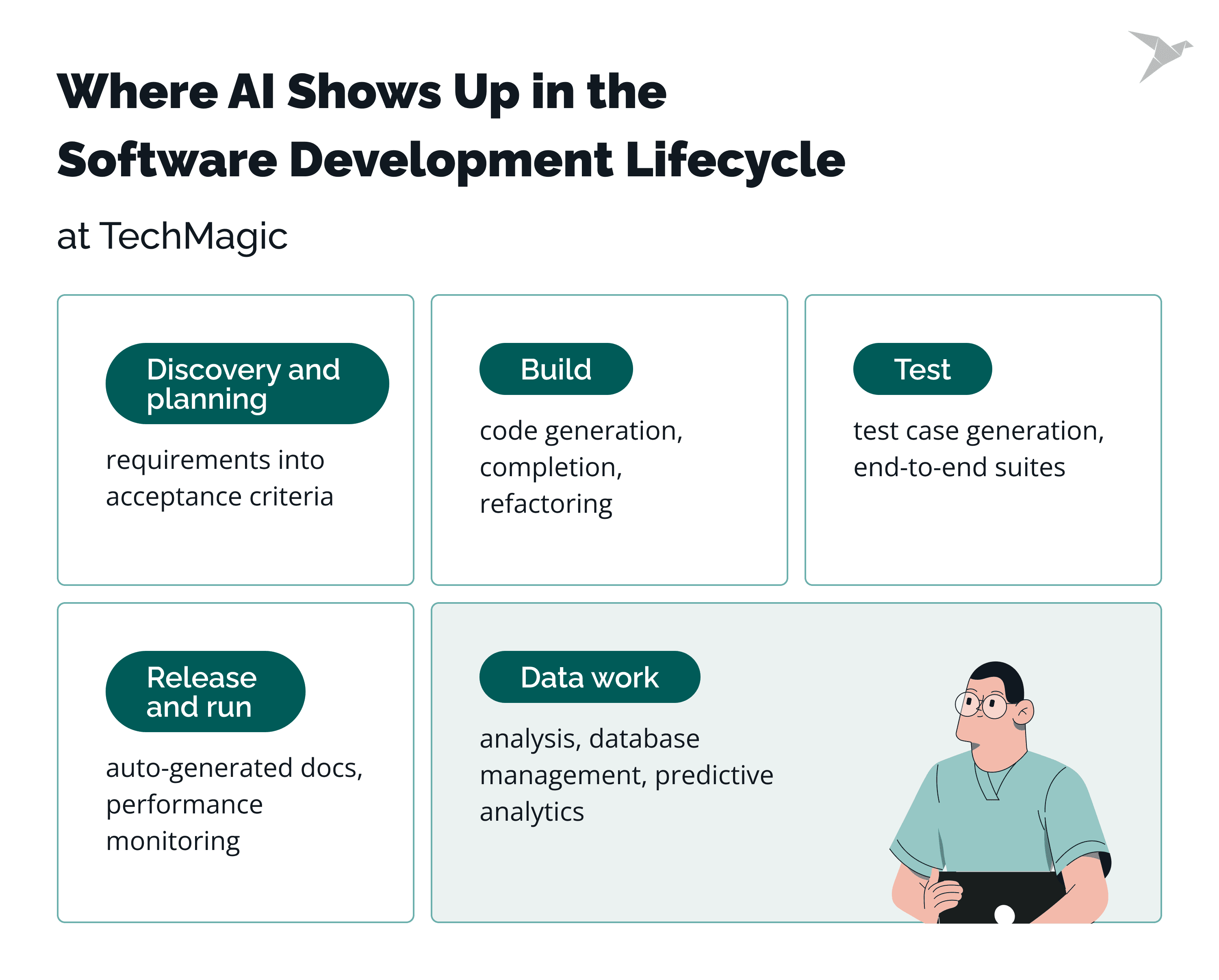
AI in software development lifecycle stages breaks down like this on our projects:
- Discovery and planning. Turning natural language descriptions of a feature into acceptance criteria, and drafting a project plan from project requirements.
- Build. Code generation, code completion, and code suggestions against an approved plan, plus refactoring existing code, mapping data structures, and translating between programming languages.
- Test. Test case generation and software testing, with end-to-end suites that help software testers identify bugs and automatically detect bugs earlier.
- Release and run. Agents automatically create documentation from merged pull requests, and we monitor system performance with the same telemetry we always used.
- Data work. Data analysis, data science, database management, and predictive analytics where a product needs them.
Engineers still own software architecture, software design, design patterns, and security design. AI tools assist developers, and AI outputs get reviewed like any junior engineer's work.
We also build AI-powered applications: generative AI in software development, Machine Learning models and algorithms, natural language processing, and computer vision. The Machine Learning frameworks follow the product, because AI in custom software development is never one template.
The best AI use cases in software development are the dull ones. Automating repetitive tasks across our software development workflow takes routine tasks off a senior engineer's desk.
Three review lanes, and nothing merges until all pass
Because agents accelerate production, the binding constraint in software engineering moves downstream to verification. So our development workflows are weighted toward it, with two QA engineers per developer.
Review splits into three independent lanes, and a merge is blocked until every one of them passes:
- Functional (QA). Quality Assurance (QA) runs functional review on a live preview and authors the automated end-to-end suite that guards every future change.
- Product (Product Owner). The Product Owner signs off the acceptance criteria and has the final say on scope. Project management stays with people.
- Technical (Architect). The Architect reviews code quality and technical design, and has the final say on approach.
Every week, a retro looks at what shipped and what stalled, then rewrites the agent instructions that caused the friction. The rules get sharper, and the same mistake stops repeating.
Read more about our

How we test a method before it reaches your project: Hackathons
Putting a new methodology on client work only makes sense once we know it holds up, so we test it on our own projects first. Our CoE runs hackathons where engineers take real business problems from our own departments and ship working solutions under a deadline measured in hours. Anything that breaks, breaks on us.
The latest run set a deliberately hard test: could engineers with zero spec-driven development experience ship working AI systems in two days?
Four teams, four internal clients, four innovative solutions:
Each was built by two or three engineers, specification first, from business problem to working product in two days.
How Do Our Teams Share What Works and What Fails?
Every quarter, our experts trade real results, including the failures, in three fixed formats. Everything is recorded and searchable afterwards.
- AI Roundtable. Specialists across disciplines share hands-on experience, new AI tools on the market, and risks to watch.
- Lean Coffee. Peer-to-peer, no slides, run separately for engineering, QA, project management and business analysis, and HR.
- AI Solutions Lab. Real project cases: the problem, how AI was applied, and what we would change.
Recordings sit on our internal learning platform, alongside a company channel where development teams post findings and AI news as they go.
How Do We Use AI Securely and Responsibly?
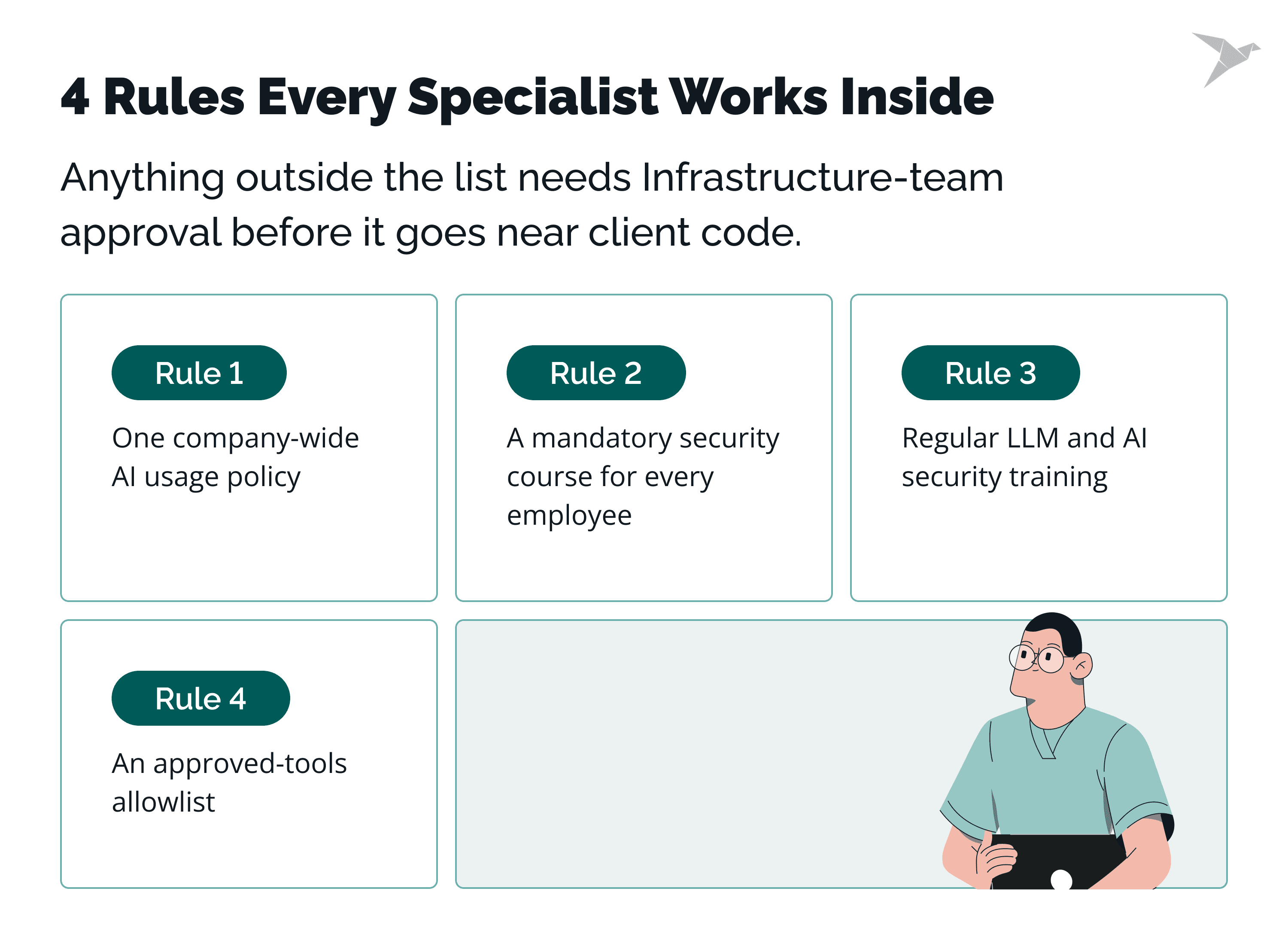
Every specialist at TechMagic works inside one AI usage policy, and only approved tools touch a project.
- A single company-wide AI usage policy, covering the principles we follow and how to handle sensitive or high-risk cases.
- A mandatory course built by our security team. AI at Work: Practical Tips for Responsible Use, required for every employee.
- Regular LLM and AI security training, for engineers and for everyone else.
- An approved-tools allowlist. Anything outside it needs Infrastructure-team approval before it goes near client code.
That last point is the one CISOs ask about first. Your codebase stays inside a reviewed development environment, and no one is quietly pasting your data into an unvetted chatbot as training data.
Read more about our
What Does Our AI Investment Change for Your Project?
Three levers, and you can check each one against the mechanisms above.
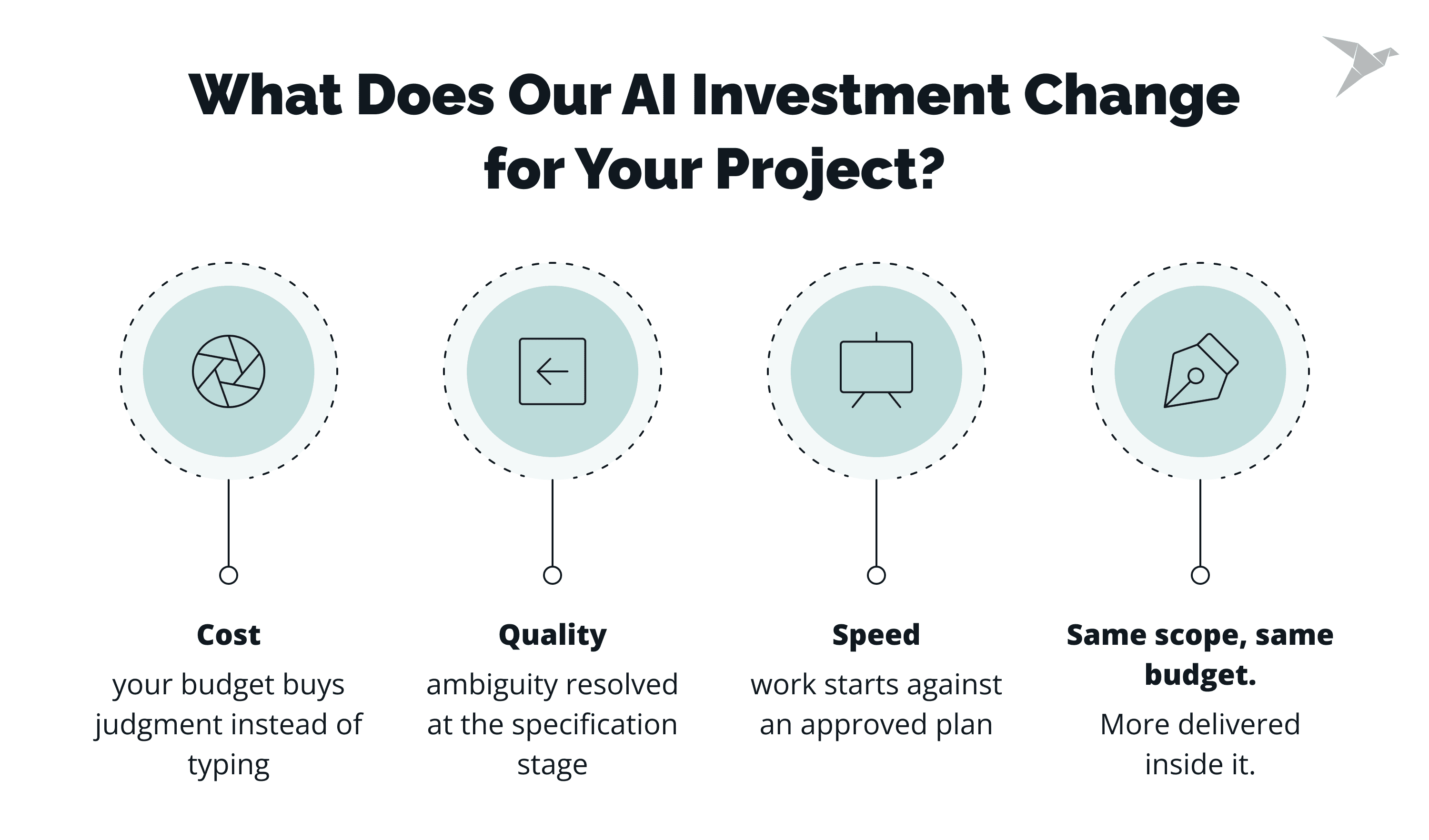
Cost. Senior software developers spend their hours on system architecture and decisions instead of boilerplate. More of your budget buys judgment, and less of it buys typing. Our Estimator Agent also works from historical project data, so you can allocate resources on evidence.
Quality. Ambiguity surfaces at the specification stage, where it is cheapest to resolve. Improving code quality is structural here: three review lanes, an automated end-to-end suite, and a weekly loop that fixes the rules behind repeated mistakes. Fewer errors reach your users, and software quality stops depending on who happened to review the pull request.
Speed. Work starts against an approved plan, so implementation begins without another round of clarification. Developers write code faster, feedback cycles shorten, and you see a demonstrable increment sooner.
Same scope, same budget. More delivered inside it.
Need Expert Help With AI in Software Development?
If you are integrating AI into an existing platform, or you have inherited a codebase that an agent wrote faster than anyone could review it, we can help with both. AI integration work and remediation work need different people, and we staff them differently.
Let's discuss your project

Final Thoughts
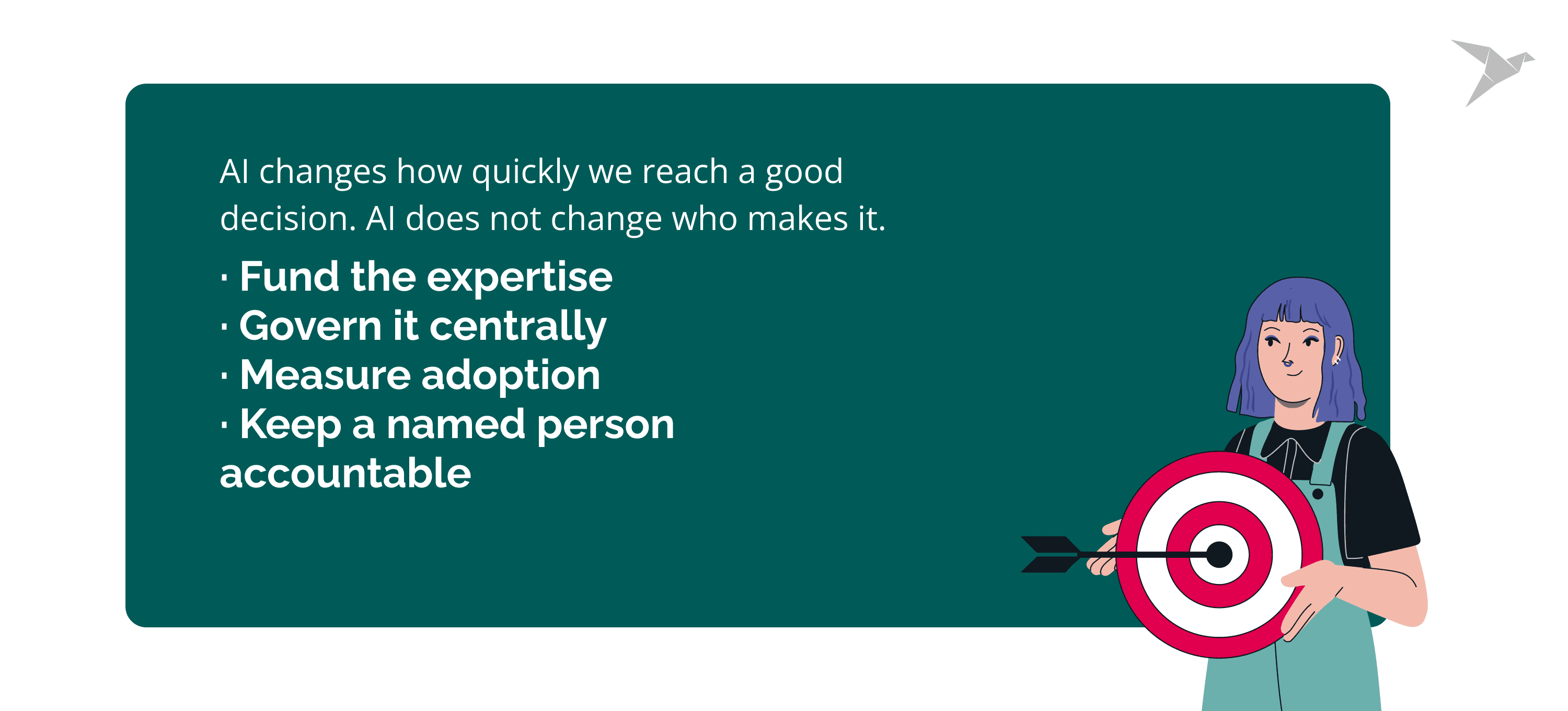
AI changes how quickly we reach a good decision. AI does not change who makes it. Our answer to how to use AI in software development is the same one we give internally: fund the expertise, govern it centrally, measure adoption, and keep a named person accountable for every output that ships.
At TechMagic, we keep pace with AI technology and treat every adoption decision as an investment. New tools and methods are assessed against a real delivery problem before they reach client work, and most are rejected at that stage. What we keep has to deliver measurable value on live projects.
What do we expect over the next three years?
- Agents are about to be everywhere in your software stack. Gartner expects 40% of enterprise applications to include task-specific AI agents by the end of 2026, up from less than 5% in 2025.
- Governing agents becomes a mainstream skill. Gartner also predicts that by 2029, at least half of knowledge workers will build new skills to work with, govern, or create AI agents on demand.
- Verification becomes a scarce resource. As AI-powered tools generate more of the code, the value shifts to the people and systems that decide whether it is correct, secure, and maintainable.
We would rather show you the mechanism than the marketing.

FAQ

Software companies use Artificial Intelligence across the software development lifecycle for code generation, code review, test case generation, documentation, and data analysis. At TechMagic, AI models work against an approved written specification, and a named engineer reviews and owns every AI-assisted output before it merges.
Artificial Intelligence is not replacing software developers at TechMagic. AI systems accelerate implementation, while human developers own the specification, software architecture, security design, and the pass or fail decision on every change. Every AI developer on the team stays accountable for what ships.
The main risks of using AI in software development are insecure output, hidden defects, data exposure through unvetted tools, and rising maintenance costs from code no one fully understands. TechMagic manages these with an approved-tools allowlist, a mandatory AI security course, three independent review lanes, and an automated end-to-end test suite.
AI-generated code is not secure by default, and it needs the same scrutiny as code from a junior engineer. TechMagic reviews every AI-assisted change against written security and access-control rules, and blocks any merge until Quality Assurance, the Product Owner, and the Architect have all signed off.
Spec-driven development is a delivery method where an approved written specification is the source of truth for a feature, and implementation is derived from it. At TechMagic, people write and approve the spec, an agent executes the numbered plan task by task, and the accountable engineer verifies the result.
TechMagic keeps a human accountable through three mechanisms: a specification written and approved by people before any code is generated, three independent review lanes that must all pass before a merge, and a named engineer who owns the delivery. Only approved AI tools may touch client code.