
 Software Development
 Security Services
 Cloud Services
 AI Services
 Other Services















 TechMagic Academy


Telemedicine Usage & Market Growth Statistics (2026)
Last updated:17 September 2026


The telemedicine market has its own rules and growing drivers. To make wise decisions, founders and healthcare business owners need precise stats and numbers.
This guide pulls the current telehealth market statistics into one place: market size and growth, who is using telehealth and for what, how adoption breaks down by specialty and region, and where Artificial Intelligence fits into the telehealth market’s next few years.
Key Takeaways
- The global telehealth market is valued between $77.4 billion and $186.4 billion for 2025, depending on the research firm, and is projected to reach $180.9 billion to well over $1 trillion by the early-to-mid 2030s at a compound annual growth rate (CAGR) between 11.5% and 24.6% (Grand View Research, Fortune Business Insights).
- 71.4% of U.S. physicians used telehealth weekly in 2024, up from 25.1% in 2018, according to the American Medical Association.
- Psychiatry leads every specialty, with 85.9% of psychiatrists reporting a weekly video visit in 2024 (AMA).
- Telehealth use among Medicare beneficiaries has settled at roughly 25%, down from a pandemic peak of 48% in 2020, per CMS’s March 2026 Medicare Telehealth Trends Snapshot.
- North America holds roughly 45% of global telehealth revenue, with Asia-Pacific growing fastest (Grand View Research).
- Congress extended Medicare’s telehealth flexibilities through December 31, 2027 under the Consolidated Appropriations Act, 2026, after a brief lapse in early 2026 (AASM). Government policies have expanded telehealth reimbursement coverage.
- The AI-in-telehealth market is forecast to grow from $4.22 billion in 2024 to $27.14 billion by 2030, a 36.4% CAGR (MarketsandMarkets).
How we gathered these statistics
Every figure below comes from a market-research firm, a government agency, or a peer-reviewed source we checked directly. We drew on:
- Grand View Research;
- Fortune Business Insights;
- MarketsandMarkets;
- Precedence Research for market sizing;
- the American Medical Association, CMS, the American Hospital Association;
- the Centers for Disease Control and Prevention’s National Center for Health Statistics for usage data;
- and peer-reviewed research for access.
Top Telehealth Market Statistics You Should Know in 2026
-
The global telehealth market was worth $77.4 billion in 2025, projected to reach $187.5 billion by 2033 at an 11.5% CAGR, per Grand View Research (June 2026).
-
Fortune Business Insights uses a broader category and puts the 2025 global market at $186.4 billion, growing to $1.27 trillion by 2034 at a 24.6% CAGR.
-
The U.S. telehealth market alone is estimated at $51.6 billion in 2025, projected to reach $439.5 billion by 2035 (Precedence Research).
-
71.4% of physicians used telehealth weekly in 2024, and 15.7% used it for more than a fifth of their weekly visits (AMA).
-
25% of Medicare beneficiaries used a telehealth service in 2023 and 2024, down from a pandemic-era peak of 48% (CMS).
-
116 million people worldwide used an online doctor consultation in 2024, up from 57 million in 2019 (Statista).
-
37% of U.S. adults used telemedicine in the prior 12 months, from 27.5% in rural counties to 40.3% in large metro areas (CDC/NCHS).
-
The global RPM device market, telehealth’s fastest-scaling adjacent category, is forecast to grow from $26.0 billion in 2025 to $110.7 billion by 2033 (Grand View Research).
-
Psychiatry has the highest telehealth usage of any specialty, with 85.9% of psychiatrists reporting a weekly video visit (AMA).
-
The AI-in-telehealth market is set to grow more than sixfold, from $4.22 billion in 2024 to $27.14 billion in 2030 (MarketsandMarkets).

How Big Is the Telehealth Market, and How Fast Is It Growing?
The telehealth market is worth somewhere between $77 billion and $186 billion globally in 2025, and it is still expanding at a double-digit rate. The exact figure depends on what a given firm or healthcare provider counts as "telehealth," so the honest answer is a range.
For a founder or product lead sizing an opportunity, the practical takeaway is to anchor on the narrower, software-and-services definition rather than the headline number that includes hardware, since that's the market a typical digital health product actually competes in.
Global telehealth market size and forecast
Grand View Research sizes the global market at $77.4 billion for 2025, rising to $87.7 billion in 2026 and $187.5 billion by 2033, an 11.5% CAGR. Fortune Business Insights counts a broader category, including hardware and platform revenue, at $186.4 billion for 2025, growing to $1.27 trillion by 2034 at a 24.6% CAGR.
Which number to use depends on what you're building: a pure software or virtual-care platform sits closer to Grand View Research's figure, while a company selling connected devices or infrastructure alongside its platform should size against Fortune Business Insights' broader total.
US telehealth market size
The U.S. telehealth market was valued at $51.6 billion in 2025, projected to grow to $63.9 billion in 2026 and then to $439.5 billion by 2035, a 23.9% CAGR (Precedence Research). That outpaces the global average, reflecting increased demand and reimbursement policy that sit inside the U.S. healthcare industry.
For a team building specifically for the U.S. market, this gap is the signal that matters most: growth here is being pulled forward by policy as much as by demand, which is why the reimbursement rules covered later in this guide are worth mapping before a single feature gets built.
How Many People Use Telehealth?
Telehealth adoption has settled well above pre-pandemic levels, even as it has cooled from its 2020 peak. 71.4% of U.S. physicians used telehealth weekly in 2024, according to a 2024 Physician Practice Benchmark Survey analyzed by the American Medical Association, nearly three times the 25.1% weekly-use rate recorded in 2018.
That level of routine, week-to-week physician use is what separates telehealth today from a pilot or a pandemic-era workaround: any product built for providers should assume telehealth is already part of the default workflow, not a feature clinicians need convincing to try.
Overall telehealth adoption rate
On the patient side, 37% of U.S. adults used telemedicine in the past year, according to the CDC's National Center for Health Statistics. Worldwide, online doctor consultations reached 116 million users in 2024, up from 57 million in 2019, per Statista – widespread adoption, with more telehealth visits and patient visits handled virtually each year.
At that scale, telehealth reads as a mainstream care channel rather than a niche one, which matters for go-to-market: the audience to design for is the general patient population, not just early adopters comfortable with new technology.
Telehealth adoption by age and demographic
Adoption skews older. In the CDC's data, adults aged 65 and up used telemedicine at the highest rate of any age group (43.3%), ahead of adults aged 18 to 29 (29.4%), and women used it more than men, 42.0% versus 31.7%.
That pattern matters for remote patient monitoring in particular, since older patients are both the heaviest telehealth users and the group most likely to be managing one or more chronic conditions. For product teams, this is a design constraint as much as a market insight: accessibility, simplicity, and support for chronic-care follow-up should be treated as core requirements, not add-ons for a secondary user segment.
Access disparities in rural areas
Rural areas lag behind cities, and limited access here tracks broadband infrastructure more closely than it tracks patient demand. CDC data shows telemedicine use at 40.3% in large metro counties versus 27.5% in the most rural, noncore counties, a gap tied to broadband more than interest in healthcare access.
A 2026 peer-reviewed analysis found why: telehealth investment shows almost no measurable effect on preventive-care access below roughly 40% to 50% rural broadband penetration, but a strong, statistically significant effect above it (PMC). Below that threshold, broadband is the bottleneck, and even the best telehealth capabilities cannot fix a connection that keeps dropping.
The conclusion for anyone weighing a rural go-to-market push: check local broadband penetration before assuming low adoption means low demand, since the two often have different causes entirely.
How Does Telehealth Usage Vary by Specialty and Provider?
Telehealth use is far from even across medicine. Behavioral health services lead every other specialty by a wide margin, and health systems have moved from piloting virtual care to running it as a standard care channel.
Telehealth use by physician specialty
Psychiatric care tops the list: 85.9% of psychiatrists reported a weekly video visit in 2024, and 68.2% used video or audio-only telehealth for more than a fifth of their weekly visits, the highest of any specialty (AMA).
Behind psychiatry: neurology (32.2% of visits), endocrinology (24.2%), gastroenterology (20.4%), family medicine and other primary care (20.1%), and urology (18.7%) round out the heaviest telehealth loads, showing virtual visits reach well beyond specialty care. On the payment side, 31.2% of Medicare spending eligible for telehealth billing was actually billed as a telehealth service that year.
Provider and health system adoption of telehealth services
Adoption is no longer confined to early movers. Health systems from academic medical centers like Cleveland Clinic to community hospitals now run virtual visits, specialty consults, and remote consultations as a routine part of scheduling rather than a pandemic-era side project.
Platforms built by Teladoc Health and Included Health compete directly for health-system and payer contracts, and device makers such as GE Healthcare supply hardware for remote monitoring programs. Clinicians and other healthcare professionals increasingly expect telehealth inside the same system they already use for in person visits, rather than a separate app.
How Does Telehealth Adoption Differ by Region?
Telehealth adoption is not evenly distributed, and where demand concentrates matters for anyone weighing where to launch first.
United States
North America accounts for roughly 45% of global telehealth revenue, the largest share of any region, with the U.S. driving most of it (Grand View Research). Government reimbursement policy, described below, explains much of why, translating into genuinely expanded access rather than access that exists on paper only.
Europe and the UK
In Europe, 78% of countries address telehealth explicitly in national health policy, though only 35.4% have fully established telemedicine services, according to Statista. Policy intent is running ahead of implementation across much of the continent.
Asia-Pacific and other high-growth markets
Asia-Pacific is the fastest-growing region for telehealth by CAGR, even though it trails North America and Europe on absolute revenue today (Grand View Research), driven by rising smartphone penetration and government digital-health investment.
What Do Patients Think About Telemedicine?
Patient satisfaction with telehealth is generally strong, but it depends heavily on how smoothly the visit goes.
In J.D. Power’s 2024 U.S. Telehealth Satisfaction Study, reported by the American Hospital Association, payer-provided telehealth offerings scored 708 out of 1,000, up 18 points from the year before, while direct-to-consumer platforms scored 730. Convenience is the top reason patients choose telehealth (65%), followed by faster access (46%) and plan coverage (30%).
Ease of use drives whether patients come back. Among patients who had an easy medication-review visit and a clear view of their treatment plans, 74% said they would use telehealth again for that need, versus just 28% of those whose chronic-care follow-up visit was difficult.
Two in three patients reported at least one barrier, most often connectivity problems or limited service availability (25% each), with data security concerns cited by 15%. A clunky telehealth visit does more damage to retention than the concept of virtual care ever does – convenient healthcare only stays convenient if the platform behind medical appointments and patient care holds up.

What’s Driving Telehealth Industry Growth, and What’s Holding It Back?
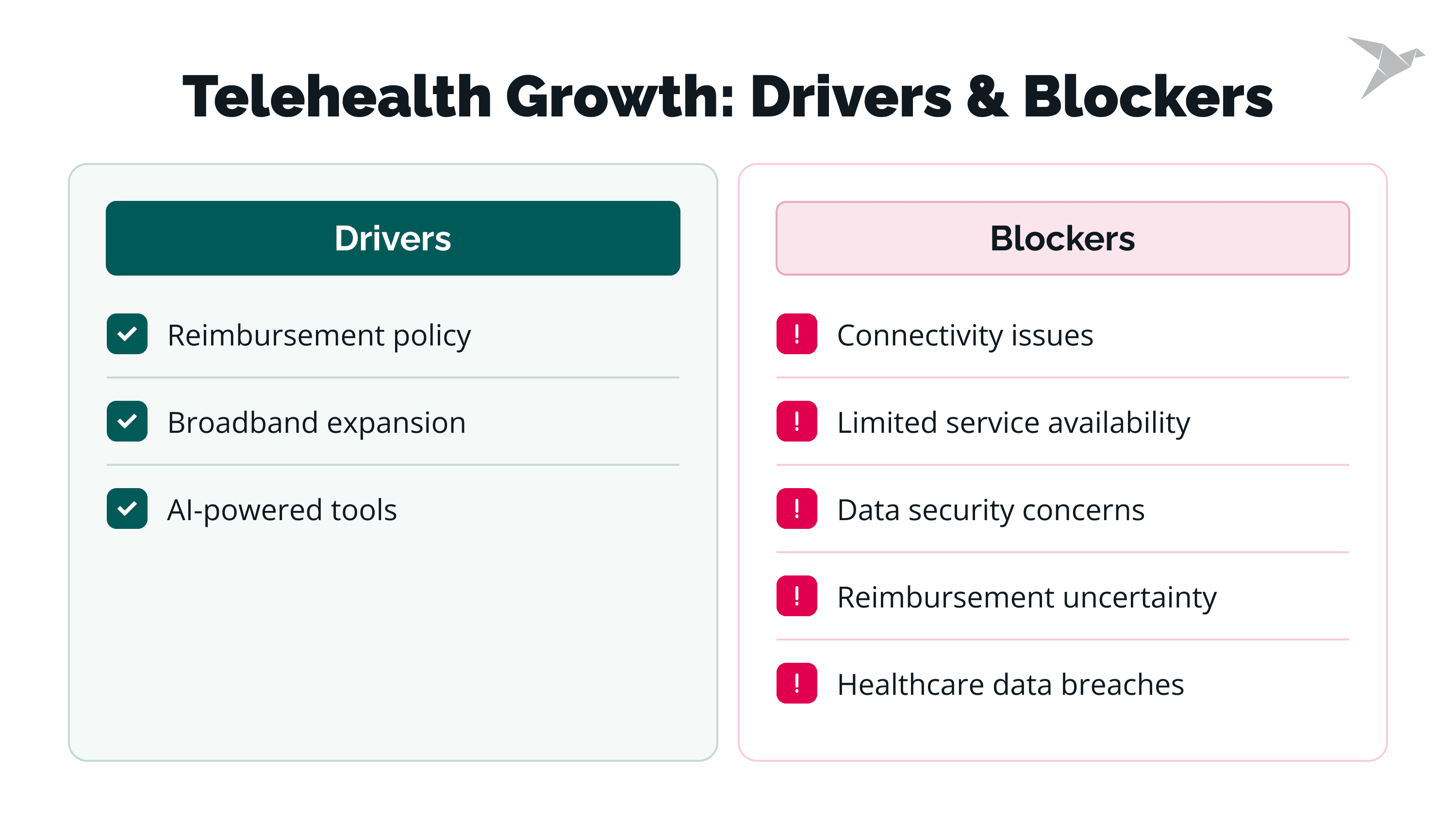
Government support for telehealth reimbursement is the single biggest tailwind in the U.S. market right now, and cybersecurity risk is one of the sharpest headwinds.
Growth drivers: reimbursement, technology, and access
Congress extended Medicare’s telehealth flexibilities, including home-based visits without geographic restriction and audio-only coverage for certain services, through December 31, 2027 under the Consolidated Appropriations Act, 2026, after the policies briefly lapsed around January 30, 2026 during a government shutdown (AASM).
State Medicaid services vary in what they reimburse, and the Health Resources and Services Administration funds rural broadband grants on top of that, which is why coverage rules are usually the first thing a product team maps before launch. Better broadband, wider smartphone ownership, and growing comfort with virtual healthcare and virtual services round out the demand side.
Barriers and headwinds: policy, security, and equity
The flip side of that policy dependency is uncertainty: telehealth flexibilities have lapsed and been restored twice since 2025, and every renewal deadline puts reimbursement, and therefore revenue, at risk. Data breaches are the other major headwind.
Hacking and other IT incidents caused more than 80% of large healthcare data breaches in 2025, and roughly 138.5 million people had health information compromised across reported breaches that year, per an analysis of HHS data by HIPAA Journal.
High costs of security engineering slow some smaller practices down, but on a cost effectiveness basis a breach is far more expensive than the safeguards that prevent one, and any team building remote healthcare services should treat patient data protection as core architecture from the start to reduce costs later.
What Are the Key Trends Shaping Telehealth Solutions?
A handful of trends are doing most of the work to move these numbers, and each one is backed by its own growth curve.
Remote patient monitoring and connected medical devices
Remote patient monitoring, paired with connected devices and wearables, is telehealth’s fastest-scaling adjacent market. The global RPM device market is projected to grow from $26.0 billion in 2025 to $110.7 billion by 2033, a 20% CAGR, with North America holding around 40% share (Grand View Research).
For chronic disease management and day-to-day chronic condition management, RPM turns a video call into more data between visits, enabling timely interventions before a chronic condition becomes an emergency, and helping improve patient outcomes for people living with chronic diseases.
Virtual-first and hybrid care models
Health systems increasingly design care around a hybrid model by default instead of routing every patient to in person care first. Telemedicine visits now sit alongside in person visits as a standard scheduling option, which is part of why platform teams building telehealth capabilities and expanding telehealth platforms design for both channels from day one rather than retrofitting virtual visits onto an existing workflow later.
Specialty telehealth, especially behavioral health
Behavioral health remains the standout use case. With 85.9% weekly usage among psychiatrists, behavioral health services and psychiatric care continue to pull further ahead of every other specialty, and demand for accessible mental health support keeps that gap widening rather than closing.
Platform consolidation and interoperability
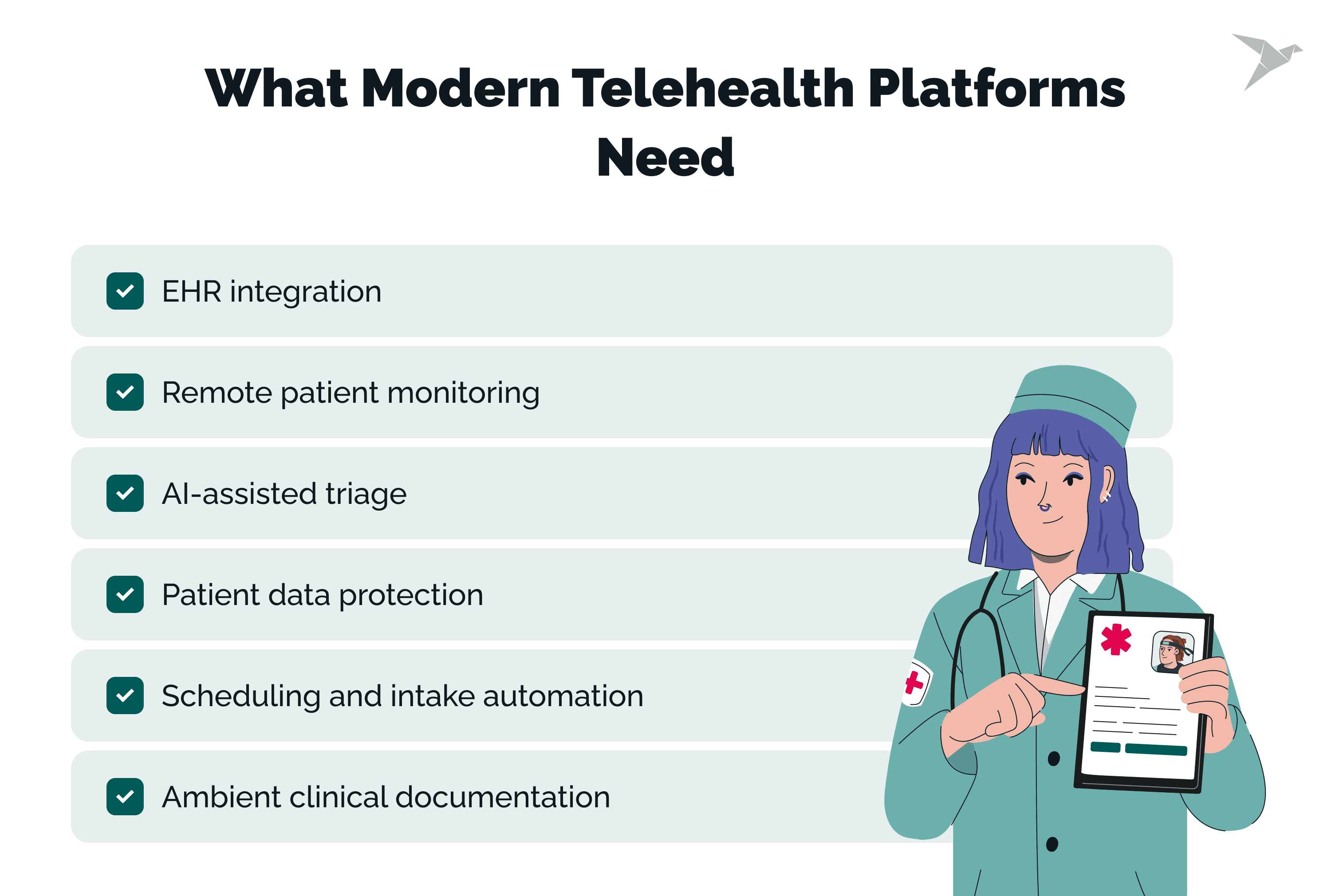
As the market matures, buyers expect telehealth technologies and digital platforms to plug into their existing electronic health record through real EHR integration rather than operate as a silo. FHIR-native platforms make that far less brittle than older, point-to-point interfaces, one reason interoperability is now a procurement requirement as digitalized healthcare becomes the default.
What Is the Role of Artificial Intelligence in Telehealth?
Artificial Intelligence is the fastest-growing part of the telehealth stack. The AI-in-telehealth and telemedicine market is projected to grow from $4.22 billion in 2024 to $27.14 billion by 2030, a 36.4% CAGR, more than double the growth rate of the underlying telehealth market itself (MarketsandMarkets).
In practice, that spending shows up in a handful of concrete places: symptom-checking and triage tools that route a patient to the right level of care, ambient clinical scribes that draft visit notes from the conversation, scheduling and intake automation, and AI driven diagnostic tools that flag patterns in imaging or lab data for a clinician to review.
Every one of those uses assists a clinician; it does not replace one. TechMagic builds AI features into healthcare products on that principle: the software supports the decision and directs scarce health resources to the patients who need them most, and a licensed clinician makes the call.
What Do the Forecasts Say About Telehealth Market Growth Through 2030?
The headline number depends on whose forecast you use and which forecast period it covers, and the honest way to report it is to show the range rather than pick a favorite.
Overall market forecast and CAGR to 2030
MarketsandMarkets puts the global telehealth and telemedicine market at $94.14 billion in 2024, growing to $180.9 billion by 2030 at an 11.5% CAGR. Grand View Research’s estimate runs lower on the base year but similar on CAGR, while Fortune Business Insights’ broader market definition projects a far larger total by the early 2030s. Three firms, three numbers, one consistent direction: sustained double-digit growth.
Adoption and usage projections
Physician-side adoption looks unlikely to reverse. With telehealth built into standard scheduling workflows and Medicare flexibilities locked in through 2027, the 71.4% weekly physician-usage rate the AMA recorded in 2024 reads like a floor to build from.
AI-in-telehealth and RPM sub-market forecasts
The two fastest-growing pieces of the market are AI, forecast to grow at 36.4% CAGR to $27.14 billion by 2030, and remote patient monitoring, forecast to grow at 20% CAGR to $110.7 billion by 2033. Both are outpacing telehealth overall, a signal for where the next wave of strategic partnerships and platform investment is headed.
Our Experience Building Telemedicine and Remote-Care Products
These numbers are useful for a deck. Turning them into a working product is a different job, and it is the one we do. We build telemedicine and remote-care platforms for healthtech teams, including a preventive-care platform for early cancer detection built on Medplum with a Health Gorilla integration for external record retrieval and lab data.
In practice, that means mapping Medicare and state Medicaid reimbursement rules before writing a line of code, designing for FHIR-based interoperability from day one instead of retrofitting it later, and treating patient data protection as core architecture rather than a compliance step added at the end. If you’re validating a build, our healthcare app development services team can help you scope it.
HIPAA-compliant app built with Medplum to support early cancer detection
Wrapping Up
The telehealth industry has settled into steady, durable growth: a market worth somewhere between $77 billion and $186 billion today, expanding at a double-digit rate through the early 2030s regardless of whose forecast you trust.
Usage has stabilized well above 2018 levels across physicians, patients, and Medicare beneficiaries alike, Artificial Intelligence is growing faster than the category around it, and where a product fits often comes down to specialty and region as much as the underlying technology.
Where telehealth growth goes next
-
The next Medicare renewal deadline will be the real test. Flexibilities now run through December 31, 2027, but the pattern of lapse-and-restore since 2025 means another renewal decision is likely before then, and how it resolves will shape reimbursement more than any single market forecast.
-
AI spending shifts from pilot features to standard infrastructure, under supervision. Ambient documentation and triage support are already the fastest-growing line item in the market; expect that spending to keep concentrating on tools that assist a clinician’s decision under human oversight, rather than autonomous diagnosis.
-
Remote patient monitoring and telehealth start to merge into one care model within the scope of HealthTech services. With RPM device adoption growing faster than telehealth overall, fewer platforms are likely to treat virtual visits and continuous monitoring as separate products.
-
Interoperability becomes a baseline requirement rather than a differentiator. FHIR-native integration is already a procurement expectation; platforms that still rely on custom point-to-point integrations will increasingly lose deals on that basis alone.

FAQ

Estimates for 2025 to 2026 range from roughly $77 billion to $186 billion globally, depending on the research firm and how broadly it defines telehealth. Grand View Research estimates $87.7 billion for 2026; Fortune Business Insights, using a broader category, puts the 2025 figure at $186.4 billion.
Forecasts for the global telehealth market cluster between an 11.5% and 24.6% compound annual growth rate through the early 2030s, with the U.S. market growing even faster, at roughly 23.9% CAGR through 2035 according to Precedence Research.
In the United States, 37% of adults used telemedicine in the prior 12 months, according to the CDC’s National Center for Health Statistics. Among Medicare beneficiaries specifically, usage has settled at roughly 25%, down from a pandemic peak of 48%.
Psychiatry leads by a wide margin: 85.9% of psychiatrists reported a weekly video visit in 2024, per the American Medical Association. Neurology, endocrinology, gastroenterology, and family medicine follow, each with more than a fifth of weekly visits delivered via telehealth.
Telehealth services saw a 60% increase in outpatient visits during COVID-19. Telehealth adoption fell sharply from its 2020 pandemic peak, but it has stabilized well above pre-pandemic levels. Medicare telehealth use, for example, dropped from 48% in 2020 to roughly 25% by 2023 and 2024, and has held steady there rather than continuing to decline.
Artificial Intelligence in telehealth is used for triage and symptom-checking, ambient clinical documentation, intake and scheduling automation, and diagnostic support that a clinician reviews rather than acts on autonomously. The AI-in-telehealth market is projected to grow to $27.14 billion by 2030. This is one of the most prominent trends, as AI tools automate administrative tasks and reduce physician burnout.