
 Software Development
 Security Services
 Cloud Services
 AI Services
 Other Services















 TechMagic Academy


Types of Penetration Testing: Methods, Approaches & How to Choose

Victoria Shutenko
Security Engineer & Pentester at TechMagic. AWS Community Builder. AWS UG Leader. Certified eWPTX, eCPPT, eMAPT, CCSP-AWS, CAP, and C-AI/MLPen
Each type produces a different picture of the same product. A test that starts from the public internet with no prior knowledge shows what an outsider can reach in a week, while a review with full source-code access surfaces security flaws an outsider would never find. More than one type exists so you can match a test to the risk you actually carry.
Choosing well means weighing what each type finds against what it misses, and your compliance deadline usually narrows the field first. TechMagic holds CREST accreditation for penetration testing, and everything below comes from the tests our experienced penetration testers run for clients. Ready to plan a test, with or without a defined scope? Our penetration testing services page is where to go next.
What Are the Types of Penetration Testing?
Penetration testing types are classified by what the pen tester knows, where the tester starts, how the engagement is structured, and what is under test. Here is the map this page follows:

How much internal knowledge the tester receives. Black box, gray box, and white box.

Where the tester operates from and what they simulate. External, internal, and social engineering.

How the work is structured and scored. A traditional scoped test, a red team assessment, or a physical test.

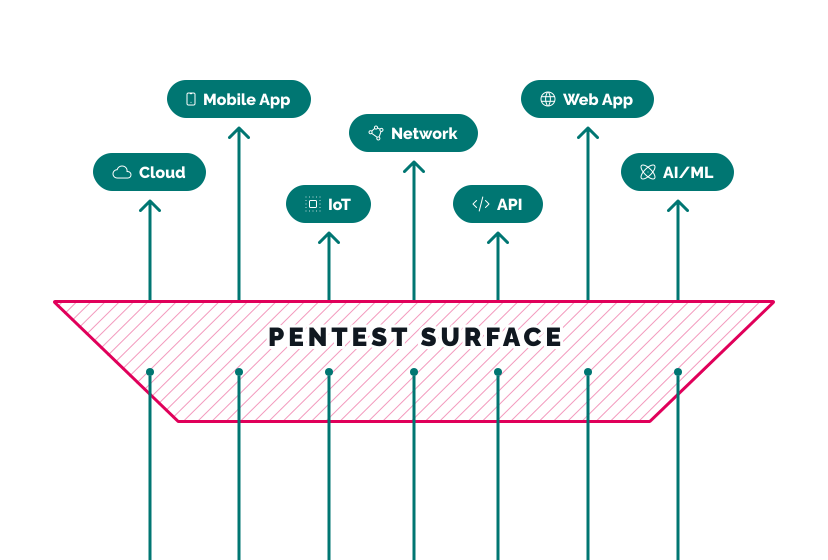
Which layer of the product is under test. Web application, mobile, API, cloud, network, and more.
Formal types of penetration testing methodologies, such as PTES, OWASP, and NIST SP 800-115, give security professionals a repeatable process underneath all of this.

Black box testing gives the penetration tester nothing beyond what any outsider could find: DNS records, exposed services, and leaked credentials. They map what is reachable and try to gain access. It is the most faithful picture of your most exposed vulnerabilities.
Suitable for: a first external test, to see your exposure as an attacker does.

Gray box penetration testing gives the tester partial knowledge: test credentials, architecture diagrams, and API documentation. Those inputs skip discovery and put the budget into exploitation. Most engagements use it, because it finds the real security weaknesses: broken object-level authorization and privilege escalation.
Suitable for: a multi-role product, where one user could reach another's data.

White box penetration testing gives the tester everything: admin rights, server configuration, operating systems, and source code. The tester can identify weaknesses by tracing a vulnerable input from the frontend to the query that executes it, down code paths a black box test misses.
Suitable for: a major release, a rewritten authentication layer, or a code-level audit.
Penetration Testing Methods
The types of penetration testing methods below describe where the tester stands when work starts. Most programs begin externally, then add internal and social engineering penetration testing coverage.
Penetration Testing Types by Engagement Style
Engagement style describes how the work is structured, scoped, and scored. Two engagements can share an approach, a method, and the same penetration techniques, and still be different projects, with scope and cost climbing down the list.

Traditional (scoped) penetration test
A standard penetration test covers an agreed target within a fixed window, usually one to three weeks. Your team knows it is running, and the deliverable is a report with severity-rated findings and a plan to remediate security vulnerabilities. Auditors expect this format.
Suitable for: a defined system, or an audit deadline that needs a formal report.
Red team assessment
A red team assessment tests whether you detect an attack and how fast you respond. The team pursues a goal by any in-scope route while your blue team defends unaware, so you learn your real response capabilities while withstanding red team attacks. TechMagic offers this as red team as a service.
Suitable for: a security team with a SOC or alerting that has never been tested.
Physical penetration testing
Physical pen testing validates the physical security controls protecting your buildings and hardware. Testers attempt tailgating, badge cloning, lock bypass, and try to gain unauthorized access to server rooms, all agreed in advance. TechMagic does not run physical tests, so scope this with a specialist vendor.
Suitable for: offices and data centers where a badge and a confident walk get you in.
Eight Areas of Pen Testing
Target area is the axis most buyers shop by, because it names the thing they are trying to protect. Most teams first meet the types of penetration testing in cyber security audits, where nobody defines the labels. TechMagic scopes and delivers six of the eight below, and the last two are here for completeness.

Web application penetration testing evaluates an application reachable through web browsers against the OWASP Top 10, with the OWASP Web Security Testing Guide setting the method. Injection, cross site scripting attacks, and broken access control remain the highest-yield categories. Retail, SaaS, and FinTech products test here first, because the web application is usually the largest attack surface a company owns. See our web app pentest services for scope and timelines.


Mobile application penetration testing covers the app binary, its local storage, and the APIs behind it, following the OWASP Mobile Application Security Verification Standard on both Android and iOS builds. Testers identify vulnerabilities such as insecure local data storage, weak certificate pinning, and hardcoded secrets. HealthTech and banking apps carry the most risk, since a stolen phone is a realistic threat model. TechMagic delivers this through mobile app pentest services.

API penetration testing targets the interfaces your applications and partners call directly, checking authentication, authorization, mass assignment, rate limiting, and object-level access control for potential vulnerabilities. The toolkit is Burp Suite, OWASP ZAP, Postman, and your Swagger or OpenAPI definitions. Broken object-level authorization is the single most common serious finding, and APIs earned a dedicated OWASP Top 10 list of their own. Scope this as an API pentest when partners or mobile clients consume your endpoints.

Cloud penetration testing examines the cloud infrastructure behind your AWS, Azure, or Google Cloud deployment and the identity model that governs it. Common targets are over-permissive IAM roles, public storage buckets, exposed managed databases, and misconfigured identity providers such as AWS Cognito or Microsoft Entra ID. Provider rules of engagement apply, so scope is agreed with the cloud vendor's testing policy in mind. Cloud-native companies retest whenever the architecture changes, and TechMagic runs cloud pentest engagements across all three major providers.

A network penetration test examines the network infrastructure carrying your traffic, on-premises or hosted. Testers review firewall rules, router and switch configuration, VPN gateways and split-tunneling rules, DNS, proxy setup, patch levels, and the encryption protecting internal traffic. Man-in-the-middle positioning and unpatched services are the usual entry points for common network based attacks. Manufacturing and logistics companies depend on this layer for network security, and you can book it as a network pen test.

AI penetration testing evaluates Large Language Models, agents, and the pipelines feeding them, probing to uncover security vulnerabilities such as prompt injection, training-data and system-prompt leakage, unsafe tool invocation, and excessive agency in autonomous workflows. The OWASP Top 10 for LLM Applications is the working reference. AI testing is the newest category on the list, and it grew as products started shipping agentic features. Our engineers hold the Certified AI/ML Pentester credential from The SecOps Group, and we scope this work as AI pentesting.

Wireless penetration testing assesses wireless networks and the devices attached to them, looking for weak WPA2 or WPA3 configuration, rogue access points, guest networks that reach production, and bypassable captive portals. The test happens on site, because radio range defines the attack surface. TechMagic does not currently sell wireless testing as a standard engagement, so treat this section as background for scoping conversations.

IoT penetration testing covers connected devices and the systems they share a network with, including firmware extraction and analysis, hardware interface probing, default-credential checks, and review of the device's cloud backend for security holes. Like wireless, IoT testing is its own discipline with its own toolchain. It appears here because buyers compare it against the categories above, and it sits outside our standard service catalog.
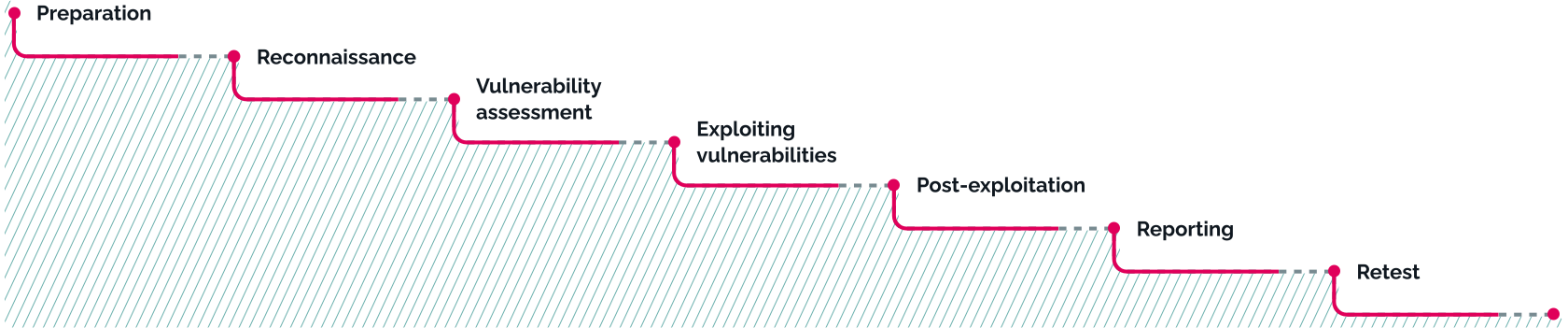
Penetration Testing Steps
How to Choose the Right Penetration Testing Type for Your Project
Choosing between the different types of penetration testing comes down to three questions: your deadline, your architecture, and your security maturity.
Penetration Testing Types Statistics You Should Know
Each figure below comes from a primary industry report published in the last 12 months. They point at unpatched, reachable software: the weakness found by the types of penetration testing cybersecurity teams run most often, such as external, web application, API, and network tests.
of breaches now begin with the exploitation of a software vulnerability, the first time that vector has outranked stolen credentials. Verizon Data Breach Investigations Report 2026
of all breaches involve ransomware, based on incidents analyzed through October 2025. 2026 Verizon DBIR
is the global average cost of a data breach, up 12% in a single year. IBM Cost of a Data Breach Report 2026
More than 1 in 4 malicious attacks are now AI-driven, a 56% year-over-year rise that adds about $1 million per breach. IBM
is the projected worldwide cybersecurity spend for 2026, growing 7.72% year over year. Statista
Case Studies
Services provided:
- Black box penetration testing
- Web application and API testing
- OWASP Top 10 testing
- Authentication and authorization validation
- Risk analysis and remediation plan
- Stakeholder presentation
Outcomes:
- Costly overhauls avoided
- No critical or high-severity findings
- Low and medium issues only
- Found in access control and data validation
- ISO 27001 compliance confirmed

Services provided:
- Cloud, web, mobile, and API pentesting
- Authentication flow testing
- Third-party integration testing
- Cloud configuration review
- Access control review
- PTES and OWASP methodology
Outcomes:
- Prioritized weakness list
- Real-world risk ratings
- Security posture improved
- Regular penetration testing scheduled
- Vulnerability scanning scheduled

Services provided:
- Black box penetration testing
- Web application and API testing
- OWASP Top 10 testing
- Authentication and authorization validation
- Risk analysis and remediation plan
- Stakeholder presentation
Outcomes:
- Costly overhauls avoided
- No critical or high-severity findings
- Low and medium issues only
- Found in access control and data validation
- ISO 27001 compliance confirmed
Services provided:
- Cloud, web, mobile, and API pentesting
- Authentication flow testing
- Third-party integration testing
- Cloud configuration review
- Access control review
- PTES and OWASP methodology
Outcomes:
- Prioritized weakness list
- Real-world risk ratings
- Security posture improved
- Regular penetration testing scheduled
- Vulnerability scanning scheduled
FAQ
Let’s safeguard your project

VP of business development

Trusted by: