









HIPAA Penetration Testing Requirements: What §164.308 Demands and What's Changing in 2026
Last updated:16 November 2026


On January 6, 2025, the US Department of Health and Human Services (HHS) published a proposed update to the Health Insurance Portability and Accountability Act (HIPAA) Security Rule. It would make HIPAA penetration test requirements explicit for the first time. Comments closed on March 7, 2025, and the latest federal regulatory agenda projects a final rule for July 2027.
Until then, the current Security Rule applies, and it never names penetration testing. Even so, a pentest is the usual way to meet its evaluation and risk analysis requirements.
Most guides ask one question: does HIPAA require penetration testing? Healthcare security teams need clearer answers. Which HIPAA requirements does a pen test cover today, and what changes once the rule is final?
In our new article, we cover the §164.308 subsections behind penetration testing, how they differ from the §164.312 technical safeguards, what the proposed rule would change, and how to prepare now.
Key Takeaways
- The HIPAA Security Rule never names penetration testing, yet it is the de facto way to meet the periodic technical evaluation in §164.308(a)(8).
- Pentest findings also feed the ongoing risk analysis under §164.308(a)(1), the focus of a dedicated HHS Office for Civil Rights (OCR) enforcement initiative.
- The proposed rule would require annual penetration testing, semiannual vulnerability scanning, multi-factor authentication (MFA), encryption, and network segmentation.
- As of November 2026, the rule is still a proposal, so mapping patient data and tracking remediation now pays off under either version.
What Are the HIPAA Penetration Test Requirements Under §164.308(a)(8)?
HIPAA penetration test requirements come from §164.308(a)(8), the Evaluation standard. The Security Rule never mentions penetration testing specifically, but the standard requires periodic technical evaluations of security controls. A pentest is the usual way to produce that evidence.
A HIPAA penetration test is an authorized, simulated attack on the systems that create, receive, maintain, or transmit electronic protected health information (ePHI). Its job is to show whether Security Rule safeguards hold up against real-world attacks.
Is a pentest the only form of technical evaluation HIPAA accepts? No. Under §164.306(b), each organization chooses security measures that fit its size, complexity, capabilities, costs, and risks.
What the evaluation standard says
Section 164.308(a)(8) requires covered entities and business associates to “perform a periodic technical and nontechnical evaluation.” The first evaluation starts from the implemented standards. Later evaluations respond to environmental or operational changes that affect the security of ePHI. Each evaluation must show how far the organization’s policies and procedures meet the Security Rule.
Three words in that standard shape every testing program:
- Technical. Policy reviews cover the nontechnical half of each security evaluation. Hands-on testing is the most direct way to show whether controls hold under attack.
- Periodic. The rule sets no interval, so the organization defines one and follows it.
- Changes. A new Fast Healthcare Interoperability Resources (FHIR) API or an identity provider migration can count as an operational change and reopen the evaluation.
NIST SP 800-66 Revision 2 is the National Institute of Standards and Technology guide to the Security Rule, published in February 2024. It lists “system security test results (e.g., penetration tests)” among the internal sources a risk assessment should draw on. OCR’s latest audit round reviews 50 covered entities and business associates against Security Rule provisions tied to hacking and ransomware.
Where penetration testing fits the other §164.308 subsections
Penetration testing produces evidence for at least eight §164.308 citations, and the Evaluation standard is only the most direct one.
“Addressable” does not mean optional. Under §164.306(d), the organization implements the specification when it is reasonable and appropriate. Otherwise, it documents the reason and adopts an equivalent alternative if one is reasonable.
What OCR investigations focus on
Checklists of HIPAA pentest requirements usually start with (a)(8). In OCR investigations, though, the risk analysis at (a)(1)(ii)(A) carries the most weight. OCR returns to it again and again and even runs a dedicated Risk Analysis Initiative, which had produced 14 enforcement actions by June 2026.
Recent cases show how closely these findings match pentest scope. In September 2026, after a phishing breach at Ambry Genetics, OCR cited potential failures in risk analysis, termination procedures, and unique user identification. A penetration test checks the last two directly by looking for stale accounts and logins shared between users.
Software vendors get the same scrutiny. In March 2026, MMG Fusion, a business associate, settled with OCR after a breach affecting about 15 million people, and the findings again included the risk analysis.
That is why the real value of a pentest lies in what happens after the report. Its findings should feed the risk analysis and turn into fixes that a retest confirms.
How Is §164.308 Different From the Technical Safeguards in §164.312?
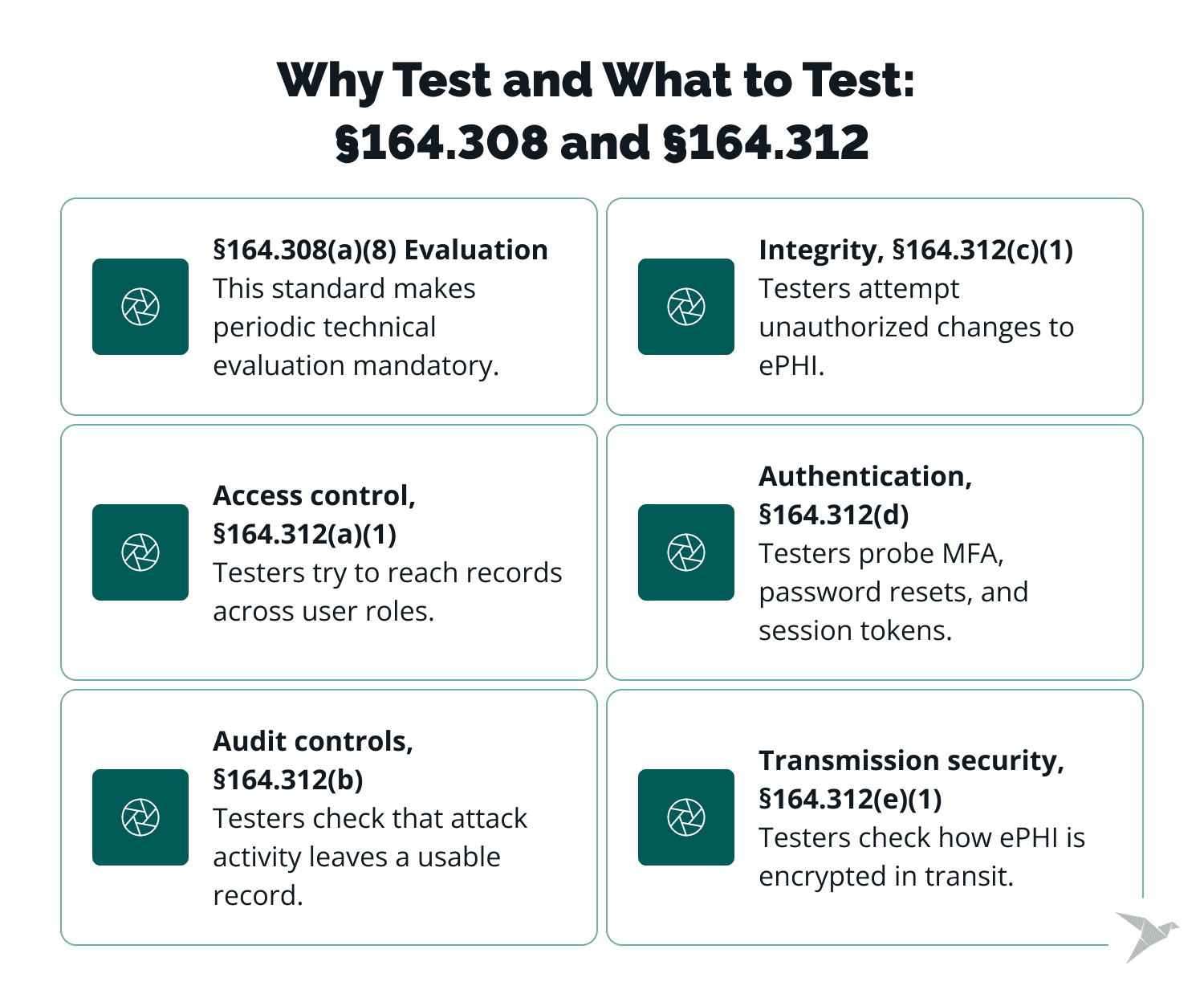
Section 164.308 sets the administrative safeguards: the policies and processes, including the evaluation that makes testing necessary. Section 164.312 sets the technical safeguards a test actually validates. They cover who can reach ePHI, what gets logged, data integrity, authentication, and transmission security.
Administrative safeguards: the evaluation mandate
Section 164.308 answers the questions an auditor asks first about a healthcare organization’s security controls. Who evaluates them, how often, and where do the findings go?
Without that layer, a penetration test is a one-off engineering exercise. A HIPAA Security Rule penetration test relies on standard offensive techniques. What makes it compliance evidence is the paper trail that ties it to §164.308.
Technical safeguards: what a test actually validates
The technical safeguards in §164.312 describe the controls a tester tries to break. Each one maps to concrete checks.
(R) marks a required specification. (A) marks an addressable one.
Audit controls are easy to leave out of scope, and a recent case shows why they matter. In October 2026, TechCrunch reported that Epic paused most product development after an AI cybersecurity model surfaced flaws that could expose patient data. MyChart, Epic’s patient portal, is used to maintain more than 320 million records across US hospitals and doctors’ offices.
Epic’s chief security officer told The New York Times that some customer configurations of MyChart could let outsiders access patient records without leaving any trace in the logs. In Security Rule terms, that one flaw hits two standards at once: access control under §164.312(a)(1) and the audit trail required by §164.312(b).
A test that only checks whether access is blocked misses the audit side of §164.312.
How Would the Proposed Rule Change HIPAA Penetration Test Requirements?
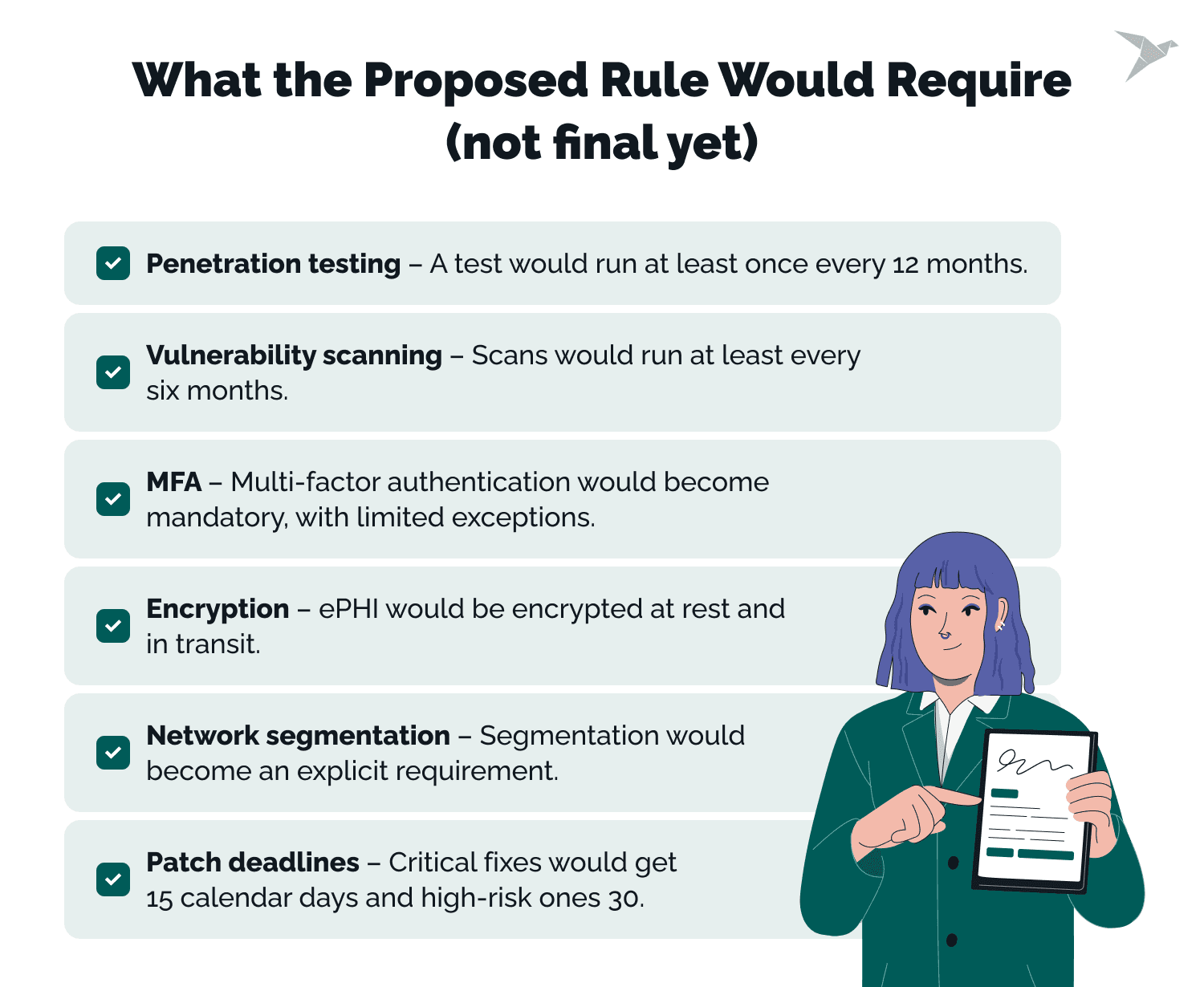
The proposed rule would make penetration testing an explicit requirement every 12 months at minimum, with vulnerability scanning at least every six months. As of November 2026, it remains a proposal, and the current Security Rule stays in force.
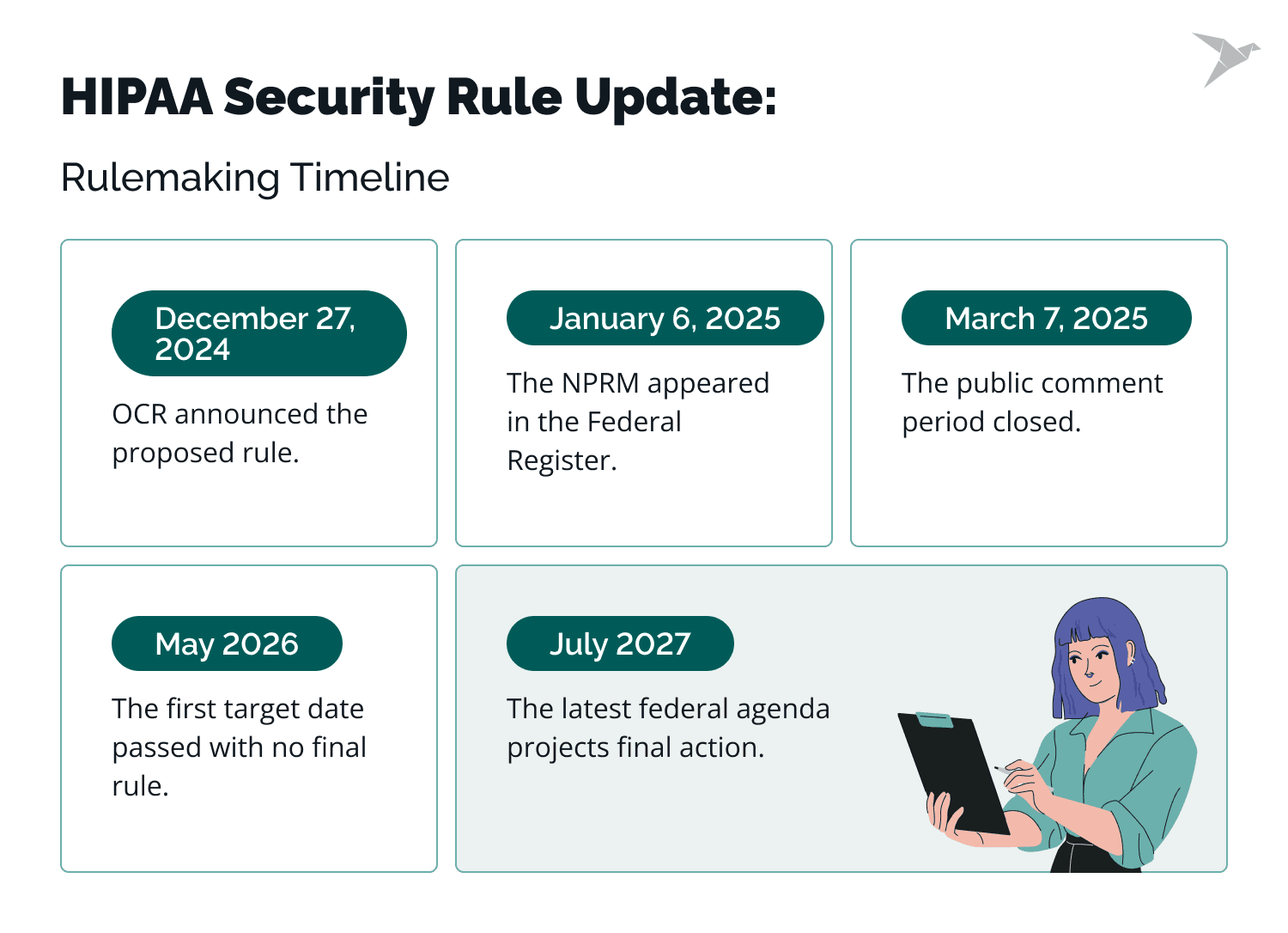
Rulemaking status as of November 2026
OCR announced the notice of proposed rulemaking (NPRM) on December 27, 2024. The timeline since then:
The NPRM itself proposes that a final rule take effect 60 days after publication, with compliance due 180 days later.
Agenda dates are projections, and this one has already slipped once. The final text may also differ, so every requirement below stays proposed until HHS publishes a final rule.
An explicit annual penetration test
Today, no HIPAA provision names a testing frequency. The HHS fact sheet on the NPRM states that the proposal would require penetration testing at least once every 12 months.
The same proposal would add three related 12-month cycles:
- A review and test of how well certain security measures work, replacing today’s general duty to maintain them
- An audit of the organization’s own Security Rule compliance
- A written verification from each business associate that it has deployed the required technical safeguards, backed by a subject matter expert’s analysis and a certification of its accuracy
That last item matters for HealthTech SaaS vendors that act as business associates. Maintaining compliance would mean giving covered-entity customers written proof every year, and a recent penetration test report can support it.
A six-month vulnerability scanning cadence
Today’s HIPAA vulnerability scan requirements are implicit. Under the risk analysis specification, an organization must accurately and thoroughly assess potential vulnerabilities to ePHI. NIST SP 800-66r2 adds that questionnaire-based tools need a method that can identify technical vulnerabilities. The NPRM would add a vulnerability management standard at proposed §164.312(h), with scanning at least every six months.
Scanning and penetration testing answer different questions. Automated vulnerability scans list known weaknesses and missing patches. A tester proves which ones are exploitable, chains them together, and finds business logic flaws that no signature covers. The proposal would require both, on different clocks.
New mandatory technical controls: MFA, encryption, segmentation, and patch deadlines
The proposal would also turn several controls that are addressable or unnamed today into hard requirements:
- No more “addressable.” Nearly all implementation specifications would become required, with narrow exceptions.
- Multi-factor authentication (MFA), with limited exceptions.
- Encryption of ePHI at rest and in transit, with limited exceptions. Today, encryption is addressable under §164.312(a)(2)(iv) and §164.312(e)(2)(ii).
- Network segmentation as an explicit requirement.
- Patch deadlines. A new patch management standard at proposed §164.308(a)(4) would set fixed deadlines. Critical risks would get 15 calendar days and high ones 30, counted from identifying the need where a patch is available.
- Asset inventory and network map of ePHI flows, reviewed at least every 12 months.
Watch the renumbering. Today, §164.308(a)(4) covers information access management, but the NPRM would give that number to patching. Policies and test reports that cite it would need an update once a final rule lands.
From our reading of the proposal, each new control also becomes a test objective. A tester would be expected to show that MFA cannot be bypassed and that segmentation actually isolates ePHI systems. Segmentation checks alone call for comprehensive testing of internal networks as well as applications.
What Should a §164.308-Aligned Penetration Testing Program Look Like Today?
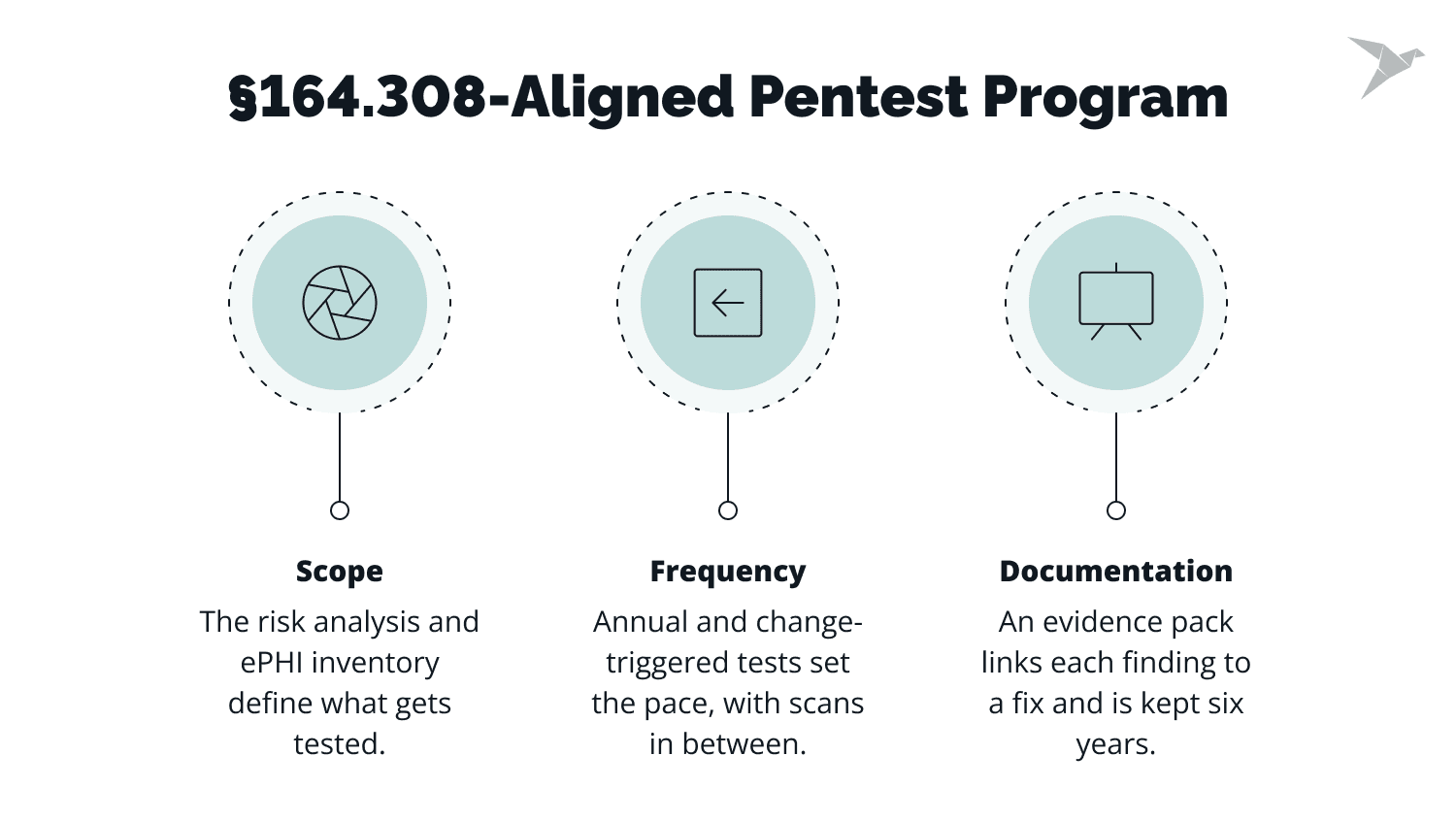
A program of penetration testing for HIPAA compliance holds up when it ties scope, frequency, and documentation to specific subsections. Scope comes from the risk analysis, frequency from the Evaluation standard, and documentation from risk management and the six-year retention rule.
Scope matched to where ePHI actually lives
The testing scope should come from the risk analysis under §164.308(a)(1)(ii)(A) and the asset inventory behind it. In electronic health information systems, ePHI usually sits in these places:
- Electronic health record (EHR) and electronic medical record (EMR) platforms, including custom modules on top of vendor systems
- Patient portals and mobile apps
- HL7 v2 interfaces and FHIR APIs, including SMART on FHIR authorization flows
- Telehealth platforms: session tokens, scheduling, and messaging
- Cloud infrastructure: storage, identity and access management, backups, and logs
- Integrations with labs, payers, and billing services
- Medical device networks that link imaging and monitoring equipment to clinical systems
In HealthTech SaaS products, attackers usually reach patient data through the user interface and its integrations, so web app penetration testing and API assessments carry the most weight.
A HIPAA compliance penetration test should start with the ePHI data-flow map. In hospital and clinic healthcare environments, medical device cybersecurity also enters scope. Testers check medical device connectivity in maintenance windows or on non-production units to avoid disrupting care.
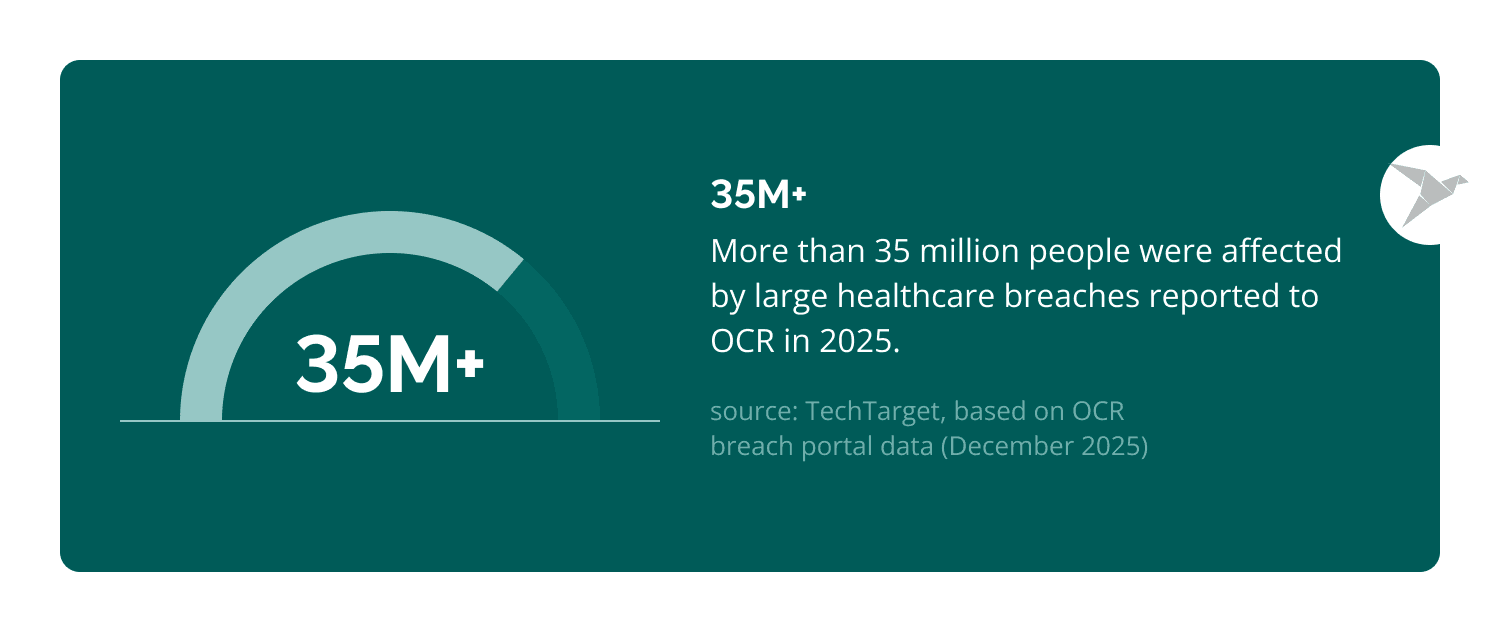
The cost of a HIPAA penetration test varies with the number of applications, APIs, and user roles in scope. A reliable HIPAA penetration test cost estimate comes after scoping. Cutting scope is risky, though: large breaches reported to OCR in 2025 affected more than 35 million people, according to TechTarget. Statista data from August 2026 still ranks healthcare first for the average cost of a data breach.
Frequency: what “periodic” actually means
Searches for HIPAA pen test requirements usually look for one number, and the current rule gives none. A defensible schedule combines these layers:
- An annual baseline test of every in-scope ePHI system. Yearly pen testing is common practice and matches what the proposal would require.
- Change-triggered tests after a major release, a new integration, an authentication update, or a cloud migration. The Evaluation standard already requires a fresh review after such events.
- Automated scanning between tests, so known vulnerabilities do not wait a year for discovery.
Products that ship every week may justify continuous testing of new features. Continuous monitoring of logs and alerts then covers the gaps between test cycles. A vulnerability disclosure program also lets outside security researchers report issues at any time.
The schedule belongs in written policy. Comprehensive penetration testing of every system several times a year is rarely realistic, so the risk analysis decides where depth goes. A public patient portal can justify more frequent testing than an internal reporting tool.
Documentation that holds up under an OCR request
Most HIPAA compliance penetration testing requirements an investigator checks come down to documentation. A complete evidence pack follows one loop:
Scope → Test → Fix → Retest → Document
- A scope statement tied to the asset inventory and the risk analysis
- The methodology, such as the Penetration Testing Execution Standard (PTES), the Open Worldwide Application Security Project (OWASP) Web Security Testing Guide, or NIST SP 800-115
- Findings with severity, affected ePHI systems, and reproduction steps
- Remediation tickets with owners and target dates
- Retest results that confirm each fix
- Risk register updates that show what exposure remains
Section 164.316(b)(2)(i) requires keeping Security Rule documentation for six years from its creation or last effective date, whichever is later. If testers may encounter ePHI or other sensitive data, the contract should set handling terms before work starts, including a business associate agreement where one applies.
How Should Healthcare Teams Prepare Before the Rule Finalizes?
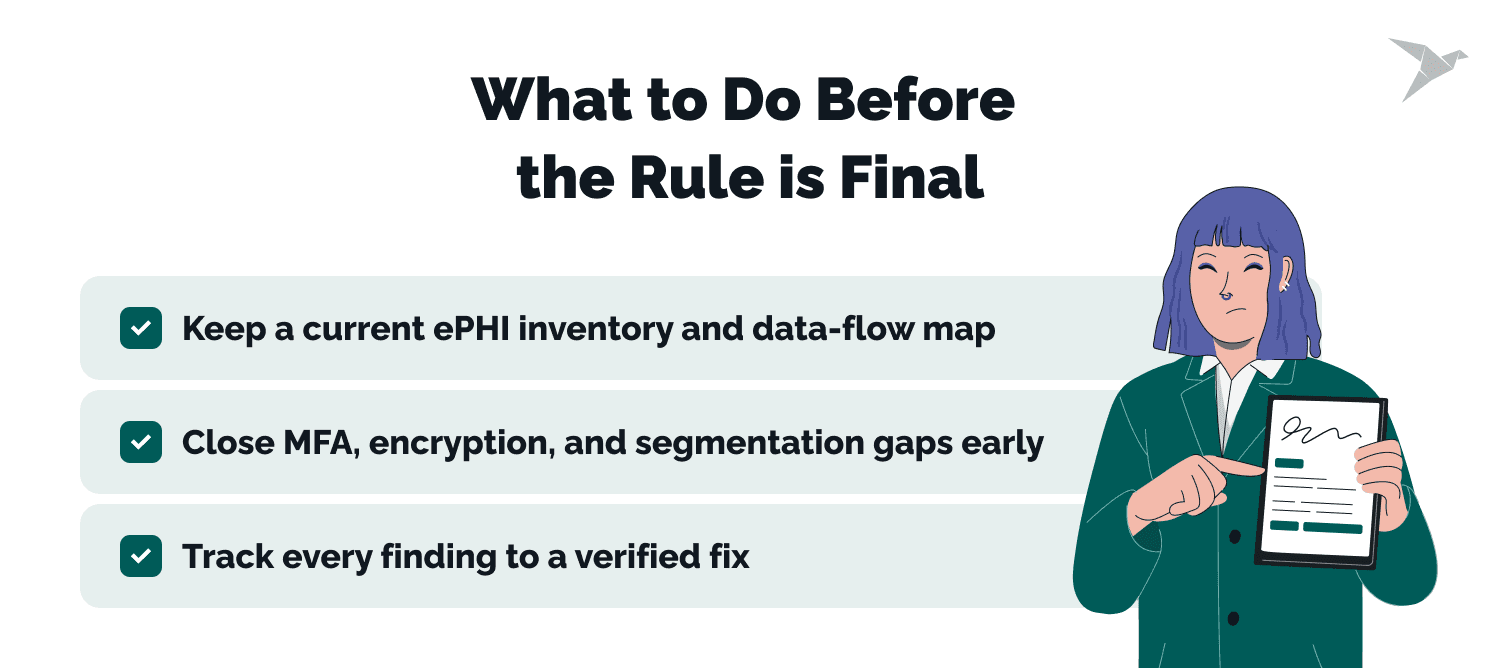
Healthcare teams should start with the controls the current rule already expects and the proposal would make explicit: an ePHI inventory, MFA, encryption, segmentation, and tracked remediation. These steps lower audit risk today and belong in any healthcare organization’s cybersecurity strategy, whatever the final rule says.
A current ePHI asset inventory and data-flow map
The inventory is the foundation for risk analysis, scope, and the proposed network map. It lists every system in the healthcare organization’s IT infrastructure that stores, processes, or transmits ePHI, including vendor-hosted ones. It also traces data flows through APIs, queues, logs, and third parties.
Shadow copies are the common miss. Analytics exports, staging databases seeded from production, and verbose application logs often hold sensitive health data no one listed.
A HIPAA compliance checklist for healthcare software helps structure this review, and the resulting map becomes the pentest scope. Organizations that conduct regular risk analyses refresh the map at each cycle.
Early fixes for MFA, encryption, and segmentation gaps
Common gaps include admin consoles without MFA, unencrypted internal service traffic, and flat cloud networks where one compromised workload can reach the production database.
Under the current rule, encryption is addressable, and MFA and segmentation are not named at all. A documented risk decision can still cover them, but the proposal would largely remove that option. Closing the gaps now turns future penetration testing requirements for HIPAA compliance into verification work.
Where in-house capacity is short, healthcare cybersecurity services can handle the architecture changes and test the result.
A remediation-tracking process auditors can inspect
A pentest finding without a closed ticket is a known risk on paper, which is hard to defend in an investigation. A remediation process that holds up looks like this:
- Every finding becomes a ticket with an owner, a severity, and a target date.
- Target dates follow a written policy. The proposal’s 15- and 30-day patch windows are a reasonable model for critical and high findings.
- A retest confirms each fix, and its result is attached to the ticket.
- Accepted risks carry a written justification signed by an accountable owner.
Organizations that track HIPAA Security Rule penetration testing requirements this way can answer an OCR request with records rather than reconstruction.
Those records also matter for penalties. Under a 2021 amendment to the HITECH Act, OCR must consider recognized security practices when it decides fines, audits, and settlement terms. The practices count only if they were in place for the prior 12 months, so work documented now starts that clock.
Our Experience Testing Healthcare Systems for HIPAA Compliance
TechMagic both tests and builds healthcare systems that handle patient data. The engagements below show each side.
Unumed: a penetration test of a cloud-native hospital management system
Unumed, a Copenhagen-based company, runs a cloud-native hospital management system with EHR, telemedicine, and analytics for healthcare providers in Africa, Southeast Asia, and Central America. We ran a targeted black-box test of its primary web application ahead of an annual ISO 27001 audit. HIPAA was not the driver, but the safeguards in scope are the ones §164.312 names.
The penetration testing process followed PTES and OWASP guidance: reconnaissance, automated scanning to identify vulnerabilities, then manual exploitation of authentication, authorization, and custom APIs through real-world attack scenarios.
The test found no critical or high-severity vulnerabilities, which confirmed a strong security posture. Low- and medium-severity issues in access controls and data validation needed only straightforward fixes.
MHC Healthcare: a HIPAA-compliant EMR portal with a built-in audit trail
For MHC HealthCare, a US injury treatment provider, we built a custom EMR portal that stores medical histories, treatment plans, and progress notes. Attorneys can access their clients’ records, and the platform runs on AWS (EC2, S3, Amazon MQ) with .NET and MSSQL Server.
The audit trail records every change to sensitive patient health information, who made it, and when, and runs separately from core business services. That design supports audit controls under §164.312(b) and activity review under §164.308(a)(1)(ii)(D), which a later penetration test can verify.
Lessons from testing ePHI-handling systems
These engagements point to a few principles:
- Authorization logic deserves the most manual time. Automated tools catch outdated libraries but rarely catch one patient opening someone else’s record through an API parameter.
- Logs belong in scope. A good test checks whether its own activity shows up in logs and alerts. If it does not, that is a §164.312(b) finding.
- Findings need a patient-data lens. A medium-rated flaw on an endpoint that returns ePHI can outrank a high-severity issue on a marketing page. Data security risk follows ePHI.
Test the system as an attacker would reach patient data, and document every step for the auditor who will read it.
Need Help Aligning Penetration Testing With HIPAA?
TechMagic’s CREST-accredited penetration testing checks whether the application, API, and cloud layers protect patient data as intended. Our testing and consulting support HIPAA compliance, while legal determinations stay with the organization and its counsel. Each test ends with a severity-ranked report, prioritized remediation guidance, and a results overview to discuss the findings. An attestation letter is available if needed.

Final Thoughts
Today, HIPAA penetration testing requirements rest on §164.308(a)(8), backed by the risk analysis and risk management specifications. The proposed rule would raise that floor with fixed testing and scanning intervals plus patch deadlines. It would not replace the evaluation logic underneath.
Where is this heading?
- Attackers will keep driving large healthcare breaches. Hacking dominates the healthcare threat landscape. Through June 9, 2026, 173 of 189 large breaches reported to OCR were hacking or IT incidents, according to TechTarget.
- Vulnerability volume will outgrow annual testing alone. Gartner expects documented Common Vulnerabilities and Exposures (CVEs) to pass 1 million by 2030, up from about 277,000 in 2025. Scanning and change-triggered tests will carry more of the load.
- Account exposures will be exploited faster. Gartner predicts AI agents will cut the time it takes to exploit account exposures by 50% by 2027. That puts authentication and MFA testing near the top of any scope.
Whatever date the final rule carries, the testing evidence an auditor asks for will look much the same. Work done now counts toward maintaining HIPAA compliance under either version.

FAQ

The HIPAA Security Rule does not explicitly require penetration testing today. Section 164.308(a)(8), the Evaluation standard, requires periodic reviews of security controls, both technical and policy-based. Penetration testing is the usual way to cover the technical side.
The main §164.308 subsection for penetration testing is the Evaluation standard at (a)(8). Test findings also feed risk analysis at (a)(1)(ii)(A) and information system activity review at (a)(1)(ii)(D). Risk management at (a)(1)(ii)(B) applies because tests drive fixes, and access controls under (a)(4) are checked directly.
Vulnerability scanning is an automated check that lists known weaknesses, such as missing patches and misconfigurations. HIPAA penetration testing is a largely manual, simulated attack that proves which weaknesses can actually be exploited to reach electronic protected health information (ePHI).
The cost of a HIPAA penetration test depends on scope: the number of applications, APIs, user roles, and environments, and whether cloud, internal network, or medical device work is included. A small, single-application assessment costs far less than a multi-environment engagement, so a reliable estimate only comes after scoping. Quotes are best compared on scope and methodology, because hourly rates alone hide what is tested.
The proposed HIPAA Security Rule update would require penetration testing every 12 months and vulnerability scanning every six months, at minimum. The proposal would also make multi-factor authentication (MFA), encryption of electronic protected health information (ePHI), and network segmentation mandatory.
The proposed HIPAA Security Rule would require penetration testing at least once every 12 months. The notice of proposed rulemaking (NPRM) suggests that a final rule take effect 60 days after publication, with compliance due 180 days later. The federal regulatory agenda projects the final rule for July 2027.
The current HIPAA Security Rule does not require annual penetration testing or set any fixed interval. A yearly test is still the common baseline for the periodic evaluation under §164.308(a)(8). The proposed rule would make that cadence mandatory once finalized.
TechMagic runs CREST-accredited penetration tests on web applications, APIs, and cloud infrastructure holding electronic protected health information (ePHI). Every penetration test HIPAA-regulated clients receive ends with a severity-ranked report and prioritized remediation guidance. TechMagic also consults on mapping findings to §164.308 and §164.312, while legal compliance determinations stay with the organization.
