








The AI Software Factory: From AI-Assisted to Agentic Development
Your team already uses AI tools. What’s usually missing is a shared, learning system around them.
Our AI Software Factory is how TechMagic builds software — AI agents woven into planning, coding, review, testing, and delivery, improving with every task it completes.
Weʼre Trusted By

















The Shift: From AI-Assisted to Agentic
The difference between “we use AI” and running a factory.
Most teams today are AI-assisted
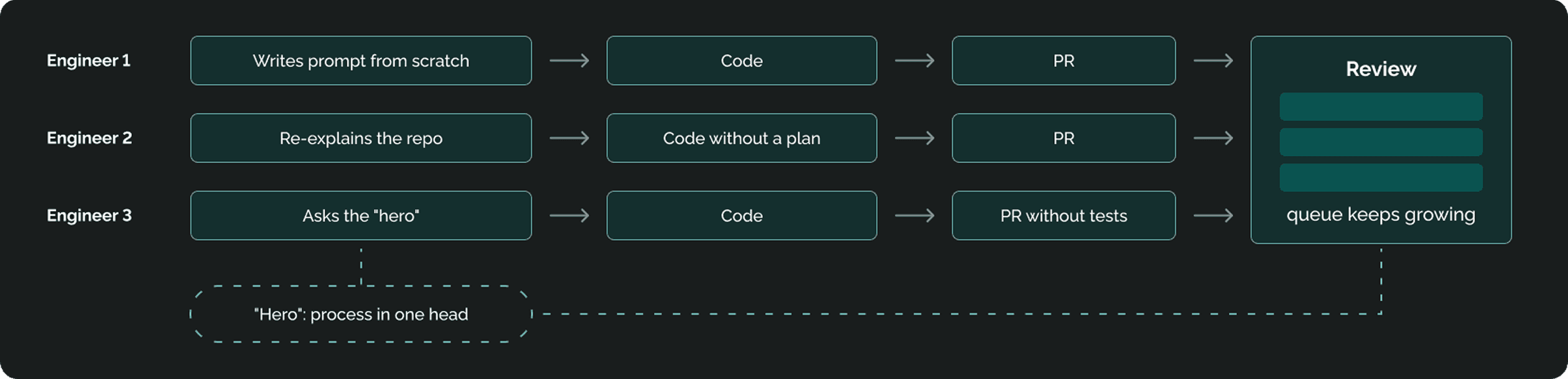
Individual engineers use copilots and chat tools, each in their own way, each re-explaining the same context to the AI every time. It speeds up typing. It doesn’t fix the coordination, review, and repeated-explanation overhead sitting underneath.
Agentic development is different
Instead of one person prompting a tool, a system of AI agents is embedded across the development lifecycle — and it learns. It studies how previous tasks were actually completed, picks up the patterns, and applies them the next time a similar task comes through. That’s the core difference between “we use AI” and “we run an AI Software Factory.”
What an AI Software Factory Actually Does
The Details Where The Devil’s Hiding

Planning, code generation, review, testing, and deployment — not a single tool or a chatbot bolted onto an IDE.

Whether a plan is right, and whether a change is safe to ship.

Friction — a misunderstanding, a repeated correction, an edge case handled wrong — gets turned into a new rule or check, so the same mistake doesn’t repeat.

It gets better at your codebase and your team’s way of working specifically, not at coding in general.
Early observation, not a universal benchmark:
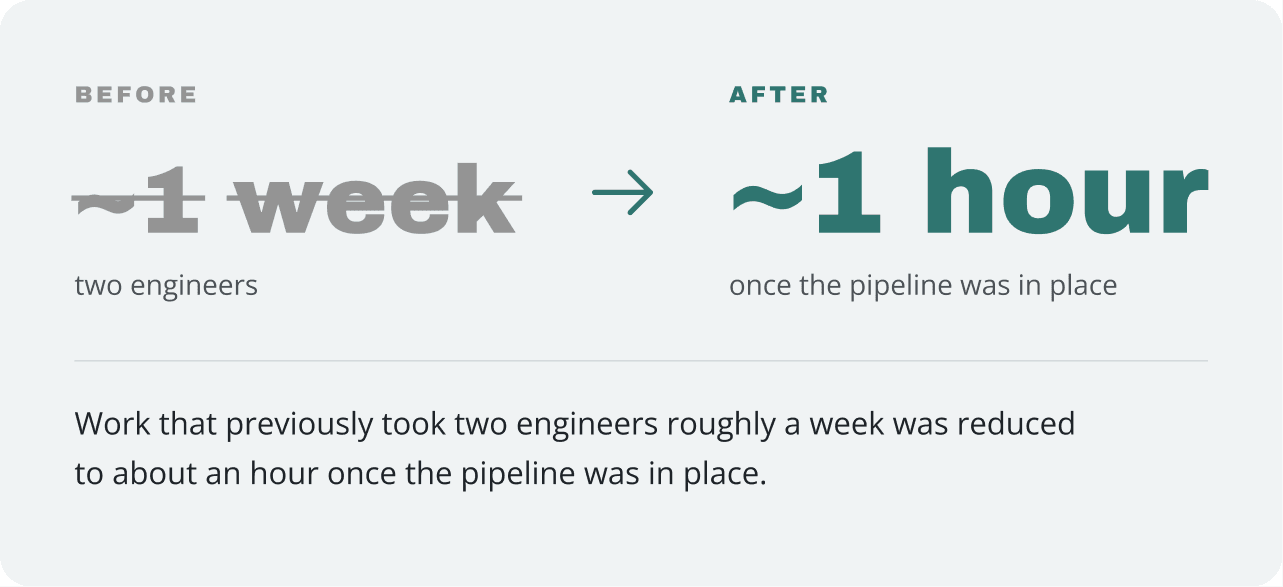
On one engagement, this approach was used to automate a repetitive, time-consuming task.
This is a single, real result from one pilot — not an average across all projects, and not a promise of what any given project will see. We’re measuring this properly as the approach expands, and we’ll only publish numbers we can stand behind.
How It Works Across the SDLC
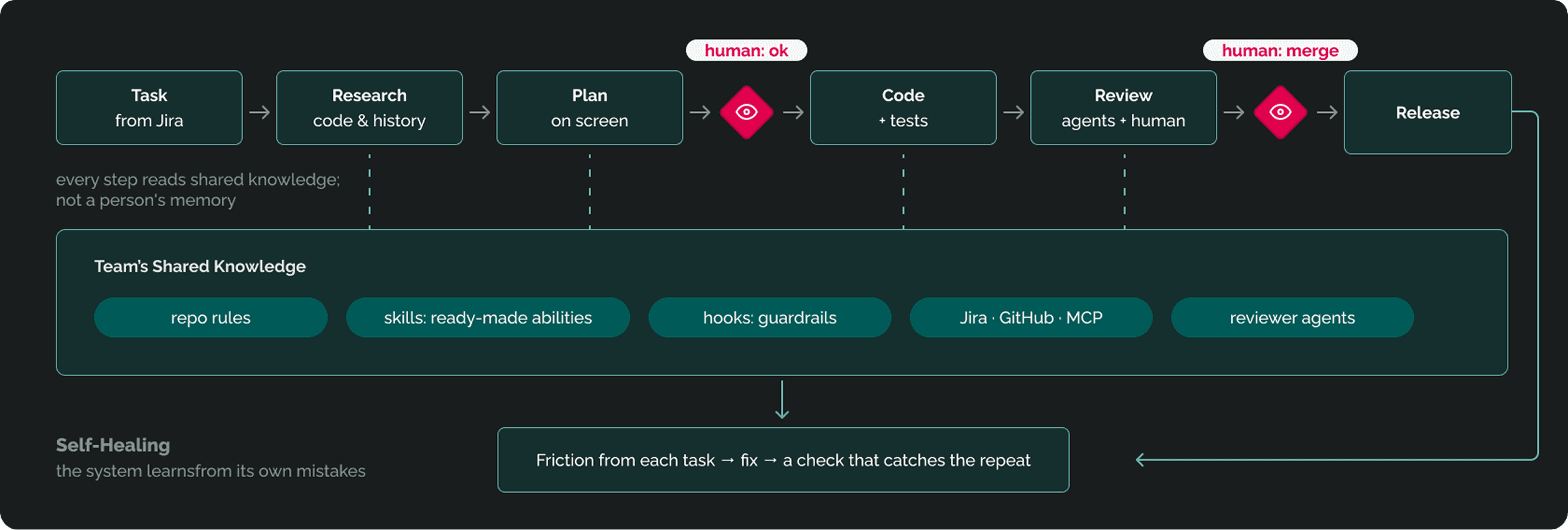
Two decisions stay human at every step: is this plan right, and is this change safe to merge. Everything else is where the agents do the work.
Spec-driven, not vibe-driven. Agents help turn a ticket into a clear, reviewable plan before any code is written
Agents write code against that plan, with a human checkpoint before it moves forward
AI reviewers check for the issues your team actually cares about — the ones that used to need a senior engineer’s eyes every time — alongside security scanning
Test coverage generated and maintained alongside the code, not bolted on afterward
CI/CD with AI-assisted checks, and monitoring that feeds learnings back into the system
Built to Get Smarter, Not Just Faster
This is the part that separates an AI Software Factory from “AI-assisted coding”: it learns from your team’s own history. It looks at how similar tasks were solved before, picks up the conventions and judgment calls your engineers already made, and reuses them — so the tenth time a certain kind of task comes through, it’s handled with the accumulated knowledge of the first nine.
When something goes wrong, that becomes a new safeguard, not just a one-off fix. The system is designed to need less correction over time, not more of the same correction repeated.
With the AI Software Factory
Secure by Design
Every change still goes through human review before it ships. Analysis of how your team works happens with consent and inside your own environment — we’re not reading private communications or scoring individual engineers, and we don’t claim otherwise.

Plus automated quality and security checks before merging.

Analysis of how work happens runs with consent.

No reading private communications, no scoring individual engineers.
FAQ
Let’s turn ideas into action

VP of business development

Trusted by:


