
 Software Development
 Security Services
 Cloud Services
 AI Services
 Other Services












 TechMagic Academy


Top Web Development Companies in 2026
Last updated:25 June 2026
Choosing the right web development partner shapes how your product performs, how fast you ship, and how much you spend fixing things later. The problem is the sheer number of options. A new agency seems to appear every week, and most lists rank them by visibility rather than substance.
This guide compares web development companies that come up most often when founders and engineering leaders build a shortlist. Each one is described with the same structure, so you can judge them on the same terms: what they do, where they are strong, where they are not, and how clients rate them. Think of it as a working shortlist of the top web development companies 2026 buyers are already comparing.
A note on transparency: TechMagic publishes this list and is included in it. To avoid an unearned ranking, the companies below are listed alphabetically, not first to last, and every company is described with the same structure, including weaknesses. Ratings are point-in-time and change, so treat them as a starting point rather than a verdict. Choose a partner for your own needs, not for its place in any ranking.
Key takeaways
- The right web development partner depends on your stack, project size, and how much design, product, and ongoing support you need, not on brand recognition.
- This list mixes boutique product studios, large outsourcing firms, and specialist shops, including Python-focused houses like STX Next and Django Stars.
- Every company is described with the same structure, including weaknesses, and carries a verified Clutch rating (checked June 2026).
- The list is alphabetical, not ranked, so weigh each one against your own requirements.
- Verify ratings, portfolios, and references yourself before signing. Clutch scores and review counts move over time.
How We Built This List: Our Methodology
We work in web and mobile application development every day, so this comparison comes from practice. TechMagic has delivered software products since 2014, shipped more than 200 projects, and runs in-house engineering, design, QA, and security teams. That range gives us a working basis for reading another firm's portfolio, stack choices, and delivery model.
Our aim here is an editorial opinion, formed the way an experienced buyer would form one. We looked at what each company actually builds, the technologies it leads with, the size of client it serves, and the pattern in its public reviews. We did not accept marketing claims at face value, and we applied the same scrutiny to our own entry.
Two limits are worth stating plainly. First, this is a point-in-time view of a fast-moving market, so facts and ratings drift. Second, no outside list can replace your own reference calls. Use this as a starting shortlist, then verify against your specific needs.
We selected these companies using industry reputation, verified client reviews, project portfolios, and recognition in the web development community, so the list reflects the leading web development companies buyers actually compare. We then described each one with the same structure. Ratings are taken from Clutch and checked in June 2026. Where a Clutch rating rests on a small number of reviews, we say so rather than implying a large sample.
Two things to keep in mind. First, our description is an editorial opinion based on public information, so it will not always match a company's own Clutch position. Second, TechMagic is included in this list, and we applied the same structure and scrutiny, including weaknesses, to our own entry. (Disclosure: TechMagic is the publisher of this article.)
What we looked at
- Reputation and track record. Years in operation, delivery history, and standing in the industry.
- Verified reviews. Clutch ratings and detailed, verifiable feedback.
- Portfolio. Range and depth of shipped work across industries.
- Technology. Modern stacks and a habit of adopting new approaches.
- Fit and clientele. The kind of client, from startup to enterprise, each serves best.
Top Web Development Companies at a Glance
The table below is the quick answer. It maps each of these top web development companies to its main focus, the buyer it fits best, and its verified Clutch rating. Detailed entries follow, in the same alphabetical order.
Learn how we built an AI-powered recruitment assistant using OpenAI stack
Top Web Development Companies in 2026
Now, we can move to more detailed review of the top web development companies we've chosen, their services, pitfalls and approaches.
Aalpha Information Systems
Aalpha Information Systems is an India-based software development company offering custom development and web and mobile app services to clients worldwide. It runs a high volume of completed projects across many industries.
Core services:
- Custom software development
- Web application development
- Mobile app development
- UI/UX design
Best suited for: Startups and small teams that need broad outsourcing capacity at an offshore price, rather than a specialized product studio.
Strengths:
- Strong value for cost, with competitive offshore rates and a large delivery bench.
- A large body of verified reviews and clear, regular communication.
Weaknesses:
- The generalist offshore model offers less depth than a focused product team.
Rating: 4.7/5 from 200+ reviews on Clutch.
BairesDev
BairesDev is a large Latin America-based outsourcing firm that provides end-to-end delivery with nearshore teams aligned to US time zones. It works with enterprises and scale-ups that need to add engineers quickly.
Core services:
- Custom software development
- Quality assurance and testing
- Staff augmentation
- Web application development
Best suited for: Mid-market and enterprise teams that need to scale headcount fast with time-zone overlap in the Americas.
Strengths:
- Fast staffing from a deep, vetted engineering bench.
- Strong nearshore time-zone overlap for North American clients.
Weaknesses:
- Its scale can mean a less boutique, more standardized experience.
Rating: 4.9/5 from 63 reviews on Clutch.
Brainhub
Brainhub is a software development company focused on building web and mobile products with JavaScript, React, and Node.js. It works mainly with startups and scale-ups that want an engineering partner embedded in their team.
Core services:
- Web application development
- Mobile app development
- Product design
- Technical consulting
Best suited for: Companies building React and Node.js products that want a senior team acting as an extension of in-house engineering.
Strengths:
- Deep JavaScript and React expertise, with high client-satisfaction scores.
- Integrates closely with client teams rather than working at arm's length.
Weaknesses:
- Boutique scale, smaller than the large outsourcing firms here.
- A JavaScript-led tech stack is less suited to other ecosystems.
Rating: 4.9/5 from 50+ reviews on Clutch.
Cleveroad
Cleveroad is a web and mobile development firm that builds scalable products with design, engineering, and QA under one roof. It serves startups and mid-sized businesses across several industries.
Core services:
- Web application development
- Mobile app development
- UI/UX design
- QA and testing
Best suited for: Mid-market companies that want full-cycle development from design through QA in a single team.
Strengths:
- High Clutch rating and recognition among top US custom-development firms.
- Full-cycle delivery, so design, build, and testing stay coordinated.
Weaknesses:
- Mid-sized capacity, rather than an enterprise-scale outsourcer.
Rating: 4.9/5 from 80 reviews on Clutch.
Django Stars
Django Stars is a full-cycle Python and Django development agency that builds scalable web applications. It has particular depth in FinTech and travel, and tends to hold long client relationships.
Core services:
- Python and Django development
- Web application development
- Product development
- UI/UX design
Best suited for: FinTech, travel, and data-heavy platforms that want a Python-focused partner for multi-year builds.
Strengths:
- Specialized Python and Django expertise, praised across multi-year engagements.
- Flexible, reliable delivery with strong retention of clients.
Weaknesses:
- Stack specialization is less suited to non-Python projects.
- Boutique scale relative to the largest firms here.
Rating: 4.8/5 from 60 reviews on Clutch.
MobiDev
MobiDev is a software engineering company that delivers web and mobile products, with growing depth in Artificial Intelligence and Machine Learning features. It works with startups and established businesses adding data-driven capabilities.
Core services:
- Web application development
- Mobile app development
- AI and Machine Learning features
- QA and testing
Best suited for: Product teams that want core engineering plus AI-enabled features from one partner.
Strengths:
- Strong value-for-cost feedback and proactive, organized teams.
- Expanding AI and Machine Learning capability alongside core development.
Weaknesses:
- A smaller public review sample than the largest firms here.
- Generalist engineering, rather than a single deep specialization.
Rating: 4.8/5 from 15 reviews on Clutch (small sample).
Sigma Software Group
Sigma Software Group is a global IT company offering software development, consulting, and technology services. It works across telecom, automotive, gaming, and other sectors, often on large, multi-team programs.
Core services:
- Custom software development
- Web application development
- Technology consulting
- Product design
Best suited for: Enterprises running complex, multi-team programs that need broad domain coverage.
Strengths:
- A large, versatile engineering organization with strong long-term partnerships.
- Broad domain coverage for complex programs across industries.
Weaknesses:
- Enterprise scale is less suited to small, fast projects.
- Generalist breadth, rather than a single niche specialty.
Rating: 4.8/5 from 37 reviews on Clutch.
STX Next
STX Next is one of Europe's largest Python software houses, delivering web and mobile applications with Python, Django, and modern frontend stacks. It serves scale-ups and enterprises that need Python depth at volume.
Core services:
- Python and Django development
- Web application development
- Mobile app development
- Product design
Best suited for: Larger Python builds that need scale plus close collaboration with in-house teams.
Strengths:
- Deep Python expertise at scale, with a very high Clutch rating.
- Strong communication and close integration with in-house teams.
Weaknesses:
- A Python focus is less suited to other ecosystems.
- Larger-firm processes can feel heavy for very small projects.
Rating: 5.0/5 from 100+ reviews on Clutch.
TechMagic
TechMagic is a full-cycle product development company with depth in FinTech, HealthTech, and MarTech, delivering web and mobile products since 2014. It has shipped 200+ projects with a team of 350+.
Core services:
- Web application development
- FinTech and HealthTech product development
- Mobile app development
- QA, test automation, and security testing
Best suited for: Startups and scale-ups in regulated sectors that need product engineering with in-house security and QA.
Strengths:
- FinTech and HealthTech domain depth, with in-house security and QA.
- CREST accreditation for security-sensitive builds, plus SOC 2 and ISO 27001 aligned practices.
Weaknesses:
- A mid-sized team, so very large enterprise programs need a bigger bench.
Rating: 4.8/5 across 50+ reviews on Clutch.
Toptal
Toptal is a talent network that connects companies with vetted freelance developers and designers, rather than a full-service agency. Clients use it to fill specific skill gaps quickly.
Core services:
- Freelance web and software development
- UI/UX design
- Staff augmentation
- Project-based talent matching
Best suited for: Teams that can manage delivery themselves and need to add screened specialists fast.
Strengths:
- Access to rigorously screened, high-caliber individual talent.
- Fast matching for a specific skill gap or short engagement.
Weaknesses:
- As a marketplace, project management and delivery ownership stay with you.
- Less suited to teams that want a single accountable web development agency.
Rating: 4.9/5 from 53 reviews on Clutch.
Web and Mobile Development Companies: What's the Difference?
Vendors often describe themselves in overlapping ways, which makes shortlists confusing. The short answer: the label matters less than proven depth in the kind of product you are building. Most web development companies offer design, build, and support together, so compare the actual work rather than the labels.
- Web development companies build browser-based web apps, covering both front-end development (the interface) and back-end development (server logic), using stacks like JavaScript, Python, PHP, or Ruby. Top-tier web development agencies pair full-stack web app development with UI/UX design under one roof.
- A mobile app development company, sometimes called a mobile application development company, focuses on iOS and Android apps, using Swift, Kotlin, or cross-platform frameworks such as React Native and Flutter.
Many firms on this list do both, offering combined design and development services. The distinction that matters for you is depth. Look for a partner whose web development solutions fit your kind of product, on your kind of stack, for your kind of user. The strongest web solutions are the ones already proven at your scale.
How to Choose the Right Web Development Partner
Answer one question first: do you need a product partner that owns delivery, or extra hands to run your own plan? That single choice narrows the list quickly. From there, weigh these factors.
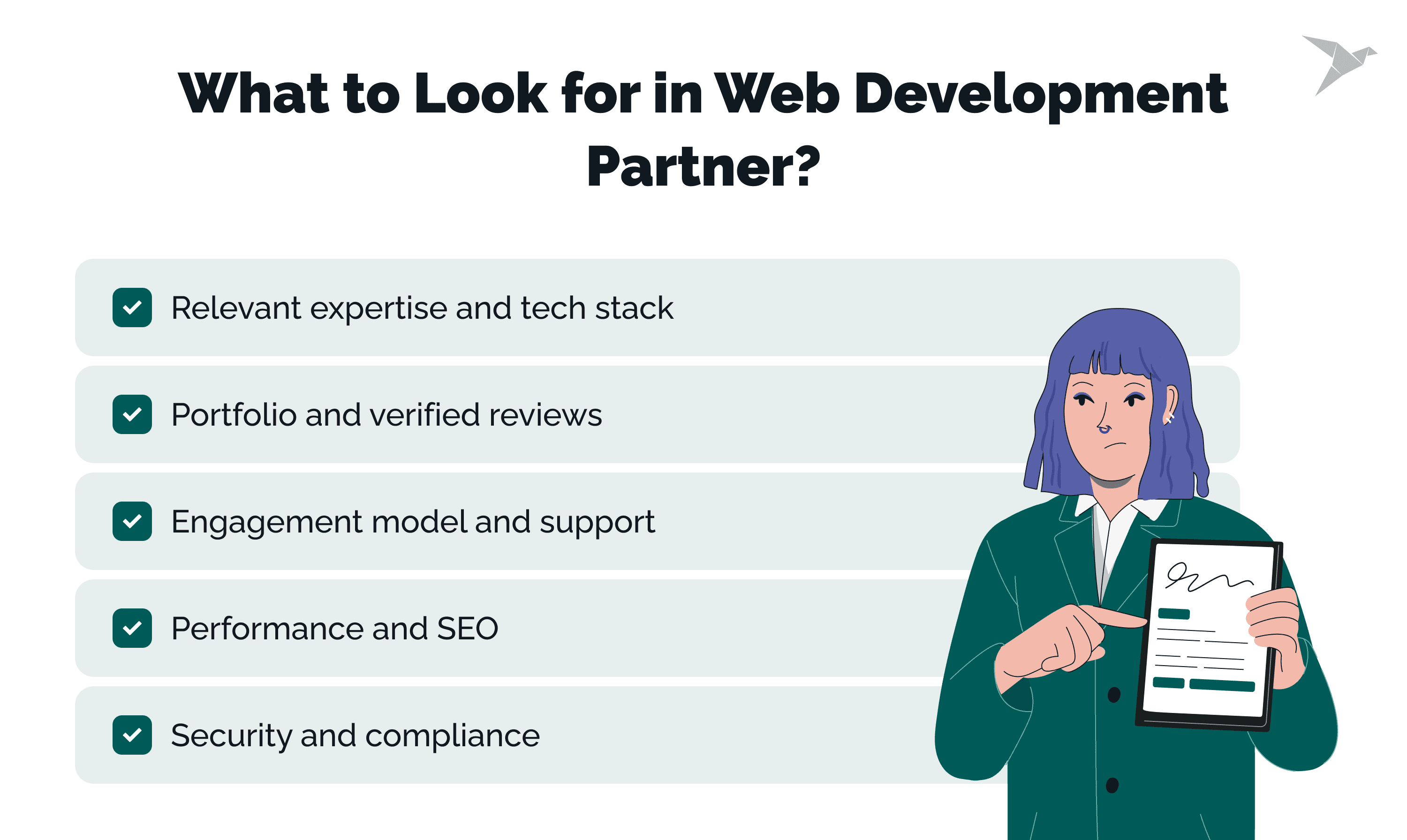
Relevant expertise and tech stack
Look for a track record with your tech stack and your industry. A team that has shipped similar products will make fewer expensive mistakes. Custom web development companies vary widely, so match the specialization to your build. Ask how the company runs its web development process, from discovery to launch, and whether it offers custom software development services beyond a single project.
Portfolio and verified reviews
A portfolio and reference calls tell you more than a sales deck. Read detailed Clutch or G2 feedback on communication, deadlines, and quality, not just the star score.
Engagement model and support
Confirm the engagement model up front: fixed scope, dedicated team, or staff augmentation. Check whether dedicated project managers own delivery, and what professional web development services you get after launch.
Performance and SEO
Web development companies should prioritize mobile responsiveness and fast loading speeds, since both affect conversion and search ranking. Strong teams also build search engine optimization into the project from the start, not as a later add-on.
Security and compliance
In regulated sectors like finance and healthcare, ask about security testing, data handling, and compliance early. It is far cheaper to build these in than to retrofit them.
How Much Do Web Development Companies Charge?
Pricing varies widely, so treat any single number as a starting point. A web development project can run from about $1,000 for a small build to $100,000 or more for a complex platform, and most web development projects on Clutch come in under $10,000.
Hourly rates depend on region and seniority. Global rates span roughly $15 to $100 per hour, US-based web development firms commonly quote $100 to $175 per hour, and Clutch's first-party data centers on about $25 to $49 per hour. A simple WordPress site can start around $2,000, and WordPress development stays popular because the platform still powers a large share of the web.
Scope drives the rest. eCommerce development often starts around $7,000 and climbs with catalog size and integrations. Many agencies build these stores on platforms like Shopify, or on custom stacks when you need more control. Some also bundle digital marketing, so if you need digital marketing services alongside the build, confirm what is included before you sign.
The Web Development Market in 2026
Demand for custom software keeps rising, which is why the web development industry stays crowded. Gartner expects worldwide IT spending to reach $6.31 trillion in 2026, up 13.5% from 2025, with software one of the fastest-growing segments at about 15%.
Talent supply is growing too, though more slowly. The US Bureau of Labor Statistics projects employment of web developers and digital designers to grow 8% from 2023 to 2033, faster than the average for all occupations, with about 16,500 openings each year.
The practical takeaway: capable teams exist, but they are in demand, so the good ones book up. A structured, like-for-like comparison beats a raw directory when you need to move fast.
Conclusion
The best web development company is the one that fits your product, your stack, and your stage, not the one at the top of a list. Boutique studios bring focus and senior attention. Large outsourcers bring scale and speed. Specialists bring deep expertise in one technology or industry.
Choosing a web development firm is a long-term decision, so it helps to know where the field is heading. A few shifts will shape the next few years:
- AI-assisted development becomes standard. Gartner forecasts worldwide AI spending of $2.59 trillion in 2026, up 47% year over year. AI tools now help teams write, test, and review code faster, so developers spend more time on architecture and product decisions.
- Accessibility and performance become baseline. Fast loading and mobile responsiveness shift from nice-to-have to table stakes, pushed by both users and search ranking.
- Security moves earlier. More teams build security testing into the pipeline instead of bolting it on before launch.
- Content platforms stay central. WordPress still powers more than 40% of all websites, so platform and integration skills remain in demand.
Use the ratings and weaknesses here as a starting point, then verify with portfolios and reference calls before you commit. Among the best web development companies, the ones worth keeping will pair these capabilities with clear communication.
FAQ
Choose a web development company by matching its expertise to your stack and industry, then checking verified reviews and portfolios. Confirm transparent pricing, the engagement model, and who owns delivery. Decide whether you need a product partner that owns the build or extra hands to run your own plan.
The cost to hire a web development company varies widely with scope, complexity, and the team’s location and seniority. Offshore teams cost less per hour than US or UK agencies, but total cost depends on delivery quality. Get itemized quotes from several providers and compare them against portfolio quality and reviews, not price alone.
A web development company and a web development agency largely overlap in practice. “Agency” often implies design and marketing services alongside engineering, while “company” can mean a product-focused engineering firm. Judge each on its actual services and portfolio rather than the label.
Artificial Intelligence is not replacing web developers, but it is changing the work. AI tools speed up coding, testing, and documentation, so teams ship faster and developers spend more time on architecture, product decisions, and review. Demand for skilled developers is still projected to grow.
Web development is still in demand in 2026. Gartner projects worldwide IT spending to reach $6.31 trillion, and the US Bureau of Labor Statistics expects web developer and digital designer employment to grow 8% through 2033. Custom software remains central to how businesses operate.
TechMagic built this list from industry reputation, verified Clutch reviews, portfolios, and technology fit, verified in June 2026. The companies are listed alphabetically, not ranked, so no firm holds an unearned top spot. TechMagic is included with the same structure and stated weaknesses as every other company.
