














Top 10 Cloud Migration Companies in 2026
Last updated:6 May 2026


Cloud migration in 2026 is no longer just about moving workloads off on-premise hardware. Companies now expect the cloud environment they land in to be secure, scalable, cost-efficient, and sustainable to run for years.
When legacy systems, tangled hybrid setups, and technical debt start slowing a business down, most turn to an experienced cloud migration company, one that can run a complex migration and still keep the technical calls aligned with strategy, security, and cost.
This article rounds up the top 10 cloud migration companies and service providers for 2026. Each one is recognized for delivering cloud migration services across AWS, Azure, and Google Cloud, and for supporting modernization, security, and post-migration operations.
Key takeaways
- A cloud migration in 2026 is a strategic project. Moving workloads is only one part of it.
- The best providers combine the migration itself with application modernization and cloud-native architecture.
- Build security, compliance, and data governance into the plan from the first day.
- Plan for FinOps, the practice of tracking and managing cloud spend. Without it, costs are hard to keep under control.
- Long-term results depend on what happens after go-live: ongoing support and regular optimization.
How We Built This List
Our cloud team has planned and executed migrations across AWS, Azure, and GCP for startups and scale-ups in healthcare, FinTech, and SaaS. That work comes with hard constraints: HIPAA data residency requirements, PCI DSS network segmentation, live transaction systems that can't tolerate unplanned downtime, and engineering teams that need to keep shipping while the migration is in progress.
That delivery context has shaped this list. Vendors that treat cloud migration as a side service didn't make the cut. Neither did companies with strong marketing but limited verifiable evidence of hands-on delivery at scale.
We held every cloud migration service provider to the same criteria we use when choosing partners for our own projects:
- Pre-migration assessment depth. Does the vendor run a rigorous discovery of your actual architecture, dependencies, and data flows before committing to a plan?
- Multi-cloud breadth. We looked for hands-on expertise across AWS, Azure, and GCP. One primary platform with nominal support for the other two didn't count.
- Cutover risk management. From what we see in practice, cutover is the highest-risk phase. We checked how each vendor handles rollback planning, staged cutover, and incident response ownership during the transition window.
- Post-migration visibility. Good reporting gives clients actual performance and cost data. Weak reporting only confirms that the migration finished.
- Regulated environment experience. We favored vendors with a track record on compliance-sensitive workloads, where a misconfigured security group or logging gap has consequences beyond a support ticket.
To check our view against outside sources, we referenced Gartner Peer Insights ratings for cloud migration services, ISG Provider Lens cloud services research, and verified client reviews on Clutch and G2. Where analyst positioning conflicted with practitioner feedback on delivery quality, we gave more weight to practitioner feedback.
Why Cloud Migration Matters in 2026
Cloud migration is now tied to bigger business goals: digital transformation, lower operating costs, keeping pace with competitors, and so on. Teams are expected to modernize legacy systems, ship faster, and adopt cloud-native capabilities; and they have to do all of it without creating new security gaps or cost overruns.
The problems migration services solve are specific. Hybrid environments become fragmented, cloud spend climbs when there are no FinOps controls, data sovereignty and regulatory rules limit where data can live. Running on several platforms at once creates sprawl. Tools help with each of these, but results depend on a clear strategy, sound architecture, and careful execution.
In addition to this, each major platform shapes migration strategy in its own way. AWS, for instance, still leads the global cloud market. It offers the widest range of migration services, automation tools, and managed infrastructure options.
Microsoft Azure fits well in enterprise environments. Native services such as Azure Migrate and Azure Site Recovery support complex, compliance-driven migrations. More teams are choosing Google Cloud Platform (GCP) for modernization-focused migrations because of its data and AI tools, such as BigQuery for analytics and TensorFlow for machine learning.
The best cloud migration companies build each plan around the platform's strengths and use its native tools where they fit.
What Successful Cloud Migration Looks Like Today
A successful migration meets both its technical goals and its business goals. The systems move, and the business keeps running while they do.
Top providers keep disruption low through a few specific practices. Automated discovery tools map your systems and dependencies before anything moves, and Infrastructure as Code (IaC) defines servers, networks; other resources in configuration files instead of setting them up by hand, so environments are repeatable and consistent. A tested, step-by-step migration method lowers the risk during cutover.
Most importantly, migration should result in cloud environments that teams can operate confidently, scale efficiently, and continuously improve over time.
Top 10 Cloud Migration Companies
1. TechMagic
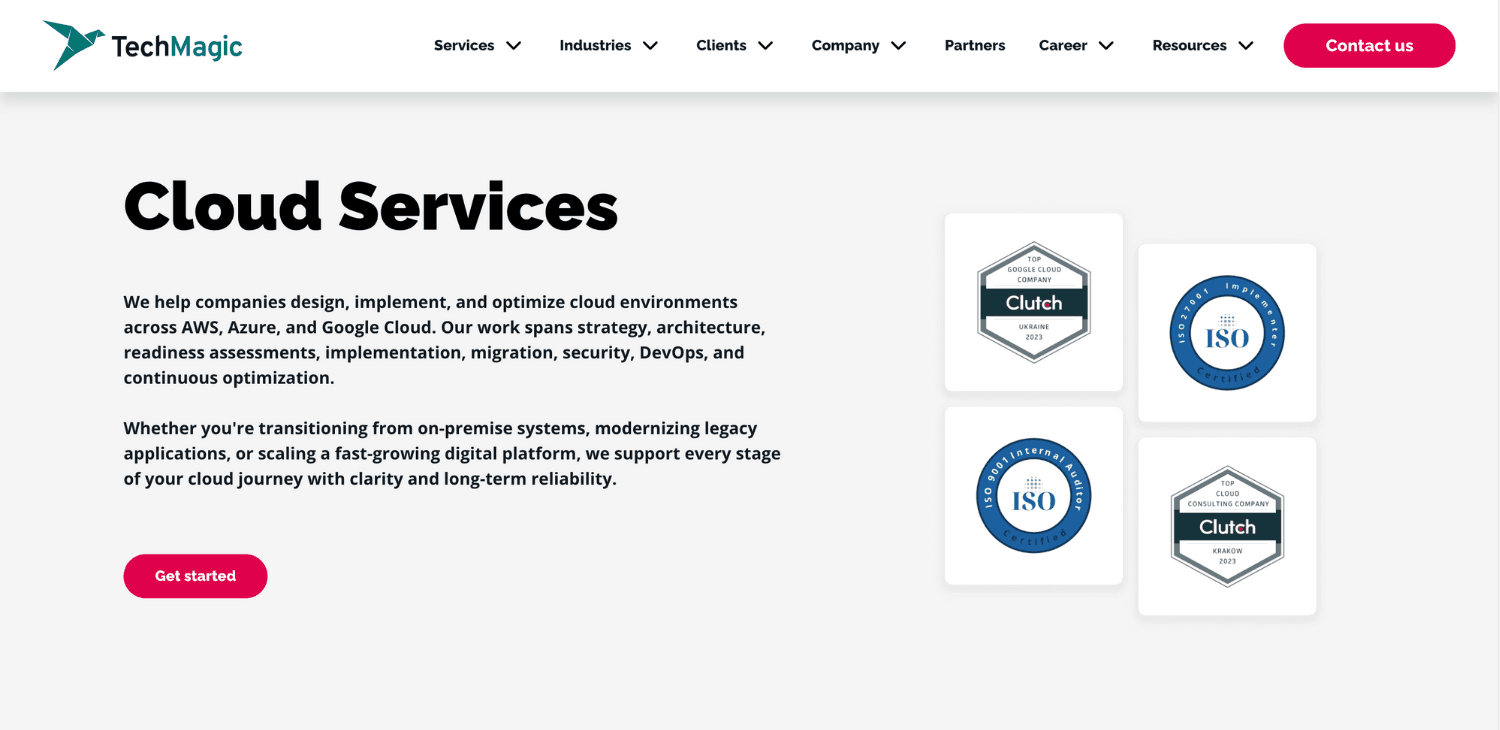
Best for: End-to-end cloud migration with modernization, security, and long-term optimization.
TechMagic handles the move and the work around it: application modernization, cloud security, DevOps automation, and FinOps governance. It works with organizations moving from legacy systems, private cloud, and hybrid setups to AWS, Azure, and Google Cloud.
The focus is on what happens after migration. Each engagement aims to improve scalability, security posture, and cost efficiency once workloads are live. Projects usually start with a cloud readiness assessment and architecture design. Phased execution, modernization, security hardening, and structured post-migration support follow.
Key strengths:
- Cloud migration services across AWS, Azure, and Google Cloud.
- A clear, transparent cloud migration process.
- Legacy system modernization and cloud-native re-architecture.
- Security built into delivery, aligned with ISO 27001 and SOC 2.
- Infrastructure as Code, CI/CD (continuous integration and continuous delivery) automation, and cloud cost management.
- Ongoing cloud management and optimization.
2. Rackspace Technology
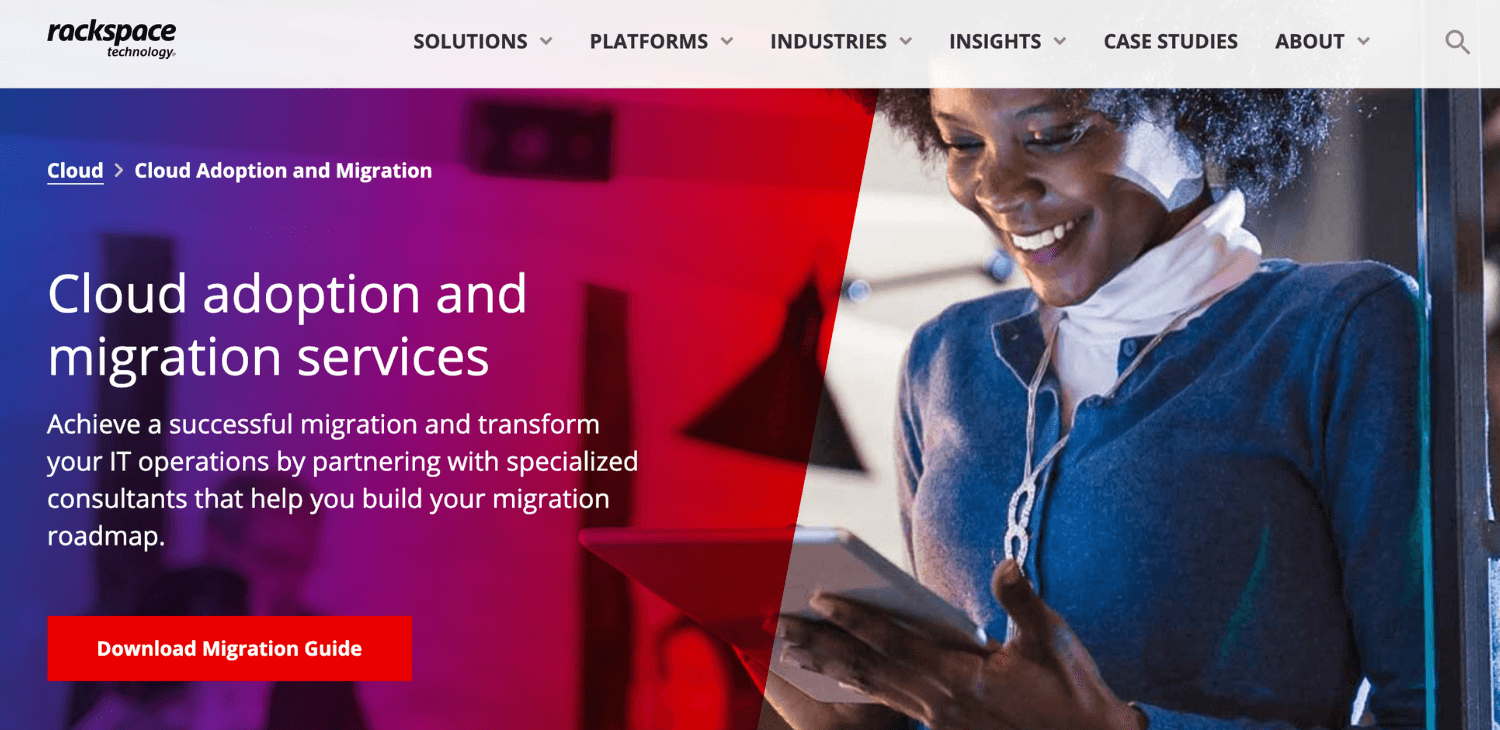
Best for: Enterprise cloud migration with managed services
Rackspace is best known for one thing: pairing the migration with managed cloud services that run for years afterward. Its consulting covers assessment, planning, and execution across public, private, and hybrid environments.
Companies usually pick it when they want to hand off cloud operations once the move is done. Beyond the technical work, Rackspace also helps clients through the regulatory, legal, and operational side of a migration.
Key strengths:
- Enterprise cloud migration programs.
- Hybrid cloud migration and multi-cloud environments.
- Managed cloud operations and ongoing support.
3. CloudZone
Best for: AWS-focused cloud migration and modernization.
CloudZone focuses entirely on AWS. Its team uses automation and established migration tooling to move workloads, and its main clients are companies standardizing or modernizing on AWS.
Most engagements center on re-platforming applications and tuning them for performance and cost. CloudZone also uses AI-driven demand forecasting to predict usage and plan cloud spending during and after the migration.
Key strengths:
- AWS cloud migration and modernization.
- Application re-platforming.
- Managed AWS services and cost optimization.
4. Accenture
Best for: Large-scale enterprise cloud migration programs.
Accenture runs cloud migrations for large global enterprises, usually as one part of a wider digital transformation program. These programs span many teams, regions, and systems, so they need strong governance, enterprise security, and industry-specific compliance.
Large organizations often bring in Accenture when a migration comes with a change to how the business operates. The focus is on moving to the new operating model while keeping core systems stable.
Key strengths:
- Enterprise-scale cloud migration.
- Industry-specific modernization.
- Global delivery, governance, and cybersecurity focus.
5. Slalom

Best for: Cloud migration aligned with business transformation.
Slalom starts with the business outcome a client wants and plans the technology around it. Migrations are designed to keep disruption low while teams adjust, and training and change management are part of the project from the start.
A typical engagement combines the migration with application modernization and data transformation. Both are tied to the business goals set at the start of the project.
Key strengths:
- Cloud migration for AWS and Azure.
- Application and data modernization.
- Business-driven cloud transformation.
6. Nordcloud
Best for: Cloud-native migration and modernization.
Nordcloud plans migrations around cloud-native architecture, so infrastructure and applications are modernized as they move. The company is now part of IBM and draws on IBM's cloud migration services for security-sensitive work, particularly in regulated industries.
It works across AWS, Azure, and GCP, with its deepest experience on GCP. There, it builds scalable platforms using GCP's managed services and AI tools.
Key strengths:
- Cloud-native re-architecture.
- Multi-cloud migration expertise.
- Platform best practices across AWS, Azure, and Google Cloud.
7. Pythian
Best for: Data-intensive cloud migration.
Pythian specializes in migrating and modernizing data-heavy platforms, such as databases and analytics systems. These systems have high performance, reliability, and security requirements, so Pythian builds the migration plan around the data.
It also works with teams in regulated industries that need their data protected and their operations running throughout the migration.
Key strengths:
- Database and data platform migration.
- Performance-driven modernization.
- Cloud optimization for data-intensive workloads.
8. EPAM Systems
Best for: Application-heavy cloud migration programs.
EPAM takes on large migrations with many applications to move. Each program follows a structured process and a detailed plan, with the goal of keeping downtime and business disruption low.
Its engineering-led approach suits complex, custom-built systems. These systems usually need careful modernization and integration work, which a lift-and-shift migration (moving applications to the cloud without changing them) doesn't cover.
Key strengths:
- Application migration and modernization.
- Enterprise cloud platforms.
- Engineering-driven delivery.
9. Cognizant
Best for: Cloud migration in regulated industries.
Cognizant puts security, compliance, and governance first. Its advisory and execution services are built for regulated sectors like healthcare and financial services.
The work covers the full lifecycle, from assessment and planning to post-migration optimization. Risk management and operational stability are priorities at every stage.
Key strengths:
- Secure cloud migration.
- Compliance-aligned delivery.
- Enterprise cloud operations.
10. Deloitte
Best for: Cloud migration with compliance and risk management.
Deloitte is known for consulting in regulated industries. Its teams handle the technical migration alongside enterprise strategy, compliance, and risk management.
It's a common choice for projects where cloud architecture, regulatory requirements, and enterprise governance must be planned together.
Key strengths:
- Cloud migration and modernization.
- Compliance and risk management.
- Enterprise advisory services.
How to Choose a Cloud Migration Company
Your choice of partner shapes the whole migration, from the first assessment to the final cutover. Strong cloud migration companies start by studying your current environment, including your legacy systems and operational constraints. They define a strategy only after that.
The good ones design the target architecture upfront and build security and compliance in from the start, instead of retrofitting them later. Automation, cloud migration tools, Infrastructure as Code, and standardized deployment keep the outcomes predictable and the friction low.
Cost is the other big one. A good partner shows you where your cloud investment actually goes, puts governance around it, and keeps optimizing well past the initial move. And ongoing support means the environment keeps pace as the business changes.
Our Own Cloud Migration Experience
A quick word on where we're coming from, since TechMagic is on this list too. We've spent 12+ years building and moving software to the cloud, with 400+ certified engineers and AWS partner status behind that work, and we're ISO 9001 and ISO/IEC 27001 certified. AWS is our deepest platform, more than a decade of it, though we run Azure and Google Cloud engagements as well.
What that looks like depends on the platform. On AWS, we often use serverless and event-driven architectures, usually for teams scaling a SaaS product. Azure projects more often involve hybrid setups, Entra ID for identity management, and AKS (Azure Kubernetes Service). Google Cloud work tends to be data-heavy, built on BigQuery, Dataflow, Pub/Sub, and GKE (Google Kubernetes Engine). In those projects, moving the data pipeline is as big a job as moving the infrastructure.
For example, we built a fully serverless Node.js application on AWS for Acorn-i to run heavy eCommerce data analytics. With a plain lift-and-shift, this kind of workload would have cost more every month. We see the same thing in most projects. Moving the systems is only the first step. The savings and stability come from the modernization and FinOps work that follows.
Most of our migrations start with a readiness assessment, followed by dependency mapping, sequencing, and a staged cutover. We stage the cutover because that's where migrations most often go wrong. Projects in healthcare and FinTech also have to meet the compliance requirements covered earlier in this article. We used the same criteria to assess every company on this list.
Comparison: TechMagic vs Leading Cloud Migration Companies
The table below shows how the top cloud migration companies differ on scope, modernization depth, governance, and long-term support.
Tell us about your platform, challenges, or migration goals — and we’ll outline a clear, low-risk path to scalable cloud solutions.

FAQ

Cloud migration companies, also called migration service providers or consulting firms, move applications, data, and infrastructure from on-premises, legacy, or hybrid environments to platforms like AWS, Microsoft Azure, and Google Cloud. Most also handle modernization, security, and ongoing cloud management.
Most offer cloud readiness assessments, migration planning, architecture design, data migration, and execution across multiple platforms. Post-migration support is usually included. Some cloud migration consulting firms also provide managed migration and ongoing optimization.
Yes. Strong providers combine the migration with application modernization, cloud-native adoption, and performance tuning. That way, workloads are redesigned to use cloud features such as autoscaling and managed services.
Cloud migration consulting companies security into the migration through identity and access management, secure networking, encryption, and logging. After the move, continuous monitoring checks that those controls stay in place. Governance follows standards and regulations such as ISO 27001, SOC 2, GDPR, and HIPAA.
A professional and reliable partner stays on after go-live to handle cloud management, monitoring, cost optimization, and security reviews. This ongoing work is where most of the long-term cost savings come from.