
 Software Development
 Security Services
 Cloud Services
 AI Services
 Other Services










 TechMagic Academy


AI Security Risk Assessment Services
Your auditor or an enterprise customer wants to know how you manage AI risk. We test and review your models, training data, integrations, and third-party AI tools, then give you a prioritized risk report you can share with them and a roadmap of what to fix first. TechMagic is CREST-accredited, and a Certified AI/ML Pentester (C-AI/MLPen) leads the testing.
We’re Trusted By






AI features, agents, and internal tools often go live faster than the security program covering them. Exposure goes undocumented, ownership is unclear, and each new integration widens the surface.
Professional AI risk assessment establishes the baseline: which AI systems run, who owns each one, and what risk each one carries.
SOC 2, PCI DSS, and HIPAA reviews can require documented AI-specific risks before the deadline. Insurers and enterprise buyers in regulated industries treat AI as its own risk category, and expect a documented assessment from a certified external team as evidence.
We map your AI systems to the regulations that apply to you and record what auditors expect to see, including ISO/IEC 42001 for teams formalizing AI risk governance.
Buying, integrating, or acquiring an AI product calls for an independent read on its risk before you sign. Vendor documentation describes what the product does, yet often, it says little about how it could be attacked.
We review what the vendor's model touches, how your sensitive data would flow through it, and how the vendor handles that data during training.
Teams adopt AI tools faster than security can track them. We map what’s actually in use, including tools nobody signed off on. That means looking at real AI usage patterns across departments rather than the approved-vendor list. Shadow AI matters because unvetted data ends up in systems your security team has never reviewed.
AI systems create attack vectors a conventional audit was never built to catch, and the clearest example – data poisoning. We check whether unvetted or malicious data could have compromised your training and fine-tuning pipelines. Poisoned input data is hard to spot after the fact and can quietly skew what a model does in production. We also look at where sensitive data sits inside those pipelines and who can reach it.
Exposed model endpoints and weak API authorization let attackers copy or abuse a model they were never meant to touch. We review where those doors are left open. When the model is the product, that exposure is an intellectual property problem as much as a security one. The review covers access controls, authorization layers, and the integration points connecting your models to the rest of your stack.
We evaluate how exposed your LLM-powered features are to adversarial inputs designed to bypass guardrails or manipulate output. Prompt security gets harder the moment a model can call tools or act for a user. Where you run AI agents with real permissions, we look at what an attacker could make them do.
Most AI products run partly on components someone else built. We review the AI vendors, APIS, and pre-trained models your stack depends on, along with the data each of them touches. Each one is a dependency you inherit. Their access, their data handling, and their security breaches all become part of your exposure.
We flag where your AI systems fall short of the regulatory requirements that apply to you. That spans EU AI Act risk management, HIPAA safeguards over AI touching PHI, GDPR obligations, and SOC 2 or PCI DSS scope that has grown to include AI. Every gap comes with the control that closes it, so your team knows what to implement and in what order.




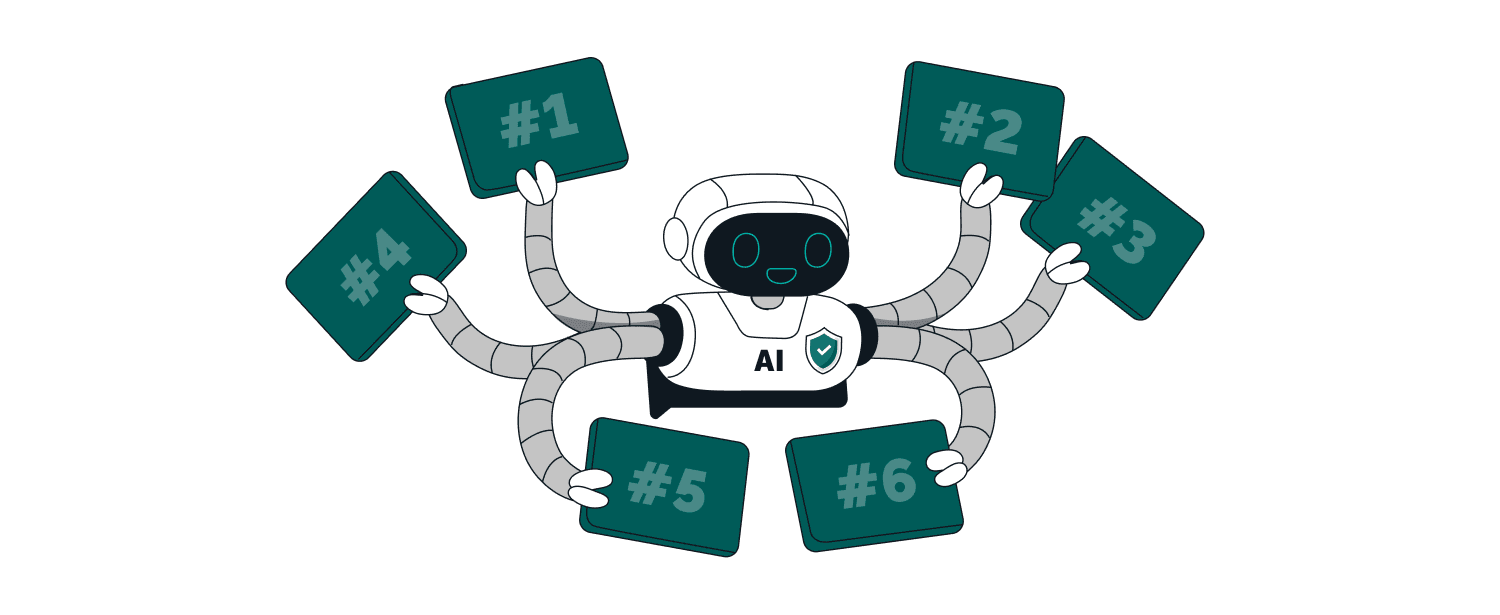
The assessment runs in six phases, and this is the first. We agree on what’s in scope: which models, systems, data, and vendors the assessment covers. Scope drives both cost and timeline, so we settle it before any work starts.
We build a threat model specific to your AI architecture and how it’s actually used day-to-day. That includes how your systems behave under adversarial conditions, and which failures would genuinely disrupt business operations.
We examine the technical controls around your AI systems. We also look at governance: who approves a new AI tool, and who owns the risk when one misbehaves. Both halves matter. Strong controls with no risk governance behind them decay as AI systems evolve.
Every finding is scored by likelihood and business impact alongside technical severity, so priority reflects what the business actually stands to lose. That includes the quieter consequences: regulatory exposure, contractual risk, and reputational damage that outlasts the incident itself.
You get a written report plus a live readout for your technical and executive stakeholders. Engineers get detail they can work from. Your board and auditors get a version they can read without a translator.
We stay available to answer questions as your team works through remediation and starts to implement controls. Systems change, data changes, and model drift sets in. The roadmap flags which controls your team should keep under ongoing monitoring, and we’ll tell you when a reassessment is worth running.
The OWASP GenAI Security Project's lists of the most critical risks in LLM applications and in AI agents that call tools and act for users, from prompt injection to data poisoning. We use them as the baseline checklist for anything LLM-powered or agentic in your stack.
A structured way to identify, measure, and manage AI risk across the AI lifecycle, from development through deployment. It also gives your risk and compliance teams language that regulators and enterprise customers already recognize.
A knowledge base of adversary tactics and techniques targeting AI systems, used to ground our threat modeling in observed attacker behavior. It keeps the assessment focused on emerging threats seen in the wild.
Security Experts Behind the Assessment

Ihor is a certified security specialist with experience in penetration testing, security testing automation, cloud and mobile security. OWASP API Security Top 10 (2019) contributor. OWASP member since 2018.






Victoria is a certified security specialist with a background in penetration testing, security testing automation, AWS cloud. Eager for enhancing software security posture and AWS solutions


Roman is an AWS Expert at TechMagic. Helps teams to improve system reliability, optimise testing efforts, speed up release cycles & build confidence in product quality.


Denys is a certified security specialist with web and network penetration testing expertise. He demonstrates adeptness in Open Source Intelligence (OSINT) and executing social engineering campaigns. His wide-ranging skills position him as a well-rounded expert in the cybersecurity industry.

From 300,000 scanner findings to a backlog the team could explain line by line
Challenge.
A client preparing for its SOC 2 audit turned on AWS Inspector across AWS accounts and got 300,000+ findings within hours. The inspector reports every vulnerable package it finds, but can't say which ones an attacker can reach, so the team had no way to distinguish real exposure from noise.
Solution.
We traced most findings to a small set of vulnerable base images shared by every account, then fixed the pattern first in the two highest-priority accounts. Priority workloads moved to hardened base images, and Lambda dependencies were patched directly. Findings the environment made hard to exploit were risk-rated, not ignored: each suppression was recorded with a rationale and a named owner.
Impact.
Open critical findings fell from 300,000 to 100 in 7 days, and every remaining item had a documented decision behind it. The client went into its audit with a vulnerability backlog it could explain line by line.
A four-stage pipeline for reviewing AI-generated codez
Challenge.
A product team on Claude Code had built its own skills and commands library. Delivery outpaced security review, and long single-session reviews lost context and gave inconsistent results.
Solution.
We split the review into four bounded stages: source code mapping, threat modeling, a vulnerability scan across priority attack surfaces, and validation in a fresh session. Validation alone removed nine false positives.
Impact.
Roughly 80% fewer false positives than the single-session approach, on about 20% of the standard token budget. We fixed every confirmed vulnerability, all moderate or low severity, including broken access control and hardcoded secrets.
AI systems touching PHI need to satisfy HIPAA safeguards on top of general security practice, and AI now sits inside diagnosis support, intake, and clinical documentation tools.
AI-driven underwriting, fraud detection, and trading tools carry regulatory scrutiny most AI products never face, and PCI DSS scope often widens once a model touches cardholder data.
Student data and AI tutoring or grading tools raise privacy questions specific to the sector.
Connected products run on dashboards, admin panels, APIs, etc., and AI now sits inside the analytics and automation behind them. We assess the software side of connected products: web and mobile interfaces, APIs, cloud configuration, and the device OS image.
Running AI in your product or workflows means it's only a matter of time before a customer, investor, or compliance requirement asks you to prove it's secure. We help teams in that position get a clear AI security risk assessment services.
Why Choose TechMagic for Your AI Security Assessment
When you pick an AI security risk assessment company, accreditation is the fastest way to check the work will hold up. TechMagic holds CREST accreditation for security testing and follows ISO 27001-aligned practices, the same bar auditors and enterprise customers expect. Our engineers work on security full time, across regulated industries from FinTech platforms to cloud-native healthcare systems.
001
/003
002
/003
003
/003
Let’s safeguard your project

VP of business development

Trusted by:


FAQ
Security
AI
14 min read
AI
HealthTech
15 min read

Security
13 min read
12 min read
AI
Security
15 min read

AI
Security
