









Penetration Testing Report: Structure, Examples & Free Template

Ihor Sasovets
Lead Security Engineer & Pentester at TechMagic. AWS Community Builder. Certified AWS SCS-C01, CCPenX-AWS, eMAPT, eWPT, CEH, and C-AI/MLPen
This guide breaks down what a strong report contains, how its depth shifts with the testing approach and scope, what a good finding looks like, and the fields a solid template needs.
We write it from the reporting desk. Our CREST-accredited security team produces these reports for FinTech, HealthTech, and SaaS companies heading into audits and enterprise security reviews. When you are ready to scope a test, our penetration testing services cover engagement options and pricing.
What Is a Penetration Testing Report?
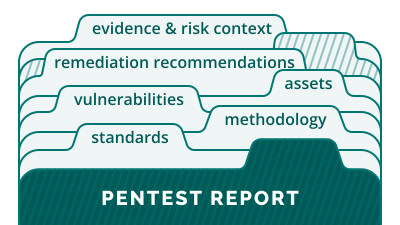
A penetration testing report is a formal document produced after a pentest engagement that records:
- every tested asset;
- the methodology the testers used;
- standards they follow;
- every vulnerability they found with evidence and risk context;
- and tailored remediation recommendations that will help to fix these findings.
It is the written record of what an authorized attacker was able to do against your systems, and how to close each gap.
A good pentest report works on two levels at once. A CISO or board member reads the executive summary for the overall risk picture, while an engineer reads the findings for the exact steps to reproduce and fix each issue. You may see the deliverable written as a pentesting report or shortened to a pentest report; the content and purpose are the same.
Penetration Testing Report Statistics You Should Know
global average cost of a data breach, a 12% YoY increase, a record high. IBM Cost of a Data Breach Report 2026
increase in AI-driven attacks (deepfake impersonation, AI-enabled malware, zero-day exploitation). IBM Cost of a Data Breach Report 2026
average breach cost specifically for AI model inversion attacks. IBM Cost of a Data Breach Report 2026
of breaches now start with exploited vulnerabilities; it is now the top initial access vector, ahead of stolen credentials (13%) Verizon 2026 Data Breach Investigations Report
median time to fully resolve a critical vulnerability, up from 32 days in 2025. Verizon 2026 Data Breach Investigations Report
of breaches now involve ransomware, and 48% of breaches involve a third party (up 60% year-over-year) Verizon 2026 Data Breach Investigations Report

A black box report documents what an external attacker with no prior knowledge of your system could achieve. The testers start with only public information, so the findings reflect real-world exposure at the perimeter.
Suitable for: An organization that wants to see its systems the way an outside attacker would. It simulates a real external attacker with zero prior knowledge.

A gray box report reflects what an attacker with partial knowledge could do, working from something like a privileged user account or limited network detail. It models insider risk, and it usually surfaces more findings per day of testing because the testers spend less time on reconnaissance.
Suitable for: Insider-risk and partial-knowledge scenarios, such as a compromised account. Teams that want broader coverage than a black box run.

A white box report is the deepest of the three. What sets it apart is not admin access; around 80% of gray box engagements already include an admin account. It is access to the source code and, where you have them, network and architecture diagrams.
With the code in front of them, our testers can follow how data moves through the application and check its internal logic rather than infer it from the outside. That has two effects on the report. Fewer findings turn out to be false positives, and the issues that only show up in data flows or internal structure get caught at all.
Manual verification by senior testers sits on top of the tooling, and the same access supports third-party dependency analysis and a remediation strategy built on defense in depth, meaning layered controls rather than a single fix per issue.
Speed and accuracy matter more here than they used to. Attackers now use AI to widen what they can exploit and how fast, so the time between finding an issue and closing it is part of the risk.
Suitable for: Deep, code-level assurance before a major release. Complex or high-risk systems where the internal structure and data flows need to be verified rather than inferred. Teams that want third-party dependency analysis and a layered remediation plan alongside the findings.
Penetration Testing Reports by Test Scope
Engagement style describes how the work is structured, scoped, and scored. Two engagements can share an approach, a method, and the same penetration techniques, and still be different projects, with scope and cost climbing down the list.
A web application report covers issues such as injection, broken access control, and authentication flaws, with proof of concept for each. It is the most common report type and maps directly to web application penetration testing.
A mobile report adds findings specific to iOS and Android, including insecure on-device storage, weak binary protections, and backend API exposure. It reflects mobile application penetration testing across both the app and the services behind it.
A network report separates external findings, reachable from the internet, from internal findings, reachable once inside the network. This split matters for prioritization and comes from network penetration testing.
A cloud report focuses on misconfigured identity, storage, and workloads rather than physical infrastructure, drawing on cloud penetration testing. For Amazon environments, an AWS penetration testing report drills into IAM, S3, EC2, and Lambda, since most cloud attacks begin with an API call rather than a network hop.
An API report documents broken authorization, excessive data exposure, and rate-limiting gaps at the interface layer, and it comes from API penetration testing. APIs now carry most application traffic, so this report type has grown in importance.
An AI report covers testing of AI agents and AI-generated code. Its scope includes prompt injection, agent tool misuse, insecure code produced by AI coding assistants, data leakage through model outputs, and more. It comes from AI penetration testing and reflects a scope most traditional pentest report types don't cover.
A social engineering report measures the human layer, covering phishing, pretexting, and how staff responded. Its findings are usually aggregated and anonymized, because the goal is to improve training and process rather than to single out individuals.

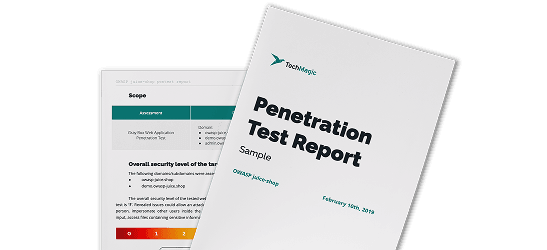
Executive summary, with the goals of the assessment and the overall risk picture.

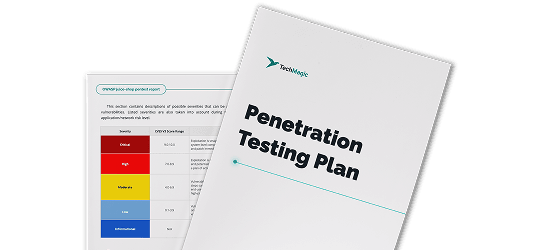
Scope, methodology, and the severity rating scale used throughout.

The overall security level of the targets in scope.

The vulnerability report: every finding, with its evidence and status.

The remediation report: short-term and long-term recommendations.

Library and appendices: references, raw evidence, and attachments.
What do we approach differently?
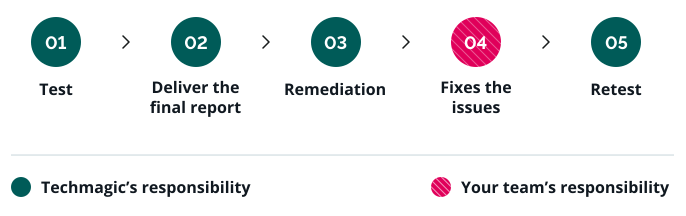
An engagement runs in two stages.
- First, we test and deliver the final report, with remediation recommendations and the supporting materials.
- Then your team fixes the issues and, once the work is done, asks us for a retest.
We recommend a window of about two months for that, and our team stays available through it. After the retest, each verified finding carries a status and a retest date you can show an auditor or a customer.
Anatomy of a Penetration Testing Report
Below is what each part does and what it holds. Treat it as a checklist rather than a running order: a web application pentest report and a cloud audit report contain the same building blocks but arrange and name them differently, depending on the assessment. If you want to see how one is put together end to end, ask us for a sample report.
Penetration Testing Report Example
A penetration testing report example is easiest to understand through a single finding. The anonymized entry below shows how one issue is documented from severity through to the fix and its owner. The identifier is what ties the report to your bug tracker. Its middle digit is the severity priority, counting up from critical, so the identifier JSA-2.3 marks a high-severity finding, and a sorted list of identifiers is already in priority order. If we detect >10 findings, we can add a tailored remediation section to each finding in the Vulnerability report, then add all extra recommendations to the Remediation report.
What a well-written finding looks like
A strong finding is specific and reproducible. It names the exact asset, shows the payload, states the business impact in one sentence, and hands the engineer a fix they can apply the same day. As a reader, you should never have to guess what was tested or what to do next.
Discover What Kind of Pentest Reports You Will Receive
What to avoid in a pentest report example
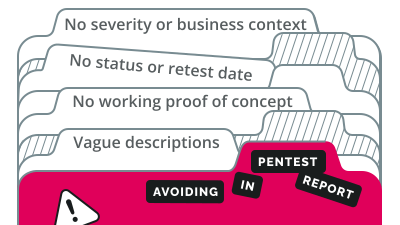
A weak pentest report example fails in a few predictable ways:
- Vague descriptions — issues written in general terms an engineer can't act on.
- No working proof of concept — a claim with nothing to reproduce it.
- No status or retest date — no way to tell whether a finding was ever closed.
- No severity or business context — findings a reader can't prioritize. Findings written this way stall in triage, because no one can confirm them or say what state they are in. A useful pentesting report example is the opposite on every count: a concrete asset, reproducible steps, a clear severity, and a status you can track.
Penetration Testing Report Template: What a Good Template Includes
A penetration testing report template is a reusable structure that keeps every engagement consistent and audit-ready. The fields below are what a strong template standardizes, and they match the format our security team uses.
The cover page carries the report title, the application or environment that was tested, the date of the assessment, and whether the document is a draft or final, so a reader can tell at a glance which assessment and which version they are holding. It also carries our contact details, so you know where to send questions about the findings. Every page after it repeats the report name and a page number, so you can cite a single finding precisely.
Every finding uses the same fields: a unique identifier, a description, a CVSS 3.1 score with its severity band, a reference to a classification such as an OWASP Top 10 category or a Common Weakness Enumeration (CWE) entry, and a status. Cloud and infrastructure audits add the affected accounts or assets. Consistent fields make findings sortable, and the identifiers let you match this report against the last one, or against the ticket you opened for that finding.
Each finding references the classification it maps to: an OWASP Top 10 category, a CWE entry, or, in a cloud audit, the specific CIS Benchmark control that failed. That gives an auditor a traceable link from a control to the evidence behind it. The report supports your PCI DSS, HIPAA, SOC 2, or ISO 27001 evidence in that way, but it is not a control-by-control mapping of those frameworks.
Start with the executive summary for the overall picture, then read the severity ratings and the reproduction steps finding by finding. Share the report with the teams that will act on it: security, development, QA, and project management. Findings stall when a report reaches one inbox and stops there.
In your bug tracker, whether that is Jira, ClickUp, Trello, or Linear, create one epic for the assessment and name it for the period it covers, for example “Pentest Findings, Q3 2026”. Then open a ticket per finding under it. Put the finding’s identifier in the ticket title so it can always be traced back to the report, and copy the description and the reproduction steps into the ticket body so a developer and a QA engineer can both reproduce the issue and validate the fix.
Map the report’s severity onto your priority field: critical first, high as soon as possible, moderate within the timeline you agree internally, low when resources allow. Informational items are optional and usually belong in longer-term planning. Your team sets the assignees and the due dates, because you know who owns which service and what capacity they have.
We recommend working through as many findings as possible within two months of receiving the report, and our team stays available to validate the fixes during that window. When the work is done, deploy the fixes somewhere we can check them, a dedicated test environment if that is feasible, and contact us to schedule the retest. Keep the report identifiers linked to your tickets and note what changed in each one; that record is what makes the next assessment faster.
FAQ
Let’s safeguard your project

VP of business development

Trusted by:


