















Penetration Testing Methodologies: Frameworks, Standards & How to Choose

Victoria Shutenko
Security Engineer & Pentester at TechMagic. AWS Community Builder. AWS UG Leader. Certified eWPTX, eCPPT, eMAPT, CCSP-AWS, CAP, and C-AI/MLPen
Ask which penetration testing methodologies they follow, and the difference shows. The answer matters after the test too: regulated industries expect a documented, repeatable testing process they can review months later, and a pentest methodology you can't name is hard to defend.
This page covers the frameworks behind most professional engagements, how they compare in scope, depth, and reporting, and how each maps to a specific compliance requirement. TechMagic's penetration testing is CREST-accredited, and we structure our engagements around these frameworks rather than an in-house checklist. Our penetration testing services page is the next step for teams ready to scope a test.

Sets what gets tested and what stays untouched: systems, applications, networks, and the limits agreed before any work begins.

Gives testers a fixed sequence of testing procedures, so coverage does not depend on who was assigned to the engagement.

Requires every finding to carry proof, impact, and reproduction steps, so your engineers can confirm it and fix it.

Keeps the testing process traceable, so an auditor or a customer can review coverage without having been in the room.
The Most Widely Used Penetration Testing Methodologies and Standards
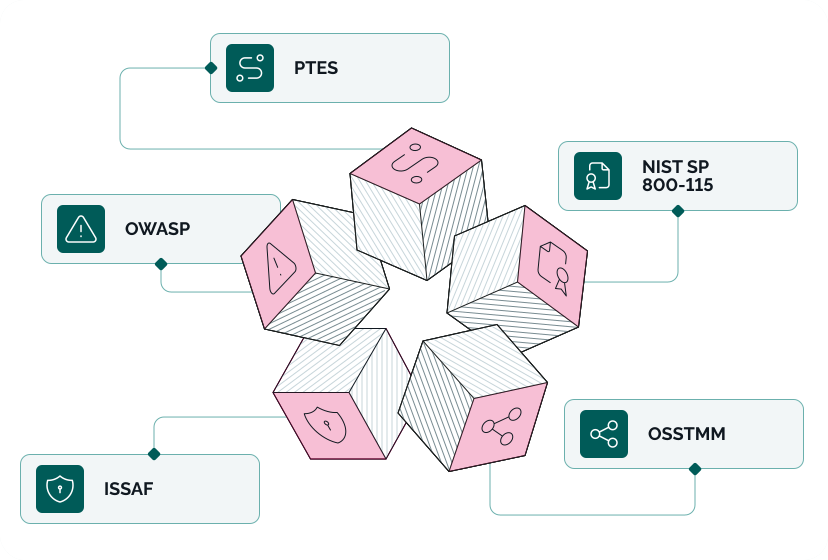
The most widely used penetration testing methodologies and standards are PTES, the OWASP Testing Guide, NIST SP 800-115, OSSTMM, and ISSAF. These popular pentesting methodologies each govern a different slice of a test, and coverage is what decides which one fits your scope.
Penetration Testing Methodologies Compared
The comparison of penetration testing methodologies below puts governance, prescriptiveness, and maintenance side by side. The status column shows which frameworks are still actively maintained.
PTES
Community working group
Full engagement, seven phases
High, with a technical guidelines companion
Widely referenced, slow release cadence
OWASP Testing Guide
OWASP
Application layer: web (WSTG), mobile (MASVS, MASTG), API and LLM Top 10s
Very high, procedure by procedure (WSTG, MASTG)
Actively maintained
NIST SP 800-115
NIST
Technical security testing and assessment process
Moderate, process-led rather than technique-led
Stable, named in PCI DSS 11.4.1
OSSTMM
ISECOM
Operational security across five channels
High, metrics-based
Version 3, published 2010
ISSAF
OISSG
End-to-end assessment, task to business objective
Very high
Not actively maintained
How These Methodologies Map to a Real Pentest Engagement

Planning and scoping
This step decides what the test may touch and how success is judged. PTES pre-engagement interactions and NIST SP 800-115 planning both live here, with the compliance requirements the results must satisfy. Scoping also fixes how much prior knowledge the tester receives: black box testing starts from public information, white box testing hands over source and configuration, and grey box testing sits between.
Key actions: rules of engagement, scope boundaries, escalation contacts, access level, success criteria.
Reconnaissance
Testers map the target environment before touching it. PTES calls this intelligence gathering, NIST SP 800-115 calls it discovery, and both start from what is publicly visible: domains, network services, open ports, exposed credentials, and staff visible on social platforms. In a black-box test, this step defines the attack surface, because nothing else has been handed over.
Key actions: OSINT collection, asset discovery, service mapping, credential exposure, attack surface review.
Threat modeling and vulnerability analysis
Here the team decides what an attacker would actually want and which weaknesses could get them there. Automated tools and vulnerability scanning surface potential vulnerabilities at scale, then a tester sorts the real from the noise. PTES treats threat modeling and vulnerability analysis as separate phases, and both sit between reconnaissance and any attempt to exploit.
Key actions: threat modeling, vulnerability scanning, manual validation, false positive triage, attack path mapping.
Exploitation
This is where testers simulate real world attacks inside the agreed rules of engagement. The goal is proof: showing that a chain of weaknesses lets an attacker gain unauthorized access, not that a scanner flagged a version number. An external penetration test and internal testing run the same phases from different starting points, and exploiting vulnerabilities is the manual work no scanner can do.
Key actions: chained exploitation, credential attacks, business logic abuse, payload delivery, access confirmation.
Post-exploitation
Once inside, the question is how far the access reaches. Testers measure whether privilege escalation is possible, whether they can access sensitive data, and whether maintaining access goes unnoticed. That last point tests your response capabilities as much as your controls: if nothing in your monitoring flagged the activity, that belongs in the findings too.
Key actions: privilege escalation, lateral movement, data access testing, persistence checks, detection review.
Reporting and remediation
Reporting is where the methodology becomes visible to everyone who didn't run the test. Every framework here mandates evidence, so a finding arrives with a request, a response, a screenshot, and steps to reproduce it. TechMagic's documents come together at the end, including the attestation letter procurement teams ask for as a security test audit report.
Key actions: severity rating, penetration test report, remediation plan, retest, incident response readiness.
How to Choose the Right Methodology for Your Organization
The right methodology follows from your compliance requirement, your scope, and whether your provider can name their framework. Among the types of penetration testing methodologies, that usually means NIST SP 800-115 for audits, OWASP for applications, and PTES for the rest.
Match the methodology to your compliance requirement
NIST SP 800-115, named as the example approach for the penetration testing required under 11.4.1

PCI DSS
NIST SP 800-115, for its documentation requirements
Federal or NIST-aligned programs
No required standard, but we recommend NIST SP 800-115 or PTES. Auditors accept any documented, repeatable methodology.
SOC 2 or ISO 27001
No required standard, but we recommend NIST SP 800-115, because HHS guidance already follows NIST. The evaluation requirement asks for evidence, not a named framework.
HIPAA
Match the methodology to what you're testing
OWASP Testing Guide, procedure by procedure
Web application or API
PTES phases, with NIST SP 800-115 discovery practice
Network penetration testing or cloud
OWASP Top 10 for LLM Applications for the risks, the OWASP AI Testing Guide for procedures, alongside AI penetration testing
AI or LLM features in scope
Ask your provider which methodology they follow and why
Which one, and why for this scope
Governing framework
Which framework covers applications, which covers network security
Layer coverage
Request, response, screenshot, reproduction steps
Evidence per finding
How conducting penetration testing under it shapes the report
Report impact
Case Studies
Penetration testing types are classified by what the pen tester knows, where the tester starts, how the engagement is structured, and what is under test. Here is the map this page follows:
Services provided:
- Black box penetration testing
- Web application and API testing
- OWASP Top 10 testing
- Authentication and authorization validation
- Risk analysis and remediation plan
- Stakeholder presentation
Outcomes:
- Costly overhauls avoided
- No critical or high-severity findings
- Low and medium issues only
- Found in access control and data validation
- ISO 27001 compliance confirmed
Services provided:
- Cloud, web, mobile, and API pentesting
- Authentication flow testing
- Third-party integration testing
- Cloud configuration review
- Access control review
- PTES and OWASP methodology
Outcomes:
- Prioritized weakness list
- Real-world risk ratings
- Security posture improved
- Regular penetration testing scheduled
- Vulnerability scanning scheduled

Services provided:
- Black box penetration testing
- Web application and API testing
- OWASP Top 10 testing
- Authentication and authorization validation
- Risk analysis and remediation plan
- Stakeholder presentation
Outcomes:
- Costly overhauls avoided
- No critical or high-severity findings
- Low and medium issues only
- Found in access control and data validation
- ISO 27001 compliance confirmed
Services provided:
- Cloud, web, mobile, and API pentesting
- Authentication flow testing
- Third-party integration testing
- Cloud configuration review
- Access control review
- PTES and OWASP methodology
Outcomes:
- Prioritized weakness list
- Real-world risk ratings
- Security posture improved
- Regular penetration testing scheduled
- Vulnerability scanning scheduled
FAQ
Let’s safeguard your project

VP of business development

Trusted by: