 Software Development
 Security Services
 Cloud Services
 AI Services
 Other Services















 TechMagic Academy


AI-Powered Attacks Are Scaling: A Practical Hardening Checklist for SaaS Companies
Last updated:27 July 2026


AI-powered attacks have already changed daily life for SaaS companies. Large Language Models let inexperienced attackers run attacks that once needed specialist skill, and they multiply the reach of experienced ones.
LLMs grant even less experienced malicious actors a wide range of opportunities. They also power numerous agents, both open source and commercial, that are capable of mapping more complex attack paths and running security checks in parallel.
The core shift is speed and automation. With generative AI in hand, threat actors now move through environments on valid credentials instead of dropping malware once inside. In a June 2026 report, Anthropic mapped 832 accounts banned for malicious cyber activity (March 2025 to March 2026) against the MITRE ATT&CK framework. The share rated medium risk or higher rose from 33% to 56% in a year, as AI let less-skilled actors run techniques that once required expert knowledge.
Our practical hardening guide covers the five areas where AI-powered attacks most often find gaps in SaaS: identity and access management, API security, phishing defense, anomaly detection, and incident readiness. If you want a concrete answer to how to prevent AI-powered cyber attacks in your own environment, the checklist below gives you actions you can apply directly.
Key takeaways
- AI-powered attacks are faster, cheaper, and mostly credential-based, so detection tuned for slower, malware-driven breaches often misses them.
- SaaS is a priority target: it concentrates high-value tokens, connects to many third parties, and carries multi-tenant blast radius.
- The gaps we see most often are long-lived over-scoped API tokens, unreviewed OAuth grants, missing baselines for service accounts, and ungoverned internal AI agents.
- Top hardening actions against AI cyber attacks are phishing-resistant MFA and least privilege, authenticated and rate-limited APIs, behavioral baselines, governed AI dependencies and agents, and tested incident playbooks.
- The same LLMs that extend attacker reach can also help defenders, so layered defense stays the goal and the best way to deal with a broad threat landscape.
What Are AI-Powered Attacks?
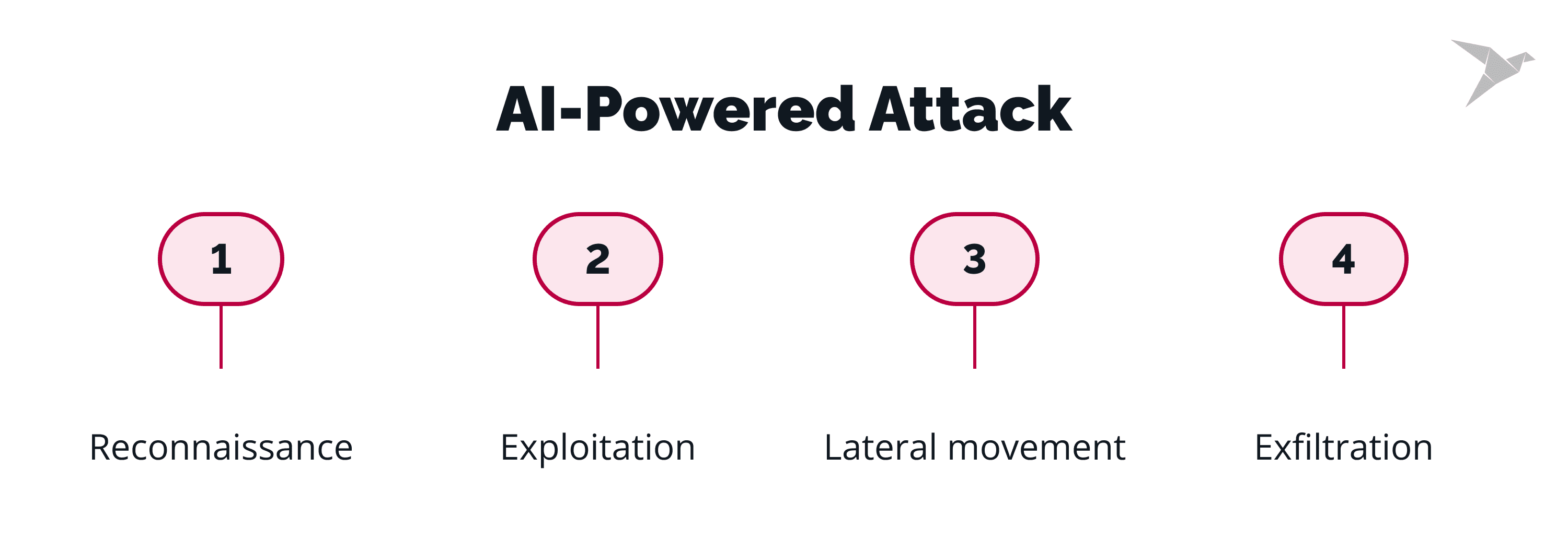
AI-powered attacks are cyberattacks in which Machine Learning models automate one or more stages of the attack chain: reconnaissance, exploitation, lateral movement, or exfiltration. This cuts the time, cost, and skill needed to run them at scale.
You will also see them called AI-driven attacks or AI-enabled attacks, and defenders often group the same trend under AI-driven threats or AI-driven cyber threats. The trait stays the same: automation replaces the manual effort that used to limit an attacker.
For teams defending SaaS and working on AI in cybersecurity, three shifts matter most:
Breakout time has dropped from hours to minutes, so detection tuned for hour-scale breaches now lags. A single campaign can run thousands of tailored attempts at once.
And evasion has gone malware-free: attackers move through SaaS on valid credentials and living-off-the-land techniques, with no malicious files. Therefore, the real signals are in identity behavior, API call patterns, and session anomalies, and not endpoint detection.
Why SaaS Companies Are a Primary Target
One compromised SaaS vendor can affect hundreds of downstream customers at once. That blast radius, plus dense, high-value credentials and many third-party integrations, makes SaaS a priority target for AI-generated attacks.
High credential and token density
SaaS concentrates OAuth tokens, API keys, and service account credentials, often broadly scoped. Long-lived credentials pile up with no rotation and little audit coverage, and AI-assisted attackers scan for them faster than manual processes can keep up.
Third-party integration surface
Most SaaS products connect to dozens of external services, each a possible entry point. These connections often run with excessive permissions and less scrutiny than first-party code, so a compromised integration can reach the core product without tripping standard detection.
Multi-tenant risks
One misconfiguration can expose data across many customer environments, usually built up through fast feature work, infrastructure changes, and weak staging-to-production separation. AI-powered attackers probe these boundaries at a scale no manual test matches.
How AI Changes the Attack Methods SaaS Teams Face
AI-powered attacks have moved from opportunistic to systematic: faster execution, harder detection, and automation across the whole attack chain. Threat actors now leverage AI to handle routine tasks at every stage. AI systems and AI models run reconnaissance and triage in parallel, while AI algorithms turn manual steps into attack automation. AI’s ability to adapt in real time widens the range of attack vectors, and loosely governed AI-powered systems become targets in their own right.
Anthropic’s MITRE ATT&CK analysis shows one clear shift: AI use moved from gaining initial access toward activity once attackers were already inside. AI-assisted account discovery rose 8.9%, while AI-assisted phishing fell 8.6%. These post-compromise steps used to need hands-on expertise. Counting techniques no longer signals risk, since a model does the technical work: the least-skilled actors used about 16 techniques on average, the most skilled about 20.
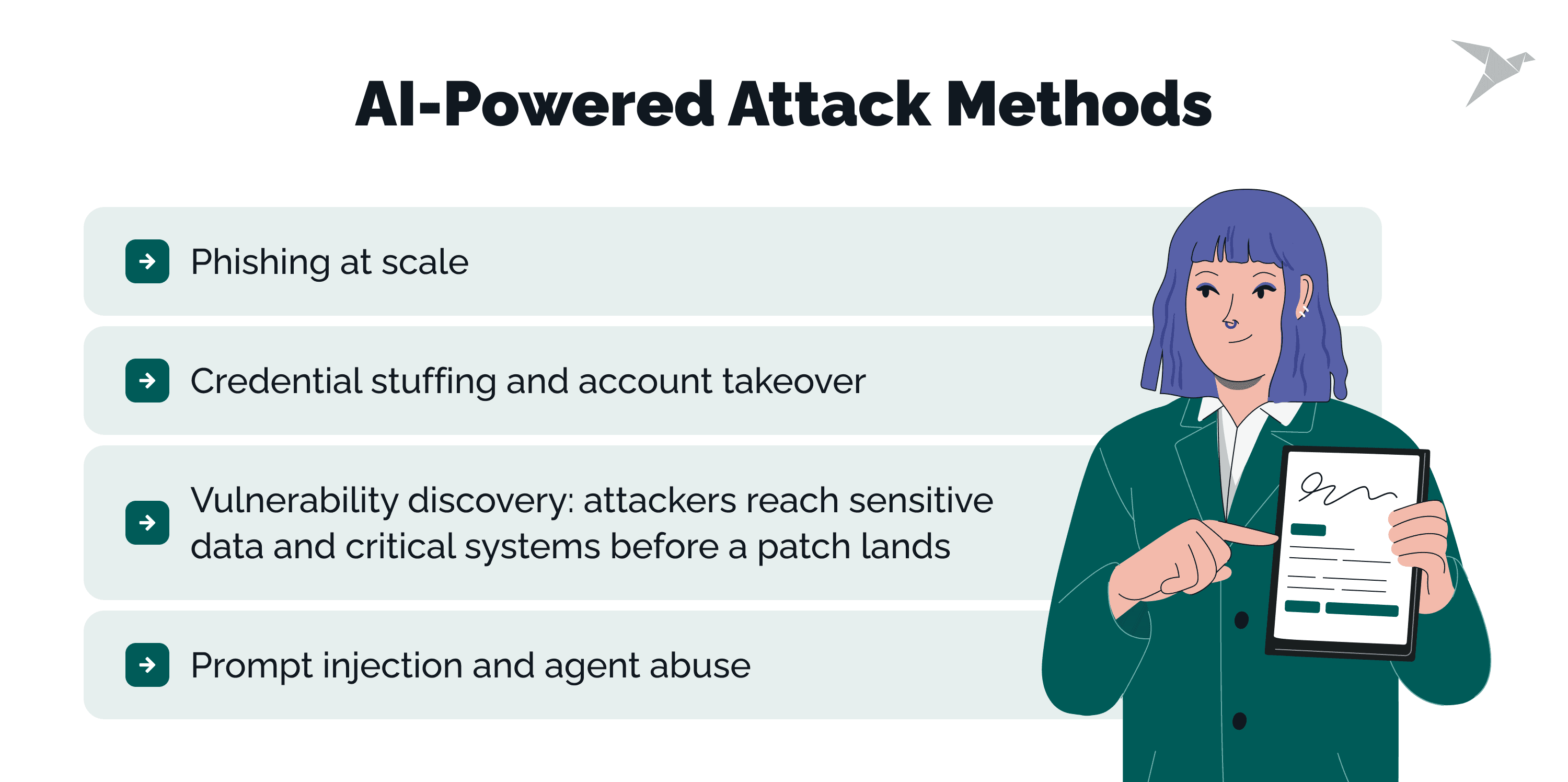
Phishing at scale
AI writes personalized phishing from public data: job titles, recent activity, product names, team structures. AI-generated phishing emails and larger AI-generated phishing campaigns mimic internal communication styles, so this AI-powered phishing beats traditional security defenses trained on mass-sent lures. The volume of convincing social engineering attacks has risen sharply, and the Verizon 2026 DBIR reports higher click rates on mobile phishing than email.
Credential stuffing and account takeover
AI tunes credential stuffing to slip past rate limits and bot detection, rotating proxies and mimicking legitimate user behavior. Takeover attempts get hard to tell from real logins, especially where MFA is missing or inconsistent.
Vulnerability discovery
AI scans for misconfigured APIs, exposed secrets, and known CVEs faster than most patch cycles allow. The gap between disclosure and exploitation has narrowed, so teams need to move from patch-and-remediate toward machine-speed response.
Once attackers map system vulnerabilities, they can reach sensitive data and critical systems before a patch lands, and the resulting security incidents can spread to affected systems across a shared environment.
Prompt injection and agent abuse
As SaaS products add LLM features and agents, prompt injection becomes a direct attack vector: malicious input through user content, connected data, or API responses can redirect an agent. Agentic AI security means treating every external input as untrusted, and most teams have not defined trust boundaries for their agent pipelines.
The most dangerous pattern Anthropic identified is agentic orchestration, where a model chains attack stages and makes real-time decisions with little human input. In an operation Anthropic disrupted in November 2025, the model ran commands, exploited vulnerabilities, and stole credentials as an autonomous agent.
SaaS Hardening Checklist Against AI-Powered Attacks
The checklist covers the five control areas where AI-powered attacks in cyber security most often find gaps in SaaS. The priorities match what our team sees in assessments: “Broken Access Control, Secrets Leakage, Vulnerable Third-Party dependencies, different types of injections.”
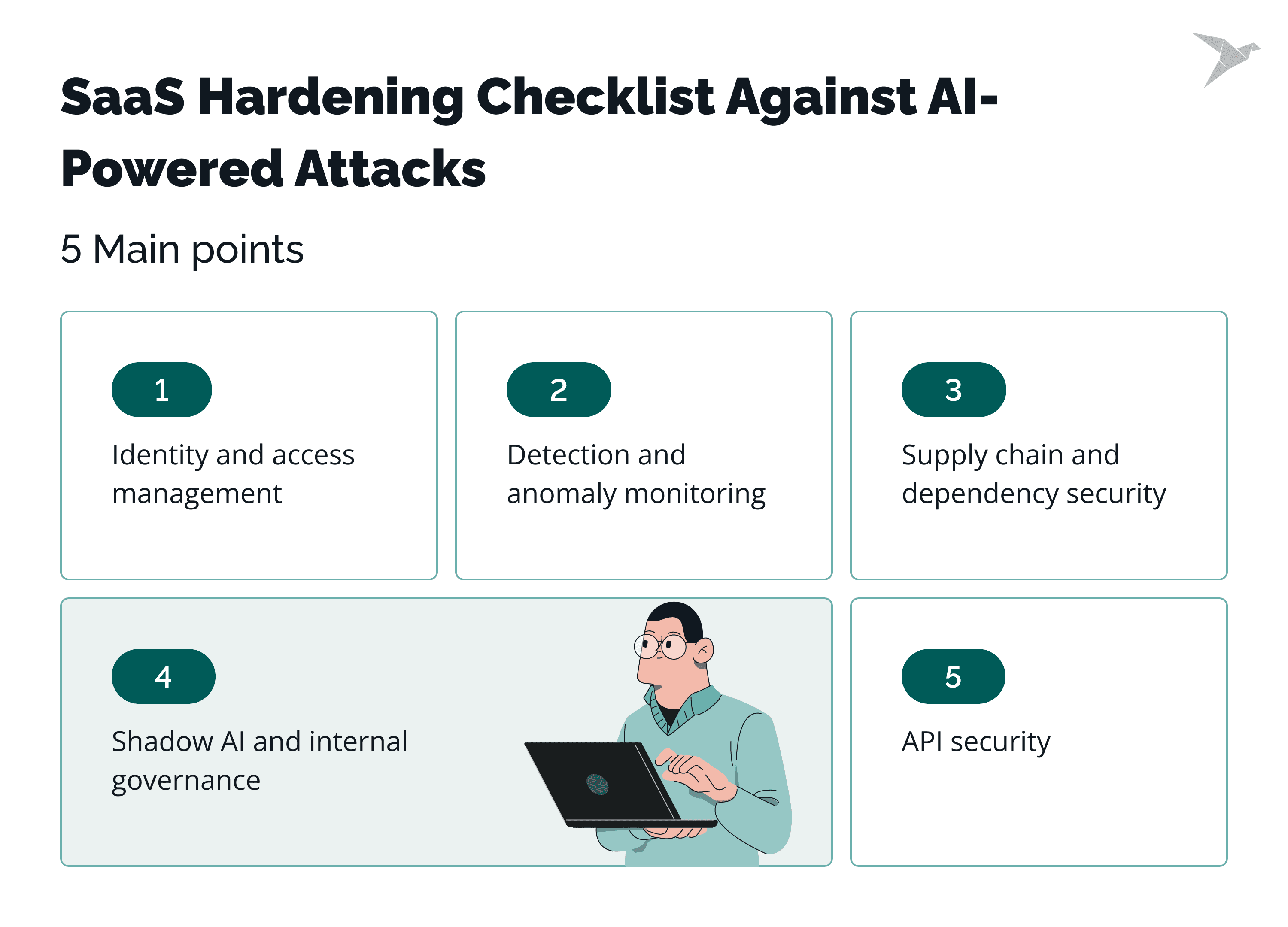
1. Identity and access management
Compromised identities are the most common entry point in SaaS breaches and AI attacks, so credential controls come first.
- Enforce phishing-resistant MFA across all user tiers: WebAuthn or passkeys, not SMS.
- Apply least privilege to every service account and API key, reviewed on a schedule.
- Rotate long-lived tokens on a fixed cadence and revoke ones past their validity window.
- Audit OAuth grant permissions across all third-party integrations, including inactive ones.
- Enforce just-in-time access for privileged operations, with automatic expiry after each session.
Pro tip: Start with service accounts. They gather excessive permissions faster than human accounts and are rarely reviewed as often.
2. API security
API misconfigurations are a consistent weak point, especially authentication gaps on internal or legacy endpoints.
- Enforce authentication and rate limiting on every API endpoint, without exception.
- Scope API keys to the minimum permissions their function needs.
- Monitor for abnormal API call patterns: unusual volume, timing, and endpoint sequences.
- Deprecate and remove unused endpoints from production.
- Require mutual TLS for service-to-service communication where supported.
Pro tip: Map every API endpoint before applying controls. Forgotten endpoints are a common source of exposure.
3. Detection and anomaly monitoring
Signature-based detection misses AI-assisted attackers using valid credentials, and traditional security methods were built for slower, known threats. Against emerging threats, sophisticated attacks, and unknown threats, security teams now pair human oversight with AI-powered cybersecurity tools that sharpen threat detection, threat intelligence, and vulnerability management.
These tools support human analysts, but they do not replace them and still require human intervention. And since human error contributes to 95% of data breaches, training staff to recognize AI-enabled attacks matters as much as the tooling cybersecurity professionals run.
- Deploy behavioral detection that flags credential use from unfamiliar locations or devices.
- Integrate SIEM/SOAR to correlate signals across identity, network, and application layers.
- Set baseline profiles for service accounts and alert on deviations.
- Alert on bulk data access or export events, with response runbooks defined in advance.
- Use AI anomaly detection to surface low-volume, high-precision signals that rules miss.
Pro tip: Set your baseline during a known-clean period. Baselining during an incident produces unreliable reference data for defense strategies.
4. Supply chain and dependency security
Third-party dependencies, including AI libraries, get less scrutiny than first-party code despite carrying equal or greater risk. Mapping them against guidance from the National Institute of Standards and Technology (NIST) helps set a consistent review bar.
- Keep a software bill of materials (SBOM) for all production dependencies, including AI libraries and open-source frameworks.
- Verify cryptographic hashes of third-party model artifacts before deployment.
- Apply the same scrutiny to AI framework updates as to any dependency change.
- Define a vendor security review for every new SaaS integration before it reaches production.
Pro tip: Include AI libraries in your SBOM from day one. Mapping them later in a mature codebase takes far longer.
5. Shadow AI and internal governance
Unsanctioned AI use is a growing blind spot, especially in engineering and customer-facing teams where adoption outpaces policy.
- Deploy tooling to find unsanctioned AI use across your SaaS environment and IDE layer.
- Set tiered AI tool classifications: approved, restricted, and prohibited.
- Require a security review for any internal AI agent that touches production data or APIs.
- Scope agent permissions to the minimum their function needs.
- Require human approval for any agent action that modifies data, triggers payments, or affects external systems.
Pro tip: Publish your AI tool classification list internally. Ungoverned use often comes from a lack of awareness.
Where Most SaaS Companies Have Gaps Right Now
Four gaps show up across our reviews. None are exotic; they build up through fast development cycles and missing review processes.
Long-lived API tokens with excessive scope, granted broad permissions for convenience and never rotated, so one leaked token carries a significant blast radius. Unreviewed third-party OAuth grants that pile up as teams add tools and keep production access long after the tool is gone. No behavioral baselines for service accounts, so unusual call volumes, atypical endpoints, or off-hours activity go undetected by rule-based alerting.
We also see issues like no governance for internal AI agents, which run with no permission boundaries, audit logging, or approval gates. Our AI pentesting services keep surfacing agents with excessive scope and no rollback. This is the fastest-growing gap we see.
Our Experience Hardening SaaS Products Against AI-Powered Threats
Engagements usually start in one of two places. Some are driven by a coming audit. In our team’s words:
“In some cases the main trigger is a future compliance audit. But I see more teams that want to understand weaknesses that could be exploited in automated ways with the help of AI.”
The typical request: run a full assessment, find easy-to-exploit issues, then help put a layered defense in place, using AI on the defensive side too.
Challenges we faced
The defined scope usually holds, but what we find inside it expands the work.
“We have discovered several additional roles inside the system that were accessible due to the broken access control issues. As a result, we had to conduct the cross-role checks… Without the proper automation in place, it can be a challenging task for the pentest team.”
The findings that stand out come from AI features, especially chatbots or agent flows with access to tools like web search and command execution. Teams often rely on a system prompt to prevent misuse, which works against common attacks but not a determined tester.
“Once the pentester applies a mix of indirect prompt injection, situational awareness and social engineering, existing guardrails fail to stop testers from achieving their goal and uncovering vulnerabilities. That is why it is always important to set up multiple layers of defense in order to reduce the risk of exploitation.”
We see the same pattern with permissions. Teams adopt AI fast and pay less attention to what their assistants and agents can do; OpenClaw and the incidents tied to it are a well-known example. Where monitoring is missing, one exposed assistant can be enough to take over the whole environment and its data. This matches what Anthropic reports at scale: attackers increasingly apply AI in the post-compromise stages of an operation, exactly where a poorly governed agent gives them a foothold.
Results
The part clients value most is the depth of the assessment. In our cybersecurity services, we document the vulnerabilities and prepare client-specific remediation steps, to help the team “not only cover the revealed issues but also improve overall security posture and develop capabilities to track more complex and stealthy exploitation flows.”
Two observations are worth passing on. The first is about balance.
“It is hard to create a completely secure system. You should always try to balance between usability and security. Investing time and effort in security controls, monitoring, actionable alerts and IAM will definitely pay off in the long run.”
The second is a pattern across clients of any size or stack. Сontrols get left out because they seem likely to break features, cost too much, or be hard to maintain, so many fail to stop attackers. An experienced security team adapts the solution to the client’s needs without breaking the bank or hurting the user experience.
Our extensive expertise is at your disposal
Wrapping Up
AI-powered attacks have already changed the threat baseline for SaaS. Attacks are faster, cheaper, and built on valid credentials more than malware, so traditional security measures tuned for slower breaches tend to miss them. The defensive response has to be operational, built into everyday work rather than kept as theory.
As for the high-priority actions, here is consistent list:
- tighten identity, access, and token hygiene;
- harden every API endpoint;
- build behavioral baselines during a known-clean period;
- govern AI dependencies and internal agents;
- and make sure your incident response plans are pre-authorized and tested against AI-accelerated scenarios, since most runbooks were written for slower ones.
The most exposed companies are the ones that have not updated their threat model for how AI changes attacker speed, scale, and evasion. This checklist is the starting point for closing that gap.
Future overlook
Looking ahead, attack strategies will keep shifting. The emergence of polymorphic malware, which continuously mutates its code to evade detection, poses a significant challenge for traditional cybersecurity measures, and AI-driven tooling only speeds that up.
The good news is the same technology works for defenders too. AI can identify anomalous user behavior, spot network traffic inconsistencies, and autonomously isolate compromised devices faster than human analysts. Expect more teams to pair ai powered tools with human oversight, flagging evolving risks and advanced threats early and allowing security teams to focus on the calls that matter.
And whatever your security system looks like, the basics still hold. Developing an incident response plan is crucial, outlining protocols and roles in the event of a cyber attack, including preparation, detection, containment, and post-incident analysis. Robust security measures come from testing those plans often and not from stacking up tools nobody has tuned.
When you are ready to test your own environment, our AI pentesting services can help you find the gaps first.
Check our

FAQ

AI-powered attacks use Machine Learning to automate stages of the attack chain: reconnaissance, exploitation, lateral movement, and exfiltration. Also called AI-enabled cyber attacks or AI-powered cyberattacks, they let threat actors run thousands of personalized attempts at once, compress breakout time from hours to minutes, and operate on valid credentials with no malicious files. Old signals like malware signatures and generic phishing templates are no longer reliable against these cyber threats.
SaaS concentrates high-value targets in one place: OAuth tokens, API keys, service account credentials, and multi-tenant customer data. One misconfiguration or compromised credential can expose many customer environments at once, and a large surface of third-party integrations pushes the risk of AI-driven cyber attacks higher than in a traditional enterprise.
AI generates individual lure content per target from public data: LinkedIn profiles, company blogs, product docs. AI-powered phishing attacks prevention starts with accepting that volume and personalization are no longer a constraint, so one campaign can hit thousands of people with accurate messages.
Standard filters struggle to keep up, so behavioral detection and user-level anomaly monitoring are more reliable than content filtering alone. AI powered cybersecurity solutions help teams stay ahead and counter emerging threats as attacker tooling evolves.
Shadow AI is Artificial Intelligence tools and models used inside an organization without formal approval or security review, most often when employees connect unsanctioned tools to production systems, customer data, or internal APIs. The tools may be legitimate, but without scoped permissions, audit logging, and classification, they open ungoverned access paths into sensitive environments and create doors for AI-enabled cyberattacks.
No single control prevents AI-powered cyber attacks. Security professionals use a layered approach to AI in cybersecurity: enforce phishing-resistant MFA and least privilege, rotate and scope tokens, authenticate and rate-limit every API endpoint, build behavioral baselines, govern third-party and AI dependencies, and pre-authorize incident playbooks. The checklist above groups these into five areas to work through in order.