














EU Cyber Resilience Act: What Changes for Connected Product Software Teams
Last updated:26 November 2026


The Cyber Resilience Act (CRA) is in force, and its reporting obligations have applied since 11 September 2026. The rest arrives on 11 December 2027. If you ship connected devices to the EU market, your companion app, cloud backend, and update pipeline are part of that scope.
The situation has a tension. We found no publicly reported fines so far, but reporting is already mandatory, and from December 2027 a product cannot carry the CE mark without meeting the essential cybersecurity requirements. From our experience on IoT projects, the first request often comes from a customer questionnaire, before engineering has a plan.
So, in this article, we’ve decided to cover what applies to connected product software now, what applies later, and what to prepare.
Key Takeaways
- The regulation is in force and applies in stages.
- Reporting obligations for actively exploited vulnerabilities and severe incidents already apply.
- Full obligations, including CE marking, apply from 11 December 2027.
- Software teams carry the secure-by-design, vulnerability handling, and security update duties.
Is the Cyber Resilience Act in Force Yet?
The regulation entered into force across the European Union on 10 December 2024 and applies in stages. As an EU regulation, it applies directly across the internal market, with no need for national transposition.
In force but not yet fully applicable means you can ship today, but a product placed on the EU market after 11 December 2027 must meet the essential cybersecurity requirements. The table below shows the stages.
The dates that matter for software teams
- In force now: reporting of actively exploited vulnerabilities and severe incidents, which has applied since 11 September 2026. It covers products already on the market.
- 11 December 2027: secure-by-design requirements, vulnerability handling, security updates, documentation, and CE marking for products placed on the market from that date.
- Standards and guidance: still in progress, with no single deadline.
What is still unsettled
The European Commission published non-binding guidance, C(2026) 5252, on 27 July 2026. Standards are the open item. On 18 November 2026, the first European standard supporting the regulation was published. It sets generic cybersecurity principles, and the product-specific standards are still to come.
What Is the Cyber Resilience Act, and Which Software Does It Cover?
The EU Cyber Resilience Act regulation sets mandatory cybersecurity requirements for products with digital elements, meaning hardware and software products with a data connection.
A manufacturer, meaning the company that develops a product or has it made and sells it under its own name, must build it securely, handle its vulnerabilities, and report exploited ones. The rules also cover importers and distributors, together called economic operators.
Your scope decides your workload. The sections below show which of your software components count as part of the product.
Products with digital elements
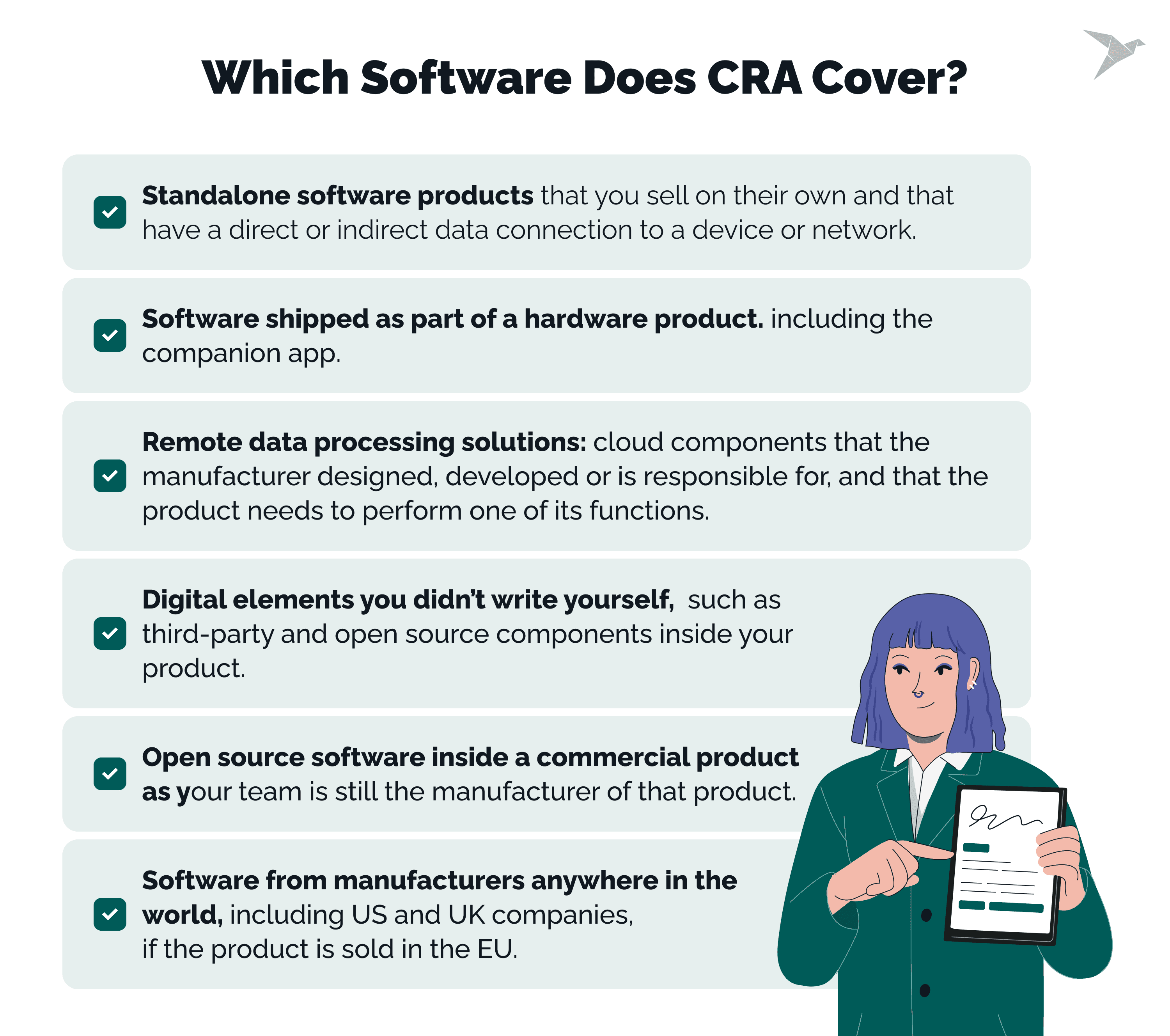
A product with digital elements is hardware or software with a direct or indirect data connection to a device or network. It must be placed on the EU market in the course of a commercial activity. Software products that you sell on their own are products with digital elements too.
The European Cyber Resilience Act covers hardware and software products wherever the manufacturer is based, so a US or UK company that sells a connected product in the European Union is in scope. The CRA applies to the product as a whole, including the digital elements that you did not write yourself.
Companion apps, cloud components, and remote data processing
Software shipped as part of a product with digital elements is in scope, including the companion app. Remote data processing solutions are also in scope. These are processing done at a distance from the product, designed and developed by the manufacturer or under its responsibility, and needed for the product to perform one of its functions.
Take a smart lock that talks to a phone app over Bluetooth Low Energy (BLE, a short-range, low-power wireless protocol). If the lock opens only after a cloud backend authorizes the request, that backend is part of the product. If your device or companion app stops working without your cloud backend, the same applies.
The European Commission's guidance adds a limit. Software that runs remotely and is only accessed by the user is not, on that basis alone, a product with digital elements, unless it supports the functionality of one.
What falls outside the regulation
Products covered by other EU legislation are excluded. Article 2 names medical devices, motor vehicles, certified civil aviation products, marine equipment, and products made exclusively for national security or defense.
Free and open source software that is not part of a commercial activity is generally not placed on the market. A team that ships open source software inside a commercial product is still the manufacturer of that product. Open source stewards have a lighter regime that this article does not cover.
Let's define your scope check

What Changes for Connected Product Software Teams?
The Cyber Resilience Act explained for engineers comes down to one line: practices many teams treat as good hygiene become legal requirements that you must document. Each section below states one of the CRA requirements, what a software team does about it, and what evidence it produces.
Secure by design and secure by default
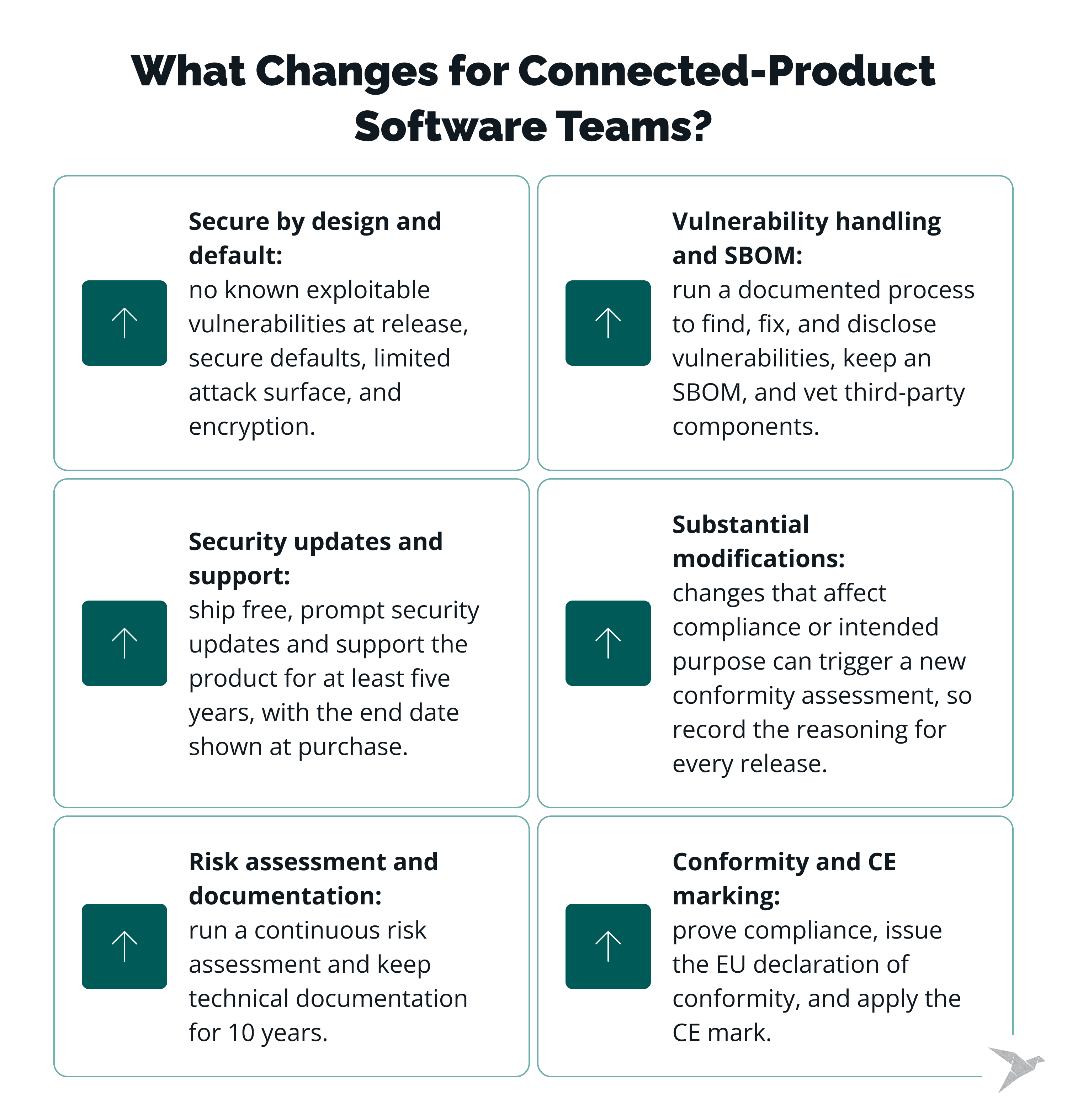
Annex I, Part I of the regulation lists the essential cybersecurity requirements. Which ones apply depends on your assessment of the cybersecurity risks of the product. They include no known exploitable vulnerabilities at release, a secure default configuration that users can reset, limited attack surfaces, protection against unauthorized access, and encryption of data.
In practice, a team threat-models the path from device to app to cloud against the cybersecurity threats it expects, reviews default settings before each release, and removes interfaces that nobody uses. The evidence is design reviews, test results, and release checklists.
Vulnerability handling and the software bill of materials
Annex I, Part II requires a documented process to identify, document, fix, and disclose vulnerabilities. It also requires a software bill of materials (SBOM), a machine-readable list of the components in your software that covers at least the top-level dependencies.
Manufacturers must also exercise due diligence on third-party components, including open source software, so your supply chain is part of the scope. You also need a coordinated vulnerability disclosure policy, which gives outside researchers a contact point and agreed rules for reporting a flaw. A regular vulnerability assessment supports the requirement for effective, regular tests. Recital 77 says manufacturers are not obliged to make the SBOM public.
Security updates and the support period
Manufacturers must distribute security updates without delay and free of charge, with advisory messages. Where applicable, automatic updates are on by default with an easy opt-out, and security updates should be separate from functionality updates where technically feasible.
The manufacturer sets the support period. It must be at least five years unless the product is expected to be used for less time. The end date, at least month and year, must be shown at the time of purchase. Manufacturers remain responsible for the security of the product throughout that period.
Over-the-air (OTA) update pipelines become compliance-relevant systems. They deliver the updates the regulation requires, and Annex I, Part II requires secure distribution mechanisms. On our IoT projects, update delivery is where mobile release cycles, device firmware schedules, and cloud rollouts meet, so no single team owns all of it.
Substantial modifications
A substantial modification is a change after market placement that affects compliance with the Annex I, Part I requirements or changes the product's intended purpose (Article 3(30)). A product with digital elements that is substantially modified counts as newly placed on the market and can need a new conformity assessment.
According to Recital 39, a security update that only reduces risk is generally not a substantial modification. A feature update can be one, so release management teams should record why each release does or does not qualify.
Risk assessment and technical documentation
Manufacturers must carry out a cybersecurity risk assessment that addresses the cybersecurity risks of the product, and treat risk management as a continuous process. You must prepare technical documentation before the product is placed on the market, and market surveillance authorities can request it. The documentation must be kept for at least 10 years after the product is placed on the market.
Conformity assessment and CE marking
Conformity assessment is the process of checking that a product meets the essential requirements. CE marking shows on the product that it does, and the manufacturer also draws up an EU declaration of conformity. The route depends on the product class. Classes that need a third party use conformity assessment bodies that Member States have notified.
Most connected products fall in the default class, but classification depends on core functionality. Smart door locks and security cameras are among the Class I examples, so check the Annex III and IV lists against your product. TechMagic is not a notified body and does not certify products.
What Must You Report Since 11 September 2026?
You must report actively exploited vulnerabilities in your product and severe incidents that affect its security. This duty has applied since 11 September 2026.
The reporting duty covers products already on the market. Under Article 69(3), the CRA applies Article 14 to all in-scope products placed on the market before 11 December 2027. Vulnerability reporting and incident reporting use the same process.
What triggers a report
An actively exploited vulnerability is one for which there is reliable evidence that a malicious actor used it against a system without the owner's permission. A vulnerability you fixed before anyone exploited it falls under normal vulnerability handling.
A severe cybersecurity incident negatively affects, or could affect, the product's ability to protect the availability, authenticity, integrity, or confidentiality of sensitive or important data or functions. Incidents that lead to malicious code running in the product or a user's network also count.
The 24-hour, 72-hour, and final-report steps
Each report has three steps, according to the European Commission's reporting page and Article 14.
Where you report and who is affected
Manufacturers report through the Single Reporting Platform that ENISA runs. You report once, and the notification reaches the national CSIRT (computer security incident response team) of the country where you have your main establishment and ENISA at the same time.
Micro and small enterprises cannot be fined for missing the 24-hour early warning deadline. The duty itself still applies to them.
What a software team needs ready
- A named person who decides that a vulnerability is actively exploited.
- A named person who files the report on the platform, with a deputy.
- Logs and tickets that show when you became aware of the issue.
- Templates for the 24-hour and 72-hour submissions.
Is the Cyber Resilience Act Enforced? Fines, Recalls, and Real Risk
Enforcement is only starting. As of 24 November 2026, no fine under the regulation has been publicly reported.
Under the Cyber Resilience Act (CRA), EU Member States designate their own authorities and set penalties in national law, so enforcement depends on where you sell.
What the penalties are
Article 64 sets three tiers for breaches of the cybersecurity requirements and related duties. In each case, the higher amount applies. Authorities weigh the nature, gravity, and duration of the infringement and the size of the operator.
Who enforces and what else they can do
National market surveillance authorities can request documentation, order corrective action, and withdraw or recall a product. A fine is not the only consequence.
Germany is a worked example. Its implementation act names the Federal Office for Information Security (BSI) as market surveillance authority and notifying authority, according to the Federal Ministry of the Interior.
The Bundesrat had the act on the agenda of its 20 November 2026 session. Other Member States are at different stages, so check each market you sell into.
Have any fines been issued?
There are no publicly reported fines yet. That is expected, because Article 71(2) lists only Article 14 and Chapter IV as applying before 11 December 2027.
Risks that arrive before fines
Buyers may ask for evidence: for a compliance attestation or a documented plan, an SBOM, and an end-of-support date for each product. This shows a buyer expectation, and it is not a statement of law. Your records help you demonstrate compliance when buyers ask.
Liability is the second risk. The new Product Liability Directive must be transposed by 9 December 2026. Missing cybersecurity requirements or security updates can make a product defective.
How Should Software Teams Prepare for the Cyber Resilience Act Now?
Start with a scope check and a gap analysis, then fix the process gaps that reporting already exposes. Six steps cover it.
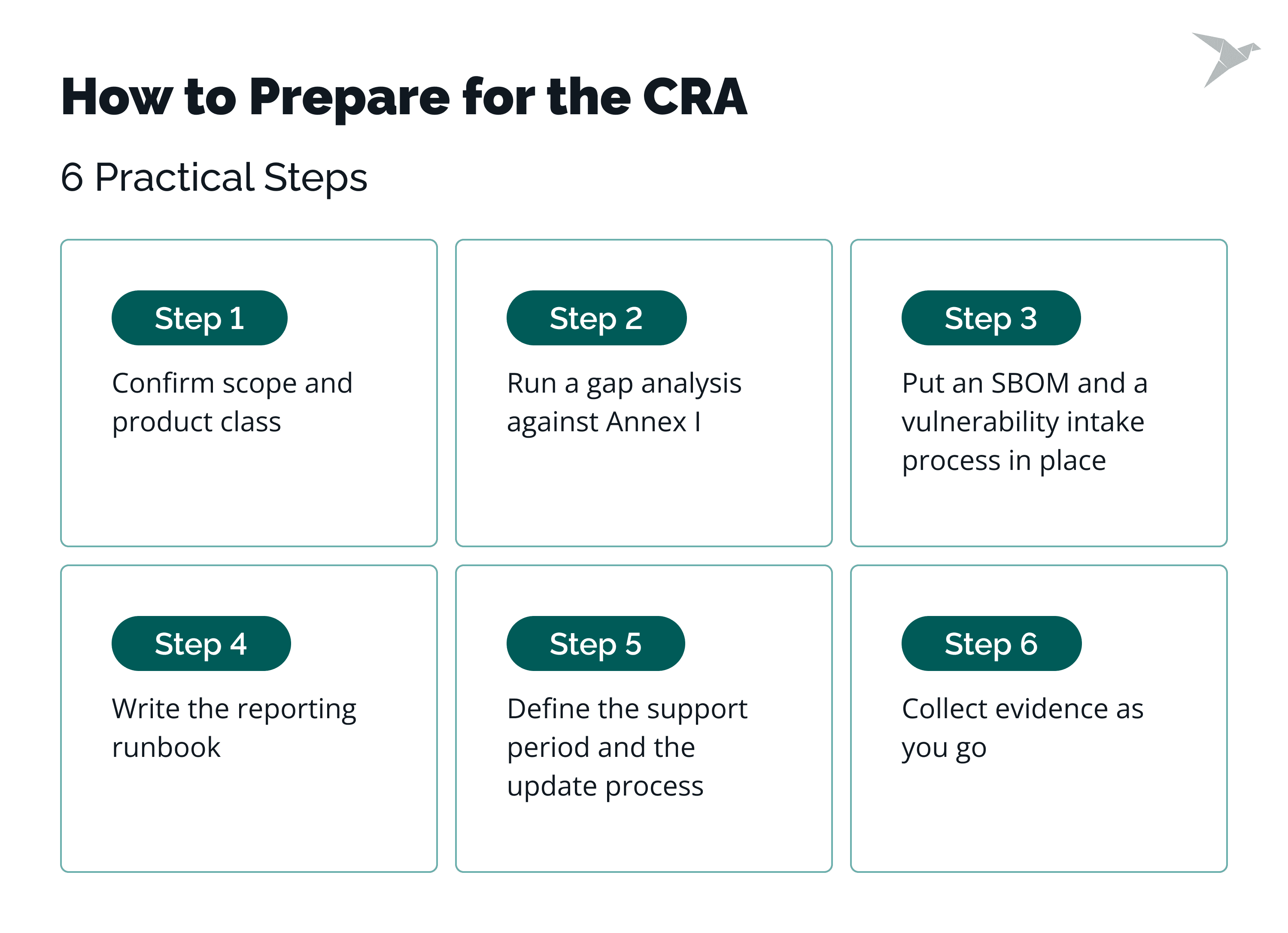
Step 1: Confirm scope and product class
List every product with digital elements, along with the software components and remote services that belong to it. Check each against the Annex III and IV lists to see which CRA requirements apply, and note the main cybersecurity risks.
Step 2: Run a gap analysis against Annex I
Compare your secure development practices, vulnerability handling, update delivery, and documentation with the CRA requirements. Fix first what reporting already exposes.
Step 3: Put an SBOM and a vulnerability intake process in place
Generate the SBOM in the build pipeline with DevSecOps practices. Publish one contact point for vulnerability reports, and set triage rules. Review your supply chain for components that no longer receive updates. This is the core of product security work.
Step 4: Write the reporting runbook
Define roles for vulnerability reporting, keep 24-hour and 72-hour templates ready, and rehearse once. Register on the Single Reporting Platform before you need it.
Step 5: Define the support period and the update process
Set the end date for each product, keep the update channel secure, and record the release decisions that determine whether a change is a substantial modification.
Step 6: Collect evidence as you go
Keep test results, cybersecurity risk assessments, and review records, so the technical documentation and the EU declaration of conformity can be prepared when an authority or a buyer asks.
What CRA Cyber Resilience Act readiness means for your roadmap
CRA readiness is mostly process work that you can schedule. Preparation reuses practices that ISO 27001 programs already contain, such as risk assessment, change control, supply chain checks, and incident handling. The two are not equivalent, and an ISO 27001 certificate does not show conformity with the regulation.
How We Build the Software Layer of Connected Products With the CRA in Mind
Our experts build the software behind connected devices: the companion app, the cloud backend, and the connectivity between them.
For example, for the electric scooter company Etergo, we built native iOS and Android companion apps, with business logic in Kotlin Multiplatform, a toolkit that shares code between both platforms. The backend is serverless and uses AWS IoT Core to send commands to scooters and receive their data. We also built a scooter simulator to test the connected features while the backend was in development.
For VitalsBridge, a healthcare simulation product, we worked on the Android and iOS apps and moved the embedded stack from Windows IoT Core to Linux. We also replaced Bluetooth Classic with Bluetooth Low Energy (BLE) and added D-Bus middleware for communication between hardware components. Another project, Scoozer, uses BLE for scan-to-unlock scooter rentals in US malls.
Where this work meets the CRA
Our product work treats device authentication, encrypted telemetry, and access control as design-stage items. These are the same areas Annex I, Part I covers. Our software tests run against real devices and cover the app, the pairing flow, and the cloud path.
In IoT development consulting, we review the split between edge and cloud, and we plan security around device identity, credential rotation, data retention, and audit trails. The edge and cloud split also shapes which backend services you bring into CRA scope.
Final Thoughts
The Cyber Resilience Act (CRA) is already part of your work, even though most of it applies later. Reporting is live today, and the remaining duties apply from 11 December 2027. That leaves time to prepare in steps, and you do not need to do everything at once.
A calm order works well. Confirm which of your software components are in scope, set up your reporting process, then build the SBOM, the update process, and the technical documentation and evidence trail. Each step reuses practices that many teams already follow.
What to expect next
Nobody can say exactly how the next year will go, but the current milestones point in a clear direction.
- More standards. The Commission says over 30 standards are in the making. The first one, published on 18 November 2026, sets generic principles. We expect product-specific standards to follow, and teams will likely map their practices to them.
- More guidance. Article 26 lets the European Commission issue guidelines, so more guidance may follow. Plan to revisit your scope decisions when new guidance appears.
- Gradual enforcement. Fining powers apply from 11 December 2027. Until then, we expect more Member States to name their authorities and adopt national laws, so check each market you sell into.
- More questions from buyers. Customers and partners may ask for an SBOM, an end-of-support date, or a reporting plan before any regulator does. Having these ready will shorten those conversations.
Where to start, by role
- CTO or Head of Product: put the SBOM pipeline, the update process, and the support period on the roadmap.
- Compliance lead: start collecting evidence now, beginning with risk assessments and test records.
- Founder: scope the regulation before your next EU release.
Start with scope. Every other step is easier once you know which parts of your software the regulation covers.
FAQ
Standalone software is in scope when it is a product with digital elements placed on the EU market commercially. Pure software as a service is not covered unless it is a remote data processing solution for a product. The Commission guidance says software that runs remotely and is only accessed by the user is not a product with digital elements on that basis alone.
Penalties reach EUR 15 million or 2.5% of worldwide annual turnover, whichever is higher, for breaching the essential requirements or Articles 13 and 14. As of 24 November 2026, no fine has been publicly reported. Authorities can also order corrective action, withdrawal, and recall.
Reporting obligations under Article 14 apply to in-scope products already on the market. The other requirements apply to those products only if they are substantially modified after 11 December 2027.
Yes. Annex I, Part II requires manufacturers to draw up a software bill of materials in a commonly used, machine-readable format that covers at least the top-level dependencies. Recital 77 states that manufacturers are not obliged to make it public.
TechMagic supports preparation, scoping, and secure development of the software layer, including DevSecOps practices and vulnerability assessment. TechMagic does not certify products, audit compliance, or act as a notified body.