







Prior Authorization Software: Automating the Approval Bottleneck
Last updated:5 November 2026


CMS says requesting prior authorizations (PA) takes an average of 13 hours per week. PA is the approval a payer gives before care is delivered. From January 1, 2027, impacted payers must also run a Prior Authorization API under the CMS-0057-F final rule. Many vendors sell prior authorization software as the fix for this queue.
A request goes to a payer and waits. The schedule slips. Someone calls for a status update. The tools that promise to help differ in three ways: who they serve (provider or payer), what they automate, and where a person still decides.
In this article, we cover what PA software automates, what the CMS rule changes, how to compare tools, and how to choose between buying, building, and integrating.
Key takeaways
- 1 in 3 providers report prior authorization delays cause adverse events.
- Prior authorization automation removes repetitive work from the prior authorization process, such as form hunting, data re-keying, submission, and status checks.
- A licensed clinician or trained reviewer still determines medical necessity. Software assists and records.
- CMS-0057-F puts the API deadline on payers. It is a product deadline for payer-facing teams and a readiness question for providers.
- Provider-side and payer-side tools solve different halves of the same transaction. Buy for the side you are on.
- Buy when a packaged tool covers your payers and EHR. Build or integrate when your product or payer mix does not fit one.
What Is Prior Authorization Software, and What Does It Automate?
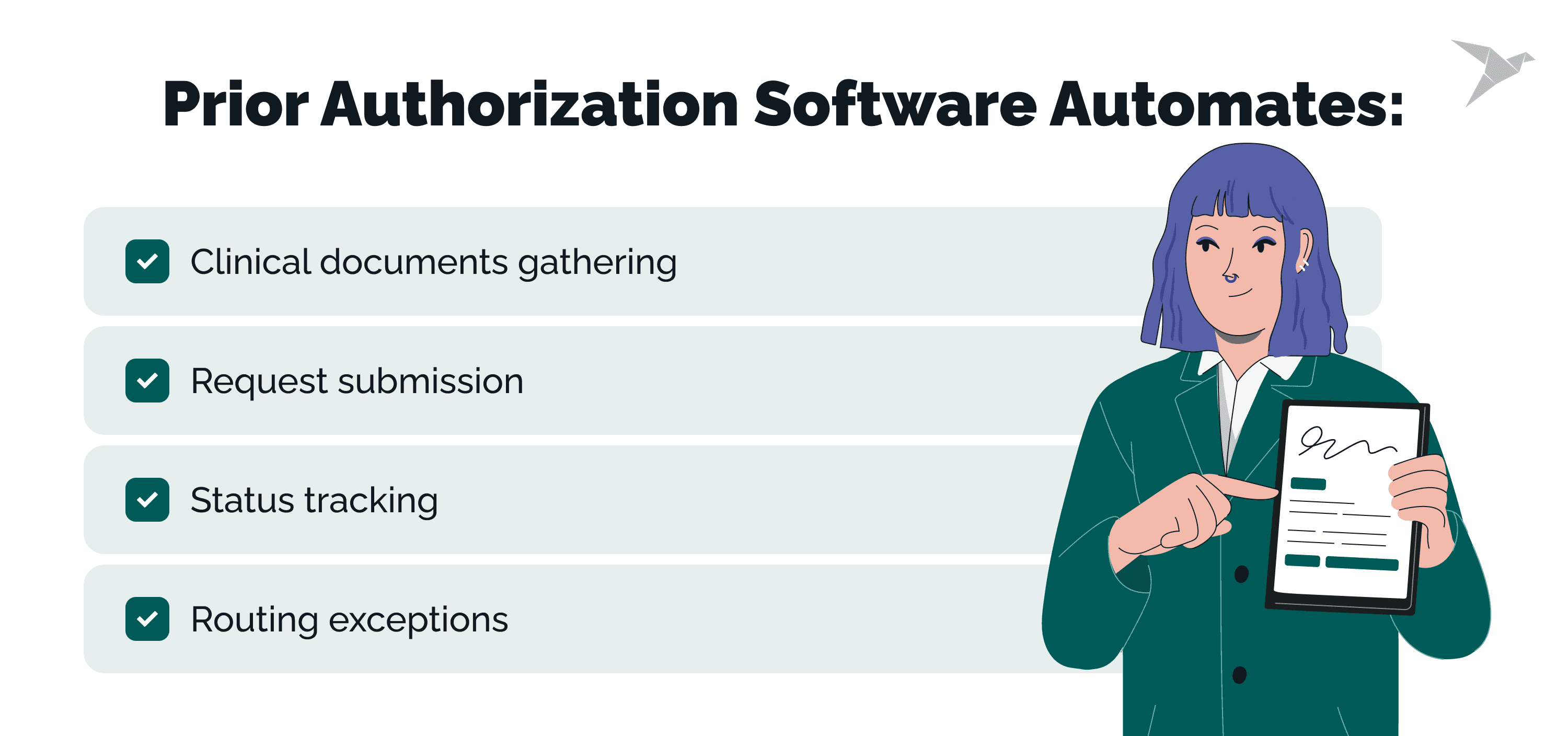
Prior authorization software is a system that helps providers and payers handle PA requests by:
- gathering clinical documents,
- submitting the request,
- tracking status,
- and routing exceptions.
The aim is less phone, fax, and portal work. PA itself is a payer's approval, given before care is delivered, that a service is covered. Staff often shorten the category to prior auth software. The meaning is the same.
What the software does
Most tools do some mix of four jobs across the prior authorization process:
- Collect. Pull the clinical information a payer asks for from the record.
- Submit. Send the request by portal, fax, or electronic transaction.
- Track. Watch the request until the payer decides.
- Route exceptions. Send missing information, denials, and appeals to a person.
Together, these jobs cover the repetitive middle of the workflow. A person handles what is left. Done well, automation can cut phone and fax time, lower administrative costs, and reduce re-keying errors. Results depend on your payers and your workflow.
The prior authorization workflow, step by step
The prior authorization process looks similar in most organizations. Each step has its own failure mode.
- Identify that a PA is needed. A missed requirement means a delayed visit or a denied claim later.
- Collect clinical information. Missing required information sends a prior authorization request back and forth.
- Submit by portal, fax, or electronic transaction. Each payer wants exact information in its own format and channel.
- Track status. Without tracking, staff call or log in to check.
- Handle a denial or appeal. A person with clinical context has to respond.
Can you do your own prior authorization? A patient or practice can submit one. But the payer sets the criteria and the channel.
Prior authorization systems vs prior authorization software
Prior authorization systems are the whole stack a request crosses. That means the EHR (electronic health record), the clearinghouse, the payer portal, and the payer's review system. The software is the layer that automates the work between them. A tool can be excellent at that layer and still leave the rest untouched.
Why Is Prior Authorization Still a Throughput Bottleneck?
Most of the work is manual, and it sits between systems that do not share data. Staff re-key information, wait on payers, and chase status by phone. The main prior authorization challenges are manual hand-offs, payer-specific rules, and status nobody can see.
This manual process is time-consuming and pretty complex. The increased administrative burden falls on medical staff and front-office teams, who also have patient care to deliver. Delays reach the patient experience too, through later appointments and slower starts to treatment. So, as you can see, streamlined approvals can improve patient satisfaction too.
Where the time goes
In general, time goes to manual authorization work. Staff re-key clinical data into forms that follow each payer's requirements. They check payer portals, make phone calls, and follow up on requests that stalled. Each step is short, and together they add up to the 13 hours a week CMS describes.
Why the manual work does not go away on its own
Payer requirements for prior authorization vary between insurers. Every health plan has its own prior authorization criteria and channel, and health plans change them often.
EHR systems and payer systems do not share data by default. Status lives in a portal or a phone call, so nobody sees the whole queue in one place. Monitoring and reporting on open requests are the first things a good tool adds.
What delay costs downstream
Delayed patient care, rescheduled visits, write-offs, and denials that start as incomplete requests all trace back to this queue. Patients wait longer for care, and long delays can affect patient outcomes. Denial management has its own playbook, so we keep it out of this article.
What Does the CMS Prior Authorization Rule Change, and by When?
The CMS Interoperability and Prior Authorization final rule (CMS-0057-F) sets new duties for impacted payers. They must send prior authorization decisions within 72 hours for expedited requests and seven calendar days for standard ones.
Impacted payers also must give a specific reason for denials and report PA metrics publicly. And they must implement a Prior Authorization API starting January 1, 2027. CMS (the Centers for Medicare & Medicaid Services) set these dates in a fact sheet. The API date turns this from a policy topic into a product deadline.
The CMS deadlines at a glance
Source: CMS-0057-F fact sheet, dated January 17, 2024. FHIR (Fast Healthcare Interoperability Resources) is the HL7 standard for exchanging health data through APIs.
Who the rule applies to
The rule applies to impacted payers: Medicare Advantage organizations, state Medicaid and CHIP fee-for-service programs, Medicaid managed care plans, CHIP managed care entities, and QHP issuers on the federally facilitated exchanges. The API duties sit with them, and providers are not the regulated party.
The rule does not cover prior authorization for drugs. A proposed rule, CMS-0062-P, would change that, but it is not final.
What it means for a payer-facing product founder
You are in scope, so the date is a product deadline. The open decision is whether to build or buy the Prior Authorization API and the decision workflow behind it. Start there, because it shapes your regulatory readiness plan and the rest of your roadmap. Plan early for payer-specific rules. They drive many prior authorization challenges.
Check our

What it means for a provider RCM leader
Expect faster and more structured prior authorization decisions from payers. That can mean faster access to care for patients. Prepare submission workflows that can use them. RCM (revenue cycle management) teams at health systems and provider groups that still rely on fax and phone will see the gap widen as payers modernize.
What it means for EHR and health IT product teams
Provider-side obligations come from separate programs. ASTP/ONC's HTI-4 rule adds certification criteria for electronic prior authorization to certified health IT.
The criteria are based on the HL7 Da Vinci guides: Coverage Requirements Discovery (CRD), Documentation Templates, and Rules (DTR), and Prior Authorization Support (PAS).
Providers must also report an electronic prior authorization measure under MIPS (the Merit-based Incentive Payment System) beginning in 2027.
For EHR vendors, that turns PA from a connector into a certified feature set.
How Does Prior Authorization Automation Work, and What Stays Human?
Prior authorization automation removes repetitive work. That includes finding the right form, pulling clinical data from the record, submitting, and checking status. A licensed clinician or trained reviewer still determines medical necessity and signs off on anything clinical. The software moves the request. A person owns the judgment.
Three levels of automation
We frame it in three levels:
- Digital forms and checklists. They digitize forms and replace paper and fax. Staff still decide what to send and when to follow up.
- EHR-integrated submission and status tracking. They connect to the EHR, pull patient information from the record, and watch the request. A person still handles exceptions and appeals.
- Rules-based decisioning on the payer side. It applies payer policy and prior authorization criteria to a request. A trained reviewer or clinician still decides anything that affects care or a denial.
Providers and EHR teams sit mostly at the first two levels. Payer-facing teams sit at the third.
What AI can do in the workflow?
Artificial Intelligence might be very helpful in gathering documentation, matching a request to payer criteria, and routing exceptions to the right person. This is the territory of healthcare AI automation.
Many AI-powered tools combine robotic process automation (RPA) with natural language processing (NLP). RPA repeats portal and form steps, and NLP reads clinical notes for the details a payer asks for.
Payer requirements change, so automated rule sets and decision trees need regular updates and monitoring. So can AI do prior authorizations on its own? No. It assists, and a person decides.
What a person still decides
Clinical review stays with a clinician or trained reviewer, who determines medical necessity. They also handle anything that affects care or a denial, and every exception. Their sign-off belongs in the audit trail, with the name, the time, and the evidence they saw. Software that cannot record that is not ready for clinical work.
Standards underneath
Prior authorization systems exchange data through electronic transactions. HHS has said it would use enforcement discretion on the X12 278 transaction when payers implement an all-FHIR Prior Authorization API, per the CMS-0057-F fact sheet. The Da Vinci guides named above define how that API works between provider systems and payer systems.
A newer proposal, CMS-0062-P, would extend electronic PA to drugs. That brings medication prior authorization into scope. It would also move certain HIPAA PA transactions to FHIR. It is a proposal and may change. Read it as a signal about direction. It is not a current requirement.
What it touches after the approval
A PA number and its supporting documentation follow the claim. Clean authorization data upstream makes coding and billing easier downstream. It also supports revenue cycle management as a whole.
A Guide to Prior Authorization Software: How Should You Compare Options?
Compare tools on four things: who they serve (provider or payer), how they connect to your EHR and payers, what they automate and what they leave to staff, and what they record for audit. Treat this prior authorization software guide as a screening list. It ranks no vendor and publishes no price.
Provider-side vs payer-side tools
The two sides of a PA request have different buyers and different systems. A provider tool submits and tracks. A payer tool receives, applies policy, and decides. No single prior authorization solution covers both sides. Check which side a product was built for before you read its feature list.
Categories of tools
Automated PA systems fall into four categories:
- EHR-embedded electronic PA, built into the record clinicians already use.
- Standalone provider platforms, which sit beside the EHR.
- Clearinghouse or network-based tools, which route requests across many payers and help standardize submission and tracking.
- Payer-side utilization management platforms, which handle review and decisions.
Evaluation criteria
Weight the rows by your side of the transaction.
Questions to ask in a demo
Run three scenarios and watch what the tool does:
- A request that is missing information. Does it flag the gap before submission?
- A request that needs follow up. Does it surface the stalled request, or wait for someone to check?
- A payer that cannot use your preferred connection. Does it fall back to a portal or another channel?
A tool that handles all three cleanly is worth a deeper trial.
Buy, Build, or Integrate: Which Path Fits Your Team?
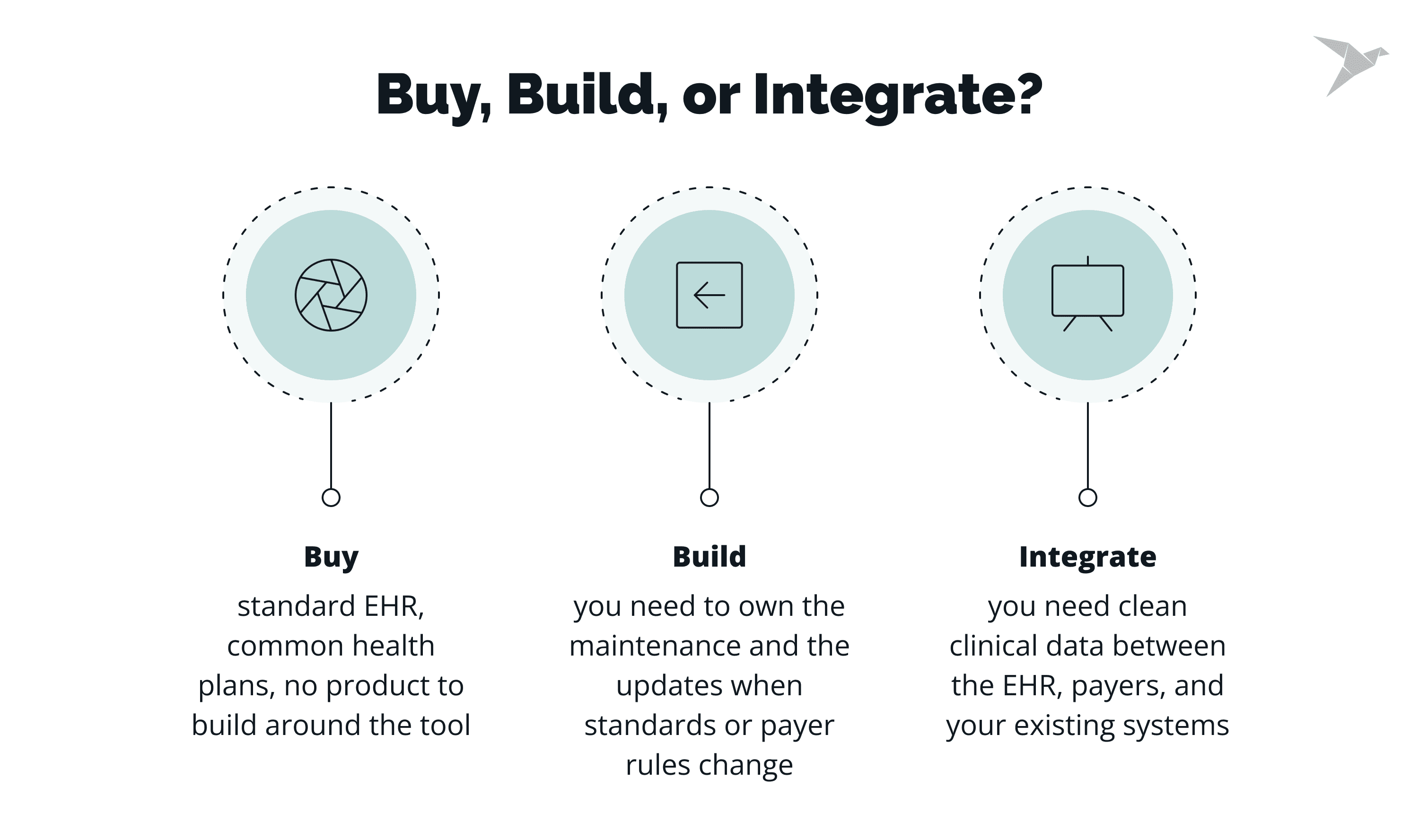
Buy when a proven product covers your payers and EHR. Build a workflow layer when your payer mix, your product, or the CMS Prior Authorization API requirement does not fit a packaged tool. Integrate when the real gap is moving data between systems you already own.
Buy when an off-the-shelf product is enough
Buy if you run a standard EHR, work with common health plans, and have no product to build around the tool. The vendor already maintains the payer connections and updates the forms when payer rules change, so you get a working system sooner and do not carry the maintenance.
The main trade-off lies in control. You get the features the vendor ships, in the order it ships them, so check that the tool already covers the payers that make up most of your volume.
Build when a custom workflow layer pays off
A payer-facing product that must expose a Prior Authorization API is the clearest case, because the API is a product you ship and a generic tool rarely fits. Multi-payer rules that packaged tools handle poorly are another. So is a product that embeds PA inside a clinical or revenue cycle workflow, where a separate tool would add a hand-off.
Building means you own the maintenance and the updates when standards or payer rules change, so start with one payer or one request type before you widen it.
Check our

Integrate when data movement is the actual gap
If the bottleneck is getting clean clinical data between the EHR, payers, and your existing systems, you need HL7 FHIR integration more than a new tool. Many teams already have software for submission and tracking, and the delay comes from data that staff re-key or fetch by hand.
Connecting the systems you own removes that work without replacing anything. It also prepares you for the payer APIs that arrive from 2027, because they use FHIR.
Run a proof of fit before you commit
Run a short, scoped trial on your two hardest payers, or on your hardest request type in your highest-volume service lines. It tells you more about your real prior authorization challenges than a feature checklist. Agree on what counts as success before it starts. Then check that the tool fits your existing workflows.
Our Experience With Prior Authorization Workflows and Healthcare Integration
TechMagic's health insurance software development services include prior authorization management. We have also shipped agentic and AI-driven workflows for clinical documentation, prior authorization, and patient intake. We do not name clients or publish metrics for PA work.
A preventive-care platform on Medplum and FHIR
For a preventive-care platform focused on early cancer detection, we built physician tools for case review and lab test ordering on Medplum and FHIR. The platform also integrates with Health Gorilla for bi-directional external record retrieval. It is not a PA project. It does show the same data movement a PA workflow depends on.
An EMR interoperability layer for 10+ systems
For a US healthcare intake platform, we built one integration layer and one codebase that delivers data into 10+ EMRs, including Epic, athenahealth, NextGen, and Medplum. New health systems onboard through configuration. Every document delivery is logged for compliance review. This work is not PA either. But connecting many systems with an audit trail is the same engineering problem.
How we approach it
We embed human oversight in every AI-assisted step. We use standards-based data exchange over FHIR and HL7 and scope the first workflow narrowly before widening it. For X12 278 and payer-side utilization management, we can consult on the approach.
If you are weighing a build against a buy, a short consult on which path fits your team is a reasonable first step.
Final Thoughts
The right tool removes the repetitive work, connects to your EHR and payers, and keeps a person responsible for clinical decisions. For an RCM or operations leader, that means testing a tool on your hardest payers before you commit.
For a payer-facing product founder, it means deciding early whether to build or buy the Prior Authorization API that CMS requires from January 1, 2027. Both teams gain efficiency when there are fewer calls and less re-keying. That is the operational efficiency payoff.
Where is this heading?
- Provider and payer tools will converge on the same standards. The Da Vinci guides sit behind both the payer API and the EHR certification criteria, so one data model can serve both sides.
- Drugs are the next scope. CMS-0062-P proposes extending electronic PA to drugs, with most proposed dates starting October 1, 2027. It is a proposal, so plan for it without committing to it.
- Adoption is rising, with room left. The 2025 CAQH Index puts fully electronic medical PA at 40% of transactions, up from 35% in 2024.
- Physician trust is the gap. In the American Medical Association's May 2026 survey, only one in three physicians (33%) believed the latest insurer pledge would make a meaningful difference.
None of this changes the core rule: software moves the request, and a person owns the clinical decision.
Check our healthcare IT consulting services

FAQ

Prior authorization software is a system that helps providers and payers handle prior authorization requests. It gathers clinical documents, submits the request, tracks status, and routes exceptions to a person. The goal is less phone, fax, and portal work.
Prior authorization automation pulls clinical data from the record, fills and submits the request, and tracks its status. A licensed clinician or trained reviewer still decides medical necessity and handles exceptions. The software records each step for the audit trail.
AI can assist with prior authorizations by gathering documentation, matching payer criteria, and routing exceptions. A person decides medical necessity and signs off on anything clinical. TechMagic builds AI-assisted workflows with human oversight at every step.
The CMS Interoperability and Prior Authorization final rule (CMS-0057-F) sets new duties for impacted payers. They must send PA decisions within 72 hours for expedited requests and seven calendar days for standard ones. They must also give specific denial reasons, publish PA metrics, and implement a Prior Authorization API starting January 1, 2027, per the CMS fact sheet. A separate proposed rule, CMS-0062-P, would extend electronic PA to drugs. It is not final.
The CMS prior authorization rule, CMS-0057-F, places its API duties on payers, so providers are not the regulated party. Providers still benefit from faster decisions and payer APIs. Provider-side requirements come from separate programs, including the MIPS electronic prior authorization measure beginning in 2027 and ASTP/ONC's HTI-4 certification criteria for EHRs.
Choose prior auth software by checking which side of the transaction it serves, how it connects to your EHR and payers, what it automates, and what it records for audit. Then test it on your two hardest payers before you commit. Ask any vendor about human sign-off on AI output and about BAA terms.