









Retrieval Augmented Generation In AI System: Best And Worse Use Cases
Last updated:29 October 2026


It’s easy to assume that a stronger model will fix wrong answers. But what if the model was never the problem?
A Large Language Model (LLM) only knows its training data, and that never includes a company’s refund policy or the code merged this morning. That is the gap RAG in AI systems closes: retrieval augmented generation (RAG) hands the model the right internal facts when the question arrives.
In our new article, we cover what RAG is, how it works, and its best and worst use cases. We also share what we learned building a RAG-powered coding agent at TechMagic.
Key Takeaways
- Retrieval augmented generation adds passages from a company’s own data to the prompt, so the model answers from facts it never saw in training.
- RAG reduces hallucinations and keeps answers current without retraining, but retrieval quality decides most outcomes.
- RAG fits poorly with whole-dataset questions, millisecond decisions, and missing or untrusted knowledge bases.
- TechMagic’s coding agent taught us that retrieval must match the data: semantic search suits prose, while grep and syntax-aware tools often suit code better.
What Is RAG in AI?
Retrieval augmented generation (RAG) is a technique that connects a generative AI model to external knowledge bases, such as company documents and wikis. Before the model answers, an information retrieval component searches those sources to retrieve relevant information and adds it to the prompt. The model then answers from that material instead of relying solely on its training data.
Patrick Lewis and colleagues at Facebook AI Research introduced the term in 2020. Generative models such as Large Language Models write fluent text, but their knowledge stops at a training cutoff.
What Are the Benefits of RAG in AI Systems?
RAG gives an AI system facts the model was never trained on and lets the business choose those facts. The key benefits are fewer hallucinations, fresher data, better accuracy, and control over responses.
Fewer hallucinations in LLM outputs
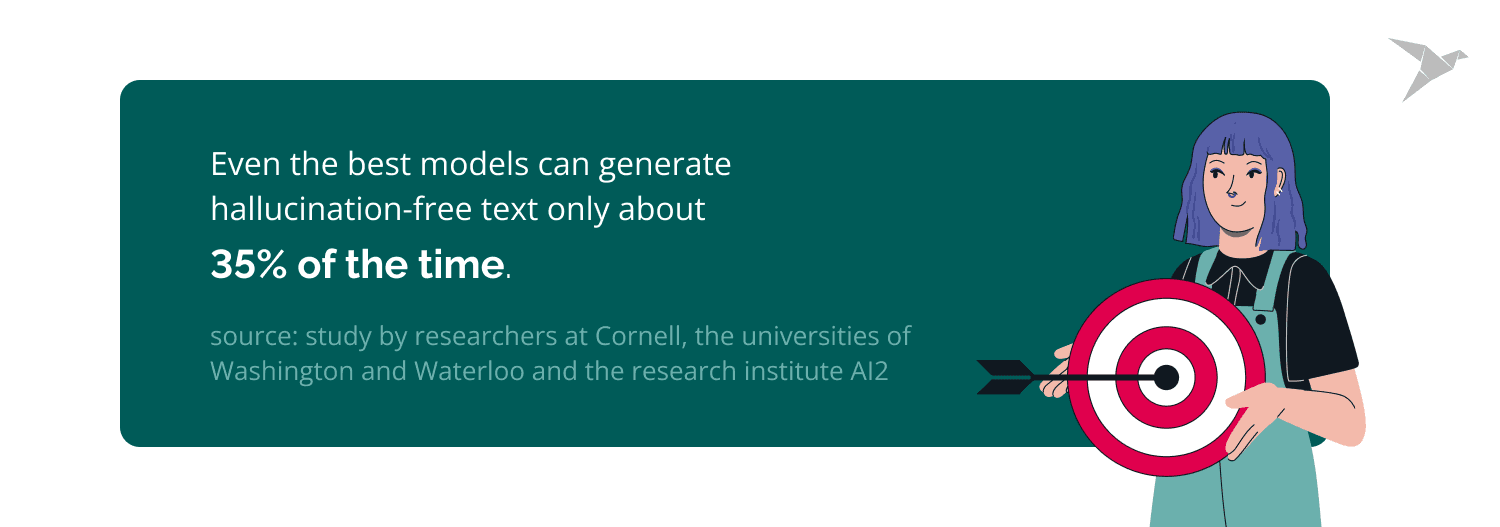
A model without the right facts still answers, with text that only sounds plausible. Researchers from Cornell, the University of Washington, the University of Waterloo, and AI2 tested this in 2024, and a co-author told TechCrunch that even the best models can generate hallucination-free text only about 35% of the time.
RAG reduces this by giving the model source material to answer from. The reduction has limits: in the same study, even models that can search the web struggled with questions Wikipedia could not answer.
Access to up to date and proprietary data
Training data never includes internal documents. RAG reads them from live data sources such as wikis, tickets, and contracts. Any external data source the business trusts can join the index. When a policy changes, the team indexes the new data, and the next answer reflects it. Up to date information in the index is the simplest defense against outdated answers.
Better answer accuracy and relevance
Retrieval narrows each question to the most relevant documents, and accurate answers start there. Generated responses can cite their sources, which supports user trust. Teams evaluating RAG models should test factual accuracy on questions that match real world usage.
Control over responses through internal knowledge
The knowledge base defines what the system can say. Teams decide which documents enter the index and who can retrieve them, which keeps generative AI outputs under business control. Access controls belong in the retrieval layer. A user should only receive chunks from documents that the user is allowed to open.
How Does RAG Work in Real Systems?
A RAG system works in two phases. Offline, it prepares and indexes the data, and at query time, it retrieves relevant context and passes it to the model.
Ingest → Chunk → Embed → Index → Retrieve → Generate
Data ingestion and indexing
The pipeline pulls text data from knowledge sources such as Confluence, ticket systems, and code repositories. Engineers prepare data by cleaning it, removing duplicates, and splitting it into chunks. Each chunk keeps metadata: source, date, owner, and permissions.
Most retrieval augmented generation work is data work. Messy internal data stays messy in every answer, so cleaning, chunking, and metadata shape retrieval quality.
Embeddings and vector search
Embedding models convert each chunk into numerical representations called vectors. Text with similar meaning gets vectors that point in similar directions. A vector database stores them and runs similarity search, often with cosine similarity, to find the closest matches.
That is how semantic search works: a query for “login validation” can find a function named checkCredentials. Some teams fine tune the retrieval model on domain specific data to sharpen these matches.
Vector search can miss exact terms such as error IDs. Hybrid search adds keyword matching and gives more accurate responses on those queries.
Retrieval of relevant context
The system embeds the user input with the same model and returns the closest chunks, such as the top 10. Strong setups filter the search results by metadata and rerank them with a second model. More context is not always better. Every extra chunk adds tokens, cost, and noise, so only relevant data should reach the model.
Generation with retrieved data
The system builds the augmented context: instructions, the retrieved information, and the user’s question in one prompt. Prompt engineering sets the rules, such as “answer only from the sources, and say when the answer is missing.
These rules shape LLM responses, but they cannot replace a missing document. High quality output needs the right passages for relevant responses and clear rules that make the model more likely to admit gaps.

Best Use Cases for RAG in Production AI Systems
The RAG best use cases share a pattern: a large, changing body of text and questions that a few passages can answer.
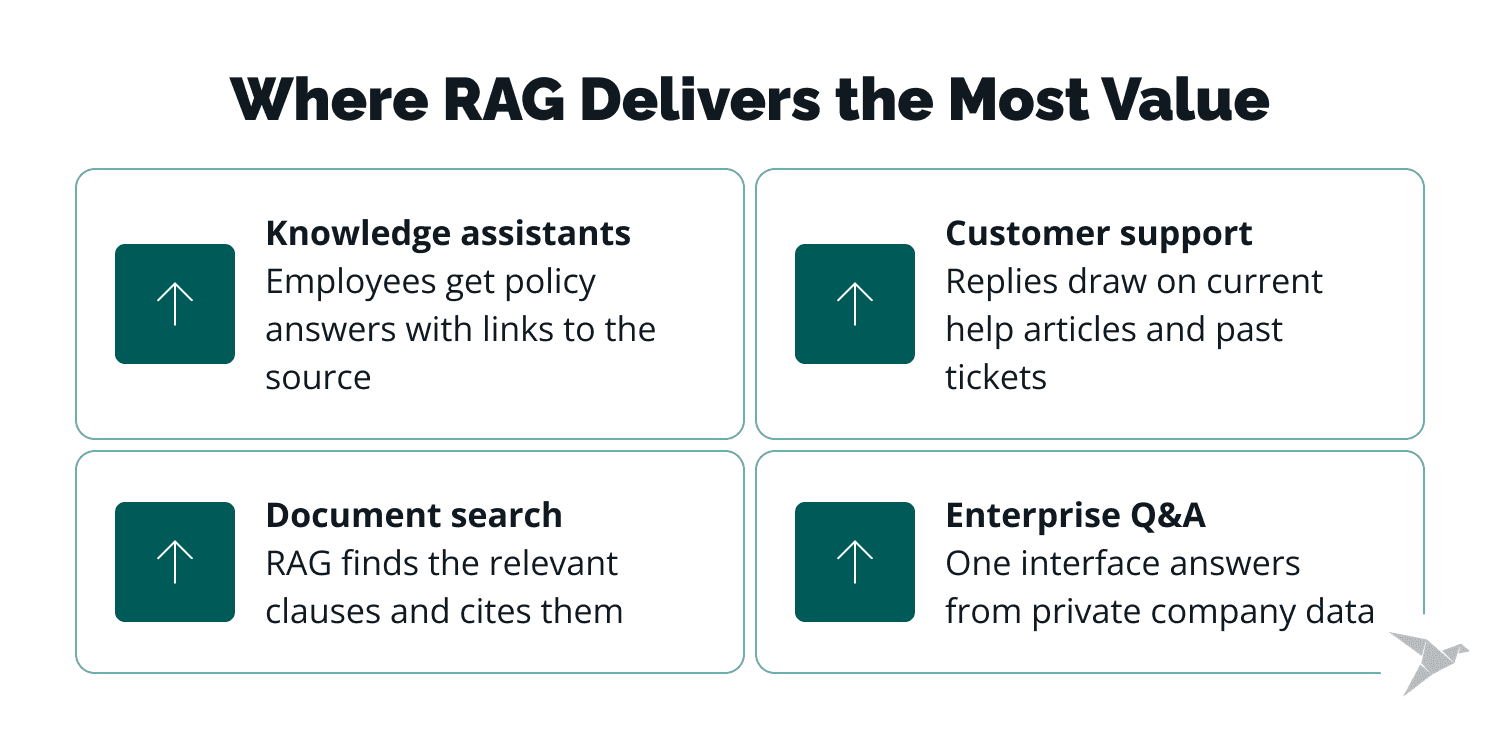
Internal knowledge base assistants
Employees ask about HR policies or engineering standards, and the answers sit somewhere in internal knowledge bases. A RAG assistant searches multiple documents at once and replies with links to the source pages.
Customer support and helpdesk automation
Support teams answer the same user queries every day. RAG grounds replies in current help articles, past tickets, and release notes. Resolved tickets can join the index, and customer feedback shows where answers fall short, so the assistant improves without retraining.
Document search and summarization
Legal and compliance teams work with contracts too long to reread for every question. RAG finds the relevant clauses across multiple data sources and summarizes them with references. The result is an enterprise search that returns an answer with its evidence.
Enterprise Q&A systems
Enterprise Q&A systems put policies, specs, and wikis behind one interface and answer questions with specialized data no public model has seen. That private knowledge makes RAG applications worth their cost.
Across these retrieval augmented generation use cases, success depends on whether retrieval finds the right passage. A narrow pilot is a sensible start, and AI MVP development keeps the first version small enough to measure.
RAG Worst Use Cases: Where Does RAG Fall Short?
RAG falls short when a few retrieved passages cannot answer the question or cannot be trusted. Most RAG limitations trace back to the scenarios below.
Tasks that require deep reasoning or complex logic
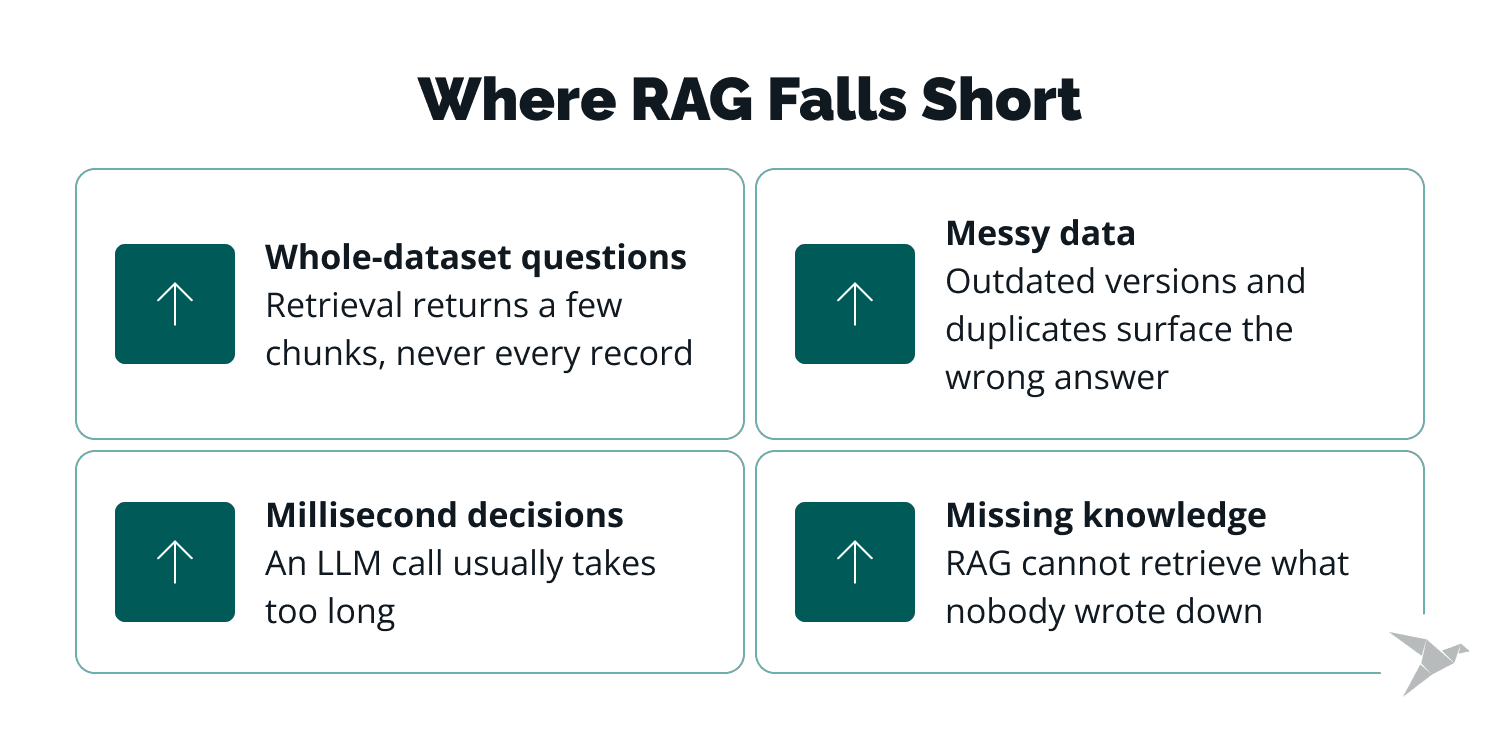
Vector search returns only the closest matches, never the whole corpus. “What was the average contract value across 4,000 agreements?” needs every record, but retrieval hands the model perhaps 10 chunks. The model then answers confidently from that sample.
SQL, structured queries, or an agent that runs code suit such questions better. Multi-step reasoning over conflicting sources is also weak, because the model receives fragments without the full picture.
Low-quality or poorly prepared data environments
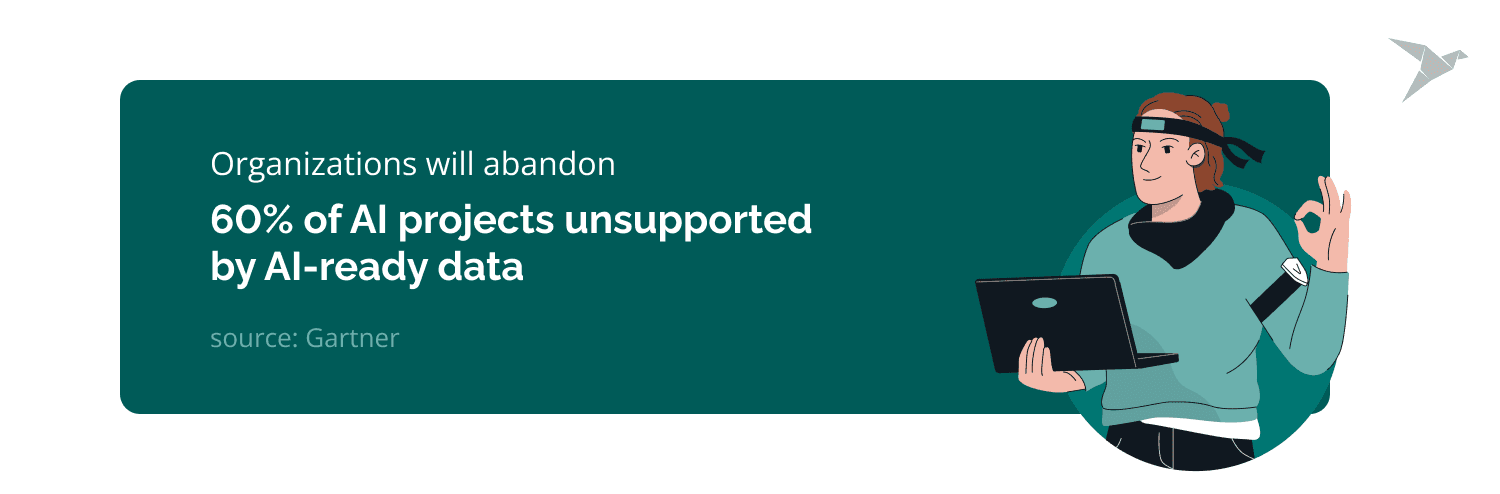
RAG retrieves whatever is in the index, including outdated versions, duplicates, and scanned PDFs with broken text. If three versions of a policy exist, the system may quote the wrong one. Gartner predicts that through 2026, organizations will abandon 60% of AI projects unsupported by AI-ready data.
Real-time decision systems with strict latency limits
Every RAG request adds steps: embedding the query, searching the index, and processing a longer prompt. A chat assistant can afford a second or two. Fraud scoring, ad bidding, and machine control need decisions in milliseconds, and an LLM call usually takes longer. Classic Machine Learning models or rules engines serve them better.
Use cases with no reliable knowledge base
RAG cannot retrieve knowledge that was never written down, and it cannot tell which of two conflicting documents is right. The first investment there is documentation. Fine tuning can optimize models for style and format, but it cannot supply missing facts.
Deciding when to use RAG in AI products comes down to two checks: does a trustworthy source exist, and can a few passages answer the question?
RAG Impact on AI Systems: TechMagic’s Experience
The RAG impact on AI systems depends on whether retrieval matches the shape of the data. Our clearest lesson came from a RAG-powered coding agent built by Oleh Naumov, a full-stack developer at TechMagic with more than six years of experience.
The project: a coding agent inside VS Code
Oleh built a VS Code extension that works like a homemade Copilot. A developer asks for a change, and the agent plans and applies it across files.
He presented it at MagicJS #11, a JavaScript community meetup powered by TechMagic. The full talk is on YouTube in Ukrainian, so this section sums up its key practical points in English.
Oleh calls it “a museum piece” today, but it still shows how RAG works under the hood. The stack was Node.js, LangGraph for the agent, LanceDB as the vector database, and the all-MiniLM-L6-v2 embedding model running through Transformers.js.
The retrieval layer
The extension re-indexed files after every change. Oleh split code into logical blocks, such as imports, a class, or a function, each capped at 400 characters. Each chunk kept its file path, line range, workspace, and vector.
The embedding model ran locally in Node.js, in an 8-bit quantized version small enough to ship with an extension. Indexing and search stayed local, while generation used a hosted model, GPT-4.1 mini in the demo.
LanceDB runs embedded and filters by fields during vector search, which allowed queries like “the 10 nearest chunks from this workspace.”
The agent loop
The agent ran on three LangGraph nodes:
- Analyzer gathers context with semantic search, file reads, and terminal commands.
- Planner turns that context into tasks, each naming a file and the change to make.
- Editor reads, edits, creates, and deletes files and runs commands such as npm, git, and eslint.
The search tool’s description set strict rules: search only when context is missing, at most twice per session, and never repeat a query. Only code went into the index, without LLM-written summaries, and a low temperature gave Oleh the answers he preferred.
Results and honest limits
The agent handled some tasks well and others poorly, and it worked best for inline suggestions: a developer typed a function name, and the agent wrote the body. The bigger question is whether vector search suits code at all, and Oleh answered it directly in his talk.
Expert view: Is semantic search still the right tool for code?

“Modern agents don’t use semantic search to edit code at all. It’s already a somewhat outdated approach. Modern agents use grep. They also have tools that read files directly, and for code they use mechanisms based on the Abstract Syntax Tree. To get a node and all its connections, whether it’s a variable, a class, or a function, the agent doesn’t need to read a pile of embeddings. It doesn’t clutter its context with irrelevant pieces of code, so it works better.”
The field has not fully settled. Cursor reported in November 2025 that combining grep with semantic search gave its agent the best results in large codebases.
Expert view: Where does this setup make sense today?
“Documentation gets updated often. So you don’t need to retrain the model. You just index the new files and everything that goes in there, and your AI picks up what you ask about.”
RAG best practices from the build
These retrieval augmented generation best practices come from the project and apply well beyond code:
- Chunk by meaning. Split code by function and prose by section, with overlap for text.
- Store metadata with every chunk. Paths, line ranges, and workspace IDs enable filtering and citations.
- Set the similarity threshold per task. In Oleh’s view, a cosine similarity of 0.75 is enough for text and documentation, while duplicate detection needs more.
- Cap retrieval inside agents. Limit search calls and block repeated queries.
- Match the retrieval method to the data. Semantic search suits prose, and syntax-aware tools suit code.
- Keep generation conservative. A low temperature keeps answers consistent, and source-only instructions cut down inaccurate responses.
A RAG system is only as good as the passages it hands to the model.
Need Expert Help With RAG in AI Systems?
TechMagic builds and integrates AI features into apps and platforms, including retrieval over a company’s own data. Our engineers cover the full RAG pipeline: data preparation, access controls, and evaluation criteria based on real user questions.
TechMagic also checks whether RAG fits the task or another approach works better. Our CREST-accredited security team tests AI systems for data leakage and prompt injection, and TechMagic holds ISO 42001 certification for AI management systems.

RAG in AI Systems: Summary and What’s Next
RAG connects language models to a business’s own knowledge. The strongest RAG use cases involve large, changing text collections, and most best practices of RAG in AI systems point back to retrieval: clean sources, sensible chunks, and honest evaluation.
Where is this heading?
RAG is moving into the data platform. Gartner says RAG “is becoming a cornerstone for deploying GenAI applications” and predicts that 80% of GenAI business applications will be developed on existing data management platforms by 2028.
Retrieval will run inside agents. Agents need company data to act, and retrieval is how they reach it. In Deloitte’s 2026 State of AI in the Enterprise research, 74% of respondents expect their companies to use AI agents at least moderately by 2027. Only 21% report a mature governance model for agentic AI, so permission-aware retrieval will matter more.
Retrieval methods will mix. We expect RAG in production AI systems to become a set of tools, with agents choosing vector search, keyword search, or code-aware tools for each query.

FAQ
Retrieval augmented generation (RAG) is an AI technique that retrieves relevant documents from a knowledge base and adds them to a Large Language Model’s prompt. RAG lets the model answer from private or current information it was never trained on.
A team should use retrieval augmented generation when answers depend on facts that change often or must be traced to a source. Fine tuning changes a model’s weights and suits stable needs such as tone, format, or domain vocabulary.
The best use cases for retrieval augmented generation are internal knowledge assistants, customer support automation, document search, and enterprise Q&A systems. RAG performs best on large, changing text collections.
RAG systems depend on retrieval quality, so poor or outdated data leads to wrong answers. RAG also struggles with whole-dataset questions, millisecond latency limits, and topics no document covers.
TechMagic builds retrieval into AI products as part of its generative AI development work. TechMagic engineers used vector databases over proprietary data for ElementsGPT and built a RAG coding agent with LangGraph and LanceDB.
A RAG system is evaluated in two parts: the retriever, which must find the right passages, and the generator, which must answer faithfully from them. A golden dataset of real questions with verified answers makes these tests repeatable. Open-source frameworks such as RAGAS score metrics like context recall, faithfulness, and answer relevancy.
Retrieval quality in retrieval augmented generation improves with chunking that follows headings, sections, and tables instead of fixed-length splits. Hybrid search adds keyword ranking such as BM25 to vector search, and a reranker reorders the top results. Query rewriting helps too: with HyDE (Hypothetical Document Embeddings), a model drafts a hypothetical answer, and the system searches with that draft instead of the short question.
