







Enterprise Security Questionnaires for SaaS: How to Respond Without Burning Engineering or Losing Deals
Last updated:13 November 2026


According to Verizon’s 2026 Data Breach Investigations Report, third parties were involved in 48% of breaches, up from 30% a year earlier. IBM’s 2026 Cost of a Data Breach Report puts the global average cost at $4.99M, a record high. Large buyers know these numbers, so enterprise security questionnaires for SaaS have become a routine step before a large deal closes.
When you use a checklist or automation software, usually an engineer gets pulled off the roadmap to dig up evidence, and the same fire drill repeats on the next deal. We see these reviews from the answering side. TechMagic runs penetration tests and compliance programs for SaaS teams, and we help clients through the security reviews that follow.
In our new article, we cover the formats buyers send, the evidence to have ready, who should own the process, how to answer honestly when you have gaps, and whether automation actually helps.
Key Takeaways
- Buyers mostly send one of a few standard formats, such as SIG, CAIQ, or VSAQ, instead of a custom list.
- Security questionnaires burn engineering time when nobody owns the process, and answers come from memory instead of evidence.
- Keep a current penetration test report, SOC 2 or ISO 27001 progress, and living policies ready before the next request.
- An honest “not yet” with a dated remediation plan stalls fewer deals than a vague answer.
- Automation tools assemble answers faster, but they cannot create the evidence behind those answers.
What Do Enterprise Security Questionnaires for SaaS Actually Ask?
Enterprise buyers mostly send one of a handful of standard formats instead of a bespoke list. The standard formats you are most likely to meet are SIG and CAIQ, and most custom lists borrow from them. Older programs may send Google’s VSAQ, but Google has archived the project.
All of them probe the same ground: data handling, access control, incident response, subprocessors, and encryption. Each one assesses a vendor’s security and compliance posture before the buyer connects the product to its network or data, which helps the buyer identify compliance gaps before signing. Reviewers commonly evaluate vulnerability management as well.
In our experience, even a custom SaaS vendor security questionnaire borrows heavily from these formats. Buyers in regulated sectors sometimes add framework-based lists, such as NIST 800-171, which guides how to protect controlled unclassified information, or the CIS Critical Security Controls, which help protect against cyber threats.
The standard formats: SIG, CAIQ, and VSAQ
The Standardized Information Gathering questionnaire, or SIG, is a vendor risk assessment tool that the Shared Assessments program maintains. A SIG questionnaire gives buyers a common format for third-party risk management, so they do not write vendor security questions from scratch. It comes in a lighter version for lower-risk vendors and screening, and a more comprehensive version for higher-risk ones.
The Consensus Assessments Initiative Questionnaire, or CAIQ, comes from the Cloud Security Alliance. Cloud service providers use it to document which controls their services include. It is published with the Cloud Controls Matrix, and its yes or no questions map to the matrix’s controls.
The Vendor Security Assessment Questionnaire, or VSAQ, is an interactive questionnaire application for assessing the security programs of third parties. Google released it as an open-source project, and the repository is now archived and read-only.
What they are actually trying to find out
Security teams on the buyer side read your questionnaire responses to judge your security posture. They want to see which security measures protect sensitive information. They also ask where data is stored and which critical systems process it. Each technical question maps to a business worry:
Reviewers also ask when you last ran an independent penetration test, because a dated report is easy to verify. The same goes for patch management: buyers want to know how often you test and how fast you fix what the tests find.
AI-specific questions are arriving
The Cloud Security Alliance released its AI Controls Matrix in July 2025, with 243 control objectives across 18 domains, and an AI-specific CAIQ now maps to it. If you ship Large Language Model features, expect buyers to add questions on training data, model security, and agent access to their usual SIG, CAIQ, or VSAQ package.
The next standard to watch is ISO/IEC 42001, the international standard for an AI management system (AIMS). It works the way SOC 2 or ISO 27001 does today: buyers accept it as proof that a vendor governs its AI use, so they don’t have to ask the question themselves. Expect ISO 42001 to become a checkbox in these questionnaires, the way ISO 27001 already is.
We went through this ourselves. Clients kept asking how our staff use AI tools, what data goes in, and how we check the output, usually inside a security questionnaire. In September 2026, TechMagic achieved ISO/IEC 42001 certification. It extends our existing ISO 27001 and ISO 9001 management system. Quay Audit UK carried out a combined Stage 1 and Stage 2 audit, and certification took about three months from kickoff.
The work produced nine new or updated policies: an AI Policy, an AIMS Governance Policy that names our CTO as accountable for AI governance, an AI Inventory Register, and a Statement of Applicability covering 27 of 38 Annex A controls. The other 11 controls did not apply, because vendors handle the actual AI development and deployment on our side. Every employee completes a course on responsible AI use before touching an AI tool.
Why Do Enterprise Security Questionnaires for SaaS Burn Engineering Time?
The cause is usually a missing owner and a missing evidence library. Without them, every questionnaire becomes a fresh fire drill pulled straight out of an engineer’s week.
Guides on this topic tend to skip the cause and jump to checklists or tools. Buyers send these forms as part of their third-party risk management programs to gauge cybersecurity risk, so enterprise security reviews run on the buyer’s timeline and a missing owner shows up as a delayed deal.
No single owner means every deal reinvents the process
Security questionnaires for SaaS companies often land in a shared Slack channel. The first person who replies becomes the owner, and that person is rarely the same one twice.
When a company answers multiple questionnaires in the same quarter, each one starts from zero. Each new owner builds the answers from scratch and invents a new way to track them. The result is a process that lives only as long as one deal.
Meanwhile, sales waits, engineers switch context, and a founder keeps asking for status.
Answers get written from memory instead of evidence
Memory-based answers drift, and they hide security gaps until a reviewer finds them. One engineer writes that penetration tests run annually, and the latest report turns out to be older than 12 months.
Buyers compare what you write in SaaS security questionnaires against your SOC 2 report, your penetration test letter, and your earlier answers. Inconsistent answers raise more questions than an honest gap does.
Past answers help only when someone verifies them. A reused answer about a control you retired last quarter is wrong, and a reviewer may catch it.
What Evidence Should You Have Ready Before the Next Questionnaire Arrives?
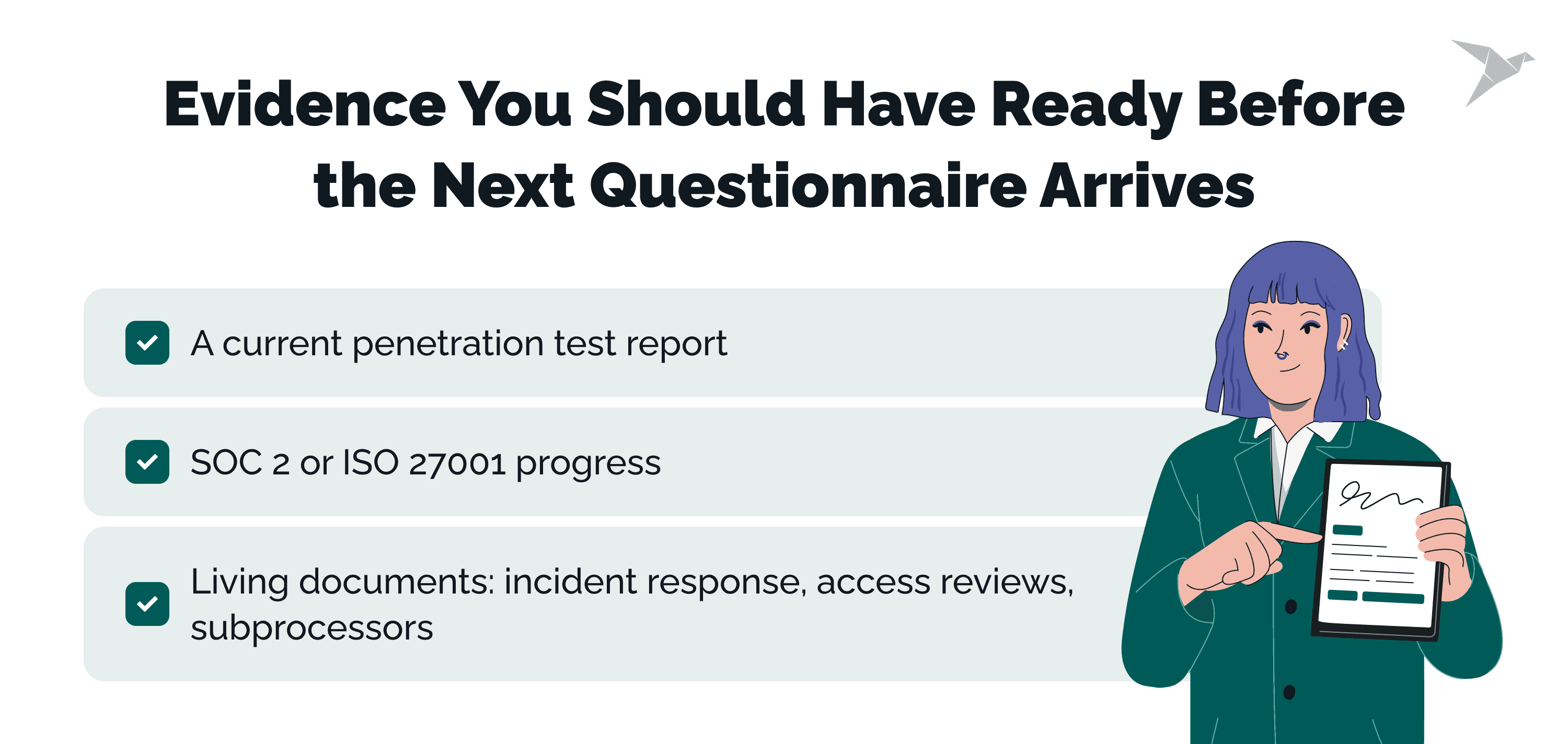
Five artifacts do most of the work: a penetration test report under 12 months old, SOC 2 or ISO 27001 progress, documented incident response and access review procedures, a subprocessor list, and your encryption and multi-factor authentication posture. Reviewers look for evidence of each control, so a bare “yes” gives them little to work with. Prepare the artifacts once and reuse them on every deal.
Think of this section as a short SaaS security questionnaire guide to what belongs in the folder. When the next enterprise security questionnaire for SaaS arrives, that folder should be the first place anyone looks.
A current penetration test report
Enterprise buyers commonly ask for an independent penetration test from the last 12 months. A report scoped to the product the buyer is evaluating answers more questions than a generic one.
Include the retest status as well. A list of open findings with no plan raises questions, and a retest confirmation closes them. Our testing is human-led and runs under TechMagic’s company-level CREST accreditation.
SOC 2 or ISO 27001 progress, even before a formal audit
A SOC 2 (System and Organization Controls 2) report is an independent auditor’s attestation of your security controls. ISO 27001 certifies an information security management system against international security standards. Buyers often accept evidence of progress when the report is not ready yet. That progress shows your compliance posture through a defined scope, written policies, named control owners, and a dated audit window. A SOC 2 Type II report can answer many questions at once, which cuts down on one-off questionnaires.
A practical start is to map your controls against the SOC 2 compliance requirements and pick an audit date, even if the report is a few months out.
Living documents: incident response, access reviews, subprocessors
These security documents change with your company, so each one needs an owner and a review date:
Pro tip: put a review date on every document, so a buyer’s question about currency has a ready answer.
Check our

Who Should Own Your Security Questionnaire Process?
The owner should never be whichever engineer is least busy that week. Someone needs to own the evidence library, route the technical questions, and keep security questionnaire responses consistent from deal to deal. That someone can sit inside the company or be an external vCISO (virtual Chief Information Security Officer).
Every vendor security questionnaire for SaaS needs one named owner from the moment sales receives it from an enterprise prospect.
What “ownership” actually means here
Ownership is a short list of recurring jobs:
- Keep the evidence library current and dated.
- Identify the format on arrival and map it to existing answers.
- Send only new or ambiguous technical questions to engineers.
- Review every answer against evidence before it goes out.
- Keep a record of questionnaire responses, so every later answer stays consistent.
Engineers stay in the loop for questions only they can answer. The owner handles everything else, which keeps your security team’s attention on the questions that need an expert.
Why this is a natural vCISO responsibility
A vCISO already owns risk assessments, policies, and evidence for the security program, including security governance over third-party services, so the security questionnaire process belongs to the same job. Enterprise buyers send these forms as part of third-party vendor reviews, and the vCISO is the person who answers for the whole program.
That includes planning the audit window and the SOC 2 audit cost, so the budget conversation happens before a deal is at risk. At TechMagic, our vCISO service owns the program through the audit and usually through the next cycle, so questionnaires keep one owner after the report arrives. We do not advise once and leave.
Within that scope, we can answer questionnaires on a client’s behalf and route only the technical questions to engineers.
Get experienced cybersecurity guidance

How Do You Answer Honestly When You Have Gaps?
Pair an honest “not yet” with a concrete, dated remediation plan. In our experience, that answer moves a review forward faster than an evasive one.
Enterprise security teams expect some gaps from a growing vendor. They judge whether you know your gaps, own them, and fix them. They also check whether your security controls are owned and improving. A candid account of your security posture holds up better under follow-up questions. An enterprise SaaS security questionnaire is mostly a test of that control.
What “honest plus a timeline” looks like in practice
A good gap answer has four parts: the current state, the risk it leaves, the owner, and a date.
Question: Do you review access control assignments every quarter?
Answer: Not yet. Today we review access at every role change and offboarding. A quarterly review owned by our head of engineering starts on [date], and we will share the first completed record.
That answer shows control of the posture. The remediation plan gives the reviewer something to track.
The answers that actually stall a deal
These patterns slow a review more than any gap does:
- A confident “yes” that your own evidence contradicts.
- Answers copied from another product or an old security questionnaire, with details that no longer apply.
- Marketing language in place of a control description.
- Promises with no owner or date.
- Silence on the hard questions.
A confident answer you cannot prove costs more than an honest gap.
Should You Automate Your Security Questionnaire Responses?
Automation and knowledge-base tools, including those built on Artificial Intelligence (AI), can speed up assembling answers you already have evidence for. They cannot create the evidence, and they cannot make judgment calls on ambiguous questions. The right move is to pair the tool with real ownership.
Tools such as Vanta, with its Trust Center, help teams store approved answers and share documents with buyers. We work alongside those tools: the tool automates evidence collection, and our team provides the human layer that fits the program to your architecture and knows what auditors expect. Teams still choosing a tool often start by comparing Vanta alternatives.
What automation actually speeds up
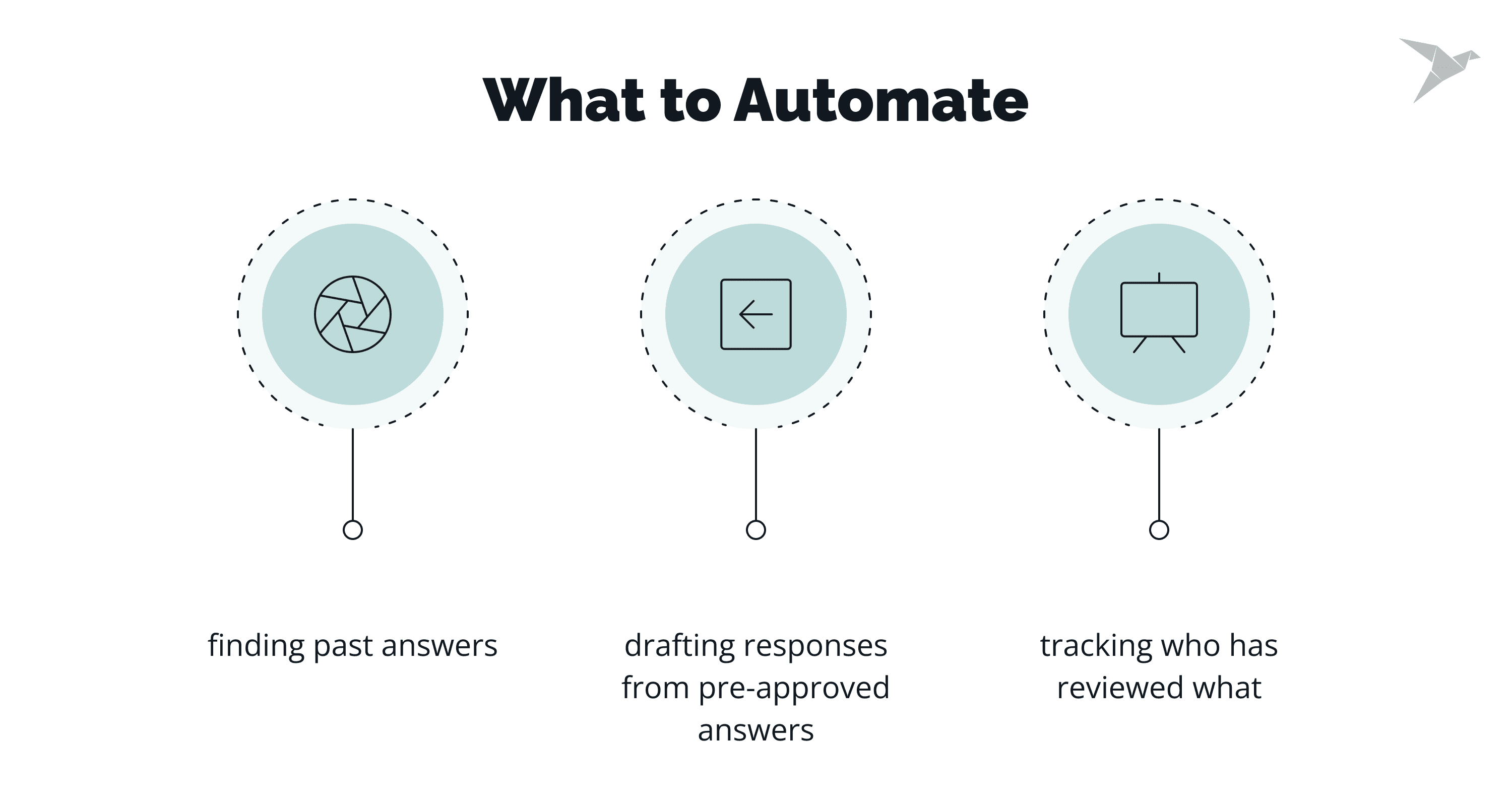
Tools are good at three jobs: finding past answers, drafting responses from pre-approved answers, and tracking who has reviewed what. Those jobs are slow by hand and quick with software. A centralized knowledge base of approved answers speeds up response times, and a tool can track progress in real time.
They share one condition. The source material has to be current and approved, because response quality follows it.
What it can’t do for you
A tool cannot produce a penetration test report or open a SOC 2 audit window. It also cannot decide how to answer a question that fits your architecture only partly.
A stale knowledge base writes stale answers faster. An AI draft that cites a control you do not run is worse than a blank field.
Our Experience Building Evidence Systems That Survive Enterprise Review
Our security work produces the artifacts a questionnaire asks about. These engagements show what reviewers look for and what holds up under questioning.
Mamo: penetration testing for a FinTech company
Mamo, a payments solutions provider in the UAE, asked us to test its cloud infrastructure, mobile apps, and web platform, including APIs and authentication flows. We worked from the Penetration Testing Execution Standard (PTES) and OWASP testing guides, tested manually in isolated environments, and delivered a prioritized analysis with remediation guidance.
The documentation supported regulatory compliance and stakeholder confidence.
Quizrr: an ISMS internal audit
Quizrr, a training platform based in Stockholm, wanted an independent internal audit of its Information Security Management System (ISMS) ahead of an ISO 27001 certification audit. We reviewed its documentation, interviewed stakeholders, gathered evidence, and compared its security controls with the standard.
The report listed strengths, weaknesses, and nonconformities, with a roadmap to close the gaps. A compliance snapshot showed which controls met the standard and which needed adjustment.
Haiqu: a full security program for a quantum computing SaaS
Haiqu, a California-based quantum computing company, sells a multi-tenant SaaS platform to enterprise teams in finance, aerospace, automotive, and life sciences. Enterprise buyers required formal security attestation before signing, and Microsoft’s supplier program asked for the same. Haiqu had no ISMS, no security owner, and no formal policies or risk processes.
Our vCISO service took ownership of the program, including the ISMS and the risk assessment, and backed Haiqu through the external audit. ISO 27001 certification followed roughly three months after kickoff, and Microsoft accepted that certificate in place of DPR Section J on security.
A CREST-accredited black-box and grey-box penetration test, aligned to the OWASP Top 10 and OWASP API Security Top 10, came with a 60-day retest window and an attestation letter for customers and auditors. On the cloud side, AWS vulnerability management took triage from more than 300,000 findings to under 100 items needing genuine client-side action in under a week. SOC 2 Type 2 is in progress, with the observation window running through the end of 2026.
What we’ve learned about what actually unblocks a deal
Evidence prepared before the deal moves a review faster than answers written during it. Each engagement above produced something a reviewer can check: a dated penetration test report, an audit with a roadmap to close gaps, or a certified program with an attestation letter. Name an owner first, build the evidence second, and answer from the folder.
Final Thoughts
The lasting fix is never starting from zero. Build the evidence once, name an owner, and answer gaps honestly with a date. That approach protects enterprise deals from late surprises and prepares you for future questionnaires, whatever format arrives.
Where is this heading? Three shifts are already visible.
AI will sit on both sides of the form
According to Gartner’s 2026 predictions for third-party cyber risk management, 70% of organizations and vendors will use generative AI on both sides of the questionnaire process by 2028. Buyers will expect faster turnaround, and your answers will still need a human owner.
Evidence will become continuous
Gartner also expects half of third-party cyber risk programs to focus on continuous monitoring by 2028. A penetration test report from 12 months ago will still help, and we expect dated retests and reviews to carry more weight.

FAQ
SIG (Standardized Information Gathering), CAIQ (Consensus Assessments Initiative Questionnaire), and VSAQ (Vendor Security Assessment Questionnaire) are three standard formats for vendor security reviews. Shared Assessments maintains SIG, the Cloud Security Alliance publishes CAIQ, and Google released VSAQ as an open-source application. Buyers choose based on how deeply they review a vendor and which framework their own program uses.
A SaaS company can answer an enterprise security questionnaire without a SOC 2 (System and Organization Controls 2) report. The report helps because it answers many questions with independent evidence. Without it, share your SOC 2 or ISO 27001 progress, a current penetration test report, and your core policies, and add a dated timeline for the gaps.
An AI tool can draft answers from approved material faster than a person can search old files. The draft is only as good as the evidence behind it, so a named owner must still review every answer. We recommend pairing any automation tool with a clear owner and a current evidence library. And, of course, every AI tool and workflow needs human oversight.
Response time depends on the format, the number of questions, and how much evidence already exists. With a maintained evidence library, most answers become copy-and-verify work, and engineers only handle new questions. Without one, every response takes as long as building the evidence from scratch.
Our vCISO service owns the security program, including the evidence library that questionnaire answers rely on. Within that scope, we can answer questionnaires on a client’s behalf and route only the technical questions to engineers. TechMagic's security team also provides the penetration testing and SOC 2 or ISO 27001 work that gives those answers something true to say.