







HIPAA Violation & Compliance Fines Statistics: Breaches, Penalties, and Enforcement in 2026
Last updated:20 November 2026


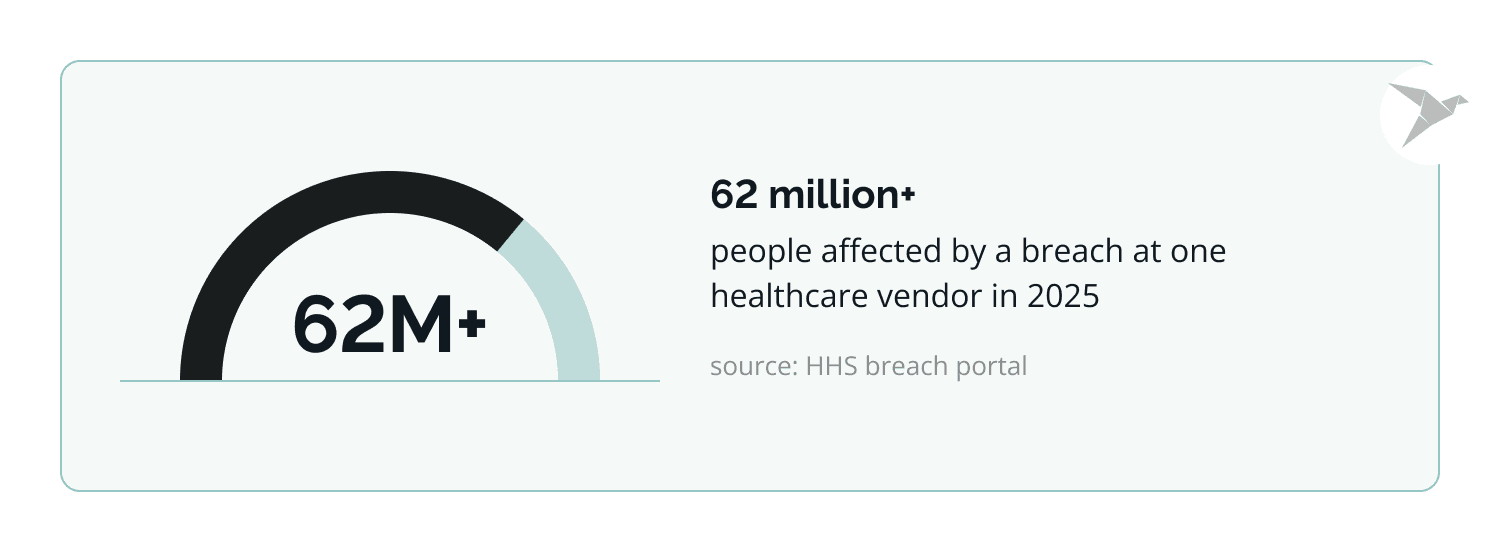
In 2025, a breach at one healthcare vendor affected more than 62 million people, according to the HHS breach portal. How many incidents like it could stronger security awareness prevent? The answer starts with knowing the numbers.
Current HIPAA compliance violation statistics show which attacks lead to breaches, how often regulators step in, and what a penalty can cost. That picture lets security budgets, vendor reviews, and board updates rest on evidence.
As of November 2026, the breach portal of the Office for Civil Rights (OCR) lists more than 800 large healthcare incidents submitted in 2025. The total can still change, because OCR, which enforces the Health Insurance Portability and Accountability Act (HIPAA), keeps adding and updating entries.
In our new article, we cover HIPAA violation statistics for 2025 and 2026: breach counts, their causes, who files them, the 2026 penalty tiers, and what OCR actually collected. Every figure comes from the U.S. Department of Health and Human Services (HHS), OCR, the Federal Register, or the original study, with a date. This page is not legal advice.
Key Takeaways
- 811 large breaches were submitted to HHS in 2025, and 637 in 2026 through October 16 (HHS OCR portal).
- Hacking and IT incidents made up 80.9% of 2025 breach reports and 95.6% of the individuals affected (HHS OCR portal).
- Business associates filed 17.4% of 2025 reports but covered 62.4% of affected individuals (HHS OCR portal).
- HIPAA civil monetary penalties are capped at $2,190,294 per calendar year for identical violations in 2026 (Federal Register).
- OCR settlements announced in 2026 ranged between $10,000 and $800,000, well below that cap (HHS).
How We Gathered These HIPAA Compliance Violation Statistics
These statistics on HIPAA violations come from HHS, OCR, the Federal Register, and the Unified Agenda of regulatory actions. Two industry studies add context: Verizon’s 2026 Data Breach Investigations Report and IBM’s Cost of a Data Breach Report 2026. Trade press and compliance blogs served only as leads, and each figure was traced to the organization that published it.
Incident counts come from our own November 2026 export of the OCR data breach portal, which covers both the “under investigation” list and the archive. Because OCR adds and revises entries after the fact, each count reflects that export.
A breach report, a complaint, and a penalty measure different things, so this page never divides one by another or combines them into a rate. We also give no average HIPAA fine. OCR does not publish one, and settlement amounts vary too widely for an average to be useful.
Key HIPAA Violation Statistics for 2026
These key HIPAA violation statistics are the quotable headline figures from 2025 and 2026, each with its source.
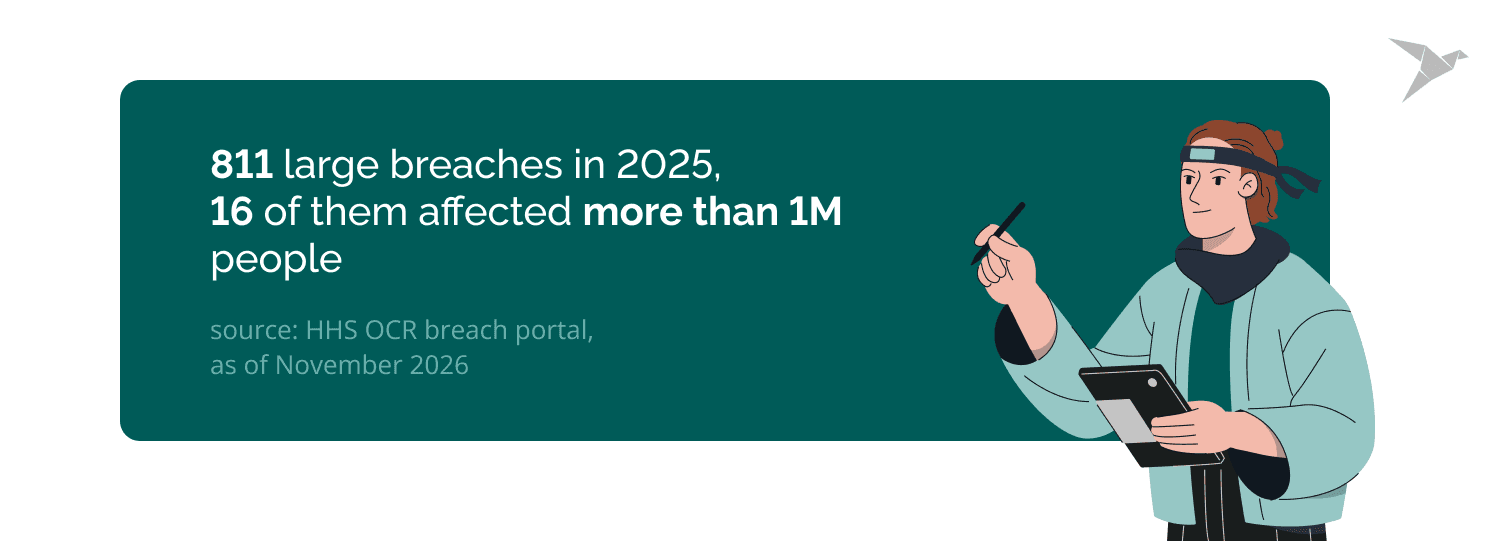
- 811 large incidents, each affecting 500 or more people, were submitted to HHS in 2025 (HHS OCR breach portal).
- 16 of the incidents submitted in 2025 each affected more than one million individuals (HHS OCR breach portal).
- 62,224,658 individuals were affected by the largest 2025 entry, filed by the vendor Conduent Business Services (HHS OCR breach portal).
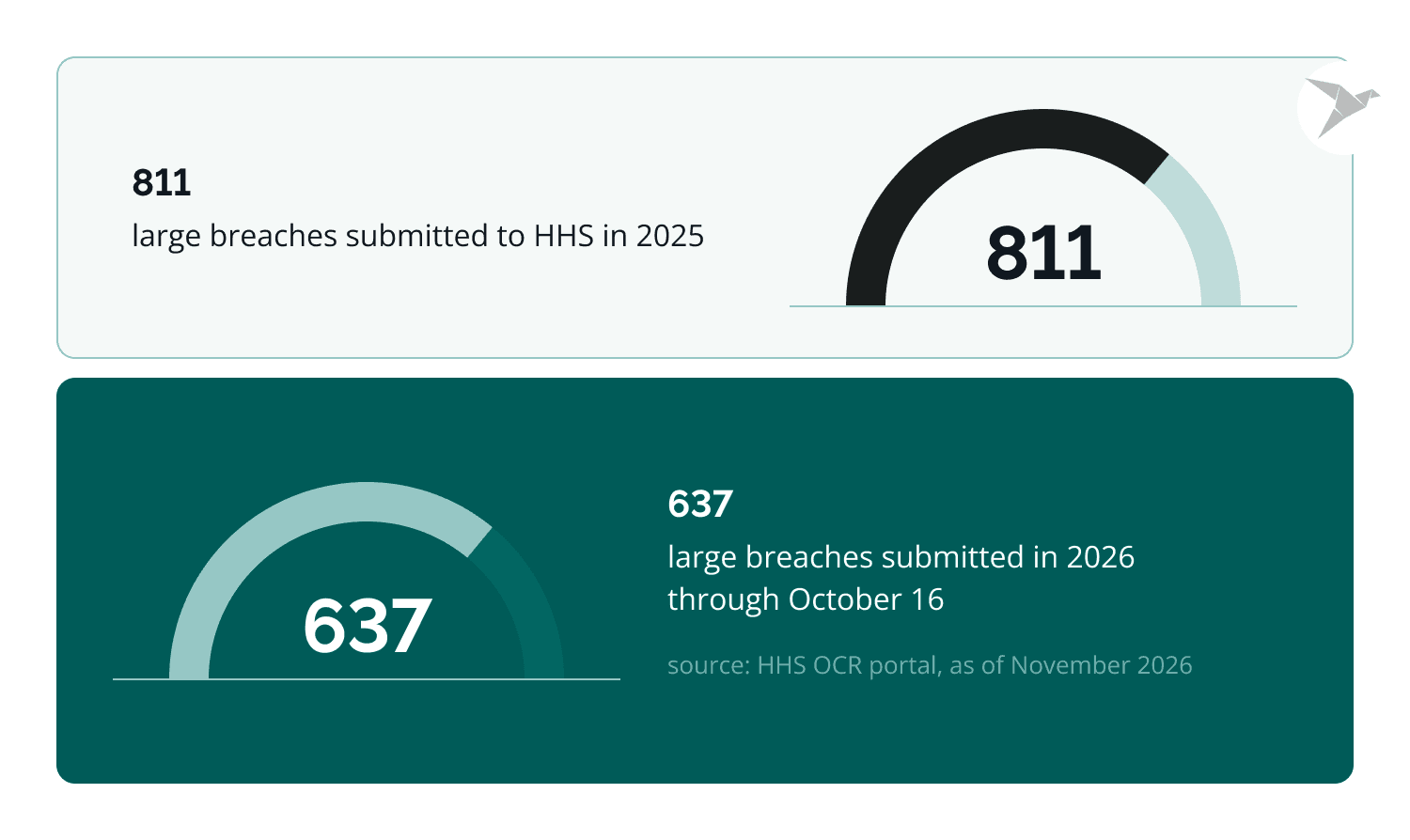
- 637 large breaches were submitted to HHS between January 1 and October 16, 2026, which is 3.3% fewer than in the same period of 2025 (HHS OCR breach portal).
- System Intrusion caused 61% of healthcare breaches, up from 53% a year earlier (Verizon 2026 DBIR).
- 32% of healthcare breaches involved a third party (Verizon 2026 DBIR).
- 1,438 of 1,492 analyzed healthcare incidents ended in a confirmed data disclosure (Verizon 2026 DBIR).
- $2,190,294 is both the highest HIPAA civil monetary penalty per violation and the calendar-year cap per tier in 2026 (Federal Register, January 28, 2026).
- $700,000 was paid by Ambry Genetics in September 2026 to settle an OCR investigation into a 2020 phishing attack that affected the health data of 225,370 people (HHS).
- $4.99 million is the global average cost of a data breach in 2026, a record high and 12% more than the year before (IBM).
How Many Healthcare Data Breaches Were Reported in 2025 and 2026?
811 large breaches were submitted to HHS in 2025 and 637 in 2026 through October 16, as of November 2026 (HHS OCR portal). Under the HIPAA Breach Notification Rule, covered entities must report every incident affecting 500 or more individuals to HHS, which posts it on the portal.
Breaches reported in 2025
In the 2025 breach data, entries cover 141,747,246 individuals (HHS OCR portal). The mean entry affected 174,781 people, but the median was 4,908, because a few giant incidents pull the average up.
These HIPAA violation stats show 9.4% more reports than the 741 the same export lists for 2024. People affected fell by about half, since the 2024 total of 290,088,141 includes the 192,700,000 attributed to the Change Healthcare attack (HHS OCR portal).
Read these HIPAA statistics as a floor. Forty-eight of the 2025 entries list exactly 500 or 501 individuals, which sit at the reporting threshold and may change once final counts arrive.
Breaches reported in 2026 so far
The latest submission date in our export is October 16, 2026. By then, the portal listed 637 large breaches for 2026, covering 89,923,179 individuals, against 659 in the same January 1 to October 16 window of 2025 (HHS OCR portal). January through April 2026 produced 270 reports, compared with 277 for the same months of 2025, a 2.5% drop.
Size has not shrunk, though. Seventeen reported breaches from 2026 have already passed one million individuals each, one more than the full-year 2025 tally (HHS OCR portal).
The largest breaches of 2025 and 2026
The vendor Conduent Business Services filed the largest 2025 entry, which accounts for 43.9% of everyone affected that year (HHS OCR portal). Aflac followed with 13,924,906 individuals, then Episource with 6,725,572 and Yale New Haven Health System with 5,556,702. All four appear on the portal as hacking or IT incidents.
In 2026, the largest entry so far comes from DentaQuest, a health plan, at 15,000,000 individuals (HHS OCR portal). Aesto, a business associate, followed with 9,540,683, then iRhythm Technologies with 8,179,772. New York City Health and Hospitals Corporation also reported 1,800,000.
What Causes Healthcare Data Breaches?
Hacking and system intrusion cause most healthcare data breaches, with social engineering and human error behind most of the remainder. Verizon’s attack patterns and OCR’s incident types measure this from two angles.
Healthcare breach patterns in Verizon’s 2026 report
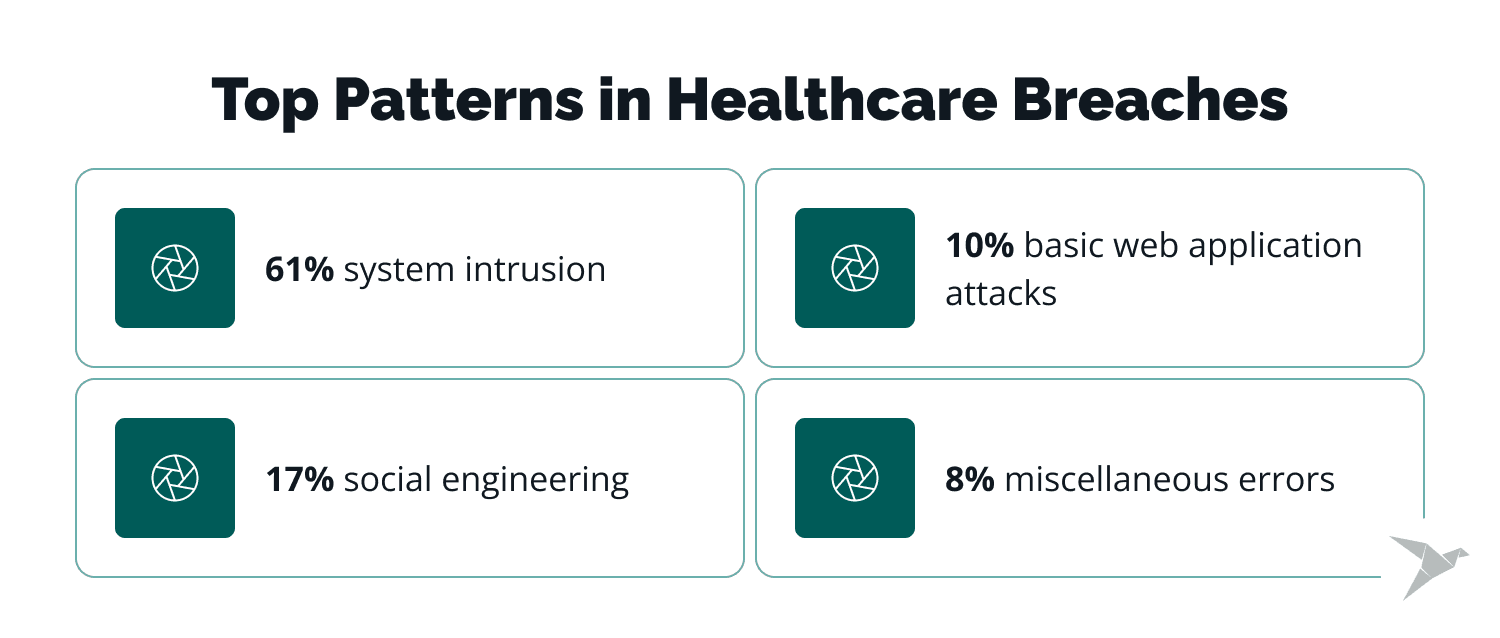
System Intrusion caused 61% of healthcare breaches in the Verizon 2026 Data Breach Investigations Report (DBIR), up from 53% a year earlier, and held the top spot for the second year in a row (Verizon 2026 DBIR). The report covers incidents in the healthcare sector between October 2024 and November 2025.
Social Engineering followed at 17%, Basic Web Application Attacks at 10%, Miscellaneous Errors at 8%, and Privilege Misuse at 3% (Verizon 2026 DBIR). External actors drove 81% of the breaches and insiders 19%, and 99% had a financial motive. Internal company data appeared in 65% of breaches, personal information in 37%, and credentials in 25%.
Attacker entry points
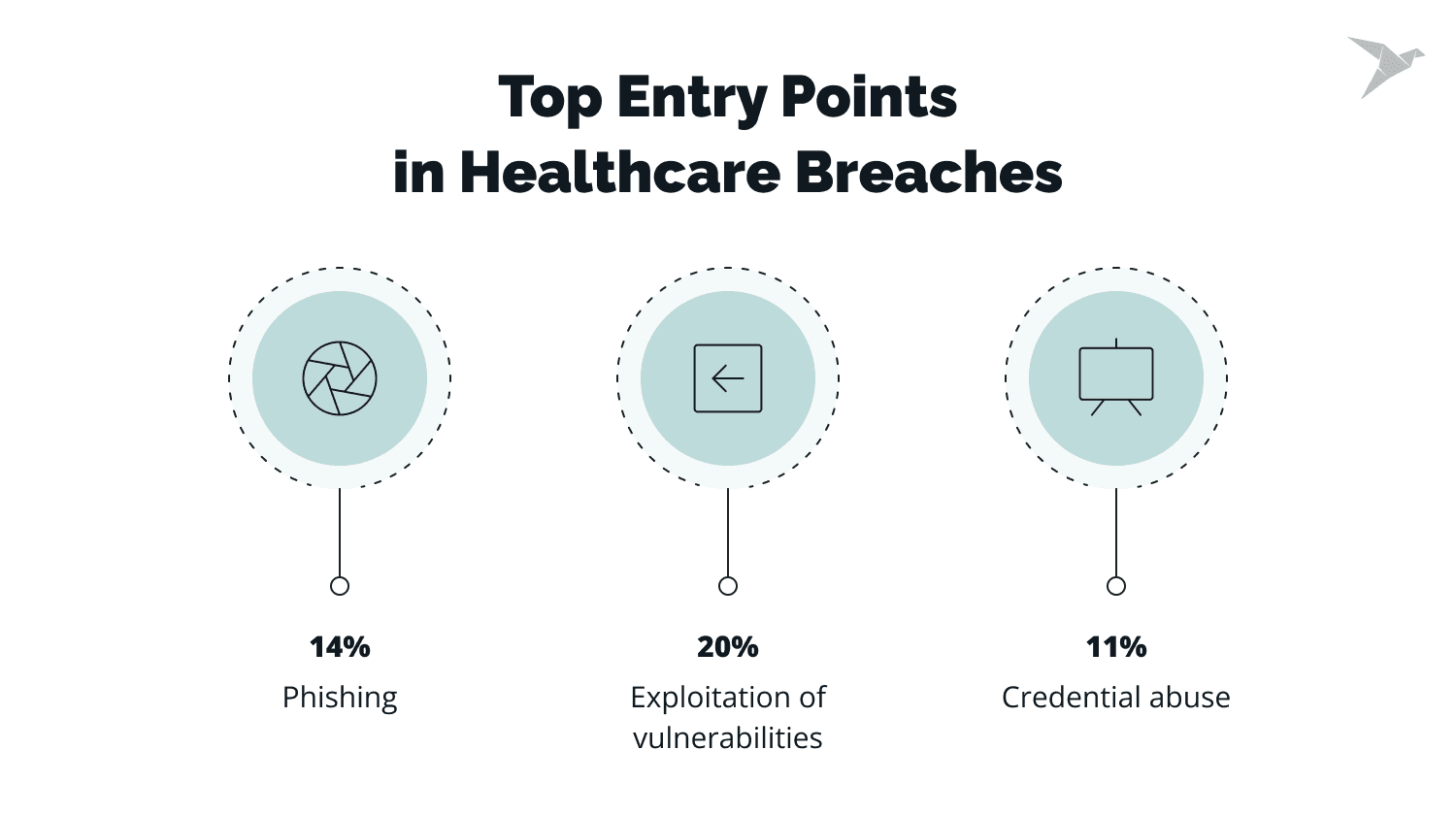
Exploitation of vulnerabilities was the most common way in, at 20% of healthcare breaches (Verizon 2026 DBIR). Phishing came next at 14%, and credential abuse, where attackers log in to healthcare accounts with stolen or guessed passwords, made up 11%.
A human element, such as an error or a person tricked by a message, featured in 54% of breaches. Ransomware reached 48% of breaches across all industries, up from 44% a year earlier, a share the healthcare snapshot does not give for the sector alone (Verizon 2026 DBIR).
Hacking versus unauthorized access in OCR data
Each entry in the OCR breach portal carries a type label and no motive, so the data cannot isolate malicious negligence. Accidental negligence stays invisible too. The closest proxy is the split between hacking and unauthorized access or disclosure.
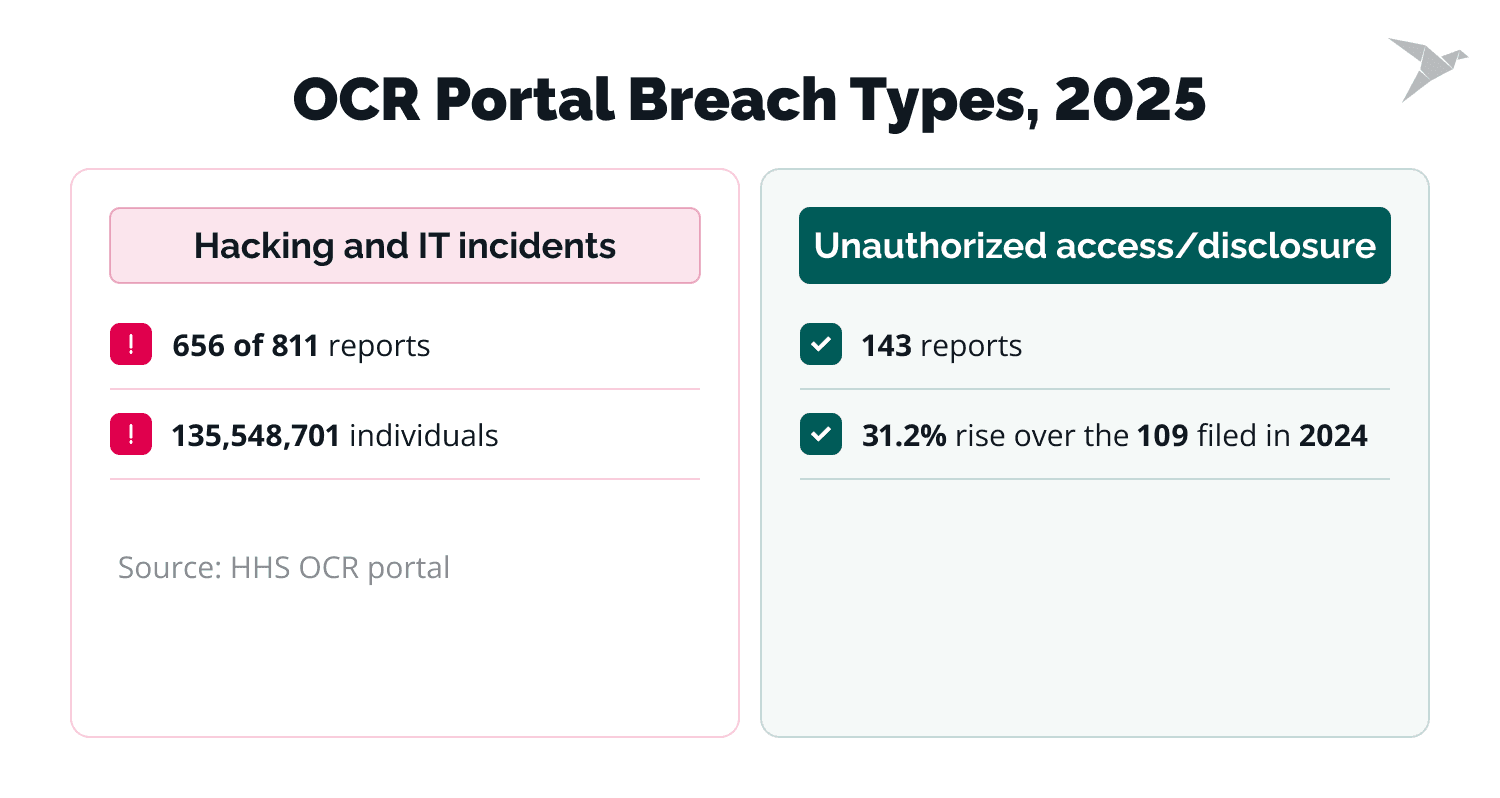
In 2025, the portal category for hacking and IT related incidents covered 656 of 811 reports and 135,548,701 individuals (HHS OCR portal). Hacking related data breaches also ran large: the average one affected 206,629 people, and the median was 6,763.
Unauthorized access or disclosure grew to 143 reports in 2025, a 31.2% rise over the 109 filed in 2024 (HHS OCR portal). Physical causes stayed rare, with nine theft reports, two for loss, and one for improper disposal.
Which Organizations Report the Most HIPAA Breaches?
In 2025, healthcare providers filed the most reports, while business associates accounted for the most records breached. The split below comes from the covered entity type field on the OCR portal.
Business associates and third parties
Business associates are vendors that handle protected health information (PHI) for covered entities, and PHI means individually identifiable health information. A covered entity must have a written business associate agreement (BAA) with each such vendor (HHS).
In 2025, business associates filed 141 of the 811 portal entries, yet those reports covered 88,431,051 individuals (HHS OCR portal). Conduent’s single entry makes up most of those breached records.
The portal also flags whether a vendor was present, even when the covered entity filed the report itself. That flag appears on 285 of the 2025 reports, or 35.1% (HHS OCR portal).
Every vendor connection is another route for records moving between organizations, the same flows our patient data interoperability statistics track. A third party was involved in 32% of healthcare breaches in Verizon’s data (Verizon 2026 DBIR).
Providers, health plans, and clearinghouses
HIPAA covered entities are providers, health plans, and clearinghouses (HHS). Healthcare providers filed 608 of the 2025 reports, or 75%, but those covered 37,817,164 people, which is 26.7% of the year’s total (HHS OCR portal).
Health plans filed 60 reports in 2025, affecting 15,285,524 individuals, and clearinghouses submitted two (HHS OCR portal). In 2026, health plans have already filed 72 reports through October 16, more than in all of 2025.
In 2026 so far, providers lead on both counts, with 469 reports covering 40,392,885 individuals (HHS OCR portal).
Implications for healthcare software products
These numbers point to vendor connections, unpatched systems, and stolen credentials as major sources of exposure. For healthcare organizations building apps and platforms, that is where the engineering conversation starts. Which vendors touch ePHI, meaning PHI held in electronic form?
How is access to electronic health records (EHR) granted and revoked, and how quickly do known flaws get fixed? Clear answers to those questions form the base of data security in healthcare services and of every EHR integration they depend on.
How Does OCR Enforce HIPAA, and What Did It Collect in 2025 and 2026?
OCR enforces HIPAA through investigations that end in corrective action, settlements, or civil monetary penalties, and most amounts collected in 2025 and 2026 stay below the $2,190,294 annual cap for a single violation type. The financial penalties below come from the HHS resolution agreements page and the press release behind each case.
Penalties and settlements in 2025
Solara Medical Supplies paid $3,000,000 in January 2025 to settle a phishing investigation in which 114,007 people were potentially affected (HHS). Warby Parker received a $1,500,000 civil monetary penalty (CMP) in February 2025 after credential stuffing attacks on customer accounts that affected 197,986 people (HHS). Oregon Health & Science University received a $200,000 CMP in March 2025 for failing to give a patient timely access to records (HHS).
Smaller amounts appear too. Health Fitness Corporation paid $227,816 in March 2025 after OCR found it had not conducted an accurate and thorough risk analysis (HHS). The case was the fifth under OCR’s Risk Analysis Initiative, and Northeast Surgical Group settled a ransomware investigation for $10,000 in January 2025 (HHS).
Penalties and settlements in 2026
On April 23, 2026, OCR announced four ransomware settlements totaling $1,165,000 (HHS). The largest of them, $375,000, came from Assured Imaging, whose breach affected 244,813 individuals.
The group health plan of Spencer Gifts paid $450,000 in June 2026 over a ransomware breach affecting 10,023 people (HHS). Ambry Genetics paid $700,000 in September 2026 over a 2020 phishing attack (HHS). In October 2026, Lehigh Valley Health Network agreed to pay $800,000 and accept a three-year corrective action plan after a 2023 ransomware attack affecting 248,359 people (HHS).
Right of access violations form a separate stream of cases. Azul Vision, an eye care provider, settled for $50,000 in August 2026 (HHS), and Shen Smiles, a Pennsylvania dental practice, paid $140,000 in October (HHS). OCR numbered those its 55th and 56th right of access enforcement actions, a sign that small medical practices face money penalties too.
Recurring patterns in OCR enforcement
Three issues recur across the 2025 and 2026 entries on the HHS page: ransomware, phishing, and a missing or incomplete risk analysis. OCR’s own numbering shows the pace, with 19 completed ransomware investigations by April 2026 (HHS) and Lehigh Valley as the 22nd such enforcement action in October (HHS).
These HIPAA compliance statistics do not add up to a yearly total. The HHS index lists amounts for only some entries, so any sum would rest on partial data (HHS).
How Much Are HIPAA Violation Fines in 2026?
In 2026, HIPAA fines range between $145 and $73,011 per violation in the three lower tiers, and uncorrected willful neglect can reach $2,190,294 (Federal Register). The calendar-year cap for identical violations is $2,190,294 in every tier, and all of these figures are legal limits rather than typical amounts.
The four penalty tiers
HIPAA fines follow four culpability tiers that the HITECH Act introduced in 2009 (HHS). HHS adjusts the amounts for inflation each year, and the current figures took effect on January 28, 2026 (Federal Register, 91 FR 3665). They apply to penalties assessed from that date onward, for violations that occurred on or after November 2, 2015.
The notice prints these amounts in a column labeled 2025, next to the prior figures, which ranged between $141 and $2,134,831 (Federal Register).
Maximums versus actual OCR collections
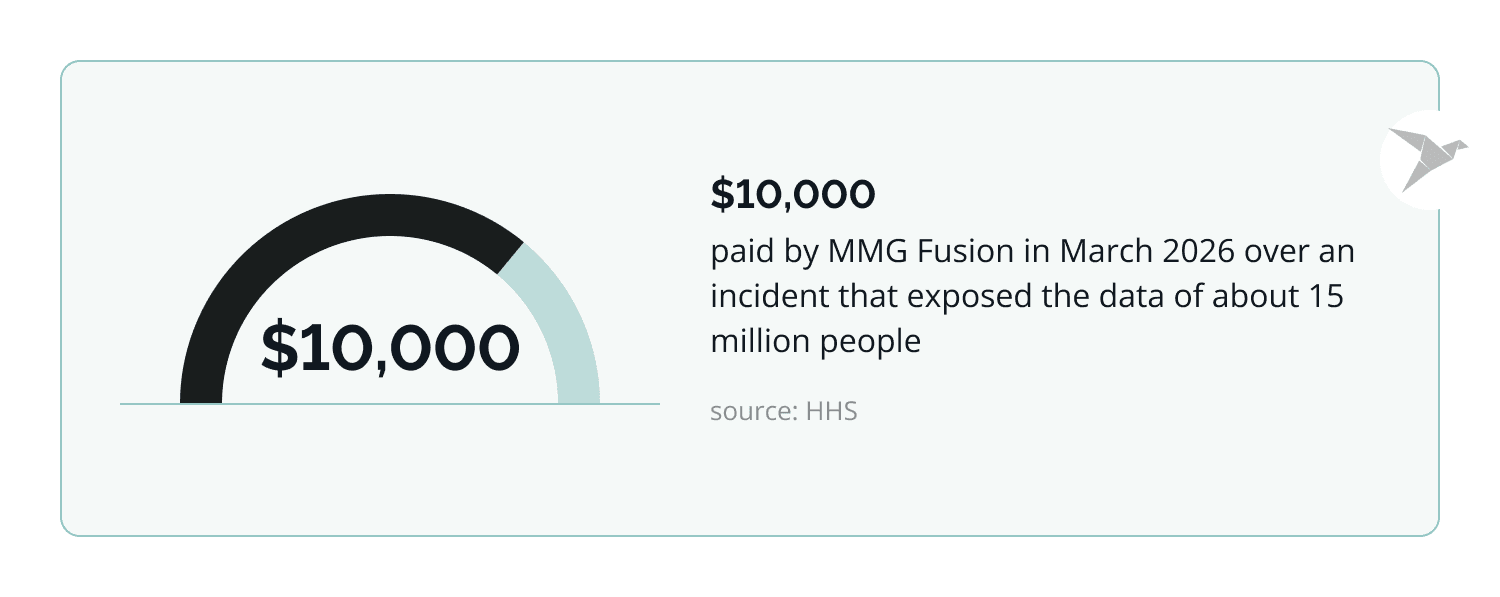
Most HIPAA violation penalties in 2025 and 2026 sit well below those ceilings. In March 2026, MMG Fusion, a Maryland software company acting as a business associate, paid OCR $10,000 over an incident that exposed the data of about 15 million people (HHS). OCR also cited potential failures to conduct a thorough risk analysis and to notify the covered entities it served.
A settlement amount reflects the case OCR builds and negotiates, so the number of records exposed predicts little about the fine.
Enforcement beyond OCR
HIPAA enforcement does not stop at OCR. The HITECH Act gave state attorneys general the authority to bring civil actions for violations of the HIPAA Privacy and Security Rules (HHS). OCR may refer possible criminal HIPAA violations to the Department of Justice (HHS), which also has a dedicated section for healthcare fraud (DOJ).
The Centers for Medicare & Medicaid Services (CMS) enforces other HIPAA Administrative Simplification standards, such as code sets and unique identifiers, while privacy and security complaints stay with OCR (CMS). The Federal Trade Commission applies its Health Breach Notification Rule to most health apps that HIPAA does not cover (FTC).

What Is the New HIPAA Rule in 2026?
As of November 2026, there is no final update to the HIPAA Security Rule. HHS proposed the update, “HIPAA Security Rule to Strengthen the Cybersecurity of Electronic Protected Health Information,” in the Federal Register on January 6, 2025 (90 FR 898). The federal Unified Agenda lists it as a long-term item with final action projected for July 2027 (reginfo.gov).
One change that did take effect in 2026 concerns substance use disorder records. Since February 16, 2026, entities subject to 42 CFR Part 2 must comply with its 2024 final rule, and OCR accepts complaints and breach notifications for those records (HHS). Penalties for noncompliance align with those available under HIPAA.
What Does a Data Breach Cost Beyond HIPAA Fines?
A data breach costs more than a typical OCR settlement. The global average cost of a breach reached $4.99 million in 2026, a record high and 12% more than the prior year (IBM).
The IBM study covers 602 organizations whose breaches occurred between March 2025 and February 2026 (IBM). Even the largest settlement listed above, Solara Medical Supplies’ $3,000,000, stays below that average.
How Common Are HIPAA Complaints and Violations? The 2024 Baseline
OCR’s latest annual reports to Congress cover calendar year 2024, and the HHS listing page showed no 2025 edition as of November 2026 (HHS). A complaint is an allegation, and OCR confirms a violation in only some of them.
Complaints and the issues they allege
OCR received 30,256 new complaints in 2024 and resolved 28,228 (HHS). It closed 17,466 of those (62%) before any investigation began, and resolved another 9,392 (33%) through technical assistance.
The most common allegations across those resolved complaints, which remain the latest official HIPAA violations statistics on this question, were these (HHS):
- Impermissible uses and disclosures: 660
- Right of access: 541
- General safeguards: 481
- Security Rule administrative safeguards: 147
- Breach notice to individuals: 122
Investigations and corrective action
OCR finished 1,370 complaint investigations in 2024 and required corrective action in 663 of them, or 48% (HHS). It also closed 797 compliance reviews, with corrective action in 670, or 84%.
OCR closed 22 of these matters with monetary settlements, which together brought in $9,944,612. No HIPAA audit started in 2024, and the report gives the reason plainly: a lack of financial resources (HHS).
What Is the Role of Artificial Intelligence in HIPAA Compliance and Risk?
Artificial Intelligence (AI) tools that create, receive, store, or transmit PHI fall under the same HIPAA regulations as any other system that handles it, and a person still owns every compliance decision. An AI vendor that works with PHI for a covered entity counts as a business associate and needs a BAA (HHS). The tool also belongs in the risk analysis, which must cover all ePHI (HHS).
The HIPAA Privacy Rule protects personal health information in any form or media, so a prompt to a Large Language Model or a generated summary is no exception (HHS). HHS’s proposed Security Rule update also asks for public input on AI and other emerging technologies (Federal Register). OCR’s breach portal does not record whether AI was involved, so official counts of AI-related HIPAA breaches are not available for healthcare professionals to cite (HHS OCR portal).
Our Experience With HIPAA-Ready Healthcare Software
TechMagic builds secure healthcare apps and platforms and runs HIPAA consulting that prepares organizations for compliance reviews. Both lines of work focus on the issues that recur in OCR’s enforcement record, starting with risk analysis.
A secure records portal for MHC HealthCare
The MHC HealthCare case study describes a secure records portal we built for an injury treatment provider. Physicians and attorneys use it to exchange medical records, and an integrated audit trail logs every system change, including who made it and when. The stack runs on AWS (EC2, S3, and MQ) with .NET, C#, and MSSQL Server.
Our approach to HIPAA readiness
We start with a full HIPAA risk assessment across systems, cloud setups, and daily workflows, because a missing analysis of that kind sits behind several recent OCR actions. Then we help close the gaps and guide clients through dry runs and mock audits before a real review. Since no official HIPAA certificate exists, our role is preparation: getting systems, policies, and documentation ready for the people who will review them.
A risk analysis that matches the real system is where HIPAA readiness starts.

Wrapping Up
Taken together, these HIPAA compliance violation stats show that hacking drives most reported data breaches in the healthcare industry, while vendors account for a large share of the people affected. The counts keep shifting as OCR revises its portal, and most money penalties stay below the legal maximums.
What to watch next
These predictions are our own reading of the trends.
- Hacking will likely stay the leading cause of large healthcare breaches. Hacking and IT incidents account for 546 of the 637 portal reports submitted in 2026 through October 16, or 85.7% (HHS OCR portal).
- Vendor exposure will keep drawing attention. A business associate was present in 223 of those 637 reports in 2026, a 35% share (HHS OCR portal).
- Risk analysis will likely remain a focus of OCR enforcement. The Spencer Gifts plan settlement in June 2026 was the 14th action under OCR’s Risk Analysis Initiative (HHS).
- AI-enabled cyber threats will likely show up in more incident investigations. One in four malicious breaches studied by IBM was AI-enabled, a 56% increase over the prior year, and these breaches cost an average of $6 million (IBM).
FAQ
HIPAA violations show up in three separate counts: breach reports, complaints, and money penalties. As of November 2026, the HHS portal lists 811 large breaches submitted in 2025, and the Office for Civil Rights (OCR) received 30,256 complaints in 2024, its latest published year. OCR closed 22 matters with monetary settlements in 2024, and the three counts should not be blended into one rate (HHS OCR breach portal; OCR report to Congress, 2024).
The most common HIPAA violations alleged in complaints that the Office for Civil Rights (OCR) resolved in 2024 were impermissible uses and disclosures (660), right of access (541), general safeguards (481), Security Rule administrative safeguards (147), and breach notice to individuals (122). These figures come from OCR’s 2024 report to Congress, the latest one published.
In 2026, HIPAA fines in the three lower tiers range between $145 and $73,011 per violation, and uncorrected willful neglect can reach $2,190,294. The calendar-year cap for identical violations is $2,190,294 in every tier, and these amounts are legal limits rather than typical penalties, according to the Federal Register adjustment published January 28, 2026.
Hacking and system intrusion cause most healthcare data breaches. The Verizon 2026 Data Breach Investigations Report puts System Intrusion at 61% of healthcare breaches and Social Engineering at 17%, with a third party involved in 32%. In HHS portal data, hacking and IT incidents made up 80.9% of large breach reports submitted in 2025.
The new HIPAA Security Rule is still a proposal as of November 2026. The U.S. Department of Health and Human Services (HHS) published the proposed update on January 6, 2025, and the federal Unified Agenda projects final action for July 2027. Since February 16, 2026, a separate rule for substance use disorder records under 42 CFR Part 2 is enforceable, with penalties aligned to HIPAA.
TechMagic helps healthcare organizations prepare for HIPAA through risk assessments, gap remediation, and audit dry runs. The company also builds HIPAA-ready apps and platforms, such as a secure records portal with an audit trail of every system change for MHC HealthCare. Since no official HIPAA certificate exists, TechMagic’s role is preparation for the review.